In the Fall 2013 Issue of ‘Konsthistorisk Tidskrift’
Konsthistorisk Tidskrift / Journal of Art History 82 (Fall 2013)
A special issue of Konsthistorisk Tidskrift / Journal of Art History, guest edited by Peter McNeil (Faculty of Design, Architecture and Building University of Technology Sydney, Australia and Centre for Fashion Studies, Stockholm University) and Patrik Steorn (Centre for Fashion Studies, Stockholm University), addresses the theme of “Fashion and Print Culture: Translation and Transformation.”
From the editorial:
Print itself is both a materiality as well as a vehicle of representation. How did the meaning of various forms of fashion-related prints change as they were circulated in new contexts? What was the relationship of ‘fashion words’ and images? What were the mechanisms through which print – as newsprint, almanac, trade-card, respectful or satirical image – supported or undermined the spread of fashions, from ‘head-piece’ to ‘borders’? A pluralistic perspective is needed to better understand the transmission of ideas about fashion in print as well as in practice – and their interrelationship for the new readers and viewers of the period from the renaissance to the eighteenth century. This theme issue of Konsthistorisk tidskrift publishes some of the findings related to the Humanities in the European Research Area (HERA)/European Science Foundation funded project ‘Fashioning the Early Modern: Innovation and Creativity in Europe, 1500–1800’ (FEM) and the portfolio ‘Print Culture and Fashion Products’ managed therein by Peter McNeil and Patrik Steorn. HERA FEM was a three-year major funded project conducted from 2010 to 2013.
C O N T E N T S
· Peter McNeil and Patrik Steorn, The Medium of Print and the Rise of Fashion in the West, pp. 135–56.
· Chia-hua Yeh, From Classical to Chic: Reconsidering the Prints from Varie acconciature di teste usate da nobilissime dame in diverse città d’Italia by Giovanni Guerra, c. 1589, pp. 157–68.
· Lena Dahrén, Printed Pattern Books for Early Modern Bobbin-made Borders and Edgings, pp. 169–90.
· Cecilia Candréus, The Use of Printed Designs in Seventeenth-Century Embroidery: Layers of Transfer and Interpretation, pp. 191–204.
· Mark de Vitis, Sartorial Transgression as Socio-political Collaboration: Madame and the Hunt, pp. 205–18.
· Patrik Steorn, Migrating Motifs and Productive Instabilities: Images of Fashion in Eighteenth-Century Swedish Print Culture, pp. 219–34.
· Carolina Brown, Portraits en savoyarde and the Shepherdess of the Alps: Portraits, Prints, Literature, and Fashion in Eighteenth-Century Sweden, pp. 235–51.
· Arlene Leis, Displaying Art and Fashion: Ladies’ Pocket-Book Imagery in the Paper Collections of Sarah Sophia Banks, pp. 252–71.
· Audrey Millet, Dessiner La Mode En Régime De Fabrique: L’imitation Au Cœur Du Processus Créatif, pp. 272–86.
The Burlington Magazine, October 2013
The eighteenth century in The Burlington:
The Burlington Magazine 155 (October 2013)
 A R T I C L E S
• Simon Lee, “A Newly Discovered Portrait of Napoleon by Jacques-Louis David,” pp. 687–92.
Discusses the various versions of David’s portrait of the emperor, including a previously unknown example.
R E V I E W S
• François Marandet, Review of Karen Chastagnol, Nicolas Colombel, 1644–1717 (Editions Nicolas Chaudun, 2012), p. 711.
Painting in France at the end of Louis XIV’s reign has for many years been regarded as the precursor of the Rococo era. Charles de La Fosse’s aimables figures anticipate Antoine Watteau’s world of the fêtes galantes, who himself was the precursor of the peintre des grâces François Boucher. One of the merits of the exhibition devoted to Nicolas Colombel recently at the Musées des Beaux-Arts, Rouen (closed 24th February), was to demonstrate that the story of history painting c. 1700 was much more complex. Karen Chastagnol, curator of the exhibition, rightly insists on the direct link between early eighteenth-century French artists and the art of Poussin: as well as François Verdier, René-Antoine Houasse and Daniel Sarrabat, to which could be added the names of Sébastien II Leclerc of Henri de Favanne. . .
• Willibald Sauerländer, Review of Guilhem Scherf and Séverine Darroussat, Jean-Jacques Rousseau et son image sculptée, 1778–1798 (Paris: Varia, 2012), pp. 711–12.
The iconography of the grands hommes des Lumières has become a fashionable topic. In 1994 Guilhem Scherf wrote an important essay on the iconographie sculptée of Voltaire; now he has added a substantial text on Jean-Jacques Rousseau et la Révolution: Les avatars d’une representation sculptée. . .
• Robin Middleton, Review of John Martin Robinson, James Wyatt, 1746–1813: Architect to George II (London: The Paul Mellon Centre for Studies in British Art, 2012), pp. 712–13.
The range and diversity of James Wyatt’s designing, the sheer number of buildings with which he was involved (the Catalogue of Works lists 283 sites) makes any attempt to chart his career a task of the utmost difficulty. Anthony Dale’s pioneering but nonetheless solid account of Wyatt’s career is, however, quite overtaken by John Martin Robinson’s new book. Dates and attributions are sharpened. The nature of the ordnance work is fully revealed — all quite decent. But the most significant revelations are contained in the chapter on Wyatt’s activity as an industrial and furniture designer. . .
• Ann Massing, Review of Noémie Etienne, La Restauration des peintures à Paris, 1750–1815: Pratiques et discours sur la matérialité des œuvres d’art (Rennes: Presses Universitaires de Rennes, 2012), p. 713.
The period before and after the French Revolution in Paris was one of enormous change and, due to the French centralised administration, the French National Archives and the AMN (Archives des musées nationaux) are a fertile source of information for one of the most interesting periods of the history of painting restoration — when the King’s painters became professional art restorers. Noémie Etienne’s book contributes much to our knowledge of this fascinating period. Her archival research encompasses not only the rich resources in Paris, but also those in Rome, Venice, Madrid, Antwerp and Brussels. Her approach is mainly based on eighteenth- and nineteenth-century written sources, and the wealth of information she has culled is presented not as a chronological series of events but by theme. . .
• Shearer West, Review of Marcia Pointon, Portrayal and the Search for Identity (London: Reaktion, 2013), p. 714.
Marcia Pointon has a distinguished record of scholarly publication about portraiture, since Hanging the Head (1993) revolutionised and enlivened a historiography that had somewhat fallen in the doldrums. There are few historians of British art who have not been inspired by her nimble imagination, unexpected visual analysis and deep intellectual engagement with her textual and visual sources past and present. Her latest collection of essays on portraiture will not disappoint her admirers, although the more dazzling parts of her analysis are intertwined with sections that have the flavour of a work in progress . . .
• Rüdiger Joppien, Review of Olivier Lefeuvre, Philippe-Jacques de Loutherbourg (Paris: Athena, 2012), pp. 714–15.
. . . The catalogue raisonné is of exceptional value, and lies at the very heart of the book, . . . [which] gives a splendid account of Loutherbourg’s career as a painter, as well as a thoroughly documented, reliable idea of his artistic output. That this monograph could be published so fully and handsomely is due to the assistance of the Athena publishing house. Its appearance coincided with the retrospective exhibition devoted to the artist at the Musée de Beaux-Arts in Strausbourg (17th November 2012 to 18th February 2013), which the author organized. Both the book and the exhibition are indicative of the esteem in which France still holds the artist, even though he worked less than ten years in Paris and almost forty years in London.
Review | A Selection of Digital Humanities Projects
The current issue of Renaissance Quarterly includes Michael Ullyot’s assessment of five digital resources, several of which are relevant to eighteenth-century studies:
Michael Ullyot, “Review Essay: Digital Humanities Projects,” Renaissance Quarterly 66 (Fall 2013): 937–47.
 “Are databases the defining genre of the twenty-first century? This question was at the core of a debate in 2007 over the nature of the Walt Whitman Archive in PMLA (Publications of the Modern Language Association of America). With digital resources now firmly established as an essential scholarly research tool, the question remains: what status do we afford databases relative to other forms of publication, like editions or monographs? The question is pertinent not just to tenure and promotion decisions, as the MLA Committee on Information Technology recently advocated, but more fundamentally to the circulation and provocation of ideas.1 If databases help us to interact with texts and cultural objects differently, enabling us to interpret them in ways we
could not otherwise do, how do they differ from monographs or journal articles? . . .” (937)
1. “Guidelines for Evaluating Work in Digital Humanities and Digital Media.” http://www.mla.org/guidelines_evaluation_digital; accessed 17 January 2013.
◊ ◊ ◊ ◊ ◊
· Mapping the Republic of Letters, which draws on the University of Oxford’s Electronic Enlightenment data, a collection containing over 50,000 letters.
· The Map of Early Modern London, a digital atlas of sixteenth- and seventeenth-century London (Ullyot references, in passing, Locating London’s Past, which is based on John Rocque’s 1746 map).
· 1641 Depositions Project, which collects 8,000 manuscript accounts of the 1641 Irish rebellion of Catholic gentry against Protestant settlers from England and Scotland.
· The Medici Archive Project, which aims to catalog the Medici Archival Collection (Mediceo del Principato), a collection of over four million letters written between 1537 and 1743. To date, approximately 10 percent of the archive is included within the database, though Ullyot explains a number of new, “promising” features aimed at making the platform more efficient and more interactive.
· Early English Books Online, a collection of texts published between 1473 and 1700. “What makes EEBO truly innovative and interesting is the Text Creation Partnership (TCP), under which the University of Michigan and Oxford University began in 1999 to convert these PDFs [created from microfilm copies of the books] into fully searchable texts. The TCP has focused on transcribing all 70,000 of the unique monographs in EEBO’s collection. These transcriptions are cross-linked to the page images they are taken from, so they are fully integrated into EEBO. At present, only members of the TCP consortium of libraries are able to access this resource, but it will ultimately pass into the public domain [starting in 2015 and finishing up in 2020]” (945).
September 2013 Issue of ‘The Art Bulletin’
The eighteenth century from the September issue:
Matthew M. Reeve, “Gothic Architecture, Sexuality, and License at Horace Walpole’s Strawberry Hill,” The Art Bulletin 95 (September 2013): 411–39.
From 1747 Horace Walpole and a close circle of male friends and associates designed, decorated, and furnished Strawberry Hill, the remarkable neo-Gothic villa in Twickenham, a fashionable suburb of London. An examination of the role of Walpole’s sexuality in the design and reception of the house and its furnishings, following the lead of recent studies in literature, historiography, and the history of sexuality, reveals the interrelations between the revival of the Gothic as one of the “modern styles” of eighteenth-century architecture and fundamental changes in human sexuality characterized by the rise of a “third sex.”
In addition, the “Notes from the Field” feature addresses the theme of time, with the following responses drawing on the eighteenth century:
Malcolm Bull, “Time,” The Art Bulletin 95 (September 2013): 360–62.
Ludmilla Jordanova, “Time,” The The Art Bulletin 95 (September 2013): 364–67.
Gerrit Walczak, “Time,” The Art Bulletin 95 (September 2013): 377–79.
David E. Wellbery, “Time, The Art Bulletin 95 (September 2013): 379–80.
We All Scream for Ice Cream
In case you’re somewhere hot, thinking about ice cream . . . (a full list of contents for the current issue of Past & Present is available here).
Melissa Calaresu, “Making and Eating Ice Cream in Naples: Rethinking Consumption and Sociability in the Eighteenth Century,” Past & Present 220 (August 2013): 35-78.
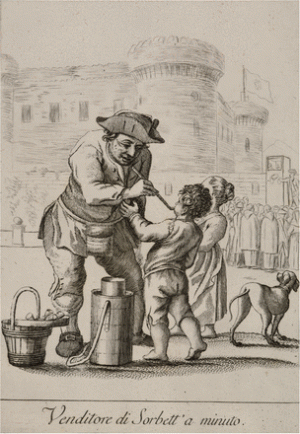
Pietro Fabris, Venditore di sorbett’a minuto, from his Raccolta di varii vestimenti ed arti del Regno di Napoli (Naples, 1773). © British Library Board D-7743.h.13.
Two barefoot children reach out to lick the spoon of the ice-cream seller. He carries a pouch around his waist that hints at the profits that are to be made from his trade. Two wooden containers rest on the ground beside him, one of which has a canister inside it and a strap outside to carry it, while the other holds a tray of cups to serve the ice cream (Plate 1).1 Behind this scene is the Angevin castle in Naples and a crowd gathered around a puppet stall. Pietro Fabris made this engraving as part of a collection depicting the costumes and customs of Neapolitans which was published in 1773 and dedicated to the British emissary to Naples, William Hamilton. Three years later, Fabris would provide elaborate hand-coloured illustrations for Hamilton’s scientific study of the eruptions of Vesuvius published in French and English and dedicated to the members of the Royal Society.2 Both books projected an image of Naples that appealed to the Grand Tourists who were flocking to see the excavations of the ancient cities of Herculaneum and Pompeii and the volcanic spectacle nearby (Vesuvius was particularly active in the last decades of the eighteenth century), and to experience life on the streets of the city. The collection of engravings including the sorbet seller appealed directly to a growing interest in Neapolitan popular culture and presented an image of the city as a theatre of extremes, in which the pleasures of life collided with the extreme poverty of the lazzaroni, and where its poorest inhabitants splurged on what — from a northern European perspective — might be seen as one of the great luxuries of the eighteenth century. We could leave our interpretation of the Fabris engraving there, safely within a history of the vast visual production of the Grand Tour in Italy, but the image conveys more than a tourist discourse about the exotic.3 In fact, the engraving illustrates the eating of a food product that was far from a luxury, and its sale to ordinary people on the streets of Naples, a point that has been completely overlooked by historians of the early modern period. . .
N O T E S
1 There is a variety of vocabulary in English, French and Italian describing ice or frozen desserts and drinks with a water or milk base. In Italian, sorbetto is used in the eighteenth century generally to describe what we know today as both sorbet and ice cream. Here I use the term ‘ice cream’ generically. All translations from Italian are my own unless otherwise stated.
2 Pietro Fabris, Raccolta di varii vestimenti ed arti del Regno di Napoli (Naples, 1773); William Hamilton, Campi Phlegræi: Observations on the Volcanos of the Two Sicilies as They Have Been Communicated to the Royal Society of London, 3 vols. (Naples, 1776–9), i–ii. On Fabris and Hamilton, see the essays in Ian Jenkins and Kim Sloan (eds.), Vases and Volcanoes: Sir William Hamilton and his Collection (London, 1996).
3 The use and the study of the term lazzaroni have a long history. It generally had a pejorative sense in travel accounts describing some of the poorer inhabitants of Naples, meaning ‘scoundrels’ or ‘layabouts’, although the lazzaroni became of increasing ethnographic interest at the end of the eighteenth century: see Melissa Calaresu, ‘From the Street to Stereotype: Urban Space, Travel and the Picturesque in Late Eighteenth-Century Naples’, Italian Studies, lxii (2007).
Eighteenth-Century Studies 46 (Summer 2013)
Eighteenth-Century Studies 46 (Summer 2013)
A R T I C L E S
 Patrick C. Fleming, “The Rise of the Moral Tale: Children’s Literature, the Novel, and The Governess,” pp. 463–77.
Sarah Fielding’s The Governess has been called the first children’s novel. But by conflating two separate genres, critics risk oversimplifying both the novel and children’s literature. This article brings together children’s literature studies and novel studies in order to address the narrative form of The Governess, and to suggest that the term “moral tale” better captures the complex origins of the eighteenth-century children’s novel.
Mark Koch, ” ‘A Spectacle Pleasing to God and Man’: Sympathy and the Show of Charity in the Restoration Spittle Sermons,” pp. 479–97.
In the 1670s the long-standing Spittle sermons became almost exclusively charity sermons, many of which argued that almsdeeds are accompanied with a sensual pleasure and articulated principles of sympathetic response involving an affective theatricality. This paper considers the place of these sermons and their ancillary children’s processions in the London public sphere, how they worked as spectacle to evoke pity from spectators, and how, despite the Latitudinarian tendency toward rationalism, they often contained elements of what was deemed an empirically nebulous “show” or “fiction.”
Catherine Packham, “Cicero’s Ears, or Eloquence in the Age of Politeness: Oratory, Moderation, and the Sublime in Enlightenment Scotland,” pp. 499–512.
This paper argues that Hume’s essay, “Of Eloquence,” should be read as part of a Scottish Enlightenment attempt to accommodate the sublime to commercial modernity. Hume inherits the sublime of ancient oratory not as a matter for narrow stylistic regulation—to be rejected in a new age of politeness, as some have argued—but as a moral problem at the heart of modern subjectivity. Hume looks to taste to regulate and contain the sublime, but it is Adam Smith who solves the problem of the sublime by recouping its excess as a mark of the possibilities for virtue in the modern age.
Lisa T. Sarasohn, ” ‘That Nauseous Venomous Insect’: Bedbugs in Early Modern England,” pp. 513–30.
Bedbugs were perceived as a new entry in the rich range of vermin that plagued eighteenth-century England, and the way they were viewed and treated reveals much about the mentality, prejudices, assumptions and aspirations of society at that time. Their presence increasingly elicited repugnance and even hysteria. The reaction to bedbugs during the eighteenth century serves as an indicator of modernity and emerging attitudes towards the body, class, nature and science.
Ryan Whyte, “Exhibiting Enlightenment: Chardin as tapissier,” pp. 531–54.
This essay addresses the work of Jean-Baptiste Chardin as tapissier to show his design of the Salon du Louvre functioned as an ideological system that derived meaning from Enlightenment discourses of epistemology and taxonomy. First, this essay explores how the Salon design answered the Académie’s need to represent its structure to the Salon public, and to guide the public in judging the individual works comprising it. Second, this essay examines points of contact between Chardin, the Académie, Carl Linnaeus and the authors of the Encyclopédie of Diderot and Jean le Rond d’Alembert as intellectual context for the Salon design.
Abigail Zitin, “Thinking Like an Artist: Hogarth, Diderot, and the Aesthetics of Technique,” pp. 555–70.
In The Analysis of Beauty, William Hogarth advocated an unusual kind of formalism based in artistic practice: not form distilled into a rule for judgment but rather derived from the artist’s techniques for perception and composition. Denis Diderot, too, embraced an aesthetics of technique, particularly in the Paradoxe sur le comédien, in which he contends that what appears impassioned in an affecting dramatic performance is in fact calculated. Diderot, however, had the extra burden of reconciling the ideal of illusion with his demystification of the practitioner’s perspective, a reconciliation he could only conceive as a paradox.
R E V I E W S
Mark K. Fulk “Travel And/As Enigma: Review of Ian Warrell, ed., Turner Inspired in the Light of Claude (National Gallery Company, 2012) and Yaël Schlick, Feminism and the Politics of Travel After the Enlightenment (Bucknell University Press, 2012),” pp. 571–73.
Recent work on travel by scholars Nicola Watson (The Literary Tourist: Readers and Places in Romantic and Victorian Britain [2008]), Zoë Kinsley (Women Writing the Home Tour, 1682–1812 [2008]), and Ann C. Colley (Victorians in the Mountains [2010]) has added markedly to our understanding of British travel in the latter eighteenth and the nineteenth centuries through its foregrounding of issues of class, gender, and the changing understanding of landscape aesthetics and theories of the sublime. The books in this review supplement this discussion by their emphasis on Anglo-French experiences of travel in the period. . .
Jennifer Milam, “Review of Michael Yonan, Empress Maria Theresa and the Politics of Habsburg Imperial Art (The Pennsylvania State University Press, 2011),” pp. 575–77.
. . . Thanks to Yonan’s interpretive approach, Empress Maria Theresa and the Politics of Habsburg Imperial Art is a ground-breaking study in the history of Austrian art and architecture. His book is a substantial contribution to the study of women as powerful agents in the production and reception of visual culture in European court circles during the eighteenth century. Moreover, Yonan’s wide-ranging choice of material—portraiture, decorative objects, architecture, interior decoration, and garden sculpture—provides the reader with a comprehensive understanding of Maria Theresa’s individualized approach to the representation of her personal authority in the visual arts. This is complemented by a number of quality illustrations that allow readers to consider the details of many works that are rarely discussed in depth. . .
Mark K. Fulk, “Review of Adrian J. Wallbank, Dialogue, Didacticism and the Genres of Dispute: Literary Dialogue in an Age of Revolution (Pickering and Chatto, 2012),” pp. 578–79.
In his postscript, Adrian J. Wallbank explains that his project was meant to “open up multiple avenues for further research . . . into this seriously neglected literary genre” of the written dialogue, gesturing toward the beginnings of a history of “dialogic didacticism” in the Romantic era (217). The book meets these expectations well by revealing in elaborate detail this overlooked genre, and suggesting ways that Wallbank’s readings can help complement our approach to already canonical markers of the period. . .
Christopher Gibbs and a Remarkable Georgian Sofa
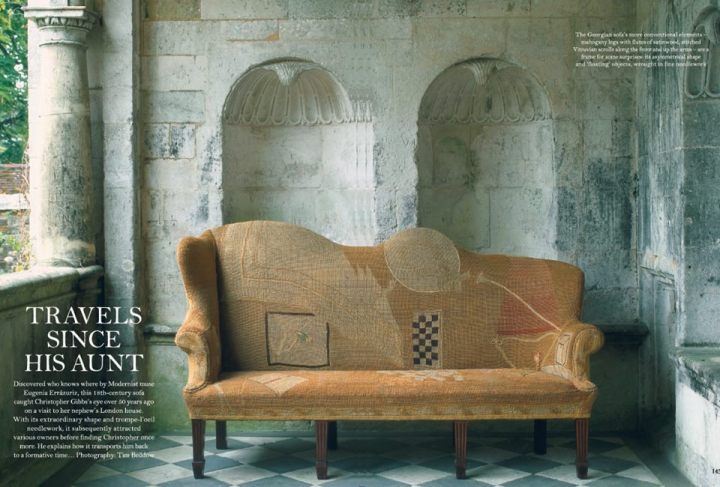
With its trompe-l’oeil needlework, this sofa is extraordinary (items depicted include a gameboard and cards, a box, a basket of yarn, a bird on a branch, and a bag). The one-page essay in The World of Interiors by the antiques dealer Christopher Gibbs, accompanied by stunning photographs, underscores just how compelling an object can be as a subject. -CH
◊ ◊ ◊ ◊ ◊
Christopher Gibbs, “Travels Since His Aunt,” The World of Interiors (June 2013): 144-49.
Discovered who knows where by Modernist muse Eugenia Errázuriz, this 18th-century sofa caught Christopher Gibbs’ eye over 50 years ago on a visit to her London home. With its extraordinary shape and trompe-l’oeil needlework, it subsequently attracted various owners before finding Christopher once more [via the antique dealer Edward Hurst]. Gibbs explains how it transports him back to a formative time, in the June issue of The World of Interiors. Photography: Tim Beddow.
Exhibition and Book | The Art of Living, Augsburg ca. 1780
The June 2013 issue of The World of Interiors features a remarkable album from the 1780s, believed to the the work of Balthasar Cornelius Koch. It was the subject of a 2010-11 exhibition in Augsburg; the catalogue is available in German.
◊ ◊ ◊ ◊ ◊
Michael Huey, “A Cabinet Curiosity,” The World of Interiors (June 2013): 150-57. The stuff of life, c1780, is laid bare in a handmade album documenting the décor and possessions of a prosperous goldsmith, and his family of servants, in 18th-century Augsburg. From watercolour to scraps of fabric, the enchanting tour, from pantry to salon, literally opens the doors on inner courtyards and armouries. The June issue of The World of Interiors uncovers shoes, nightcaps and lace — but no skeletons — in the closets.
. . . Part pen/ink and watercolour, part découpage (it incorporates copperplate engravings), part scrapbook (it also uses real historical fabrics and papers) and, in a sense, part diary, it records the everyday functions of the rooms of the house in full colour and significant detail. Included are a dining room; five salons (chose from green, white, ladies’, music and tea); five bedrooms (including those for the maids, the maternity room and one for a child); and five public or service spaces (halls, kitchen, pantry), with all their particular floorings, textiles, furnishings and other accoutrements. . . (156).

◊ ◊ ◊ ◊ ◊
From the museum’s website:
Die Kunst zu Wohnen: Ein Augsburger Klebealbum des 18. Jahrhunderts
Deutsche Barockgalerie im Schaezlerpalais, Augsburg, 24 November 2010 — 20 February 2011
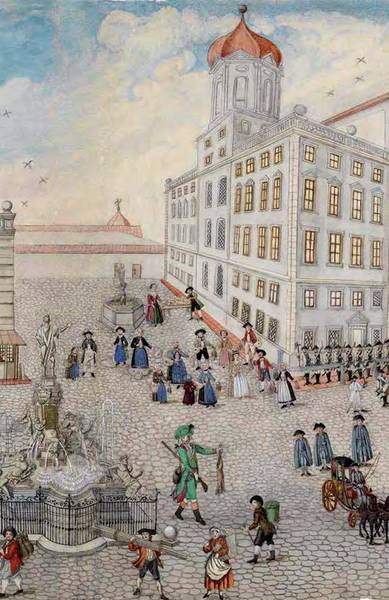 Augsburg war seit dem 16. Jahrhundert nicht nur eine Hochburg für den Buchdruck und die grafischeProduktion, hier entstanden ebenfalls sogenannte “Klebealben”. Diese wurden angelegt, um Kindern und Heranwachsenden aus bürgerlichen Familien die Welt zu erklären.
Die Jugendlichen schnitten aus eigens zu diesem Zweck herausgegebenen Bögen historische oder biblische Figuren, Tiere oderberühmte Bauwerke aus und klebten sie in gedruckte Vorlagen ein. Auch andere Druckgrafiken, Buntpapiere oder sogar Stoffe wurden zerschnitten und in die Klebealben eingefügt.
Das hier ausgestellte Klebealbum wurde nach 1780 für die Juwelierstochter Regina Barbara Waltherangelegt. Teile des Albums wie gezeichnete und kolorierte Figuren und Raumsituationen wurdenvermutlich bei dem Zimmerpolier Balthasar Cornelius Koch in Auftrag gegeben. Auf den Seiten blieb aber genügend Platz, so dass Regina Barbara selbst Figuren ausschneiden und einkleben konnte. Das Album stellt “die Kunst zu Wohnen” vor und verschafft den Betrachtern so bis heute einen Einblick in das Leben des Augsburger Bürgertums im
18. Jahrhundert. . .
More from the museum’s website»
◊ ◊ ◊ ◊ ◊
From the publisher:
Georg Haindl, Die Kunst zu Wohnen: Ein Augsburger Klebealbum des 18. Jahrhunderts (Berlin: Deutscher Kunstverlag, 2010), 240 pages, ISBN: 978-3422070400, 40€.
 Als beliebte Alternativen zu den Puppenhäusern wurden in Augsburg als wichtiger Verlagsstadt des 18. Jahrhunderts so genannte „Klebealben” von liebenden Eltern für ihre Kinder angelegt. Sie zeigen neben zentralen Plätzen Augsburgs auch die Räume idealtypischer Bürgerhäuser, in die ausgeschnittene Darstellungen von Figuren, Möbeln oder Geschirren eingeklebt werden konnten. Als Ressource hierfür dienten nicht nur die Augsburger „Ausschneidebögen”, wie sie von den Verlagen Johann Martin Wills oder Martin Engelbrechts extra für diesen Zweck herausgegeben wurden, sondern auch Modejournale, Buntpapiere, Textilien oder alte Bücher, die zerschnitten wurden.
In der Publikation widmen sich mehrere Autoren einem besonders qualitätsvollen und gut erhaltenen Album, bei dem nicht Kinder, sondern Heranwachsende die Adressaten waren, um ihnen einen perfekt funktionierenden Haushalt vor Augen zu führen. Das Album wurde in den 1780er Jahren vermutlich von dem Zimmerpolier Balthasar Kornelius Koch gefertigt und zeigt durch seine additive Darstellungsweise wichtige Aspekte des bürgerlichen Lebens dieser Zeit in Augsburg – eine unschätzbare kulturhistorische Quelle.
The Historical Journal, March 2013
From The Historical Journal:
David Gilks, “Attitudes to the Displacement of Cultural Property in the Wars of the French Revolution and Napoleon,” The Historical Journal 56 (March 2013): 113-43.
 Abstract: The French state expropriated an enormous quantity of cultural property from across Europe during the Wars of the Revolution and Napoleon, but much was returned in 1815 after the fall of the Empire. This article examines contemporary attitudes to the displacement of works of art, antiquities, scientific specimens, and rare books. The seizures were controversial: since they occurred at a time when plundering the vanquished was already considered questionable behaviour, they attracted opposition and needed to be justified. The article identifies the resulting repertoire of attitudes, arguing that this repertoire evolved with changing circumstances and was more varied than hitherto maintained. By situating this repertoire in a larger historical context, the article also reassesses the extent to which attitudes were derivative and innovative. It contends that the disputation as a whole did not amount to a decisive rupture in the treatment of foreign cultural property during wartime, but that it was nevertheless remarkable in two respects: concepts from hitherto unrelated subjects were applied to considerations about cultural property; and the perceived conditions under which cultural property could be legitimately transferred were revised.
2012-13 Clifford Prize | Messbarger on the Florentine Anatomical Venus
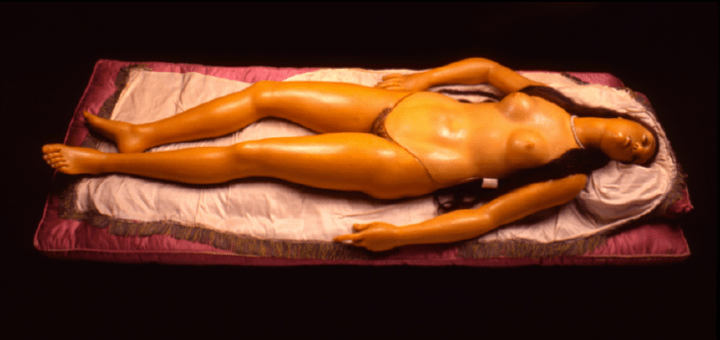
Anatomical Venus, ca. 1780, wax, Museum of Natural History in Florence
(Photo: Saulo Bambi)
◊ ◊ ◊ ◊ ◊
ASECS recently announced that the 2012-13 James L. Clifford Prize was awarded to Rebecca Messbarger for her article “The Re-Birth of Venus in Florence’s Royal Museum of Physics and Natural History” published by the Journal of the History of Collections (May 2012): 1-21.
Messbarger is the author of The Lady Anatomist: The Life and Work of Anna Morandi Manzolini (Chicago: University of Chicago Press, 2010).










leave a comment