From the ‘Journal of the History of Collections’ March 2013
The eighteenth century in the March 2013 issue of the Journal of the History of Collections:
A R T I C L E S
Linda Bauer and Nello Barbieri, “Forming a Collection of Paintings in Late Baroque Siena,” Journal of the History of Collections 25 (2013): 45-57.
 By the time of his death in 1727, the Cavaliere Marcello Biringucci possessed some 600 paintings. A group of unpublished documents, mainly forty-two sheets in the Archivio di Stato in Siena offers unusual insight into this Sienese nobleman’s collecting activities. The papers – memoranda, lists, invoices, orders for payment, receipts, accounts of expenses – many in the Cavaliere’s own hand, illustrate the range of sources he drew upon, not only geographical but those in the secondary art market. He employed agents, purchased from the estates of other collectors, acquired art at auctions, and even redeemed the pawn of a debtor. The documents include the names of artists – many well known – with prices or values for some works, and by reference to the largely unpublished inventory of his estate, give some indication of which works in the documents Biringucci acquired and how his taste conformed to the prevailing trends of the period. Online appendices to the paper, at http://www.jhc.oxfordjournals.org, reproduce the 1727 inventory, working papers, and a selection of letters.
Ellen Adams, “Shaping, Collecting and Displaying Medicine and Architecture: A Comparison of the Hunterian and Soane Museums,” Journal of the History of Collections 25 (2013): 59-75.
Collections played a critical role as teaching tools for particular disciplinary doctrines in Enlightenment Britain, including medicine and architecture. The two protagonists examined here are the architect Sir John Soane and surgeon John Hunter, whose museums now face one another across Lincoln’s Inn Fields in central London. Skeletons, body parts and artistic models illustrated and explained the workings of the body, while architectural pieces and casts, together with interior design and furnishings, supplied inspiration for architects. These collections dissect, respectively, bodies and buildings in order to build new schools of thought. Hunter’s and Soane’s original house museums were both designed to promote particular disciplinary practices and to impress polite society, through various kinds of representations and methods. They differ, however, in the use of the classical tradition. Hunter strode forwards, leaving this legacy behind, while Soane stood Janus-like, interweaving past and present into a multi-layered narrative.
Elena Dmitrieva, “On the Formation of the Collection of Gem Impressions in the State Hermitage Museum,” Journal of the History of Collections 25 (2013): 77-85.
This article deals with the history of the State Hermitage Museum’s collection of gem casts [initiated in the eighteenth century by Catherine the Great}, with a focus on the dactyliotheca stored in the Department of Classical Antiquity containing over 25,000 pieces and currently kept in storage. This collection of plaster impressions has never been displayed to the public and its contents have not yet been published. Nevertheless, it forms a unique example of a collection of casts made from cameos and intaglios, both antique and modern. It is important in a number of ways, including its usefulness in studying the evolution of engraving techniques and its value in contributing to the repertoire of images encountered on gems. It is also an important resource for the study of gems that have not survived in original form to present day.
R E V I E W S
Christian Tico Seifert, Review of Christien Melzer, Von der Kunstkammer zum Kupferstich-Kabinett: Zur Frühgeschichte des Graphiksammelns in Dresden, 1560-1738 (Zurich: Georg Olms Verlag, 2010), 821 pages, ISBN: 978-3487143460, €75, Journal of the History of Collections 25 (2013): 140-41.
Melzer’s book is a major publication on the history of collecting prints and drawings in Central Europe. The results of her study, a Ph.D. dissertation written under the supervision of Bruno Klein (Dresden) and Michel Hochmann (Paris), go far beyond tracing the history of the Dresdner Kupferstich-Kabinett (Print Room) from the sixteenth to the mid-eighteenth centuries. She combines thorough research on a huge amount of graphic art, treatises and archival material (much of it hitherto unpublished) with theoretical reflection on collecting and the development of classifications and display of collections, a field that has received enormous attention over the past two decades. . .
Mia Jackson, Review of Abigail Harrison Moore, Fraud, Fakery and False Business: Rethinking the Shrager v. Dighton ‘Old Furniture Case’ (London and New York, Continuum, 2011), 224 pages, ISBN: 978-1441115751, £65, Journal of the History of Collections 25 (2013): 143-44.
Abigail Harrison Moore weaves together a rich variety of sources in this account of the infamous ‘Old Furniture Case’, which preoccupied the British media and antiques trade in 1923. Adolph Shrager, a Jewish immigrant from Germany, brought a case of fraud against a prominent London firm of antique furniture dealers, Dighton & Co., in regard to a large quantity of furniture purchased from them between 1919 and 1921. In these two years, Shrager bought over 500 pieces to furnish his new house in Kent. The pieces were largely purported to be English eighteenth-century, and he spent in excess of £111,000. Shrager ran into financial difficulty and ill-health in 1921, and, unable to settle his account with Dighton, who were also feeling the pinch, decided to sell some of his burgeoning collection. The first suspicion that all was not as it might have appeared was raised by Dighton’s pessimism in reply to Mrs Shrager’s suggestion that they sell at Christie’s a suite of furniture for which Mr Shrager had paid £3,000 cash. ‘There is little chance of selling your suite of Chippendale furniture’, came the reply, ‘as there is practically no business’. Shrager called in an expert, (later, and under duress, revealed to be Frederick Litchfield), to advise him on which pieces he could sell ‘so as not to spoil the collection’, and received the devastating judgement that ‘some ninety-eight or ninety-nine percent of them could not be described as genuine antique pieces of furniture of the highest class’. . .
In the Fall 2012 Issue of ‘American Art’
Ethan W. Lasser, “Selling Silver: The Business of Copley’s Paul Revere,” American Art 26 (Fall 2012): 26-43.
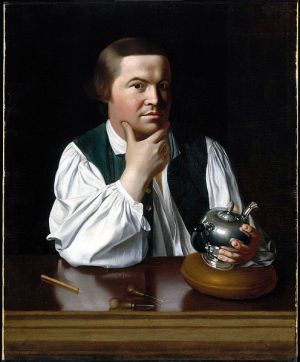
John Singleton Copley, Paul Revere, 1768. Oil on canvas, Museum of Fine Arts, Boston, Gift of Joseph W., William B., and Edward H. R. Revere (Photo: Wikimedia Commons)
. . . Few examples of colonial American painting have been studied as extensively as Copley’s Paul Revere. Scholars have argued that the portrait depicts Revere in his workshop as he pauses while engraving a silver teapot and have proposed a range of explanations to account for this subject matter. They have analyzed Copley’s sources, searched for (and ultimately uncovered little) information about the commission of the portrait, and speculated about the connection between the painting and Revere’s radical politics[note 2]. But interpreters have yet to consider seriously the connection between the portrait and the increasingly dire state of Revere’s financial affairs. Though Copley depicted the silversmith plying his trade, the bottom-line realities of this trade have been left out of the story of this iconic painting [p. 27]. . . .
My interpretation will draw on two different types of evidence. First is the portrait itself. Paul Revere is a far richer and more singular work than past scholars have acknowledged. While many writers have discussed the subject matter of the painting, few have seriously explored the portrait’s exceptional
composition. . . .
Since this is an image of a craftsman that emphasizes artisanal practice, questions about the processes of making, raising, and decorating silver teapots will also figure centrally in my account. In the period when Copley painted Paul Revere, elites grew increasingly interested in and familiar with artisanal materials and techniques [p. 28]. . . .
In proposing Paul Revere as such a strategic image, my argument locates the portrait within a broader field of eighteenth-century painting that functioned to promote the wares of particular retailers and artisans. This field includes genre paintings like Jean-Antoine Watteau’s iconic Shop Sign [p. 29] . . .
The full article is available here (J-Stor subscription required)
December 2012 Issue of the ‘Oxford Art Journal’
In the current issue of the Oxford Art Journal:
Clare Walcot, “Hogarth’s The South Sea Scheme and the Topography of Speculative Finance,” Oxford Art Journal 35 (December 2012): 413-32.
 William Hogarth’s elaborate graphic satire The South Sea Scheme (1721) stages a moral tale of speculation run riot and a capital in thrall to ‘mony’s magick power’. Published in response to the failure of the eponymous scheme, Hogarth offers a satirical commentary on all forms of government-sanctioned speculation and illicit gambling. The scene is set in an imagined topography comprised of London landmarks, public buildings and temporary structures; places of authority, commerce and finance. His rearrangement of the Monument to the Great Fire and Guildhall brings into conjunction sites of cultural memory, which allude to the tense relationship between City and Crown during the post-Restoration period and rebuilding of the capital after 1666. Hogarth draws on the links these sites have with the theatre of the street, in the form of popular protest and pageantry, as it appeared on the ground and on paper. This essay examines the spectacular use of urban space and how it shaped Hogarth’s early graphic satire, as well as continental imports adapted to a London market, such as Bernard Baron’s (after Bernard Picart) A Monument Dedicated to Posterity (1721), often taken to be the model for The South Sea Scheme.
Clare Walcot’s research interests focus on financial innovation in the eighteenth century and its impact on the visual arts, and develop out of her PhD thesis entitled ‘Figuring Finance: London’s New Financial World and the Iconography of Speculation, c. 1689–1763’ (University of Warwick, 2003).
The Burlington Magazine, November 2012
The eighteenth century in The Burlington:
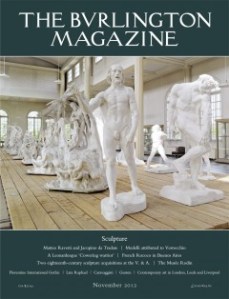
The Burlington Magazine 154 (November 2012)
 A R T I C L E S
• Marjorie Trusted, “Two Eighteenth-Century Sculpture Acquisitions for the Victoria and Albert Museum, London,” pp. 773-79. Two marble sculptures, a Crouching Venus by John Nost (1702) and a relief of Julius Caesar Invading Britain by John Deare (1796), have been acquired by the Victoria and Albert Museum, London.
• Gauvin Alexander Bailey, “French Rococo Prints and Eighteenth-Century Altarpieces in Buenos Aires,” pp. 780-85. French Rococo designs used in altarpiece decorations in eighteenth-century Buenos Aires.
R E V I E W S
• Philip Ward-Jackson, Review of Stefano Grandesso and Laila Skjøthaug, Bertel Thorvaldsen, 1770–1844 (Milan: Silvana, 2010), pp. 798-99.
• Mark Stocker, Review of Mary Ann Steggles and Richard Barnes, British Sculpture in India: New Views and Old Memories (Kirstead, Norfolk: Frontier Publishing, 2011), pp. 800-01.
• Christopher Baker, Review of the exhibition and catalogue The English Prize: The Capture of the Westmorland, an Episode of the Grand Tour (2012), pp. 817-18.
June 2012 Issue of ‘The Court Historian’
Eighteenth-century topics in the current issue of The Court Historian 17 (June 2012) . . .
Articles
• Clarissa Campbell Orr, “Popular History, Court Studies, and Courtier Diaries,” pp. 1-15.
• Robin Thomas, “Building the Monarchy: The Teatro di San Carlo in Naples, 1737,” pp. 35-60
• Neil Jeffares, “Between France and Bavaria: Louis-Joseph d’Albert de Luynes, Prince de Grimberghen,” pp. 61-85.
Reviews
• Clare Hornsby, Review of David Marshall, Susan Russell, and Karin Wolfe, eds., Roma Britannica: Art Patronage and Cultural Exchange in Eighteenth-Century Rome (London: British School at Rome, 2011), pp. 91-93.
• Wolf Burchard, Review of Christina Strunck and Elisabeth Kieven, eds., Europäische Galeriebauten: Galleries in a Comparative European Perspective (1400-1800), Römische Studien der Bibliotheca Hertziana 29 (Munich: Hirmer Verlag, 2010); and Mathieu da Vinha and Claire Constans, eds., Les grandes galeries européennes XVIIe-XIXe siècles (Paris: Éditions de la Maison des sciences de l’homme, 2010), pp. 95-104.
Conference Reports
• Antonio Ernesto Denunzio, “Aristocratic Residences in Naples: The Palazzo Zevallos Stigliano and Arts Patronage by the Nobility from the 16th to the 20th Centuries” (Naples, October 2011), pp. 113-14.
• Charles C. Noel, “The Court in Europe: Politics and Religion, 1500-1800,” (Madrid, December 2010), pp. 117-20.
September 2012 Issue of ‘The Art Bulletin’
In the current issue of The Art Bulletin, the “Notes from the Field” feature addresses the theme of contingency. Making a strong case for the proposition that it is possible to say something worthwhile in less than two pages, many of the essays are insightful and stimulating. The following two particularly address the eighteenth century. -CH
Gloria Kury, “On Contingency,” The Art Bulletin 94 (September 2012): 352-54.
Invoking Charles Le Brun, Emma and William Hamilton (“the first spell-binding teacher of art history was . . . a husband-wife duo”), and Dr. James Graham (famous for his sexual prescriptions involving the Celestial Bed at his Temple of Health and Hymen), Kury urges “scholars to start giving due heed to the significance of the spellbinding lecturer and / or master of the slide show, from the Hamiltons through Leo Steinberg and T. J. Clark, in the establishment and vitality of their discipline” . . . (354).
Mark Ledbury, “On Contingency,” The Art Bulletin 94 (September 2012): 354-55.
Addressing the “brilliant, but infuriating essay,” Charles Baudelaire’s “The Painter of Modern Life,” Ledbury draws readers’ attention to the critic’s coupling of “the contingent” with “the other half of art . . . the eternal and the immovable,” arguing that, in fact, modernity “has no monopoly over the contingent: wherever specialists look, the eternal and the immutable are thin on the ground” (354). Turning his attention then to eighteenth-century France (with reference to Richard Rorty’s Contingency, Irony, and Solidarity), Ledbury contends “that compelling history is always aware of the gravitational forces of contingency tugging it from its lofty heights. . . . Certainly, in my own scholarship, to even begin to chart the fortunes of the Neoclassical generation is to appreciate both the force and unpredictability of contingency in the making of lives, works, and careers” . . . (355).
ARIAH Prize for Online Publishing
From the Association of Research Institutes in Art History (ARIAH) . . .
ARIAH Prize for Online Publishing
Nomination due by 1 September 2012
 ARIAH looks for new initiatives to promote art historical research throughout the world, and invites nominations and self-nominations for the ARIAH Prize for Online Publishing. This award, which carries a $1,000 prize, seeks to encourage and promote high scholarly standards in online publishing in all fields of art history. The prize will be awarded annually to the author(s) of a distinguished article or essay published online in the past three years in the form of an e-journal or other short-form e-publication which advances the study of art history and visual culture. The article should either appear exclusively online, or should be substantially distinct from any print version, creatively capitalizing on the potential of digital publishing.
The competition is open to anyone, with the exception of delegates to ARIAH. Entries may be submitted by the author(s), or by others nominating authors for the prize, including publishers. Entries must be accompanied by the ARIAH Prize Entry Form.
Online publications must have appeared within three years of the submission date. All languages will be considered, but non-English submissions must also provide an English translation. Closing date for entries: September 1, 2012. Prize-winners will be notified by December 1, 2012. Please direct any questions to ARIAHprize@ariah.info
Articles and projects should contain substantial original scholarship and research, and enrich our understanding of art history and visual culture. Submissions will be considered that contribute new ideas and innovative approaches to the online presentation of information, and which exploit the potential offered by digital technology. Entries will be judged by a committee of ARIAH members.
August 2012 Issue of ‘Past & Present’
In the latest issue of Past and Present (August 2012), Michael Sonenscher responds to a recent article by William H. Sewell, “The Empire of Fashion and the Rise of Capitalism in Eighteenth-Century France,” Past and Present 206 (February 2010): 81-120. Sewell then weighs in with his own reply (access to full texts will require institutional subscriptions).
◊ ◊ ◊ ◊ ◊
Michael Sonenscher, “Debate: The Empire of Fashion and the Rise of Capitalism in Eighteenth-Century France,” Past and Present 216 (2012): 247-58.
[Full Text] [PDF]
 ‘Fashionable consumption’, Bill Sewell writes, ‘played a constitutive role in the development of French capitalism not only in the eighteenth century but also over the long term’. The claim goes with the grain of the many recent publications on eighteenth-century French trade and manufacturing industry that Sewell has expertly synthesized. But two further aspects of his article invite fuller comment. The first is an examination of the relationship between fashionable consumption and capitalist development that involves a modified version of Marx’s concept of surplus value. The second is a suggestion about the bearing of this fashion-oriented characterization of French capitalism on the subject of the origins and attributes of the French Revolution. Together they add up to an ambitious argument about the history of consumption as the way to overcome the neglect of social and economic considerations that, according to Sewell, has been one of the effects of the revisionist historiography of the French Revolution. . . .
◊ ◊ ◊ ◊ ◊
William H. Sewell, “Reply to Michael Sonenscher,” Past and Present 216 (2012): 259-67.
[Full Text] [PDF]
I would like to thank Michael Sonenscher for his learned and respectful comments on my article. In his comments he has filled out an aspect of the topic of ‘fashion’s empire’ that I made no sustained effort to cover in my own essay: varying contemporary opinions about the economics of fashion and about fashion’s relationship to France’s monarchical and aristocratic constitution. However, I think that his reflections on these eighteenth-century (or, in the case of Jean-Baptiste Say, early nineteenth-century) arguments about fashion have little bearing on what I take to be the central points of my essay. These are: (1) that fashion played a central role in French (and European) capitalist development in the eighteenth century; (2) that the dynamism of the fashion sector was based to a significant extent on harnessing the desires and labour of consumers; and (3) that certain consequences of the rise of fashion in eighteenth-century France ‘were … conducive to notions of equality of the sort specified in the Declaration of the Rights of Man and Citizen in 1789’ and were therefore ‘a key source’ of the French Revolution’s ‘epochal political and cultural transformations’. . .
July 2012 Issue of the Journal of the History of Collections
The following selection of articles from the current issue address the eighteenth century (access to full texts will require institutional subscriptions).
◊ ◊ ◊ ◊ ◊
Journal of the History of Collections 24 (July 2012)
A R T I C L E S
 Thomas Ketelsen and Christien Melzer, “The Gottfried Wagner Collection in Leipzig: Insights into a Middle-Class Private Collection of c. 1700,” pp. 199-218.
[Abstract] [Full Text] [PDF]
Cristiano Giometti, “‘Per accompagnare l’antico’: The Restoration of Ancient Sculpture in Early Eighteenth-Century Rome,” pp. 219-30.
[Abstract] [Full Text] [PDF]
David A. Wisner, “French Neo-Classical Artists and Their Collections,” pp. 231-42.
[Abstract] [Full Text] [PDF]
B O O K R E V I E W S
Nicholas Tromans, “Review of Spanish Art in Britain and Ireland, 1750-1920: Studies in Reception in Memory of Enriqueta Harris Frankfort, edited by Nigel Glendinning and Hilary Macartney (2010),” pp. 276-77.
[Full Text] [PDF]
CAA Joins JSTOR Register & Read Program
As noted at CAA News (2 July 2012):
 CAA has joined JSTOR’s new Register & Read program, which offers free, read-online access to a wide-range of academic journals to independent scholars and researchers. The service is designed to make scholarship available to those not affiliated with a subscribing institution by allowing them to register for a MyJSTOR account.
CAA is pleased to contribute the full back run of The Art Bulletin and Art Journal, through 2008, to an expanding, eclectic list that includes BOMB Magazine, Film Quarterly, Modern Law Review, and American Journal of Sociology. All articles from The Art Bulletin and Art Journal during this time will be available for individuals to read and, in some instances, to download and purchase as a PDF file.
Since JSTOR launched Register & Read in January 2012, approximately forty publishers have contributed material from seventy-seven journals to the beta site. The user-friendly program mimics the experience of a library by allowing visitors to store up to three articles on a virtual shelf for two weeks before exchanging items. Feedback is key to improving the borrowing service that Register & Read provides. JSTOR plans to perfect the functionality of the program and enlarge its scope to meet the unique research needs of the scholarly community.










 Enfilade
leave a comment