The 2012 Issue of ‘The Walpole Society’
The Walpole Society 74 (2012)
• Rodney Griffiths, “The Life and Works of Edward Haytley (1713-1762),” pp. 1-60.
• Jason M. Kelly, “Letters from a Young Painter Abroad: James Russel in Rome, 1747-53,” pp. 61-164.
• Andrew Graciano, “The Memoir of Benjamin Wilson FRS (1721-1788): Painter and Electrical Scientist,” 165-244.
• Hugh Brigstocke, “The Journals and Accounts of James Irvine in Italy (1802-1806): Art Dealing and Speculation for William Buchanan, Arthur Champernowne and Alexander Gordon,” 245-432.
General information about The Walpole Society is available here»
In the May 2012 Issue of ‘Apollo Magazine’
From the current issue of Apollo Magazine:
◊ ◊ ◊ ◊ ◊
Elizabeth Angelicoussis, “An Olympiad’s Portrait,” Apollo Magazine (May 2012)
During excavations at Hadrian’s Villa at Tivoli the archaeologist Gavin Hamilton unearthed a classical statue of Hermes. Hamilton’s conservation of the sculpture transformed its identity to create an 18th-century image of an Olympic victor inspired by the ideals of ancient Greece
 In the late 18th century, the 1st Marquess of Lansdowne, William Petty-Fitzmaurice (1737–1805), assembled the most impressive collection of classical marbles in the British Isles, which he displayed in Lansdowne House, in London’s Berkeley Square.1 Many prime specimens were sold at a Christie’s auction in London in 1930, but at a Sotheby’s sale in New York in 1972, a very perceptive buyer purchased one choice piece that deserves examination.2
The sculpture represents a life-size youth with a smooth complexion and flawless features (Figs. 1–4).3 The nose is straight and large; from its bridge the razor-sharp ridges of the eyebrows flare out horizontally. The thin-lidded eyes are unmarked and only the rightwards torsion and the slightly parted lips animate the face. The coif is unfinished: at the crown, thick hair clusters, coarsely carved into spiral curls, lack drill holes to define their centres, while the hair at the back is roughly modelled into two large masses divided by a deep furrow. A lump of marble protrudes from the hair at the right, while a branch chiselled into the tresses above the left ear divides into two sprigs bearing a lanceolate leaf and tiny berries – the genus of the foliage remains undetermined. A wide groove encircles the head. The nude bust is ancient, and the uneven fracture around the neck argues for an original connection between the two parts.4 . . .
Elizabeth Angelicoussis specialises in ancient sculptures in private British museums.
__________________________
1/ This article is an offshoot from my project of the reconstruction of the Lansdowne collection of classical marbles. For surveys of the Lansdowne collection and the construction of Lansdowne House, with further bibliography, see Adolph Michaelis, Ancient Marbles in Great Britain, Cambridge, 1882, pp. 103–06, 453–71; Jonathan Scott, The Pleasures of Antiquity: British Collectors of Greece and Rome, New Haven and London, 2003, pp. 160–68; Ilaria Bignamini and Clare Hornsby, Digging and Dealing in Eighteenth-Century Rome, New Haven and London, 2010, vol. I, pp. 321–26. For more on the Marquess, see Oxford Dictionary of National Biography, online edn. May 2010, http://www.oxforddnb.com/view/article/22070 (J. Cannon).
2/ Catalogue of the Celebrated Collection of Ancient Marbles, the Property of the Most Honourable the Marquess of Lansdowne, 5 March 1930, p.77, lot 60; Sotheby’s Sales Catalogue of Egyptian, Western Asiatic, Greek, Etruscan and Roman Antiquities, 4 December 1972, p. 30, lot 122.
3/ See Michaelis op cit., Ancient Marbles in Great Britain, Cambridge, 1882, p. 452, no. 62. The restorations include the tip of nose, a section of the left brow and a piece of the right side of the neck at the front.
4/ There is a diagonal break running from the back across the chest. The repairs of the bust include the base and index plate, the patchwork of the spine, and the left breast. The inside and the rim of the support have been smoothed over. . . .
◊ ◊ ◊ ◊ ◊
The full article is available here»
In the March 2012 Issue of ‘French History’
 Selections from the current issue of French History:
Julian Wright and Penny Roberts, “Editors’ Note,” French History 26 (March 2012).
This issue allows us to mark a number of points about the continuing importance of the study of the French Revolution. Without having planned it as a special issue, it so happened that we have been able to publish together a number of important new studies of the French Revolutionary decade and its historiography. . .
◊ ◊ ◊ ◊ ◊
Claire Trévien, “Le monde à l’envers: The Carnivalesque in Prints of the Construction of the Fête de la Fédération of 1790,” French History 26 (March 2012).
Abstract: This article explores representations of the carnivalesque during the construction of the Fête de la Fédération of 1790. Bakhtin’s assertion that the carnival is always separate from official festivities is exemplified by this spontaneous manifestation which was shunned by officials and disregarded appropriate class and gender roles. This article focuses on the pictorial depiction of this unique event and discusses how a study of its iconography also reflects the suppression of the carnivalesque in early revolutionary Paris.
◊ ◊ ◊ ◊ ◊
David Gilks, “Art and Politics during the ‘First’ Directory: Artists’ Petitions and the Quarrel over the Confiscation of Works of Art from Italy in 1796,” French History 26 (March 2012).
Abstract: This article examines the place of artists’ petitions in the quarrel over confiscating works of art. It argues that the dispute provided opportunities for its participants to advance a series of distinct agendas that reflected political and professional concerns rather than judgements about the art in question. By tracing the earliest stages of the quarrel and radically reinterpreting Quatremère’s crucial contribution—his Letters on the Plan to Abduct the Monuments of Italy—as part of his reactionary politics, the article clarifies the meaning of the ensuing artists’ petitions. It argues that while Quatremère duped ‘insider’ artists into supporting the Papist cause by signing his petition questioning the confiscations, the artists themselves instead signed as a means to re-assert their status and right to patronage. The vituperative responses to his petition included a counter-petition supporting art confiscations; it was signed by ‘outsider’ artists, reluctant to let their more famous co-professionals monopolize the debate at their expense.
The 2012 Issue of ‘SECC’
Art history in the current issue of Studies in Eighteenth-Century Culture:
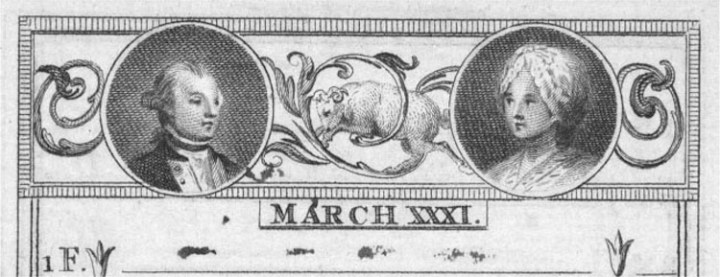
Head vignette, The Royal Engagement Pocket Atlas for 1781.
◊ ◊ ◊ ◊ ◊
• Michael Yonan, “The Wieskirche: Movement, Perception, and Salvation in the Bavarian Rococo,” Studies in Eighteenth-Century Culture 41 (2012): 1-25.
• Sandro Jung, “Print Culture, Marketing, and Thomas Stothard’s Illustrations for The Royal Engagement Pocket Atlas, 1779–1826,” Studies in Eighteenth-Century Culture 41 (2012): 27-53.
• Jennifer Germann, “Tracing Marie-Éléonore Godefroid: Women’s Artistic Networks in Early Nineteenth-Century Paris,” Studies in Eighteenth-Century Culture 41 (2012): 55-84.
• Marc H. Lerner, “William Tell’s Atlantic Travels in the Revolutionary Era,” Studies in Eighteenth-Century Culture 41 (2012): 85-114.
April 2012 Issue of ‘Apollo Magazine’
Eighteenth-century offerings from the latest Apollo Magazine (for the full text of each article, click on the images below). . .
◊ ◊ ◊ ◊ ◊
Anne Kapeller, “A Unique Heritage: Treasures of the Swiss National Museum in Nyon,” Apollo Magazine (April 2012).
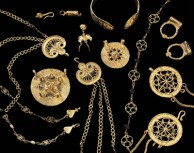 . . . In 1741, the curate Johann Georg Sulzer carried out a series of excavations at Lunnern, in the Reuss Valley near Zurich, leading to the discovery of a Roman temple, baths and a necropolis. On 17 November, he uncovered a hoard consisting of 17 pieces of gold jewellery and 84 silver coins, hidden in a recess. Three days later news of the sensational discovery reached Zurich. The painter Johann Balthasar Bullinger was commissioned to visit the site and produce a picture of the excavations. It was preserved along with the jewels in the art collection of the Wasserkirche in Zurich, before becoming part of the collections of the SNM. . .
◊ ◊ ◊ ◊ ◊
Lucy Davis & Christoph Martin Vogtherr, “A Taste for Blue,” Apollo Magazine (April 2012).
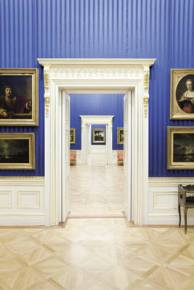 The Wallace Collection is famous for its exceptional group of works from the French 18th century. A smaller collection of around 150 Dutch 17th-century paintings is of equally fine quality, including masterpieces by Frans Hals, Rembrandt, Gerard ter Borch, Pieter de Hooch, Jan Steen, Gabriel Metsu, Caspar Netscher, Jacob van Ruisdael, Nicolaes Berchem, Philips Wouwermans and other leading painters of the Golden Age. It is particularly rich in genre paintings, landscapes by the Dutch Italianates and the work of some outstanding artists – Rembrandt first of all, but also Steen, Metsu, Willem van de Velde, Meindert Hobbema and Willem van Mieris. The resulting view of Dutch art does not provide a systematic overview but follows the personal preferences of the collectors and the typical view of Dutch art during the 18th and early 19th centuries. Artists such as Jan van Goyen, Hercules Seghers and Vermeer, but also the earlier periods before Rembrandt, are hardly represented. They were only admitted to the canon
at a time when the Hertford family had stopped collecting Dutch art. . .
◊ ◊ ◊ ◊ ◊
Juliet Carey, “A House of Cards: Taking Time,” Apollo Magazine (April 2012).
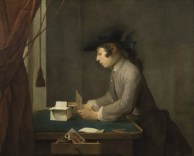 Waddesdon Manor is temporarily home to a small but extraordinarily beautiful group of works by one of the most revered of all French painters. The exhibition Taking Time: Chardin’s ‘Boy Building a House of Cards’ and Other Paintings is prompted by the recent acquisition of one of four works by Jean-Siméon Chardin (1699–1779) of a subject that particularly fascinated him. The last to enter the public domain, the Waddesdon canvas, is united for the first time with three other variations on the theme, on loan from national collections in France, Britain and the United States. . .
◊ ◊ ◊ ◊ ◊
Humphrey Wine, “The Art of a Connoisseur: Review of Pierre Rosenberg and Laure Barthélemy-Labeeuw, Les Dessins de la Collection de Pierre-Jean Mariette (2011),” Apollo Magazine (April 2012).
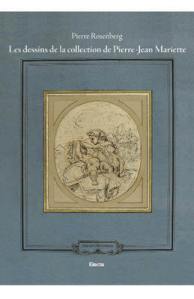 Soon after the death of Pierre-Jean Mariette (1694–1774) his heirs had Pierre François Basan organise a sale of his collection. It included paintings (among them Poussin’s Nurture of Bacchus, c. 1628, now in the National Gallery, London), terracottas, antique marbles, bronzes and engraved gems; the bulk of the sale, however, comprised some 9,000 Italian, Dutch, Flemish and French drawings. It was not only size that distinguished Mariette’s collection of drawings – the earlier collection of Pierre Crozat, built with Mariette’s advice, had been twice as large – but also its quality and comprehensive nature. . . .
March 2012 Issue of ‘The Art Bulletin’
Offerings bearing on the eighteenth century from the March 2012 issue:
 • Anne M. Wagner, “Regarding Art and Art History,” The Art Bulletin 94 (March 2012): 8-9.
• Elizabeth King, J. M. Bernstein, Carolyn Dean, Caroline Van Eck, Finbarr Barry Flood, Dario Gamboni, Jane Garnett and Gervase Rosser, James Meyer, Miya Elise Mizuta, and Alina Payne, “Notes from the Field: Anthropomorphism,” The Art Bulletin 94 (March 2012): 10-31.
• Andrei Pop, “Henry Fuseli: Greek Tragedy and Cultural Pluralism,” The Art Bulletin 94 (March 2012): 78-98.
Abstract: The wash drawings and oil paintings of subjects from Greek tragedy by Anglo-Swiss painter Henry Fuseli (1741–1825), routinely categorized as romantic classicism, might be better explained in terms of the contemporary revival of Greek tragedy, made possible by the philosophical anthropology of Johann Gottfried von Herder and David Garrick’s theater of character. From this climate of experimentation with foreign cultures arose a morally detached spectator and a critique of Eurocentrism in the era of Captain Cook and the American Revolution. Fuseli’s classicism thus played its part in the formation of the modern liberal version of cultural pluralism.
Getty Research Journal 4 (2012)
The eighteenth century in the latest Getty Research Journal:
◊ ◊ ◊ ◊ ◊
Articles
• Adriano Amendola, “Frames for Drawings in Roman Collections: A Case Study,” Getty Research Journal 4 (2012): 45–56.
 Using salient examples and on the basis of a comparative analysis of archival data from the Provenance Index® databases of the Getty Research Institute, this paper identifies the typologies of frames used to display drawings in Roman collections of the 17th and 18th centuries. The phenomenon of exhibiting framed drawings, which has not been fully studied up to now, began during the early 1600s when refined collectors began to display the drawings in their collections on the walls of their residences instead of keeping them in albums or drawers. The chromatic quality of the drawings was enhanced by the frames, which were gilded, black, wood-colored, or white, and usually quite simple in design, as in the Salvator Rosa type. In such frames, drawings could hold their own with paintings as part of an arrangement of works on a wall. With the dissemination of academic drawings of nudes, instituted by the most important Roman families during the course of the 17th century, framed drawings began to occupy an important position in collections, soon becoming the focal point of entire rooms devoted to a particular theme.
• Alden R. Gordon, “A Rare Engraving of an Italian Rococo Parade Apartment of 1736: Andrea Bolzoni’s Print of the Interior of the Palazzo Cervelli in Ferrara,” Getty Research Journal 4 (2012): 57–74.
 Engraved images of real secular interiors are rare before 1790. Even more rare are illustrations of nonroyal houses in which the domestic and parade apartments are depicted fully furnished, with portable objects that were actually in use. An illustration by Andrea Bolzoni (1689–1760) accompanying the publication in 1736 of a poem by Jacopo Agnelli (1701 or 1702–99) celebrating a grand festival given by Fortunato Cervelli (1683–1755), the Holy Roman imperial consul in Ferrara, on the occasion of the marriage of Maria Theresa of Austria (1717–80), female heiress to the Habsburg dynasty, provides an exceptional record of Cervelli’s nonroyal suite of parade apartments decorated in a unique “chinoiserie” variant of the Rococo style. The actual decorative interiors represented were prompted by a special set of political and commercial circumstances designed to project the Habsburg interests abroad in the Papal States.
Web extra: Appendix (PDF, 14pp., 11.7 MB)—a transcription of and room-by-room commentary on the engraving
• Vimalin Rujivacharakul, “How to Map Ruins: Yuanming Yuan Archives and Chinese Architectural History,” Getty Research Journal 4 (2012): 91–108.
 In 1860, the 18th-century European-style pavilions, along with the rest of the Yuanming Yuan imperial palace in Beijing, China, were burned down during an invasion of the palace by Anglo-French troops. Thereafter, with further looting and physical aggression, the former Qing dynasty architectural marvel continually deteriorated into complete ruin. By the turn of the 20th century, the only remaining visual reference of its original state was a set of 20 engravings that showed selected building facades. No plans, sections, or other architectural data were available. The situation changed dramatically in the 1930s. Within a few years, researchers of different backgrounds—Chinese, American, and French—began publishing their research on the European-style pavilions and displaying materials that had never appeared before the public. This article examines the sudden emergence of those visual archives and reveals some of their interestingly intertwined stories. Furthermore, by discussing ways in which the new archives contributed to a rereading of the old ruins, it also explores a long-standing paradox in architectural history: How, in reality, did historians connect what they saw on paper to the buildings that no longer existed?
Acquisitions & Discoveries
• Stephanie Schrader, Nancy Turner, and Nancy Yocco, “Naturalism under the Microscope: A Technical Study of Maria Sibylla Merian’s Metamorphosis of the Insects of Surinam,” Getty Research Journal 4 (2012): 161–72.
Oxford Art Journal March 2012
The latest issue of Oxford Art Journal is now available. For a free trial, visit: http://www.oxfordjournals.org/page/4541/2
◊ ◊ ◊ ◊ ◊
Dominic Janes, “Unnatural Appetites: Sodomitical Panic in Hogarth’s The Gate of Calais, or, O the Roast Beef of Old England (1748),” Oxford Art Journal 35 (March 2012): 19-31.

William Hogarth, "O the Roast Beef of Old England ('The Gate of Calais')," oil on canvas, 1748 (London: Tate Britain)
Abstract: Hogarth’s The Gate of Calais, also known as O the Roast Beef of Old England (1748), has been extensively studied in relation to its expression of British Protestant prejudice against the French and against Roman Catholicism. However, other aspects of the work have not received such attention. In the eighteenth-century the appetite for food was popularly employed as a metaphor for sexual desire. The painting, and the widely circulated engraving made from it, could, therefore, admit of an erotic reading, particularly bearing in mind the frequency of complex sexual references in Hogarth’s works. The carnality so satirised was not simply related to anti-Catholic parody of transubstantiation, because this composition can be interpreted as having been structured around coded expressions of same-sex desire. Hogarth’s interest in this theme can be related not only to his homosocial environment, but also to the events in Calais that inspired him. Hogarth’s experience as a prisoner aroused in him a ‘sodomitical panic’ which can be seen as the precursor of the ‘homosexual panic’ studied by Eve Kosofsky Sedgwick as an aspect of male sexual anxiety at the end of the nineteenth century. This work can be interpreted, therefore, as evidence for sexual as well as national and religious insecurity in mid-eighteenth-century Britain.
Dominic Janes is Senior Lecturer in the Department of History of Art and Screen Media, Birkbeck College, University of London. His work focuses on representations of religious belief, morality and sexuality in Britain since the eighteenth century. His most recent book is Victorian Reformation: The Fight over Idolatry in the Church of England, 1840–1860 (Oxford University Press, 2009). He is currently researching images of martyrdom and deviance during the duration of an AHRC Fellowship.
Spring 2012 Issue of ‘Eighteenth-Century Studies’
Art historical offerings from the Spring 2012 issue of Eighteenth-Century Studies:

• Ian Haywood, “Rude Britannia: New Perspectives on Caricature,” Review of Amelia Rauser, Caricature Unmasked: Irony, Authenticity, and Individualism in Eighteenth-Century English Prints (2008) and Todd Porterfield, ed., The Efflorescence of Caricature, 1759-1838 (2011), Eighteenth-Century Studies 45 (Spring 2012): 437-40.
• John Bonehill, “The Art of Empire,” Review of John Crowley, Imperial Landscapes: Britain’s Global Visual Culture (2011) and Geoff Quilley, Empire to Nation: Art, History, and the Visualization of Maritime Britain (2011), Eighteenth-Century Studies 45 (Spring 2012): 440-42.
• Michael Yonan, Review of Christiane Hertel, Pygmalion in Bavaria: The Sculptor Ignaz Günther and Eighteenth-Century Aesthetic Art Theory (2011), Eighteenth-Century Studies 45 (Spring 2012): 457-59.
• Stephanie Koscak, Review of Wendy Bellion, Citizen Spectator: Art, Illusion,
and Visual Perception in Early National America (2011), Eighteenth-Century
Studies 45 (Spring 2012): 459-61.
The Burlington Magazine, February 2012
The eighteenth century in The Burlington:
The Burlington Magazine 154 (February 2012)
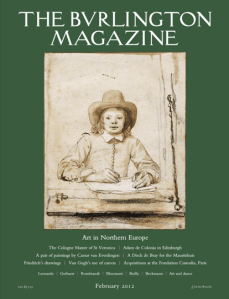 • Sophie Raux, “Carel Fabritius in Eighteenth-Century Paris,” pp. 103-06. This article establishes, among other things, that Carel Fabritius’s Mercury and Argus (c.1645–47; Los Angeles County Museum of Art) was in the collection of François Boucher, where it was seen by Fragonard.
Reviews
• Christian Tico Seifert, Review of Vadim Sadkov, The Pushkin State Museum of Fine Arts: Netherlandish, Flemish, and Dutch Drawings of the XVI-XVIII Centuries. Belgian and Dutch Drawings of the XIX-XX Centuries (Amsterdam: Foundation for Cultural Inventory, 2010), pp. 128-29.
• Xander Van Eck, Review of Lyckle de Vries, How to Create Beauty: De Lairesse on the Theory and Practice of Making Art (Leiden: Primavera Pers, 2011), pp. 129-30.
• Kate Retford, Review of the exhibition The First Actresses: Nell Gwyn to
Sarah Siddons (London: National Portrait Gallery), pp. 134-35.
• Xavier F. Salomon, Review of the exhibition Il Settecento a Verona: Tiepolo,
Cignaroli, Rotari — La Nobilità della Pittura (Verona: Palazzo della Gran
Guardia), pp. 146-48.










 Enfilade
leave a comment