July Issue of ‘The Burlington’
The Burlington Magazine 153 (July 2011)
 • Gerlinde Klatte, “New documentation for the ‘Tenture des Indes’ tapestries in Malta” — Unpublished documents on the Anciennes Indes tapestry set (1708–10) woven by Etienne Le Blond for the Order of St John, Valletta, Malta.
Reviews
• Ann Compton, Review of Rune Frederikson and Eckart Marchand, eds., Plaster Casts: Making, Collecting and Displaying from Classical Antiquity to the Present (Berlin and New York, 2010),
• Rose Kerr, Review of Robert Finlay, The Pilgrim Art: Cultures of Porcelain in World History (Berkeley, 2010)
• Humphrey Wine, Review of the exhibitions, Watteau’s Drawings, Watteau and His Circle
• Todd Longstaffe-Gowan, Review of the exhibition, French Romantic Gardens
• Neil Jeffares, Review of the exhibition, Pastel Portraits
May Issue of ‘The Burlington’
This posting on eighteenth-century topics from the May issue of The Burlington is long overdue, but given the discovery of a new Watteau document, I wanted to include it all the same — in hopes of sending good luck to all of you busy in the archives this summer. Good hunting! -CH.
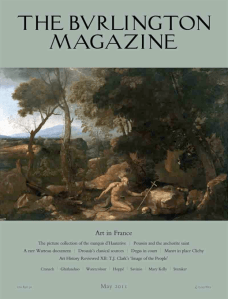 The Burlington Magazine 153 (May 2011)
• François Marandet, “Jean-Antoine Watteau: The First Documents,” pp. 312-13.
Newly discovered notarial acts from the National Archives in Paris clarify what happened to the painter’s property after his death in 1721, revising Gersaint’s account on two accounts.
• Todd Magreta, “Marius at Minturnae by Jean-Germain Drouais: A Classical Source and the Sublime,” pp. 314-17.
An examination of Marius at Minturnae (1786) by Jean-Germain Drouais.
• Satish Padiyar, “Neoclassicisms,” pp. 357-58.
Review of the exhibition, L’Antiquité rêvée / Antiquity Rediscovered.
June 2011 Issue of ‘The Art Bulletin’ — In Memory of Anne Schroder

Fragonard, "The Meeting," from the Progress of Love, 1771-73 (NY: The Frick Collection)
The June issue of The Art Bulletin is dedicated to the memory of Anne L. Schroder, who passed away suddenly in December 2010. The issue includes her article, “Fragonard’s Later Career: The Contes et Nouvelles and the Progress of Love Revisited,” pp. 150-177.
◊ ◊ ◊ ◊ ◊
Abstract: Late in his career, which spanned the Revolution and beyond, Honoré Fragonard revived two major projects in limbo since 1773. His unsuccessful effort to have engraved his illustrations for La Fontaine’s Contes et nouvelles (17880-1809) demonstrates the dramatic upheavals in the post-Revolutionary print market and publishing industries and shifting reactions to his art. The unfinished series Progress of Love, expanded and recontextualized by the artist during the late 1790s and early 1800s, reveals Fragonard’s adaptation of his perennial subjects — flirtation, love, and picturesque nature — to changing cultural attitudes regarding the sexual power of women in the aftermath of the Revolution.
In the May Issue of ‘Apollo’: From the Landsdowne Collection
From Apollo:
Elizabeth Angelicoussis, “Diomedes and Diskobolus,” Apollo Magazine (May 2011)
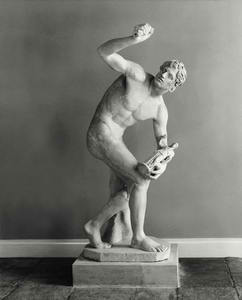 Among the collection of classical sculpture belonging to the 1st Marquess of Lansdowne was a Roman copy of a lost bronze of Diskobolus by the Greek sculptor Myron. Excavated by the dealer Gavin Hamilton in 1774, the marble’s fascinating story has much to reveal about late 18th-century.
. . . It is hoped that this article’s examination of this particular distinctive Lansdowne sculpture and its interesting history will stimulate awareness in a new book, developed by this author in conjunction with Ian Jenkins, Senior Curator of Greek and Roman Antiquities at the British Museum and Daniella Ben-Arie, co-curator of the 2008 Thomas Hope exhibition at the Victoria and Albert Museum. The book aims to rediscover, examine, photograph and interpret the once coherent group of Lansdowne sculptures that is now widely dispersed across the globe. . . .
A brief bit of online searching for details regarding the new book turned up nothing, though presumably we will hear more in the coming months. -CH
This Month’s ‘Burlington Magazine’
This month’s issue of The Burlington Magazine is devoted to British Art with the following eighteenth-century offerings:
 The Burlington Magazine 153 (April 2011)
- Richard Hewlings, “Nicholas Hawksmoor in Chester,” pp. 224-28.
- Hugh Belsey, “Reading the Caricature Groups of Thomas Patch,” pp. 229-31.
- Malcolm Warner, Review of British Paintings in the Metropolitan Museum of Art, 1575-1875, Katharine Baetjer, p. 257.
- Brian Allen, Review of James Barry, 1741-1806: History Painter, ed. Tom Dunne and William Pressly, pp. 258-59.
- Timothy Wilcox, Review of Constable, Jonathan Clarkson, pp. 259-60.
- Giles Waterfield, Review of The English Virtuoso: Art, Medicine, and Antiquarianism in the Age of Empiricism, Craig Hanson, pp. 266-67.
- Alex Kidson, Review of the exhibition Georgian Faces: Portrait of a County, pp. 274-75.
Latest Issue of ‘Journal for Eighteenth-Century Studies’
Journal for Eighteenth-Century Studies 33 (December 2010)
Special Issue: Animals in the Eighteenth Century, guest edited by Glynis Ridley
 Peter Singer, “Foreword”
Glynis Ridley, “Introduction: Representing Animals”
Speakers
Ann Cline Kelly, “Talking Animals in the Bible: Paratexts as Symptoms of Cultural Anxiety in Restoration and Early Eighteenth-Century England,” pp. 437-51.
Conrad Brunström and Katherine Turner, “‘I shall not ask Jean-Jacques Rousseau’: Anthropomorphism in the Cowperian Bestiary,” pp. 453–68.
Jane Spencer, “Creating Animal Experience in Late Eighteenth-Century Narrative,” pp. 469–86.
Subjects
Sam George, “Animated Beings: Enlightenment Entomology for Girls,” pp. 487–505.
Jeff Loveland, “Animals in British and French Encyclopaedias in the Long Eighteenth Century,” pp. 507–23.
Christopher Plumb, “‘Strange and Wonderful’: Encountering the Elephant in Britain, 1675-1830,” pp. 525–43.
Craig Ashley Hanson, “Representing the Rhinoceros: The Royal Society between Art and Science in the Eighteenth Century,” pp, 545–66.
Boundaries
Tobias Menely, “Sovereign Violence and the Figure of the Animal, from Leviathan to Windsor-Forest,” pp. 567–82.
Anne Milne, “Sentient Genetics: Breeding the Animal Breeder as Fundamental Other,” pp. 583–97.
Peter C. Messer, “Republican Animals: Politics, Science and the Birth of Ecology,” pp. 599–613.
Paula Young Lee, “The Curious Affair of Monsieur Martin the Bear,” pp. 615–29.
Emotions
Lisa Berglund, “Oysters for Hodge, or, Ordering Society, Writing Biography and Feeding the Cat,” pp. 631-45.
James P. Carson, “Scott and the Romantic Dog,” pp. 647–61.
Elizabeth Amy Liebman, “Animal Attitudes: Motion and Emotion in Eighteenth-Century Animal Representation,” pp. 663–83.
Latest Issue of ‘Ars Orientalis’: Globalizing Cultures
Volume 39 of Ars Orientalis, “Globalizing Cultures: Art and Mobility in the Eighteenth Century,” guest-edited by Nebahat Avcıoğlu and Finbarr Barry Flood, is now available. The volume addresses various aspects of the movement of cultural forms in Europe and Asia during the eighteenth century.
Contents
- Nebahat Avcıoğlu and Finbarr Barry Flood, “Globalizing Cultures: Art and Mobility in the Eighteenth Century”
- Sanjay Subrahmanyam, “A Roomful of Mirrors: The Artful Embrace of Mughals and Franks, 1550–1700”
- Kristel Smentek, “Looking East: Jean-Etienne Liotard, the Turkish Painter”
- Tülay Artan, “Eighteenth-Century Ottoman Princesses as Collectors: From Chinese to European Porcelain”
- Anton Schweizer and Avinoam Shalem, “Translating Visions: A Japanese Lacquer Plaque of the Haram of Mecca in the L. A. Mayer Memorial Museum, Jerusalem”
- Chanchal Dadlani, “The ‘Palais Indiens’ Collection of 1774: Representing Mughal Architecture in Late Eighteenth-Century India”
- Elisabeth A. Fraser, “‘Dressing Turks in the French Manner’: Mouradgea d’Ohsson’s Panorama of the Ottoman Empire”
- Mercedes Volait, “History or Theory? French Antiquarianism, Cairene Architecture, and Enlightenment Thinking”
Oldest American Porcelain Traced to Charleston Area, ca. 1765
From The Magazine Antiques:
Robert Hunter, “American Porcelain Teabowl,” The Magazine Antiques
Unveiled for the first time at the Winter Antiques Show, a small teabowl is revealed to be the earliest intact piece of American porcelain known to date—and it was made near Charleston.
 . . . For years, scholars had been aware that another master potter, John Bartlam immigrated to South Carolina from Staffordshire around 1763 to exploit the abundant clays of the region and to take advantage of the growing American market for English style table wares. Bartlam may have been producing soft-paste porcelain as early as 1765 in the settlement of Cain Hoy just north of Charleston, and then later in Charleston until 1773. But the extent of his manufactory was not recognized until archaeologist Stanley South and his team from the South Carolina Institute of Archaeology and Brad Rauschenberg, former director of research at the Museum of Early Southern Decorative Arts, found the nants of his site in Cain Hoy. Their excavations recovered misfired waster fragments of press-molded creamware and blue decorated porcelain. Of particular interest was the recovery of three
fragmentary but matching porcelain teabowls . . . .
Armed with the information provided by the scientific and visual analysis of the Bartlam sherds, one of the researchers working on the project, the English porcelain dealer and scholar Roderick Jellicoe, recently discovered the bowl shown here in an English collection. The printed scenes are identical to those on the Bartlam archaeological examples, and in fact, appear to have come from the same copperplates. . . .
The full article is available here»
In the December Issue of ‘Art History
Rosalind P. Blakesley, “Pride and the Politics of Nationality in Russia’s Imperial Academy of Fine Arts, 1757-1807,” Art History 33 (December 2010): 800-35.
Abstract: In 1757, the Imperial Academy of Fine Arts was founded in St Petersburg to professionlize painting, sculpture, and architecture, and to further the careers of Russian artists in all three disciplines. While the Academy’s early chamipons relied on western European artists to galvanize local developments, they also harboured ambivalent attitudes towards foreign involvement in Russian artistic affairs. This article traces the resulting web of conflicting loyalties and aspirations which underpinned, but also complicated, Russia’s quest to create a body of art which it could call its own. It then attends to the ways in which the portraitists Dmitry Levitsky and Vladimir Borovikovsky both interacted with and set themselves apart from western European practice. Rethinking Russian painting in this way as a critical component of a European mainstream sheds light on the realization (or otherwise) of a national school of art.
◊ ◊ ◊ ◊ ◊
Though dealing mainly with the history of a Renaissance building in the nineteenth century, Allie Terry’s article on the Bargello in Florence may also be of interest to Enfilade readers. As she notes, the transition of power in the eighteenth century from the Grand Duchy of Tuscany to the House of Lorraine brought to a close the practice of torture at the site, though it remained a prison: “In 1782, Pietro Leopoldo I ordered a mass burning of all torture instruments in the Bargello courtyard” (841).
Allie Terry, “Criminals and Tourists: Prison History and Museum Politics at the Bargello in Florence,” Art History 33 (December 2010): 836-55.
Abstract: Focusing on the Bargello, this essay interrogates the use of violence as an aesthetic frame for tourists to Florence and examines the architectural transformation of the prison through attention to the cultural agenda of the nineteenth-century Risorgimento and its manipulation of the material culture of the city. The replacement of a historical blemish, such as the corporeal violence associated with the Bargello prison, with a new historical monument, the Bargello museum, in the nineteenth century effectively drew on the power of the place to project both backward into the past and forward into the future. By transforming the site in a cultural institution that still retained its architectural shell, the museum displayed its institutional past to expose its foreignness to the present moment and initiated the creation of a new meta-narrative of Italian judicial, and cultural, history.
New Journal for the Decorative Arts: ‘West 86th’
At the ever informative Art History Newsletter, Jon Lackman reports on the final issue of Studies in the Decorative Arts, which will, as of next year, be replaced by West 86th, a new journal published by the Bard Graduate Center in cooperation with the University of Chicago Press. As noted at the Bard’s website:
West 86th: A Journal of Decorative Arts, Design History, and Material Culture
 Publication, in print and online, is a major part of the BGC’s intellectual project. For 17 years, the BGC published Studies in the Decorative Arts, an internationally acclaimed journal covering the decorative arts, design history, and material culture. The success of this journal represents the success also of a new institution at catalyzing intellectual conversation. We are substantially rethinking Studies in the Decorative Arts after its final issue, printed in fall 2009. A new journal, West 86th: A Journal of Decorative Arts, Design History, and Material Culture, is planned for spring 2011, in collaboration with the University of Chicago Press, and will focus on the wider crossroads where the decorative arts meet design history and material culture. In addition to its print manifestation, this new journal will be published online and will be the starting point for an open-access Web site dedicated to journal-related digital content.
The “Guidelines for Contributors” can be downloaded here.










 Enfilade
leave a comment