Current Issue of ‘Eighteenth-Century Studies’
Selections from Eighteenth-Century Studies 44 (Fall 2010):
- Lisa L. Moore, “Exhibition Review: Mary Delany and Her Circle, in the Museum and on the Page,” pp. 99-104.
- Yuriko Jackall, “Exhibition Review: Jean Raoux, 1677-1734,” pp. 104-111.
- Katherine Arpen, “Review of Thomas Kavanagh’s Enlightened Pleasures: Eighteenth-Century France and the New Epicureanism (Yale UP, 2010),” pp. 136-38.
From the September Issue of ‘Art History’
Caroline van Eck, “Alfred Gell’s Art and Agency: Living Presence Response and the Sublime,” Art History 33 (September 2010): 642-59.
 Abstract: At issue in the reception of Alfred Gell’s Art and Agency is the relation between this ahistorical account of art works as agents operating in social networks and the historical study of art. In this article the merits are considered of applying a Gellian analysis to one, very widespread, case of art acting on the viewer: living presence response, in which viewers react to art works as if they are living beings. The first section of the article argues that such responses make sense only if their experiental aspect is taken into account, and Gell’s art nexus is adapted accordingly. Concentrating on the experience of art seeming alive also allows for an historical account of such responses. In the second part the argument is that theories of the sublime, as developed first by Longinus and subsequently by eighteenth-century authors such as Burke, Lawson and Usher, can be read as a theory of art’s agency, while the experience of living presence can be read as a sublime experience.
Paul Duro, “‘Great and Noble Ideas of the Moral Kind’: Wright of Derby and the Scientific Sublime,” Art History 33 (September 2010): 660-79.
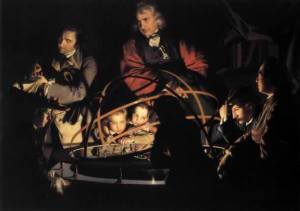
Joseph Wright, "A Philospher Lecturing on an Orrery," 1766, Derby Museums and Art Gallery (Image from Wikimedia Commons)
Abstract: In the 1760s Joseph Wright of Derby produced two important paintings — the Orrery, and the Air Pump — that show lectureres demonstrating the laws of science to a small audience of men, women, and children. While Wright’s paintings have been widely and variously discussed in terms of their representation of science, as images of the Industrial Revolution, their use of artificial light, and what they tell us about gender relations, they have hitherto not been specifically considered from the point of view of the eighteenth-century’s interest in the aesthetic category of the sublime. This article seeks to redress the balance through exploration of the paintings’ relationship to the sublime, particularly as it is represented in the writings of Edmund Burke and Immanuel
Kant, and to further consider Wright’s paintings as a commentary
on contemporary society’s fascination with art, science, and the
Enlightenment ideal of human perfectability.
In This Month’s ‘Apollo Magazine’
The eighteenth century in the September issue of Apollo Magazine:
 Michael Pick, “Remarkable and Curious” — The quantity and superb quality of 18th-century French furniture in English collections is testament to the British passion for their neighbours’ designs, yet the presence of these works is little known in the UK or abroad.
Selma Schwartz, “Objects of Desire” — Sèvres’ lesser-known output of veilleuses, exquisite 18th-century nightlights or perfume burners, reflect in miniature the contemporary fashions and collectors’ interests of the time, including the depiction of drunken men in the style of Teniers the Younger.
Sylvain Levy-Alban, “A Taste for History” — The interior designer Jacques Garcia, currently refurbishing the 17th- and 18th-century period rooms at the Louvre, shares his obsessive passion for collecting with Apollo.
Current Issue of ‘The Art Bulletin’
Eighteenth-century coverage in the current issue of The Art Bulletin 92 (September 2010):
Richard Taws, “Material Futures: Reproducing Revolution in P.-L. Debucourt’s Almanach National,” pp. 169-87.
Abstract: Philibert-Louis Debucourt’s 1790 Almanach national, intended to serve as a frame for a pasted calendar for the subsequent year, is a unique combination of allegory and everyday scene. Dominated by a bas-relief representing the National Assembly, the image presents responses to the French Revolution organized in terms of race, age, and social class and features a singular representation of a female newspaper vendor at work. Debucourt’s image effectively mobilizes print to conceptualize the reproduction of Revolution across temporal and national boundaries, providing a means of thinking about the relation between Revolutionary time and the materiality of the image.
Darius A. Spieth, “Giandomenico Tiepolo’s Il Mondo Nuovo: Peep Shows and the ‘Politics of Nostalgia’,” pp. 188-210.
Abstract: What was the historiography of Il mondo nuovo, a fresco painted in 1791 by Giandomenico Tiepolo? How did its title emerge? Giandomenico likely found the inspiration for his subject in popular entertainment on Venice’s Piazzetta. The houselike structure in the fresco’s middle ground—a peep show—had been labeled il mondo nuovo by the eighteenth-century playwright Carlo Goldoni. Yet the fresco was not named until after 1906. Art historian Pompeo Molmenti introduced the Goldoni-inspired title, his efforts seconded by Corrado Ricci, a powerful art administrator. Both were steeped in the “politics of nostalgia,” associated with the Italian Aesthetic movement.
Satish Padiyar, Review of Erika Naginski’s Sculpture and Enlightenment, pp. 256-58.
“. . . This ambitious book is the result of a productive interaction between the new cultural history, which has sought to rethink a history of cultural objects and practices beyond disciplinary confines, art histories of French sculpture and architecture, the history of philosophy, and the study of iconoclasm, or demonumentalizing acts of destruction. Over the last twenty years, the sculptural work of Augustin Pajou, Jean-Antoine Houdon, Clodion, Pierre Julien, and Jean Guillaume Moitte has received monographic and curatorial attention: it is thus no longer true to say that eighteenth-century French sculpture is a neglected field. But a careful reframing of key sculptural projects (either realized or planned) within the shift from a theological to a secular idea of immortality, leading to the radical minimalism of sculpture produced during the French Revolution, is long overdue — and very welcome. It begins to do for the eighteenth-century French public funerary monument what has already been achieved so impressively for the British . . .”
In This Month’s ‘Burlington Magazine’
From this month’s issue of The Burlington Magazine 152 (August 2010):

 Teresa Leonor M. Vale, “An Eighteenth-Century Roman Silver Altar Service in the Church of S. Roque, Lisbon,” pp. 528-35.
- Louise Rice, “Art History Reviewed: Francis Haskell’s Patrons and Painters: A Study in the Relations between Italian Art and Society in the Age of the Baroque (1963),” pp. 543-46
- Margaret Scott, review of The Borghese Collections and the Display of Art in the Age of the Grand Tour by R. Duits.
- John Brewer, review of The Arts of Industry in the Age of Enlightenment by C. Fox, pp. 554-55.
The July Issue of ‘The Burlington Magazine’
The Burlington Magazine 152 (July 2010); the issue concentrates on the eighteenth century with the following:
Articles
- Todd Longstaffe-Gowan, “Mignard, the Marquise and Martinique: A West Indian Setting for a Masterpiece of ‘Grand Epoque’ Portraiture,” pp. 448-51.
- Alden R. Gorden, “Sets and Pendants by J.-B.-M. Pierre and François Boucher in the Collections of Madame de Pompadour and the Marquis de Marigny,” pp. 452-60.
- Deborah Gage, “The Chatsworth Vases: A Gift from Louis XV in 1768 to Henry Léonard Jean-Baptise Bertin,” pp. 461-63.
- Wendy W. Erich, “Did Benjamin Franklin Invent Transferware?,” pp. 464-69.
- Rosalind Savill, “A New Catalogue of French Porcelain in the Royal Collection,” pp. 470-73.
Reviews
- Christoph Martin Vogtherr, Review of Jean-Baptiste Deshays, 1729-1765 by A. Bancel, pp. 479-80.
- Jonathan Scott, Review of Digging and Dealing in Eighteenth-Century Rome by I. Bignamini and C. Hornsby, p. 480.
- Christopher M. S. Johns, Review of The Borghese Collections and the Display of Art in the Age of the Grand Tour by C. Paul, pp. 480-81.
- Richard Rand, Review of Watteau to Degas: French Drawings from the Frits Lugt Collection by C. B. Bailey, S. Grace, and M. van Berge-Gerbaud, p. 482.
- Chris Miele, Review of The Judicious Eye: Architecture against the Other Arts by J. Rykwert, p. 482.
From the June Issue of ‘Art History’
Camilla Smith, “Between Fantasy and Angst: Assessing the Subject and Meaning of Henry Fuseli’s Late Pornographic Drawings, 1800-25,” Art History 33 (June 2010): 420-47.
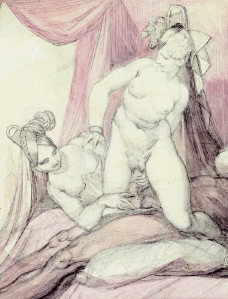 Abstract: This article examines four sexually violent drawing by Henry Fuseli, assessing how they functioned as personal fantasies and vehicles for institutional criticism It relates Fuseli’s images to the libertine fiction of Sade and London’s illicit underworld, arguing that the artist’s works can be located alongside growing libertine tendencies in a pan-European market. The exquisite dress, nudity, and physical power displayed by his protagonists, combined with pseudo-religious rituals of circumcision, reveal a complex relationship with institutional modes of control and regulation, developed during his ministerial training in Zurich. The restraints as a Royal Academician appear tantamount to the severity of Zurich’s seminary thirty years earlier, and both prove to be factors in shaping his illicit material. Fuseli’s pornographic drawings were not a public, rebellious descent into Sadean nihilism; rather, they exemplify a type of ‘revolt without revolt’ as remote, experimental products of a privileged individual only discovered after
his death in 1825.
Current Issue of ‘Eighteenth-Century Studies’
Selections from Eighteenth-Century Studies 43 (Summer 2010):
Stacey Sloboda, “Displaying Materials: Porcelain and Natural History in the Duchess of Portland’s Museum,” pp. 455-72.
Abstract: Porcelain in eighteenth-century aristocratic collections was associated with both the curious and the foreign. The Duchess of Portland’s Museum contained large amounts of porcelain along with thousands of natural history specimens. The material and geographic plurality of the collection mirrored its totalizing claims to have a comprehensive display of the world’s natural and artificial materials. This essay explores the relationship between porcelain and natural history, arguing that Portland’s collection attempted to bridge conceptual distinctions between science and art in the eighteenth century, and that this project was particularly important to making sense of eighteenth-century female collecting practices and their sociable display.
Dorothy Johnson, “Review Article — The Matter of Sculpture,” pp. 505-08.
- Erika Naginski, Sculpture and Enlightenment (Los Angeles: Getty Research Institute, 2009).
- Martina Droth and Penelope Curtis, eds., Taking Shape: Finding Sculpture in the Decorative Arts (Leeds and Los Angeles: Henry Moore Institute and the J. Paul Getty Museum, 2008-09).
- Anne Betty Weinshenker, A God or a Bench: Sculpture as a Problematic Art during the Ancien Régime (Bern: Peter Lang, 2008).
Clorinda Donato, “Review Article — Fresh Legacies: Giovanni Battista Piranesi’s Enduring Style and Grand Tour Appeal,” 508-11.
- Mario Vevilacqua, Fabio Barry, and Heather Hyde Minor, eds., The Serpent and the Stylus: Essays on G. B. Piranesi (Ann Arbor: University of Michigan Press, 2006).
- Andelka Galic and Vladimir Malekovic, eds. Piranesi: Vasi candelabri cippi sarcofagi tripodi lucerne ed ornamenti antichi, exhibition catalogue, translated into Italian by William Klinger (Zagreb: Museum of Arts and Crafts, 2007).
“A Collector’s Obsession”: Beckford at the Strawberry Hill Sale
On the 250th anniversary of William Beckford’s birth, Bet McLeod writes in the June 2010 issue of Apollo Magazine about the collector’s acquisitions at the 1842 sale of the contents of Strawberry Hill:

John Hoppner, "Portrait of William Beckford," ca. 1800 (City of Salford Art Gallery)
Horace Walpole (1717–97) and William Beckford (1760–1844), two of the most prominent and well-known collectors, builders and authors of the 18th and 19th centuries in Britain, are inextricably linked. Both had a passion for the past and an uncanny ability to recreate a highly imaginative version of that past. The comparisons between their renowned Gothic residences (Strawberry Hill and Fonthill Abbey) and novels (Castle of Otranto, 1764, and Vathek, 1786) have invited much debate, as have the parallels between their patterns of collecting, their acquisitions, and the arrangement of the collections in their residences. Much interest has also been paid to the on-site public auctions of both their collections, the production of the sale catalogues and the intense public interest that the auctions generated, manifested in the enormous number of visitors and extensive print coverage.
This year sees a celebration of both of these complex and contradictory individuals. It marks the 250th anniversary of Beckford’s birth, which will be commemorated by several publications and a special exhibition at Beckford’s Tower in Bath. It is also the year in which the first large-scale exhibition devoted to Horace Walpole and Strawberry Hill is on view in London at the Victoria and Albert Museum, having opened at the Yale Center for British Art, New Haven, in October 2009. Taking as its basis Beckford’s own words as selected from his correspondence, this article provides some insight into his reactions to and acquisitions of decorative works of art and sculpture at the 1842 sale of the contents of Strawberry Hill, which took place over 24 days. . . .
For the full article, click here»
Forthcoming in ‘Studies in Eighteenth-Century Culture’
A selection of articles of in the forthcoming issue of Studies in Eighteenth-Century Culture 40 (Spring 2011), edited by Lisa Forman Cody and Mark Ledbury:
- Shelley King, “Portrait of a Marriage: John and Amelia Opie and the Sister Arts”
- Mary Sheriff, “The King, the Trickster, and the Gorgon: On the Illusions of Rococo Art” (2009 Clifford Lecture)
- Josephine Touma, “From the Playhouse to the Page: Some Visual Sources for Watteau’s Theatrical Universe”
Pre-order yours through the Johns Hopkins University Press (800.748.1784).










 Enfilade
leave a comment