Book Launch in Honour of Peter Borsay
From Eventbrite:
Book Launch in Honour of Peter Borsay
Online and in-person, University of Leicester, 29 September 2023, 3pm
The Centre for Urban History at the University of Leicester will mark the publication of Peter Borsay’s last book, The Invention of the English Landscape c. 1700–1939, with a symposium in honour of the late professor, who passed away in 2020. Free and open to all, the event will take place on Friday, 29th September 2023, from 15.00 until 17.00, via Teams Live and in person in the Attenborough Film Theatre. Please contact hypirfinance@le.ac.uk with any questions.
The symposium will be chaired by Professor Rosemary Sweet with the following panel of speakers:
• Penelope J. Corfield (President of the International Society of Eighteenth-Century Studies)
• Richard Coopey (Emeritus Senior Lecturer, Department of History & Welsh History, Aberystwyth University)
• Katy Layton Jones (School of History, Open University)
• Keith Snell (Emeritus Professor of English Local History, University of Leicester)
Online Talks | Digital Art History
From the series webpage:
Narrowing the Divide: A Dialogue between Art History and Digital Art History
Artl@s Conversation Series in Digital Art History, Visual Contagions, 2023–24
Organized by Béatrice Joyeux-Prunel, Catherine Dossin, and Nicola Carboni
The the Artl@s Lectures are a series of conversations that Artl@s will organize throughout the 2023–2024 academic year on the theme of Narrowing the Divide: A Dialogue between Art History and Digital Art History.
The field of Digital Art History (DAH) is currently experiencing a notable shift towards establishing its autonomy as a distinct discipline. However, its survival is challenged by the limitations of its investigations. The lack of relationships between computational effort and traditional analysis often limits the generation of novel insight. Digital art history risks becoming a mere spectacle when it relies solely on stunning visualizations without engaging in rigorous research questions. Conversely, art history limits itself from harnessing robust methodologies by disregarding computational approaches.
The digital approach increasingly demands advanced technical skills, thereby often placing art historians in a position where they lack the means and expertise to engage with it. Yet, art historians possess a keen awareness of the pressing issues within the discipline and possess the knowledge of which corpuses are relevant for addressing them. They could potentially provide their questions and corpuses to experts in digital art history. Hence, it is crucial to establish more frequent and substantive opportunities for collaboration between these two approaches. The 2023–2024 Artl@s Conversation Series aims to cultivate a convergence between the field of digital art history and the discipline of art history. The exchange of ideas and results among digital art history specialists, art historians, and the audience will foster a deeper understanding of the possibilities and implications of computational methodologies in the study of art history.
Each event will facilitate a unique encounter between two experts engaged in overlapping subject areas but employing markedly different methodologies. Within this framework, art historians will put forth inquiries and collections to experts in digital approaches, while scholars in digital art history will present the outcomes of their methodologies, along with the aspects they would readily suggest for monographic or non-digital explorations. The aim is to foster collaborations and a heightened mutual understanding of the outcomes between the realms of art history and digital art history. These gatherings provide valuable opportunities for aspiring PhD students in digital humanities and art history to discover new subjects and gain insights into the notable progress being made in both disciplines.
Organizers: Béatrice Joyeux-Prunel (UNIGE), Catherine Dossin (Purdue University), and Nicola Carboni (UNIGE)
s e s s i o n s
AI for Art History, Art History of AI
Online, Friday, 8 September 2023, 14.15–15.45 (Paris and Geneva time) / 8.15–9.30am (EST)
• Leonardo Impett, University of Cambridge
• Pascal Griener, Université de Neuchatel
Click here to join us on Zoom || Read more about the speakers.
◊ ◊ ◊ ◊ ◊
Do We Need Digital Visual Studies?
Online, Friday, 29 September 2023, 14.15–15.45 (Paris and Geneva time) / 8.15–9.30am (EST)
• Béatrice Joyeux-Prunel, Université de Geneve
• Leora Auslander, University of Chicago
Click here to join us on Zoom || Read more about the speakers.
Lecture | Pascal Bertrand on Boucher and the Decorative Arts
From BGC:
Pascal Bertrand | Boucher and the Decorative Arts: Promoting and Maintaining His Fame
A Françoise and Georges Selz Lecture on Eighteenth- and Nineteenth-Century French Decorative Arts and Culture
Bard Graduate Center, New York, 20 September 2023, 6.00pm
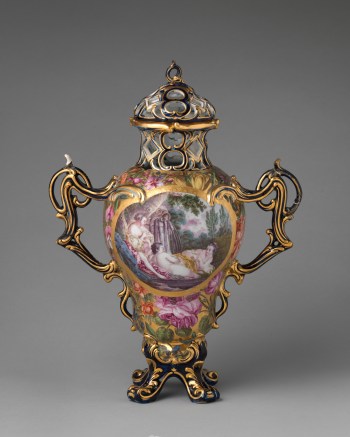
One of a pair of perfume vases, Chelsea Porcelain Manufactory (British, Gold Anchor Period, 1759–69), ca. 1761, soft-paste porcelain, burnished gold ground, 36 cm high (New York: The Metropolitan Museum of Art, 64.101.509a, b). The vase depicts three nymphs after the painting La Source by Francois Boucher.
In this lecture, Pascal Bertrand will explore the role of the decorative arts in the process of making and maintaining an artist’s fame, using the example of the quintessentially Rococo painter François Boucher. Boucher’s art was translated to a wide range of mediums—primarily tapestry and porcelain, but also gold and lacquer objects as well as printed fabrics and fans. How did he use these decorative arts to build his own reputation? And how did the decorative arts transmediate his paintings, prints, and drawings to disseminate them during his lifetime and preserve them after his death, right up to the present day? While the first question has been the subject of specific in-depth studies in one medium or another (porcelain in particular), Dr. Bertrand’s lecture considers the second question and the significance of intermediality.
Registration is available here»
Pascal Bertrand is Professor of Art History at the Université Bordeaux Montaigne in Pessac. His areas of research include the history of European tapestries, furniture, and the decorative arts generally.
Bard Graduate Center is grateful for the generous support of the Selz Foundation.
Lecture | Peter Burke on the Invention of Connoisseurship
From BGC:
Peter Burke | The Invention of Connoisseurship
Bard Graduate Center, New York, 6 September 2023, 6.00pm
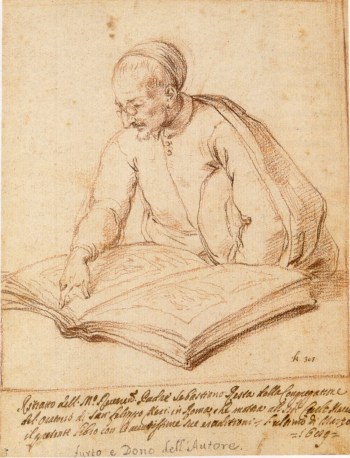
Carlo Maratti, Padre Sebastiano Resta Examining a Folio of Drawings (The Devonshire Collections). The drawing was included in the exhibition Lines of Beauty: Master Drawings from Chatsworth, on view in the fall of 2021 at The Lightbox in Woking, Surrey.
Connoisseurship—a bundle of practices combining a sense of the quality of works of art, the ability to attribute them to their makers, and to discriminate between originals, copies, and forgeries—is a contested term with a contested history. In this lecture, Peter Burke argues that the ‘invention’ of connoisseurship happened gradually rather than suddenly and took place in the West neither, as has sometimes been argued, in the nineteenth century, nor—perhaps surprisingly—in the Renaissance, but in the seventeenth century when treatises on the subject begin to appear.
Registration is available here»
Peter Burke is a cultural and social historian who was born in 1937, studied at Oxford (1957–62), and taught at the Universities of Sussex (1962–78) and Cambridge (1979–2004). He is a Life Fellow of Emmanuel College. His publications have focused in turn on historiography, the Renaissance, popular culture, and the history of knowledge, including the distinctive roles of exiles and polymaths. His latest book is a history of ignorance, and his next will be a history of connoisseurship.
Chris Schüler on the Wood that Built London
An evening lecture at the Society of Antiquaries:
Chris Schüler, The Wood That Built London
In-person and online, Society of Antiquaries of London, 12 October 2023, 5pm
Drawing on historic documents, maps and environmental evidence, The Wood That Built London charts the fortunes of the Great North Wood that once covered much of what is now South London [‘north’ relative to Croydon]. It records its botany, ecology, ownership and management, the gradual encroachment of the metropolis, and the battles fought by locals and the London Wildlife Trust to save what remained.
The lecture will discuss the documentary research into historic land ownership and management in the medieval and early modern periods that informed the book, which draws on a wide range of primary sources, some never previously cited. These include 16th-century Court of Exchequer depositions in a dispute over land ownership in the National Archives at Kew; Archbishop Morton’s 1492 survey of the Manor of Croydon and a 1678 plan of the Archbishop’s woods in Croydon Museum; Archbishop Cranmer’s 1552 survey of the Manor of Croydon in the Bodleian Library; estate maps in the British Library and London Metropolitan Archives; parish accounts; and records of woodland management in Dulwich College Archive and Lambeth Palace Library. Considered together, these scattered records combine to create a picture of the former extent of the wood, which stretched from Deptford to Croydon, its ownership by religious bodies such as Bermondsey Abbey and the Archbishopric of Canterbury, and its management by rotational coppicing, which generated income for its owners over several centuries. Tudor Acts of Parliament and the publications of 16th– and 17th-century agronomists such as Thomas Tusser and Barnaby Googe are examined to provide insight into the theory and practice of woodland management at this period.
The book also records how that income dwindled as the Industrial Revolution rendered many woodland products obsolete, leading landowners to grub up coppices, at first for farmland and then, as the railways brought the area within commuting distance of London, for housing development, to the fury of commentators such as John Ruskin and John Stuart Mill.
Presented both in-person at Burlington House and online, the event is free and open to the public. Please reserve tickets here.
Museum Tour | Art and Aroma at the Met: 18th-C. France

François Boucher, The Toilette of Venus, detail, 1751, oil on canvas
(New York: The Metropolitan Museum of Art)
◊ ◊ ◊ ◊ ◊
From Eventbrite:
Jessica Murphy, Art and Aroma at the Met: 18th-Century France
The Metropolitan Museum of Art, New York, Saturday, 9 September 2023, 2.00–3.30pm
Engage your senses of sight and smell in a gallery tour that explores the history of French perfumery at the Metropolitan Museum of Art.
Sophisticated … seductive … classic. The phrase ‘French perfume’ often evokes these ideas. But how did France become known as the center of Western perfumery? This genre-blending gallery tour will illustrate France’s fragrant history in the 1700s through works of art and design in the Metropolitan Museum of Art, spotlighting some of the events and individuals behind perfume’s ascendance as one of France’s signature luxury goods. Experiencing these spaces and objects as a small group, we’ll sample and sniff aromatic materials while we simultaneously educate our eyes and noses. A ticket for this 90-minute gallery tour ($45) includes access to the rest of the Met after the event. Please arrive 30 minutes early to allow time for security checkpoints and weekend crowds.
Jessica Murphy is a museum professional with a passion for perfume. She holds a PhD in art history and has worked at the Philadelphia Museum of Art, the Metropolitan Museum of Art, and the Brooklyn Museum. Meanwhile, she has also been writing about fragrance since 2007 at Now Smell This and her own blog Perfume Professor. Since 2015 she has taught and lectured about the history and culture of fragrance through venues including the Brooklyn Brainery, the Institute for Art and Olfaction, the New Jersey Council for the Humanities, the Timken Museum, and the Fashion Institute of Technology. You can follow her on Instagram @tinselcreation.
Lecture | Alessia Attanasio on Neapolitan Art in English Collections
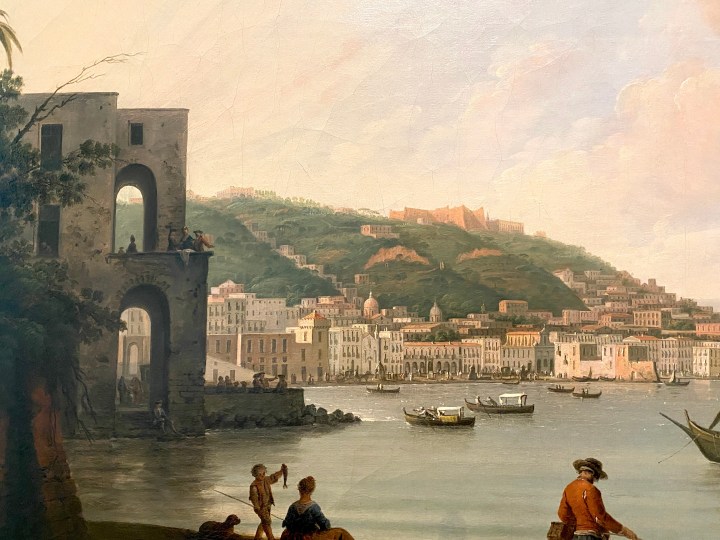
Pietro Fabris, The Bay of Naples from Posillipo, detail, ca. 1770, oil on canvas, 75 × 128 cm
(Compton Verney, Warwickshire)
◊ ◊ ◊ ◊ ◊
From The Wallace Collection:
Alessia Attanasio, The Fortunes of Baroque Neapolitan Art in English Collections during the Grand Tour, 1680–1800
Wallace Collection Seminars on the History of Collections and Collecting
Online and in-person, The Wallace Collection, London, Monday, 26 June 2023, 5.30pm
This talk aims to provide an overview of the history of collecting Baroque Neapolitan art in England from 1680s to 1800s, a period when many English artists and collectors travelled to Naples during the Grand Tour. Based on Alessia Attanasio’s PhD research, it will introduce artists from the Kingdom of Naples who enjoyed considerable success among English patrons, demonstrating how the Grand Tour influenced the market for Baroque Neapolitan art—not just for the newly discovered antiquities in Pompeii, Herculaneum, and Stabiae.
Today, Baroque Neapolitan paintings form a significant part of private and public English art collections; yet there is no publication exploring the significance of these collections as a whole. Therefore, the lecture aims to fill this gap by identifying and locating Neapolitan art in public and private English collections, now disclosed in an up-to-date database. The database will include images, references, notes on subject, author, and context, as well as acquisition and provenance details, providing the first comprehensive view of Neapolitan paintings in England. Alessia will focus on specific private British collections held in country houses such as Compton Verney, with the new redisplay of its unique Neapolitan collection, and Holkham Hall, which owns several Neapolitan paintings, both of which reflect the changes in art collecting in England. The lecture will bring together different fields of study, from the history of art to the art market, and shed new light on the material conditions that made art collecting possible.
Alessia Attanasio is a PhD candidate at the University of Birmingham, focusing on Baroque Neapolitan art that was collected in England during the Grand Tour (1680s–1820s), with particular interests in country houses, history of collecting, and museum studies. Alessia’s interest in museums is supported by eight years of experience working in museums as an assistant curator and museum educator, including Capodimonte Museum in Naples, and the Royal Collection Trust in London. Most recently, Alessia has been undertaking research into Baroque artworks in the Neapolitan Collection of Compton Verney, contributing to the curation of its permanent redisplay, Sensing Naples.
New Book | Media and the Mind
To mark the book’s launch, Matthew Eddy will give a 45-minute talk this Friday (16 June, 5pm) at the University of Edinburgh Main Library to mark the book’s launch; there will also be on view a small exhibition of student manuscripts that Eddy used in writing the book. From The University of Chicago Press:
Matthew Daniel Eddy, Media and the Mind: Art, Science, and Notebooks as Paper Machines, 1700–1830 (Chicago: The University of Chicago Press, 2023), 512 pages, ISBN: 978-0226183862, $65.
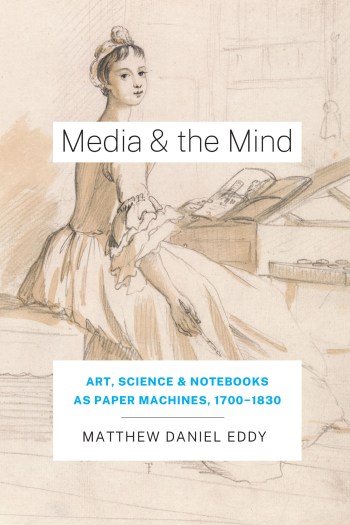 A beautifully illustrated argument that reveals notebooks as extraordinary paper machines that transformed knowledge on the page and in the mind.
Information is often characterized as facts that float effortlessly across time and space. But before the nineteenth century, information was seen as a process that included a set of skills enacted through media on a daily basis. How, why, and where were these mediated facts and skills learned? Concentrating on manuscripts created by students in Scotland between 1700 and 1830, Matthew Daniel Eddy argues that notebooks functioned as workshops where notekeepers learned to judge the accuracy, utility, and morality of the data they encountered. He shows that, in an age preoccupied with ‘enlightened’ values, the skills and materials required to make and use notebooks were not simply aids to reason—they were part of reason itself.
Covering a rich selection of material and visual media ranging from hand-stitched bindings to watercolor paintings, the book problematizes John Locke’s comparison of the mind to a blank piece of paper, the tabula rasa. Although one of the most recognizable metaphors of the British Enlightenment, scholars seldom consider why it was so successful for those who used it. Eddy makes a case for using the material culture of early modern manuscripts to expand the meaning of the metaphor in a way that offers a clearer understanding of the direct relationship that existed between thinking and notekeeping. Starting in the home, moving to schools, and then ending with universities, the book explores this argument by reconstructing the relationship between media and the mind from the bottom up.
Matthew Daniel Eddy is professor and chair in the history and philosophy of science at Durham University. He is the author and editor of numerous works on the cultural history of Britain and its former empire.
C O N T E N T S
Bibliographic Note
Prologue
Introduction
1 Recrafting Notebooks
The Tabula Rasa and Media Interface
Notebooks as Artifacts
Notekeeping as Artificing
Notekeepers as Artificers
Thought as a Realtime Activity
Science as a System
Book Outline
Part I | Inside the Tabula Rasa
2 Writing
Writing as a Knowledge-Creating Tool
The Place of Writing within Literacy
Script and Observational Learning
Grids and Verbal Pictures
Copies and the Exercise of Memory
3 Codexing
Paper Machines as Material Artifacts
Paper as an Informatic Medium
Quires and Knowledge Management
Books and Customized Packaging
4 Annotating
Revisibilia Made through Annotation
Marginalia as Scribal Interface
Paratexts and Editorial Training
Ciphers and the Acquisition of Numeracy
Part II | Around the Tabula Rasa
5 Categorizing
Headings as Realtime Categories
Headings as Mnemonic Labels
Headings as Visual Cues
Headings as Coordinates for Scanpaths and Sightlines
6 Drawing
Description and Movement across a Page
Learning to Draw a Picture
Figures as Developmental Tools
Scenes as Observational Training
Observation and the Utility of Perception
7 Mapping
Mapkeepers and Knowledge Systems on Paper
Map-Mindedness and Embodied Experience
Desk Maps as Crafted Constructions
Field-Mindedness in the Classroom
Field Maps and Visualized Data
Maps as Mnemonic Devices
Part III | Beyond the Tabula Rasa
8 Systemizing
The Syllabus as a System and a Machine
Lecture Notebooks and Knowledge Formation
The Syllabus and Its Organizational Technologies
Scroll Books and the Strategies of Realtime Learning
Transcripts and the Extension of Memory
Lines and the Media of the Mind
9 Diagramming
Paths and Diagrammatic Knowledge
Schemata as Useful Mnemonic Aids
Shapes as Repurposed Perceptual Devices
Pictograms and Visual Judgment
Tables as Kinesthetic Diagrams
Traces and Realtime Observation
10 Circulating
Local and Global Networks
Personal and Institutional Libraries
Commodities within Knowledge Economies
Courts of Law and Public Opinion
Conclusion
11 Rethinking Manuscripts
The Tabula Rasa and Manuscripts
Manuscripts as Dynamic Artifacts
Manuscript Skills as Artifice
Manuscript Keepers as Artificers
Acknowledgments
Bibliography
Abbreviations
Primary Sources
Manuscripts and Ephemera
Printed Primary Sources
Secondary Sources
Index
Exhibition | A Very Strong Likeness of Her: Portraiture and Identity
Opening this month at the Milwaukee Art Museum:
A Very Strong Likeness of Her: Portraiture and Identity in the British Colonial World
Milwaukee Art Museum, 23 June — 22 October 2023

Francis Cotes, Portrait of Miss Frances Lee, 1769, oil on canvas. 36 × 28 inches (Milwaukee Art Museum: Gift of Mr. and Mrs. William D. Vogel, M1964.5; photo by Larry Sanders).
Focusing on a singular work from the Museum’s collection, A Very Strong Likeness of Her explores the challenging and sometimes conflicting histories that an artwork can represent. On its surface, the English artist Francis Cotes’s (1726–1770) portrait of Miss Frances Lee is a charming image of a young girl and her napkin-turned-rabbit companion. The exhibition’s close study of the painting, however, reveals a complex story of identity, family dynamics, and British colonialism in Jamaica. A Very Strong Likeness of Her employs a range of materials to bring to life the underlying narratives in this deceptively simple painting.
Lecture by Mia L. Bagneris
Thursday, 27 July, 6.15pm
Learn about race and class status in colonial Jamaica through the story behind the portrait of Miss Frances Lee. Mia L. Bagneris, associate professor of art history and Africana studies and director of the Africana Studies Program at Tulane University, details this complex history.
Gallery Talk with Tanya Paul
Thursday, 10 August, noon–1pm
Tanya Paul is the Museum’s Isabel and Alfred Bader Curator of European Art.
Exhibition | Visions in Porcelain: A Rake’s Progress
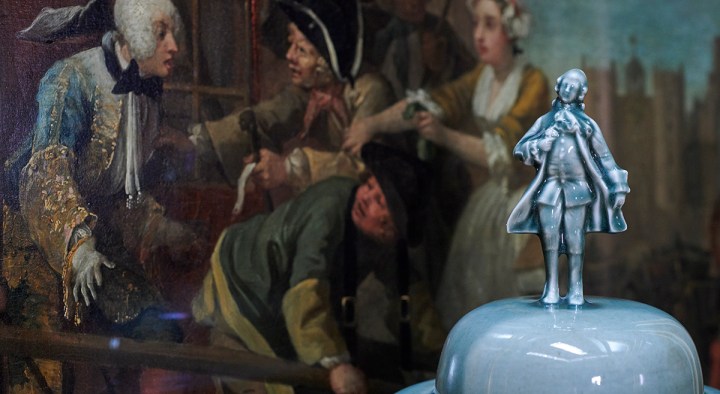
Opening this week at the Soane Museum:
Visions in Porcelain: A Rake’s Progress
Sir John Soane’s Museum, London, 7 June — 10 September 2023
Bouke de Vries’ latest work—beautifully displayed in the Museum’s Foyle Space— responds to William Hogarth’s A Rake’s Progress.
Inspired by Hogarth’s series of original paintings at the Soane Museum, de Vries draws on his love of storytelling, and talent for symbolism through ceramics, with eight newly created porcelain vases presented in various states of (dis)repair. Starting with an immaculate celadon vase, de Vries treats the following seven increasingly deteriorating vases with a variety of restoration processes and glazes, which parallel the moral and physical degeneration of Hogarth’s anti-hero Tom Rakewell. Cracks appear in the surface, the vessels slump and implode—with obvious and drastic methods of repair failing to save the vase or Rake from their ultimate demise.
Originally working in fashion before retraining as a restorer, Bouke de Vries began creating his works of art in 2008. He has since gained a significant following and now has work in an impressive range of international public collections, including the National Museum of Scotland; the National Museum of Art, Architecture, and Design in Oslo; and the Philadelphia Museum of Art. De Vries sees an inherent value in the discarded objects he reinvents, giving a new lease of life to a broad spectrum of ceramics otherwise destined to be thrown away.
Bouke de Vries in Conversation with Louisa Buck
13 June 2023, 7pm BST
To celebrate the opening of his new exhibition Visions in Porcelain: A Rake’s Progress, ceramic artist Bouke de Vries will discuss his latest work with Louisa Buck, a contributing editor and London contemporary art correspondent for The Art Newspaper and a regular reviewer and commentator on BBC radio and TV. The evening includes an exclusive out-of-hours viewing of the exhibition and the opportunity to view Hogarth’s paintings that inspired the series in the Picture Room.
Book tickets here»










 Enfilade
leave a comment