Online Talk | Ivan Day on Ice Cream Coolers
From the Connecticut Ceramics Circle (with the full 2023–24 lecture schedule available here). . .
Ivan Day | Frozen Treats: The Development of the Ice Cream Cooler
Online, Connecticut Ceramics Circle, Monday, 12 February 2024, 2pm (Eastern)

Worcester Ice Cream Cooler (Ice Pail), ca. 1770, ‘Jabberwocky’ design, soft-paste porcelain (Houston: Rienzi Collection, 84.584.1.A-.C). Images of the bucket, liner, and cover pulled apart are available at Day’s Instagram account here.
Ice creams and water ices evolved in Italy in the second half of the seventeenth century. Initially they were a high-status luxury confined to court entertainments. Serving ices at table was not easy, as they had to be kept in a frozen state. Eventually, attractive three-part tin-glazed earthenware vessels called seaux à glace started to appear in France in the 1720s. Only a few of these faïence examples have survived, the earliest from Rouen dating from 1700–25. Another from Moustiers made in the Clérissey manufactory dates from circa 1725.
In order to keep the contents frozen, ice mixed with salt needed to be placed in the lower pail and the lid, with the ice cream contained in a bowl between. However, earthenware was not an ideal material for this purpose. It is likely that salt eventually found its way through any crazing in the glaze and was absorbed by the porous clay body, resulting in the glaze flaking off. Soft-paste and later hard-paste porcelain proved to be a much more durable material for making these beautiful vessels. The Sèvres manufactory based their porcelain seaux on the earlier faïence shapes, but developed a range of new forms closely allied to their own wine cooler designs. At first other European factories based their designs on the Sèvres model. In this illustrated Zoom lecture, Ivan Day will not only outline the development of these wonderful vessels, but demonstrate how they were used with an example from his collection.
Ivan Day is an independent historian of the social history and culture of food. He is celebrated for his reconstructions of historical table settings, which combine museum objects with accurate re-creations of period dishes. His work has been exhibited in many major museums in the UK, Europe, and North America, including the Getty Research Institute, Detroit Institute of Arts, Gardiner Museum, and Minneapolis Institute of Arts. In 2007, he worked on a re-creation of an imperial table featuring a Meissen Parnassus by Johann Joachim Kändler for the BGC exhibition Fragile Diplomacy: Meissen Porcelain for European Courts, ca. 1710–63, curated by Maureen Cassidy-Geiger.
◊ ◊ ◊ ◊ ◊
As Day notes through his Instagram account,
“The lecture is a much revised version of one that I once delivered at a symposium at the Gardiner Museum in honour of the truly great porcelain scholar Meredith Chilton. Meredith is a close friend and colleague, but also a highly valued mentor. I have learnt so much from her. So my presentation is in honour of this wonderful woman.”
Exhibition | Is It Any Good?
Now on view at The Walpole Library with a talk from Dr Roman on February 4:
Is It Any Good? Prints, Drawings, and Paintings at the Lewis Walpole Library
The Lewis Walpole Library, Farmington, CT, 22 September 2023 — 28 June 2024
Curated by Cynthia Roman
 Art historians, curators, and connoisseurs often pose the question, ‘Is it any good?’ evoking a sense of quality manifest in canonical works of art. By contrast, when building a collection of 18th-century prints that would become a cornerstone for research at the Lewis Walpole Library, W.S. and Annie Burr Lewis envisioned a visual collection that is essentially archival. Prints were valued foremost as documents that would improve their library dedicated to the life and times of Horace Walpole and to 18th-century studies. The Lewises’ iconographic approach, however, does not preclude the importance of assessing what is good. Aesthetic, material, and technical attributes are integral to understanding the power of visual art and artifacts to communicate the eighteenth-century histories they document. Asking Is it any good? this exhibition presents a selection of prints, drawings, and paintings at the Lewis Walpole Library to explore the intersections of quality and documentary value.
◊ ◊ ◊ ◊ ◊
Cynthia Roman, Curating the Caricature Collection at the Lewis Walpole Library
Sunday, 4 February 2024, 2.00pm
Cynthia Roman, Curator of Prints, Drawings and Paintings at the Lewis Walpole Library will present the story of the library’s internationally recognized print collection. Often in W.S. Lewis’s own words, this talk will explore the commitment that he and Annie Burr Lewis shared to “make more use of political and personal caricatures” when building a research collection for 18th-century studies that included Annie Burr’s celebrated chronological and subject-based card catalog. Reflecting on more than twenty years of stewarding the print collection, Roman will present both the Lewises’ vision of caricature as archival documents and subsequent curatorial initiatives to acquire prints that more deliberately embrace material, technical, and aesthetic considerations; circumstances of production, marketing and circulation including prolific practices of copying; as well as the legacy of caricature today.
Cynthia E. Roman, PhD, is Curator of Prints, Drawings and Paintings at the Lewis Walpole Library, Yale University. Her research focuses on 18th-century British art, particularly prints. She has published essays on graphic satire, collecting history, and ‘amateur’ artists, and has edited and co-edited collected volumes including Horace Walpole’s Strawberry Hill Collection with Michael Snodin (2009–10), Hogarth’s Legacy (2016), Staging ‘The Mysterious Mother’ with Jill Campbell (2024), and Female Printmakers, Printsellers, and Print Publishers in the Eighteenth Century: The Imprint of Women, c. 1700–1830, with Cristina Martinez (2024).
Lecture | Pascale Ballesteros on Painters Historicizing 18th-C Fashion
This spring at BGC:
Pascale Gorguet Ballesteros, Eighteenth-Century Fashion and the Decisive Museological Action of French Historicizing Painters
A Françoise and Georges Selz Lecture on Eighteenth- and Nineteenth-Century French Decorative Arts and Culture
Bard Graduate Center, New York, 3 April 2024
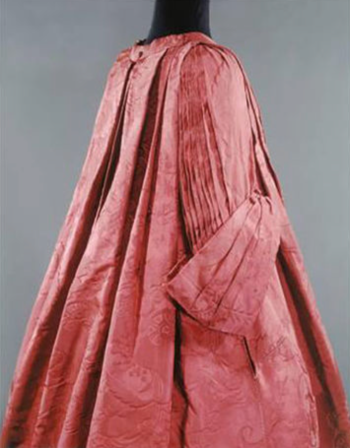
Dress detail from the collection of the Musée de la Mode de la Ville de Paris, formerly known as Musée Galliera.
On January 10, 1907, the Société de l’Histoire du Costume was founded in Paris to create a ‘Musée du Costume’. Sixteen of the founders were painters, and most of them were artists that historicized the eighteenth century. In this lecture, curator and scholar Pascale Gorguet Ballesteros considers the influence of artists such as Maurice Leloir (1853–1940), Gustave Jean Jacquet (1846–1909), and François Flameng (1856–1923) in the formation of the eighteenth-century fashion collection of the Palais Galliera and the construction of its image.
Responsible for the nineteenth-century collections at Palais Galliera, Musée de la Mode de la Ville de Paris, Pascale Gorguet Ballesteros has curated several exhibitions including Fastes de cours et cérémonies royales in 2009 at the castle of Versailles and L’art de paraître au 18e siècle at Nantes and Dijon Fine Arts Museums in 2021 and 2022. She teaches fashion history and fashion materials at Sorbonne Université. Her next exhibition will deal with women, travels, art, and fashion in the Enlightenment.
Registration is available here»
Online Talk | Julie Park, Lady Scott’s Landscape in a Dark Room

Paul Sandby, Roslin Castle, Midlothian, ca. 1780, gouache on medium laid paper, mounted on board, sheet: 46 × 68 cm
(New Haven: Yale Center for British Art, Paul Mellon Collection, B1975.4.1877)
◊ ◊ ◊ ◊ ◊
This afternoon from 12.30 to 1.00, from the Yale Center for British Art:
Julie Park | Lady Scott’s Landscape in a Dark Room
Online, Tuesday, 5 December 2023, 12.30pm
Julie Park will discuss the role of the camera obscura used by Lady Frances Scott as depicted in Paul Sandby’s landscape painting Roslin Castle, Midlothian (ca. 1780) and the dynamics of interiority and looking that it mediates. Park chose a detail from this painting for the cover of her recent monograph My Dark Room, which explores the camera obscura as a paradigm for the designs and experiences of interiority in eighteenth-century England’s spaces of the built environment. Please register here»
Julie Park is Paterno Family Librarian for Literature and professor of English at Pennsylvania State University. She is the author of My Dark Room (2023) and The Self and It (2009).
Exhibition | Pleasing Truths: Power and Portraits in the American Home
Closing this month at the DAR Museum, with a curatorial talk scheduled for the 12th.
Pleasing Truths: Power and Portraits in the American Home
Daughters of the American Revolution Museum, Washington, DC, 17 March — 31 December 2023
Curated by William Strollo

Unidentified French artist, Portrait of Elisabeth Has Haley, ca. 1810, oil on canvas, 32 × 38 inches (Washington, DC: DAR Museum, Gift of Sarah Hawkes Thornton, 75.189.2).
In 1754, artist Lawrence Kilburn advertised that “all Gentlemen and Ladies inclined to favour him in having their pictures drawn, that he don’t doubt of pleasing them in taking a true Likeness.” Kilburn’s advertisement, loaded with meaning, is one of many examples of advertisements placed by artists in the 18th and 19th centuries to garner portrait commissions. This ad reveals a lot about his, and other artists, potential clients, and their desires for being represented on canvas. In looking closer at portraits, subjects, artists, and the context in which they were produced, a deeper understanding of society is revealed—a society that valued power, personal leisure, and prescribed gender roles. This exhibition takes a deeper dive into the context and symbolism of early portraits to better understand the transmission of ideas and their impact on people over time.
William Strollo, Pleasing Truths: Power and Portraits in the American Home (Washington, DC: Daughters of the American Revolution Museum, 2023), 135 pages, $35.
◊ ◊ ◊ ◊ ◊
As noted at Events in the Field, the calendar maintained by The Decorative Arts Trust:
Curator’s Talk: William Strollo on Pleasing Truths
Online and in-person, DAR Museum, Washington, DC, 12 December 2023, noon
The exhibition Pleasing Truths: Power and Portraits in the American Home features over 50 portraits from the DAR Museum’s collection, dating from the 17th to the 19th centuries. In this talk, William Strollo, Curator of Exhibitions, will discuss the use of portraits to convey power and prestige and to reinforce traditional gender roles in the early American home. This free event will take place in-person and will also be streamed online; pre-registration is requested.
Lecture | Maxime Georges Métraux on Jean-Michel Papillon
As noted at the blog for the ApAhAu:
Maxime Georges Métraux | Jean-Michel Papillon: Artiste, encyclopédiste et historien de l’estampe
Online and in-person, École du Louvre, Paris, 6 December 2023, 10am
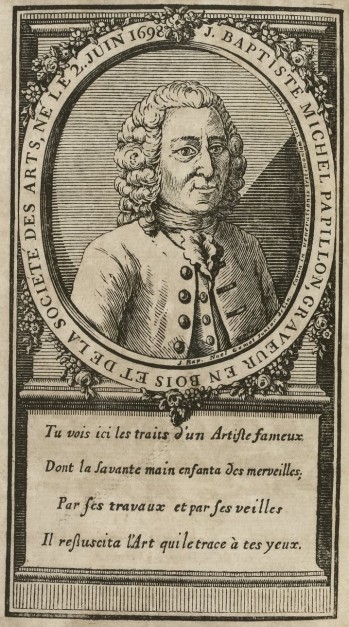 Issu d’une importante dynastie de graveurs, Jean-Michel Papillon (1698–1776) ambitionne de redonner du prestige à la gravure sur bois durant la première moitié du XVIIIe siècle. Outre sa foisonnante production graphique, cette entreprise se concrétise principalement par une volonté de transmettre les savoirs liés à son art. Il s’est notamment fait théoricien en rédigeant un imposant Traité historique et pratique de la gravure en bois. Bien qu’à manier aujourd’hui avec parcimonie, celui-ci n’en demeure pas moins une ressource extraordinaire et constitue une référence essentielle pour l’histoire de l’estampe et plus largement pour la culture visuelle du XVIIIe siècle.
Cette vaste somme de connaissances n’est pourtant pas sa seule contribution à l’histoire de l’art puisque Jean-Michel Papillon est aussi rédacteur de nombreuses entrées dans l’Encyclopédie de Diderot et d’Alembert. Il est non seulement l’auteur de plusieurs articles dédiés à la gravure mais il fournit également des ornements typographiques pour celle-ci.
Conscient de l’importance de l’accès au savoir et du rôle de l’écrit dans la transmission des techniques artistiques, Jean-Michel Papillon est une figure dont l’étude permet de saisir pleinement le phénomène de « réduction en art », concept théorisé par Hélène Vérin et Pascal Dubourg-Glatigny. Membre de la Société des Arts, le graveur s’est grandement intéressé aux monogrammes mais aussi à de nombreux domaines en lien avec la pratique de la gravure. Son riche témoignage sur sa formation d’historien autodidacte renseigne avec précision sur sa manière d’acquérir ses connaissances, de restituer son savoir et d’écrire sur son art en tant que praticien, dans un champ alors majoritairement dominé par les hommes de lettres.
Séminaire de recherche en partenariat entre l’École du Louvre, l’Université de Poitiers (Criham) et l’Université Rennes 2, adossé au projet « Amateurs et réseaux savants en France (1700–1914). Histoire intellectuelle, culturelle et sociale des amateurs et collectionneurs d’images gravées et enluminées » (UR Histoire et critique des Arts, Université Rennes 2). Les séances ont lieu simultanément à l’École du Louvre et en visio-conférence. Pour tout renseignement et inscription, merci d’écrire à pascale.cugy@univ-rennes2.fr.
Organisation
• Pascale Cugy (Université Rennes 2)
• Estelle Leutrat (Université de Poitiers, Criham)
• François-René Martin (École du Louvre)
Paul Mellon Centre Book Night

From the PMC:
Winter Book Night
Paul Mellon Centre, London, 13 December 2023, 5.30pm
Join us for our winter Book Night to celebrate our latest publications. Each author will give a short talk discussing the research behind their book, followed by the opportunity to ask questions. Afterwards, there will be drinks, canapes, and a chance to meet the authors.
Session 1
• Finola O’Kane, Landscape Design and Revolution in Ireland and the United States
• Mark Crinson, Shock City: Image and Architecture in Industrial Manchester
Session 2
• Tim Clayton, James Gillray: A Revolution in Satire
• Tom Young, Unmaking the East India Company: British Art and Political Reform in Colonial India, c. 1813–1858
• Kirsty Sinclair Dootson, The Rainbow’s Gravity: Colour, Materiality and British Modernity
◊ ◊ ◊ ◊ ◊
And Clayton’s book was recently named Book of the Year by Apollo.
FHS Annual General Meeting
From the FHS (membership information is available here) . . .
Furniture History Society, Annual General Meeting
The East India Club, St James’s Square, London, 25 November 2023
The FHS Annual General Meeting for the year ending 30 June 2023 will be held at the East India Club. The meeting will start at 11.00am, with coffee from 10.30am. Talks will follow the business of the day. Admission to the AGM is free for members, but all members wishing to attend should notify the Events Secretary at least seven days in advance. Tickets for a sandwich lunch with a glass of wine (£22 per head) should also be booked with the Events Secretary at least seven days in advance. We plan to record the talks for those who cannot attend in person.
t a l k s
• Louis Platman (Curator at the Museum of the Home) will talk about Real Rooms, a massive redevelopment project that will see the construction on many new period rooms and immersive displays at the Museum. He will also provide updates on the Cotton Collection of English Regional Chairs and the recently acquired Cotton Archive.
• Dr Tessa Kilgariff (English Heritage Curator of Collections and Interiors, South London). Marble Hill is a villa situated on the banks of the river Thames in Twickenham, London. Built in the 1720s, it was home to the courtier Henrietta Howard, Countess of Suffolk. In the spring of 2022, English Heritage re-opened Marble Hill following an extensive National Lottery Heritage funded project. This talk will explore that project, Marble Hill Revived, by detailing the restoration of the house and gardens and sharing discoveries made in the course of research in the villa’s interiors, collections, and occupants. With a particular focus on the conservation of some important pieces of furniture, we will explore the history of Henrietta Howard’s riverside home.
• Stacey Clapperton (Curator of Works of Art for the Palace of Westminster) and Lucy Odlin (Collections Conservation Manager for the Palace of Westminster) on the history of the design and use of the Speaker’s State Coach (ca. 1690s). Full details will be in the November issue of the Newsletter and also on the website later in the year.
• Dr Amy Frost (Senior Curator at Bath Preservation Trust) will reveal the work currently underway at Beckford’s Tower in Bath to conserve the building and refit the museum, including how William Beckford’s collection and furniture will be presented and interpreted when the museum reopens in March 2024.
Panel Discussion | Caricature Collectors in Conversation
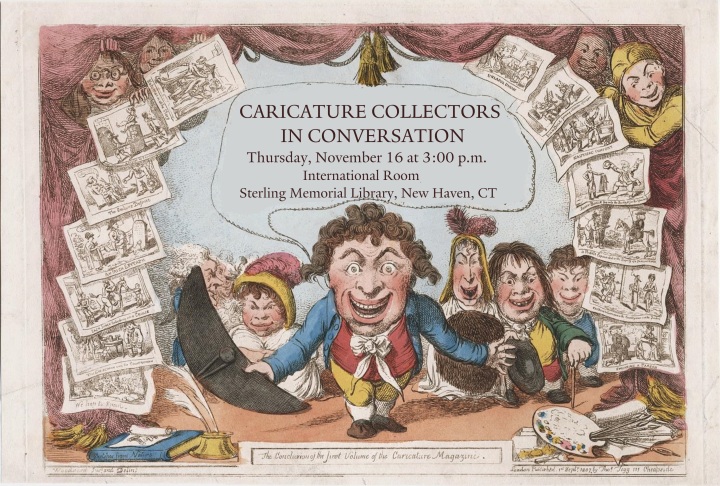
Modified version of Charles Williams, after George Moutard Woodward, The Conclusion of the First Volume of the Caricature Magazine, published by Thomas Tegg, 1807, hand-colored etching.
◊ ◊ ◊ ◊ ◊
Sponsored by The Lewis Walpole Library:
Panel Discussion | Caricature Collectors in Conversation
Sterling Memorial Library, New Haven, Thursday, 16 November 2023, 3pm
Please join us for a panel of distinguished private collectors and print curators for lively conversation about their interests, expertise, and adventures in building their collections of eighteenth- and early nineteenth-century British caricature and satiric prints. They will share stories of discovery and the pursuit of coveted acquisitions, and we will invite their thoughts on the role of appreciation, connoisseurship, and learning that grows along with the collection and the value that they find in engagement with fellow collectors and curators, and in research at library and museum print rooms. The program is free and open to the public.
Lecture | Iris Moon on Queen Mary’s Blue and White Ceramics
This Thursday at Yale’s History of Art Department:
Iris Moon | Blue Milk: Mary II, Porcelain, and the Queen’s Body at the Hampton Court Dairy
Yale University, 2 November 2023, 4pm
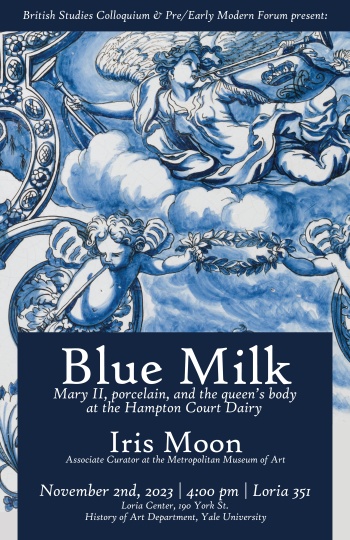 In this talk Iris Moon will explore the porcelain and delftware collection of Mary II (1662–1794) and how these artificial blue and white objects shaped the image of the queen and co-ruler of England with William III. After taking the throne in 1689, Mary II became actively involved in the extensive renovation of Hampton Court, the dilapidated Tudor residence. This included the creation of spaces designed for the queen’s pleasure, in particular the dairy in the Water Gallery, constructed out of the Tudor Watergate, a former royal retreat. Dairies in the early modern period, as the work of Meredith Martin has suggested, were not only gendered retreats of pleasure and privacy, but strategic sites of power. This presentation argues that these sites, premised upon an endless flow of milk and the promise of maternal fecundity and provisioning, also functioned as the architectural means through which female rulers worked through the anxieties of dynastic succession and the pressures to reproduce an heir. Bringing feminist theories of the body to bear upon the rare survivals from Mary II’s now destroyed dairy, such as a blue and white earthenware tile in The Metropolitan Museum of Art, Dr. Moon looks at how Mary’s extensive ceramics collection of Dutch earthenware and Asian export porcelain shaped her public persona after her sudden death in 1694. More than this, it created a surrogate, artificial body of blue and white that became mapped onto memories of the queen.
Iris Moon is an assistant curator in the European Sculpture and Decorative Arts Department at The Metropolitan Museum of Art, where she is responsible for European ceramics and glass. At The Met, she participated in the reinstallation of the British Galleries, and she is currently planning an exhibition on Chinoiserie, women, and the porcelain imaginary that will open in 2025.










leave a comment