New Book | Media and the Mind
To mark the book’s launch, Matthew Eddy will give a 45-minute talk this Friday (16 June, 5pm) at the University of Edinburgh Main Library to mark the book’s launch; there will also be on view a small exhibition of student manuscripts that Eddy used in writing the book. From The University of Chicago Press:
Matthew Daniel Eddy, Media and the Mind: Art, Science, and Notebooks as Paper Machines, 1700–1830 (Chicago: The University of Chicago Press, 2023), 512 pages, ISBN: 978-0226183862, $65.
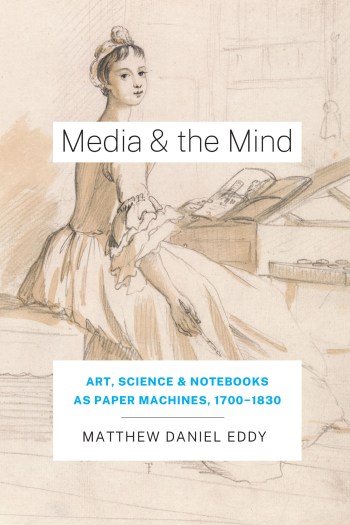 A beautifully illustrated argument that reveals notebooks as extraordinary paper machines that transformed knowledge on the page and in the mind.
Information is often characterized as facts that float effortlessly across time and space. But before the nineteenth century, information was seen as a process that included a set of skills enacted through media on a daily basis. How, why, and where were these mediated facts and skills learned? Concentrating on manuscripts created by students in Scotland between 1700 and 1830, Matthew Daniel Eddy argues that notebooks functioned as workshops where notekeepers learned to judge the accuracy, utility, and morality of the data they encountered. He shows that, in an age preoccupied with ‘enlightened’ values, the skills and materials required to make and use notebooks were not simply aids to reason—they were part of reason itself.
Covering a rich selection of material and visual media ranging from hand-stitched bindings to watercolor paintings, the book problematizes John Locke’s comparison of the mind to a blank piece of paper, the tabula rasa. Although one of the most recognizable metaphors of the British Enlightenment, scholars seldom consider why it was so successful for those who used it. Eddy makes a case for using the material culture of early modern manuscripts to expand the meaning of the metaphor in a way that offers a clearer understanding of the direct relationship that existed between thinking and notekeeping. Starting in the home, moving to schools, and then ending with universities, the book explores this argument by reconstructing the relationship between media and the mind from the bottom up.
Matthew Daniel Eddy is professor and chair in the history and philosophy of science at Durham University. He is the author and editor of numerous works on the cultural history of Britain and its former empire.
C O N T E N T S
Bibliographic Note
Prologue
Introduction
1 Recrafting Notebooks
The Tabula Rasa and Media Interface
Notebooks as Artifacts
Notekeeping as Artificing
Notekeepers as Artificers
Thought as a Realtime Activity
Science as a System
Book Outline
Part I | Inside the Tabula Rasa
2 Writing
Writing as a Knowledge-Creating Tool
The Place of Writing within Literacy
Script and Observational Learning
Grids and Verbal Pictures
Copies and the Exercise of Memory
3 Codexing
Paper Machines as Material Artifacts
Paper as an Informatic Medium
Quires and Knowledge Management
Books and Customized Packaging
4 Annotating
Revisibilia Made through Annotation
Marginalia as Scribal Interface
Paratexts and Editorial Training
Ciphers and the Acquisition of Numeracy
Part II | Around the Tabula Rasa
5 Categorizing
Headings as Realtime Categories
Headings as Mnemonic Labels
Headings as Visual Cues
Headings as Coordinates for Scanpaths and Sightlines
6 Drawing
Description and Movement across a Page
Learning to Draw a Picture
Figures as Developmental Tools
Scenes as Observational Training
Observation and the Utility of Perception
7 Mapping
Mapkeepers and Knowledge Systems on Paper
Map-Mindedness and Embodied Experience
Desk Maps as Crafted Constructions
Field-Mindedness in the Classroom
Field Maps and Visualized Data
Maps as Mnemonic Devices
Part III | Beyond the Tabula Rasa
8 Systemizing
The Syllabus as a System and a Machine
Lecture Notebooks and Knowledge Formation
The Syllabus and Its Organizational Technologies
Scroll Books and the Strategies of Realtime Learning
Transcripts and the Extension of Memory
Lines and the Media of the Mind
9 Diagramming
Paths and Diagrammatic Knowledge
Schemata as Useful Mnemonic Aids
Shapes as Repurposed Perceptual Devices
Pictograms and Visual Judgment
Tables as Kinesthetic Diagrams
Traces and Realtime Observation
10 Circulating
Local and Global Networks
Personal and Institutional Libraries
Commodities within Knowledge Economies
Courts of Law and Public Opinion
Conclusion
11 Rethinking Manuscripts
The Tabula Rasa and Manuscripts
Manuscripts as Dynamic Artifacts
Manuscript Skills as Artifice
Manuscript Keepers as Artificers
Acknowledgments
Bibliography
Abbreviations
Primary Sources
Manuscripts and Ephemera
Printed Primary Sources
Secondary Sources
Index
Exhibition | A Very Strong Likeness of Her: Portraiture and Identity
Opening this month at the Milwaukee Art Museum:
A Very Strong Likeness of Her: Portraiture and Identity in the British Colonial World
Milwaukee Art Museum, 23 June — 22 October 2023

Francis Cotes, Portrait of Miss Frances Lee, 1769, oil on canvas. 36 × 28 inches (Milwaukee Art Museum: Gift of Mr. and Mrs. William D. Vogel, M1964.5; photo by Larry Sanders).
Focusing on a singular work from the Museum’s collection, A Very Strong Likeness of Her explores the challenging and sometimes conflicting histories that an artwork can represent. On its surface, the English artist Francis Cotes’s (1726–1770) portrait of Miss Frances Lee is a charming image of a young girl and her napkin-turned-rabbit companion. The exhibition’s close study of the painting, however, reveals a complex story of identity, family dynamics, and British colonialism in Jamaica. A Very Strong Likeness of Her employs a range of materials to bring to life the underlying narratives in this deceptively simple painting.
Lecture by Mia L. Bagneris
Thursday, 27 July, 6.15pm
Learn about race and class status in colonial Jamaica through the story behind the portrait of Miss Frances Lee. Mia L. Bagneris, associate professor of art history and Africana studies and director of the Africana Studies Program at Tulane University, details this complex history.
Gallery Talk with Tanya Paul
Thursday, 10 August, noon–1pm
Tanya Paul is the Museum’s Isabel and Alfred Bader Curator of European Art.
Exhibition | Visions in Porcelain: A Rake’s Progress
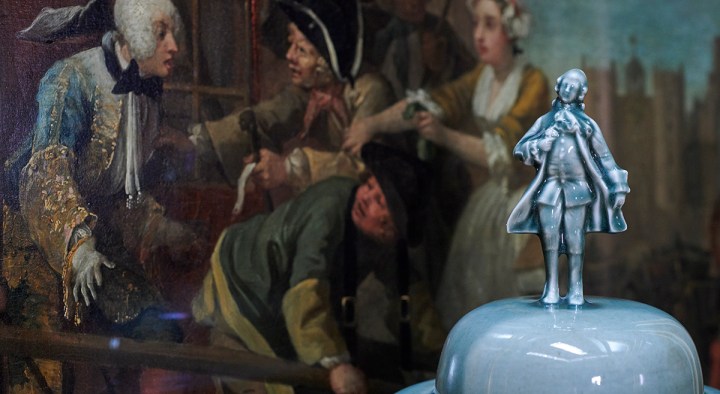
Opening this week at the Soane Museum:
Visions in Porcelain: A Rake’s Progress
Sir John Soane’s Museum, London, 7 June — 10 September 2023
Bouke de Vries’ latest work—beautifully displayed in the Museum’s Foyle Space— responds to William Hogarth’s A Rake’s Progress.
Inspired by Hogarth’s series of original paintings at the Soane Museum, de Vries draws on his love of storytelling, and talent for symbolism through ceramics, with eight newly created porcelain vases presented in various states of (dis)repair. Starting with an immaculate celadon vase, de Vries treats the following seven increasingly deteriorating vases with a variety of restoration processes and glazes, which parallel the moral and physical degeneration of Hogarth’s anti-hero Tom Rakewell. Cracks appear in the surface, the vessels slump and implode—with obvious and drastic methods of repair failing to save the vase or Rake from their ultimate demise.
Originally working in fashion before retraining as a restorer, Bouke de Vries began creating his works of art in 2008. He has since gained a significant following and now has work in an impressive range of international public collections, including the National Museum of Scotland; the National Museum of Art, Architecture, and Design in Oslo; and the Philadelphia Museum of Art. De Vries sees an inherent value in the discarded objects he reinvents, giving a new lease of life to a broad spectrum of ceramics otherwise destined to be thrown away.
Bouke de Vries in Conversation with Louisa Buck
13 June 2023, 7pm BST
To celebrate the opening of his new exhibition Visions in Porcelain: A Rake’s Progress, ceramic artist Bouke de Vries will discuss his latest work with Louisa Buck, a contributing editor and London contemporary art correspondent for The Art Newspaper and a regular reviewer and commentator on BBC radio and TV. The evening includes an exclusive out-of-hours viewing of the exhibition and the opportunity to view Hogarth’s paintings that inspired the series in the Picture Room.
Book tickets here»
Lecture Series | Peter Miller on Conservation as a Human Science
From the Warburg:
Peter Miller, On Conservation as a Human Science
E. H. Gombrich Lecture Series
In-person and online, Warburg Institute, London, 13, 14, 15 June 2023
‘Conservation’, ‘preservation’, ‘care’—these words are frequently used today, but by different people, speaking to different audiences. On Conservation as a Human Science makes the case for treating conservation as a single human activity with an intellectual history of its own. Then, focusing more particularly on the kind of conservation done to man-made things it explores the entwined relationship between conservation and history. Like archaeology, to which it bears a close resemblance, conservation explores the depth of time stratigraphically to answer questions about what was in the past from what survives into our present. But, turned around, history, too, can function as a form of conservation—indeed, this was an initial self-definition that persisted into the age of modern, academic history. The ambition of this project is to shift how we understand conservation for a twenty-first century in which climate change will make the task of conservation and the challenge to conservation a more urgent part of public and private life. Moreover, rethinking conservation as a human science also opens up a new perspective on the organization of knowledge at a time when inherited distinctions between disciplines and fields and ‘pure’ and ‘applied’ learning, like those between the ‘head’ and the ‘hand’, are being reconsidered.
Lecture 1 | Tuesday, 13 June, 5.30–7.00pm
In Search of Conservation’s History
Lecture 2 | Wednesday, 14 June, 5.30–7.00pm
Conservation as History
Lecture 3 | Thursday, 15 June, 5.30–7.00pm
History as Conservation
Free and open to all with advance booking, in person at the Warburg Institute, or online via Zoom.
Organised by the Warburg Institute and sponsored by Princeton University Press, the E. H. Gombrich Lecture Series features prominent humanities scholars who address pressing concerns in art, literature, and ideas, across historical periods.
Peter N. Miller is Dean and Professor of Cultural History at the Bard Graduate Center in New York City, and incoming President of the American Academy in Rome. He is the author of a series of books on the early seventeenth-century antiquarian, Nicolas Fabri de Peiresc, on the history of antiquarianism, and on the modern study of objects as evidence. He co-curated Dutch New York between East and West: The World of Margarieta van Varick (BGC, 2009); What Is the Object? (BGC, 2022); and Conserving Active Matter (BGC, 2022), the exhibition and website that concluded the ten-year long project he directed, “Cultures of Conservation,” funded by the Andrew W. Mellon Foundation. His main current interest is in the how and why of research, whether done by professional historians or by curators, conservators or artists. He has been at Bard since 2001. He previously taught at the University of Cambridge, University of Chicago, and University of Maryland, College Park. He was a research fellow at the Warburg Institute, the Wissenschaftskolleg zu Berlin, and visiting professor at the École des Hautes Études en Sciences Sociales in Marseille and École Normale Supérieure in Paris. He has been the recipient of fellowships from the National Endowment for the Humanities, the John Simon Guggenheim Foundation, and the John D. and Catherine T. MacArthur Foundation.
Online Talk | Kate Hunter on Three Maps
From the SHARP listserv and Eventbrite:
Kate Hunter | Unexpected Adventures Told in Three Maps: Western Australia, the Indian Ocean, and Captain James Cook’s First Voyage
Online, Thursday, 8 June 2023, 1pm (EDT)
Kate Hunter, Senior Specialist at Daniel Crouch Rare Books, in conversation with Arthur Dunkelman, Curator of the Jay Kislak Collection, University of Miami Libraries
The University of Miami Special Collections cordially invites you to a ‘Conversation on Cartography’. Kate Hunter will share stories about three maps. The first is a map of Western Australia, where she grew up. The second is a Dutch East India Company [VOC] 18th-century chart of the Indian Ocean on vellum that helped the company establish a trade route that netted a fortune. Last, Hunter will look at a silver punch bowl whose upside-down surface includes an engraved early rendering of Captain James Cook’s first voyage (1769–70).
Kate Hunter has helped private collectors and institutional libraries to acquire and catalog maps, globes, and atlases the world over. Currently, she is the senior specialist at the New York office of Daniel Crouch Rare Books. She is also consulting curator and cataloger for the Map and Atlas Museum of La Jolla, California. During her three-decade career, Hunter has witnessed great changes, from a landscape over-populated by independent bookshops, to one almost bereft of them. According to Hunter, much of today’s commerce takes place online, and that has transformed the way collectors collect—from compulsive completists focused with detailed wish-lists to trophy-hunting connoisseurs.
The program will be followed by an audience question and answer session. Free and open to the public, the event will be hosted via Zoom. It will also be streamed via Facebook Live. All events in this series will be recorded for on-demand access following the broadcasts.
Lecture | Michael Yonan on the Bavarian Rococo
This week in Chicago, at Northwestern:
Michael Yonan | The Bavarian Rococo, the Outlier of Eighteenth-Century Art
Block Museum of Art, Northwestern University, Evanston, Illinois, Wednesday, 17 May 2023, 5pm

Wieskirche, designed by the Zimmermann brothers, near Steingaden, Germany, 1745–55, view toward altar (Wikimedia Commons, 2019).
Bavarian rococo art and architecture has long received both attention and derision from art historians. It is incredibly sophisticated in design and seemingly totally out of sync with the broader narrative of European art: backward-looking, regionally influential, and exuberantly unrestrained in its abundant use of ornamentation. As part of the Warnock Lecture Series, this talk will explore what we can do with this visually arresting art and suggest that it deserves a firmer place in art history.
Michael Yonan is Professor of Art History and Alan Templeton Endowed Chair in the History of European Art, 1600–1830, at the University of California, Davis. His areas of research are eighteenth-century European art, the decorative arts, material culture studies, and art historical historiography and methodology. He is the author of Empress Maria Theresa and the Politics of Habsburg Imperial Art (2011), Messerschmidt’s Character Heads: Maddening Sculpture and the Writing of Art History (2018), and with Stacey Sloboda is co-editor of Eighteenth-Century Art Worlds: Global and Local Geographies of Art (2019). In 2022 he was visiting guest professor at the Institute for Culture and Aesthetics, Stockholm University, Sweden. He is currently writing a book on materiality in art history.
Lecture | Forgeries, Replicas, and Native American Art
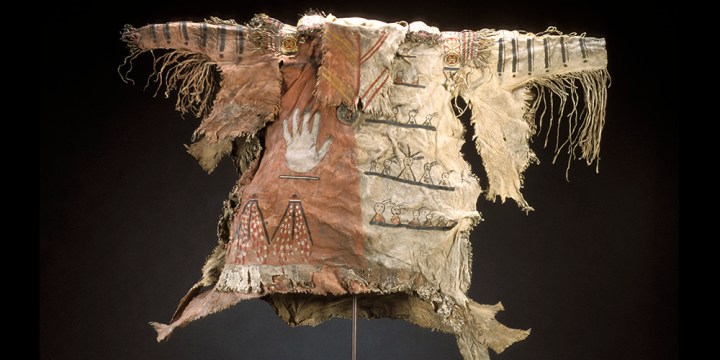
‘Mato-tope’s Shirt’, likely made by George Catlin (Washington, DC: National Museum of Natural History, Smithsonian Institution, NMNHanthropology 8420507). More information is available here»
◊ ◊ ◊ ◊ ◊
From the Bard Graduate Center:
Janet Catherine Berlo | Not Native American Art? Forgeries, Replicas and Other Vexed Identities
Bard Graduate Center, New York, 3 May 2023, 6.00pm
In Native North American artistic traditions, what is a replica? What constitutes a copy? In contrast with the larger field of art history, there is almost no literature on forgeries and replicas in this sub-field. Join us for Janet Catherine Berlo’s lecture, adapted from the introduction to her forthcoming book, Not Native American Art, where she considers notions of replicas, copies, tributes, forgeries, pastiches, and even digital surrogates as they apply to archaeological, historical, and contemporary Native arts of North America.
Register here»
Janet Catherine Berlo, professor of art history and visual and cultural studies emerita at the University of Rochester, holds a PhD in the history of art from Yale University. She is the author of many publications on the Indigenous arts of the Americas, including the most widely-used textbook in the field, Native North American Art, with Ruth B. Phillips (Oxford, second edition 2015). Berlo has also written on American art history and quilt history. Her forthcoming book, Not Native American Art: Fakes, Replicas, and Invented Traditions will be published by the University of Washington Press in July 2023.
Research Lunch | Fionn Montell-Boyd on 18th-C Photography

David Allan, Lead Processing at Leadhills: Pounding the Ore, detail, 1780s, oil on canvas, 38 × 58 cm
(Edinburgh: National Galleries Scotland)
◊ ◊ ◊ ◊ ◊
From the Mellon Centre:
Fionn Montell-Boyd | Manufacturing Pictures: Photographic Experimentation at the End of the Eighteenth Century
Paul Mellon Centre for Studies in British Art, London, 5 May 2023, 1pm
In the decades before photography was announced to the public in 1839, a number of individual experimenters devised ways of using the light-sensitive properties of metallic salts to form images. This paper takes up two sets of investigations of particular significance, carried out between 1780 and 1802: those of Elizabeth Fulhame, an amateur chemist working in Edinburgh, who used metallic reductions to adorn textiles, and of Thomas Wedgwood, son of the famous Staffordshire potter Josiah, who developed a process by which images of objects of varying transparency could be formed on samples of prepared paper and leather.
Fulhame used photochemistry to transform pieces of silk, linen and calico into lustrous novelties, with elite consumption in mind. Creating maps of cities and waterways in silver and gold, her vision of commercial utility aligned with contemporary developments in the Forth valley, including the modernisation of the cloth trade and the introduction of a network of canals, described by Adam Smith in The Wealth of Nations as “the greatest of all improvements.” Wedgwood’s experiments, too, were enmeshed in an industrial landscape: new methods of chemical image transfer were on the rise in the potteries, a setting in which the division of labour had grown apace, stimulated by new mass markets and long-distance trade. Working in different parts of Britain, Fulhame and Wedgwood appear not to have been in contact, yet they moved in overlapping circles of industrialists and reformers who sought to define chemistry as an enterprise of public benefit.
Examining the ways in which these experiments were tied into industrial networks by way of both the materials from which they were made and their pictorial function, this paper traces early photography’s response to the demands of the manufacturing economy. Fulhame and Wedgwood’s published accounts both came to be cited by later experimenters in 1839, yet their roles have been minimised within a history of photography centred on figures for whom there are large bodies of extant photographs. This rereading of Fulhame and Wedgwood’s experiments seeks to open up the discussion over photography’s origins, providing an expanded frame through which to consider the medium’s relationship to modern industry.
Book tickets here»
Fionn Montell-Boyd is a doctoral candidate in history of art at the University of Oxford, whose thesis examines the political economy of the emergence of photography in Britain between 1780 and 1841, with a focus on the role of silver as the commodity which formed photography’s light-sensitive basis. Her research foregrounds the materials of photography and the labour behind their production; themes she has developed through teaching and exhibition making. Prior to her doctoral studies, she obtained degrees from the University of Oxford and University College London and worked as a curatorial researcher for the Ashmolean Museum.
Online Conversation | Paris Spies-Gans, A Revolution on Canvas
From the invitation:
Paris Spies-Gans and Martina Droth in Conversation | A Revolution on Canvas: The Rise of Women Artists in Britain and France, 1760–1830
Online, 3 May 2023, 12.00pm (Eastern Daylight Time)

Maria Cosway, The Duchess of Devonshire as Cynthia from Spenser’s ‘Faerie Queene’, 1781–82 oil on canvas (Chatsworth: The Devonshire Collection).
Please join the MA State Committee of the National Museum of Women in the Arts (MA-NMWA) and our sister committees in the UK and France for an exciting virtual event on Wednesday, 3 May 2023. Paris Spies-Gans and Martina Droth will discuss Spies-Gans’ important first book, A Revolution on Canvas: The Rise of Women Artists in Britain and France, 1760–1830.
Just as the National Museum of Women in the Arts founder Wilhelmina Cole Holladay sought to challenge the assumption that there have been ‘no great women artists’ by collecting and publicly exhibiting many indisputably ‘great’ works of artist women, so too has Paris Spies-Gans investigated the same assumption, through evidence-based analysis. Her body of work includes site and time-specific research that reveals how women have found ways to achieve critical and commercial success despite the obstacles they have faced. Both women—Wilhelmina, the collector, and Paris, the scholar—intend their work not as end-points but as part of ongoing discussion and learning. Tracing the activity of more than 1,300 women who exhibited more than 7,000 works of art across genres at premier exhibition venues in London and Paris throughout the Revolutionary era, the book demonstrates that women artists professionalized in significant numbers a century earlier than scholars have previously thought.
Paris Spies-Gans’s scholarship and resultant discoveries complement the mission of the National Museum of Women in the Arts and its committees, three of which are presenting this event. Martina Droth, as interlocutor, will use her expertise to contextualize the material in A Revolution on Canvas: The Rise of Women Artists in Britain and France, 1760–1830. We hope you can join us for what promises to be a fascinating discussion. Although this event is free of charge, advance registration is required; details about the event will then be sent to registered attendees. International guests are invited to use this email to register: contact@ma-nmwa.org.
Paris Spies-Gans is a historian and historian of art with a focus on women, gender, and the politics of artistic expression. She holds a PhD and MA in History from Princeton University, an MA in Art History from the Courtauld Institute of Art, and an AB in History and Literature from Harvard University. Her work prioritizes women artists and their writings, paintings, drawings, sculptures, prints, illuminating how women have navigated sociopolitical barriers to participate in their societies through diverse forms of intellectual and creative expression, even with the obstacles they regularly faced—and especially at moments of political revolution and change. Her first book, A Revolution on Canvas: The Rise of Women Artists in Britain and France, 1760–1830, was published by the Paul Mellon Centre for Studies in British Art in Association with Yale University Press in June 2022. It was named one of the top art books of 2022 by The Art Newspaper and The Conversation and received the American Society for Eighteenth-Century Studies’ Louis A. Gottschalk Prize, Honorable Mention, for an outstanding historical or critical study on the eighteenth century. She is currently working on her second book, A New Story of Art (Doubleday/US and Viking/UK).
Martina Droth is Deputy Director and Chief Curator of the Yale Center for British Art, where she oversees collections, exhibitions, and publications. Her curatorial work and research focus on sculpture and British art. She was the Chair of the Association of Research Institutes in Art History from 2016 to 2022. Current and recent curatorial projects include: Bill Brandt | Henry Moore (Hepworth, Sainsbury Center, and YCBA, 2020–23); Things of Beauty Growing: British Studio Pottery (YCBA and Fitzwilliam Museum, 2017–18); and Sculpture Victorious: Art in an Age of Invention, 1837–1901 (YCBA and Tate Britain, 2014–15). Prior to joining the Center, she was at the Henry Moore Institute in Leeds, where her exhibitions included Taking Shape: Finding Sculpture in the Decorative Arts (HMI and John Paul Getty Museum, 2008–2009) and Bronze: The Power of Life and Death (HMI, 2005). Her forthcoming projects include an exhibition on Hew Locke.
New Book | Beauty and the Brain
On Thursday, 4 May 2023, at 7pm (EST), Rachel Walker will discuss her book at the American Antiquarian Society in Worcester, Massachusetts. The event will be live-streamed via YouTube. Registration is required for both in-person and online attendance.
From The University of Chicago Press:
Rachel Walker, Beauty and the Brain: The Science of Human Nature in Early America (Chicago: The University of Chicago Press, 2022), 288 pages, ISBN: 978-0226822563, $45.
 Examining the history of phrenology and physiognomy, Beauty and the Brain proposes a bold new way of understanding the connection between science, politics, and popular culture in early America.
Between the 1770s and the 1860s, people all across the globe relied on physiognomy and phrenology to evaluate human worth. These once-popular but now discredited disciplines were based on a deceptively simple premise: that facial features or skull shape could reveal a person’s intelligence, character, and personality. In the United States, these were culturally ubiquitous sciences that both elite thinkers and ordinary people used to understand human nature. While the modern world dismisses phrenology and physiognomy as silly and debunked disciplines, Beauty and the Brain shows why they must be taken seriously: they were the intellectual tools that a diverse group of Americans used to debate questions of race, gender, and social justice. While prominent intellectuals and political thinkers invoked these sciences to justify hierarchy, marginalized people and progressive activists deployed them for their own political aims, creatively interpreting human minds and bodies as they fought for racial justice and gender equality. Ultimately, though, physiognomy and phrenology were as dangerous as they were popular. In addition to validating the idea that external beauty was a sign of internal worth, these disciplines often appealed to the very people who were damaged by their prejudicial doctrines. In taking physiognomy and phrenology seriously, Beauty and the Brain recovers a vibrant—if largely forgotten—cultural and intellectual universe, showing how popular sciences shaped some of the greatest political debates of the American past.
Rachel E. Walker is an Assistant Professor at the University of Hartford, where she teaches courses on the history of race, gender, and science in America. Her recent article “Facing Race,” received the Murrin Prize for the best article published in Early American Studies in 2021.
C O N T E N T S
Introduction
1 Founding Faces
2 A New Science of Man
3 Character Detectives
4 The Manly Brow Movement
5 Criminal Minds
6 Facing Race
Conclusion
Acknowledgments
Notes
Bibliography
Index










 Enfilade
leave a comment