Lecture Series | 2023 Wallace Seminars on Collections and Collecting
This year’s Wallace Seminar Series on Collections and Collecting:
2023 Wallace Collection Seminars on the History of Collections and Collecting
Online and/or In-Person (depending upon session), The Wallace Collection, London, last Monday of most months
Established in 2006, the Seminars in the History of Collecting series helps fulfil The Wallace Collection’s commitment to the research and study of the history of collections and collecting, especially in the 18th and 19th centuries in Paris and London. Seminars are normally held on the last Monday of every month, excluding August and December. They act as a forum for the presentation and discussion of new research into the history of collecting, and are open to curators, academics, historians, archivists and all those with an interest in the subject. Each seminar is 45–60 minutes long, with time for Q&A.
Book your place via the Wallace Collection website. Bookings will open a few weeks before each seminar. A detailed summary of each forthcoming seminar will be provided around the same time. The 2023 Seminars in the History of Collecting will be on Zoom and livestreamed via YouTube for the months of January to April. We hope to be able to hold our seminars in hybrid format from the month of May, in person at the Wallace Collection and live on YouTube. For enquiries or to join our mailing list, please contact collection@wallacecollection.org.
Monday, 30 January
Simon Spier (Curator, Ceramics and Glass 1600–1800, Victoria & Albert Museum, London), Creating the Bowes Museum: Collectors, Dealers, and Auctions in Mid-19th-Century Paris
Monday, 27 February
Caroline Dakers (Professor Emerita in Cultural History, University of Arts London), Millionaire Shopping: The Collections of Alfred Morrison (1821–1897)
Monday, 27 March
Thomas Cooper (PhD candidate, University of Cambridge), Reconstructing the Art Collection of May Morris (1862–1938)
Monday, 17 April
Diana Davis (Independent researcher), ‘Fertile in Resources and in Ingenious Devices’: Ferdinand de Rothschild and His Dealers Revealed through the Archive
More information available here»
Monday, 22 May
Jonathan Conlin (University of Southampton), Knickerbocker Glory? Alphonso Trumpbour Clearwater (1848–1933) and the Collecting of American Silver
More information available here»
Monday, 26 June
Alessia Attanasio (PhD candidate, University of Birmingham), The Fortunes of Baroque Neapolitan Art in English Collections during the Grand Tour, 1680–1800
Monday, 31 July
Sarah Thomas (Birkbeck, University of London), Slavery and the ‘Life’ of a Painting: Parmigianino’s Virgin and Child and the Taylor Plantations of Jamaica
Monday, 18 September
Ellinoor Bergvelt (University of Amsterdam), The Collection of William Cartwright (1606–1686) at Dulwich Picture Gallery
Monday, 30 October
Barbara Lasic (Senior Lecturer, MA in Fine and Decorative Art and Design, Sotheby’s Institute of Art), ‘Like a Tale from the Thousand and One Nights’: Reconstructing the Taste and Collections of William Williams-Hope (1802–1855)
Monday, 27 November
John Holden (Independent author, researcher, and an Associate at Demos) and Rebecca Wallis (Cultural Heritage Curator, National Trust), Ralph Dutton (1898–1985), 8th Baron Sherborne: The Life of a Collector
◊ ◊ ◊ ◊ ◊
Note (added 29 June 2023) — The posting was updated with a change for July’s presentation; originally Peter Humfrey (Emeritus Professor of Art History, University of St Andrews) was scheduled to speak on “The Picture Collections of the Poet Samuel Rogers (1763–1855) and of His Siblings.”
Royal Oak Programs, Spring 2023
18th-century offerings from the Royal Oak Foundation this spring:
Robert Sackville-West | Knole: A Private View into One of Britain’s Great Houses
Charleston Library Society, Charleston, 21 March 2023, 6pm ET
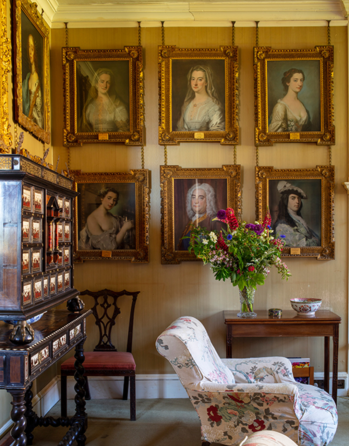
Set of pastels at Knole by Rosalba Carriera: Charles Sackville, 2nd Duke of Dorset at bottom right and his Italian mistress Lucia Panichi, at bottom left (Photo by Ashley Hicks, from Knole: A Private View of One of Britain’s Great Houses, Rizzoli, 2022).
The Sackvilles have inhabited Knole, one of Britain’s greatest houses, for more than 400 years. In his talk, Robert Sackville-West, the 13th generation of the family to live at Knole, will take Royal Oak members on a personal tour of this ‘calendar house’, with its legendary 365 rooms, 52 staircases, 12 entrances, and 7 courtyards. Lord Sackville will illustrate the smoldering spirit of Knole, from the state rooms—with the finest collection of 17th-century Royal Stuart furniture in the world and outstanding tapestries—to the private apartments filled with portraits by Van Dyck, Gainsborough, Sir Peter Lely, and Reynolds. He will include a trip behind-the-scenes into the labyrinth of cellars and show attics filled with family mementos.
He will describe his ancestors who inhabited his family home—the grave Elizabethan statesman, the good-for-nothing gadabout at the seedy court of James I, the dashing cavalier, the Restoration rake, the 3rd Duke of the ancien régime—who inhabited his family home and were described by Vita Sackville-West (born at Knole) as “a race too prodigal, too amorous, too weak, too indolent, and too melancholy.” Lord Sackville will talk about the way his family has shaped and furnished the house and describe how Knole itself has shaped the Sackvilles, influencing their lives and their relationships up to the present day. The talk will feature stunning images of the interiors and architectural and decorative features taken by Ashley Hicks for Knole: A Private View of One of Britain’s Great Houses, published by Rizzoli in 2022.
More information available here.
Robert Sackville-West, 7th Baron Sackville, studied history at Oxford University and went on to work in publishing. He now chairs Knole Estates, the property and investment company that, in parallel with the National Trust, runs the Sackville family’s interests at Knole.
◊ ◊ ◊ ◊ ◊
Oliver Gerrish | Distinguished to Eccentric: Norfolk Country Houses
Online, Zoom Webinar, 20 April 2023, 2.00pm ET
Also available as a digital rental from April 21 to May 5

Houghton Hall.
For centuries, Norfolk’s wide-open skies, unspoilt coastline, and rich and beautiful agricultural land have inspired writers and poets, artists, and designers, as well as architects and builders. Join architectural historian Oliver Gerrish on an enchanting visual journey through Norfolk’s rich architectural heritage. From the Jacobean splendors of Blickling Hall, believed to be the birthplace of Anne Boleyn, to the early Palladian elegance of Raynham Hall, possibly influenced by Inigo Jones’ circle, and for 400 years the seat of the Townshend family.
When one thinks of Norfolk, two of the grandest private houses in England immediately come to mind: Houghton and Holkham Hall. More than a country house, Holkham, designed by William Kent and Lord Burlington for the Earls of Leicester, can be described as a symmetrical Palladian palace. The sublime grandeur continues inside in the Marble Hall, which was modelled on a Roman basilica, with steps leading to the impressive State Rooms on the piano nobile.
The other neo-Palladian Norfolk ‘palace’ is Houghton Hall, one of England’s most beautiful stately homes designed by Colen Campbell and James Gibbs, with lavish interiors by William Kent. Both of these stately homes were built to reflect the wealth, taste, collections, and power of its inhabitants. Oliver will also examine private Norfolk houses from the 19th and 20th century. One from the Arts & Crafts movement is E.S. Prior’s 17-bedroomed Voewood in High Kelling, Norfolk, which is now owned by a well-known book dealer.
Finally, we will see the quirky Edwardian Sennowe Park, remodeled by George Skipper in 1900–1907 for the grandson of the founder of Thomas Cook travel. Known for its imaginative design, barrel vaulted library, and Art-Deco style tiling, the house is rarely on view.
More information available here.
Oliver Gerrish has a Master’s degree in architectural history from the University of Cambridge. He is a trustee of the Derbyshire Historic Buildings Trust and helped to found their Architecture Awards. For over 10 years he was actively involved with The Georgian Group, for whom he re-founded and successfully led the Young Georgians from 2002 to 2016. He was one of the youngest feature writers for Country Life, and has written for The Georgian magazine and reviews for House and Garden and others. He has lectured nationally on subjects ranging from the masters of the Arts and Crafts to the role country houses play in the lives of younger people. He regularly organizes tours of historic buildings throughout Britain for private clients and charities.
◊ ◊ ◊ ◊ ◊
Rufus Bird | St. James Palace: From Leper Hospital to Royal Court
The Union League of Philadelphia, 2 May 2023, 6.30pm (with an option for dinner)
The General Society Library, New York, 4 May 2023, 6pm ET
Also available as a digital rental from May 5 to May 19

Bird’s eye view of St James Palace.
Visitors to London may recognize the red brick building at the bottom of St. James’ Street—St James’ Palace—and its location near many Pall Mall clubs and boutique hotels. St James’s Palace is a remarkable building at the heart of the history of the British monarchy and served as the official residence of the British monarchy from 1698 to 1837. However, despite its pivotal role in British history, St. James’s Palace is the least known of the royal residences.
While King Charles III and the Queen Consort live at Clarence House, their home is actually one of several structures which formed a part of the buildings that emerged from the Tudor palace in 1530s. St. James’s medieval origins were as a leper hospital dedicated to St. James. The palace’s history also includes stories of murder; family arguments between father and son; a lost masterpiece building by William Kent; and lavish royal apartments. Over the centuries, St. James’s Palace survived dilapidation and fire, 19th century reconstruction, and remained the location for important international diplomacy. Rufus Bird—whose office was in the heart of St. James’s Palace for over 10 years—will bring to life the stories of this remarkable palace. He will explore the role of the palace a principal seat of the British monarchy after fire consumed Whitehall Palace, and explain the building’s impact on the development of London and the West End.
More information on Philadelphia available here and for New York available here.
Rufus Bird is an art advisor at Gurr Johns where he is Director of Decorative Arts and Heritage Collections, Europe. After receiving History of Art from Cambridge University, he joined Christie’s as a graduate trainee and joined the Furniture Department in 1999. In 2010, he was appointed by HM Queen Elizabeth II as Deputy Surveyor of the Queen’s Works of Art, and then in 2018 as Surveyor of the Queen’s Works of Art. At the Royal Collection, he was responsible for about 500,000 works of decorative art across fifteen residences. He is one of the authors of the official history of St James’s Palace published by Yale University Press and Royal Collection Trust in 2022.
◊ ◊ ◊ ◊ ◊
Jeremy Musson | ‘Still Life Drama’: Dennis Severs’ House Revived
Online, Zoom Webinar, 9 May 2023, 2pm ET
Also available as a digital rental from May 10 to May 24
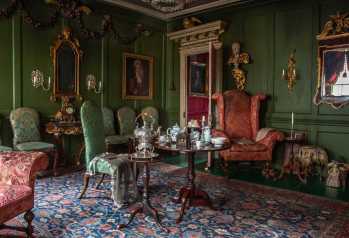
Drawing Room of the Dennis Severs’ House (Photo by Lucinda Douglas-Menzies).
Step back in time at the Dennis Severs’ House, located at 18 Folgate Street in London. Visitors are invited to participate in what the American founder called “a still life drama.” This extraordinary multi-sensory experience allows guests to walk through each room of the house feeling as if the 18th- and 19th-century inhabitants have only just withdrawn a moment before.
Collector and founder Dennis Severs bought the semi-derelict 18th-century Spitalfields house in the 1970s. With no desire to restore, Severs wanted to honor what he imagined were the echoes of the house’s history. He created the fictional story of a Huguenot silk merchant’s family named Jervis, who lived in the house for generations from 1724 to 1914. Each room tells the triumphs and tragedies of this fictional family through the original objects Severs bought from London’s street markets and sale rooms, atmospherically lit by candlelight. Painstakingly assembled over 20 years, many of the rooms were mocked up in the manner of stage scenery using inexpensive materials—all conveying a haunting sense of London’s past: silk waistcoats are flung on rumpled bed clothes, a card game has just ended, fires crackle, and steam rises from a filled punch bowl.
Jeremy Musson recently featured this unusual house in Country Life Magazine. Jeremy will speak about the house which he says “defies categorization…and is a house of mystery and paradox.” He will illustrate the rooms—recently repaired and conserved by the trustees during COVID lockdown—and show English houses that possibly influenced Severs’ designs. He also will show how the founder used costume and set designers, as well interior designers, to create a remarkable home that captures a moment in time and history.
More information available here.
Jeremy Musson is a leading authority on the English country house. He is a Fellow of the Society of Antiquaries and sits on a number of boards and trusts including the Country House Foundation. He was awarded an M Phil in Renaissance History at the Warburg Institute, University of London in 1989 and was architectural editor of Country Life from 1995 to 2007. Before joining Country Life in 1995, Jeremy was an assistant regional curator for the National Trust in East Anglia. He has written and edited hundreds of articles on historic country houses, from Garsington Manor to Knebworth House. He also presented 14 programmes on BBC 2, making up two series called The Curious House Guest in 2005–07. He lectures and supervises for academic programmes with Cambridge University, London University, and Buckingham University, as well as the Attingham Summer School. His books include Up and Down Stairs: The History of the English Country House Servant (2009), English Country House Interiors (2011), Robert Adam: Country House Design, Decoration & the Art of Elegance (2017), The Country House: Past, Present, Future: Great Houses of the British Isles (2018), and Romantics and Classics: Style in the English Country House (Rizzoli, 2021).
◊ ◊ ◊ ◊ ◊
Sophie Chessum | Clandon Park: Uncovering the Secrets of the Past
Online, Zoom Webinar, 23 May 2023, 2pm ET
Also available as a digital rental from May 24 to June 9

Recovered items following the fire at Clandon Park.
National Trust Curator Sophie Chessum witnessed the devastating fire at Clandon Park, Surrey on the night of April 29, 2015. The Palladian style house, a NT property, had been built in the early 1730s by Thomas Onslow and his wife to impress and entertain their friends, and included a Marble Hall with richly carved marble fireplaces by John Michael Rysbrack. Everyone was safely evacuated, but the 2015 fire raged through the house, leaving Clandon literally open to the skies.
Firefighters and NT staff tried to salvage some of the remarkable artifacts and objects, but the inside was gutted. Planning for the house’s future started almost before the cinders had cooled. Within weeks cranes removed the dangerous timbers and bricks, and a self-supporting scaffold was designed to wrap and roof the four-story structure. Everyone hoped for restoration, but after years of forensic investigation and consultation with experts, it was not deemed possible apart from the Speaker’s Parlour. The NT and teams of experts developed a new approach that celebrates what survives of the 18th-century building and seeks to tell the stories about how this masterpiece was built. The fire may have destroyed much of Clandon’s interior, but it also revealed how the house was constructed and crafted. Hidden secrets from Clandon’s history now revealed include: construction dating from timbers, stones reused from the previous Jacobean structure, hidden doorways and alcoves, and paneling in the State Bedroom.
Sophie will talk about that fateful night, show some of the salvaged fragments and objects under conservation—including the State Bed—and explain what curators and specialists have learned about the house. She will describe the current project which gives access to spaces conserved, offering visitors a unique ‘X-ray view’ and celebrating the craft skills of the people who created some of England’s greatest country houses.
More information available here.
Sophie Chessum is Clandon Park’s Senior Project Curator. Chessum has been with the National Trust since 1998, when she started as a Curatorial Researcher. Since 2002 she has been a curator for a number of internationally important houses, collections, gardens, and landscapes including Clandon Park, Claremont, Hatchlands Park, Hinton Ampner, Petworth House, Polesden Lacey, The Homewood, Uppark, and Woolbeding. She has been a consultancy manager at the National Trust since 2013, where she provides specific consultancy support to Ham House, Sutton House and 575 Wandsworth Road, Osterley Park, Morden Hall Park, Rainham Hall, Carlye’s House, Fenton House, Red House, and 2 Willow Road. In addition she is the curator for Ham House, Richmond Surrey. Since the fire at Clandon Park in April 2015, she has been seconded to lead the salvage elements of this project, providing curatorial expertise on the house and its collection and working closely with archaeologist and conservator.
◊ ◊ ◊ ◊ ◊
Justin Scully | Saving Fountains Abbey: Project Update
Online, Zoom Webinar, 1 June 2023, 2pm ET
Also available as a digital rental from June 2 to June 16
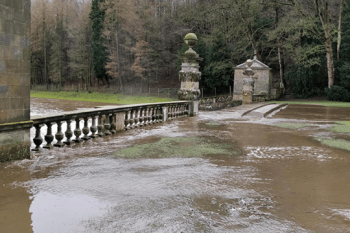
Flooding at Studley Royal Water Garden.
In 2020, Royal Oak donated $250,000 to preserve one of England’s most magnificent sites which was one of the first places in the UK to become a World Heritage Site in 1986. Fountains Abbey & Studley Royal Water Garden is an awe-inspiring landscape, owned by the National Trust since 1983. Cistercian monks established the Abbey in 1132, manipulating the River Skell to harness its power for grinding grain into flour. Over time, the Abbey became one of the largest, richest, and most influential Cistercian sites in Britain—until the Dissolution in the 1530s by Henry VIII.
In the early 18th century, John Aislabie began transforming his nearby landscape garden of Studley Royal into a picturesque design that incorporated the entire wooded valley and featured a huge water garden with lakes, grottos, canals, and cascades. Paths were created with viewpoints that centered on classical statues and follies. In 1767, his son William bought the neighboring Abbey ruins to incorporate them into the landscape and to create the ultimate vista or ‘Surprise View.’ Centuries later, the garden design is much the same, but this important landscape is often flooded from the River Skell. To save the site, the National Trust has partnered with conservation organizations, local farmers, and landowners to implement a natural flood management program.
Justin Scully, the site’s General Manager, will update Royal Oak members on the on-going progress of these efforts, including the planting of woodland and hedgerows and the creation of ponds and meadows to slow the water flow. He will illustrate the changes and explain the challenges faced by the preservation team. Additionally, he will talk about the surviving relics of the Chinese Garden and the wider 18th-century and monastic landscape, as well as exciting discoveries in the historic archives.
More information available here.
Justin Scully is General Manager at Fountains Abbey & Studley Royal Water Gardens, National Trust. The site is one of the busiest properties in the National Trust welcoming in excess of 600,000 visitors per year. Justin has worked for the National Trust for 14 years and in his 6 years at Fountains has overseen multi-million pound investment in visitor infrastructure and conservation, as well as the Skell Valley project, a £2.5m landscape scale conservation project.
New Book | The Sewing Girl’s Tale
John Sweet’s book The Sewing Girl’s Tale was recently awarded a Bancroft Prize in American History and Diplomacy. Sweet will be speaking at the American Philosophical Society next week.
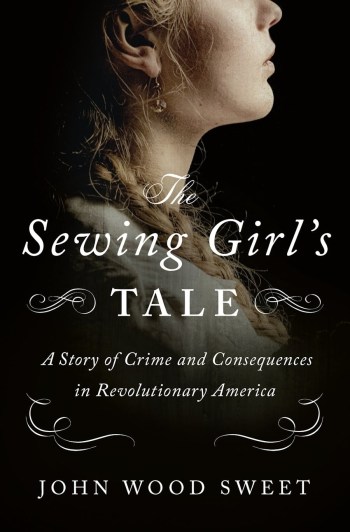
John Wood Sweet, The Sewing Girl’s Tale
American Philosophical Society, Philadelphia, 23 March 2023, 6pm
 On a moonless night in the summer of 1793 a crime was committed in the back room of a New York brothel―the kind of crime that even victims usually kept secret. Instead, seventeen-year-old seamstress Lanah Sawyer did what virtually no one in US history had done before: she charged a gentleman with rape. Her accusation sparked a raw courtroom drama and a relentless struggle for vindication that threatened both Lanah’s and her assailant’s lives. The trial exposed a predatory sexual underworld, sparked riots in the streets, and ignited a vigorous debate about class privilege and sexual double standards. The ongoing conflict attracted the nation’s top lawyers, including Alexander Hamilton, and shaped the development of American law. The crime and its consequences became a kind of parable about the power of seduction and the limits of justice. Eventually, Lanah Sawyer did succeed in holding her assailant accountable―but at a terrible cost to herself. Based on rigorous historical detective work, this book takes us from a chance encounter in the street into the sanctuaries of the city’s elite, the shadows of its brothels, and the despair of its debtors’ prison. The Sewing Girl’s Tale shows that if our laws and our culture were changed by a persistent young woman and the power of words two hundred years ago, they can be changed again.
John Wood Sweet, The Sewing Girl’s Tale: A Story of Crime and Consequences in Revolutionary America (New York, Henry Holt and Co., 2022), 384 pages, ISBN: 978-1250761965, $30.
John Wood Sweet is a professor of history at the University of North Carolina at Chapel Hill and former director of UNC’s Program in Sexuality Studies. He graduated from Amherst College (summa cum laude) and earned his PhD in History at Princeton University. His first book, Bodies Politic: Negotiating Race in the American North, was a finalist for the Frederick Douglass Prize. He has served as a Distinguished Lecturer for the Organization of American Historians, and his work has been supported by fellowships from the National Endowment for the Humanities, the Mellon Foundation, the National Humanities Center, the Institute for Arts and Humanities at UNC, the Gilder Lehrman Center at Yale, the McNeil Center at Penn, and the Center for Global Studies in Culture, Power, and History at Johns Hopkins.
Lectures | John Finlay and Kristel Smentek on China and France
From BGC:
John Finlay and Kristel Smentek | China and France in the Intercultural 18th Century
Bard Graduate Center, New York, 19 April 2023, 6.00pm
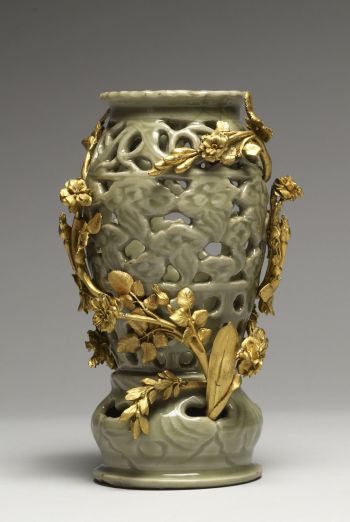
Long Quan celadon lamp, 15th–16th century, Ming dynasty, porcelain, with French gilt mounts, mid-18th century, gilt bronze (Baltimore: The Walters Art Museum, 49.1508).
A Françoise and Georges Selz Lecture Duet on Eighteenth- and Nineteenth-Century French Decorative Arts and Culture with John Finlay and Kristel Smentek. In this pairing of mini-lectures, scholars John Finlay and Kristel Smentek offer complementary views on arts and intercultural exchange between France and China in the eighteenth century.
John Finlay | Henri Bertin and the Representation of China in 18th-Century France
The role of Henri-Léonard Bertin (1720–1792), who served as a minister of state under Louis XV, is crucial to understanding the encounters between China and France in the eighteenth century. Bertin first established his contact with the French Jesuits in Beijing through two Chinese Catholic priests, Aloys Ko and Étienne Yang. When the missionaries returned to China in 1765, they took with them an important set of gifts to be presented to the Qianlong emperor. Not to be misconstrued as tribute from France to China, these gifts were intended to stimulate Chinese interest in French culture and French artistic production.
Kristel Smentek | Disorienting China: Negotiating the Foreign in 18th-Century France
As European trade with the Qing empire accelerated in the eighteenth century, France was flooded with objects from China whose technologies, materials, and motifs challenged European understanding. These ranged from the lacquers and porcelains with which historians are familiar, to scroll paintings, bronzes, and worked jades whose presence in eighteenth-century Europe is far less studied. This talk investigates the display and material alteration of Asian imports in France and the design of new objects in response to them—strategies by which the French negotiated the pleasures and disorientations of China’s arts.
Formerly a curator of Chinese art, John Finlay is an independent scholar based in Paris, affiliated with the Centre d’Études sur la Chine Moderne et Contemporaine (CECMC). He began his academic career studying paintings and prints produced for the Qing imperial court in the eighteenth century. His current research focuses on Henri-Léonard Bertin (1720–1792), who served as a minister of state under Louis XV. His passion for all things Chinese placed him at the center of intersecting networks of like-minded individuals who shared his vision of China as a nation from which France had much to learn.
Kristel Smentek is associate professor of art history in the Department of Architecture at MIT. Her research focuses on eighteenth-century European graphic and decorative arts in their transcultural contexts. She is the author of Mariette and the Science of the Connoisseur in Eighteenth-Century Europe (2014), co-curator of Dare to Know: Prints and Drawings in the Age of Enlightenment recently on view at the Harvard Art Museums, and co-editor of its accompanying catalogue. She is currently completing Disorient: Arts from China in Eighteenth-Century France, a book investigating French responses to Chinese imports over the course of the long eighteenth century.
Registration is available here»
Iris Moon and Rachel Silberstein on Feminist Revisions of Chinoiserie
An upcoming research seminar at the Paul Mellon Centre:
Iris Moon and Rachel Silberstein on Feminist Revisions of Chinoiserie
Online and in-person, Paul Mellon Centre, London, Wednesday, 22 March 2023, 5–7pm
Part of the series ‘In Conversation: New Directions in Art History’, which will explore the changing modes and methodologies of approaching visual and material worlds. Book tickets here.
Iris Moon — The Woman in the Mirror
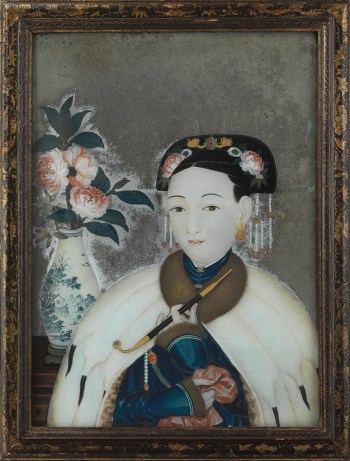
Woman with a Pipe, ca. 1760–80, reverse-painted crown glass, imitation lacquer frame, 52 × 40 × 3 cm (New York: The Metropolitan Museum of Art, Larry and Ann Burns Gift, in honor of Austin B. Chinn, 2022.52).
Chinoiserie, a style of decoration that emerged in early modern Europe, has typically been pictured as a neutral, harmless, and nostalgic fantasy of the ‘exotic’ Far East, one that was embodied by the traffic, trade and ravenous consumption of luxury objects such as mirrors, wallpaper, furniture, and porcelain. Though Chinoiserie is often pictured as encompassing a wide field of material production, it has rarely been considered as part of the contested forms of subjectivity that emerged in the eighteenth century. This presentation proposes that we rethink the history of Chinoiserie. It asks what a feminist approach to Chinoiserie might look like, and what the ramifications are for British decorative arts in positioning Chinoiserie at the inflection point of racialised and gendered forms of subjectivity that continue to exert a hold on the present. Building on a rich and growing body of critical and theoretical literature, the presentation nonetheless anchors the discussion of Chinoiserie in a formal analysis of a group of reverse-painted mirrors made for the British market. These eighteenth-century mirrors picture women, both real and imagined, in different modes of dress and postures, painted on the reverse side of the glass scraped of its reflective surface. Scholars have relegated these export objects to a secondary status, considering them as trade paintings of little artistic merit, refusing in turn to probe the subtle and complex questions they raise about gender, identity, power, representation, and reflection. Yet these are the questions that materialise when standing before the mirrors. You ask: Who is the woman in the mirror? Myself or another? Where do I position myself? Who am I supposed to be?
Iris Moon is an assistant curator in the European Sculpture and Decorative Arts Department at The Metropolitan Museum of Art, where she is responsible for European ceramics and glass. At The Met, she participated in the reinstallation of the British Galleries, and she is currently planning an exhibition on Chinoiserie, women, and the porcelain imaginary that will open in 2025. She is the author of Luxury after the Terror, and co-editor with Richard Taws of Time, Media, and Visuality in Post-Revolutionary France. A new book on Wedgwood, generously supported by a publication grant from the Paul Mellon Centre, will be published next year with MIT Press. In addition to curatorial work, she teaches at Cooper Union.
◊ ◊ ◊ ◊ ◊
Rachel Silberstein — The Women on the Garment
Chinese material culture offers several routes for a feminist approach to Chinoiserie. One could counter its insistence on the generic Chinese woman by exploring histories of specific Chinese women: the Qing dynasty social counterparts of the privileged European women who purchased Chinoiserie silks, porcelains, and mirrors. Their consumption, especially of textiles and fashion, offers an arena of specificity, agency, and control that refutes Chinoiserie’s imagined Qing beauties: languorous and ahistorical. Alternatively, one could consider a different counterpart: Qing society’s engagement with images of European women. Though such imagery may not have travelled far beyond the imperial palace, recent scholarship has clarified how European textiles, architecture, and dress fascinated those elites able to access such new visualities, introduced by Jesuit missionaries, print culture, and the East India Companies.
But perhaps most intriguing when considering Chinoiserie’s potential for contesting female subjectivities is to understand it not as a European fantasy unrelated to Chinese practice, but rather a shared global visual space whose dynamic was driven by fashion. Accordingly, the presentation focuses on a genre of Qing fashion: the embroidered figures of beauties that adorned the fabrics and trimmings of the mid-late period jackets, robes, and accessories. Similar to the eighteenth-century mirror designed for a European consumer, these embroideries depict women, both real and imagined, in different postures and dress. In the same way as the eighteenth-century mirror, the embroideries derived from imagery circulating in pattern books and print culture. Yet, these embroideries were produced for Chinese female consumers and, in an intriguing act of self-referentiality, the female figures were placed on the very surface that covered the female wearer’s body. By showing how this fashion trend traversed different media, cities, and classes, this presentation explores how it allowed Chinese women a way of exploring identity by playing with narrative, and how this figural bricolage can be understood alongside European women’s consumption of Chinoiserie.
Rachel Silberstein is currently an adjunct assistant professor in the Department of Art History at the University of Florida. She has also taught courses in fashion history and art history at Rhode Island School of Design, the University of Washington, and the University of Puget Sound. Her research focuses on textiles, dress, and fashion in Chinese and global history. Her monograph, A Fashionable Century: Textile Artistry and Commerce in the Late Qing (University of Washington Press, 2020)—a study of fashion and textile handicrafts in early modern China—won the Costume Society of America’s Millia Davenport Publication Award 2021. Rachel has published widely on Qing fashion in the journals West 86th, Fashion Theory, Costume, and Late Imperial China. Forthcoming publications include an essay on Ming-Qing Fashion in the Cambridge Encyclopedia of Global Fashion. She has also served as a consultant on Chinese dress collections and exhibits at museums including the Fine Arts Museums of San Francisco, Rhode Island School of Design Museum, Seattle’s Museum of History & Industry, and the Cooper Hewitt Smithsonian Design Museum.
Seminar | Anthony Downey and Maya Ganesh on AI and Images
◊ ◊ ◊ ◊ ◊
From the PMC:
Anthony Downey and Maya Ganesh | Neo-Colonial Visions: Artificial Intelligence and Epistemic Violence
In-person and online, Paul Mellon Centre for Studies in British Art, London, 15 March 2023, 5pm
Part of the series In Conversation: New Directions in Art History, which will explore the changing modes and methodologies of approaching visual and material worlds. Running from January to March 2023.
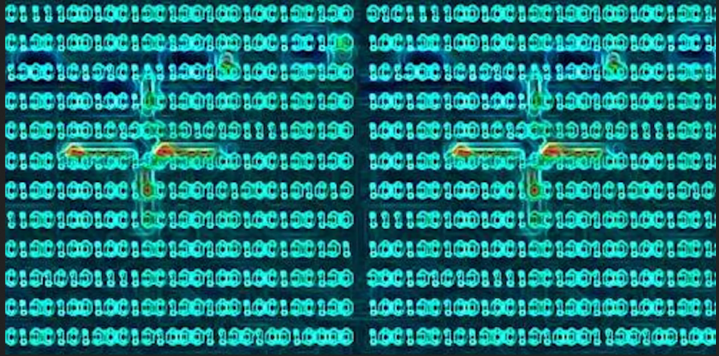
Artificial Intelligence (AI), often presented as an objective ‘view from nowhere’, constitutes a regime of power that further establishes historical forms of bias and evolving models of subjugation. A key component in this process, this presentation will suggest, involves the extraction of data from digital images in order to train AI. How, therefore, do we understand the transformation of images from their symbolic and representational contexts to their contemporary function as sources of digital data? Bringing together researchers in the field of visual culture and AI technology, and taking as its starting point the representational biases of colonial imagery, Anthony Downey and Maya Indira Ganesh will explore how the digital image has increasingly become the means to extract, archive and repurpose information. Based on the extraction and statistical repurposing of data, they will observe how AI renders entire communities susceptible to encoded and overt forms of epistemological violence. Designed for the purpose of training machine vision and the apparatus of AI, these repurposed “images” reveal, furthermore, how the extractive practices of colonialism have become inexorably aligned with corporate interests and neo-colonial economies of data extraction.
Book tickets here»
Anthony Downey is an academic, author, and editor. He is Professor of Visual Culture in the Middle East and North Africa (Birmingham City University). He sits on the editorial boards of Third Text (Routledge), Journal of Digital War (Palgrave Macmillan), and Memory, Mind & Media (Cambridge University Press). He is the series editor for Research/Practice (Sternberg Press, 2019–ongoing). Recent and upcoming publications include Algorithmic Anxieties and Post-Digital Futures (forthcoming, MIT Press, 2024); Nida Sinnokrot: Palestine is Not a Garden (Sternberg Press and MIT Press, 2023); Khalil Rabah: Falling Forward/Works (1995–2025) (Sharjah Art Foundation and Hatje Cantz, 2022); Topologies of Air: Shona Illingworth (Sternberg Press and the Power Plant, 2021); and Heba Y Amin: The General’s Stork (Sternberg Press, 2020). Downey is the cultural and commissioning lead on a four-year multi-disciplinary AHRC Network Plus award, where his research focuses on cultural practices, digital methods, and educational provision for children with disabilities in Lebanon, the Occupied Palestinian Territories, and Jordan (2020–2024). This award was preceded by an AHRC Development award in 2019. In 2020, Downey curated Heba Y. Amin: When I See the Future (at the Mosaic Rooms, London), and in 2022, he curated Heba Y. Amin: When I See the Future, Chapter II (Zilberman Gallery, Berlin).
Maya Indira Ganesh is a cultural scientist, researcher, and writer working on the social and cultural politics of AI, autonomous and machine learning systems. She is a senior researcher at the Leverhulme Centre for the Future of Intelligence and an assistant professor, co-teaching a masters programme on AI, ethics, and society at the University of Cambridge. Ganesh earned her PhD in cultural sciences from Leuphana University, Lüneburg. Her work examined the reshaping of the ‘ethical’ through the driverless car, an apparatus of automation and automobility, big data, cultural imaginaries of robots, and practices of statistical inference. Before turning to academic work, Maya Indira Ganesh spent a decade as a feminist activist working at the point of intersection of gender justice, digital security, and digital freedoms of expression. Her work has consistently brought questions of power, justice, and inequality to those of the body, the digital, and knowledge making.
Robbie Richardson and Ruth Phillips on Indigenous Objects Abroad

Smoking-pipe, 1600–1750, soapstone, 9.5 × 10 × 5.5 cm (London: The British Museum, Am1991,09.1). As noted in the catalogue entry: “The pipe bowl is from the painter Benjamin West’s studio, and was used as a model in both Death of Wolfe and Penn’s Treaty with the Indians.”
◊ ◊ ◊ ◊ ◊
From the Mellon Centre:
Robbie Richardson and Ruth Phillip on Indigenous Objects Abroad
Online and in-person, Paul Mellon Centre, London, Wednesday, 1 March 2023, 5–7pm
Part of the series ‘In Conversation: New Directions in Art History’, which will explore the changing modes and methodologies of approaching visual and material worlds. Book tickets here.
Robbie Richardson | ‘Peace Pipes’ in Europe: Collecting the Calumet in the Eighteenth Century
This talk will consider early European collections of Indigenous tobacco pipes, often called ‘peace pipes’ or calumets (a word of French origin). Described as “the most mysterious thing in the world” by seventeenth-century Jesuits for their perceived power and significance among south-eastern nations, pipes would over time become one of the ubiquitous icons of Indigeneity in western eyes. Part of their inscrutability from the British perspective was that their own tobacco pipes were ephemeral and disposable, with many even still washing up daily on the shores of the Thames.
Towards the end of the eighteenth century, one of the most popular trade goods which Europeans brought to Indigenous nations were steel European-manufactured ‘pipe-tomahawks’, which blended metaphors of peace and war. The manifestation of this transcultural object is itself revealing of the complex dynamics of material cultural production. Notwithstanding their provenance in Sheffield and Birmingham steel mills, pipe-tomahawks became widely collected as Indigenous curiosities by British soldiers and collectors. This talk will discuss British representations of Indigenous diplomacy and spirituality through their understanding and collecting of the calumet. It will look at several of the pipes that found their ways into European collections, to unravel Indigenous practices and agency.
Robbie Richardson is Assistant Professor of English at Princeton University and the author of The Savage and Modern Self: North American Indians in Eighteenth-Century British Literature and Culture (University of Toronto Press, 2018). He has recent chapters in Material Literacy in Eighteenth-Century Britain: A Nation of Makers (Bloomsbury, 2020) and in Small Things in the Eighteenth Century: The Political and Personal Value of the Miniature (Cambridge University Press, 2022), and forthcoming pieces in Studies in Romanticism, Eighteenth-Century Studies, and Eighteenth Century: Theory and Interpretation. He is currently working on a monograph about Indigenous objects from the Americas and South Pacific in Europe up until the end of the eighteenth century. He is a citizen of Pabineau Mi’kmaq First Nation in New Brunswick, Canada.
◊ ◊ ◊ ◊ ◊
Ruth Phillips | Curiosity and Belonging: Legacies of Eighteenth-Century Collecting in the Twenty-First Century
This talk will examine two contrasting modes of engagement between Europeans and Indigenous peoples in eighteenth-century North America and how these interactions led to the formation of public and private collections. It will urge that in the twenty-first century developing accurate understandings of eighteenth-century collecting practices can usefully disrupt assumptions about the restitution of Indigenous cultural belongings.
The periodic wars waged for colonial control of eastern North America brought tens of thousands of British, French, German and Swiss soldiers into the region. Both officers and common soldiers were avid collectors of curiosities for themselves, to present to patrons and family members, and to resell at a profit. Indigenous makers, for their part, actively produced finely made ornaments, pipes, moccasins and other items for the trade, acquiring in return: guns and tools that made hunting and warfare more effective; rum, tea, pottery, woollen cloth and printed cottons that made life more enjoyable; and silk ribbons, woollen yarn, glass beads, needles, thread and manufactured wampum beads that stimulated artistic creativity. There could also, however, have been other reasons for an Indigenous maker to produce these items for outsiders, for they were also presented in diplomatic negotiations to ratify treaty agreements and in ritual adoptions that transformed a military officer or a colonial official into a member of an Indigenous kin group who could be expected to support its interests.
Contemporary Indigenous peoples are actively tracing their cultural belongings in museum collections as part of a larger process of decolonisation that aims to recover histories of Indigenous agency and heal the damages and losses enacted by centuries of colonial rule. This talk argues that restitution, if conducted in ignorance of the historical circumstances of gifting or trade, risks, on the one hand, denying the agency of Indigenous peoples who chose to engage in curiosity production and, on the other, disappearing the material embodiments of agreements that, although made long ago, still demand to be recognised and honoured.
Ruth B. Phillips is Professor of Art History Emerita at Carleton University, Ottawa where she was also appointed to a Canada Research Chair in Modern Culture. She earned her PhD in African art history at SOAS, University of London, and has since focused on Indigenous North American arts and museology. As director of the Museum of Anthropology, University of British Columbia from 1997 to 2002 she initiated a major renewal of the museum’s digital and physical research infrastructure adapted to collaborative research with Indigenous peoples. She is the author of Trading Identities: The Souvenir in Native North American Arts from the Northeast, 1700–1900; Museum Pieces: Toward the Indigenization of Canadian Museums; and Native North American Art, with Janet Catherine Berlo. With Nicholas Thomas she organised the Multiple Modernisms project to address Indigenous modernisms in a global comparative framework, co-editing its first publication, Mapping Modernisms: Art, Indigeneity, Colonialism with Elizabeth Harney, and its second, Mediating Modernisms: Indigenous Artists, Modernist Mediators, Global Networks, with Norman Vorano. She is a fellow of the Royal Society of Canada and recipient of lifetime achievement awards from the American Anthropological Society and the Universities Art Association of Canada.
Research Lunch | Anna Jamieson on Topographical Asylum Prints
From the Mellon Centre:
Anna Jamieson | Viewing Virtually and Learning to Look: The Topographical Asylum Print
Paul Mellon Centre for Studies in British Art, London, 17 March 2023, 1pm

T. H. Shepherd, St Luke’s Hospital, Cripplegate, London, 1815, engraving (London: Wellcome Collection).
By the final decades of the eighteenth century, asylums and hospitals had become mainstays of England’s philanthropic tourist circuit. Providing visitors with the opportunity to interact with human suffering, asylums were uniquely placed to encourage and facilitate the display of humanity deemed socially appropriate during this period.
For the educated elite engaged in philanthropic tourism, the asylum was often first encountered via the topographical print. Analysing a range of prints that depict asylum exteriors and their environs, this talk argues that these prints played an important role in shaping first impressions before a tour, guiding tourists in ways to look and behave in these unique and unsettling spaces. It demonstrates that viewing topographical prints prior to a visit evoked one’s social status, in that they characterised asylums as polite and esteemed destinations only accessible to the elite classes. At the same time, the talk suggests that topographical prints were designed to intrigue and titillate guests, with painters and printmakers employing unusual perspectives or fragmentary scenes to pique the interest of the visitor and provide a tantalising glimpse of life behind the asylum façade.
Book tickets here»
Anna Jamieson is an interdisciplinary art historian, a postdoctoral fellow at the Paul Mellon Centre, and an associate lecturer at Birkbeck, University of London. Anna specialises in visual and material cultures of the late eighteenth and early nineteenth century, with a particular interest in women’s mental illness; the cultural history of psychiatry; and dark tourism. She is currently writing her first monograph, The Gaze of the Sane: Asylum Tourism in England, 1770–1845. She is co-director of Birkbeck’s Centre for Museum Cultures and a member of the steering committee for Birkbeck’s Centre for Interdisciplinary Research on Mental Health. Anna’s research has been published in Eighteenth-Century Studies and Journal for Eighteenth-Century Studies, and her co-edited volume, Pockets, Pouches and Secret Drawers is forthcoming with Brill (2023). She is an associate editor for the medical humanities website The Polyphony and tweets at @annafranjam.
Research Lunch | Deepthi Bathala on Crop Trials and Tropicality in India
From the Mellon Centre:
Deepthi Bathala | Plantation Failures, Famine Crops, and Contesting Tropicality: Trials of the Calcutta Botanic Garden in the Early Nineteenth Century
Paul Mellon Centre for Studies in British Art, London, 10 March 2023, 1pm

“The Physical Geography of India and the Botanical Provinces 1855,” published in Joseph Dalton Hooker and Thomas Thomson, Flora Indica: Or Description of Indian Plants (1855; image from the Biodiversity Heritage Library).
In the late eighteenth century during a famine in British India, the Botanical Garden in Calcutta emerged as a response to the crisis. Envisioned as an institution of agricultural improvement, the garden sought to mobilise and introduce climatically suitable crops from various parts of the world for what was understood to be the tropical climate in India. In a quest to introduce famine crops such as wheat and potatoes from the Cape along with plantation crops like coffee, teak, and mulberry, horticulture, along with plantation trials, were administered at the same time both within and outside the garden compound. This paper discusses the plantation and horticultural trials of the Botanic Garden and their subsequent failures in the early nineteenth century to argue that these experiments were integral to contesting the preconceived tropicality of India. These failures determined not only the agricultural landscape of the country but also dictated the siting of other botanical gardens through the production of new climate knowledge in relation to the plants that grew, thrived, or failed. By using maps of the garden, rough sketches of early plantation grounds, and correspondence letters between officials of the garden and the company, the paper illustrates how the officials and affiliates of the garden produced an imaginary climate for British India contesting the tropicality of India while at the same time transforming its landscape in the early nineteenth century.
Book tickets here»
Deepthi Bathala is a PhD candidate in Architecture (History/Theory) at the University of Michigan. Her research interests include environmental histories of the built environment at the intersection of colonialism, climate knowledge, and horticulture. Her research is being supported by the Paul Mellon Center for Studies in British Art, London; Oak Spring Garden Foundation, Virginia; Society of Architectural Historians; and the Rackham Graduate School at the University of Michigan. She has a MSArch in Architecture History and Theory from the University of Washington in Seattle, and a BArch from the College of Engineering Trivandrum, Kerala University in India.
Exhibition | Crafting Freedom: Thomas W. Commeraw

Thomas W. Commeraw, Jug, detail, ca. 1797–1819, salt-glazed stoneware, cobalt oxide, 12 inches (30 cm) high
(New-York Historical Society, purchased from Elie Nadelman, 1937.820).
◊ ◊ ◊ ◊ ◊
From the press release (6 October 2022) for the exhibition:
Crafting Freedom: The Life and Legacy of Free Black Potter Thomas W. Commeraw
New-York Historical Society, 27 January — 28 May 2023
Fenimore Art Museum, Cooperstown, New York, 24 June — 24 September 2023
Curated by Margi Hofer, Mark Shapiro, and Allison Robinson, with Leslie M. Harris
The New-York Historical Society presents Crafting Freedom: The Life and Legacy of Free Black Potter Thomas W. Commeraw, the first exhibition to bring overdue attention to Thomas W. Commeraw, a successful Black craftsman who was long assumed to be white. Formerly enslaved, Commeraw rose to prominence as a free Black entrepreneur, owning and operating a successful pottery in the city. Over a period of two decades, he amassed property, engaged in debates over state and national politics, and participated in New York City’s free Black community. The exhibition explores Commeraw’s multi-faceted history as a craftsman, business owner, family man, and citizen through approximately 40 pieces of stoneware produced by Commeraw and his competitors between the late 1790s and 1819, in the largest presentation of his work to date. Alongside these pieces are the primary documents that enabled historians to reconstruct the arc of his professional career and personal life, and through them convey a deeper understanding of free Black society in New York in the years between the Revolutionary and Civil Wars.
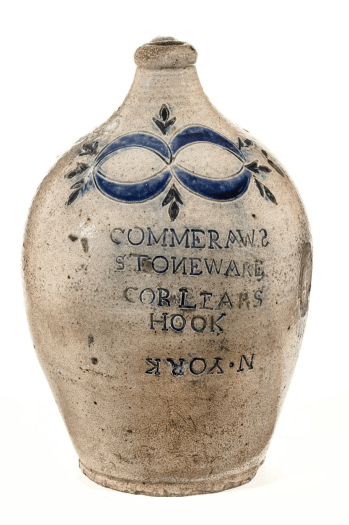
Thomas W. Commeraw, Jug, ca. 1797–1819, salt-glazed stoneware, cobalt oxide, 12 inches (30 cm) high, (New-York Historical Society, purchased from Elie Nadelman, 1937.820).
“Crafting Freedom continues the tradition at New-York Historical of presenting groundbreaking exhibitions that reveal the complex dimensions of race in the early years of New York City and our nation,” said Dr. Louise Mirrer, president and CEO of New-York Historical. “Through this exhibition of Thomas W. Commeraw and his work, we gain an in-depth understanding of a Black artisan’s life in New York, while also seeing how our understanding of history continues to evolve to give us greater insight into issues that affect our society today. This exhibition will transform our visitors’ perspective on New York’s free Black community, challenging long-held myths about post-revolutionary race relations in northern states.”
“This exhibition illuminates the story of a man who was emancipated as a child, went on to own and operate his own business, and advocated for the rights of full citizenship for his fellow Black Americans,” said Margi Hofer, New-York Historical’s vice president and museum director, who co-curated the exhibition. “While Commeraw’s distinctive pottery has been admired and collected for over a century, his true story has been obscured for far too long. It is incredibly meaningful that we are able to bring to light a true portrait of the man, both as a citizen and as a craftsman.”
The New York City directories first list Thomas “Commerau” working as a potter in 1795, living near Pot Baker’s Hill in the vicinity of today’s City Hall. By 1797, he had established his own workshop at Corlears Hook on the East River. There, he produced vessels in the local tradition, often decorated with distinctive flourishes of swags, tassels, and bowknot motifs filled with vivid cobalt. Stoneware vessels were essential kitchenware in that era and stored everything from milk, butter, salted meat, and preserves, to molasses, cider, and beer. Commeraw also manufactured oyster jars for the city’s oystermen, who were predominantly from the free Black community. His crocks and jugs traveled on ships to ports along the eastern seaboard and as far afield as Guyana and Norway. Most of the Commeraw vessels that survive today are boldly stamped with his name and the location of his pottery at Manhattan’s Corlears Hook. In addition to signaling pride in his work, Commeraw’s prominent branding helped him attract and retain customers.
In addition to revealing Commeraw’s successes and struggles as a pottery owner in a city riven by racism, the exhibition explores his commitment to securing a better future for the Black community through his work with abolitionist, political, religious, and mutual aid organizations. In 1790, the majority of Black New Yorkers were enslaved. By 1810, 6 out of 7 were free. Businessmen like Commeraw faced daunting challenges, not just raising capital but building civic and religious organizations to support the Black community. Free Black men had voted in New York since the Revolution, but in 1811, the state legislature passed a law to suppress Black voters, requiring them to submit a Certificate of Freedom that included a sworn statement from a third party attesting to the voter’s free status and residency and to pay a filing fee. A highlight of the exhibition is the 1813 Certificate of Freedom held by New-York Historical’s Patricia D. Klingenstein Library that bears Commeraw’s confident signature as witness. It is the only confirmed manuscript in his hand. The exhibition also examines how Black New Yorkers responded to economic and political oppression by developing a lively cultural and artistic community.
The final chapter in Commeraw’s story concerns his effort to promote the emigration of Black settlers to Sierra Leone, as the prospect of full citizenship for Black New Yorkers dimmed. Commeraw traveled there with his extended family in 1820 on the first voyage of the American Colonization Society. He arrived full of optimism and plans to found a Black republic; instead, he experienced unimaginable hardship and tragedy. What began as a venture for political rights ended as a struggle for survival. Many of the settlers died of malaria, including Commeraw’s wife and niece. He returned to the U.S. in 1822 and died the following year in Baltimore. The exhibition closes with a coda that describes future generations of the Commeraw family carrying forward the potter’s entrepreneurial energy and political engagement.
Additionally, Queens-based ceramic artist and activist Sana Musasama has created a new work that reflects on Commeraw’s life as a New York potter, his transatlantic odyssey of two centuries ago, and her own artistic journey. Passages will be installed in New-York Historical’s grand lobby, the Robert H. and Clarice Smith Gallery, to introduce the exhibition and encourage visitors to contemplate how Commeraw’s story continues to resonate today.
Crafting Freedom is co-curated by New-York Historical’s Vice President and Museum Director Margi Hofer, potter and Commeraw researcher Mark Shapiro, and Mellon Foundation Postdoctoral Fellow in Women’s History and Public History Allison Robinson. Leslie M. Harris, professor of history and African American studies at Northwestern University, served as scholarly advisor. The exhibition next travels to the Fenimore Art Museum, where it will be on view from June 24 until September 24, 2023.
Major support for Crafting Freedom: The Life and Legacy of Free Black Potter Thomas W. Commeraw is provided by the Decorative Arts Trust and Emily and James Satloff.
Leslie Harris in Conversation with David Rubenstein, The Shadow of Slavery and the History of African Americans in New York City, from the Settling of New Amsterdam to the Civil War
New-York Historical Society, 10 April 2023

“Test of Patriotism,” Commercial Advertister (20 August 1814)
(Patricia D. Klingenstein Library, New York Historical Society)
◊ ◊ ◊ ◊ ◊
A. Brandt Zipp, Commeraw’s Stoneware: The Life and Work of the First African-American Pottery Owner (Sparks, Maryland: Crocker Farm, 2022), 311 pages, ISBN: 979-8218002909, $95.
 Presented here for the first time in two centuries is the lost story of New York City potter Thomas W. Commeraw, a key early African American figure whose identity slipped through the fingers of history. Rediscovered by the author in the first years of this century, Commeraw stands as one of the most fascinating of all historic American decorative artists: an abolitionist, activist, highly influential craftsman and, ultimately, the hopeful founder of a new African republic. Topics include: Commeraw’s fascinating life story, from childhood to death; a comprehensive discussion and illustration of Commeraw’s pottery, made from the mid-1790s to late 1810s; Commeraw’s abolitionism, political activism, and role as an important local free black figure; a thorough history of New York City stoneware; an in-depth breakdown of the work of other New York City stoneware manufacturers including Clarkson Crolius Sr., John Remmey III, and David Morgan; and Commeraw’s harrowing experiences on the west coast of Africa.
Brandt Zipp is a founding partner of Crocker Farm, Inc., the nation’s premier auction house specializing in historic American utilitarian ceramics. A graduate of Johns Hopkins University, Brandt’s research regularly breaks important new ground, no greater example being his serendipitous discovery of Thomas Commeraw’s heritage. Commeraw’s Stoneware represents the culmination of almost two decades of research, writing, and lecturing.










 Enfilade
leave a comment