Lecture Series | 2022 Wallace Seminars on Collections and Collecting
This year’s Wallace Seminar Series on Collections and Collecting:
2022 Wallace Collection Seminars on the History of Collections and Collecting
Online and/or In-Person (depending upon session), The Wallace Collection, London, last Monday of most months
Established in 2006, The Seminars in the History of Collecting series helps fulfil The Wallace Collection’s commitment to the research and study of the history of collections and collecting, especially in the 18th and 19th centuries in Paris and London. Seminars are normally held on the last Monday of each month, excluding August and December. They act as a forum for the presentation and discussion of new research into the history of collecting, and are open to curators, academics, historians, archivists and all those with an interest in the subject. Each seminar is 45–60 minutes long, with time for Q&A.
Book your place via the Wallace Collection website. Bookings will open a few weeks before each seminar. A detailed summary of each forthcoming seminar will be provided around the same time. Please also check the website nearer the time to find out whether the seminar will be held in person at the Wallace Collection, or online via Zoom.
Monday, 17 January
Lelia Packer (Curator of Dutch, Italian, Spanish, German, and Pre-1600 Paintings, The Wallace Collection), The Laughing Cavalier, the ‘Mad Marquis’, and the Revival of Frans Hals
Monday, 28 February
Malika Zekhni (PhD Candidate, Faculty of History, University of Cambridge), Between Empires and beyond Labels: Collecting and Presenting Central Asia in British Museums
Monday, 28 March
John D. Ward (Head of Silver and Vertu Department, Sotheby’s, New York), The Lost George J. Gould Collection and the Beginning of Duveen Taste in America
Monday, 25 April
Paweł Gołyźniak (Research Fellow, Department of Classical Archaeology, Institute of Archaeology, Jagiellonian University, Krakow, Poland), Philipp von Stosch (1691–1757) and His Circle: Collecting and Studying of Ancient Engraved Gems, from Antiquarianism to Proto-Archaeology
Monday, 30 May
Simon Kelly (Curator and Head of Department of Modern and Contemporary Art, Saint Louis Art Museum), Collector, Photographer, Art Critic: The Multiple Roles of Paul Casimir-Périer (1812–1897)
Monday, 27 June
John E. Davies (Independent Scholar), Ancient and Modern: The Collecting Habit of John Campbell, First Baron Cawdor (1755–1821)
Monday, 25 July
Felicity Myrone (Lead Curator, Western Prints and Drawings, British Library, London), Prints and Drawings at the British Library: Revealing Hidden Collections
Monday, 26 September
Feng Schöneweiß (PhD Candidate, University of Heidelberg), Provenancing the Dragoon Vases: Porcelain, Architecture, and Monumentality in German Antiquarianism, 1700–1933
Monday, 31 October
Rosie Razzall (Curator of Prints and Drawings, Royal Collection Trust, London), Paul Sandby’s Collection of Drawings
Monday, 28 November
Tom Hardwick (Consulting Curator of Egyptology, Houston Museum of Natural Science), Wonderfully Expensive Things: Howard Carter and the Market for Egyptian Art, 1920–1940
Online Talks | HECAA Emerging Scholars Showcase, Spring 2022
HECAA Emerging Scholars Showcase
Online, Saturday, 23 April 2022, 12.30–2.00pm (ET)
Please save the date for HECAA’s Spring 2022 Emerging Scholars Showcase, scheduled for Saturday, 23 April 2022. The showcase will take place from 12.30 to 2pm Eastern Time (a time slot that allows us to accommodate presenters from five different time zones). Registration is available here.
We hope you’ll join us for eight exciting presentations:
1 Chiara Betti (SAS: Institute of English Studies), Richard Rawlinson (1690–1755) and His Printing Plates
2 Demetra Vogiatzaki (Harvard University), On Marvels and Stones: Architecture and Virtuality in Late Eighteenth-Century France
3 Nandita Punj (Rutgers University), Jain Artistic Practices and Visual Culture in Eighteenth-Century Bikaner
4 Tamara Ambramovitch (Hebrew University, Jerusalem), Cutting Edges: The Symbolic and Social Role of Frames in Eighteenth-Century France
5 Jean Chistensen (Southern Methodist University), ‘In the Style of a Sovereign’: The Politics of Beauty and Disability in Queen Anne’s Portraiture
6 Aubrey Hobart (Savannah College of Art and Design), Reading Inhumanity in the Casta Paintings of New Spain
7 Felix Martin (RWTH Aachen University), The Inhabited Monument: Sir William Chambers’s Casino at Marino in Dublin
8 Anastasia Michopoulou (University of Crete), Aedes Pembrochianae: Displaying and Publishing the Collections in Wilton House
Please note that the order of presenters is subject to change.
◊ ◊ ◊ ◊ ◊
Note (added 16 April)— The original posting, based on a ‘save-the-date’ email sent to HECAA members, included nine speakers. The updated posting reflects the latest program, along with the registration link. –CH
Online Talk | Christopher Webster on Late Georgian Churches

St Mary, Paddington Green, London, 1788–91, designed by John Plaw. It is a one of the finest surviving interiors from the late Georgian period, one carefully designed for the auditory worship of the age. (Photograph by Geoff Brandwood).
◊ ◊ ◊ ◊ ◊
Presented by the Ecclesiological Society:
Christopher Webster, Late-Georgian Churches: A Reassessment
Online and In-person, Art Workers’ Guild, London, Thursday, 21 April 2022, 7pm
In the summer of 2022, Christopher Webster’s book Late-Georgian Churches: Anglican Architecture, Patronage, and Church-Going in England, 1790–1840 will be published by John Hudson Publishing. It will be the first comprehensive study of church-building in the late Georgian period. After centuries of post-Reformation inactivity, the Church of England began to address the desperate shortage of accommodation and build on a huge scale. Almost all the leading architects were involved and, amongst approximately 1500 new churches, there are some outstanding designs—buildings of the very highest order architecturally. The lecture will examine these churches, free from the Ecclesiological zeal that condemned them and has, for so long, prevented their serious study. It will consider them in the context of Georgian auditory worship and the period’s attitudes to the architecture of the past. Revealing some remarkable buildings, the talk will also explore what church-going involved at the time.
The Ecclesiological Society’s annual general meeting (for ES members) will begin at 6.30pm followed at 7.00 by Dr. Webster’s lecture (for the general public).
We are excited to provide the option of attending the annual meeting and this lecture either in-person at the Art Workers’ Guild or by Zoom for those who would like to join from home. Current government regulations suggest the in-person option will be entirely feasible, and it is the organisers’ intention that it be available: only new government restrictions will remove that option. After so long, we would love to see you in person and to enjoy a glass of wine! In the event, however, of new regulations, the lecture will still take place, though solely as a Zoom event–in which case it is assumed that all those who have booked for ‘live’ attendance will be content to move online. For those who opt to join us via Zoom, the link to the meeting will be sent a couple of days in advance.
Online Talk | Anne Helmreich on the Future of Art Market Studies
From Art Market Studies:
Anne Helmreich | Charting our Future: Art Market Studies & Provenance Research in a Digital Age
The 2022 Hugo Helbing Lecture
Online, Zentralinstitut für Kunstgeschichte, Munich, 27 April 2022, 18.15 (CET)
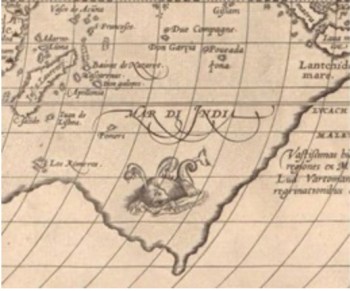
Frans Hogenberg and Abraham Ortelius, Typvs Orbis Terrarvm, detail (Antwerp: Abraham Ortelius, 1584?) https://www.loc.gov/item/2017585795/
‘Here be dragons’, a trope used by Western early modern mapmakers to signify uncharted or dangerous territories may also describe attitudes to digital approaches in art history within certain circles. But if we aim to understand the histories of art markets at scale and over space and time, we must set sail. This talk will chart potential future directions for art market studies and provenance research, exploring both possibilities and challenges offered by digital methods. To frame this exploration, the talk will draw on complex issues raised by the transatlantic art trade at the turn of the last century and its key nodes of New York and London. In particular, it is concerned with the role played by dealers, such as Boussod, Valadon & Cie, Knoedler, Yamanaka & Co., and Hagop Kevorkian, and the different forms of archival evidence we can deploy to study this question, ranging from paper documents produced at the time—stockbooks, exhibition catalogues and reviews, correspondence, photographs, etc.—to today’s digital databases and online museum catalogues.
Anne Helmreich is Associate Director, Getty Foundation, and formerly Associate Director, Digital Initiatives, Getty Research Institute, both of the J. Paul Getty Trust. She has also served as Dean, TCU College of Fine Arts; Senior Program Officer, The Getty Foundation; and Associate Professor of Art History and Director, Baker-Nord Center for the Humanities, Case Western Reserve University. Her current research focuses on the history of the art market and the productive intersection of the digital humanities and art history. Her essay “The Art Market as a System, Florence Levy’s Statistics” appeared in American Art in Fall 2020. “Purpose-built: Duveen and the Commercial Art Gallery,” co-authored with Edward Sterrett and Sandra van Ginhoven, was published by Nineteenth-Century Art Worldwide in Summer 2021. She and Pamela Fletcher recently co-authored “Digital Methods and the Study of the Art Market” for The Routledge Companion to Digital Humanities and Art History (Routledge, 2020) and the epilogue to Art Crossing Borders: The Internationalisation of the Art Market in the Age of Nation States, 1750–1914 (Brill, 2019).
The lecture will also take place via Zoom; you can attend via the following link:
https://us02web.zoom.us/j/85659345839?pwd=UmFZYU0xN1NxMGJ1MjlQM054NXgvZz09
Meeting-ID: 856 5934 5839 | Password: 148258
Online Talk | Database Presentation: Black People in European Sculpture
Presented by the Public Statues and Sculpture Association:
Vicky Avery, Database Presentation: Black People in European Sculpture, 1450 to the Present Day
Online, Public Statues and Sculpture Association, Wednesday, 4 May 2022, 1.30pm
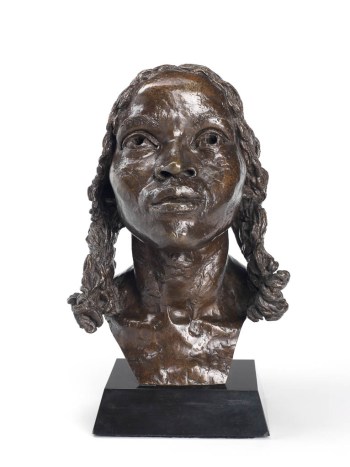
Jacob Epstein, First Portrait of Roma of Barbados (detail), ca. 1932, bronze (Cambridge: Fitzwilliam Museum, M.1-1945).
Vicky Avery is keen to share her new sculpture mapping database with the PSSA in order to get critical feedback on its pilot phase—which focuses exclusively on sculpture located in the UK—before she applies for further funding. The database aims to increase expert and lay understanding of, and engagement with, sculptures of Black people created from 1450 onwards by artists born in, or based in, the continent of Europe. This is a neglected but important category of Western art, which needs urgent research and reinterpretation.
Dr Victoria Avery has been Keeper of the Applied Arts Department at the Fitzwilliam Museum, University of Cambridge, since 2010, prior to which she was Associate Professor in the History of Art Department, University of Warwick. Vicky has researched, lectured, and published widely on all aspects the applied arts, especially on European sculpture and Italian Renaissance bronzes, most recently editing the monograph Michelangelo: Sculptor in Bronze. She has also been responsible for co-curating several ambitious, interdisciplinary, research-led collaborative exhibitions at the Fitzwilliam, most recently Feast & Fast: The Art of Food in Europe, 1500–1800. She is currently co-curating a legacies-related exhibition, Enslavement and Resistance: Cambridge’s World History (working title, 25 July 2023 — 7 January 2024).
Exhibition Programming | Jacques Louis David: Radical Draftsman
I noted the exhibition in February but included no programming information. Perrin Stein’s introduction is still available to watch on YouTube, and Daniella Berman will focus on a selection of works in her upcoming “Conversations with a Scholar” sessions. Berman will also lead three public tours. –CH
Virtual Opening | Jacques Louis David: Radical Draftsman
Online, 28 February 2022 [and still available via YouTube]
Join Perrin Stein, Curator, in the Department of Drawings and Prints, for a virtual tour of Jacques Louis David: Radical Draftsman, the first exhibition devoted to works on paper by the celebrated French artist. David navigated vast artistic and political divides throughout his life—from his birth in Paris in 1748 to his death in exile in Brussels in 1825—and his iconic works captured the aspirations and suffering of a nation, while addressing timeless themes that continue to resonate today. Through the lens of his preparatory studies, the exhibition looks beyond his public successes to chart the moments of inspiration and the progress of ideas. Visitors will follow the artist’s process as he gave form to the neoclassical style and created major canvases that shaped the public’s perceptions of historical events in the years before, during, and after the French Revolution. Organized chronologically, the exhibition features more than eighty drawings and oil sketches—including rarely loaned or newly discovered works—drawn from the collections of The Met and dozens of institutional and private lenders.
From The Met:
Conversation with a Scholar | Daniella Berman on Jacques Louis David: Radical Draftsman
The Metropolitan Museum of Art, New York, Mondays, 11 and 25 April 2022, 11.00am
Join Daniella Berman for a lively 30-minute dialogue, exploring a selection of objects from the exhibition Jacques Louis David: Radical Draftsman. Free with museum admission. Please note: Limited space is allotted on a first come, first served basis.
In addition, Berman will lead three public tours of the exhibition on the following dates:
Friday, 22 April 2022, 2.00pm
Friday, 6 May 2022, 10.30am
Monday, 9 May 2022, 2.00pm
Daniella Berman, a doctoral candidate in art history and archaeology at NYU’s Institute of Fine Arts, is the 2019–20 Marica and Jan Vilcek Fellow in the Department of Drawings and Prints at The Met.
Online Talk | Cabinet Cup and Stand by Thomas Baxter
From Rienzi:
Misty Flores | Worcester Cabinet Cup and Stand by Thomas Baxter
Online, Rienzi, MFAH, Houston, Tuesday, 19 April 2022, 1pm (Central Time)
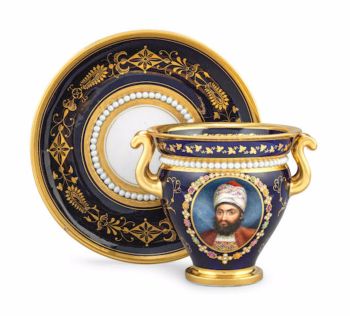
Worcester Porcelain Manufactory, Thomas Baxter, Cabinet Cup and Stand, ca. 1814–16, porcelain (Museum of Fine Arts, Houston / Photograph: Bonham, 2021).
This Worcester porcelain cup depicts Mirza Abu’l Hassan Khan (1776–1845), the Persian ambassador sent to the English court in 1809. A figure of much fascination while in England, he was the subject of prints and poetry and was even depicted on porcelain objects. Find out more about this Cabinet Cup and Stand, newly acquired by Rienzi, during this free 30-minute talk with assistant curator Misty Flores. Live via Zoom.
Registration is available here»
Online Panels | Museum Careers
Presented by the Yale Center for British Art:
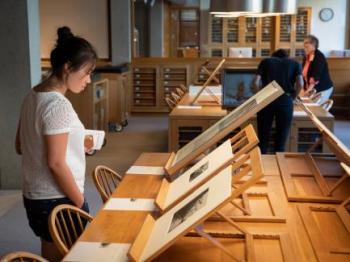
Visitors in the Study Room, YCBA (Photo by Harold Shapiro).
This two-part online discussion is for graduate students from any discipline who are interested in pursuing a professional career in museums. In each session, Yale alumni who work in the field share their personal experiences and professional opinions. The goal is to better equip individuals for a museum position by discussing the range of specialist professions that support museums and sharing information about how to be competitive in the job market. There will be opportunities to ask questions with the online Q&A feature.
Attendees must register to receive the link.
Yale Alumni Panels: Museum Careers and Trajectories
Friday, 8 April 2022, 11.00am (ET)
This session addresses personal career trajectories to highlight the diversity of pathways into museums and the range of positions related to audience outreach, curatorial practice, collections, and programming. Each panelist shares their current duties and responsibilities and how their position fits into their wider career goals and intellectual life. The discussion also touches on how to prioritize the skills and experience needed to be competitive in the job market, such as publishing scholarly research, gaining work experience, presenting at conferences, networking, interning, and applying to professional or fellowship positions.
Panelists
• Ashley James (Yale PhD 2021, English Literature, African American Studies, and Gender Studies), Associate Curator, Contemporary Art, Solomon R. Guggenheim Museum
• Elizabeth Mattison (Yale MA 2014, History of Art), Andrew W. Mellon Assistant Curator of Academic Programming, Hood Museum of Art
• Rebecca Peabody (Yale PhD 2006, History of Art and African American Studies), Head of Research Projects & Programs, Getty Research Institute
Moderator
• Laurel Peterson (Yale PhD 2018, History of Art), Assistant Curator of Prints and Drawings, Yale Center for British Art
To join us for this program, please register here»
◊ ◊ ◊ ◊ ◊
Yale Alumni Panels: Museums and the Hiring Process
Friday, 22 April 2022, 11.00am (ET)
This session focuses on the process of applying, interviewing, and securing a position within the museum field. Panelists reflect on their own successes and share insights into the recruitment process at their respective institutions. The conversation also covers some of the effective strategies that candidates have used and touches on resources and training options.
Panelists
• Desirée Gordon (Yale BA 2002, American Studies and Cultural Anthropology), Director of Programs and Strategy, Brooklyn Arts Council
• Megan Heuer (Yale BA 2000, Women’s and Gender Studies), Director of Public Programs and Public Engagement, Whitney Museum of American Art
• Julie Ludwig (Yale MA 1996), Associate Archivist, The Frick Collection
Moderator
• James Vanderberg, Educator, High School, College, University, and Community Engagement, Yale Center for British Art
To join us for this program, please register here»
Online Talk | Sarah Grandin on Drawings Engraved
This Thursday from The Clark:
Sarah Grandin | A Market for Imitation: Engraving Drawing in Eighteenth-Century France
Online, The Clark Art Institute, Williamstown, Massachusetts, 7 April 2022, noon (ET)
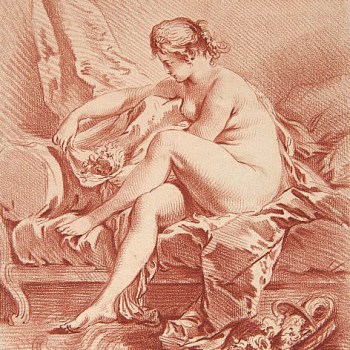
Gilles Antoine Demarteau, after François Boucher, Femme nue, after 1757, engraving in crayon manner with roulette on laid paper.
Sarah Grandin leads a virtual lunchtime talk exploring works on paper from the Clark’s collection, showcasing the role prints played in making drawing more accessible to the public in eighteenth-century France. After Grandin’s (recorded) presentation of a selection of works by Jean-Honoré Fragonard, François Boucher, Jean-Antoine Watteau, and others, she will join in a live Q&A session. Presented via Zoom and Facebook Live, the event is free, but advance registration for the Zoom transmission is required.
Sarah Grandin holds a PhD in the History of Art and Architecture from Harvard University (awarded in 2021) and is the Clark-Getty Paper Project Curatorial Fellow (2020–22) at The Clark Art Institute.
This program is made possible with support from the Getty Foundation through The Paper Project initiative.
Lecture | Anne Lafont, Making Ornamental Africa
From the BGC:
Anne Lafont, Making Ornamental Africa: An Enlightenment Process
The Iris Foundation Awards Lecture
Online and in-person, Bard Graduate Center, New York, 26 April 2022, 6pm
Could it be that in the geographical conception of art developed in Enlightenment Europe, the primary role and the function of the so-called Black Continent was one of ornament? Or, on the contrary, did the aesthetic conception elaborated by the European Enlightenment deprive Africa of artistic potentiality? These two opposing hypotheses coexist in eighteenth-century artworks and texts. The talk will focus on some objects whose material, form, argument, use and reception invite us not only to historicize the notion of African art, but also to identify the registers of categorization specific to this pivotal eighteenth-century moment, when both anthropology and aesthetics were invented. African objects, as well as European objects inspired by the African presence in Europe, rub up against the emergence of these two disciplines, which intersected around the importance of the senses and sight, in particular.
Registration is open for a limited in-person audience. Bard Graduate Center requires proof of vaccination and photo identification to enter the building. Guests are required to wear masks regardless of vaccination status. This talk will also be available on Zoom (registration is available here). A link will be circulated to registrants by 4pm on the day of the event. This event will be live with automatic captions.
Anne Lafont is an art historian and professor at the École des hautes études en sciences sociales. She is interested in the art, images, and material culture of France and its colonial empire in the modern era, as well as in historiographical questions related to the notion of African art. She has published on art and knowledge in an imperial context, on gender issues in the discourse on art in the 18th and 19th centuries, and her most recent book is entitled L’Art et la Race: L’Africain (tout) contre l’oeil des Lumières. It was awarded the 2019 Fetkann Maryse Condé Literary Prize and the 2020 Vitale and Arnold Blokh Prize. Anne Lafont participated, as a member of the scientific committee, in the Musée d’Orsay exhibition The Black Model (2019). In 2021, she was awarded a residential fellowship from the cultural services of the French Embassy in the United States, the Villa Albertine, and she serves, for the academic year 2021–22, as the Robert Sterling Clark Visiting Professor of Art History at Williams College (Massachusetts).










 Enfilade
leave a comment