Lunch Lecture | Ulrich Leben on German Cabinetmakers in Paris
Upcoming at the BGC (the lecture is scheduled to be livestreamed; see the website for details). . .
Ulrich Leben, Cabinetmakers of German Origin in Eighteenth-Century Paris
A Chapter in European History of Migration and Transfer of Knowledge and Craft in the Age of Enlightenment
Bard Graduate Center, New York, 9 October 2017
Ulrich Leben will be giving a Brown Bag Lunch presentation on Monday, October 9, at 12:15pm. His talk is entitled “Cabinetmakers of German Origin in Eighteenth-Century Paris: A Chapter in European History of Migration and Transfer of Knowledge and Craft in the Age of Enlightenment.”
The fact that a large number of cabinetmakers working in Paris during the eighteenth century were of German origin is well known. It is therefore surprising that there has never been research on the lives and work of these more than one hundred craftsmen. This talk will present various aspects of a project currently being undertaken by Dr. Ulrich Leben and Miriam Schefzyk on these craftsmen and provide insight into archive-based research in France and abroad exploring questions regarding social, economic, and cultural circumstances. A major goal of this project is the publication of a dictionary of these craftsmen that will be a tool for further work in the field.
E. Ulrich Leben is an independent art historian based in Paris and Associate Curator for the Rothschild Collection at Waddesdon Manor in Buckinghamshire. He teaches classes on French and German decorative arts and interior architecture for the European programs of Parsons, The New School. From 2010 to 2015 he was Visiting Professor and Special Exhibitions Curator at Bard Graduate Center, where in 2013 he co-curated the exhibition Salvaging the Past: Georges Hoentschel and French Decorative Arts from The Metropolitan Museum of Art. After an apprenticeship as a cabinetmaker in Germany he studied the History of Art at the École du Louvre in Paris and received his PhD at the Rheinische Friedrich Wilhelm Universität in Bonn. He is the author of numerous articles and exhibition catalogues on the history of French and German interiors and furniture design.
Lecture | Basile Baudez on Color in Architectural Drawings
Upcoming at the BGC (the lecture is scheduled to be livestreamed; see the website for details). . .
Basile Baudez, Inessential Colors: A History of Color in Architectural Drawings, 16th–19th Centuries
Bard Graduate Center, New York, 3 October 2017
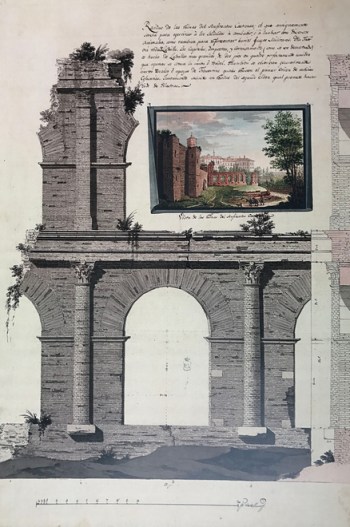
Isidro Velázquez (1765–1840), Roma, Anfiteatro castrense. Alzado, sección y vista de sus ruinas, 1792–96, 48.5 × 32.5cm (Madrid, Biblioteca Nacional Dib/13/5/51).
Basile Baudez will deliver a Françoise and Georges Selz Lecture on Eighteenth- and Nineteenth-Century French Decorative Arts and Culture on Tuesday, October 3, at 6pm. His talk is entitled “Inessential Colors: A History of Color in Architectural Drawings, 16th–19th Centuries.”
Architectural historians have focused on the history of drawing primarily as a project design tool. By applying the methods of art history, this talk traces color as a key player in the long history of rivalry and exchange between European traditions in architectural drawing and practice. While Italian Renaissance drawings were largely monochrome and developed their conventions under pressure from engravers, seventeenth-century European drawings are characterized by a contrast between a colorful German and Dutch world—developed around architect-painters’ designs that influenced French and Spanish draughtsmanship—and a still largely monochrome tradition in Italy and England. At the end of Louis XIV’s reign, French architects adopted color conventions taken from engineers, largely for informational purposes. In the middle of the eighteenth century, however, a color revolution took place, one in which a new generation of architects who were working alongside painters developed a wide chromatic range that was no longer limited to informing the worker but to persuading academic juries and gaining commissions. This eighteenth-century French employment of color laid the foundation for Beaux-Arts architectural drawings in the first half of the nineteenth century, at a moment when English architectural drawings also adopted color in response to the English watercolor movement.
Since 2007, Basile Baudez has been Maître de Conférences in heritage studies and architectural history at Université Paris-Sorbonne, Paris IV. For the 2015–16 year he was a Visiting Scholar in the History of Art Department at the University of Pennsylvania. His research has been supported by fellowships from CASVA at the National Gallery of Art and the Getty Research Institute. He received his PhD from the Ecole Pratique des Hautes Études in 2006 and published his dissertation at the Presses Universitaires de Rennes under the title Architecture et tradition académique au siècle des Lumières. His main areas of research are the history of architectural schools and the Beaux-Arts system as well as the history of architectural representation in the Western world. He co-edited a monograph on Les Hôtels de la Guerre et des Affaires étrangères à Versailles (Paris: Chaudun, 2010) and a volume Chalgrin, architectes et architecture entre l’Ancien Régime et l’Empire (Bordeaux: Blake and Cie, 2016). He has published extensively, including in La Revue de l’Art, Metropolitan Museum Journal, Journal of Art Historiography, Bulletin Monumental, The Burlington Magazine, and Livraisons d’Histoire de l’Architecture. He curated the exhibition À la Source de l’Antique (2011) at the Ecole des Beaux-Arts, devoted to Italian, Russian, and French neo-classical architectural drawings, and he co-curated, with Nicholas Olsberg, the exhibition Civic Utopia, France 1765–1837 (2016–17) at the Courtauld Institute of Art. His current book project addresses the history of color in architectural representation from the Renaissance to the nineteenth century.
Lecture Tour | Wolf Burchard on Charles Le Brun
 Wolf Burchard, The Sovereign Artist: Charles Le Brun and the Image of Louis XIV
• Charleston Library Society, Charleston
Tuesday, 26 September 2017, 6:00
• Institute of Classical Architecture and Art / Boston Design Center
Friday, 29 September 2017, 2:00
• Institute of Classical Architecture and Art / New York School of Interior Design
Thursday, 5 October 2017, 6:00
• National Gallery of Art, Washington D.C.
Friday, 6 October 2017, 3:30
• The Bard Graduate Center, New York
Tuesday, 10 October 2017, 12:15
King Louis XIV’s favorite artist, Charles Le Brun (1619–1690) has often been described as a “dictator of the arts in France”—a view Burchard reassesses in his new book, The Sovereign Artist (Holberton 2017). Le Brun was a gifted and versatile artist, an excellent painter and designer of tapestries, sculpture, architecture, and furniture. As Louis XIV’s principal painter and director of the Gobelins manufactory, he sought to translate the Sun King’s claim for absolute power into a visual form. This lecture will explore Le Brun’s different fields of activities and his relationship to the great monarch.
Wolf Burchard, an art and architectural historian and a specialist on seventeenth- and eighteenth-century royal patronage, is the Furniture Research Curator at Britain’s National Trust. From 2009 to 2014 he was Curatorial Assistant at the Royal Collection Trust, where he assisted Desmond Shawe-Taylor, Surveyor of The Queen’s Pictures, in curating The First Georgians: Art & Monarchy, 1714–1760, an exhibition held at The Queen’s Gallery, Buckingham Palace, to commemorate the tercentenary of George I’s accession to the British Throne. He studied history of art and architecture at the universities of Tübingen and Vienna as well as the University of London, where he earned the MA and PhD at the Courtauld Institute of Art. He regularly publishes and lectures on art and architectural patronage at the British, French, and German courts. He is a Trustee of the Georgian Group and a member of the Committee of the Society for Court Studies and of the Events Committee and Editorial Panel of the Furniture History Society.
Seminar | The Interiors of Jean de Jullienne’s Paintings Collection
From the seminar flyer:
Seminars in the History of Collecting
Laura Langelüddecke | Lieux de Collection: The Interiors of Jean de Jullienne’s Paintings Collection
The Wallace Collection, London, 26 June 2017
This seminar focuses on entrepreneur, amateur, and collector Jean de Jullienne (1686–1766), whose comprehensive activities are paradigmatic of the heyday of private collecting during the Régence period. Chiefly known for his substantial collection of Dutch, Flemish, and French paintings, Jullienne also spent lavishly on furniture and sculpture, as well as porcelain, lacquer objects, and other exotic curiosities. Director of the Manufacture royale des Gobelins, the leading producer of tapisseries and other luxurious furnishings, his private hôtel adjacent to the manufactory was at the heart of a dynamic artistic milieu that defined the style of contemporary fashionable interiors.
While recent research on Jullienne and fellow collectors of his time has focused on the identification of individual paintings and the social and professional networks involved in the formation of these cabinets, little attention has been given to the interiors which housed these works. Understanding the collection as an intrinsic part of the domestic realm, this seminar will investigate the creation and modification of domestic spaces to accommodate works of art in early eighteenth-century Paris. Taking into account archival evidence as well as contemporary writings on architecture and interior design, the paper will explore the principles according to which an interior intended for the display of paintings was conceived and how the juxtaposition of different colours, textures, and material qualities was used to impact the sensory effect of the presentation.
The Wallace Collection Lecture Theatre, Monday, 26 June, 5:30pm (free).
Laura Langeluddecke is a PhD candidate at the University of Bonn and Assistant Curator at The Wallace Collection.
Lecture | John Chu on Philip Mercier
From the Paul Mellon Centre:
John Chu, ‘Newly Invented Original Paintings’:
Philip Mercier and the Origins of the British Fancy Picture
Paul Mellon Centre for Studies in British Art, London, 13 June 2017
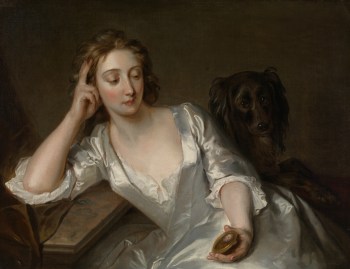
Philip Mercier, Portrait of Margaret (Peg) Woffington, oil on canvas (London: The Garrick Club).
The Huguenot painter Philip Mercier (1689–1760) was at the vanguard of one of the most intriguing of eighteenth-century British art forms: the fancy picture. Playful in tone and fluttering in execution, Mercier’s fancies typically depict a non-too-serious world of modern men, women and children living a life of fashion, pleasure and the senses. Though manifestly trivial in theme and decorative by design, these are often nonetheless rather imposing works of art, presenting their life-scale characters close to the viewer so as to evoke a palpable sense of presence. Mercier’s role in adapting Continental prototypes of this kind of picture for the diversifying and growing British art market has long been recognised. This talk offers an enhanced version of this origin story, setting the imagery of this first wave of fancies in the context of extraordinary expansion in the British consumption of fine and modish goods of all kinds. It also takes a close look at how, as a maker of novel luxuries, Mercier both profited by and fell victim to the very world of fleeting fashions that he took as his primary subject, exposing the tribulations that lurked beneath the surface of the British fancy picture during its light-hearted beginnings.
John Chu is Assistant Curator of Pictures and Sculpture for the National Trust and has taught at the Courtauld Institute of Art and the University of Reading. He has published on the art of Thomas Gainsborough, Joshua Reynolds, and French artists working in eighteenth-century Britain, as well as on various dimensions of the National Trust’s picture collections. He read English literature at the University of Cambridge before pursuing postgraduate studies in the history of art at the Courtauld. Having specialised in eighteenth-century British and French art during his masters’ degree, he gained his doctorate in 2015 for ‘The Fortunes of Fancy Painting in Eighteenth-Century England’. He is currently writing a book on the same subject with a Postdoctoral Fellowship from the Paul Mellon Centre for Studies in British Art.
The Fellows Lunch Series is a series of free lunchtime research talks given by recipients of Paul Mellon Centre Fellowships. All are welcome but please book a ticket in advance. Tuesday, 13 June 2017, 12:30–2:00pm.
New Book | Collecting the World: Hans Sloane
From the Royal College of Physicians:
James Delbourgo, The Life and Curiosity of Hans Sloane
Royal College of Physicians, London, 7 June 2017
This lecture by Professor James Delbourgo explores the astonishing story of Sir Hans Sloane, a young Irish doctor who became one of the greatest physicians, collectors, and figures of the eighteenth century. Wednesday, 7 June 2017, 18:00–20:00. Please note that places for this free event are extremely limited and advance booking is essential. For additional details, please see the Royal College of Physicians website.
◊ ◊ ◊ ◊ ◊
From Harvard UP:
James Delbourgo, Collecting the World: Hans Sloane and the Origins of the British Museum (Cambridge: Belknap Press, 2017), 544 pages, ISBN 978 06747 37334, $35 / £28 / €32.
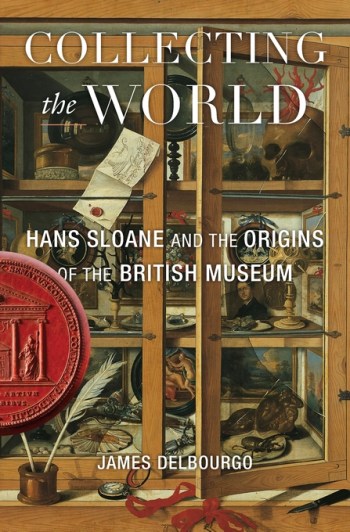 In 1759 the British Museum opened its doors to the general public—the first free national museum in the world. James Delbourgo’s biography of Hans Sloane recounts the story behind its creation, told through the life of a figure with an insatiable ambition to pit universal knowledge against superstition and the means to realize his dream.
Born in northern Ireland in 1660, Sloane amassed a fortune as a London society physician, becoming a member of the Whig establishment and president of the Royal Society and Royal College of Physicians. His wealth and contacts enabled him to assemble an encyclopedic collection of specimens and objects—the most famous cabinet of curiosities of its time. For Sloane, however, collecting a world of objects meant collecting a world of people, including slaves. His marriage to the heir of sugar plantations in Jamaica gave Sloane access to the experiences of planters and the folkways of their human property. With few curbs on his passion for collecting, he established a network of agents to supply artifacts from China, India, North America, the Caribbean, and beyond. Wampum beads, rare manuscripts, a shoe made from human skin—nothing was off limits to Sloane’s imagination. This splendidly illustrated volume offers a new perspective on the entanglements of global scientific discovery with imperialism in the eighteenth century. The first biography of Sloane based on the full range of his writings and collections, Collecting the World tells the rich and complex story of one of the Enlightenment’s most controversial luminaries.
James Delbourgo is Associate Professor of History at Rutgers University.
◊ ◊ ◊ ◊ ◊
C O N T E N T S
List of Illustrations
List of Maps
Introduction: The Original Sloane Ranger
I. Empire of Curiosities
1 Transplantation
2 Island of Curiosities
3 Keeping the Species from Being Lost
II. Assembling The World
4 Becoming Hans Sloane
5 The World Comes to Bloomsbury
6 Putting the World in Order
7 Creating the Public’s Museum
Conclusion: The Man Who Collected the World
Acknowledgements
Notes
Bibliography
Index
Exhibition | Showstoppers: Silver Centrepieces

Thomas Pitts, Epergne, London, 1759
(Leeds Museums and Galleries)
◊ ◊ ◊ ◊ ◊
Opening this weekend at Temple Newsam:
Showstoppers: Silver Centrepieces
Temple Newsam House, Leeds, West Yorkshire, 13 May — 16 October 2017
Curated by Rachel Conroy
Silver is a seductive, glamorous material and the centrepiece is one of its most wondrous uses. Showstoppers takes two iconic eighteenth-century centrepieces from Temple Newsam’s renowned historic silver collection and presents them alongside contemporary masterpieces by artists Junko Mori and Miriam Hanid. The exhibition showcases the continuation and reinvention of traditional silversmithing techniques and celebrates women in silver, as makers and owners.
S A T U R D A Y , 1 0 J U N E 2 0 1 7
Silversmithing Demonstration
An exciting opportunity to see artist silversmith Miriam Hanid demonstrating chasing and engraving in the Great Hall. 11.00–12.00 and 12.30–1.30. Free with general admission.
Surtouts, Epergnes and Grands Platts Menages: Silver and Ceramic Centrepieces
Join James Lomax for a survey of the wondrous array of silver and ceramic centrepieces produced in England during the eighteenth century. 2.00–3.00. Free with general admission, but booking required.
Exhibition Tour
Join exhibition curator, Rachel Conroy, for a tour of the exhibition. 3.00–3.45. Free with general admission, but booking required.
O T H E R E V E N T S
Artist Talk: Miriam Hanid
9 June, 2.00–3.00
Miriam will explain how she started her silversmithing journey and how her capabilities have now developed into creating large commissions for a range of collectors and private clients. Followed by a tour of the exhibition. £7 (including admission), booking required.
Silver and Yachts: The Glamorous Possessions of Women at Temple Newsam
5 July, 2.00–3.00
Curator Rachel Conroy will tell the stories behind some of the most luxurious objects in the collection that were owned by or connected to women. Free with general admission, but booking required.
Shining Silver Commissions from the Sheffield Assay Office Collection: The Work of Junko Mori
16 September, 2.00–3.00
Emma Paragreen (Sheffield Assay Office) will give a brief introduction to the history and work of the Sheffield Assay Office and then focus on two examples of work commissioned by Sheffield Assay Office from Junko Mori. Free with general admission, but booking required.
An Eye for Design: Rosalinde Gilbert, Fashion Designer and Collector
14 October, 2.00–3.00
In this talk, Hanne Faurby (V&A) will introduce Rosalinde Gilbert, a fashion designer working in wartime London. Charlotte Johnson (V&A) will then discuss the Gilbert Collection, formed by Rosalinde and her husband Arthur, examining how Rosalinde’s background in design may have informed their collecting practices. Free with general admission, but booking required.
Seminar | Collecting Ancien Régime France from Boston
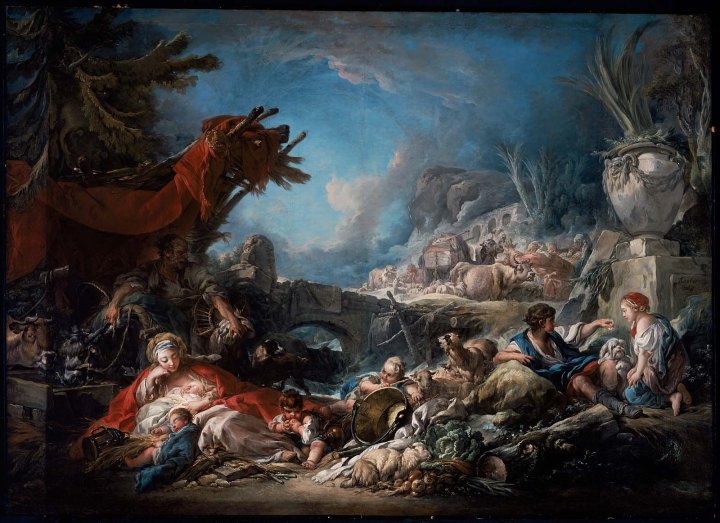
François Boucher, Halt at the Spring, 1765, oil on canvas, 82 × 114 inches
(Boston: MFA, 71.2)
◊ ◊ ◊ ◊ ◊
Seminars in the History of Collecting
David Pullins | Collecting Ancien Régime France from Boston between 1789 and 1848
The Wallace Collection, London, 22 May 2017
This seminar addresses the opportunities provided by revolutions in France for Boston collectors James Swan and Edward Preble Deacon—Swan in 1789 and Deacon in the 1840s—to gather French royal furnishings and paintings of the highest calibre. Swan (1754–1831) served as the official United States agent to the French revolutionary government between 1794 and 1796. He supplied grain, ammunition and sundry goods for which he was willing to receive, in lieu of cash, confiscated royal furniture, textiles and metalwork. At the end of the 1840s, at a time of political unrest in France, Deacon (1813–1851) acquired for his Boston home François Boucher’s monumental Halt at the Spring (1765) and Return from the Market (1767) and exceptional panelling designed by Claude-Nicolas Ledoux for the hotel Montmorency (c. 1770), which had been demolished in 1848.
The Swan and Deacon collections come remarkably early in the history of collecting ancien régime material culture in the Americas and provided the foundation of the European holdings of the Museum of Fine Arts, Boston. In this seminar, I propose to look in particular at how exemplary works from ancien régime France were installed in expressly built Boston interiors and how these collections were perceived in early America through an examination of journals and the popular press. Embodying a level of craftsmanship to which early American industrialists could only aspire, they also held a peculiar political status as plunder from a royalist faction—albeit one that had, within living memory, helped the United States secure its independence from the British monarchy.
The Wallace Collection Lecture Theatre, Monday, 22 May, 5:30pm.
Dr David Pullins (History, Theory Criticism, Department of Architecture, Massachusetts Institute of Technology and The Frick Collection).
Conference | Women Artists and Patrons at the Late Medici Court
From H-ArtHist:
A Legacy of Ladies: Women Artists and Patrons at the Late Medici Court
The Medici Archive, Palazzo Alberti, 21 April 2017
Organized by Sheila Barker, Amy Fredrickson, and Julie James
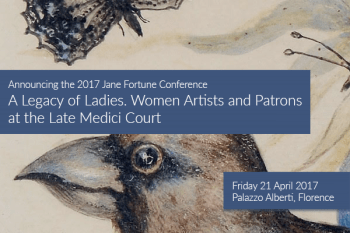 The 2017 Jane Fortune Conference examines the deep imprint that women left on the artistic ferment of Baroque Florence, beginning under the regency of Archduchess Maria Maddalena of Austria and continuing through the last years of Electress Palatine. To do so, it will explore the cultural agency of both female patrons at the Medici court and the women artists who flourished there, from the mid seventeenth century to the early eighteenth century.
Only in recent years has attention been given to the complex web of female social patterns at the late Medici court. Vittoria della Rovere has been acknowledged as a key patron, yet her successors and their own patronage patterns have yet to be fully explored. The physical spaces used by noble women and their female households throughout Europe are essential to this study. Here, both heraldry and the displays of art collections helped to demarcate these spaces. Thanks to their talents, some low-born women were given a degree of access to female courts. Exacting standards of moral conduct were expected of them, mitigating against their social station. Juxtaposing women painters with the irreproachable embroiders and lacemakers and the potentially licentious singers and actresses opens a discussion about the social and behavioral aspects of female creativity in early modern Florence.
P R O G R A M M E
10:00 Introductory Remarks
10:15 Keynote Address
• Adelina Modesti, Women Artists at the Medici Court of Grand Duchess Vittoria della Rovere (1622–1694): Painters, Pastellists, Lacemakers, and Embroiderers
11:15 Morning Session
• Ilaria Hoppe, Uno spazio di potere femminile: Villa del Poggio Imperiale, residenza di Maria Maddalena d’Austria
• Silvia Benassai, ‘Io ho grande ardire, e non temo niente’: Violante Beatrice di Baviera, mecenate nella Toscana degli ultimi Medici
• Laura Windisch, Between Power and Privacy: Anna Maria Luisa de’ Medici’s Patronage at Villa La Quiete
• Laura Cirri, Le Granduchesse di Toscana: la loro rappresentazione attraverso l’araldica
1:00 Lunch
14:45 Afternoon Session
• Lisa Goldenberg Stoppato, Agnese Dolci: New Attributions
• Sheila Barker, Suor Teresa Vitelli’s Natural History Paintings: Women Artists and the Scientific Culture of the Early Enlightenment
• Julie James, A Nun Artist at the Medici Court: The Religious Pastel Works of Suor Teresa Vitelli
• Amy Fredrickson, Giovanna Fratellini: Motives, Patronage, and Success within the Medici Court System
• Poiret Masse, Violante Siries Cerroti at the Medici Court, ca. 1724–37
• Francesca Fantappiè, Donne in carriera: attrici, cantanti, musiciste alla corte medicea
Moderators: Alessio Assonitis, Elisa Acanfora, Susanna Cecilia Berger, and Catherine Turrill Lupi
Smithsonian American Art Museum Fellows Lectures, 2017
I’ve noted details for the session most relevant to the eighteenth century; the full schedule is available via the posting at H-ArtHist. –CH
Smithsonian American Art Museum Fellows Lectures
Smithsonian American Art Museum, Washington, D.C., 3–5 May 2017
The Smithsonian American Art Museum cordially invites you to attend three afternoons of lectures delivered by its research fellows. The talks will be held in the museum’s McEvoy Auditorium, located at 8th and G Streets NW, Washington, D.C. This event is open to the public, and no reservations are required. The talks will be available through a simultaneous webcast, available here. A wine reception will conclude the series on Friday evening. For further information, please e-mail SAAMFellowships@si.edu.
Wednesday, 3 May 2017, 2:00–3:40
Moderator: William H. Truettner (Curator Emeritus, Smithsonian American Art Museum)
• Emily Thames (Joe and Wanda Corn Predoctoral Fellow, Florida State University), Rendering Reform, Rendering Empire: José Campeche as Draftsman in Late Eighteenth-Century San Juan, Puerto Rico
• Jennifer Chuong (Predoctoral Fellow, Harvard University), Bedeviling the Stamp Act: Materiality and Protest in Revolutionary America [as Chuong notes below in the comments: “due to some late-breaking research finds, I will actually be talking about a different Revolutionary-era printer: that is, Benjamin Franklin, and his interest in paper marbling.”]
• Patricia Johnston (Terra Foundation Senior Fellow in American Art, College of the Holy Cross), The China Trade and the Classical Tradition in Federal America










 Enfilade
leave a comment