New Book | Slavery and the Invention of Dutch Art
From Duke UP, with a talk on Thursday at BGC:
Caroline Fowler, Slavery and the Invention of Dutch Art (Durham: Duke University Press, 2025), 176 pages, ISBN: 978-1478028093 (hardcover), $125 / ISBN: 978-1478031321 (paperback), $30.
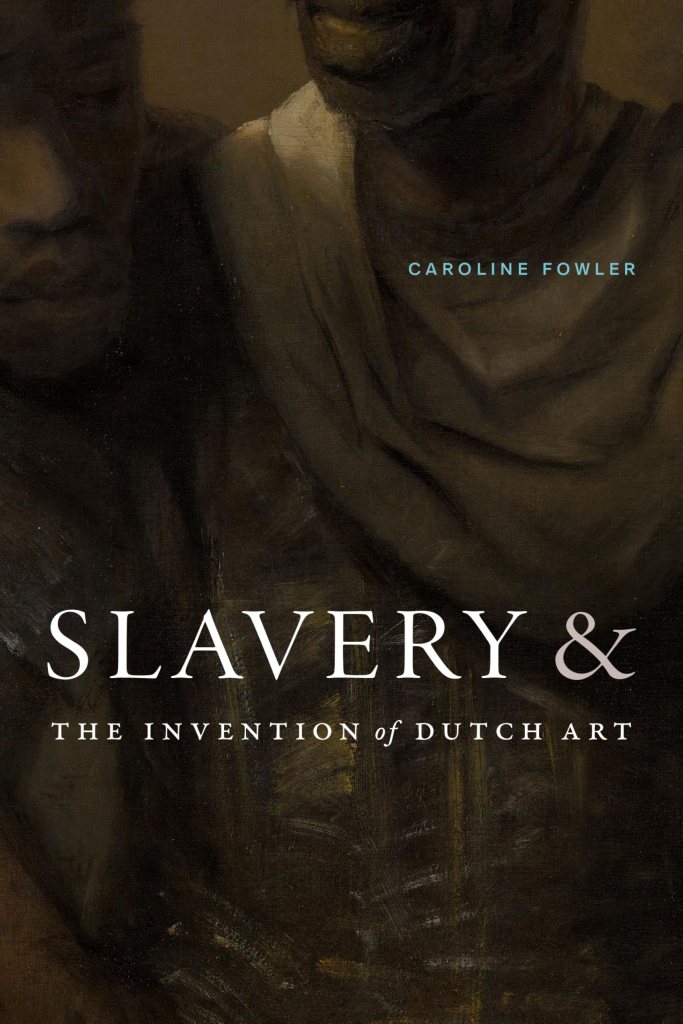 In Slavery and the Invention of Dutch Art, Caroline Fowler examines the fundamental role of the transatlantic slave trade in the production and evolution of seventeenth-century Dutch art. Whereas the sixteenth-century image debates in Europe engaged with crises around the representation of divinity, Fowler argues that the rise of the transatlantic slave trade created a visual field of uncertainty around picturing the transformation of life into property. Fowler demonstrates how the emergence of landscape, maritime, and botanical painting were deeply intertwined with slavery’s economic expansion. Moreover, she considers how the development of one of the first art markets was inextricable from the trade in human lives as chattel property. Reading seventeenth-century legal theory, natural history, inventories, and political pamphlets alongside contemporary poetry, theory, and philosophy from Black feminism and the African diaspora, Fowler demonstrates that ideas about property, personhood, and citizenship were central to the oeuvres of artists such as Rembrandt van Rijn, Hercules Segers, Frans Post, Johannes Vermeer, and Maria Sibylla Merian and therefore inescapably within slavery’s grasp.
Caroline Fowler is Starr Director of the Research and Academic Program at the Clark Institute. She is the author of The Art of Paper: From the Holy Land to the Americas and Drawing and the Senses: An Early Modern History.
c o n t e n t s
Acknowledgments
Introduction: Transubstantiation across Atlantic Worlds
1 Art Markets and Futures Speculation
2 Seascapes and Landscapes
3 Monuments and Architectural Painting
4 Domestic Interiors and Natural History
Conclusion: Historiography and Race
Notes
Bibliography
Index
◊ ◊ ◊ ◊ ◊
Slavery and the Invention of Dutch Art | A Conversation with Caroline Fowler and Helga Davis
Bard Graduate Center, New York, 13 February 2025, 6pm
Caroline Fowler will speak with renowned artist and podcaster Helga Davis about the book Slavery and the Invention of Dutch Art, thinking about the role of poetics in writing history, the importance of Black feminism in rethinking art history, and the ways in which ‘Old Master’ painting continues to impact how the world is seen and interpreted.
Registration is available here»
New Book | The Empire’s New Cloth
Available soon from Yale UP (and please note Rado’s upcoming BGC talk, noted below) . . .
Mei Mei Rado, The Empire’s New Cloth: Cross-Cultural Textiles at the Qing Court (New Haven: Yale University Press, 2024), 208 pages, ISBN: 978-0300275148, $75.
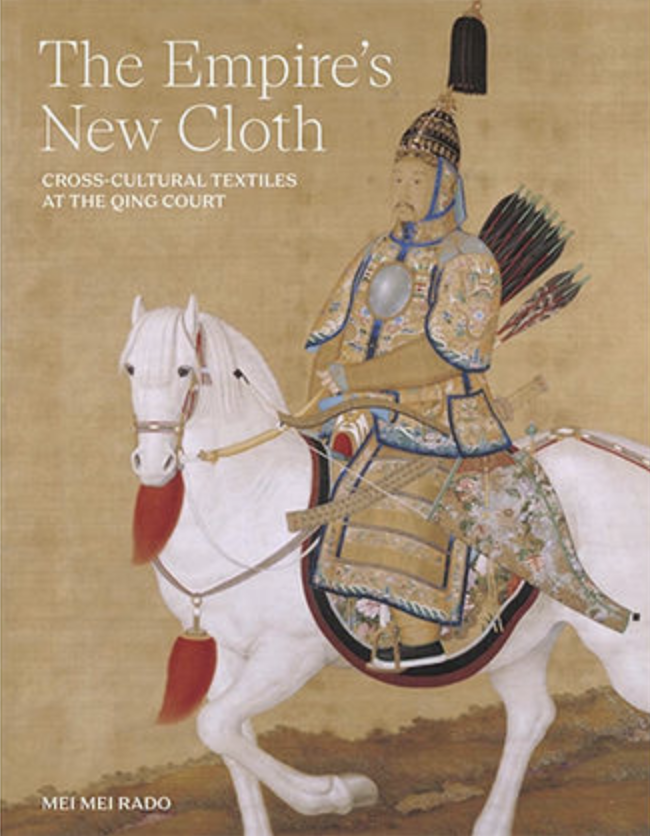 A groundbreaking study of textiles as transcultural objects in the Qing court that provides a new understanding of the interconnectedness of the early modern world
In the early modern period luxury textiles circulated globally as trade goods and diplomatic gifts, fostering cultural exchange between distant regions. By the eighteenth century, both China and Europe had developed a splendid tradition of silk and tapestry weaving. While the role of Chinese silk imports in Europe has been well studied, this book reconstructs the forgotten history of the eastward movement of European textiles to China and their integration into the arts and culture of the Qing Empire. The Empire’s New Cloth explores how Qing court workshops adapted European textile designs and techniques and uncovers the specific uses and meanings of these textiles in imperial military ceremonies, religious spaces, and palace interiors. Through careful study of a wide range of previously unpublished objects, Mei Mei Rado illuminates how these cross-cultural textiles provided the visual and material means for the Qing ruler to convey political messages. By revealing how Qing imperial patrons and artisans responded and assigned meanings to European influences, this beautifully illustrated volume highlights the reciprocity in eighteenth-century Sino-European exchanges and centers textiles within the dynamic global flow of objects and ideas.
Mei Mei Rado received her MA from the University of Chicago and her PhD from Bard Graduate Center, New York, where she is currently an assistant professor. Her research and teaching focus on the history of textiles, dress, and decorative arts in China and France from the eighteenth to the early twentieth centuries, especially on Sino-French exchanges. From 2020 to 2022 she was associate curator of costume and textiles at Los Angeles County Museum of Art, and previously she has held research fellowships in the Department of European Sculpture and Decorative Arts at the Metropolitan Museum of Art and in the Department of Court Arts at the Palace Museum, Beijing..
◊ ◊ ◊ ◊ ◊
Mei Mei Rado | The Empire’s New Cloth
Bard Graduate Center, New York, 19 February 2025, 6pm
Registration is available here»
Master Drawings New York, 2025
Happening this week, with more information here:
Master Drawings New York, 2025
1–8 February 2025, New York
Taking place in more than 25 galleries on New York’s Upper East Side, Master Drawings New York is the premier U.S. art fair for exceptional drawings and works on paper from all periods, paired with complementary paintings, photographs, and sculpture.
◊ ◊ ◊ ◊ ◊
From The Drawing Foundation:
Master Drawings Symposium 2025
Villa Albertine, The Payne Whitney Mansion, New York, 4 February 2025, 4pm
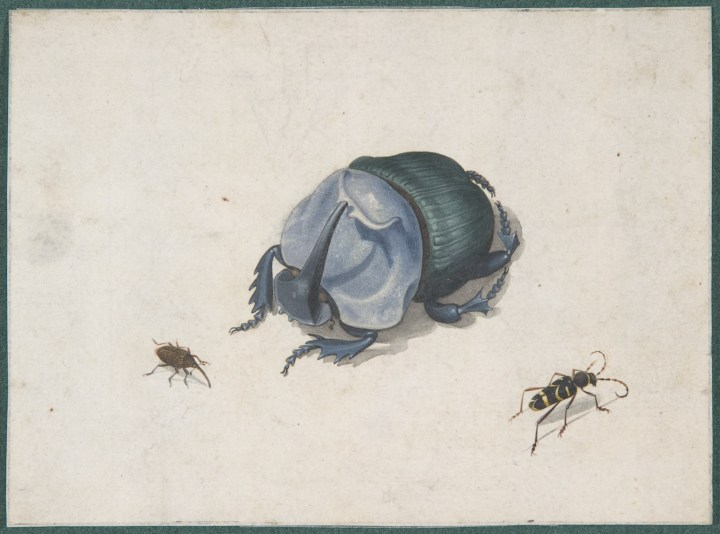
Pieter Holsteyn II, Blue Rhinoceros Beetle, Chestnut Weevil, and Wasp, ca. 1650–60, gouache and watercolor (New York: The Metropolitan Museum of Art).
This year’s winner is Olivia Dill, a PhD candidate at Northwestern University and current Moore Curatorial Fellow at the Morgan Library & Museum. Her prize-winning research was conducted during her two years as the recipient of the Diamonstein-Spielvogel Fellowship at the Metropolitan Museum of Art, a training program combining experience in three departments: Drawings and Prints, Paper Conservation, and Scientific Research. Besides assigning a previously anonymous watercolor of three insects, including an iridescent Rhinoceros beetle native to Brazil, to seventeenth-century Dutch natural history artist Pieter Holsteyn II (1614–1673), Ms. Dill used an interdisciplinary approach and technical analysis of several blue pigments, particularly smalt (ground cobalt and glass), to shed light on the artist’s color choices and his efforts to translate the beetle’s iridescence on a sheet of paper.
2024 runner-up Tamara Kobel, MA from the University of Bern and a former fellow at the Zentralinstitut für Kunstgeschichte in Munich, will delve into the fascinating world of Swiss artist Wilhelm Stettler (1643–1708). Focusing on his ‘Eyerstock’, a rich artistic tool of sketches and doodles that he described as his fertile pantry of motifs, she helps us understand what role his diverse sources (a menagerie of finely drawn animals, war machines, musical instruments, skeletons, flowers, temples, and ships) played in the artist’s career and creative process.
Master Drawings Symposium celebrates winners of its Ricciardi Prize. This event is organized by The Drawing Foundation in partnership with Master Drawings, and in association with Master Drawings New York 2025. The Symposium is made possible through the generous support of the Tavolozza Foundation.
Research Seminar | Artists and the East India Company, 1760–1830
Upcoming at the Mellon Centre:
Holly Shaffer and Laurel Peterson | Painters, Ports, and Profits: Artists and the East India Company, 1760–1830
Online and in-person, Paul Mellon Centre, London, 5 February 2025, 5pm
In January 2026, the Yale Center for British Art (YCBA) will open Painters, Ports, and Profits: Artists and the East India Company, 1760–1830. This exhibition explores the interactions between artists trained in India, China, and Britain amid the relentless commercial ambitions of the East India Company at key ports and centres of trade in Asia. Featuring over a hundred objects drawn from the YCBA collection in various media—including architectural drafts, opaque watercolours, hand-coloured aquatints and small- and large-scale portraits—the exhibition highlights works by artists who are no longer well known alongside those of well-established ones. Brought together for the first time, these works tell a story of artists compelled by new subjects, styles and materials in expanding markets, profoundly affecting art within and beyond Asia.
As the power of the British empire waned in the twentieth century, ‘Company painting’ became a prevalent umbrella term to describe works made for Company officials, specifically by Indian artists, and ‘Export art’ became a descriptor for works created by Chinese artists for a European market. Painters, Ports, and Profits challenges and critically rethinks these terms while also putting the arts into dialogue. It presents an expanded conception of arts made under the auspices of the Company by focusing on artists trained in different ways who worked for Company patrons as well as commercial markets in India, China, and Britain; the types of subjects in which they specialised; and the artistic materials with which they experimented. By examining the range of arts and relationships developed during the Company’s relentless pursuit of profits, the exhibition sheds light on aesthetic and colonial discourses that were formed in the eighteenth and nineteenth centuries and persist today. Co-curators Laurel Peterson and Holly Shaffer will preview the themes and objects explored in the exhibition and the related catalogue.
Book tickets here»
Holly Shaffer is Robert Gale Noyes Assistant Professor of Humanities in the department of history of art and architecture at Brown University. Her research focuses on eighteenth- and nineteenth-century arts in Britain and South Asia, and their intersections. Her first book, Grafted Arts: Art Making and Taking in the Struggle for Western India, 1760–1910 (London and New Haven: Paul Mellon Centre with Yale University Press, 2022), was awarded the Edward C. Dimock Jr. Prize in the Indian Humanities and an Historians of British Art Book Award. In 2011, she curated Adapting the Eye: An Archive of the British in India, 1770–1830 at the YCBA, and in 2013, Strange and Wondrous: Prints of India from the Robert J. Del Bontà Collection at the National Museum of Asian Art. She has published essays in Archives of Asian Art, The Art Bulletin, Art History, Journal 18, Modern Philology, and Third Text, and recently edited volume 51 of Ars Orientalis on the movement of graphic arts across Asia and Europe.
Laurel O. Peterson is the Assistant Curator of Prints and Drawings at the Yale Center for British Art. She specialises in British works on paper produced during the long eighteenth century. She served as the organising curator of John Singer Sargent: Portraits in Charcoal in 2019 and as co-curator of Architecture, Theater, and Fantasy: Bibiena Drawings from the Jules Fisher Collection in 2021, both at the Morgan Library and Museum. She received her PhD in the history of art from Yale and her research has been supported by the Sir John Soane’s Museum Foundation, the Paul Mellon Centre for Studies in British Art, and the Lewis Walpole Library. She has held positions at the British Museum and the Morgan Library.
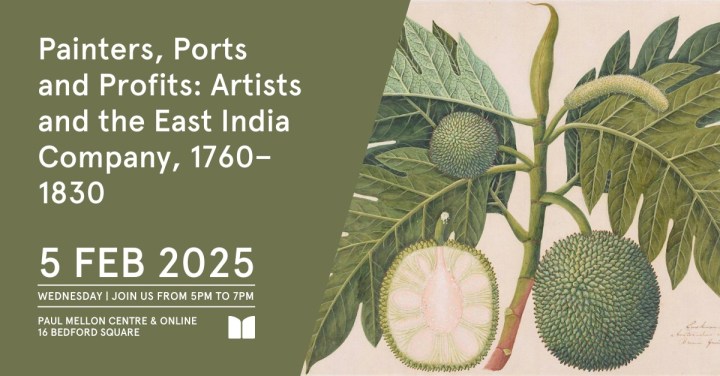
Image: Unknown artist (Company style), Breadnut (Artocarpus camansi), ca. 1825, watercolor, gouache, and graphite (New Haven: Yale Center for British Art, Paul Mellon Fund, B2022.5).
Lecture | Beatrice Glow on Speculative Objects
From the BGC:
Beatrice Glow | Speculative Objects
Bard Graduate Center, New York, 5 February 2025, 6pm

Beatrice Glow, Pax Hollandica (Dutch Peace), 2022. VR-sculpted photopolymer 3D print, metallic paint, acrylic paint, enamel coating, chains (Photo: Aertiron).
Responding to archival research on lesser-known public histories, artist Beatrice Glow creates objects that blend digital processes (such as virtual reality sculpting and 3D printing) with meticulous handcrafting to envision speculative futures. In this talk, Glow will introduce two of her recent projects that leverage playful artistry to foster a deeper public understanding of cultural inheritance. First, she will unpack her recent New York Historical solo exhibition, When Our Rivers Meet, in which she collaborated with culture bearers whose heritages were impacted by Dutch colonialism to create an alternative commemoration of the 400th anniversary of the founding of New Amsterdam. This exploration has continued beyond the exhibition and has taken a new form as a board game—Finding Magic Turtle (Unpacking the Four Continents)—commissioned by the Institute of Contemporary Art, San Diego. Glow will also share her current work-in-progress, Gilt/Guilt, a performance-installation imagined as a speculative auction. The hauntingly luxurious collectibles in this project reveal the cascading impacts of colonial violence and environmental extraction.
Beatrice Glow is an American multidisciplinary artist of Taiwanese heritage whose practice includes examinations of archives and collaboration with culture bearers and researchers in the creation of sculpture, installations, textiles, emerging media, and olfactory experiences to envision a more just and thriving world guided by history. Recent solo exhibitions have taken place at the New York Historical and the Baltimore Museum of Art. Her work has been supported by Creative Capital, the National Endowment for the Arts, Rockefeller Brothers Fund, Smithsonian Artist Research Fellowship, Yale-NUS College, Lower Manhattan Cultural Council, the Asian/Pacific/American Institute at New York University, the Fulbright Program, and many more. More information about her work is available here.
Book Launch | The Dominion of Flowers
From EventBrite:
The Dominion of Flowers: North American Book Launch
Online and in-person, University of Toronto, Thursday, 23 January 2025, 6.30pm
 Between 1760 and 1840, plants were imported into Britain via empire and depicted in periodicals and scientific treatises as specimens alongside objects of natural history. Mark Laird’s provocative new book—part art history, part polemic—weaves fine art, botanical illustration, gender studies, and rare archival material into a political and ethical account of Britain’s horticultural heritage. Drawing on Professor Laird’s genealogical research into his family’s colonial past, The Dominion of Flowers foregrounds Indigenous ideas about ‘plant relations’ in a study that animates trans-oceanic movements of plants and people.
The talk will show how, researched ‘virtually’ in pandemic Toronto, the book’s three-part structure emerged: global, pan-European, and local. His epilogue links New Zealand to Canada, past and present. Following the talk, Therese O’Malley, a historian of landscape and garden design, will facilitate a conversation about Laird’s 40-year career as scholar and practitioner. Prompted by one reviewer who claimed “Laird pioneered plant humanities avant la lettre,” the conversation will turn to botanical studies within the humanities.
Mark Laird is Professor Emeritus at the University of Toronto’s John H. Daniels Faculty of Architecture, Landscape and Design, and a former faculty member of Harvard University. He is the author of The Flowering of the Landscape Garden and A Natural History of English Gardening. The Dominion of Flowers completes his trilogy. In the UK he has been historic planting consultant to Painshill Park Trust, English Heritage, and Strawberry Hill Trust, and in Ontario he has worked on Rideau Hall, Parkwood, and Chiefswood.
Therese O’Malley, FSAH is an historian of landscape and garden design, focusing on the 18th to 20th centuries and the transatlantic exchange of plants and ideas. Former associate dean of CASVA, National Gallery of Art (1984–2021), she continues to lecture and publish internationally. Her many publications include Keywords in American Landscape Design (2010), now expanded as the website, History of Early American Landscape Design (heald.nga.gov). O’Malley has held guest professorships at Penn, Harvard, and Princeton, and serves on boards and advisory committees including those of Dumbarton Oaks, New York Botanical Garden, and the U.S. State Dept. Ambassadors Fund for Cultural Property. She was chair of the Association of Research Institutes in Art History (1994–2000) and president of the Society of Architectural Historians (2000–2006).
Mark Laird, The Dominion of Flowers: Botanical Art and Global Plant Relations (London: Paul Mellon Centre for Studies in British Art, 2024), 277 pages, ISBN: 978-1913107451, £35 / $50.
Talk | Paris Spies-Gans on Sophie Fremiet’s Portrait of a Woman
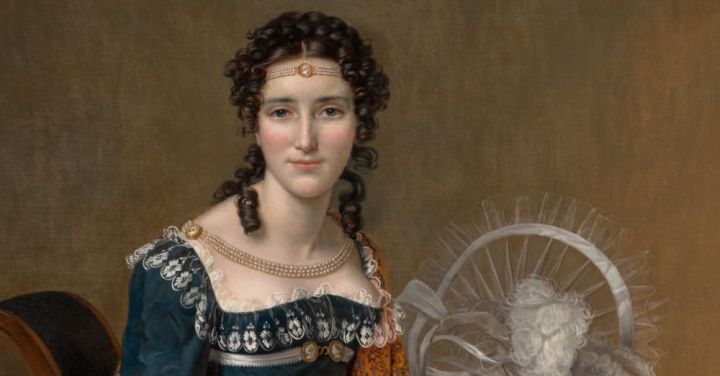
Sophie Frémiet (later Rude), Portrait of a Woman, detail, 1818, oil on canvas, 64 × 46 inches
(Los Angeles: Getty Museum, 2024.25).
◊ ◊ ◊ ◊ ◊
Upcoming at the Getty (which acquired the painting in 2024), as we all watch the fires with ache and concern . . .
Paris Spies-Gans | Breaking Barriers: Sophie Frémiet and the Rise of Women Artists in Europe
Online and in-person, Getty Center, Los Angeles, 4 May 2025, 2pm (originally scheduled for 26 January)
Around the turn of the 18th century, over a thousand women contributed more than 7,000 works to London’s and Paris’ premier exhibitions. It was a transformative moment for women artists in Europe, who exhibited and sold their art in unprecedented numbers. In this context, Sophie Fremiet painted her luminous Portrait of a Woman (1818). Paris Spies-Gans delves into this era to upend longstanding assumptions about women’s opportunities and wrongly forgotten triumphs. Tickets are free, but required for event entrance. Your event ticket will also serve as your Center entrance reservation. To watch online, please register via Zoom.
Paris A. Spies-Gans is a historian of art with a focus on women, gender, and the politics of artistic expression. Her first book, A Revolution on Canvas: The Rise of Women Artists in Britain and France, 1760–1830 (Paul Mellon Centre in association with Yale University Press, 2022), was named one of the top art books of 2022 by The Art Newspaper and The Conversation. It also received several prizes in the fields of British history, art history, and 18th-century studies. She is currently working on her second book, A New Story of Art (US/Doubleday and UK/Viking).
◊ ◊ ◊ ◊ ◊
Note (added 21 January 2025) — The posting has been updated with the rescheduled date.
Talk | Stephanie O’Rourke on John Martin and Romantic Extraction
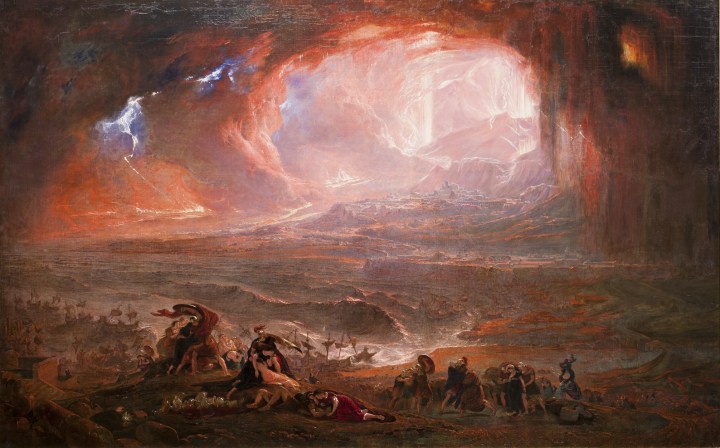
John Martin, The Destruction of Pompeii and Herculaneum, 1822, oil on canvas, 162 × 253 cm
(London: Tate, N00793).
◊ ◊ ◊ ◊ ◊
From the Mellon Centre:
Stephanie O’Rourke | John Martin and Romantic Extraction
Online and in-person, Paul Mellon Centre, London, 22 January 2025, 5pm
The early nineteenth-century artist John Martin bore witness to a rapidly carbonising Britain. Although he is most famous for his dramatic portrayals of epic, historical narratives, Martin was also exceptionally attuned to the transformations visited upon his environment by the rise of industrial resource extraction. His was a world characterised by the subterranean flows of dangerous substances such as noxious gases and sewage, by the desired inflow of natural resources such as water to urban centres and by the invisible spread of less-material phenomena across Britain’s imperial boundaries. In this paper, O’Rourke explores some of the many flows that shaped Martin’s world and his art. We often assume it was J.M.W. Turner’s paintings that best captured the arrival of steam-powered modernity in early nineteenth-century Britain through their explosive treatment of colour and their formal irresolution. But what if it were Martin’s work? What could we come to understand about the conditions of fossil-powered modernity and about romanticism if we took Martin as our guide?
Book tickets here»
Stephanie O’Rourke is a senior lecturer in Art History at the University of St Andrews specialising in eighteenth- and nineteenth-century art. Her second book Picturing Landscape in an Age of Extraction: Europe and its Colonial Networks 1780–1850 (University of Chicago Press, 2025) charts the relationship between landscape and resource extraction in the first half of the nineteenth century. Her prize-winning first book, Art, Science, and the Body in Early Romanticism (Cambridge UP, 2021), examines the changing evidentiary authority of the human body in European romantic thought. She has published widely on the relationship between art and resource extraction, scientific knowledge, and media technologies.
Online Talk | Vanessa Sigalas on Meissen Figures
As noted at Events in the Field:
Vanessa Sigalas | All Walks of Life: Meissen Porcelain Figures of the 18th Century
Online, Connecticut Ceramics Circle, 9 December 2024, 2pm (EST)
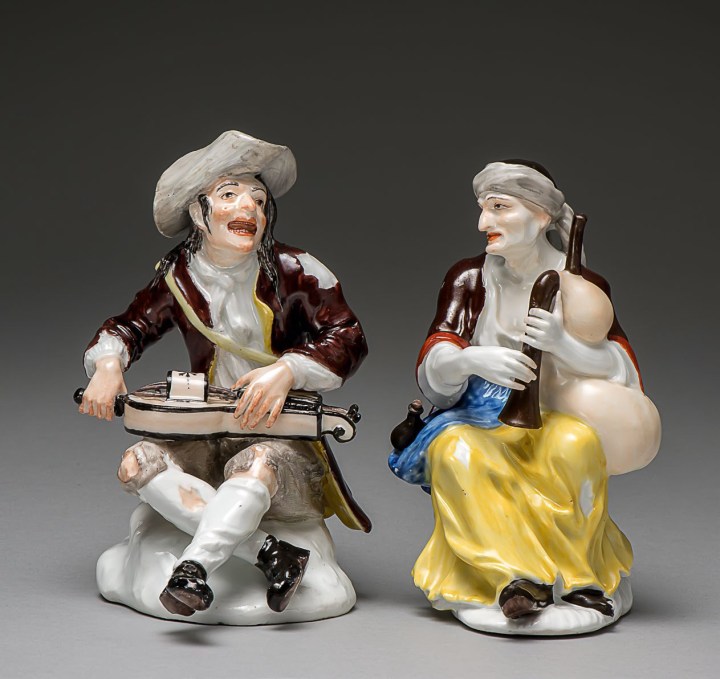
Pair of Figures of Beggar Musicians, German, Meissen Porcelain Manufactory, models by Johann Joachim Kaendler (1706–1775). Original year of modelling: ca. 1736; beggar-woman reworked later. Date of porcelain paste: both ca. 1730–65; date of decoration: both 18th century. Hard-paste porcelain. Man: Blue crossed swords mark on base; woman: no marks. Heights: man 13.4 cm; woman 13 cm. Model no. man: 918; woman: 915. Shimmerman Collection nos. MPBP_16 & 17.
Dr. Vanessa Sigalas will guide the audience through a captivating exploration of 18th-century life in Saxony, Paris, London, and St. Petersburg, using Meissen porcelain sculptures from the Alan Shimmerman Collection in Toronto, Canada, as well as the Wadsworth Atheneum’s collection in Hartford, Connecticut. Renowned master modeler Johann Joachim Kaendler, in collaboration with his fellow modelers at Meissen, portrayed glimpses of daily existence, meticulously capturing even the minutest details. From the carefully arranged trinkets of a street vendor to the intimate script of a love letter and the culinary tools of a cook preparing a hare, Kaendler’s work unveils the richness of ‘All Walks of Life’.
The Alan Shimmerman Collection, with its emphasis on groups of criers (street sellers) and artisans, offers a fresh perspective on the inception, production, and dissemination of Meissen porcelain. Dr. Sigalas’s lecture is based on her recently published collection catalogue bearing the same title, providing an immersive journey into the intricate world of 18th-century European society as depicted through these masterfully crafted sculptures.
Vanessa Sigalas holds a Dr. phil. in Art History from the Eberhard-Karls-Universität Tübingen, Germany. She joined the Wadsworth Atheneum in 2011, As an art historian, Sigalas specializes in European art from the 17th to the first half of the 20th centuries, especially 18th- and 19th-century German porcelain. One of her research interests is the connection between ivory and porcelain, particularly at the Dresden Court of Augustus the Strong (1670–1733). At the Wadsworth, she works with American and European decorative arts and sculpture from the ancient to the modern worlds, but also explores the collections of non-Western art. Despite her deep love for books and archives, Sigalas has always enjoyed the hands-on work with objects. In 2013, she assisted with the Storage Renovation and Relocation Project, and in 2015 she was part of the team to reinstall the European art collections, where she assisted the curatorial team and led the installation team of decorative arts.
She has published in a variety of journals, exhibition catalogues, and books. Her latest book, All Walks of Life: A Journey with the Alan Shimmerman Collection (2022), focuses on Meissen porcelain figures from the 18th century. She has taken on the role of editor for several publications, with her most recent work being Morgan—The Collector: Essays in Honor of Linda Roth’s 40th Anniversary at the Wadsworth Atheneum Museum of Art, co-edited with Jennifer Tonkovich. Additionally, she served as the managing editor of the American Ceramic Circle Journal from 2015 to 2023. Sigalas has curated exhibitions in Germany and the US. Her most recent exhibitions at the Wadsworth include, in conjunction with director Matthew Hargraves, Between Life & Death: Art and the Afterlife (Fall 2023), as well as the community-focused and staff-curated exhibition, Styling Identities: Hair’s Tangled Histories, which was on view until August 2024.
Online Talks | Pets and Portraiture / Art and the Portuguese Court
The final seminar of the series takes place on Wednesday:
Luba Kozak and Diogo Lemos | Pets, Portraiture, and Identity
Online, Material and Visual Culture Research Cluster, Edinburgh, 4 December 2024
 Each week we hear from two speakers, sharing their research on, and approaches to, the study of seventeenth- and eighteenth-century material and visual culture. We aim to make a space in which these rich histories can be explored from varied disciplines to enhance our research practices. We meet on Wednesdays, 5–6pm GMT, online using Zoom; registration closes 1 hour before seminar start time.
Luba Kozak | Pet Animals as Connectors: Exploring the Role of Pet Animals in Shaping British Identity and Colonial Encounters in 18th-Century British Portraiture
This paper explores the role of pet animals in shaping British identity and colonial encounters as portrayed in eighteenth-century British portraiture. Through an analysis of John Eccardt’s Portrait of Lady Grace Carteret, Countess of Dysart with a Child, Black Servant, Cockatoo, and Spaniel (1740) and Johann Zoffany’s Colonel Blair and his Family with an Indian Ayah (1786) as case studies, I investigate how pet animals reveal power structures and hierarchies within the domestic sphere, exposing deeper tropes of colonisation and race (Braddock; Bocquillon). Ultimately, I propose that pet animals act as critical contact points between the British aristocracy and enslaved individuals in these artworks, bridging cultural, racial, and species divides.
Recognising the need to address the material presence of animals in art and their marginalisation in the field of art history, I analyse these paintings through more inclusive theoretical frameworks including ecocriticism and post-colonialism. Building on the scholarship of Ingrid Tague and Erin Parker, who discuss the domestication of animals within British households, I examine how these animals negotiated status and place within elite homes as depicted in visual culture. This approach repositions non-human figures as active subjects rather than pictorial accessories. Adopting an interdisciplinary perspective, this paper is at the intersection of art history, animal studies, philosophy, and ethics. Amidst growing concern for animal ethics and the Anthropocene, this timely research offers a broader understanding of the complexities of human-animal relations, relevant in historical and contemporary.
Luba Kozak is a third-year Ph.D. student at the University of Regina, Saskatchewan (Canada).
◊ ◊ ◊ ◊ ◊
Diogo Lemos | Spreading the Icon: Visual Culture and Royal Patronage under the Reign of John V, King of Portugal
During his reign (1707–1750), John V recognized the importance of emulation and identifying the most renowned masterpieces of his time. By so, he instructed his diplomats to collect copies of certain artworks from various courts. The most iconic among them served as vital iconographic sources for artworks commissioned by the king, executed by artists trained in Europe’s leading apprenticeship circuits, who later disseminated these same iconographic references in other courts. This talk aims to highlight a set of artworks produced within European courts which played a pivotal role in shaping the image of the Portuguese court.
The primary goal is to decipher the mechanisms of ‘promotion’ of these artworks; to grasp the processes and means (ex. the press but also espionage) used to transform them into true icons. Relating this context with the Portuguese court, documentation will also reveal the mechanisms—and circles of influences—used by John V to know and acquire them. Furthermore, the project seeks to intersect these artworks (primarily portraits) with the material culture of both the Portuguese and European courts in which France plays an important role. Nevertheless, rather than solely emphasizing France as the primary influencer, the intention is to accentuate the nuances and distinctiveness of the artistic and material cultures within these courts, moreover, highlighted by Portuguese court itself. In short, focusing on the iconology of the Catholic Kings, this proposal aims to unveil and decode a curated collection of artworks commissioned by King John V, providing new insights into the cultural (and political) milieu of the era and demonstrating how certain iconic masterpieces (yet often underestimated) not only reflected cultural exchanges between nations during the reign of John V but also shaped European visual culture during this period.
Diogo Lemos is a researcher at the Centre for the History of Society and Culture of the University of Coimbra, where he is developing an art history PhD project in the Faculty of Arts and Humanities for which he was awarded a fellowship by the Portuguese Foundation for Science and Technology.










leave a comment