Online Talk | Karen Jensen on Cataloging Rare Maps
From the registration page:
Karen Jensen | An Introduction to Cataloging Rare Maps
Online, 30 April 2025, 3pm (Eastern Time)
The Bibliographic Standards Committee (BSC) of the ACRL Rare Books and Manuscripts Section (RBMS) invites you to the webinar, “An Introduction to Cataloging Rare Maps.” The session will introduce rare map cataloging with the original RDA Toolkit; it will include discussion of DCRM(C)—Descriptive Cataloging of Rare Materials (Cartographic)— highlighting the distinctive aspects of cataloging pre-twentieth century maps. The aim is to assist those who rarely work with maps. Participants will become familiar with searching for cataloging records in WorldCat and selecting the best record for the map in hand. They will be able to decide when a new record is justified and be able to add an original cataloging record. The webinar will also briefly review map subject analysis and Library of Congress call numbers.
Karen Jensen is Head of Cataloguing and Collection Maintenance at Concordia University Library in Montreal.
Representing nearly 8,500 individuals and libraries, the Association of College and Research Libraries (ACRL), the largest division of the American Library Association, develops programs, products, and services to help those working in academic and research libraries learn, innovate, and lead within the academic community. Founded in 1940, ACRL is committed to advancing learning, transforming scholarship, and creating diverse and inclusive communities.
Online Talk | Michael Ohajuru on the Black Presence in European Art

◊ ◊ ◊ ◊ ◊
This evening from YCBA:
Michael Ohajuru | From Subjects of Capital to Makers of Culture
The Black Presence in Western European Art
Online and in-person, Norma Lytton Lecture, Yale Center for British Art, 10 April 2025, 5.30pm (ET)
Michael Ohajuru explores how Black figures, once positioned as exotic, subservient, or symbolic, have moved toward the center of artistic representation—sometimes through shifts in artistic intention, sometimes through reinterpretation by contemporary audiences. Through this lens, Ohajuru questions historical silences and considers how the Black presence in art speaks to the evolving relationship between Black and white identities in the Western world.
Join the livestream here»
Michael Ohajuru is a Fellow of the Royal Society of Arts and a Senior Research Fellow of the Institute of Commonwealth Studies. He blogs, writes, and speaks regularly on identifying, understanding, and interpreting the Black African presence in Renaissance art. He is founder of the Image of the Black in London Galleries, a series of gallery tours that highlight the overt and covert Black presences to be found in the national art collections of London. Ohajuru is the project director of the John Blanke Project, a contemporary art and archive project celebrating John Blanke, the Black trumpeter to the Tudor courts of Henry VII and Henry VIII. He is also a founding member of the Black Presence in British Portraiture network, managing their podcast The BP2 Podcast.
Generous support for this program has been provided by the Norma Lytton Fund for Docent Education, established in memory of Norma Lytton by her family. Lytton was an active docent at the YCBA for more than twenty years and subsequently spent a decade engaged in research for the museum’s Department of Paintings and Sculpture.
Banner images from left to right (all details): Francis Harwood, Bust of a Man, ca. 1758, black limestone on a yellow marble socle (Yale Center for British Art, Paul Mellon Collection); Sir Joshua Reynolds, Charles Stanhope, Third Earl of Harrington and Marcus Richard Fitzroy Thomas, 1782, oil on canvas (Yale Center for British Art, Paul Mellon Collection); Joanna Mary Wells (née Boyce), Fanny Eaton (née Antwistle or Entwistle), 1861, oil on paper laid to linen (Yale Center for British Art, Paul Mellon Fund); and Kehinde Wiley, Portrait of Lynette Yiadom-Boakye, Jacob Morland of Capplethwaite, detail, 2017, oil on canvas (Yale University Art Gallery and Yale Center for British Art, purchased with a gift from Mary and Sean Kelly in honor of Courtney J. Martin and with the Janet and Simeon Braguin Fund and Friends of British Art Fund. © Kehinde Wiley. Courtesy of Sean Kelly, New York).
Lecture | Jessica Riskin on Lamarck
Upcoming at Yale University:
Jessica Riskin
Professor of Insects and Worms: Jean-Baptiste Lamarck and his Life-Made World
27th Lewis Walpole Library Lecture
Yale University, New Haven, 30 April 2025, 5.30pm
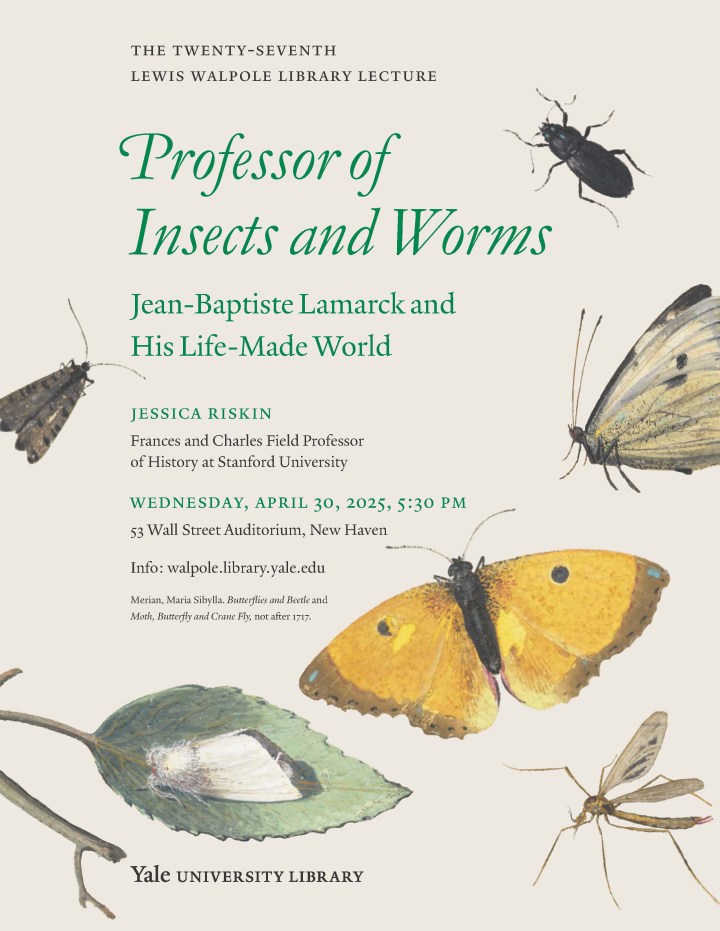 Jean-Baptiste Lamarck (1744–1829) was the Professor of Insects and Worms at the Museum of Natural History in Paris. Living through the storms of the French Revolution and Napoleonic period, he founded biology, coining the term to name a new science devoted to all and only living things, and authored the first theory of evolution. Lamarck’s science was foundational to modern biology, yet its radicalism—he usurped God’s monopoly on Creation and re-assigned it to mortal, living beings—brought him and his ideas plenty of trouble. During Lamarck’s lifetime, Napoleon and his scientific inner circle hated him and did what they could to undermine him. Charles Darwin then adopted central elements of Lamarck’s theory, but after Darwin’s death, his most influential followers re-interpreted his theory to eradicate all traces of Lamarckism, rendering organisms once again the passive objects of outside forces, allowing room for an omnipotent God working behind the scenes. This conception of living organisms as passive in the evolutionary process has remained dominant since the turn of the twentieth century. In contrast, in Lamarck’s theory, living beings were active, creative, self-making and world-making. Elements of this very different conception of living organisms have recently, gradually been returning to mainstream biology in fields such as niche construction and epigenetic inheritance.
The lecture will present Lamarck’s radical, embattled, and perhaps re-emerging approach to living things, their evolutionary and ecological agency, and the science that studies them. The event is free and open to the public, with no registration required.
Jessica Riskin, the Frances and Charles Field Professor of History at Stanford University, teaches modern European history and the history of science. Her work examines the changing nature of scientific explanation, the relations of science, culture and politics, and the history of theories of life and mind. Her books include The Restless Clock: A History of the Centuries-Long Argument over What Makes Living Things Tick (2016), which was awarded the 2021 Patrick Suppes Prize in the History of Science from the American Philosophical Society, and Science in the Age of Sensibility (2002), which received the American Historical Association’s J. Russell Major prize for best book in French history. She is a regular contributor to various publications including Aeon, the Los Angeles Review of Books, and The New York Review of Books.
New Book | Jewish Country Houses
From Brandeis UP:
Juliet Carey and Abigail Green, eds., with photography by Hélène Binet, Jewish Country Houses (Waltham, MA: Brandeis University Press, 2024), 300 pages, ISBN: 978-1684582204, $60. Part of the Tauber Institute Series for the Study of European Jewry.
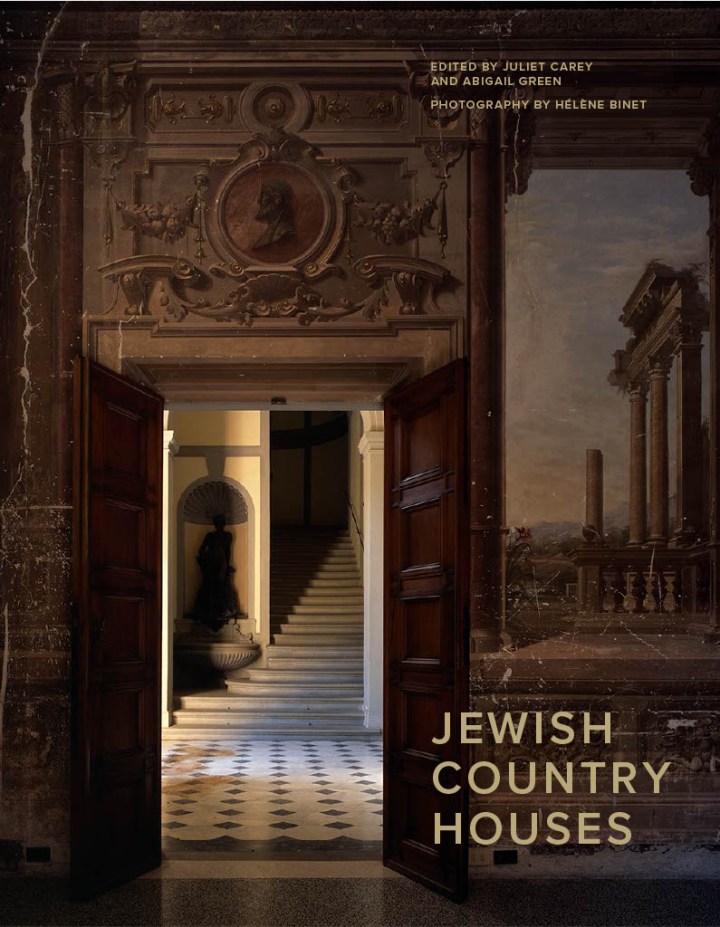 Country houses are powerful symbols of national identity, evoking the glamorous world of the landowning aristocracy. Jewish country houses—properties that were owned, built, or renewed by Jews—tell a more complex story of prejudice and integration, difference and connection. Many had spectacular art collections and gardens. Some were stages for lavish entertaining, while others inspired the European avant-garde. A few are now museums of international importance, many more are hidden treasures, and all were beloved homes that bear witness to the remarkable achievements of newly emancipated Jews across Europe—and to a dream of belonging that mostly came to a brutal end with the Holocaust. Lavishly illustrated with historical images and a new body of work by the celebrated photographer Hélène Binet, this book is the first to tell their story, from the playful historicism of the National Trust’s Waddesdon Manor in Buckinghamshire to the modernist masterpiece that is the Villa Tugendhat in the Czech city of Brno—and across the pond to the United States, where American Jews infused the European country house tradition with their own distinctive concerns and experiences. This book emerges from a four-year research project funded by the UK Arts and Humanities Research Council that aims to establish Jewish country houses as a focus for research, a site of European memory, and a significant aspect of European Jewish heritage and material culture.
Juliet Carey is senior curator at Waddesdon Manor. Abigail Green is an Oxford historian and author of the award-winning Moses Montefiore: Jewish Liberator, Imperial Hero.
◊ ◊ ◊ ◊ ◊
A conversation with the authors will take place at Yale on Monday:
Juliet Carey and Abigail Green | Jewish Country Houses
Yale University, New Haven, 24 March 2025, 4pm
Juliet Carey and Abigail Green will discuss their new book, Jewish Country Houses, which explores these remarkable houses, their architecture and collections, and the lives of the extraordinary men and women who created and transformed them. Moderated by Laurel O. Peterson, Assistant Curator of Prints and Drawings, Yale Center for British Art; the event is cosponsored by the Yale Center for British Art and Yale Jewish Studies Program.
Anna Jameson Lecture by Paris Spies-Gans
This evening at The National Gallery (the lecture is fully booked, but it will be live-streamed) . . .
Paris Spies-Gans | ‘The Spirit of a Particular Age’
Women Artists and the Challenges of an Integrated Art History
Online and in-person, The National Gallery, London, 13 March 2025, 6pm GMT

Elisabeth Louise Vigée Le Brun, Self Portrait in a Straw Hat, 1782 (London: The National Gallery).
Women artists are having a moment—featuring in exhibitions, headlines, and auctions. Art historians have, however, long known of their existence. Why do we continue to treat these creators as rare, exciting discoveries? This lecture will consider the complicated legacies surrounding women artists and notions of historical truth. Taking Anna Jameson’s concept of the ‘Spirit of a Particular Age’ as a jumping-off point, it will explore the tensions that often accompany studies of women in their own places and times and suggest a path towards a more integrated—and hopefully lasting—narrative of art: one that includes women as the prominent historical players they regularly were. Sometimes this entails uncomfortable work, such as questioning canonical narratives about women and art. However, embracing such complexities can ultimately lead to a deeper, fuller understanding of the cultural and gender dynamics that shaped the past—and continue to influence the present.
The lecture will also be live-streamed; please book tickets here»
Paris A. Spies-Gans holds a PhD in History from Princeton University, an MA in Art History from the Courtauld Institute of Art, and a BA from Harvard University. Her research has been supported by fellowships from the Harvard Society of Fellows and the J. Paul Getty Trust, among other institutions. Her first book, A Revolution on Canvas: The Rise of Women Artists in Britain and France, 1760–1830 (PMC/YUP 2022), has won several prizes in the fields of British art history and 18th-century studies and was named one of the top art books of 2022 by The Art Newspaper and The Conversation. She is currently working on her second book, A New Story of Art (US/Doubleday and UK/Viking).
Online Talks | Tempus Fugit / Time Flies
I’m sorry to have missed the first half of the series; the last two talks take place in March and April. –CH
Tempus Fugit / Time Flies: Measuring, Perceiving, and Living Time in Early America
Online, Historic Deerfield, Sundays: 26 January, 23 February, 30 March, 27 April 2025

Tall Clock, detail, by Aaron Willard of Boston for Asa Stebbins of Deerfield, Massachusetts, ca. 1799 (Historic Deerfield).
Early New Englanders frequently invoked the passage of time in religious terms, but the ‘horological revolution’ of the seventeenth and eighteenth centuries produced technological developments in timepieces that complemented older cultural views of time. These developments went on to play an important role in the standardization of timekeeping, the rise of market economies, and industrialization. Sundials, mechanical clocks, and pocket watches were not only scientific marvels but also style-bearing objects that displayed refinement. Such objects provide suggestive windows into everyday life, especially when we broaden our sense of the many different objects and practices that marked the passage of time for diverse early Americans. This series features speakers who will address both the abstract and material nature of time found not only in clocks but also in other objects and processes central to life in early New England such as brewing, needlework, husbandry, farming, and cooking. Together the presentations will complicate our sense of what the passage of time meant for early New Englanders who had more than one way to ‘keep’ and ‘spend’ time. All lectures are free of charge and will be presented virtually via Zoom webinar. Registration required.
January 26, 2pm
Bob Frishman | Edward Duffield and Colonial American Clockmaking
Bob Frishman has professionally repaired nearly 8,000 timepieces and sold more than 1,700 vintage clocks and watches. In recent years, he has reduced his clock-repair activities and now devotes his time to research, writing, and lecturing. He has organized horology-related conferences at the Winterthur Museum, the Museum of Fine Arts Boston, the Henry Ford Museum, the Museum of the American Revolution, and the Horological Society of New York; he was also an organizer of the 2019 Time Made in Germany symposium in Nuremberg. Along with more than 100 articles and reviews, his recent book on the Philadelphia clockmaker Edward Duffield was published by the American Philosophical Society Press in 2024.
February 23, 2pm
Alexandra Macdonald | ‘Regard Not Time, but This Sign’: Recipes and Embodied Knowledge
Alexandra M. Macdonald is an historian of labour and the body with a particular interest in embodied knowledge and practices of making in the Atlantic world in the eighteenth century. As part of her research, she is interested in using period specific ingredients and methods to recreate historical craft and culinary recipes, for example indigo vats and preserved food. Alexandra has received a number of fellowships to support her research, including a fellowship from the New England Regional Fellowship Consortium which brought her to Deerfield. Most recently she was a Postdoctoral Fellow at Winterthur Museum, Garden & Library where she worked closely with conservation scientists to analyze a canvaswork embroidery made in Connecticut in the mid-eighteenth century. She is currently the Social Science and Humanities Research Council Postdoctoral Fellow at Brock University where she is working on a book length study of indigo in the Atlantic world.
March 30, 2pm
Sara Schechner | Marking Time during the American Revolutionary Period: Sundials and Clocks
Sara J. Schechner is the David P. Wheatland Curator of the Collection of Historical Scientific Instruments at Harvard University.
April 27, 2pm
Elizabeth Bacon Eager | Mastering Time: Slavery, Self-Sovereignty, and the 18th-C. Clockmaker
Elizabeth Bacon Eager is an assistant professor of art history at Southern Methodist University, where she teaches courses on early American art, architecture, and material culture. Exploring intersections between art, science, and technology of the eighteenth- and nineteenth-century Atlantic World, she is particularly interested in questions of materiality and process and fascinated by the reconstruction of historical tools and techniques. Her current research examines the material culture of time in early America, with a particular focus on objects and images produced by Black, Indigenous, and female makers. Dr. Eager’s work has been published in The Art Bulletin, Journal18, and Panorama: Journal of the Association of Historians of American Art.
Online Talk | Conserving Paper with Live Demonstration
From The Linnean Society:
John Abbott | How to Conserve 18th- and 19th-Century Paper with Live Demonstration
Online and in-person, The Linnean Society, Burlington House, 5 March 2025, 2pm
The Linnean Society takes the preservation of its collections seriously. The Society has a full-time conservator, Janet Ashdown, and an adopt-an-item programme (AdoptLINN). The Society is also incredibly fortunate in having had an experienced volunteer and retired paper conservator, John Abbott, who has been working with Janet since 2018. In the past seven years, John has conserved many illustrations within the Society Papers Collection, and in this talk, he will demonstrate how to conserve loose 18th- and early 19th-century papers. By showcasing papers in need of conservation, John will reveal the decision-making process even before the start of conservation, and then undertake a live conservation demonstration. The demonstration will cover cleaning as well as repairing paper. We will send the link for this online event two hours before it starts.
Registration is available here»
John Abbott is a retired archive conservator who worked for the National Archives and its predecessor The Public Record Office for 43 years. He was involved in the conservation and preservation of archival material including paper and parchment manuscripts, maps, plans, designs, posters, photographs, and seals. Between 1984 and 1986 John was part of a team of three (two archive conservators and one book conservator) involved in the conservation and rebinding of Great and Little Domesday books.
Lectures | Barbara Kirshenblatt-Gimblett on Warsaw’s POLIN Museum
.
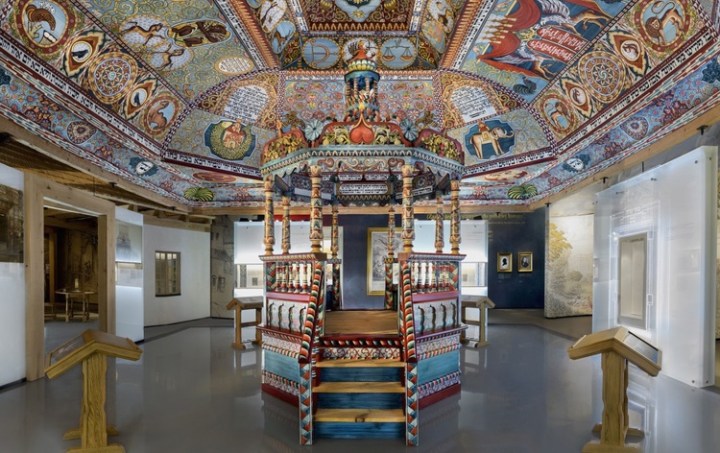
Rebuilding of the painted ceiling, timber-frame roof, and bimah (platform where the public reading from the Torah scroll is performed) of the wooden synagogue that once stood in Gwoździec and is now a centerpiece of the 18th-century gallery, “The Jewish Town” (Warsaw: POLIN Museum of the History of Polish Jews; photo by Magdalena Starowieyska and Darek Golik).
◊ ◊ ◊ ◊ ◊
From BGC:
Barbara Kirshenblatt-Gimblett | Materializing History
The Making of POLIN Museum’s Core Exhibition
Leon Levy Foundation Lectures in Jewish Material Culture
Bard Graduate Center, New York, 27 February, 20 March, 20 April 2025
Each year, Bard Graduate Center presents the Leon Levy Foundation Lectures in Jewish Material Culture, a three-lecture series dedicated to the study of the Jewish past through its material remains. Join us for this year’s lectures.
The Museum of the History of Polish Jews is located on the site of the Warsaw ghetto. It began without a building, collection, or funds. Its greatest asset was the story it would tell, a thousand-year history of Polish Jews. In exploring the creation of POLIN Museum’s Core Exhibition and its extensions, this series of lectures by curator Barbara Kirshenblatt-Gimblett will reveal how the museum materialized history and created and discovered novel kinds of objects.
Bard Graduate Center gratefully acknowledges the Leon Levy Foundation’s support of these lectures.
◊ ◊ ◊ ◊ ◊
Masterplan: Theatre of History
Thursday, February 27, 6pm
This first lecture explores how the Masterplan attempted to plot the thousand-year history of Polish Jews in space, how the exhibition evolved as a theater of history, and how the materializing of history led to the creation of a new kind of object.
Materializing History: The Making of POLIN Museum’s Core Exhibition
Thursday, March 20, 6pm
A centerpiece of the Core Exhibition is the 85 percent-scale painted ceiling and timber-frame roof of the seventeenth-century wooden synagogue that once stood in Gwoździec—today in Ukraine—but was destroyed during World War I. This object exemplifies how material practices produce new knowledge and unique kinds of objects in the process.
The Post-Jewish Object
Thursday, April 20, 6pm
Learn about POLIN Museum’s most recent temporary exhibition, which highlighted ‘post-Jewish’ property, defined by dispossession resulting from the fate of Jews during and after the Holocaust.
Research Seminar | Martin Myrone on the Foggo Brothers’ Parga

.
James and George Foggo, Parga during the Awful Ceremony that Preceded the Banishment of its Brave Christian Inhabitants and the Entrance of Ali Pacha, ca. 1819, lithograph, 42 × 64 cm (London: the British Museum, 1842,0319.14).
◊ ◊ ◊ ◊ ◊
Next month at the Mellon Centre:
Martin Myrone | A Radical Alternative within British Romanticism: The Foggo Brothers’ Parga
Online and in-person, Paul Mellon Centre, London, 19 March 2025, 5pm
This talk focuses on one of the most remarkable—but forgotten—works of British art of any era: The Christian Inhabitants of Parga Preparing to Emigrate (1822) by the brothers George and James Foggo. This huge painting, twenty-six feet long by sixteen high, was exhibited several times in the nineteenth century before disappearing. Recorded in a mezzotint, the picture features a multitude of figures in a scene of horror with the people of Parga in Greece disinterring their ancestors so that their remains were not left on ground falling under Ottoman rule. The incident of 1819 on which the picture was based was an international scandal, identified as an appalling indictment of British foreign policy. Ironically, the very size, political purpose and pictorial ambition of the Foggo brothers’ picture has made it easy to be ignored by art history. This talk will explore how the discipline has by contrast—and this is almost regardless of political orientation—been preoccupied with the subjective and commodified aesthetics assumed to be the enduring legacy of the ‘Romanticism’ of the era.
The event starts with a presentation and talk by Martin Myrone, lasting around 40 minutes, followed by Q&A and a free drinks reception. The event is hosted in our Lecture Room, which is up two flights of stairs (there is no lift). The talk will also be streamed online and recording published on our website.
More information and registration is available here»
Martin Myrone is Head of Research Support and Pathways at the Paul Mellon Centre. Before joining the Centre in 2020, Martin spent over twenty years in curatorial roles at Tate, London. His many exhibitions at Tate Britain have included Gothic Nightmares (2006), John Martin (2011), William Blake (2019), and Hogarth and Europe (2021). His research and publications have focused on eighteenth- and nineteenth-century British art, with a special interest in artistic identity and artists’ labour, class, cultural opportunity and gender. His many published works include Bodybuilding: Reforming Masculinities in British Art 1750–1810 (2005) and Making the Modern Artist: Culture, Class and Art-Educational Opportunity in Romantic Britain (2020), both published by the Paul Mellon Centre.
Online Talks | HECAA Emerging Scholars Showcase, 2025
From the Historians of Eighteenth-Century Art & Architecture:
HECAA Emerging Scholars Showcase
Online, Tuesday, 18 February 2025, 11.00am–12.30pm EST
A beloved HECAA tradition, the Emerging Scholars Showcase serves as a platform for emerging scholars to connect with the wider HECAA community and get feedback on their research. We would appreciate your presence and participation in this meaningful event!
• Emily Hirsch (Brown University) — Flemish Sculptors and Terracotta, ca. 1600–1750
• Siraye Herron (University of Oklahoma) — Degrees of Indigenous Autonomy: Aestheticizing Artistic Survivance in Colonial Cuzco, 1690s–1780s
• Katie DiDomenico (Washington University in St. Louis) — Visions of Colonial Suriname, ca.1667–1795
• Katie Cynkar (University of Delaware) — Myth Making and Remembrance: A Sensorial Examination of Framed North Carolina Plantation-Made Cloth Samples, 1861–1865
• Amelia Goldsby (University of Iowa) — Trees as Bodies of Communication: The Arboreal Aesthetic in French Painting, 1780–1870
• Benet Ge (Williams College) — Looked Through: Edward Orme’s Transparent Prints between Britain and Canton
To attend, please register here»
As always, direct all questions, suggestions (and love) to hecaa.emergingscholarsrep@gmail.com.
Warmly,
Demetra Vogiatzaki
HECAA Board Member At-Large, Emerging Scholars Representative










leave a comment