Exhibition | The Paradox of Pearls
Opening next month at The Walpole Library:
The Paradox of Pearls: Accessorizing Identities in the Eighteenth Century
The Lewis Walpole Library, Farmington, CT, 27 September 2024 — 31 January 2025
Curated by Laura Engel
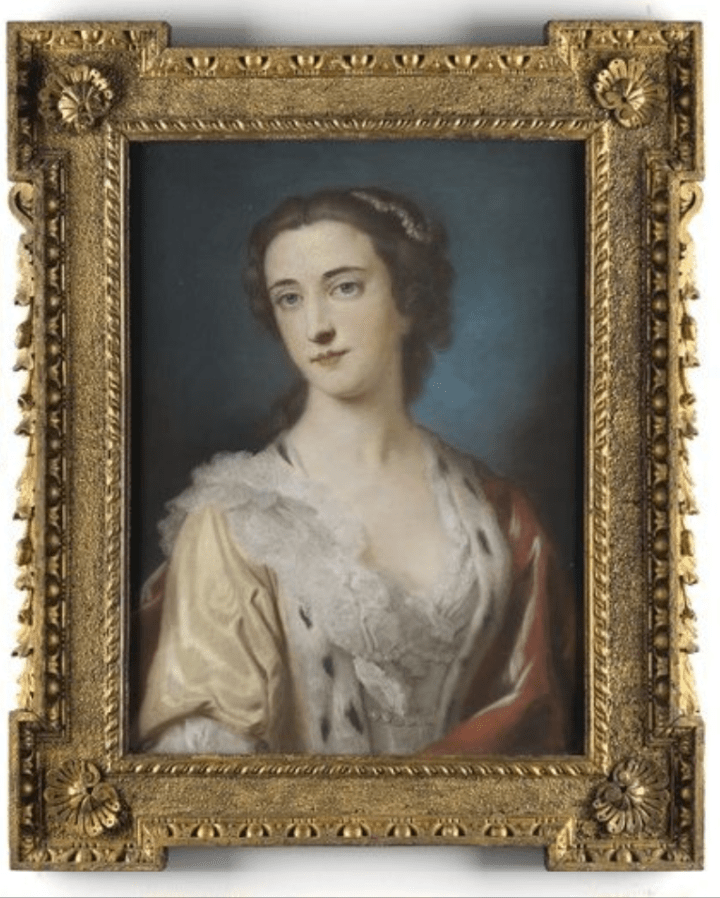
William Hoare, Portrait of Maria Walpole, ca. 1742, pastel on paper (The Lewis Walpole Library, Yale University, LWL Ptg. 152).
Pearls figure prominently in pictures of celebrated and imagined figures across the eighteenth century. Adorning royalty, celebrities, servants, and in fashion plates, the mysterious, opaque, and gleaming white accessory aligns with the mutable, seductive, and threatening emergence of new forms of identity. Worn as jewelry, as embellishments to the body and dress, or embedded in the settings of precious objects—pearls accessorize, highlight, colonize, and perform. As one of the most sought-after commodities of the early modern colonial enterprise, a precious jewel tied to bondage and violence, pearls have a baroque and complex history. Drawing from materials in the Lewis Walpole Library this exhibition will explore the ‘paradox of pearls’ by considering how the varied and often contradictory meanings of this jewel appear in period images and the ways in which practices from the past connect us to the powerful presence of pearls today. The exhibition is curated by Professor Laura Engel of Duquesne University.
◊ ◊ ◊ ◊ ◊
Curator Talk with Laura Engel
The Lewis Walpole Library, 16 November 2024, 2pm
From Queen Elizabeth I to Harry Styles, the legacy of pearls is a story about self-fashioning. Pearls feature prominently in many pictures of celebrated figures from the past. Worn as jewelry—as embellishments of the body and apparel, or embedded in the settings of precious objects—pearls illuminate ideas about beauty, power, and style. Drawing upon materials in the Lewis Walpole Library, this talk considers how the varied and often contradictory meanings of this jewel were represented in period images and the ways in which practices from the past connect us to the enduring presence of pearls today. Space is limited, and advance registration through the Farmington Libraries site is required. Registration link forthcoming.
Lecture | Cynthia Chin on Recreating a Martha Washington Gown

Gainsborough Silk Weaving Company, detail of the reproduced silk used in Cynthia Chin’s replica of a gown owned by Martha Washington
(Image courtesy of Cynthia Chin)
◊ ◊ ◊ ◊ ◊
Upcoming at the Wadsworth Atheneum:
Cynthia Chin | Off the Dressmaker’s Needle: Recreating Martha Washington’s Purple Silk Gown and Recovering the Lives Within
Wadsworth Atheneum, Hartford, CT, 15 September 2024, 2pm

Cynthia Chin, Gown and petticoat, 2024, Silk, linen, and wool. The gown is a reproduction of a garment owned by Martha Custis Washington. The original was made in the the early 1760s when Washington was in her thirties, remade around the time of the American Revolution (1775–1783), and possibly worn during her tenure as First Lady (1789–1797). The original gown is now in the collection of the New Hampshire Historical Society.
The recent work of art and material culture historian Cynthia Chin involves an in-depth study of a purple silk gown owned by Martha Custis Washington (1731–1802). Chin reveals how her research and recreation of the textile and garment illuminate the stories of the people who made, wore, and cared for it. Join us before the lecture to view Chin’s colorful replica of Washington’s gown, on view in New Nation, Many Hands. Free with reservations encouraged.
As Dr. Chin notes in her Maker-Scholar Statement: “Recreating this garment as it may have appeared when new, unworn, and unaltered honors the forced labor of the enslaved seamstresses who tended the original object, including Caroline Branham (1764–1843), Charlotte, and Ona ‘Oney’ Judge (1773–1838). I commissioned the textile specifically for this project. It was reproduced by the Gainsborough Silk Weaving Company in Suffolk, UK. This gown and its replication methodology reveal new evidence of how the original dress changed over its lifespan, and how Martha Washington may have appeared when she was young. It remembers all unseen and forced labor—the ‘many hands’ that created our new American democracy.”
Cynthia E. Chin is an art and material culture historian of Vast Early America and Britain in the eighteenth century, specializing in dress, textiles, identity, and collecting. As a researcher at the University of Glasgow, Cynthia examines collections of dress, textiles, and art from around 1600 to 1830 in order to understand how private collections, individual collectors, and museum acquisitions strategies shaped notions of ‘early America’.
Presented with support from the Joseph and Robert Cornell Memorial Foundation Fund at the Wadsworth Atheneum.
Lecture | Ned Lazaro on the Mourning Embroidery of Elizabeth Bennett
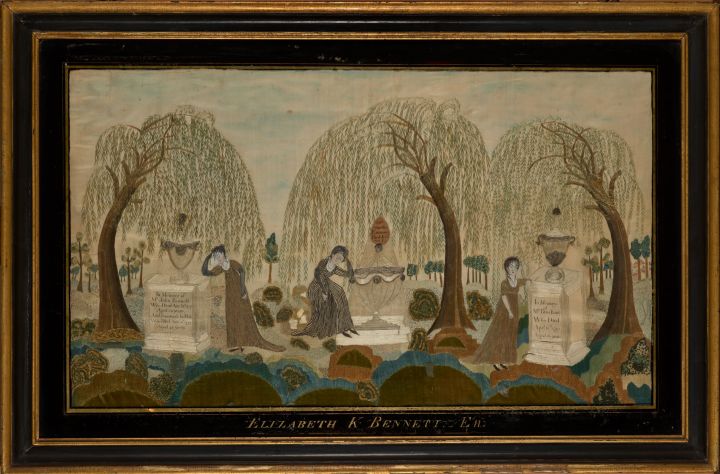
Elizabeth K. Bennett, Mourning Picture, 1801–07, polychrome silk embroidery, metallic threads, gouache and watercolor paints, plain-weave silk ground (Hartford: Wadsworth Atheneum, gift of Miss Jane W. Stone, 1938.236).
◊ ◊ ◊ ◊ ◊
Upcoming at the Wadsworth Atheneum:
Ned Lazaro | The Mourning Embroidery of Elizabeth K. Bennett
Wadsworth Atheneum, Hartford, CT, 8 September 2024, 1pm
Needlework was an important part of a young girl’s education in eighteenth- and nineteenth-century America. Mourning embroideries often depicted figures overcome with sadness and weeping willow trees. Ned Lazaro, Associate Curator of Costume and Textiles, discusses the ongoing significance of a particular example. Free with museum admission.
Roundtable | The Study of Collecting: Past, Present, and Future

Frans Francken the Younger, The Cabinet of a Collector with Paintings, Shells, Coins, Fossils, and Flowers, 1619, oil on panel, 56 × 85 cm
(Royal Museum of Fine Arts Antwerp)
◊ ◊ ◊ ◊ ◊
From the programme flyer:
Roundtable Discussion | The Study of Collecting: Past, Present, and Future
Institute of Advanced Studies Forum, University College London, 10 September 2024, 14.00–16.00
Begun in 1989, the Journal of the History of Collections has played a pivotal role in the development of the study of collecting. A multidisciplinary field by nature, the study of collecting began, arguably, with research into the early modern period and such cabinets of curiosities as those belonging to Hans Sloane and Ulisse Aldrovandi. With 35 complete volumes of the Journal now having been published, the time is ripe for a look at the past, present, and future of the field. This will also be an occasion to mark the appointment of Christina M. Anderson as Editor in Chief and the recent retirement of the Journal’s Founding Editor, Arthur MacGregor.
The UCL Centre for Early Modern Exchanges, together with the Journal of the History of Collections, is hosting a roundtable discussion to explore themes that have developed in the field over the past 35 years and to identify new ones that are emerging. In doing so, the event aims to consider not only traditional methodologies but also new approaches that have been developed in the humanities, social sciences, museum studies, heritage, art market, etc., in recent years. It also seeks to address the ways in which early modern cabinets of curiosities have inspired contemporary museums, magazines, and bloggers.
Short presentations (5–10 minutes) will be given by members of a panel, to include Paula Findlen (Stanford University), Anne Gerritsen (University of Warwick), Anna Garnett (Petrie Museum), Mark Carine (Natural History Museum), and Hélia Marçal (UCL History of Art), among others. These overviews will be followed by a moderated panel discussion and questions from the audience. Refreshments will be provided. For catering purposes, rsvp to editorjhc@gmail.com. We look forward to seeing you there!
Lecture Series | Bénédicte Savoy on Returning Looted Heritage, 1815
This fall at the Prado (as noted by Nina Siegal in The New York Times) . . .
Bénédicte Savoy | Returning Looted Heritage: 1815, The Dismantling of the Louvre and the Rebirth of Museums in Europe
La recuperación del patrimonio saqueado: 1815, el desmantelamiento del Louvre y el renacimiento de los museos en Europa
Online and in-person, Museo Nacional del Prado, Madrid, 7, 14, 21, and 28 November 2024

Bénédicte Savoy (Photograph by Maurice Weiss).
Between 1794 and 1811, successive French governments seized “works of art and science” from different states of Europe. This policy of appropriation, made legitimate by the belief that works of art, the natural by-product of freedom, should be returned to the land of liberty (i.e., France), gave rise to a major flow of cultural objects (paintings, sculptures, manuscripts, exquisite incunabula, etc.) from the countries involved towards France.
The vast majority of these objects, grouped together in the Louvre and the Bibliothèque nationale in Paris, were claimed by and returned to their rightful owners after the fall of the Empire (1814–1815). The restitution of 1815, a major historical and cultural event in Europe, mobilized the European intelligentsia and had a major impact on the cultural geography of the continent. The passions unleashed at the time fueled the European historiography of disentailment and confiscations during the 19th century. Most of the arguments exchanged then continue even now to structure the contemporary debate on restitutions. The lectures seek to identify the transnational concerns and consequences of this important event. Lectures will be given in French with simultaneous Spanish translation.
7 November — Reclaiming Cultural Heritage
The first lecture delves into the concept of restitution, especially from the point of view of those persons who traveled to Paris in 1815 with the intention of demanding the return of the plundered treasures. We shall study the relationship between post-conflict gestures of restitution and processes of reclaiming the objects of value. Among the key ideas to be discussed are the following: What steps are taken to actually reclaim the works of art? Who takes the initiative? In what circumstances? What resistance strategies are carried out by the possessing institutions?
14 November — The Interplay of Law and Morality
This lecture examines the complex relationship between legal principles and moral considerations as evidenced in the 1815 restitution debates. These discussions have profoundly influenced contemporary perspectives on repatriating looted assets. We contrast the legalists, who argue from a legal standpoint against the repossession of goods by Napoleon’s adversaries, with the moralists, who champion the rights of nations to their heritage and advocate for cultural justice. The enduring tension and the relevance of these two-century-old arguments will be critically analysed.
21 November — The Dilemma of Universality
In 1814 and 1815 European intellectuals praised the Louvre’s model for its intellectual, emotional, and historical significance while acknowledging the ethical dilemma it posed: the presence of these treasures in the museums in Paris was possible only because of their absence from other cities. This session explores the paradox of the universal museum concept and the ensuing debate over whether cultural assets should be centralized or dispersed to foster cultural development. The dismantling of the Louvre and the debates it sparked offer insights into museum discourse that echo through subsequent decades.
28 November — Paths to Reconnection
Following the upheaval of 1815, within a drastically transformed geopolitical landscape, there ensued diverse approaches to cultural reappropriation. They varied from nation to nation, community to community, spilling over even to academies and universities. The return of artworks to their places of origin opened up then, as it continues to do now, the possibility of finding a multitude of destinations beyond that of museums, including their reinstatement in original locations such as churches. This lecture will address how societies navigate the post-conflict recovery of their heritage and the time it takes to determine the rightful place for these works of art.
Devoted to the study of the processes of restitution of cultural property to countries looted by France during the Napoleonic period, the 12th Cátedra del Prado is led by Bénédicte Savoy, professor for Modern Art History at the Technische Universität Berlin. Between 2016 and 2021 Savoy also held a professorship at the Collège de France in Paris, where she taught the cultural history of artistic heritage in Europe from the 18th century to the 20th century. Her research focuses on museum history, Franco-German cultural transfer, Nazi looted art, and research on postcolonial provenance. In 2018 Professor Savoy wrote the report On the Restitution of African Cultural Heritage together with Senegalese scholar Felwine Sarr. This report was commissioned by Emmanuel Macron, President of France. She has received numerous awards for her research, academic activities, and teaching, including the 2016 Gottfried Wilhelm Leibniz Prize of the German Research Foundation and, most recently, the Berlin Science Prize. She is a member of the Berlin-Brandenburg Academy of Sciences and Humanities, a Knight of the French Legion of Honor and a member of various other institutions, advisory boards, and committees. Her most recent publications include the book Africa’s Struggle for Its Art: History of a Postcolonial Defeat, which has been translated into several languages, and the joint publication Atlas der Abwesenheit: Kameruns Kulturerbe in Deutschland (Atlas of Absence: Cameroon’s Cultural Heritage in Germany).
Online Talk | Hannah Carlson on Pockets and Gender
As noted at Events in the Field, maintained by The Decorative Arts Trust:
Hannah Carlson | Objects Up Close: Gendering Pockets and Purses
Online, Winterthur Museum, Garden & Library, 10 July 2024, 10.30am EDT
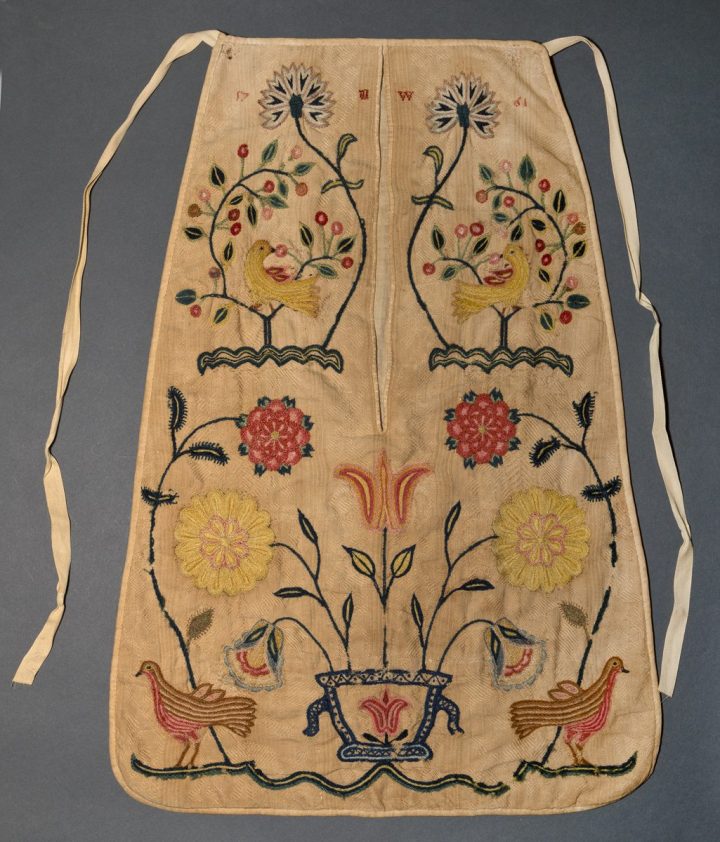
Pocket (Lady’s pocket), United States, 1780–1840, linen, wool, and silk (woven, embroidered, crewelwork), 56 × 39 cm (Winterthur, 1966.1126).
Explore the fascinating history of women’s and men’s pockets in this virtual lecture featuring a tie-on pocket in Winterthur’s collection. Through the 18th century, women used the tie-on pocket, an accessory worn under the skirt and wrapped around the waist. Men had pockets integrally stitched into the three-piece suit. Hannah Carlson, Winterthur summer research fellow and senior lecturer in the apparel design department at the Rhode Island School of Design, will explore the ‘pocket question’ and politics of individual preparedness and privacy.
Register for this free event here»
Hannah Carlson teaches dress history and material culture at the Rhode Island School of Design. After training as a conservator of costume and textiles at the Fashion Institute of Technology, she received a PhD in material culture from Boston University. She is the author of Pockets: An Intimate History of How We Keep Things Close (Algonquin Books, 2023).
Research Seminar | Katherine Gazzard on Portraiture and the Royal Navy
From The Mellon Centre:
Katherine Gazzard | Naval Gazing: Portraiture and the Royal Navy
Online and in-person, Paul Mellon Centre, London, 19 June 2024, 5pm

Joshua Reynolds, Portrait of George Edgcumbe, 1749 (Greenwich: National Maritime Museum, BHC2677).
Part of the series Out to Sea, which focuses on the influence of oceans and their coasts in relation to Britain and its global empire, on visual and architectural imagination, and production.
Joshua Reynolds’s portrait of naval officer George Edgcumbe (1749, National Maritime Museum) can be split into two zones: a maritime zone on the left, containing the young captain’s warship afloat in Plymouth Sound; and an architectural zone on the right, where ivy-covered columns evoke his Cornish country estate. Edgcumbe’s body straddles the divide, symbolising his ability to move between the worlds of naval service and aristocratic society. He wears the Royal Navy’s first-ever official uniform, introduced only months before. Perched above his shoulder is an African long-tailed paradise whydah bird, a souvenir from his travels. Positioning its sitter at the intersection of social, institutional, sartorial, local, national, and global concerns, this portrait serves as an introduction to the complex currents that have shaped the representation of naval personnel in British art. To what extent can naval portraiture be understood as a distinctive genre? What were its conventions, and how did they emerge?
In answering these questions, this talk by Katherine Gazzard will chart a visual and conceptual journey from the beach to the boardroom. Naval portraiture emerged in the eighteenth century as a genre that looked ‘out to sea’, employing coastal settings to symbolise colonial expansion, maritime trade and even the transgression of social norms. Through public display and reproduction, many portraits became known outside of naval circles, sometimes assuming immense cultural or political significance. Yet, over time, the focus of naval portraiture turned inward. Displayed in mess rooms and Admiralty corridors, portraits legitimised particular manifestations of authority within the Royal Navy and visually reinforced the service’s institutional and bureaucratic structures. This journey through the history of ‘naval-gazing’ invites us to reflect on how portraits can cross between private, public and institutional realms and what happens when they do.
Katherine Gazzard is Curator of Art (post-1800) at Royal Museums Greenwich. Through her research and curatorial work, she explores the interconnections between British art and the maritime world. She has previously taught art history and museum and gallery studies at the University of East Anglia, where she obtained her PhD in 2019. Her thesis explored the representation of naval officers in eighteenth-century British portraiture. She is the author of The Art of Naval Portraiture, published in March 2024.
Respondent: Sara Caputo is Senior Research Fellow and Director of Studies at Magdalene College, British Academy Postdoctoral Fellow at the Department of History and Philosophy of Science, and Affiliated Lecturer at the Faculty of History, University of Cambridge. Caputo specialises in the social and cultural maritime history of the eighteenth and nineteenth century, with particular focus on transnational migration, health and medicine, and mapping. Her first book, Foreign Jack Tars: The British Navy and Transnational Seafarers during the Revolutionary and Napoleonic Wars, was published by Cambridge University Press in 2022. Her second book, titled Tracks on the Ocean: A History of Trailblazing, Maps and Maritime Travel, will appear with Profile Books and The University of Chicago Press in summer 2024.
Lecture | Louis Nelson on Global Houses of the Efik
Upcoming at the Mellon Centre:
Louis Nelson | Global Houses of the Efik, with Shaheen Alikhan as respondent
Online and in-person, Paul Mellon Centre, London, 5 June 2024, 5pm

Carl Wadström, Design for a House in a Tropical Climate, from An Essay on Colonization (London, 1794).
Much of the scholarship on the globalised house of the early modern period privileges colonisers creating a false impression that globalisation was unidirectional. A more responsible examination explores the ways colonised communities also engaged in acts of collection, reinscription, and identity construction. Unlike many African communities, the Efik in Old Calabar (now modern Nigeria) never gave Europeans land rights to build the trading forts that slowly became the huge slave castles now dotting the West African coast. Forbidding European development allowed Africans far greater control over the landscapes of exchange along the waterline, where British ships’ captains would purchase enslaved Africans from Efik traders. Visitors’ descriptions include lavish accounts of the ways wealthy Efik traders donned British costume, swords, cocked hats, and umbrellas. But even more surprising for many were the traders’ houses. These took the common form of a raised two-storey house with a gallery on all sides. Over generations, some of these trading families stockpiled extraordinary collections of English material goods including gilt pier glasses, sofas, marble sideboards, engravings, clocks, and handsome dining tables. Years of negotiations while dining onboard with ships’ captains also meant that these traders could easily navigate both African and British dining practices. It was common practice for Efik traders to order not just objects but whole houses. This paper explores this practice and offers preliminary frames for interpretation.
Louis P. Nelson, Professor of Architectural History at the University of Virginia, is a specialist in the built environments of the early modern Atlantic world, with published work on the American South, the Caribbean, and West Africa, and is a leading advocate for the reconstruction of place-based public history. Louis is an accomplished scholar, with two book-length monographs published by University of North Carolina Press and Yale University Press, three edited collections of essays, two terms as senior co-editor of Buildings and Landscapes—the leading English language venue for scholarship on vernacular architecture—and numerous other articles. His work focuses on the early American South, the Greater Caribbean, and the Atlantic rim. Architecture and Empire in Jamaica (Yale, 2016) won three major book awards and was very positively reviewed in twelve different venues ranging from the popular Times Literary Supplement to the scholarly William and Mary Quarterly, The Art Bulletin, and Architectural History, many calling it a tour de force.
Shaheen Alikhan’s dissertation work, continuing from her MA thesis in architectural history on the construction of eighteenth-century slaving vessels, focuses on the reshaping and creation of waterfront spaces to facilitate the transatlantic trade in enslaved Africans. These liminal spaces, essential but unique within the larger landscape of chattel slavery, represented concentrated areas in which enslaved and legally free Africans and members of the African diaspora took opportunities to learn, communicate, earn wages, and build relationships and they have been largely overlooked. As an architectural historian, Shaheen has contributed to anthologies pertaining to the Caribbean world and reparative justice, and worked as a digital documentation specialist. She is currently in discussion with a publisher about her book Building a Floating Prison: Slave Ships throughout the Long Eighteenth Century.
Online Talk | Peter Kenny on Cabinetmaker Charles-Honoré Lannuier

◊ ◊ ◊ ◊ ◊
An ADAF online presentation (as noted at Events in the Field, the ever-useful calendar maintained by The Decorative Arts Trust) . . .
Peter Kenny | Forging a New Vernacular: French Ébéniste in Federal New York
Online, American Decorative Arts Forum, 21 May 2024, 9pm (ET)
Charles-Honoré Lannuier (1779–1819) arrived in New York in the spring of 1803 a thoroughly-trained Parisian ébéniste who, according to his inaugural newspaper advertisement, had “worked at his trade with the most celebrated Cabinet Makers of Europe.”

Charles-Honoré Lannuier, Pier Table, 1815–19, mahogany, mahogany veneer, pine, tulip poplar, maple, marble, gilded brass, die-stamped brass, plate glass, 35 inches wide (New York: The Metropolitan Museum of Art, 2018.30a, b).
Well-versed in the elegant forms of the late Louis XVI period, which still held sway during the earliest period of his training in Paris, Lannuier’s design vocabulary at the time of his arrival also included the harder edged yet brilliant neoclassical style of post-Revolutionary France known as Directoire (1795–99), and the Consulat (1799–1804), a heavier more monumental style featuring the more archaeologically correct forms of le goût antique. This was Lannuier’s Parisian stylistic legacy. How he transformed this legacy, ultimately becoming one of the two principal leaders of the New York school of cabinetmaking alongside his greatest rival, Duncan Phyfe, is an inspiring and a uniquely American story.
After a thirty-year career at the Metropolitan Museum of Art, Peter M. Kenny retired in 2014 as the Ruth Bigelow Wriston Curator of American Decorative Arts and Administrator of the American Wing. From 2015 to 2020 he served as co-president of Classical American Homes Preservation Trust, where he was responsible for the overall management and curatorial vision of its seven historic houses in New York City, the Hudson River Valley, North and South Carolina, and the U. S. Virgin Islands. A nationally recognized expert on early American furniture, he has lectured extensively on the subject at American museums and universities. The catalogs to his major exhibitions on the renowned cabinetmakers Charles-Honoré Lannuier (1779–1819) and Duncan Phyfe (1770–1854) garnered the Robert C. Smith Award of the Decorative Arts Society, and the Henry Allan Moe Prize from the New York State Historical Association. He was the 2015 recipient of the Eric M. Wunsch Award for Excellence in the American Arts and the 2018 Antiques Dealers’ Association of America Award of Merit. Mr. Kenny serves on the boards of The Chipstone Foundation in Milwaukee, which publishes the journals, American Furniture and Ceramics in America, Boscobel Restoration, Inc. in Garrison, New York, and Hyde Hall in Cooperstown, NY. He also serves as a Scholarly Advisor for Historic Huguenot Street in New Paltz, NY. Mr. Kenny is a graduate of Montclair State University and received his MA from the Cooperstown Graduate Program (State University of New York College at Oneonta) in History Museum Studies.
The American Decorative Arts Forum (ADAF) encourages the study, understanding, enjoyment and preservation of American art and design from their earliest beginnings to the present. Founded in 1983 to promote the study and appreciation of decorative arts, the ADAF has broadened its scope to include many areas of American fine arts and design, including fashion and architecture. The Forum sponsors up to twelve lectures annually by nationally recognized experts which are held in-person at the Gunn Theater, Legion of Honor, San Francisco and/or via Zoom. Members also have access to special events, including curator-led tours of exhibitions, visits to private collections, and travel opportunities. Members also receive a newsletter and emails containing updates and schedules of lectures and events.
Lecture | Basile Baudez on Fabrics in 18th-C Venice

Canaletto, Piazza San Marco, ca. 1723, oil on canvas, 68 × 112 cm
(New York, The Metropolitan Museum of Art, Purchase, Mrs. Charles Wrightsman Gift, 1988.162)
◊ ◊ ◊ ◊ ◊
From the Bibliotheca Hertziana:
Basile Baudez | Fabricating the City: Canaletto and 18th Century-Venice
Online and in-person, Bibliotheca Hertziana – Max Planck Institute for Art History, Rome, 4 June 2024, 11am
Textiles are everywhere in the modern city. Flags flutter atop buildings. Awnings stretch over sidewalks. Laundry dangles between houses. Yet the crucial role these fabrics play in urban life has not been properly understood. This research seminar looks to eighteenth-century Venice to uncover the ways in which textiles shaped politics, society, and law in the early-modern metropolis.
One of the most famous cities in Europe and a gateway to the East, visited by merchants and tourists from around the world, Venice was adorned with textiles of all types: Turkish carpets, military standards, baldachins, and clothing, among them. Focusing on the celebrated vedute of Canaletto, this seminar will discuss how textiles mediated tensions between public authorities and private citizens in the control of common spaces such as streets and squares just as distinct public and private spheres were emerging in Europe and the question of who controlled them became increasingly contentious. Eighteenth-century Venice emerges here as a vivid case study for the progressive transformation of streets and squares from sites of living to sites of regulated circulation and temporary occupation, a marker of modern cities as we know them. By exploring the rich and varied textiles that adorned one of the most beautiful cities in Europe, this research seminar will not only shed light on a key moment in Venice’s political and artistic history, it will provide valuable historical grounding for future discussions about the role of physical fabrics in the social and political fabric of our cities.
This research looks at eighteenth-century Venice to establish a model applicable to any urban context. Under the pressure of the contemporary explosion of the tourist market in the eighteenth century, Venice became the most reproduced and recognizable cityscape in the world, far more so than urban centers like Paris and London. Images of the city and its inhabitants are found in painting, print, drawing, porcelain, and furniture while being endlessly described in travel books, guides, letters, novels, and plays. An entire school of city view painters celebrated its contemporary life in contrast to the ruins of Rome, its main rival. Having lost its economic and political standing on the world stage, the Venetian Republic positioned itself as a unique space of political stability, freedom, and pleasure while celebrating its cosmopolitanism. Indeed, Venice kept its unique status as the main trade partner of the Ottoman Empire, and its tourists sought to get a glance at its exotic visitors and their luxurious fabrics. Recent historiography on Venice has challenged the traditional view of the eighteenth century as a time of decadence and backwardness; in fact, it enjoyed an era of financial prosperity (derived largely from the textile industry), intellectual, musical, and artistic renaissance that posits the city, with its unique republican government, as a perfect case study to tell a story about modernity.
St Mark’s Square, the center of Venetian political, religious, and social life, was the most tightly controlled space in the Republic and probably in the whole of Europe. It is the heart of this study and is often compared to the stage of a theater, to which seeing and being seen are integral. On the Venetian stage, the Republic’s Senate took painstaking care to regulate the usage of and access to its every part, from the porticoes under the Procuratie to the interstitial space between the two Piazzetta granite columns: beggars and prostitutes were forbidden, itinerant vendors had to be authorized, garments were carefully controlled. But the Square was also the main locus of distraction, encounters, gossip, the location of the most popular cafés like Florian and luxury shops. On St Mark’s Square the Senate organized the main religious and civic festivities from the annual, tented Corpus Domini procession to the vast ephemeral luxury market erected the week of the Ascension—and, of course, the most famous Carnival of the continent, where clothes and masks helped to disguise each participant. By focusing on images, testimonies, and laws governing St Mark’s Square, this research covers the entirety of urban life in its spatial and temporal complexity through the textile medium.
This event with be available through the Bibliotheca Hertziana’s Vimeo Channel. The link will be soon published here.
Basile Baudez is Associate Professor of Architectural History in the Art & Archaeology department at Princeton University after having taught at the Sorbonne in Paris. His first book, Architecture et Tradition Académique au Siècle des Lumières (Presses Universitaires de Rennes, 2013) questions the role of architects in early modern European academies. He co-edited several volumes on the history of architecture such as A Civic Utopia: Architecture and the City in France, 1765–1837 (Drawing Matters, 2016), Chalgrin et son Temps: Architectes et architecture entre l’Ancien Régime et l’Empire (Blake and Co, 2016), and most recently Textile in Architecture from the Middle Ages to Modernism (Routledge, 2023). He curated several shows devoted to architectural drawings, at the Ecole des Beaux-Arts and at the Musée des Arts Décoratifs in Paris, and at the Courtauld Institute in London. His latest monograph, Inessential Colors: Architecture on Paper in Early Modern Europe (Princeton University Press, 2021) was the 2022 winner of the Alice Davis Hitchcock Medallion awarded by the Society of Architectural Historians of Great Britain. He is currently completing a book project entitled Textiles in the City: Fabricating Eighteenth-Century-Venice on the role of textiles in urban settings.










 Enfilade
leave a comment