Online Talk | Brian Cowan on Extra-Illustration

◊ ◊ ◊ ◊ ◊
Today, from YCBA:
Brian Cowan | Extra-Illustration and the British Historical Imagination, ca. 1660–1850
Online, 30 April 2024, 12.30pm (Eastern Time)
Extra-illustration was a practice that developed in the later eighteenth century as a means by which collectors added imagery (most often prints, but sometimes manuscripts, objects, or original artworks) to existing books. In this talk, Brian Cowan will examine the practice of extra-illustration as a means of understanding the varieties of British historical imagination in the long eighteenth century. His project explores the relationships between political history, secret history, and biography as these genres developed over the course of the long eighteenth century in Britain.
The session is part of YCBA’s Art in Context series. Presented by faculty, staff, Student Guides, and Visiting Scholars, these talks focus on a particular work of art—often in the museum’s collections or special exhibitions—through an in-depth look at its style, subject matter, technique, or time period.
Registration is available here»
Brian Cowan is an associate professor of history at McGill University. He has published widely on early modern British and European history and is a founding member and inaugural president of the board for the international research group devoted to the history of sociability in the long eighteenth century. This group recently launched DIGIT.EN.S, an online encyclopedia of the history of sociability. Cowan’s publications include The Social Life of Coffee: The Emergence of the British Coffeehouse (2005), The State Trial of Doctor Henry Sacheverell (2012), and as a member of the twenty-two-person ‘multigraph collective’ Interacting with Print: Elements of Reading in the Era of Print Saturation (2018). His edited collection on The Cultural History of Fame in the Age of Enlightenment is forthcoming from Bloomsbury Academic, and he is currently editing (with Valerie Capdeville) The Oxford Handbook of the History of the European Enlightenment for Oxford University Press.
Image: Edward Hyde Clarendon, The History of the Rebellion and Civil Wars in England begun in the year 1641: with the precedent passages, and actions, that contributed thereunto, and the happy end, and conclusion thereof by the king’s blessed restoration and return upon the 29th of May, in the year 1660 (Oxford, 1702–04).
Lecture | Emmanuelle Chapron on Readers at the Royal Library of Paris
From the School of Advanced Study, University of London:
Emmanuelle Chapron | The Loan Registers of the 18th-Century Royal Library of Paris: A History of Readers, Books, and Institutions
Online, via Zoom, 4 June 2024, 5.30pm
The study of the loan registers of the Royal Library of Paris helps us to understand the use of the library and manuscripts in the 18th century, leading to a history of institutional trust and the library as archive.
In association with the History of Libraries seminar series. All are welcome; those wishing to attend should book a free ticket here.
Emmanuelle Chapron is Professor of Modern History at Aix-Marseille Université and Ecole pratique des hautes études, Paris. She is a specialist of the history of the book and libraries as well as history of scholarship in early modern times, in France and Italy. Among her publications are Ad utilità pubblica : politique des bibliothèques et pratiques du livre à Florence au XVIIIe siècle (Geneva, 2008) and Livres d’école et littérature de jeunesse en France au XVIIIe siècle (Liverpool, 2021). She is the curator of the digital edition of the letters and papers of Jean Jean-François Séguier (1704–1783). She is currently working in archives in libraries from the 17th century onwards.
Lecture | Andrew Foster on Chichester Cathedral Library, 1670–1735
From the School of Advanced Study, University of London:
Andrew Foster | The Restoration and Revival of Chichester Cathedral Library, 1670–1735
Lambeth Palace Library, London, 7 May 2024, 5.30pm
For the redoubtable Dr Mary Hobbs (1923–1998), the return of Bishop Henry King’s Library marked the rebirth of Chichester Cathedral Library post 1671; yet close analysis of The Old Catalogue before 1735 reveals other stories of benefactors and books in what was quite a renaissance for cathedral, city, and the surrounding region at the end of the seventeenth century.
In association with the History of Libraries seminar series. All are welcome; those wishing to attend should book a free ticket here.
Andrew Foster was formerly Director of Research at the University of Chichester and is now an Honorary Research Fellow of the University of Kent, and a Visiting Researcher with ‘Lincoln Unlocked’, Lincoln College, Oxford. He is a Fellow of the Society of Antiquaries, an ecclesiastical historian with a special interest in the history of the Church of England c.1540–1700, a former Vice-President of the Royal Historical Society, founding chair of the Public History Committee of the Historical Association, and Literary Director of the Sussex Record Society for 33 years until 2018.
Tour and Talk | Pitzhanger Manor
From Pitzhanger Manor & Gallery:
Collecting in 18th-Century London’s Grand Houses: Pitzhanger Manor, Orleans House, and More
Pitzhanger Manor & Gallery, London, 2 May 2024, 5.30–9pm
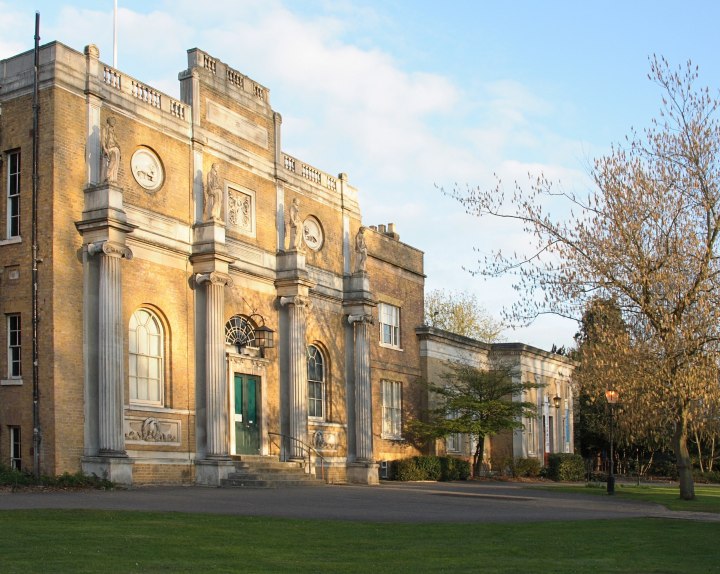
John Soane, Pitzhanger Manor, Walpole Park, Ealing, London, 1800–04 (Photo: Wikimedia Commons, April 2008).
Experience the first-ever in-person event presented by London Luminaries
The evening will include guided tours of Pitzhanger Manor, showcasing Sir John Soane’s architectural marvels, followed by an enlightening talk. Experts in historic estates—Clare Gough, Director of Pitzhanger Manor & Gallery; Tim Corum, Head of Richmond Arts Service; and Emily Burns, Curator of Collections and Interiors for English Heritage—will illuminate the art of collecting in 18th-century London, offering insights into the prestigious collections in Pitzhanger Manor, Orleans House, Marble Hill, Chiswick House, and more. Join us for an evening of history, art, and connectivity.
• Guided tours of the house commence at either 5.30 or 6pm. Guests are welcome to explore freely should they wish to arrive earlier or attend solely for the talk, which starts at 6.45.
• Tickets are £12, with all profits supporting the London Luminaries properties, an initiative born during the COVID lockdown to enhance connections between properties and people.
• Drinks and refreshments will be available for purchase at Soane’s Garden Room until 9pm, not included in the ticket price.
Pitzhanger Manor was the country home of Sir John Soane, one of the most influential architects in British history. Soane designed many extraordinary buildings, but Pitzhanger is unique as a building because it was designed, built and lived in by Soane himself. Following a major three-year conservation project, Pitzhanger reopened in March 2019. The Manor has been revitalised to take it back to Soane’s original designs, its extraordinary architecture restored for the public to see. Pitzhanger Gallery, housed in the 1939 library building, has been improved to allow for major loans and a series of contemporary exhibitions by artists, architects, and designers.
Emily Burns is the Curator of Collections & Interiors (West London) for English Heritage. Properties in her portfolio include Marble Hill, Chiswick House, and the Jewel Tower. Previously, she was a Curator at Watts Gallery – Artists’ Village (2021–23), Vivmar Curatorial Fellow at the National Gallery (2018–20), and Assistant Curator at the National Portrait Gallery (2013–18). Emily’s specialism is in British and Old Master painting and collecting. She holds degrees from the University of Cambridge and UCL and completed her AHRC-funded PhD on art and collecting in England during the Civil Wars and Interregnum, c.1640–1660 (University of Nottingham, 2018). Emily was a contributor to the Paul Mellon Centre’s research project Art and the Country House (2020), and she is the founding Editor of the Jordaens Van Dyck Journal (2021–present).
Tim Corum has worked in the arts for over 30 years, principally in museums and galleries, developing museum exhibitions and festivals at Oldham, Leeds, Bristol, the Horniman in London, and now with Richmond Arts Service. In Leeds and Oldham, he worked on developing international art programmes and a series of major capital projects. In Bristol, Tim led the development of the City Museum and Art Gallery, encouraging artists to intervene in and reframe the museum and art gallery. Though most widely known for the exhibition Banksy versus Bristol Museum, this programme also embraced a diversity of projects with both local and international partners. At the same time, he developed a new international contemporary art collection, building on Bristol’s rich historic art collection. He also led the creative team that developed the new museum, M Shed. In 2015, Tim became a director at the Horniman, where his work focussed on developing participatory programmes, bringing artists and scientists from a wide variety of backgrounds together with communities to create exhibitions and festivals that cast new light on the museum’s internationally significant collections. Tim moved to Richmond during the pandemic to lead the Borough’s Arts Service and direct the development of Orleans House Gallery.
Clare Gough is Director of Pitzhanger Manor & Gallery, architect Sir John Soane’s ‘country’ house in Ealing, West London and its adjacent contemporary gallery. Clare led Pitzhanger through a major conservation project to restore the house to Soane’s innovative design and upgrade the gallery, so it now stages exhibitions with artists ranging from Anish Kapoor to Es Devlin and Rana Begum. Clare is a Trustee of the Art Fund and was previously a Trustee of the Museum of the Home. She formerly worked at the National Gallery and National Gallery Co. Ltd before setting up an art consultancy working with the V&A and other art institutions.
Judith Hawley is Professor of Eighteenth-Century Literature in the Department of English, Royal Holloway, University of London. She frequently appears on BBC radio and TV and is a Trustee of the Pope’s Grotto Preservation Trust. Her research interests range from gin to Grub Street, and she has a particular interest in the history of amateur performance.
Lecture | Paris Spies-Gans on Imprints and Erasure

Image for the talk taken from Marie-Françoise Constance Mayer La Martinière (possibly with Pierre-Paul Prud’hon), Innocence Prefers Love to Wealth (L’Innocence préfère l’Amour à la Richesse), 1804, oil on canvas, 243 × 194 cm (St. Petersburg: Hermitage Museum).
◊ ◊ ◊ ◊ ◊
Next month at Harvard:
Paris Spies-Gans | Zerner Lecture — Imprints and Erasures: A New Story of Art
Harvard Art Museums, Cambridge, 23 April 2024, 6.00pm
In countless ways, women have been erased from the history of art. Their exhibited works have been reattributed to their male peers; their once-collected paintings have been left to deteriorate in museum storerooms; and many art historical accounts have questioned their very ability to create “great” art. We can even track the gradual removal of women’s names from the historical record in moments of deliberate, posthumous eradication. However, a growing mountain of evidence demands we recognize that women artists may have always existed—and were often quite prominent in their own places and times. In her lecture, Paris Spies-Gans will share this troubling history and present a series of recent discoveries to challenge the powerful, gendered assumptions that continue to inflect our views of the past. By recovering the traces of women artists—the imprints they left behind—we can update essential parts of art history’s most enduring narratives.
Paris A. Spies-Gans is a historian of art with a focus on women and the politics of artistic expression. She holds a PhD in History from Princeton University, an MA in Art History from the Courtauld Institute of Art, and an AB in History and Literature from Harvard University. Her research has been supported by fellowships from the Harvard Society of Fellows, the J. Paul Getty Trust, the Paul Mellon Centre for Studies in British Art, and the Yale Center for British Art, among other institutions. Her first book, A Revolution on Canvas: The Rise of Women Artists in Britain and France, 1760–1830, was published by Yale University Press in 2022. It has won several prizes in the fields of British art history and eighteenth-century studies, and was named one of the top art books of 2022 by The Art Newspaper and The Conversation. She is currently working on her second book, A New Story of Art (Doubleday/Penguin Random House).
Upcoming | Dinah Memorial Unveiling, Stenton, Philadelphia
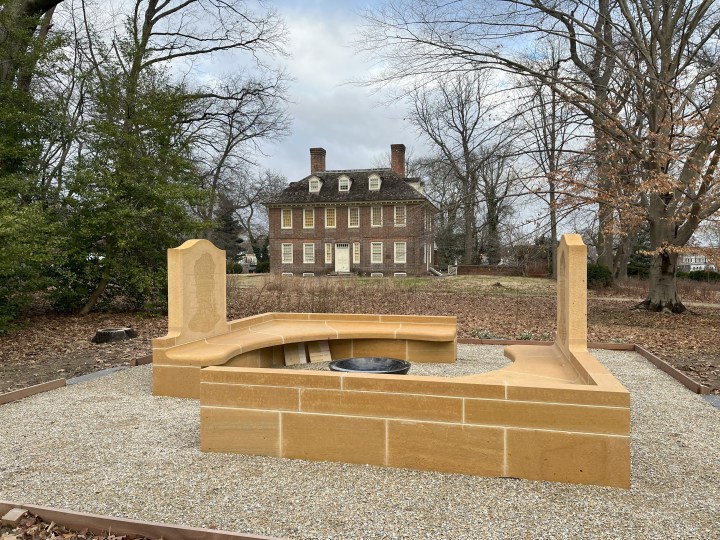
Karyn Olivier, Dinah Memorial, Stenton, Philadelphia, 2024. Nearly finished in this view, the memorial incorporates two brass plaques (one from 1912 and a new one), a small reflecting pool, and questions for both visitors and Dinah herself.
◊ ◊ ◊ ◊ ◊
I hope that Stenton’s Dinah Memorial Project garners the coverage it deserves in the coming weeks; what a compelling, important story! From the press release. . . –CH
Dinah Memorial Unveiling Celebration
Stenton Museum, Philadelphia, 20 April 2024, 2–4pm
On 20 April 2024, The Dinah Memorial, Philadelphia’s first monument dedicated to a formerly enslaved woman, will be unveiled on the grounds of Stenton, where she labored and was buried. This memorial is the physical culmination of Stenton’s Dinah Memorial Project, funded by The Pew Center for Arts & Heritage, a years-long community engagement discussion.
 Dinah’s complex life-story has been uncovered in archival sources in the Quaker Collection at Haverford College as well as in the Logan and related family papers collections at the Historical Society of Pennsylvania. Letters between family members, almanacs, ledgers, legal documents, and an investigation by the Quaker Meeting provided information that allowed Stenton staff to map Dinah’s life from her childhood in the home of Hannah Emlen, who would marry William Logan, to her death and burial in 1805. Though long celebrated for her storied role in saving Stenton from intended burning during the Revolutionary War, Stenton knew that there was more to Dinah than the ‘faithful slave’ narrative for which she was honored on a plaque erected in Stenton Park in 1912. This new memorial, a space in the Stenton landscape designed for questioning and reflection, conceived by acclaimed Philadelphia artist Karyn Olivier, seeks to rebalance Stenton’s historical interpretation, bringing to light the realities of Northern slavery and enslavement by Quakers while highlighting the fullness of Dinah’s humanity.
Executive Director Dennis Pickeral noted that “the Dinah Memorial Project has been transformative for the museum, revealing ignored and untold stories and histories of individuals who were enslaved and labored at Stenton, and for what the project has meant for the museum’s relationship with the surrounding community, who helped create the Dinah memorial and are now partners in charting Stenton’s course for the future.”
The unveiling falls on Stenton’s second annual Dinah Day celebration commemorating her requested release from bondage on 15 April 1776. Visitors can register here to attend the event.
◊ ◊ ◊ ◊ ◊
Built for James Logan, William Penn’s Secretary, between 1723 and 1730, Stenton is located in the historic Logan section of Philadelphia, at 4601 North 18th Street, four blocks east of Wayne Junction. The house is open for tours Tuesday through Saturday, from 1.00 to 4.00pm, April through December, and by appointment throughout the year. Stenton is a member of Historic Germantown, a consortium of nineteen cultural attractions and historic sites located in Northwest Philadelphia.
r e l a t e d p r o g r a m m i n g , r e c e n t a n d u p c o m i n g
Conversation with Memorial Artist Karyn Olivier and Remember My Name: Dinah’s Story Film Screening
Stenton, 2 February 2024, 6pm
The evening features Karyn Olivier, the artist who designed the Dinah Memorial, and a screening of Remember My Name: Dinah’s Story, a film written by Robert Branch and performed by Irma Gardner-Hamond and Marissa Kennedy.
Adrienne Whaley | A Glimpse into Dinah’s World: Revolutionary Black Philadelphia
Zoom, 22 February 2024, 6.30pm
Adrienne Whaley, Director of Education and Community Engagement at the Museum of the American Revolution, constructs Philadelphia through the eyes of Dinah. A recording is available here»
Laura Keim | From Archival Discoveries to Monumental Construction
Facebook Live, Historical Society of Pennsylvania, 1 March 2024, 4pm
Laura Keim has served as the Curator for Stenton since 1999. Images of archival sources for Dinah are available here. A recording of Keim’s presentation from the Historical Society of Pennsylvania is available here»
Amy Cohen | Black History in Philadelphia
Stenton, 4 April 2024, 12.30pm
After twenty years teaching social studies, Amy Cohen became Director of Education for History Making Productions and is a contributing writer for Hidden City Philadelphia. She’ll discuss her new book Black History in the Philadelphia Landscape: Deep Roots, Continuing Legacy (Temple University Press, 2024).
Lecture | Eugenia Zuroski on an Undisciplined 18th Century
At the Huntington in connection with USC’s 18th-century seminar series:
Eugenia Zuroski, A Funny Thing: An Undisciplined 18th Century
The Huntington Library, Art Museum, and Botanical Gardens, San Marino, 22 March 2024
Eugenia Zuroski of McMaster University presents “A Funny Thing: An Undisciplined 18th Century,” as part of the USC-Huntington Early Modern Studies Institute’s ‘Long 18th Century’ seminar series.
Friday, 22 March 2024
10.00–noon, with coffee available at 9.30am
Lecture | Caroline Campbell on Water and Venetian Art
In support of the Venice in Peril Fund:
Caroline Campbell | Reflections of Venice: How Water Inspired Her Artists
Royal Geographical Society, London, 14 May 2024
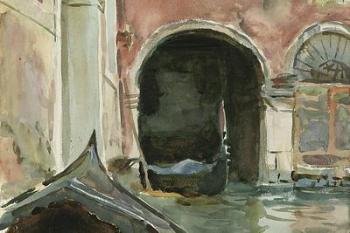
John Singer Sargent, Venetian Canal, watercolour and pencil, 25 × 36 cm (Christie’s Images / Bridgeman Images).
Ruskin famously wrote of the stones of Venice, but what of its water? Venice would be nothing without water. The lagoon and canals were the core of her trading activity and wealth, from the Middle Ages to the eighteenth century made manifest in the continuing annual tradition of the city’s marriage to the sea. From the late 19th century, the Lido also became an important element of Venice’s appeal and in particular as a tourist attraction. In this, the 17th Venice in Peril Kirker Spring Lecture, Caroline Campbell will explore the creative impulse of water—canal, river, lagoon, sea—in the work of Venetian artists and visitors to the city, from Carpaccio and Titian, Canaletto and Tiepolo, to John Singer Sargent, Thomas Mann, and John Lavery. Tickets for the lecture will be posted by the end of April; all tickets are non-refundable. A prosecco reception will begin at 6.30, with the lecture starting at 7.15. Standard tickets are £30; a recording, to be sent via email a week after the event, can be purchased for £10.
Caroline Campbell is Director of the National Gallery of Ireland. She was previously Director of Collections and Research at the National Gallery in London, a curator at the Ashmolean Museum, Curator of Paintings at the Courtauld Gallery, and the Jacob Rothschild Head of the Curatorial Department at the National Gallery, London. Dr. Campbell has curated several exhibitions devoted to Venetian art, including All Spirit and Fire: Tiepolo’s Oil Sketches (Courtauld Gallery, 2005); Bellini and the East (National Gallery and Isabella Stewart Gardner Museum, Boston, 2005–06); and Bellini and Mantegna (National Gallery and Gemaldegalerie, Berlin, 2018–19). Her love for Venetian art was honed as an MA student of Jennifer Fletcher’s at the Courtauld Institute of Art and through the experience of working as Assistant Curator of the National Gallery’s Titian exhibition in 2003. Campbell has written widely on Renaissance art—in exhibition catalogues, academic publications, and scholarly journals. Her first book, The Power of Art: A World History in Fifteen Cities, appeared in 2023. She is a Trustee of City and Guilds of London Art School, London, and of the Alfred Beit Foundation.
Lecture | Iris Moon on Stubbs and Wedgwood
Wednesday’s Research Semainar, from the Mellon Centre:
Iris Moon | A Body for Stubbs
Online and in-person, Paul Mellon Centre, London, 6 March 20224, 5.00–7.00pm
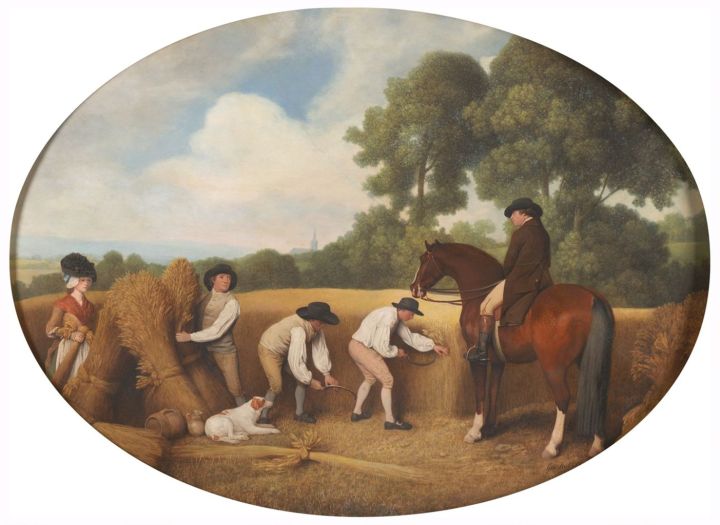
This talk focuses on the relationship between the painter George Stubbs and the potter and entrepreneur Josiah Wedgwood, and the work Reapers (1795). Alongside his commercial work making horse pictures for the landed gentry, Stubbs set out to create pictures of a more experimental nature executed on atypical surfaces, among them the oval ceramic tablets that Wedgwood created for him on demand. These were of an unusually large size, equally difficult to paint on, and fire in the kiln. Why was the horse painter drawn to the potter’s platters? Based on new material from Melancholy Wedgwood (MIT Press, 2024), this talk questions traditional readings of Wedgwood and the heritage paintings of Stubbs and, more broadly, notions of the eighteenth century as a foundational moment in Britain’s rise as a global commercial, financial, and industrial power. At the centre of this revisionist story is capitalism, empire, and exploitation. Found there too are babies, women, animals, and ceramics, among other lost figures not usually at the centre of eighteenth-century British art. Stubbs and Wedgwood take on new meanings when seen through the twisted prism of our own moment, amidst the ruins of late capitalist modernity.
Registration is available here»
Iris Moon is associate curator in the European Sculpture and Decorative Arts Department at the Metropolitan Museum of Art, where she is responsible for European ceramics and glass. At the Met, she participated in the reinstallation of the British Galleries, and she is currently planning an exhibition on Chinoiserie, women, and the porcelain imaginary that will open in 2025. She is the author of Luxury after the Terror, and co-editor with Richard Taws of Time, Media, and Visuality in Post-Revolutionary France. A new book on Wedgwood, generously supported by a publication grant from the Paul Mellon Centre, will be published next year with MIT Press. In addition to curatorial work, she teaches at Cooper Union.
Image: George Stubbs, Reapers, 1795, enamel on Wedgwood biscuit earthenware (New Haven: Yale Center for British Art, Paul Mellon Collection, B1981.25.618).
Lecture | Annette Richards on the ‘Blind Virtuosa, Mademoiselle Paradis’
In March at the Yale University Art Gallery, from The Walpole Library:
Annette Richards | Music on the Dark Side of 1800:
Listening to the Blind Virtuosa, Mademoiselle Paradis
Yale University Art Gallery, New Haven, 28 March 2024, 5.30pm
 The 26th Lewis Walpole Library Lecture will be delivered by Annette Richards, the Given Foundation Professor in the Humanities and University Organist at Cornell University.
In concerts across Europe in the 1780s, the young Viennese virtuosa Maria Theresia Paradis made blindness visible, even audible. Her performances invited listeners and viewers primed by horror ballads and literary romance to experience her story of trauma and misfortune within the frame of fictional narratives of doomed innocence and victimized Gothic heroines. Yet her outspoken views on blindness—informed by her own experience and contemporary philosophical discourse (by Diderot, Condillac, and Herder, among many others)—explicitly resisted the language of victimization, even as she sold pity for profit. This lecture brings to sounding life the Paridisian contradiction between performing disability for money and resisting pity. It asks what 18th-century music culture can tell us about contemporary views on blindness and explores the ways the public performances of a young female virtuoso simultaneously embraced and critiqued a culture of gawking spectatorship, freak show aesthetics, and the ethics and economics of pity. How did this Gothic musical heroine capture the public imagination, and what does she reveal about how music looked and sounded on the dark side of 1800?
Annette Richards is Professor of Music and University Organist at Cornell, and the Executive Director of the Westfield Center for Historical Keyboard Studies. She is a performer and scholar with a specialty in 18th-century music and aesthetics, and interdisciplinary research into music, literature, and visual culture. Dr. Richards was educated at Oxford University (BA, MA), Stanford University (PhD), and the Sweelinck Conservatorium Amsterdam (Performer’s Diploma, Uitvoerend Musicus).










 Enfilade
leave a comment