Artists in Conversation | Flora Yukhnovich
This evening from YCBA:
Artists in Conversation | Flora Yukhnovich
In-person and online, Hastings Hall, Yale School of Architecture, New Haven, 1 October 2025, 6pm

Flora Yukhnovich, photo by Kasia Bobula.
Flora Yukhnovich will talk to Eleanor Nairne, the Keith L. and Katherine Sachs Curator of Modern and Contemporary Art, the Philadelphia Museum of Art. Watch the livestream here.
The Artists in Conversation series brings together curators and artists to discuss artistic practices and insights into their work.
Born in 1990 in Norwich, UK, Flora Yukhnovich developed her characteristic painting language while studying at City and Guilds of London Art School, where she completed her MA in fine art in 2017. She also studied portraiture at the Heatherley School of Fine Art in London. Yukhnovich’s art boldly explores materiality and process as vehicles for meaning, with cascading and swirling forms that evoke rhythm and energy, flowing between representation and abstraction. Her immersive paintings splice historic styles, from French rococo and Italian baroque to abstract expressionism, with references drawn from contemporary films, music, literature, and consumer culture. Through her work, Yukhnovich addresses dynamics of power inherent in received readings of art-historical subjects and their associated hierarchies. She questions notions of femininity and gender that are hard-wired into the aesthetic language of color and form.
Yukhnovich received the Elizabeth Greenshields Foundation Award in 2013 and 2016. She has participated in group and solo exhibitions worldwide. Her work is included in many collections, including the Hirshhorn Museum, Washington, DC; the Montreal Museum of Fine Arts; the Roberts Institute of Art, London; and the National Gallery of Victoria, Melbourne. She lives and works in London.
Eleanor Nairne is the Keith L. and Katherine Sachs Curator of Modern and Contemporary Art and department head, modern and contemporary art, at the Philadelphia Museum of Art. Previously, she was the senior curator at Barbican Art Gallery, London, where her exhibitions included Basquiat: Boom for Real (2017), Lee Krasner: Living Colour (2019), Jean Dubuffet: Brutal Beauty (2021), Soheila Sokhanvari: Rebel Rebel (2022), Alice Neel: Hot Off The Griddle (2023), and Julianknxx: Chorus in Rememory of Flight (2023–24). She also curated Erotic Abstraction: Eva Hesse / Hannah Wilke (2021) at Acquavella Galleries in New York.
Panel Discussion | Jeremy Bentham’s Books at UCL
From Eventbrite:
Jeremy Bentham’s Books in UCL’s Special Collections
UCL Object Based Learning Laboratory, London, 9 October 2024
An event exploring Jeremy Bentham’s book collection and ways in which it continues to shape UCL’s library holdings today.
It has long been known that the 18th-century philosopher Jeremy Bentham bequeathed a number of his books to University College London (known at the time as the London University). But the contents of the bequest and the faith of the books had remained obscure. A recent discovery of an item-by-item list of the books in the UCL library archives by Colin Penman (UCL Head of Records) and a Bentham expert, Professor Tim Causer, sparked a project to uncover some of Bentham’s books in UCL’s rare book collections, overseen by Erika Delbecque (UCL’s Head of Rare Books). Join UCL Special Collections to hear Colin, Tim, and Erika talk about the project, the discoveries made so far, the process of identifying Bentham’s books, and their significance today. The original list of the Bentham’s bequest, along with some of the books from his library (many heavily annotated by Bentham himself), will be on display. The event is free and open to all, but booking is essential.
The UCL guide to the Bentham Book Collection offers a helpful introduction to our holdings as well as information about researching and accessing this collection. You can also read more about our ongoing research into Bentham’s bequest here.
Wednesday, 9 October 2024
3.00–4.00pm | Panel discussion and collections display
4.00–4.30pm | Collections display and refreshments
Lecture | Adrienne Childs on Pearls and Blackamoors
Presented by the Lewis Walpole Library and the Wadsworth Atheneum:
Adrienne Childs | Pearl Drops and Blackamoors: The Black Body and Pearlescent Adornment in European Art
Wadsworth Atheneum, Hartford, Connecticut, 10 October 2024, 6pm

Nicolaes Berchem, A Moor Offering a Parrot to a Lady (detail), ca. 1660–70, oil on canvas (Hartford: Wadsworth Atheneum Museum of Art, 1961.29).
European artists of the seventeenth through nineteenth centuries often depicted Black figures wearing pearl ornaments. The contrast evoked notions of luxury, distant lands, and exoticism. Art historian and curator Adrienne L. Childs, PhD explores the complexities of subjugating and enslaving Black bodies in one context and using their images to showcase luxuries in another. Before the lecture, meet at 5pm in the galleries to view works from the museum’s European art collection. Free and open to the public with registration encouraged.
The lecture is offered in connection with the exhibition The Paradox of Pearls: Accessorizing Identities in the Eighteenth Century, curated by Laura Engel, Professor, Duquesne University, on view at the Lewis Walpole Library until 31 January 2025.
Adrienne L. Childs is an independent scholar, art historian, and curator. She is Senior Consulting Curator at The Phillips Collection in Washington, DC. Her current book project is an exploration of Black figures in European decorative arts entitled Ornamental Blackness: The Black Figure in European Decorative Arts, forthcoming from Yale University Press (2025). She is co-curator of Vivian Browne: My Kind of Protest for The Phillips Collection (on view until September 2025). She recently co-curated The Colour of Anxiety: Race, Sexuality and Disorder in Victorian Sculpture at The Henry Moore Institute in Leeds, England. She was the guest curator of Riffs and Relations: African American Artists and the European Modernist Tradition at The Phillips Collection in 2020. Childs was awarded the 2022 Driskell Prize from The High Museum of Art in recognition of her contribution to African American art and art history. She holds a BA from Georgetown University, an MBA from Howard University, and a PhD in the History of Art from the University of Maryland. Currently, Childs serves as the Distinguished Scholar at the Leonard A. Lauder Center at The Metropolitan Museum of Art.
Talk | Philippa Tudor on Huguenot Records at Lambeth Palace Library
From Eventbrite:
Philippa Tudor | Huguenot Records in Lambeth Palace Library: Cataloguing Complexity
Lambeth Palace Library, London, 2 October 2024, 5.30pm
Registration due by 30 September 2024
Philippa Tudor will be talking about her work as a volunteer at LPL cataloguing the Huguenot records.
The term ‘refugees’ was first used to describe the 50,000 Protestants who fled to England from France in the 16th–18th centuries. The miscellany of related records in Lambeth Palace Library sheds light on the experiences of Huguenots in England, as well as attempts to secure the release of those condemned to the French galleys. All are welcome, but anyone wishing to attend must book an individual ticket or email archives@churchofengland.org no later than Monday, 30 September.
Philippa Tudor, who completed her doctorate in the literature of the early Reformation in England, is a volunteer cataloguer and friend of Lambeth Palace Library, working on a finding aid to its Huguenot-related resources.
Lecture | Miriam Schefzyk on German Cabinetmaker in 18th-C. Paris
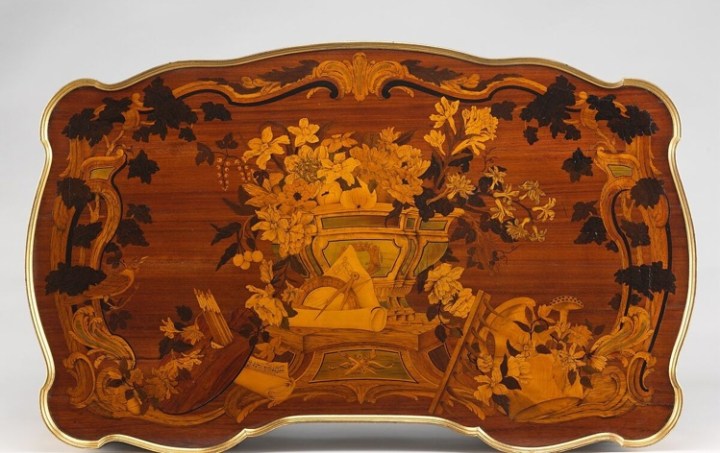
Jean-Francois Oeben and Roger Vandercruse, Tabletop of a mechanical table, ca. 1761–63, oak veneered with mahogany, kingwood, and tulipwood, with marquetry of mahogany, rosewood, holly, and various other woods; gilt-bronze mounts; imitation Japanese lacquer; replaced silk (New York: The Metropolitan Museum of Art, 1982.60.61).
◊ ◊ ◊ ◊ ◊
This fall at BGC:
Miriam Schefzyk | Parisian Dreams: German Migrants and Cabinetmaking in 18th-Century Paris
A Françoise and Georges Selz Lecture on Eighteenth- and Nineteenth-Century French Decorative Arts and Culture
Bard Graduate Center, New York, 2 October 2024, 6pm
Paris has long been a privileged destination for many, but there was a particularly significant migration that began in the seventeenth century and gathered strength during the eighteenth century: that of German cabinetmakers. Hardworking and aspiring to wealth, recognition, and a better life, these numerous artisans made Paris into the most important center in the furniture and luxury trade of the time. Many of them rose to important positions as masters or leaders in the guild, and some even obtained royal privileges and titles. Their furniture was regarded as the incarnation of French taste and is still viewed as evidence of the supremacy of French decorative arts today. In this lecture, Miriam Schefzyk will examine the living and working conditions of these artisans and how their background as migrants significantly shaped the framework in which these extraordinary pieces of furniture were created.
$15 General | $12 Seniors | Free for people associated with a college or university, people with museum ID, people with disabilities and caregivers, and BGC members.
Miriam E. Schefzyk is the associate curator of decorative arts at the J. Paul Getty Museum and previously worked at the Museum of Decorative Arts in Berlin. She studied art history at the universities of Marburg, Berlin, Münster, and Paris, earning a PhD in a joint French-German doctoral program. A specialist of French decorative arts of the seventeenth and eighteenth centuries, her research focuses on Parisian furniture, artistic transfer, social history, and materiality. Her book Migration und Integration im Paris des 18. Jahrhunderts: Martin Carlin und die deutschen Ebenisten (Bielefeld: Transcript Verlag, 2022) was awarded the Marianne Roland Michel Foundation Prize for its important contribution to French art and will soon be published in French.
Lecture | Mia Jackson on the Birds of Louis-Denis Armand

Louis-Denis Armand, Parrots, ca. 1750–70
(Paris: Galerie Dragesco-Cramoisan)
◊ ◊ ◊ ◊ ◊
This fall at BGC:
Mia Jackson | Flights of Fancy: The Birds of Louis-Denis Armand (1723–1796)
A Françoise and Georges Selz Lecture on Eighteenth- and Nineteenth-Century French Decorative Arts and Culture
Bard Graduate Center, New York, 11 December 2024, 6pm
Mia Jackson will talk about her recent exhibition, Flights of Fancy, the first ever survey of the life and work of the recently rediscovered Sèvres painter Louis-Denis Armand (1723–1796), now celebrated as one of the foremost painters of birds. Very few artisans from the eighteenth century have left us such a detailed biography; over thirty drawings by Armand survive, and research into the drawings and their inscriptions (by Jackson and collaborator Bernard Dragesco) has revealed a wealth of detail about the artist, his life, his work, and even his political opinions.
Mia Jackson has been curator of decorative arts at Waddesdon Manor since 2017. She studied French and Philosophy at the University of Oxford then completed an MA in eighteenth-century French decorative arts at the Courtauld Institute of Art. Her doctoral thesis entitled “André-Charles Boulle (1642–1732) and Paper: Prints and Drawings in the Workshop of an Ébéniste du Roi” was completed at Queen Mary, University of London in 2016. She previously worked in the Prints and Drawings Department at the British Museum, the Wallace Collection, and English Heritage. Eighteenth-century France is her area of expertise, in particular the links between works on paper and the decorative arts.
Exhibition | The Paradox of Pearls
Opening next month at The Walpole Library:
The Paradox of Pearls: Accessorizing Identities in the Eighteenth Century
The Lewis Walpole Library, Farmington, CT, 27 September 2024 — 31 January 2025
Curated by Laura Engel
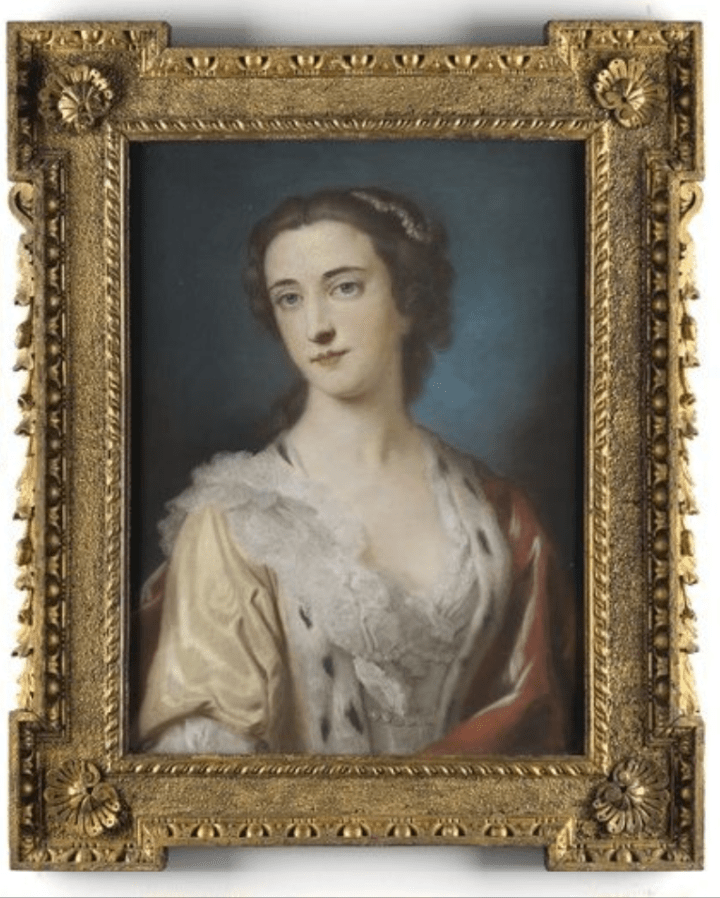
William Hoare, Portrait of Maria Walpole, ca. 1742, pastel on paper (The Lewis Walpole Library, Yale University, LWL Ptg. 152).
Pearls figure prominently in pictures of celebrated and imagined figures across the eighteenth century. Adorning royalty, celebrities, servants, and in fashion plates, the mysterious, opaque, and gleaming white accessory aligns with the mutable, seductive, and threatening emergence of new forms of identity. Worn as jewelry, as embellishments to the body and dress, or embedded in the settings of precious objects—pearls accessorize, highlight, colonize, and perform. As one of the most sought-after commodities of the early modern colonial enterprise, a precious jewel tied to bondage and violence, pearls have a baroque and complex history. Drawing from materials in the Lewis Walpole Library this exhibition will explore the ‘paradox of pearls’ by considering how the varied and often contradictory meanings of this jewel appear in period images and the ways in which practices from the past connect us to the powerful presence of pearls today. The exhibition is curated by Professor Laura Engel of Duquesne University.
◊ ◊ ◊ ◊ ◊
Curator Talk with Laura Engel
The Lewis Walpole Library, 16 November 2024, 2pm
From Queen Elizabeth I to Harry Styles, the legacy of pearls is a story about self-fashioning. Pearls feature prominently in many pictures of celebrated figures from the past. Worn as jewelry—as embellishments of the body and apparel, or embedded in the settings of precious objects—pearls illuminate ideas about beauty, power, and style. Drawing upon materials in the Lewis Walpole Library, this talk considers how the varied and often contradictory meanings of this jewel were represented in period images and the ways in which practices from the past connect us to the enduring presence of pearls today. Space is limited, and advance registration through the Farmington Libraries site is required. Registration link forthcoming.
Lecture | Cynthia Chin on Recreating a Martha Washington Gown

Gainsborough Silk Weaving Company, detail of the reproduced silk used in Cynthia Chin’s replica of a gown owned by Martha Washington
(Image courtesy of Cynthia Chin)
◊ ◊ ◊ ◊ ◊
Upcoming at the Wadsworth Atheneum:
Cynthia Chin | Off the Dressmaker’s Needle: Recreating Martha Washington’s Purple Silk Gown and Recovering the Lives Within
Wadsworth Atheneum, Hartford, CT, 15 September 2024, 2pm

Cynthia Chin, Gown and petticoat, 2024, Silk, linen, and wool. The gown is a reproduction of a garment owned by Martha Custis Washington. The original was made in the the early 1760s when Washington was in her thirties, remade around the time of the American Revolution (1775–1783), and possibly worn during her tenure as First Lady (1789–1797). The original gown is now in the collection of the New Hampshire Historical Society.
The recent work of art and material culture historian Cynthia Chin involves an in-depth study of a purple silk gown owned by Martha Custis Washington (1731–1802). Chin reveals how her research and recreation of the textile and garment illuminate the stories of the people who made, wore, and cared for it. Join us before the lecture to view Chin’s colorful replica of Washington’s gown, on view in New Nation, Many Hands. Free with reservations encouraged.
As Dr. Chin notes in her Maker-Scholar Statement: “Recreating this garment as it may have appeared when new, unworn, and unaltered honors the forced labor of the enslaved seamstresses who tended the original object, including Caroline Branham (1764–1843), Charlotte, and Ona ‘Oney’ Judge (1773–1838). I commissioned the textile specifically for this project. It was reproduced by the Gainsborough Silk Weaving Company in Suffolk, UK. This gown and its replication methodology reveal new evidence of how the original dress changed over its lifespan, and how Martha Washington may have appeared when she was young. It remembers all unseen and forced labor—the ‘many hands’ that created our new American democracy.”
Cynthia E. Chin is an art and material culture historian of Vast Early America and Britain in the eighteenth century, specializing in dress, textiles, identity, and collecting. As a researcher at the University of Glasgow, Cynthia examines collections of dress, textiles, and art from around 1600 to 1830 in order to understand how private collections, individual collectors, and museum acquisitions strategies shaped notions of ‘early America’.
Presented with support from the Joseph and Robert Cornell Memorial Foundation Fund at the Wadsworth Atheneum.
Lecture | Ned Lazaro on the Mourning Embroidery of Elizabeth Bennett
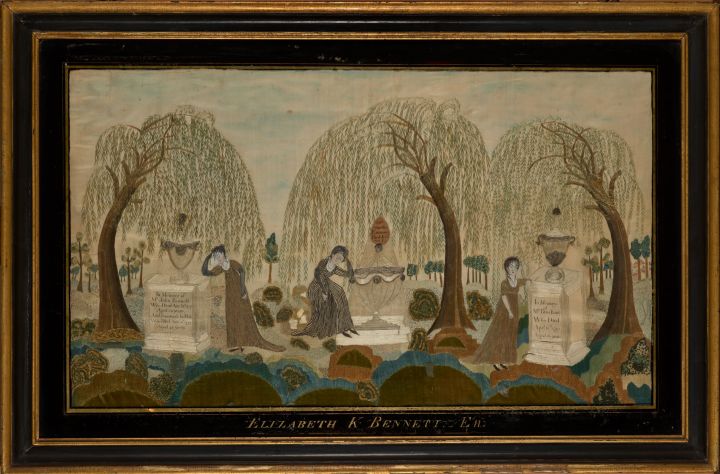
Elizabeth K. Bennett, Mourning Picture, 1801–07, polychrome silk embroidery, metallic threads, gouache and watercolor paints, plain-weave silk ground (Hartford: Wadsworth Atheneum, gift of Miss Jane W. Stone, 1938.236).
◊ ◊ ◊ ◊ ◊
Upcoming at the Wadsworth Atheneum:
Ned Lazaro | The Mourning Embroidery of Elizabeth K. Bennett
Wadsworth Atheneum, Hartford, CT, 8 September 2024, 1pm
Needlework was an important part of a young girl’s education in eighteenth- and nineteenth-century America. Mourning embroideries often depicted figures overcome with sadness and weeping willow trees. Ned Lazaro, Associate Curator of Costume and Textiles, discusses the ongoing significance of a particular example. Free with museum admission.
Roundtable | The Study of Collecting: Past, Present, and Future

Frans Francken the Younger, The Cabinet of a Collector with Paintings, Shells, Coins, Fossils, and Flowers, 1619, oil on panel, 56 × 85 cm
(Royal Museum of Fine Arts Antwerp)
◊ ◊ ◊ ◊ ◊
From the programme flyer:
Roundtable Discussion | The Study of Collecting: Past, Present, and Future
Institute of Advanced Studies Forum, University College London, 10 September 2024, 14.00–16.00
Begun in 1989, the Journal of the History of Collections has played a pivotal role in the development of the study of collecting. A multidisciplinary field by nature, the study of collecting began, arguably, with research into the early modern period and such cabinets of curiosities as those belonging to Hans Sloane and Ulisse Aldrovandi. With 35 complete volumes of the Journal now having been published, the time is ripe for a look at the past, present, and future of the field. This will also be an occasion to mark the appointment of Christina M. Anderson as Editor in Chief and the recent retirement of the Journal’s Founding Editor, Arthur MacGregor.
The UCL Centre for Early Modern Exchanges, together with the Journal of the History of Collections, is hosting a roundtable discussion to explore themes that have developed in the field over the past 35 years and to identify new ones that are emerging. In doing so, the event aims to consider not only traditional methodologies but also new approaches that have been developed in the humanities, social sciences, museum studies, heritage, art market, etc., in recent years. It also seeks to address the ways in which early modern cabinets of curiosities have inspired contemporary museums, magazines, and bloggers.
Short presentations (5–10 minutes) will be given by members of a panel, to include Paula Findlen (Stanford University), Anne Gerritsen (University of Warwick), Anna Garnett (Petrie Museum), Mark Carine (Natural History Museum), and Hélia Marçal (UCL History of Art), among others. These overviews will be followed by a moderated panel discussion and questions from the audience. Refreshments will be provided. For catering purposes, rsvp to editorjhc@gmail.com. We look forward to seeing you there!










leave a comment