Everyday Objects Symposium
Everyday Objects: Art and Experience in Early Modern Europe
Courtauld Institute Inaugural Early Modern Symposium, London, 21 November 2009
Through a focus on the everyday object, this one-day symposium explores both the experience of visual culture in everyday life and the phenomenon of the everyday in visual culture. Drawing on theories of the everyday from such fields as anthropology, phenomenology and sociology, papers will examine the seemingly banal things that formed the culture of daily life, asking: what constitutes an everyday object? How were everyday objects experienced, represented or collected? And how does their study enhance our understanding of the cultural history of early modernity?
Papers by established and emerging scholars will explore the theme of the everyday object in a variety of media, including sculpture, painting, dress, furniture and the graphic arts. Presentations will investigate ephemeral objects, quotidian spaces and habitual activities — from the social rituals of marriage, food consumption and waste disposal, to overlooked ‘things’ like taxidermy, miniature furniture and clothing accessories.
Organised by Edward Payne and Hannah Williams. To book a place, please send a cheque for £15 (£10 students) made payable to ‘Courtauld Institute of Art’ to Research Forum Events Co-ordinator, Research Forum, The Courtauld Institute of Art, Somerset House, Strand, London WC2R 0RN — clearly stating that you wish to book for the Everyday Objects Conference. For credit card bookings, call 020 7848 2785/2909. For further information, send an email to ResearchForumEvents@courtauld.ac.uk, or visit the Institute’s website.
Introduction – Edward Payne & Hannah Williams
Session 1 – Chair: Edward Payne
- Samuel Bibby (University College London), “The Triumph of the Everyday: Sculpture, Marriage, and Memory in Fifteenth-Century Florence”
- Joanna Woodall (The Courtauld Institute of Art), “Laying the Table. The Procedures of Still-life”
Session 2 – Chair: Hannah Williams
- Katie Scott (The Courtauld Institute of Art), “Cochin’s Handkerchiefs”
- Ariane Fennetaux (Université Paris-Diderot), “What’s in a Pocket? The Contribution of Material Culture to the Cultural and Social History of Eighteenth- and Nineteenth-Century Britain”
Session 3 – Chair: David Solkin
- Paula Radisich (Whittier College), “Theorizing ‘Things’ in French Genre Painting of the 1740s”
- Melinda Rabb (Brown University), “Mimesis Reconsidered: Everyday Objects in Miniature”
Session 4 – Chair: Sheila McTighe
- Beth Fowkes Tobin (Arizona State University), “Women, Decorative Arts, and Taxidermy”
- Olivia Fryman (Kingston University and Historic Royal Palaces), “‘Necessary Stooles’ and Necessary Women: Dealing with Royal Dirt, 1660-1714”
Listening to Furniture
Recently added to caa.reviews:
Dena Goodman and Kathryn Norberg, eds., Furnishing the Eighteenth Century: What Furniture Can Tell Us about the European and American Past (New York: Routledge, 2007), 272 pages, $69.95 (9780415949538)
Reviewed by Stacey Sloboda, Assistant Professor of Art History, Southern Illinois University; posted 4 November 2009.
In a conceptually wide-reaching and useful introduction to “Furnishing the Eighteenth Century: What Furniture Can Tell Us about the European and American Past,” editors Dena Goodman and Kathryn Norberg ask, “Can the settee speak?” (2). That this question remains relatively novel suggests the importance of the book. Their answer, of course, is affirmative; and the twelve essays that constitute this collection provide ample new, thoughtful, and frequently surprising revelations about what exactly eighteenth-century furniture said to a broad range of makers, users, and audiences. Written by scholars in the fields of history, literary studies, and art history, the essays are methodologically diverse yet unified by an interest in the social and cultural uses and meanings of objects and interiors in the eighteenth century. . . .
In a revelatory essay that should become standard reading for students of eighteenth-century French visual and material culture, “The Joy of Sets: The Uses of Seriality in the French Interior,” Mimi Hellman explores multiple reasons why sets, serial designs, and matching objects became characteristic features of the eighteenth-century French interior. Deftly weaving formal, cultural, and historical approaches to specific objects, Hellman deploys a wide range of theoretical insights, from anthropology to psychoanalysis, to argue that, “serial design was a crucial site for the enactment of elite self-fashioning, an eloquent representational system that elicited performances of social mastery” (147). Furthering the concept of signifying objects, Mary Salzman’s careful analysis of Jean-François de Troy’s pendant paintings “The Garter” and “The Declaration of Love” (1724) argues that decorative objects in de Troy’s paintings constitute a form of visual rhetoric that communicated with savvy viewers for whom judgment was an important critical activity. . . .
◊ ◊ ◊ ◊ ◊
Sloboda, Hellman, and Salzman are all HECAA members. For CAA members, the entire review can be found here»
Happy Birthday, Angelica Kauffman!
Angelica Kauffman turns 268 today. The following comes from Meredith Martin’s 2007 review of Angela Rosenthal’s book on the artist. From caa.reviews:
Angela Rosenthal, Angelica Kauffman: Art and Sensibility (New Haven: Yale University Press in association with Paul Mellon Centre for Studies in British Art, 2005) 352 pages, $65.
Reviewed by Meredith Martin, Assistant Professor, Wellesley College; posted 1 May 2007.
Cover Image: Angelica Kauffman, "Self-Portrait," detail, 1784 (Munich: Bayerische Staatgemäldesammlung Neue Pinakothek)
Rosenthal’s monograph restores Kauffman’s own work to center stage. Her project is not simply one of “historical recovery,” for as the author notes, “unlike some other female artists, [Kauffman] never fully lost her position within the art-historical canon” (2). Generally speaking, Kauffman’s story is not one of isolation or exclusion, but rather of strong support, widespread influence, and international renown. One need only glance at her voluminous, multilingual correspondence with the leading cultural figures of eighteenth-century Europe—Goethe, Johann Caspar Lavater, and Izabella Czartoryska among them—to get a sense of the professionally rewarding and breathlessly glamorous life that Kauffman led. Zoffany’s painting notwithstanding, Angelica Kauffman was nobody’s wallflower. . .

Member News
Angela Rosenthal is associate professor at Dartmouth. She specializes in early modern European visual culture (especially British art within a global perspective), with an emphasis on cultural history, gender studies, feminist and post-colonial theory, and the history of art criticism. She studied art history, psychology and social anthropology at Trier University, Germany and in the UK (The Courtauld Institute of Art, University College London, and Westfield College). Before joining the faculty at Dartmouth College in 1997, she was curator of contemporary art at the Stadtgalerie in Saarbrücken (1994-95), and Andrew W. Mellon Assistant Professor of Art History at Northwestern University (1995-97). Rosenthal’s most recent research project emerged from her past work on the visual formulation of subjectivity, as well as from her engagement with contemporary post-colonial art theory. In this new book project, entitled The White of Enlightenment: Racializing Bodies in 18th-Century British Visual Culture, Rosenthal seek to complement the growing field of research on concepts of “race” and “ethnicity” in the visual arts.
Meredith Martin joined the Wellesley faculty in 2008. She received a BA in Art History from Princeton University in 1997 and a PhD in the History of Art and Architecture from Harvard University in 2006. Her research interests include: eighteenth- and nineteenth-century French visual and material culture, architectural theory and landscape design; gender, space, and the domestic interior; early neo-classicism; art and colonialism; and the historiography of the Rococo. She is the co-author, with Scott Rothkopf, of Period Eye: Karen Kilimnik’s Fancy Pictures (Serpentine Gallery/Koenig Books, 2007). Her book, Dairy Queens: Pastoral Architecture and Political Theater from Catherine de’ Medici to Marie-Antoinette, is forthcoming from Harvard University Press, and she is also co-editing a volume with Denise Baxter entitled Architecture Space in Eighteenth-Century Europe: Constructing Identities and Interiors to be published by Ashgate next spring. Her current research addresses diplomatic and material exchanges between France and India in the late eighteenth century.
Recapping the Récamier Exhibition and Colloquium in Lyon
By HEATHER BELNAP JENSEN
Juliette Récamier, muse et mécène
Musée des Beaux-Arts de Lyon, 27 March – 29 June 2009
Colloquium: Historiennes et critiques d’art à l’époque de Juliette Récamier, international colloquium organised by the Institut national d’histoire de l’art, Musée des Beaux-Arts, Lyon, 26 June 2009
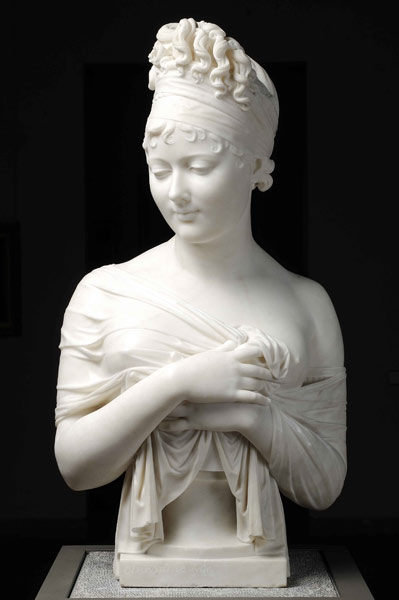
J. Chinard, "Portrait of Juliette Récamier," 1805-06 (Lyon: Musée de Beaux-Arts)
Juliette Récamier: Muse et mécène, recently mounted by the Musée de Beaux-Arts in Lyon, was surely one of the highlights of this past summer’s exhibition season. Thoughtfully conceived and beautifully executed, this show did much to restore Récamier to her rightful place as a key arbiter of taste in post-Revolutionary France. Upon entering the foyer, one was immediately transported to the refined and graceful realm of this cultural luminary. Art, fashion, and furnishings were disposed so as to emphasize her various powers. This exhibition compellingly argued that Récamier not only inspired some of the most enchanting art of the period (one thinks immediately of the portraits of this figure by Jacques-Louis David and François Gérard—neither of which were able to travel, unfortunately), but that she also figured as a formidable patron of the arts. The most exquisite space in this show was the re-creation of Récamier’s salon, as detailed in François Louis Dejuinne’s painting of 1826. To see in conversation some of the most iconic paintings of the age, including Anne-Louis Girodet’s Portrait of Chateaubriand, Elisabeth Vigée-Lebrun’s Portrait of Mme de Staël as Corinne, and Gérard’s Corinne at Cape Miseno, was a truly captivating experience. Attesting to the enduring interest in the figure of Recamier was the 1928 film of Gaston Ravel that played in an adjacent room, along with the twentieth-century works by René Magritte that paid homage to ‘la dame au sofa’. The accompanying catalogue (available here via Amazon.ca) was as exquisitely crafted as the exhibition, with contributions by the curator, Stéphane Paccoud, as well as other notable French and American scholars including Laura Auricchio. The essays attest to the complexities of Récamier’s roles as muse and patron and point to the need to reconsider conventional characterizations of such well-positioned women in the fashioning of artistic sensibilities. In sum, I must concur with Didier Rykner’s assessment of the exhibition made in La Tribune de l’Art: it did indeed approach perfection.

Robert Smirke, "Chambre de Juliette Récamier,” 1802 (London: Royal Institute of British Architects Library)
In conjunction with the exhibition, Historiennes et critiques d’art à l’époque de Juliette Récamier, a colloquium dedicated to the women writing about the arts in France, c. 1800, was held on June 26 in Lyon. This international colloquium was sponsored by the Institut national d’histoire de l’art and convened by Mechthild Fend (University College, London), Melissa Hyde (University of Florida), Anne Lafont (INHA), and Stéphane Paccoud (MBA-Lyon). Many of the presenters discussed the place of individual figures in the construction of the post-Revolutionary art world. American scholars were well represented. Mary Sheriff (University of North Carolina) argued for Vigée-Lebrun’s position as an art historian and addressed her Souvenirs as a critical historical enterprise. Susan Siegfried (University of Michigan) gave careful consideration to the role of la presse féminine in the formation of female subjectivity, and Sarah Betzer (University of Virginia) engaged Marie d’Agoult’s critical work. In my own paper, I discussed the significance of Julie Candeille’s activities as critic and agent in the career of Anne-Louis Girodet. That no one treated the contributions made to art writing by the uncontested doyenne of the era, Germaine de Staël, was much commented upon. The lively discussion that ensued after the presentations testified to the need for a continued dialogue regarding women as art historians and critics at this historical juncture. There are plans to publish the proceedings.
Heather Belnap Jensen received her Ph.D. in 2007 from the University of Kansas. She is currently assistant professor of art history at Brigham Young University. For more information about her recent scholarly activities, click here». Images are drawn from the exhibition website; other HECAA members who participated in the exhibition or colloquium are indicated with bold type.
New Work on the Académie Royale de Peinture et de Sculpture
Member News
Reed Benhamou, Regulating the Académie: Art, Rules and Power in ‘ancien régime’ France, SVEC 2009:08 ISBN 978-0-7294-0972-8, 298 pages, £60 / €93 / $127
The Académie royale de peinture et de sculpture, the second oldest academy in France, was abolished in 1793. To fully appreciate the drama of its dissolution, Benhamou examines the codes and practices of the Académie, exploring why certain rules were adopted and the power politics they engendered. This work culminates with nine annotated appendices of registered and proposed statutes, many of which are published for the first time. It’s published as part of the SVEC book series by the Voltaire Foundation. To place an order, please contact: email@voltaire.ox.ac.uk.
Reed Benhamou is a Professor Emerita at Indiana University. Her publications focus on the Académie royale de peinture, and educational programmes in art and architecture of the ancien régime. She is currently researching the effectiveness of the Ecole royale des élèves protégés.
A list of recent publications from the Voltaire Foundation is available here.
Masculin, féminin
Member News

Anne-Louis Girodet, "Self Portrait with Julie Candeille"
Heather Belnap Jensen, Assistant Professor of Art History at Brigham Young University, participated this past June in the colloquium, Historiennes et critiques d’art à l’époque de Juliette Récamier, which was organized in conjunction with the exhibition on Juliette Récamier and her circle, held at the Musée de Beaux-Arts in Lyon. Jensen’s talk, “Quand la muse parle: Julie Candeille sur l’art de Girodet,” questioned androcentric interpretations of Girodet’s life and art. Papers from the journée d’étude are to be published by the Institut national d’histoire de l’art (IHNA).
In addition, Jensen is co-editing a collection of essays (together with Temma Balducci and Pamela Warner), entitled Interior Portraiture and Masculine Identity in France, 1789-1914 (Ashgate, 2010). As a pendant, she and Balducci next turn their attention to the role of women in public: they’re chairing a session at CAA on the topic (“Women, Femininity, and Public Space in Nineteenth-Century Visual Culture”), and plans are in the works for a second edited volume.
 Jensen’s essay “Diversionary Tactics: Art Criticism as Political Weapon in Staël’s Corinne, ou l’Italie (1807),” appeared in Women Against Napoleon: Historical and Fictional Responses to his Rise and Legacy (Campus Verlag, 2008), and she recently reviewed Ruth Iskin’s Modern Women and Parisian Consumer Culture in Impressionist Painting for French Studies (volume 63, Spring 2009).
[HECAA members Mechthild Fend, Melissa Hyde, and Mary Sheriff also participated in the Récamier colloquium. A summary of the event and exhibition will be published as a separate posting in the near future.]
Gender on the Grand Tour
Member News
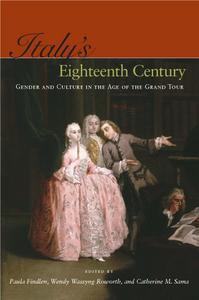
Italy's Eighteenth Century: Gender and Culture in the Age of the Grand Tour (Stanford University Press, 2009), ISBN 978-0804759045, 504 pages, 51 illustrations, $65
A new collection of essays co-edited by Wendy Wassyng Roworth recently was published by Stanford University Press. Italy’s Eighteenth-Century: Gender and Culture in the Age of the Grand Tour, edited by Roworth, Paula Findlen, and Catherine Sama, “illuminates the social and cultural landscape of eighteenth-century Italy by exploring how questions of gender in music, art, literature, science, and medicine shaped perceptions of Italy in the age of the Grand Tour.” The essays grew out of a 2002 conference held in conjunction with the Getty’s trio of exhibitions on the Grand Tour (and co-sponsored by UCLA’s Center for Seventeenth-Century Studies).
Among the thirteen essays appears Roworth’s own contribution, “‘The Residence of the Arts’: Angelica Kauffman’s Place in Rome” (fellow HECAA member Christopher Johns is also represented with “Gender and Genre in the Religious Art of the Catholic Enlightenment”).
In January, Roworth spoke at a conference in Rome on Salvator Rosa, co-sponsored by Università di Roma and Bibliotheca Hertziana; an expanded version of the paper is scheduled to appear later in the fall in Salvator Rosa e il suo tempo, 1615-1673. At the annual ASECS meeting this past spring in Richmond, Roworth presented “A ‘Tour of Painters’: Visits to Artists’ Studios
and Galleries in London.”
The Eighteenth Century, Today & Tomorrow
With topics ranging from the colonial Enlightenment (Gabrillea De la Rosa) to eighteenth-century China (Yun-Chiu Mei), art history dissertations completed in Canada and the United States in 2008 offer an array of intriguing titles. The College Art Association’s tally at caa.reviews lists eight completed dissertations in the eighteenth century, including:
- Anne-Louise Fonseca, “Pedro Alexandrino de Carvalho (1729–1810) et la peinture d’histoire à Lisbonne: cycles religieux et cycles profanes” (Université de Montréal, L. de Moura Sobral)
- Hope Saska, “Staging the Page: Graphic Satire and Caricature in Eighteenth-Century England” (Brown, K. D. Kriz)
- Kristel Smentek, “Art, Commerce, and Scholarship in the Age of Enlightenment: Pierre-Jean Mariette and the Making of Art History” (Delaware, N. Athanassoglou-Kallmyer)
- Pamela Whedon, “Sensing Watteau: The Artist’s Musical Images as Preludes to the Age of Sensibility” (UNC Chapel Hill, M. Sheriff)
CAA likewise, provides an account of dissertations in progress. For 2008 there were twelve, including:
- Amber Ludwig, “‘She is all Nature, and yet all Art’: Portraits of Emma Hamilton” (Boston, B. Redford)
- Molly Medakovich, “Between Friends: Representations of Female Intimacies in French Genre Paintings and Prints, 1770–1830” (UNC Chapel Hill, M. Sheriff)
For the full lists, see the caa.reviews site.
Belated Congratulations!
This year’s Dora Wiebenson Prize (announced in March 2009 at the HECAA luncheon) went to two outstanding conference papers:
David Pullins (Harvard University), “Mapping Chinoiserie onto the Neoclassical House: Robert Adam’s Designs ‘in the Chinese Taste’,” from ASECS, Portland, March 2008;
and
Jessica Priebe (University of Sydney), “Francois Boucher and the Rituals of Display in 18th-Century Conchology,” from CAA, Dallas, February 2008.










 Enfilade
leave a comment