Conference | London and the Emergence of a European Art Market
From The National Gallery:
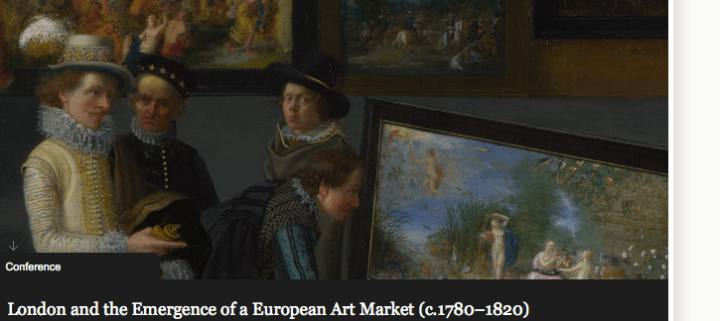
London and the Emergence of a European Art Market, c.1780–1820
The National Gallery, London, 21-22 June 2013
 ◊ ◊ ◊ ◊ ◊
The French Revolution and the ensuing Napoleonic Wars instigated a sweeping redistribution of art throughout Europe. Large volumes of valuable objects – often entire collections, from monasteries, churches, and palaces – were widely dispersed via auction and private treaty sales. Networks of agents provided the infrastructure for the circulation of art works and sales information across borders, which promoted a flourishing international art market.
This two-day conference seeks to examine the role of London in this developing market by shedding new light on the mechanisms of the art trade that connected major European centres around 1800. Scholars from a range of disciplines and countries will discuss broad research questions such as:
• Did the long-term effects of the political turmoil in France alter the existing networks of dealers and connoisseurs?
• What would have been the motivations to ship art works to distant cities?
• How sophisticated was the auction catalogue as economic tool and literary genre in various countries?
• Is it really possible to talk about a European art market or were there still relatively independent local markets?
◊ ◊ ◊ ◊ ◊
F R I D A Y , 2 1 J U N E 2 0 1 3
10.00 Registration
10.30 Nicholas Penny (The National Gallery), Welcome and introduction
10.35 Christian Huemer (Getty Research Institute, Los Angeles) and Maximilian Schich (University of Texas, Dallas), What’s in the data? Visualising the Getty Provenance Index®
Session 1: Collections
Moderator: Adriana Turpin (Institut d’Etudes Supérieures des Arts / University of Warwick)
11.00 Camilla Murgia (Université de Neuchâtel), Collecting patterns for London: From private museums to commercial art galleries
11.25 Break with refreshments
11.45 Wendy Wassyng Roworth (University of Rhode Island), Angelica Kauffman: The acquisition and dispersal of an artist’s collection, 1782–1825
12.10 Elodie Goëssant (Université Paris-Sorbonne IV), A surprising art auction: The George Watson-Taylor sale in 1823
12.35 Discussion
1.00 Lunch break
Session 2: Agents
Moderator: Gail Feigenbaum (Getty Research Institute, Los Angeles)
2.00 Julia Armstrong-Totten (Independent Scholar, Los Angeles), From jack-of-all-trades to professional: The development of the early modern picture dealer in 18th-century London
2.25 Sarah Bakkali (Université Paris X Nanterre), The Trumbull sale of 1797: Players in the Paris-London art market during the French Revolution
2.50 Carole Blumenfeld (Palais Fesch-Musée des Beaux-arts d’Ajaccio), Pierre-Joseph Lafontaine (1758-1835) and the formation of European private collections
3.15 Break with refreshments
3.45 Maria Celeste Cola (Sapienza Università di Roma), Thomas Hope and Gioacchino Marini: Roman agent ‘de’ signori inglesi’
4.10 Ana Maria García Fernández (Universidad de Oviedo), Spanish art dealers in the United Kingdom
4.35 Discussion
◊ ◊ ◊ ◊ ◊
S A T U R D A Y , 2 2 J U N E 2 0 1 3
10.00 Registration
10.30 Thomas W. Gaehtgens (Getty Research Institute), Welcome and introduction
Session 3: Information
Moderator: Hans Van Miegroet (Duke University)
10.35 David Ekserdjian (University of Leicester), William Buchanan’s Memoirs of Painting (1824) and his observations on the art trade during the Napoleonic period
11.00 Bénédicte Miyamoto (Université Paris Sorbonne-Nouvelle), British buying patterns at auction sales, 1780–1800: Did the influx of European art have an impact on the British public’s preferences?
11.25 Break with refreshments
11.45 Steven Adams (University of Hertfordshire), ‘Noising things abroad’: Sales catalogues and the construction of value in the early 19th-century art market
12.10 Rebecca Lyons (Christie’s Education, London / University of Glasgow), Marketing and selling the collection of Welbore Ellis Agar in 1806
12.35 Discussion
1.00 Lunch break
Session 4: Artworks
Moderator: Susanna Avery-Quash (The National Gallery)
2.00 Hans Van Miegroet (Duke University) and Dries Lyna (Radboud University Nijmegen), International art dealer networks and triangular arbitrage between Paris, Amsterdam and London
2.25 Guido Guerzoni (Università Luigi Bocconi, Milan), Italian exports of works of art to the United Kingdom
2.50 Peter Carpreau (M – Museum Leuven), The Getty Provenance Index® under examination: The taste for 17th-century Dutch and Flemish painting in London (1780–1820)
3.15 Break with refreshments
3.45 Olivier Bonfait (Université de Bourgogne, Dijon), London around 1800: An international art trade or a globalised art market?
4.10 Discussion
4.30 Roundtable
Moderator: Nicholas Penny (The National Gallery)
Thomas W. Gaehtgens (Getty Research Institute)
Guido Guerzoni (Università Luigi Bocconi, Milan)
Patrick Michel (Université Lille 3)
Michael North (Universität Greifswald)
Happy Arbor Day
I posted notice of this collection last September, but I’m reposting it in honor of National Arbor Day. From SVEC (formerly Studies on Voltaire and the Eighteenth Century), available from the Voltaire Foundation:
Laura Auricchio, Elizabeth Heckendorn Cook and Giulia Pacini, eds., Invaluable Trees: Cultures of Nature, 1660-1830 — SVEC 2012:08 (Oxford: Voltaire Foundation, 2012), 360 pages, ISBN 9780729410489, £65 / €95 / $110.
 Trees and tree products have long been central to human life and culture, taking on intensified significance during the long eighteenth century. In this interdisciplinary volume, contributors trace changes in early modern theories of resource management and ecology across European and North American landscapes, and show how different and sometimes contradictory practices were caught up in shifting conceptions of nature, social identity, physical health and moral wellbeing.
◊ ◊ ◊ ◊ ◊
C O N T E N T S
Introduction
• Laura Auricchio — Elizabeth Heckendorn Cook and Giulia Pacini, Invaluable trees
I. Arboreal Lives
• Hamish Graham — ‘Alone in the forest’? Trees, charcoal and charcoal burners in eighteenth-century France
• J. L. Caradonna — Conservationism avant la lettre,? Public essay competitions on forestry and deforestation in eighteenth-century France
• Paula Young Lee — Land, logs and liberty: the Revolutionary expansion of the Muséum d’histoire naturelle during the Terror
• Peter Mcphee — ‘Cette anarchie dévastatrice’: the légende noire of the French Revolution
• Paul Elliott — Erasmus Darwin’s trees
• Giulia Pacini — At home with their trees: arboreal beings in the eighteenth-century French imaginary
II. Strategic Trees
• Elizabeth Heckendorn Cook — The vocal stump: the politics of tree-felling in Swift’s ‘On cutting down the old thorn at Market Hill’
• Michael Guenther — Tapping nature’s bounty: science and sugar maples in the age of improvement
• Meredith Martin — Bourbon renewal at Rambouillet
• Susan Taylor-Leduc — Assessing the value of fruit trees in the marquis de Fontanes’s poem Le Verger
• Elizabeth Hyde — Arboreal negotiations, or William Livingston’s American perspective on the cultural politics of trees in the Atlantic world
• Lisa Ford — The ‘naturalisation’ of François André Michaux’s North American sylva: patriotism in early American natural history
III. Arboreal Enlightenments
• Tom Williamson — The management of trees and woods in eighteenth-century England
• Steven King — The healing tree
• Nicolle Jordan — ‘I writ these lines on the body of the tree’: Jane Barker’s arboreal poetics
• Waltraud Maierhofer — Goethe and forestry
• Paula R. Backscheider — Disputed value: women and the trees they loved
• Aaron S. Allen — ‘Fatto di Fiemme’: Stradivari’s violins and the musical trees of the Paneveggio
Summaries
Bibliography
Index
◊ ◊ ◊ ◊ ◊
Laura Auricchio is Associate Professor of Art History and Chair of Humanities at The New School in New York. Her current research addresses Franco-American cultural exchanges in the Age of Revolution.
Elizabeth Heckendorn Cook is Associate Professor of English at the University of California, Santa Barbara. She studies the history of environmental ethics and early modern representations of trees and forests.
Giulia Pacini is Associate Professor of French at The College of William & Mary. Her current research focuses on the political and material significance of trees in early modern France.
Conference | The Louvre Before The Louvre: Artisans, Artists, Academies
From the conference website:
The Louvre Before The Louvre: Artisans, Artists, Academies
Wallace Collection, London, 5 July 2013
Organized by Mia Jackson and Hannah Williams

Antoine Coysevox, Charles Le Brun, terracotta, 1676 (The Wallace Collection)
Now one of the world’s most famous museums, the Louvre was once a vast artistic and cultural centre of a different kind. This one-day conference addresses the fascinating but little-known period of the Louvre’s history throughout the seventeenth and eighteenth centuries, exploring the role this space, its objects, and its inhabitants played in the histories of art production and artistic sociability in early modern Paris.
Eminent and emerging scholars including two guest speakers from the Musée du Louvre will together provide an intimate understanding of the artistic and intellectual neighbourhood of the Louvre and its effect on art and design in the period. Papers on the day will investigate the collective spaces and sociable practices of the Louvre (from the royal academies to artists’ studios), the intersections between personal and professional spaces for the artists and artisans who both lived and worked in the Louvre, and the wider significance of the Louvre in artistic social networks both locally and internationally.
Taking place in the Wallace Collection, which houses one of the United Kingdom’s finest collections of art from this period, this conference offers attendees the opportunity to experience the results of these artistic collaborations.
Generously supported by the Wallace Collection and the Faculty of History of the University of Oxford.
To book: www.louvrebeforelouvre.eventbrite.co.uk
◊ ◊ ◊ ◊ ◊
P R O G R A M M E
Welcome by Christoph Vogtherr (Wallace Collection)
Introduction by Mia Jackson (QMUL) and Hannah Williams (University of Oxford)
I. Reception Pieces at the Académie Royale de Peinture et de Sculpture: New Research
Geneviève Bresc-Bautier (Musée du Louvre) Integration of Works into the Collections of the Académie during the Ancien Régime
Guilhem Scherf (Musée du Louvre) Reception and Diffusion of the Morceaux de Réception during the Ancien Régime
II. Collective Spaces and Sociable Practices
Drew Armstrong (University of Pittsburgh) Life and Loss in the Académie Royale d’Architecture
Esther Bell (Cincinnati Art Museum) Coypel the Curator: Studio as Sociable Space
Pierre-Édouard Latouche (Université de Québec à Montréal) Des Recueils des Maisons Royales en Petit (1745) à L’Architecture Française (1756) de Blondel: Le remploi d’un Plan de la Cour Carré
Anne Higonnet (Barnard College, Columbia University) Studios, Sociability, and Unexpected Consequences in the Old Louvre
III. Living and Working in the Louvre
Susan Wager (Columbia University) Un-occupying the Louvre: The Royal Gem-Engraver Jacques Guay
David Maskill (Victoria University of Wellington) Louis Tocqué (1696-1772): A Portrait Painter at the Louvre
Katie Scott (Courtauld Institute of Art) Parade’s End: On Charles Coypel’s Bed
IV. Neighbourhoods and Networks
Dena Goodman (University of Michigan) 4 rue des Orties: the Louvre of the Silvestres, 1675-1805
Bärbel Küster (State Academy for Art and Design, Stuttgart) Britons in the Louvre in the 18th Century
Laura Auricchio (The New School) Beyond the Louvre: Re-mapping the Paris Art World in the Age of Louis XVI
Call for Papers | HECAA Session at UAAC
Thanks to Christina Smylitopoulos, HECAA will be represented at this year’s UAAC Conference! Details and a full list of panels are available here»
◊ ◊ ◊ ◊ ◊
Universities Art Association of Canada / l’association d’art des universités du Canada
The Banff Centre, Banff, Alberta, 17-20 October 2013
Proposals due by 4 June 2013
HECAA Open Session (Historians of Eighteenth-Century Art and Architecture)
As the first HECAA-spsonored UAAC panel, this open session welcomes proposals for papers that consider any aspect of art and visual culture of the eighteenth-century. Please email proposals for 20-minute papers to Prof. Christina Smylitopoulos: csmylito@uoguelph.ca.
Exhibition | Piranesi, Rome, and the Arts of Design
From the San Diego Museum of Art:
Piranesi, Rome, and the Arts of Design
Giorgio Cini Foundation, Venice, 28 August 2010 — 9 January 2011
Caixa Forum, Madrid, 24 April — 9 September 2012
Caixa Forum, Barcelona, 9 October 2012 — 20 January 2013
San Diego Museum of Art, 30 March — 7 July 2013
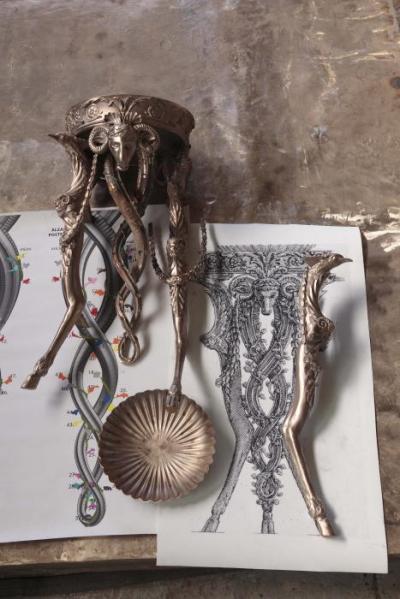 Giovanni Battista Piranesi (1720-1778) was a printmaker, architect, antiquarian, art dealer, theorist, and designer—one of the foremost artistic personalities of the 18th century, whose views of Rome remain the city’s defining image. Fresh, thought-provoking, and innovative, Piranesi, Rome, and the Arts of Design sets out to show the range of the artist’s genius in a 21st-century approach to his creative endeavors. More than 300 original prints have been selected from the world renowned collection of the Fondazione Giorgio Cini in Venice, Italy. These prints are combined with modern-day interpretations in new technologies such as video, photography, and digital modeling. Utilizing the most advanced technologies, the exhibition enables Piranesi’s two-dimensional renderings of a monumental vase, a candelabrum, tripods, a teapot, an altar, and a fireplace to assume their rightful three-dimensional forms. These never-before-seen and never-before-crafted objects take center stage in the exhibition and attest to the creative intellect of Piranesi’s designs. In addition, the exhibition brings to life Piranesi’s most famous works, the Carceri (Prisons), in the form of a virtual reality 3-D installation. The legendary Caffè degli Inglesi is represented as a full scale evocation, and visitors may browse through Piranesi’s sketchbooks using a touchscreen monitor. Strikingly designed by world renowned architect Michele De Lucchi, the exhibition embodies the progressive spirit of Piranesi’s own eclectic visions and his modernity, emphasizing the popular appeal of his work and its continuing relevance to designers and architects. Having previously appeared at the Fondazione Cini in Venice and at the Caixa Forum in Madrid and Barcelona, the show makes its only U.S. stop at The San Diego Museum of Art.
Exhibition conceived by Michele De Lucchi, produced by Fondazione Giorgio Cini, Itatly, together with Factum Arte, Spain, in collaboration with Exhibits Development Groups, USA.
Photos from the installation at the Giorgio Cini Foundation (Le Arti di Piranesi: architetto, incisore, antiquario, vedutista, designer) are available here»
◊ ◊ ◊ ◊ ◊
From Factum Arte:
Michele de Lucchi, Guiseppe Pavanello, John Wilton-Ely, Norman Rosenthal, and Adam Lowe, The Arts of Piranesi: Architect, Etcher, Antiquarian, Vedutista, Designer (Madrid: Caixaforum, 2012), 304 pages, ISBN 978-8461576371, 35€.
 The Arts of Piranesi: Architect, Etcher, Antiquarian, Vedutista, Designer is a catalogue for the homonymous exhibition on the work of Giambattista Piranesi, curated by Michele de Lucchi, Adam Lowe and Giuseppe Pavanello, taking place in CaixaForum Madrid from 25 April to 9 September 2012 and CaixaForum Barcelona from October 2012 to January 2013.
A collaboration between Factum Arte and the Fondazione Giorgio Cini, the exhibition opened in Madrid after receiving great reviews when it was in Venice for the Biennale of Architecture in 2010. In addition to objects realised using traditional and digital modelling from the original designs by Piranesi, the exhibition also contains Gabriele Basilico’s sensitive black and white photographs of the famous Vedute and over 250 etchings by Piranesi.
◊ ◊ ◊ ◊ ◊
From the San Diego Museum of Art:
Symposium: Piranesi, Rome, and the Arts of Design
San Diego Museum of Art, 30 March 2013
Scholars from around the country will offer their insights to contextualize the culture, time period, and artistic concerns of Giovanni Battista Piranesi. Speakers include Christopher M.S. Johns, Norman L. and Roselea J. Golberg, Professor and Chair of the Department of History of Art, Vanderbilt University; John Pinto, Howard Crosby Butler Memorial Professor of Art and Archeology, Princeton University; and Jeffrey L. Collins, Professor and Chair of Academic Programs, Bard Graduate Center; and will be moderated by Dr. John Marciari, Curator of European Art.
◊ ◊ ◊ ◊ ◊
Film | Yo-Yo Ma Inspired by Bach: The Sound of The Carceri
San Diego Museum of Art, 5 April 2013
The Sound of The Carceri explores the deep relationship between music and architecture through a high-tech ‘virtual confrontation’ between Bach and his contemporary, the architect Giovanni Battista Piranesi. Using a striking visual style, director François Girard (The Red Violin and Thirty-Two Short Films about Glenn Gould) places Yo-Yo Ma within a series of computer-generated, three-dimensional recreations of Piranesi’s well-known prison etchings. Through Yo-Yo Ma’s and music producer Steven Epstein’s struggle to recreate and interact with the imaginary space that Ma performs in, the film examines the complexity of illusion, of representation and reality.
◊ ◊ ◊ ◊ ◊
Lecture | Purchasing Piranesi: Buying Art on the Grand Tour
San Diego Museum of Art, 19 April 2013
Buying art was a key element of the British Grand Tour to Italy in the 18th century, and a visit to Piranesi’s workshop was never to be missed. The studio was like a superstore of antiquities where those on the Grand Tour could buy antiquities and prints that recorded them, as well as casts, copies, and forgeries. Making use of unpublished archival research, Dr. John Marciari, Curator, European Art and Head of Provenance Research, will discuss the ways in which travelers set about buying works by Piranesi, Batoni, and others in 18th-century Italy.
◊ ◊ ◊ ◊ ◊
From Factum Arte:
One of the key elements of the exhibition Le Arti di Piranesi: architetto, incisore, antiquario, vedutista, designer (The Art of Piranesi: architect, engraver, antiquarian, vedutista, designer), a 12-minute animation of Piranesi’s Carceri series made by Gregoire Dupond at Factum Arte specifically for the exhibition. This series of 16 visionary images, originally etched by Piranesi when in his late 20s, shows the workings of his imagination, merging his architectural ambitions with his obsessive interest in antiquity. Watching Gregoire Dupond’s animation is literally like entering Piranesi’s mind. A CD containing both high resolution reproductions of the prints and the complete video will be released soon.
New Book | Seeing Satire in the Eighteenth Century
From the Voltaire Foundation:
Elizabeth C. Mansfield and Kelly Malone, eds., Seeing Satire in the Eighteenth Century, SVEC 2013:02 (Oxford: Voltaire Foundation, 2013), 320 pages, ISBN-978-0729410632, £65 / €80 / $106.
 A moment in history when verbal satire, caricature, and comic performance exerted unprecedented influence on society, the Enlightenment sustained a complex, though now practically invisible, culture of visual humor. In Seeing Satire in the Eighteenth Century contributors recapture the unique energy of comic images in the works of key artists and authors whose satirical intentions have been obscured by time.
From a decoding of Gabriel de Saint-Aubin’s Livre de caricatures as a titillating jibe at royal and courtly figures, a reinterpretation of the man’s muff as an emblem of foreignness, foppishness and impotence, a reappraisal of F. X. Messerschmidt’s sculpted heads as comic critiques of Lavater’s theories of physiognomy, to the press denigration of William Wilberforce’s abolitionist efforts, visual satire is shown to extend to all areas of society and culture across Europe and North America. By analysing the hidden meaning of these key works, contributors reveal how visual comedy both mediates and intensifies more serious social critique. The power of satire’s appeal to the eye was as clearly understood, and as widely exploited in the Enlightenment as it is today.
Elizabeth C. Mansfield’s research encompasses modern and early modern European art. Her publications include an award-winning book on the classical legend of Zeuxis ‘Selecting Models’. She is currently Vice-President of Scholarly Programs at the National Humanities Center. Kelly Malone is a scholar of the literature and culture of eighteenth-century England. She is currently Associate Professor of English at Sewanee, the University of the South.
◊ ◊ ◊ ◊ ◊
C O N T E N T S
Introduction, Elizabeth C. Mansfield and Kelly Malone — Seeing satire in the Age of Reason
1. Emmanuel Schwartz — Satire unmasked by reading
2. Eric Rosenberg — The impossibility of painting: the satiric inevitability of John Singleton Copley’s Boy with a Squirrel
3. Julie-Anne Plax — Watteau’s witticisms: visual humor and sociability
4. Emily Richardson — ‘Tu n’as pas tout vü!’: seeing satire in the Saint-Aubin Livre de Caricatures
5. Melissa Lee Hyde — Needling: embroidery and satire in the hands of Charles-Germain de Saint-Aubin
6. Kimberly Chrisman-Campbell — ‘He is not dressed without a muff’: muffs, masculinity, and la mode in English satire
7. Trevor Burnard — ‘A compound mongrel mixture’: racially coded humor, satire, and the denigration of white Creoles in the British Empire 1784-1834
8. Reva Wolf — Seeing satire in the peepshow
9. Steven Minuk — Swift’s satire of vision
10. Michael Yonan — Messerschmidt, the Hogarth of sculpture
11. Katherine Mannheimer — Anatomizing print’s perils: Augustan satire’s textual bodies
12. Marcus C. Levitt — ‘Women’s wiles’ in Mikhail Chulkov’s The Comely Cook
List of illustrations
Summaries
Bibliography
Index
Supporting HECAA: Dues and Contributions via PayPal
From the President
After some remarkable digital wrangling by our treasurer, Jennifer Germann, we are once again able to receive HECAA dues via PayPal! So, if you’re a regular reader, please consider making a contribution to the Historians of Eighteenth-Century Art & Architecture. The organization needs your financial support to pursue its mission, an important part of which includes modest grants for graduate students through the Vidal and Wiebenson Awards. For current members, now is a good time to send in your dues for 2013 (just $20/$5 for graduate students), and if you didn’t pay dues for 2012, please consider making an additional contribution (also easily done via PayPal). You may also pay by mailing Jennifer a check, as directed on the membership page.
Anyone interested in the eighteenth century is welcome as a HECAA member. So if you’re reading, consider joining!
— Michael Yonan
New Title | Invaluable Trees: Cultures of Nature, 1660-1830
Just out from SVEC (formerly Studies on Voltaire and the Eighteenth Century), available from the Voltaire Foundation:
Laura Auricchio, Elizabeth Heckendorn Cook and Giulia Pacini, eds., Invaluable Trees: Cultures of Nature, 1660-1830 — SVEC 2012:08 (Oxford: Voltaire Foundation, 2012), 360 pages, ISBN 9780729410489, £65 / €95 / $110.
 Trees and tree products have long been central to human life and culture, taking on intensified significance during the long eighteenth century. In this interdisciplinary volume, contributors trace changes in early modern theories of resource management and ecology across European and North American landscapes, and show how different and sometimes contradictory practices were caught up in shifting conceptions of nature, social identity, physical health and moral wellbeing.
◊ ◊ ◊ ◊ ◊
C O N T E N T S
Introduction
• Laura Auricchio — Elizabeth Heckendorn Cook and Giulia Pacini, Invaluable trees
I. Arboreal Lives
• Hamish Graham — ‘Alone in the forest’? Trees, charcoal and charcoal burners in eighteenth-century France
• J. L. Caradonna — Conservationism avant la lettre,? Public essay competitions on forestry and deforestation in eighteenth-century France
• Paula Young Lee — Land, logs and liberty: the Revolutionary expansion of the Muséum d’histoire naturelle during the Terror
• Peter Mcphee — ‘Cette anarchie dévastatrice’: the légende noire of the French Revolution
• Paul Elliott — Erasmus Darwin’s trees
• Giulia Pacini — At home with their trees: arboreal beings in the eighteenth-century French imaginary
II. Strategic Trees
• Elizabeth Heckendorn Cook — The vocal stump: the politics of tree-felling in Swift’s ‘On cutting down the old thorn at Market Hill’
• Michael Guenther — Tapping nature’s bounty: science and sugar maples in the age of improvement
• Meredith Martin — Bourbon renewal at Rambouillet
• Susan Taylor-Leduc — Assessing the value of fruit trees in the marquis de Fontanes’s poem Le Verger
• Elizabeth Hyde — Arboreal negotiations, or William Livingston’s American perspective on the cultural politics of trees in the Atlantic world
• Lisa Ford — The ‘naturalisation’ of François André Michaux’s North American sylva: patriotism in early American natural history
III. Arboreal Enlightenments
• Tom Williamson — The management of trees and woods in eighteenth-century England
• Steven King — The healing tree
• Nicolle Jordan — ‘I writ these lines on the body of the tree’: Jane Barker’s arboreal poetics
• Waltraud Maierhofer — Goethe and forestry
• Paula R. Backscheider — Disputed value: women and the trees they loved
• Aaron S. Allen — ‘Fatto di Fiemme’: Stradivari’s violins and the musical trees of the Paneveggio
Summaries
Bibliography
Index
◊ ◊ ◊ ◊ ◊
Laura Auricchio is Associate Professor of Art History and Chair of Humanities at The New School in New York. Her current research addresses Franco-American cultural exchanges in the Age of Revolution.
Elizabeth Heckendorn Cook is Associate Professor of English at the University of California, Santa Barbara. She studies the history of environmental ethics and early modern representations of trees and forests.
Giulia Pacini is Associate Professor of French at The College of William & Mary. Her current research focuses on the political and material significance of trees in early modern France.
On Site | Kladruby Abbey Church, Czech Republic
Eighteenth-Century Encounters: Kladruby Abbey Church, Czech Republic
By Michael Yonan

Jan Blažej Santini-Aichl, Abbey Church of Kladruby,
near Stříbro, completed in 1726 (Photo by Michael Yonan)
◊ ◊ ◊ ◊ ◊
For most eighteenth-century specialists, the phenomenon of the period’s Gothic revival architecture is principally understood as an English one. Less well known is existence of another eighteenth-century Gothic, this one Central European. I’m speaking of the series of so-called Czech ‘Gothic Baroque’ churches by the Prague-born architect Jan Blažej Santini-Aichl (1677–1723). This summer I traveled to western Bohemia and, generously stewarded by art historian Dr. Martin Mádl, was able to visit one of the more distinctive of Santini-Aichl’s buildings: the abbey church of Kladruby, part of a complex of ecclesiastical buildings that make up a Benedictine cloister, located not far from the town of Stříbro.1
 From a distance, the church doesn’t immediately reveal its eighteenth-century origins. Its height, the pinnacled columns, exterior buttresses, and of course ogive arches all suggest a medieval vintage. That is until one notices the centralized cupola, an element whose arrangement and form is not typically Gothic. Dislocations of style and date increase as one enters the church. As with many Gothic buildings, Kladruby has a basilican plan and employs architectural forms like pointed arches and ribbed vaulting. But few, if any, Gothic churches look quite like this. The ribbed vaults zigzag into stylized lilies, the coat-of-arms of the local abbots. The interior’s pink and pistachio green tonalities, its original hues, are more reminiscent of the rococo than of medieval churches. And the illusionistically painted dome, replete with saints tumbling through the heavens and an oculus representing the Holy Spirit, recalls seventeenth-century Roman predecessors more than Chartres or Ulm. Kladruby reveals itself to be a surprising synthesis of late baroque and medieval architectural styles.
What could possibly explain this? As an American art historian trained to see eighteenth-century art through specific narratives, I’ll confess that this building floored me. To understand it, it helps to know the monastery’s history and the unique culture of Czech religious communities. A church was first consecrated here in 1233, not long after the abbey’s formation. In subsequent centuries the community’s fortunes waxed and waned; it fell into disarray in the sixteenth century and was conquered and plundered during the Thirty Years’ War. Repairs to its buildings began in 1653, but in 1712 the presiding abbot, Maurus Fintzguth, commissioned Santini-Aichl to build an entirely new church, the one we see today, which was completed in 1726.
‘New’ is not quite the right term, however. Most of what one encounters at Kladruby dates, in fact, from the eighteenth century, but scholars have speculated that somewhere within the walls are fragments of the original church. In constructing this new building out of and on top of its predecessor, Santini-Aichl described his architectural process as one of renovation. He did more than simply reconstruct an old church or build a new one on its site, but rather constructed something that simultaneously evokes its predecessor, incorporates it, and improves upon it. In this respect, Santini-Aichl’s building maintains and visualizes the monastery’s medieval history, which Fintzguth viewed as a Golden Age, even as it celebrates its modern resilience.
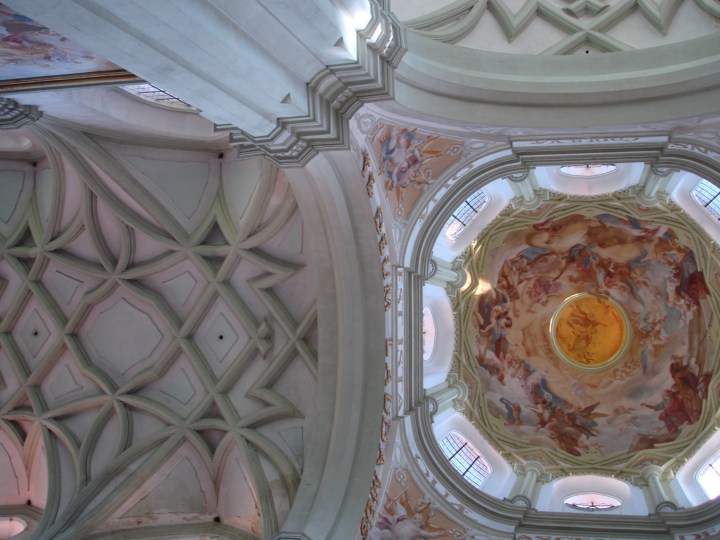
Some scholars have suggested that Kladruby is essentially an eighteenth-century building wrapped in Gothic skin, and indeed given what we know about the eighteenth-century love of surfaces, architectural and otherwise, this would seem to fit. But a recent article by the Czech art historian Pavel Kalina claims that the situation is actually more complicated.2 The interior ribbed vaulting is not used in a manner true to Gothic structural techniques, for sure, but neither is it entirely decorative. It’s somewhere in between, partially structural and partially ornamental, and in achieving this balance it combines medieval and eighteenth-century architectural knowledge. In this synthesis of old and new, Kalina argues, lie traces of dialogues between learned abbots and skilled artisans, as well as existential tensions between the abbey’s past and its present.
Kladruby isn’t an isolated example of such a synthesis. Santini-Aichl constructed a similar Gothic-baroque church at Sedlec, a village near the city of Kutná Hora, and he designed particularly daring synthesis of classical and Gothic architectural forms for the Pilgrimage Chapel of St. John Nepomuk at Žďár nad Sazavou. All are easily reachable as day trips from Prague.
◊ ◊ ◊ ◊ ◊
Notes
1. Three different 360-degree views of the church and its surroundings are available at 360globe.net. Martin Mádl’s wife, Claire Mádl, is editor and co-founder of the journal Cornova, the ‘Eighteenth-Century Studies’ of the Czech Republic.
2. Pavel Kalina, “In opere gotico unicus: The Hybrid Architecture of Jan Blažej Santini-Aichl and Patterns of Memory in Post-Reformation Bohemia,” Umění 58 (2010): 42–56.
◊ ◊ ◊ ◊ ◊
President of HECAA, Michael Yonan is Associate Professor of Art History at the University of Missouri-Columbia. His book, Empress Maria Theresa and the Politics of Habsburg Imperial Art, appeared in 2011 from Penn State University Press.
Reviewed | Dubin’s ‘Futures and Ruins’
Recently added to caa.reviews:
Nina L. Dubin, Futures and Ruins: Eighteenth-Century Paris and the Art of Hubert Robert (Los Angeles: Getty Research Institute, 2010), 210 pages, ISBN: 9781606060230, $50.
Reviewed by Frédérique Baumgartner, Mellon Postdoctoral Fellow, Columbia University; posted 27 July 2012.
In an article entitled “Les musées ne sont pas à vendre” (“Museums Are Not For Sale”) published on December 12, 2006, in the daily French paper ‘Le Monde’, the art historians Françoise Cachin, Jean Clair, and Roland Recht strongly denounced the increasing commercialization of the national patrimony, epitomized by the Louvre’s plan to rent out part of its collection to a branch established in Abu Dhabi. The authors warned the French administration against the incoherence of its cultural policy: claiming to protect the nation’s artistic treasures, while at the same time using those treasures as commodities.
The controversy over the Louvre Abu Dhabi is one of the many contemporary resonances that Nina Dubin’s book, ‘Futures and Ruins: Eighteenth-Century Paris and the Art of Hubert Robert’, holds for its reader. A meticulously researched study examining Robert’s paintings of Parisian ruins in light of the new financial interests and related economic and cultural risks that defined the city’s urban and patrimonial policies in the 1770s–1790s, ‘Futures and Ruins’ will prompt readers to consider the origins of the economic and cultural precariousness of today’s world. As such, the book is both historically stimulating and morally engaging.
At the center of ‘Futures and Ruins’ lies the following historical claim: in the course of the eighteenth century, Paris, in the grip of the forces of early capitalism, became the terrain of intense real estate speculation. It was enabled by the introduction of paper money in 1716, as the greater capacity for circulation of paper money precipitated transactions and engendered prospects of hastily accumulated wealth. At the same time, the reliance of the real estate market on the expansion of credit raised the specter of bankruptcy. As Dubin underscores, in agreement with the historian Michael Sonenscher, the nature of credit was characterized by “the ease with which it enabled economic prosperity, while at the same time catalyzing the potential for expansive debt” (Michael Sonenscher, ‘Before the Deluge: Public Debt, Inequality, and the Intellectual Origins of the French Revolution‘, Princeton: Princeton University Press, 2007, 91).
These economic phenomena, Dubin argues, found their aesthetic counterpart in pictures of ruins—a genre in which Robert (1733–1808), received as Peintre d’architecture at the Royal Academy of Painting and Sculpture in 1776, excelled. . .
The full review is available here» (CAA membership required)










 Enfilade
leave a comment