New Title | Plumes et Pinceaux: Discours de femmes sur l’art en Europe
This new collection of essays, with a number of contributions from HECAA members, is published in memory of Anne Schroder and Angela Rosenthal. Now available in hard copy, it’s scheduled to appear online in three years, joining the second volume, an anthology of primary sources, already online at the INHA website.
◊ ◊ ◊ ◊ ◊
From the publisher:
Edited by Mechthild Fend, Melissa Hyde, and Anne Lafont, Plumes et Pinceaux: Discours de femmes sur l’art en Europe (1750-1850) – Volume 1 (Dijon: Les Presses du Réel, 2012), 336 pages, ISBN: 9782840664574, €28.

Introduction
• Mary D. Sheriff — Portrait de l’artiste en historienne de l’art : à propos des Souvenirs de Mme Vigée-Lebrun
• Noémie Étienne — La pensée dans la pratique : le cas de Marie-Jacob Godefroid, restauratrice de tableaux au XVIIIe siècle
• Sarah Betzer — Marie d’Agoult : une critique d’art « ingriste »
• Anne L. Schroder — « Elle était née pour peindre les héros ! » : l’éducation artistique des filles et les femmes peintres vue par Mme de Genlis
• Isabelle Baudino — Les voyageuses britanniques à Paris : un point de vue féminin sur l’art ?
• Satish Padiyar — Les lettres de Mme Récamier à Canova (1813-1819) : une écriture féminine entre grâce et exil
• Heather Belnap Jensen — Quand la muse parle : Julie Candeille sur l’art de Girodet
• David Blankenstein, Nina Struckmeyer et Malte Lohman — Helmina von Chézy, une historienne de l’art (?) berlinoise à Paris sous l’Empire
• Susan L. Siegfried — Expression d’une subjectivité féminine dans les journaux pour femmes, 1800-1840
• Charlotte Foucher — Le bas-bleu artistique : portrait au vitriol de la femme critique d’art
• France Nerlich — Johanna von Haza, alias Heinrich Paris. De la critique d’art comme critique sociale
Index
Crédits photographiques
◊ ◊ ◊ ◊ ◊
The second volume, as described at Les presses du réel:
Edited by Anne Lafont, with Charlotte Foucher and Amadine Gorse, Plumes et Pinceaux: Discours de femmes sur l’art en Europe (1750-1850) – Volume 2, Anthologie (Dijon: Les Presses du Réel, 2012), 560 pages, ISBN: 9782840664581, €32.
 Si Germaine de Staël et Marceline Desbordes-Valmore sont connues pour leurs réflexions sur l’art, d’autres écrits et pensées de femmes des années 1750-1840 en France, mais aussi en Angleterre et en Allemagne, le sont moins, ou pas du tout. C’est un florilège de ces voix qui est donné à lire dans ces pages : de Mme de Beaumer à Edmée de Syva, en passant par Félicité de Genlis (dont sont publiés ici deux textes inédits, Essai sur les arts et Catalogue pittoresque du cabinet de tableaux de Monsieur le comte de Sommariva), Élisabeth Vigée-Lebrun, Helmina von Chézy, Anne Plumptre, parmi une quinzaine d’autres. Journalistes, critiques d’art, artistes ou voyageuses curieuses et averties visitant les musées européens avec passion, elles usent de tous moyens littéraires, pour faire entendre des positions esthétiques, morales, voire politiques sur l’art et
son histoire. Elles portent un regard aigu, mais pourtant jamais univoque, sur les grands événements de leur temps – de la Révolution
française à la conquête napoléonienne et à ses conséquences –, et sur
l’art et la création artistique.
The 2012 Issue of ‘SECC’
Art history in the current issue of Studies in Eighteenth-Century Culture:
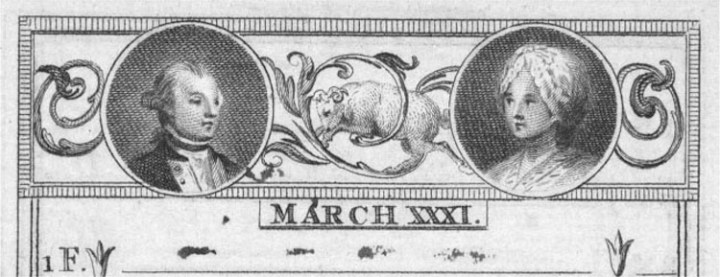
Head vignette, The Royal Engagement Pocket Atlas for 1781.
◊ ◊ ◊ ◊ ◊
• Michael Yonan, “The Wieskirche: Movement, Perception, and Salvation in the Bavarian Rococo,” Studies in Eighteenth-Century Culture 41 (2012): 1-25.
• Sandro Jung, “Print Culture, Marketing, and Thomas Stothard’s Illustrations for The Royal Engagement Pocket Atlas, 1779–1826,” Studies in Eighteenth-Century Culture 41 (2012): 27-53.
• Jennifer Germann, “Tracing Marie-Éléonore Godefroid: Women’s Artistic Networks in Early Nineteenth-Century Paris,” Studies in Eighteenth-Century Culture 41 (2012): 55-84.
• Marc H. Lerner, “William Tell’s Atlantic Travels in the Revolutionary Era,” Studies in Eighteenth-Century Culture 41 (2012): 85-114.
ASECS 2012, San Antonio
2012 American Society for Eighteenth-Century Studies Conference
San Antonio, 22-24 March 2012

Mission San Francisco de la Espada at San Antonio, ca. 1750s
Photo by Travis Witt, 2010, Wikimedia Commons
◊ ◊ ◊ ◊ ◊
The 2012 ASECS conference takes place in San Antonio, March 22-24, at the Hyatt Regency San Antonio Riverwalk. This year’s annual HECAA luncheon and business meeting will be held on Friday at nearby Boudro’s restaurant. In terms of sessions, HECAA will be represented by two panels, also on Friday, chaired by Melissa Hyde and Heidi Kraus and Heidi Strobel and Amber Ludwig, with Christopher Johns serving as a respondent. In addition to these, a wide selection of sessions are also included below (there are, of course, lots of others that will interest HECAA members). For the full program, see the ASECS website. Elle Decor, incidentally, featured San Antonio in its March 2012 issue.
◊ ◊ ◊ ◊ ◊
HECAA New Scholar’s Open Session
Friday, 23 March 2012, 11:30-1:00, Bowie C
Chair: Melissa HYDE, University of Florida, and Heidi KRAUS, University of Iowa
1. Katherine ARPEN, University of North Carolina, Chapel Hill, “Touch, Sensation, Imagination: Étienne-Maurice Falconet’s Bather”
2. Zirwat CHOWDUHRY, Northwestern University, “Incongruously Indian: The Joke behind George Dance the Younger’s Guildhall Façade”
3. Amanda STRASIK, University of Iowa, “Portraying the (Future) Queen: Le Portrait de Marie-Joséphe de Saxe et Le Duc de Bourgogne”
4. Hyejin LEE, University of North Carolina, Chapel Hill, “The Language of Magic in Jean-Baptiste-Siméon Chardin’s Food Still Lifes”
◊ ◊ ◊ ◊ ◊
HECAA Luncheon and Business Meeting
Friday, 23 March 2012, 1:00
Boudros, 205 Presa St. at Charles Court (between Market and Commerce) — ask for the event space at Charles Court; see comments below for directions.
◊ ◊ ◊ ◊ ◊
Exoticisms: Global Commodity Exchange in the Long Eighteenth Century, (HECAA)
Friday, 23 March 2012, 4:15-5:45, Bowie C
Chairs: Heidi STROBEL, University of Evansville, and Amber LUDWIG, Honolulu Academy of Arts
1. Dana LEE, Art Institute of Atlanta, “Between Worlds: Performing Gender and Class through Exoticism in Madame de Pompadour’s Boudoir Turq”
2. Adrienne CHILDS, Independent Scholar, “The Taste for Blackness: Coffee, Race, and Exoticism in Eighteenth Century Luxury Objects”
3. Alden GORDON, Trinity College, “A Golden ‘Chinese’ Interior in Italy made of Imported Rock Crystal and Lacquer: The Commodities and Language of Global Exoticism in the Decorative Arts and in Engraving”
4. Elizabeth WILLIAMS, Los Angeles County Museum of Art, “Familiarizing the Foreign: Chinoiserie and Eighteenth-Century English Silver”
Respondent: Christopher JOHNS, Vanderbilt University
◊ ◊ ◊ ◊ ◊
OTHER SESSIONS RELATED TO THE VISUAL ARTS
T H U R S D A Y , 2 2 M A R C H 2 0 1 2
8:00-9:30
Audiences, Observers, Spies, & Witnesses: Types of Attention in the Eighteenth Century, Bowie A
Chair: Cheryl WANKO, West Chester University
1. Kathleen E. URDA, Bronx Community College, CUNY, “Theatrical Spectatorship and Jane Austen’s Mansfield Park”
2. Fiona RITCHIE, McGill University, “Sentimental Attention: Women Watching Shakespeare in the Mid-Eighteenth Century”
3. David Francis TAYLOR, University of Toronto, “Spectators at the Print Shop Window: Caricature and the Corporate Gaze”
◊ ◊ ◊ ◊ ◊
9:45-11:15
Aesthetic Reception, Sensibility, and Social Engineering: Interrogating the Effects of the Work of Art in the Long Eighteenth Century, Pecos
Chair: Julia SIMON, University of California, Davis
1. Jean MARSDEN, University of Connecticut, “Sentimental Drama as Social Engineering”
2. Philipp SCHWEIGHAUSER, Universität Basel, “Sympathy Control: Sentimental Literature and Early European Aesthetics”
3. Peter ERICKSON, University of Chicago, “Conversion in the Museum: Friedrich Schlegel at the Louvre, 1802-1804”
4. Laurence LEMAIRE, University of California, Davis, “Rousseau, Writing and Aesthetics: a Moral Agent at Work”
◊ ◊ ◊ ◊ ◊
Directing Light and Adjusting Outlooks: Mirrors, Lenses, Windows, Reflections, Refractions, Translucencies, (South Central Society for Eighteenth-Century Studies) Frio
Chair: Kevin L. COPE, Louisiana State University
1. Robert CRAIG, Independent Scholar, “Zur Farbenlehre- Goethe’s Theory of Colors: Goethe versus Newton – and the Winner Is . . . ?”
2. Laura MILLER, University of West Georgia, “Light, Space, and Masculinity in Newtonian Optical Experiments”
3. William STARGARD, Pine Manor College, “Scientific and Divine Light in Bernard Vittone’s Architecture for the Poor Clares”
4. Jeremy WEAR, University of Illinois at Urbana-Champaign, “Lilbertine Philosophy and the Error of the Eyes in Aphra Behn’s The Emperor of the Moon”
◊ ◊ ◊ ◊ ◊
The Aesthetics of Science and the Science of Aesthetics – I, Rio Grande Center
Chair: Peter MESSER, Mississippi State University
1. Bryan HURT, University of Southern California, “Laurence Sterne and the Science of True Feeling”
2. Paula BROWN, Louisiana Tech, “Edmund Burke’s Philosophical Enquiry into the Origin of Our Ideas of the Sublime and the Beautiful: Ethics and Empiricism ‘Confounded’”
3. Jessica DECKARD, Indiana University, “The Lily Adeline: Botany and Botanical Knowledge in Radliffe’s The Romance of the Forest”
◊ ◊ ◊ ◊ ◊
Home Away from Home: Transient Artists in the Eighteenth Century, Bowie A
Chair: Christina LINDEMAN, Pima Community College
1. Catherine M. SAMA, University of Rhode Island, “‘On the Road’: Rosalba Carriera in Paris, Modena, and Vienna (1720-30)”
2. Wendy Wassyng ROWORTH, University of Rhode Island, Benjamin West’s First Tour of England: Speculations on an Anonymous Sketchbook”
3. Jennifer VAN HORN, Towson University, “‘Straggling Adventurers of the Brush’: Transatlantic Artists and the Making of the British Empire”
4. Elisabeth FRASER, University of South Florida, “Mediterranean Self-Fashioning: Louis-François Cassas, Itinerant Artist in the Ottoman Empire”
◊ ◊ ◊ ◊ ◊
11:30-1:00
The British Grand Tour, Pecos
Chair: Alison O’BYRNE, University of York
1. Alistair DURIE, University of Stirling, “The Home Tour Revisited”
2. Denys VAN RENEN, University of Illinois, Urbana-Champaign, “Salvaging British Identity in Johnson’s Journey to the Western Islands of Scotland”
3. Gordon TURNBULL, Yale University, “Boswell’s Jaunts: A Britain ‘Yet Minutely Diversified’”
4. Susan EGENOLF, Texas A&M University, “‘There’s a View in My Soup’: Wedgwood’s Green Frog Service and the Promotion of the British Picturesque”
◊ ◊ ◊ ◊ ◊
Roundtable: Demystifying the Academic Journal (Professionalization Panel Sponsored by the Graduate Student Caucus) Live Oak
Chair: Nicholas E. MILLER, Washington University in St. Louis
1. Cristobal SILVA, Columbia University, The Eighteenth Century: Theory and Interpretation
2. Marion L. RUST, University of Kentucky, Early American Literature
3. Downing A. THOMAS, University of Iowa, Studies in Eighteenth-Century Culture
4. Hazel GOLD, Emory University, PMLA
5. Julia SIMON, University of California, Davis, Eighteenth-Century Studies
6. Jonathan Beecher FIELD, Clemson University, Common-place: The Interactive Journal of Early American Life
◊ ◊ ◊ ◊ ◊
The Aesthetics of Science and the Science of Aesthetics – II, Rio Grande Center
Chair: Peter G. DEGABRIELE, Mississippi State University
1. Tili Boon CUILLÉ, Washington University in St. Louis, “From Scientific Principle to Aesthetic Practice: The Natural Laws of Artistic Composition”
2. Peter MESSER, Mississippi State University, “Jeremy Belknap’s Sublime Science of Natural History”
◊ ◊ ◊ ◊ ◊
Art and Life: Cultural Practices of Animation in the Eighteenth Century (The Role of the Viewer/Reader/Observer) – I, Regency East
Chair: Amelia RAUSER, Franklin and Marshall College
1. Sarah R. COHEN, University at Albany, State University of New York, “Expert Brutes: Animating Artistry in Eighteenth-Century Painting”
2. Keith BRESNAHAN, OCAD University, “Parallax Views: Animating Architecture in Eighteenth-Century France”
3. Hannah Vandegrift ELDRIDGE, University of Chicago, ‘“No time there is, no power, can decompose /The minted form that lives and living grows’: Goethe’s Animated Forms”
4. Sarah BETZER, University of Virginia, “Shadow Play: Ingres, Sculpture, and Spectacle”
◊ ◊ ◊ ◊ ◊
2:30-4:00
Art and Life: Cultural Practices of Animation in the Eighteenth Century (The Life Force as Spark) – II, Bowie C
Chair: Amelia RAUSER, Franklin and Marshall College
1. Wendy BELLION, University of Delaware, “Speaking Statues”
2. Erin M. GOSS, Clemson University, “Animated Dialogue: Bentham’s Corpse Play”
3. Bendta SCHROEDER, Brandeis University, “Erasmus Darwin’s ‘Amorous Ocean’: Organic Sexuality in The Loves of the Plants”
4. Emily Hodgson ANDERSON, University of Southern California, “Animating Perfection: Sarah Siddons’s Hermione”
◊ ◊ ◊ ◊ ◊
The Wit and Wisdom of Eighteenth-Century Thought, (Northwest Society for Eighteenth-Century Studies – NWSECS), Llano
Chair: Ken ERICKSEN, Linfield College
1. Pamela PLIMPTON, Warner Pacifi c College, “Laughing on the Dark Side: Theory of Mind [Reading] in Matthew Lewis’s The Monk”
2. Johann REUSCH, University of Washington. “Wit Lies in Brevity: Christoph Georg Lichtenberg’s Aphorisms as Cosmopolitan Wisdom”
3. Robert MODE, Vanderbilt University, “Juxtapositions and Parodies in Hogarth’s The Enraged Musician”
4. Marvin LANSVERK, Montana State University, “The Comedy in Blake’s Divine Comedy Illustrations”
◊ ◊ ◊ ◊ ◊
The Medical Gothic, (Western Society for Eighteenth Century Studies), Rio Grande East
Chair: Lisa Forman CODY, Claremont McKenna College
1. Sara LULY, Kansas State University, “A Gothic Science: Gothic Motifs in the Medical Texts of Eighteenth-Century German Magnetists”
2. Dana Gliserman KOPANS, State University of New York, Empire State College, “Nymphomania, or the Horrors of Female Desire”
3. Kevin CHUA, Texas Tech University, “Fuseli and Gothic Preformation”
4. Christine CROCKETT, Claremont McKenna College, “Dreadful Portraits: Medical Gothic and the Regulation of Desire”
◊ ◊ ◊ ◊ ◊
4:15-5:45
Innovative Course Design, Pecan
Chair: Paula LOSCOCCO, Lehman College, City University of New York
1. Susan LANSER, Brandeis University AND Jane KAMENSKY, Brandeis University, “London in the Long Eighteenth Century: People, Culture, City”
2. Janie VANPÉE, Smith College, Re-Membering Marie Antoinette”
3. Zach HUTCHINS, Brigham Young University, “American Love Letters”
◊ ◊ ◊ ◊ ◊
F R I D A Y , 2 3 M A R C H 2 0 1 2
8:00-9:30
Life and Luxury: Material Culture and Decorative Arts, Blanco
Chair: Denise Amy BAXTER, University of North Texas
1. Kevin JUSTUS, Independent Scholar/University of Phoenix Humanities, “The Chime of a Clock and the Scratch of a Pen: Louis XV’s Astronomical Clock and Roll Top Desk –A King of Art, Science and Industry Decorative Art as Portrait”
2. Chloe NORTHROP, University of North Texas, “Colonial Exchanges of Material Goods: The Case of Pauline Bonaparte Leclerc and Maria Nugent”
3. Dana LOUGHLIN, University of British Columbia, “Laughing at Gilded Butterfl ies: Essai de Papilloneries Humaines and the Ornamentation of Social Spaces in Eighteenth-Century France”
4. Heidi STROBEL, University of Evansville, “Portraiture and the Art of Mary Linwood”
◊ ◊ ◊ ◊ ◊
9:45-11:15
Pompeii and Herculaneum in the Eighteenth Century, Bowie C
Chair: Julie-Anne PLAX, University of Arizona
1. Bernadette FORT, Northwestern University, “The Discoveries at Herculaneum and the Debate on Ancient Painting”
2. Sandra BARR, Independent Scholar, “A Spot of Bother! Naples and the Grand Tour Penchant for Disaster Imagery”
3. Amelia RAUSER, Franklin and Marshall College, “Performing Antiquity: Emma Hamilton’s ‘Attitudes’ and the Fragments of Pompeii and Herculaneum”
4. Leslie REINHARDT, Independent Scholar, “The Endurance of the Literary: A Cestus of Venus in Anglo-American Art”
◊ ◊ ◊ ◊ ◊
11:30-1:00
New Scholar’s Open Session, (Historians of Eighteenth-Century Art and Architecture), Bowie C
Chair: Melissa HYDE, University of Florida, AND Heidi KRAUS, University of Iowa
1. Katherine ARPEN, University of North Carolina, Chapel Hill, “Touch, Sensation, Imagination: Étienne-Maurice Falconet’s Bather”
2. Zirwat CHOWDUHRY, Northwestern University, “Incongruously Indian: The Joke behind George Dance the Younger’s Guildhall Façade”
3. Amanda STRASIK, University of Iowa, “Portraying the (Future) Queen: Le Portrait de Marie-Joséphe de Saxe et Le Duc de Bourgogne”
4. Hyejin LEE, University of North Carolina, Chapel Hill, “The Language of Magic in Jean-Baptiste-Siméon Chardin’s Food Still Lifes”
◊ ◊ ◊ ◊ ◊
The Cultural Life of Things: Material Culture in the Long Italian Eighteenth-Century, (Italian Studies Caucus), Rio Grande East
Chair: Sabrina FERRI, University of Notre Dame
1. Rebecca MESSBARGER, Washington University in St. Louis, “Anatomy of the Venus de Medici in Peter Leopold’s Science Museum”
2. Paola GIULI, Saint Joseph’s University, “The Rare and the Marvelous: Leone Strozzi’s Cabinets of Natural and Artistic Curiosities”
3. Francesca SAVOIA, University of Pittsburgh, “Window Shopping in Eighteenth-Century London: Giuseppe Baretti and Alessandro Verri”
4. Irene ZANINI-CORDI, Florida State University, “Natural Wonders and Ingenious Inventions in Margherita Sparapani Gentili Boccapadule’s Viaggio d’Italia”
◊ ◊ ◊ ◊ ◊
4:15-5:45
Exoticisms: Global Commodity Exchange in the Long Eighteenth Century, (Historians of Eighteenth-Century Art and Architecture), Bowie C
Chairs: Heidi STROBEL, University of Evansville, and Amber LUDWIG, Honolulu Academy of Arts
1. Dana LEE, Art Institute of Atlanta, “Between Worlds: Performing Gender and Class through Exoticism in Madame de Pompadour’s Boudoir Turq”
2. Adrienne CHILDS, Independent Scholar, “The Taste for Blackness: Coffee, Race, and Exoticism in Eighteenth Century Luxury Objects”
3. Alden GORDON, Trinity College, “A Golden ‘Chinese’ Interior in Italy made of Imported Rock Crystal and Lacquer: The Commodities and Language of Global Exoticism in the Decorative Arts and in Engraving”
4. Elizabeth WILLIAMS, Los Angeles County Museum of Art, “Familiarizing the Foreign: Chinoiserie and Eighteenth-Century English Silver”
Respondent: Christopher JOHNS, Vanderbilt University
◊ ◊ ◊ ◊ ◊
S A T U R D A Y , 2 4 M A R C H 2 0 1 2
8:00-9:30
Deep in the Art of Texas, Llano
Chair: Amy FREUND, Texas Christian University
1. Heather MACDONALD, Dallas Museum of Art, “Stormy Weather: Joseph Vernet’s A Mountain Landscape with an Approaching Storm at the Dallas Museum of Art”
2. C.D. DICKERSON, Kimbell Art Museum, “Bringing the Eighteenth Century to Texas: Bertram Newhouse and the Kimbells”
3. James CLIFTON, Museum of Fine Arts, Houston, “Paolo de Matteis and the Artist’s Profession: On Two Paintings in Houston”
4. Nicole ATZBACH, Meadows Museum, “Richard Worsam Meade: Vicente López’s Portrait of an American Entrepreneur and Collector in Spain”
5. Iraida RODRIGUEZ-NEGRON, Institute of Fine Arts, New York University and Meadows Museum, ‘“Quiere un retrato de S.M. para Sortija:’ Introducing the Portrait Miniatures at the Meadows Museum by Francisca Meléndez, Portraitist at the Court of Charles IV”
◊ ◊ ◊ ◊ ◊
9:45-11:15
Publishing the Past: History and Eighteenth-Century Print Culture – II, Frio
Chair: Hannah DOHERTY, Stanford University
1. Mark TOWSEY, University of Liverpool, “ ‘A Table of the Human Passions’: Learning to Read the Past in Eighteenth-Century Britain”
2. Jeff STRABONE, Connecticut College, “The Middle Scots Poets in the Eighteenth Century: Creating a Usable Past for Scotland”
3. Crystal B. LAKE, Wright State University, “Surrounded by the Congenial Elements of Books and Dirt: Women Antiquaries in the Long Eighteenth Century”
4. Adam BUDD, University of Edinburgh, “History of India in the Scottish Enlightenment: Methods and Vision”
◊ ◊ ◊ ◊ ◊
2:00-3:30
Théâtre et actualité(s) avant la Révolution- I, Blanco
Chair: Yann ROBERT, Stanford University AND Logan J. CONNORS, Bucknell University
1. Pannill CAMP, Washington University in St. Louis, “‘Belle Horreur:’ Hubert Robert’s Architectural Fantasies and the Paris Opera Fire of 1781”
2. Olivier FERRET, Université Lyon 2, “Faire des ‘applications’ au théâtre sous l’Ancien Régime”
3. Jack IVERSON, Whitman College, “Performing Beaumarchais’s Benevolence: Norac et Javolci and the Institut de bienfaisance pour les mères-nourrices”
4. Jennifer TAMAS, Stanford University, “De l’alcôve à la tribune: déclaration des sentiments et déclaration des droits”
◊ ◊ ◊ ◊ ◊
3:45-5:15
Roundtable: Disciplinary Approaches to Eighteenth-Century Material Culture, Frios
Chair: Michael YONAN, University of Missouri
1 Denise Amy BAXTER, University of North Texas
2. Barbara M. BENEDICT, Trinity College
3. Jennifer GERMANN, Ithaca College
4. Karen HILES, Muhlenberg College
5. Chloe WIGSTON SMITH, University of Georgia
Now Accepting Nominations for HECAA’s Next President
From the President
My term as president will be coming to a close this year, and we will need to elect a new president. I hope to accomplish this efficiently so we can introduce the new president at our HECAA business luncheon in San Antonio. (Note that we will NOT be having the $60.00 cold cuts buffet in the hotel but a $40.00 lunch at nearby Boudro’s restaurant, I’ll send a map!). Please send nominations, including self nominations, to me at:
Thanks,
Julie-Anne Plax
Vidal Award Results
Warm congratulations to this year’s recipients of the Mary Vidal Award!
Lauren Cannady (New York University) to present a paper, “The Garden Landscape and the French Interior” at the HECAA New Scholars session at CAA
Amanda Strasik (University of Iowa) to present a paper, “Portraying the (Future) Queen: Le Portrait de Marie-Josèphe de Saxe et le duc de Bourgogne,” at the HECAA New Scholars session at ASECS
CAA 2012, Los Angeles
The 2012 College Art Association conference takes place in Los Angeles, February 22-25, at the Los Angeles Convention Center. HECAA will be represented by two panels, as listed here. The following sessions may also be of interest for dixhuitièmistes. A full list of panels is available here»
H E C A A E V E N T S
Pictures in Place: Depicting Location and the Siting of Representation in the Eighteenth Century
Friday, February 24, 2:30–5:00, Concourse Meeting Room 408B
Chair: Craig Ashley Hanson (Calvin College)
- Dawn Odell (Lewis and Clark College) Place as a Thing: Chinese Screens in Dutch Colonial Contexts
- Hannah Williams (University of Oxford), From Salon to Altar: Relocating Religious Art in Eighteenth-Century Paris
- Julie M. Johnson (University of Texas at San Antonio), A Surplus of Frames: Allegorizing Collecting in the 1720 Stallburg Installation
- Jocelyn Anderson (Courtauld Institute of Art), Paintings in Country Houses and the Development of British Cultural Heritage
- Heather McPherson (University of Alabama at Birmingham), Branding Shakespeare: Boydell’s Shakespeare Gallery and the Politics of Display
◊ ◊ ◊ ◊ ◊
New Scholars Session
Saturday, February 25, 12:30–2:00, West Hall Meeting Room 501ABC
Chair: Kevin Chua (Texas Tech University)
- Lauren Cannady (Institute of Fine Arts, New York University), The Garden Landscape and the French Interior
- Christina Smylitopoulos (University of McGill), “Last Visit from the Doctors Assistant”: Thomas Rowlandson’s Tribute to the “Dying Nabob” and the Birth of the British Body Abroad
- Abigail Zitin (Trinity University), Hogarth among the Moderns
◊ ◊ ◊ ◊ ◊
O T H E R S E S S I O N S R E L A T E D T O T H E 1 8 T H C E N T U R Y
Where the Bodies Lie: Landscapes of Mourning, Memory, and Concealment
Wednesday, February 22, 9:30–12:00, West Hall Meeting Room 501ABC
Chairs: Cynthia Mills (Smithsonian American Art Museum, emeritus) and Kate C. Lemay (Georgia O’Keeffe Museum Research Center); Discussant: Petra ten-Doesschate Chu (Seton Hall University)
- Jennifer Van Horn (Towson University), Civilizing Cemeteries: Portrait Gravestones in Colonial Charleston
- Caterina Y. Pierre (Kingsborough Community College, CUNY), The Corpse Revealed: The Gisant and Modern Memorials at the Fin de Siècle
- Karen Shelby (Baruch College, CUNY), In Flanders Fields: Collection Cemeteries for the German Dead
- Emily Mark-Fitzgerald (University College Dublin), Remembering the Irish Famine: Commemorating the Famine Graveyard and Workhouse, 1990-2011
- Patricia Cronin (Brooklyn College, CUNY), Until Death Do Us Part: National Politics, Modern Love, and “Memorial to a Marriage”
◊ ◊ ◊ ◊ ◊
Icons of the Midwest: Henry Fuseli’s Nightmare (Midwest Art History Society)
Wednesday, February 22, 12:30–2:00, Concourse Meeting Room 405
Chairs: Laura D. Gelfand (Utah State University) and Judith W. Mann (Saint Louis Art Museum)
- Salvador Salort-Pons (Detroit Institute of the Arts), Living with Fuseli’s “Nightmare”
- Beth S. Wright (University of Texas at Arlington), “As I Was Perpetually Haunted by These Ideas”: Fuseli’s Influence on Mary Shelley’s Mathilda and Frankenstein
- Scott Bukatman (Stanford University), Dreams, Fiends, and Dream Screens
◊ ◊ ◊ ◊ ◊
Feminism and Early Modern Art (Society for the Study of Early Modern Women)
Wednesday, February 22, 12:30–2:00, Concourse Meeting Room 407
Chair: Andrea Pearson (American University); Discussant: Mary D. Garrard (American University)
- Jane C. Long (Roanoke College), Shaping Feminine Conduct in Renaissance Florence
- Sarah Joan Moran (Universität Bern), The Word of God on Women’s Shoulders? Pulpits in the Beguine Churches of the Southern Low Countries, ca. 1650-1725
- Corine Schleif (Arizona State University), From Early Modern to Postmodern, from Female to Feminisms to Feminizing: Where Do We Find Our Subjects and Ourselves after 100 Years in the College Art Association?
◊ ◊ ◊ ◊ ◊
Future Directions in the History of British Art (Historians of British Art)
Thursday, February 23, 2:30–5:00, Concourse Meeting Room 403B
Chair: Peter Trippi, Fine Art Connoisseur and Projects in 19th-Century Art, Inc.; Discussant:Kimberly Rhodes, (Drew University)
- Roberto C. Ferrari (The Graduate Center, CUNY), Reconsidering John Gibson, Remolding British Sculpture
- Cristina S. Martinez (University of Toronto ), Legal Thinking: The Rise of Eighteenth-Century British Art
- Corey Piper (Virginia Museum of Fine Arts), Doing the Thing and the Thing Done: The Social World of the British Sporting Print, 1750-1850
- Irene Sunwoo (Princeton University), From the “Well-Laid Table” to the “Market Place”: The Architectural Association Unit System
- Amy M. Von Lintel (West Texas A&M University), Art within Reach: The Popular Origins of Art History in Victorian Britain
◊ ◊ ◊ ◊ ◊
National Endowment for the Humanities Funding Opportunities (NEH)
Thursday, February 23, 5:30–7:00, Concourse Meeting Room 406AB
Chair: Danielle Shapiro (National Endowment for the Humanities)
- Linda Komaroff (Los Angeles County Museum of Art)
- Amy Lyford (Occidental College)
◊ ◊ ◊ ◊ ◊
How to Get Published and How to Get Read: (Arts) Journals in the Digital Age
Friday, February 24, 12:30–2:00, Concourse Meeting Room 404B
Chair: Loren Diclaudio (Routledge, Taylor & Francis Group)
- Jennifer Roberts (Routledge, Taylor & Francis Group)
- Christine L. Sundt (Visual Resources: An International Journal of Documentation)
- Natalie Foster (Routledge, Taylor & Francis Group)
◊ ◊ ◊ ◊ ◊
New Research in the Early Modern Hispanic World (American Society for Hispanic Art Historical Studies)
Saturday, February 25, 9:30–12:00, West Hall Meeting Room 511BC
Chairs: Michael A. Brown (Denver Art Museum) and Sofia Sanabrais (Los Angeles County Museum of Art)
- Laura Leaper (Institute of Fine Arts, New York University), Old Meets New: Classicizing Visions in Diego de Valadés’s “Rhetorica Christiana”
- Niria Leyva-Gutiérrez (Institute of Fine Arts, New York University), Soldier Ecclesiasticus: Images of the Archangel Michael in New Spain
- Sylvia Shorto (American University of Beirut), Dovetailed Cultures
- Luis Gordo-Peláez (University of Texas at Austin), “A Palace for the Maize”: The Granary of Granaditas in Guanajuato and the Neoclassical Civic Architecture in Colonial Mexico
- Daniela Bleichmar (University of Southern California), Visible Empire: Science, Imperial Knowledge, and Visual Evidence in the Hispanic World
◊ ◊ ◊ ◊ ◊
Art and Architecture in Europe: 1600-1750
Saturday, February 25, 9:30–12:00, Concourse Meeting Room 408A
Chair: John Beldon Scott (University of Iowa)
- Karen J. Lloyd (Tulane University), A New Samson: Scipione Borghese and the Representation of Nepotism in the Vatican Palace
- Jason Ciejka (Agnes Scott College), Rhetoric and Narrative in the Architecture of Carlo Rainaldi
- Sabina de Cavi (Getty Research Institute), Artistic Practices and Raw Materials for the Collaborative Art Form of the Festino in Baroque Palermo (1625-1750)
- Robin L. Thomas (Pennsylvania State University), The Bourbon Theater of State: Decorating the Royal Palace at Portici (1744-1745)
- Simone Zurawski (DePaul University), Revealing the Crossroads of Paris at the Cusp of the Revolution: The Works of Henri-Louis Duhamel du Monceau at the Clos Saint-Lazare
◊ ◊ ◊ ◊ ◊
“Useful to the Public and Agreeable to the King”: Academies and Their Products in Spain and New Spain (American Society for Hispanic Art Historical Studies)
Saturday, February 25, 12:30–2:00, Concourse Meeting Room 402AB
Chair: Kelly Donahue-Wallace (University of North Texas)
- Andrew Schulz (University of Oregon), Shifting Attitudes toward Cultural Patrimony in the Madrid Royal Academy of San Fernando, 1755-1808
- Kelly Donahue-Wallace (University of North Texas), Jerónimo Antonio Gil and the Formation of a Director General
- Susan Deans-Smith (University of Texas at Austin), “Open the Door so that Misery Can Leave”: The Rhetoric of Public Utility of the Royal Academy of San Carlos and Public Responses in Late Colonial Mexico
◊ ◊ ◊ ◊ ◊
New Approaches to Post-Renaissance Florence, ca. 1600–1743
Saturday, February 25, 2:30–5:00, Concourse Meeting Room 404A
Chairs: Eve Straussman-Pflanzer (The Art Institute of Chicago) and Eva Struhal (Université Laval)
- Morten Steen Hansen (Stanford University), Ariosto’s Florentine Fortune
- Nina E. Serebrennikov (Davidson College), Manipulating the Miniscule: The Case of Jacques Callot
- Rebecca J. Long (Indianapolis Museum of Art), Florentine Paintings for a Spanish Queen: The Medici Gift in the Convento de las Descalzas Reales, Valladolid
- Elena Ciletti (Hobart and William Smith Colleges), “Ne Posteri Ignorent Quid Factum Sit”: Anna Maria Luisa de’Medici at San Lorenzo
- Jacqueline Marie Musacchio (Wellesley College), Florence, the Medici, and Bianca Cappello through the Eyes of Horace Walpole
Reviewed: The English Virtuoso
On a personal note, I want to say how much I appreciate Janice Neri’s thoughtful review. Her reading of my book is, I think, careful and fair. More importantly, her questions and criticisms are spot-on. Thanks as well to Laura Auricchio for doing such a terrific job coordinating reviews as the field editor for the eighteenth century! -CH
Recently added to caa.reviews:
Craig Ashley Hanson, The English Virtuoso: Art, Medicine, and Antiquarianism in the Age of Empiricism (Chicago: University of Chicago Press, 2009), 344 pages, ISBN: 9780226315874, $50.
Reviewed by Janice Neri, Boise State University; posted 28 December 2011.
To the modern day reader, hospitals and scientific societies might seem to be unlikely settings for exhibiting and discussing contemporary art. In ‘The English Virtuoso: Art, Medicine, and Antiquarianism in the Age of Empiricism‘, Craig Ashley Hanson shows how it made perfect sense that such venues would foster art theory and practice in seventeenth- and eighteenth-century England. The leading role in this book is played by the figure of the virtuoso, whose eclectic interests were united under the umbrella of curiosity. Encompassing activities as wide ranging as medicine (learned and unlearned), classical studies, and art collecting, patronage, practice, and theory, Hanson’s study of English virtuoso culture makes an important contribution to an understanding of the intellectual foundations of art scholarship and writing. In illuminating the complex world of the virtuoso, this insightful book also shows how early forms of interdisciplinarity actually worked. Drawing connections between the seventeenth and eighteenth centuries, ‘The English Virtuoso’ provides an opportunity to reflect on the ways that boundaries were often blurred between intersecting areas of knowledge. . . .
The full review is available here» (CAA membership required)
Reviewed: Architectural Space in Eighteenth-Century Europe
Recently added to caa.reviews:
Denise Amy Baxter and Meredith Martin, eds., Architectural Space in Eighteenth-Century Europe: Constructing Identities and Interiors (Burlington: Ashgate, 2010), 284 pages, ISBN: 9780754666509), $119.95.
Reviewed by Heather Hyde Minor, University of Illinois, Urbana-Champaign; posted 13 December 2011.
Eighteenth-century Europe was home to a dazzling array of architectural interiors, from priest-holes designed to hide ecclesiastics from Protestant authorities in England to the home theaters of courtesans in Paris. Diverse characters populated these domains. Bluestockings gathered in a Chinoiserie room while guests waited to be served refreshments before taking in Europe’s premier public collection of ancient sculpture.
‘Architectural Space in Eighteenth-Century Europe’ examines all of these environments and personages, exploring the role architecture and interiors played in fashioning identity in the eighteenth century. The ten essays that it gathers together seek to demonstrate that these spaces served to form a sense of self in creative ways. The book’s editors, Denise Amy Baxter and Meredith Martin, are to be commended for addressing this important question, one that spans a range of fields, and for gathering essays written by scholars from a range of disciplines. Contributing to the recent explosion of interest in eighteenth-century interiors, the volume builds on the work of Katie Scott, Mimi Hellman (both of whom are cited in the introduction), and others. . . .
The full review is available here» (CAA membership required)
Exhibition: Royalists to Romantics
The following exhibition soon opens at the National Museum of Women in the Arts (in conjunction, artist-in-residence Celia Reyer will be creating a Brunswick traveling coat inspired by 18th-century fashion). -AH
◊ ◊ ◊ ◊ ◊
Royalists to Romantics: Women Artists from the
Louvre, Versailles, and Other French National Collections
National Museum of Women in the Arts, Washington, D.C., 24 February — 29 July 2012

Rose Adélaïde Ducreux, "Portrait of the Artist," ca. 1799 (Rouen: Musée des beaux-arts)
In keeping with its mission to rediscover and celebrate women artists of the past and demonstrate their continued relevance, the National Museum of Women in Arts (NMWA) presents Royalists to Romantics: Women Artists from the Louvre, Versailles, and Other French National Collections. The exhibition features 77 paintings, prints, and sculptures dating from 1750 to 1850—many of which have never been seen outside of France. To develop the exhibition, NMWA spent months scouring the collections of dozens of French museums and libraries to cull rarely-seen works by women artists. Royalists to Romantics showcases these exceptional works and reveals how the tumultuous period that saw the flowering of the court of Louis XVI and Marie Antoinette, the terrors of the French revolution, the rise and fall of Napoleon, and the restoration of the monarchy affected the lives and careers of women artists.
Featuring 35 artists, including Marguerite Gérard, Antoine Cecile Haudebourt-Lescot, Adélaïde Labille-Guillard, Sophie Rude, Anne Vallayer-Coster, and Élisabeth Louise Vigée-Lebrun, the exhibition explores the political and social dynamics that shaped their world and influenced their work. Some of these artists flourished with support of such aristocratic patrons as Marie Antoinette, who not only appointed her favorite female artists Élisabeth Louise Vigée-LeBrun and Anne Vallayer-Coster to court, but advocated their acceptance into the Académie Royale de peinture et de sculpture. The political upheavals of the French Revolution and the following decades brought a new set of challenges for women artists. Royalists to Romantics explores the complex ways that women negotiated their cultural positions and marketed their reputations in France’s shifting social, political and artistic environment.
Royalists to Romantics: Women Artists from the Louvre, Versailles, and other French National Collections has been organized by the National Museum of Women in the Arts, Washington, D.C., with logistical support from sVo Art, Versailles.
◊ ◊ ◊ ◊ ◊
 Laura Auricchio, Melissa Hyde, and Mary D. Sheriff have contributed essays to the catalogue:
Jordana Pomeroy, ed. Royalists to Romantics: Women Artists from Versailles, the Louvre, and Other French National Collections (New York: Scala Publishers, 2012), 144 pages, ISBN: 9781857597431, $45.
This beautifully illustrated book examines eighteenth-century French theories of sexual difference and their influence on the ‘woman-artist question’; paradoxical Revolutionary attitudes toward women artists, who encountered as many new limitations as opportunities; and the complex ways that women marketed their reputations and managed their cultural positions in France’s intricate social and artistic hierarchy.
Reviewed: Fordham’s ‘British Art and the Seven Years’ War’
Recently added to caa.reviews:
Douglas Fordham, British Art and the Seven Years’ War: Allegiance and Autonomy (Philadelphia: University of Pennsylvania Press, 2010), 352 pages, ISBN: 9780812242430, $65.
Reviewed by Kay Dian Kriz, Brown University; posted 8 December 2011.
In ‘British Art and the Seven Years’ War: Allegiance and Autonomy’, Douglas Fordham offers an original and provocative re-interpretation of the emergence of public art and art institutions in eighteenth-century Britain. Scholars have long noted that the 1750s and 1760s were marked by increasing concern about the development and institutionalization of a school of British art. “Why,” Fordham asks, “did the visual arts become a pressing national concern at this moment in Britain’s history?” (1) He argues that any answer to such a question must take into account the “transformative place in British culture” (2) occupied by the Seven Years’ War, which was fought in the middle of this time period (1756–63). And indeed, cultural, political, and military history were deeply intertwined at this moment when the British Empire in America was firmly secured through a war that has largely been overlooked by art historians.
Books about art and war usually focus on military painting; Fordham’s book is much more expansive and ambitious, being concerned with the effects of militarism on the development and organization of the arts, as well as on their subject matter. . . .
The full review is available here» (CAA membership required)










 Enfilade
leave a comment