Installing a Ceramic Room in Honolulu
As a follow-up to yesterday’s essay from Amanda Strasik, which relied heavily upon an interview she conducted with Amber Ludwig, today’s posting gives us a glimpse at one of the projects keeping Amber busy these days . . . From her posting at the Honolulu Academy of Arts Blog (1 November 2011) . . .
◊ ◊ ◊ ◊ ◊
 Many museums are reinstalling their ceramics collections in a manner that reflects the high point of innovation in Western ceramics—the 18th century. It was during the early 18th century that Europeans were finally able to produce the strong, thin, white-bodied ceramic known as porcelain, some 1,100 years after the Chinese began making it. Porcelain was so highly valued in the Western world that wealthy collectors displayed their collections not in large breakfronts or atop delicate tea tables, but in entire rooms filled floor-to-ceiling with “white gold,” as porcelain was commonly called.
Gallery five at the Honolulu Academy of Arts is the second gallery to be reinstalled as part of a year-long curatorial project that began with gallery four. The new design of gallery five includes a ceramics cabinet that reflects this curatorial trend of large-scale installations of porcelains and other ceramics. Currently, gallery five displays exquisite examples of 17th-century painting and sculpture. Soon, however, it will be reinstalled with European and American paintings and sculpture from the 18th and 19th centuries and will also include a floor-to-ceiling ceramics display, meant to evoke the great “ceramic rooms” of the 18th century.
I was hired in September as the Curatorial Assistant to Theresa Papanikolas, Curator of European and American Art, and, for my first project, Theresa asked me to research the Academy’s collection of European and American ceramics for the reinstallation. My academic background is 18th- and 19th-century European art, so this is a good fit and something I am enjoying immensely. For the past month, I’ve been scouring the Academy’s holdings of European ceramics to determine a checklist and to create a design for the gallery five ceramics cabinet. I find myself often visiting the Seattle Art Museum’s Guide to the Porcelain Room for inspiration. . . .
The full posting is available here»
This Year’s Seminar Series at the BGC
The Bard Graduate Center’s 2011-2012 Seminar Series looks especially promising. The following is a selection of eighteenth-century topics, while the full program is available here
◊ ◊ ◊ ◊ ◊
Bard Graduate Center Seminar Series
New York, 2011-2012

Bard Graduate Center, West 86 Street, New York, NY. Photo: Wikimedia Commons
October 11
Florian Knothe (Curator of European Glass, Corning Museum of Glass)
Beyond the Old Silk Road: International Influences in Glassmaking in the 18th and 19th Centuries
October 25
Sylvain Cordier (Independent Scholar)
Bellangé, Ebénistes à Paris: A History of Taste in Early Nineteenth-Century France
February 22
Robert Stein (Museum Information Systems, Indianapolis Museum of Art)
Conversation and Collaboration: Strategies to Cultivate Meaningful Engagement with Cultural Audiences
February 28
Kristel Smentek (Architecture, MIT)
Encountering Asia in Eighteenth-Century France
March 13
Sussan Babaie (Art History, Ludwig-Maximilians University, Munich)
Nadir Shah’s Delhi Loot and the Eighteenth-Century Exotics of Empire
April 3
Kimberly Chrisman-Campbell (Independent Curator)
When Fashion Set Sail: Maritime Modes in Pre-Revolutionary France
On Site: Looking for the Habsburgs in Serbia
Eighteenth-Century Encounters: Novi Sad, Serbia
By Michael Yonan
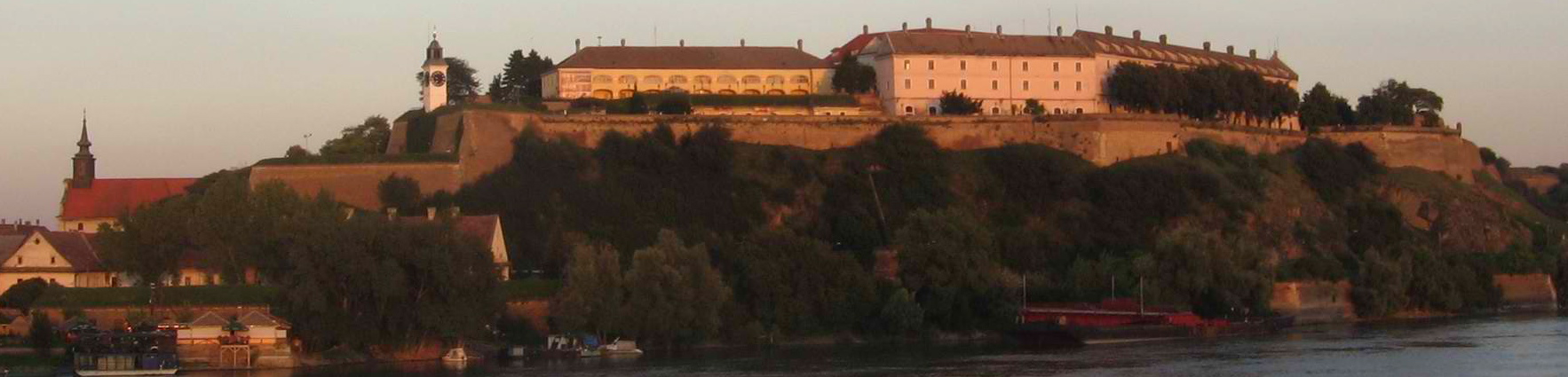
Petrovaradin Fortress, Serbia (Photo: Wikimedia Commons)
THANKS TO THE hospitality of a former student, Višnja Kisić, this year’s summer travels took me into a region of the former Habsburg Empire much less well known than Bohemia or Hungary. This is Vojvodina, a flat, largely agricultural area that forms an autonomous province within modern Serbia.

Plan of Novi Sad (Ratzenstadt in archaic German) and the Petrovaradin fortress, 1745
Vojvodina is not too familiar to English-language art historians. Mentioning Serbia might bring to mind the rich legacy of medieval monasteries in the country’s south, the scattered Ottoman architecture that remains after centuries of Turkish rule, or perhaps Belgrade’s extensive heritage of Communist architecture. Imagine my surprise when I discovered substantial eighteenth-century sights in and around the regional capital of Novi Sad, Serbia’s second largest city.
The city itself has an almost perfect eighteenth-century pedigree. It was founded in 1694 as a new settlement across the Danube from the Petrovaradin Fortress, a large military structure that was instrumental in the Austrian army’s defense against the Ottomans. Novi Sad developed rapidly in the eighteenth century and still maintains its historical core with beautiful civic, domestic, and religious edifices. Unlike Belgrade, a sprawling and rather hectic place, Novi Sad has a much more relaxed feel that recalls Vienna or Budapest and bespeaks its Habsburg heritage.
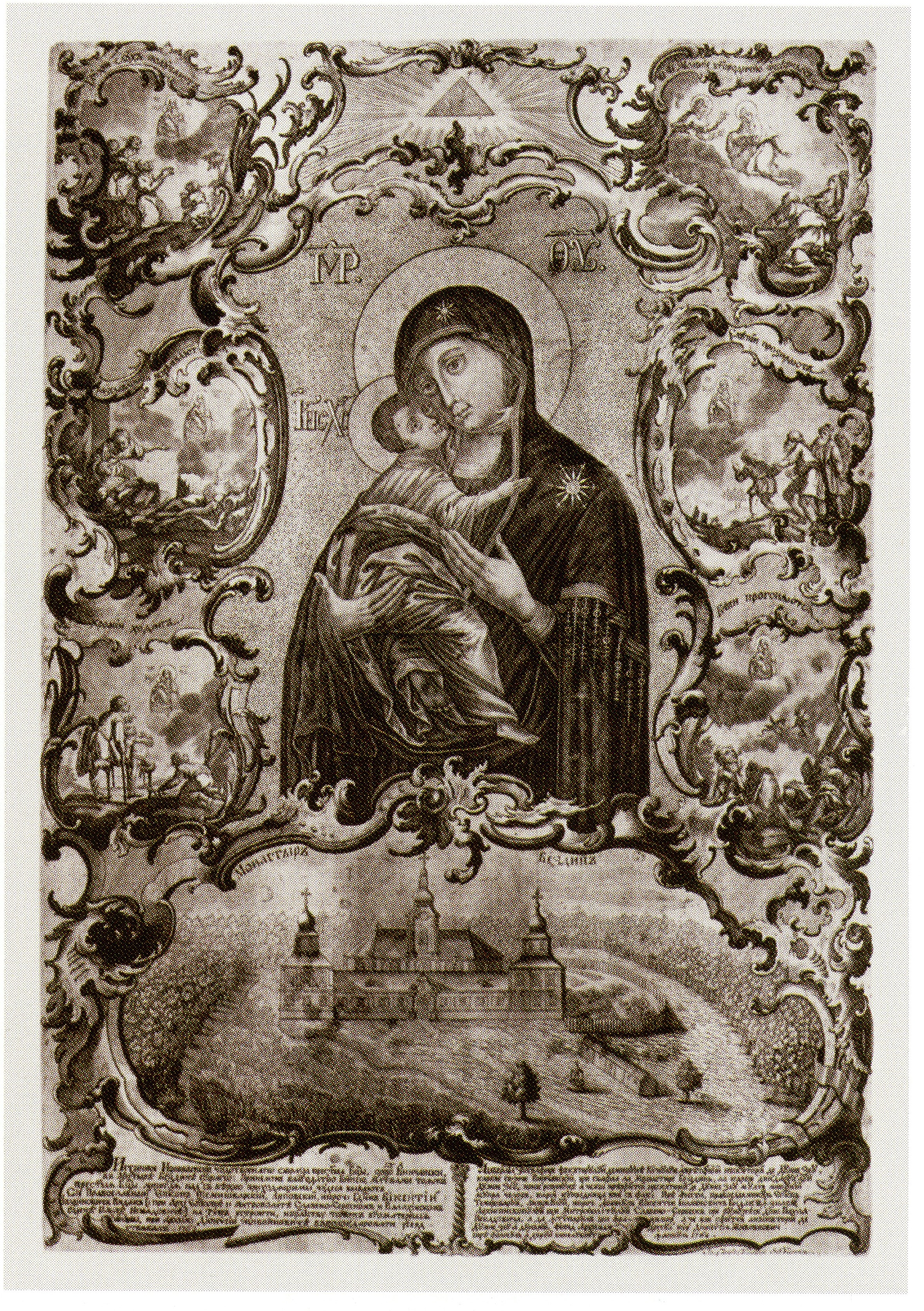
J. K. Winkler, Virgin and Child, print, 1762
There are excellent museums in Novi Sad that would be of great interest to American scholars. For eighteenth-century specialists, the highlight certainly is the Gallery of Matica Srpska, where I was privileged to give a lecture on July 19. The gallery is the most important museum of Serbian art, and the quality of its holdings is impressive (“Matica” means “queen bee” and is used in Slavic countries to designate institutions of cultural promotion and scholarship). The museum is home to a gorgeous collection of painted religious images and carved wooden church outfittings, as well as an extensive group of eighteenth-century Serbian Orthodox prints. In addition, there are numerous painted portraits from the eighteenth through twentieth centuries, academic history paintings by Serbian artists, and galleries of modern art. The real standouts for me were the beautiful Orthodox rococo church outfittings. These are composite constructions of gilded wood and paint that adorned Orthodox churches, usually altars and iconostases.

Teodor Kračun, "The Prophet Gideon," 1776
Orthodox Rococo? For many Enfilade readers, this must come as a huge surprise. I suspected that such art existed at the point where Catholic regions abutted Orthodox ones, but had never encountered it in person, nor knew much about it. Art Historian Dr. Branka Kulić has researched this material extensively and written about how local painters worked with craftsmen trained in Vienna to produce a fascinating synthesis of rococo and Byzantine traditions. Later examples break somewhat with the strict rules of icon representation to incorporate greater three-dimensionality and naturalism into their works, and these traditions continued well into the nineteenth century. As Dr. Kulić has noted, artists produced such imagery for churches across the region, not just in Novi Sad, and they can perhaps be understood as visual manifestations of this region’s multivalent social, economic, and religious structure.
Personally, I was struck by of how many fascinating things remain to be encountered in eighteenth-century art, how much can still surprise the curious investigator, and how diverse this century’s visual and material production really was. It also brought to mind how inconsistent the narratives we tell about art’s history can be, and how the desire to see some
things clearly necessitates obscuring others from view.

Teodor Kračun and Arsenije Marković, "The Descent of the Holy Spirit and The Council of Prophets with the Holy Virgin," 1775-1780
There are also significant eighteenth- and early nineteenth-century sights in the nearby cities of Sremski Karlovci and Zemun, as well as the more distant town of Vršac, all of which have preserved pockets of eighteenth-century architecture. And in Novi Sad there is yet another museum worth visiting, this one for modern art: the Pavle Beljanski Memorial Collection, a fascinating example of a high-quality private art collection installed and housed entirely according to its collector’s wishes.
◊ ◊ ◊ ◊ ◊
Michael Yonan is Associate Professor of Art History at the University of Missouri-Columbia. His book, Empress Maria Theresa and the Politics of Habsburg Imperial Art, appeared earlier this year from Penn State University Press.
Call for Papers: ASECS 2012 in San Antonio
2012 American Society for Eighteenth-Century Studies Conference
San Antonio, Texas, 22-25 March 2012
Proposals due by 15 September 2011
The 2012 ASECS conference takes place in San Antonio, 22-25 March. Along with our annual luncheon and business meeting, HECAA will be represented by two panels chaired by Christopher Johns, Heidi Strobel, and Amber Ludwig and Melissa Hyde and Heidi Kraus. In addition to these, a wide selection of sessions that might be relevant for HECAA members are also included below. A full list of panels is available at the ASECS website.
◊ ◊ ◊ ◊ ◊
Exoticisms: Global Commodity Exchange in the Long Eighteenth Century (Historians of Eighteenth-Century Art and Architecture)
Christopher Johns, Heidi Strobel, and Amber Ludwig, for Strobel: Dept. of Archaeology and Art History, 1800 Lincoln Ave., U. of Evansville, Evansville, IN, 47722; Tel: (812) 746-9711; Fax: (812) 488-2430; E-mail: hs40@evansville.edu
Global commodity exchange radically altered European culture in the long eighteenth century. Exoticisms became fundamental to understanding colonization and routes of international exchange, as well as iconographic and stylistic transformations in the arts. Each paper proposal should define exoticism, its geographical parameters, and its unique and unfamiliar qualities. The role of material culture, decorative arts, and prints in defining and developing the idea(s) of exoticism(s) is of particular interest. Interdisciplinary approaches are welcome and encouraged.
◊ ◊ ◊ ◊ ◊
New Scholar’s Open Session (Historians of Eighteenth-Century Art and Architecture)
Melissa Hyde, University of Florida and Heidi Kraus, University of Iowa; Tel: (Hyde) (352) 273 3057; E-mail: mhyde@ufl.edu AND heidiekraus@yahoo.com
This panel, sponsored by the Historians of Eighteenth-Century Art and Architecture, seeks papers that deal with any aspect of visual art and culture, or architecture. It is open to graduate students (priority will be given to those who are ABD) or who have received the Ph.D. in the past 5 years.
◊ ◊ ◊ ◊ ◊ (more…)
New Title: Cultures of Court, Cultures of the Body
From PUPS:
Mathieu Da Vinha, Catherine Lanoë, and Bruno Laurioux, eds., Cultures de cour, cultures du corps XIVe-XVIIIe siècle (Paris: Presses de l’Université Paris-Sorbonne, 2011), 316 pages, ISBN: 9782840507635, 22€.
 Dans toute l’Europe occidentale, du Moyen Âge jusqu’à l’Époque moderne, se sont épanouies des sociétés de cour qui ont accordé au corps une place nouvelle, assurant sa promotion dans le jeu politique et social. Ainsi, les stratégies de son maintien, de son entretien et de son apparence tiennent une place toute particulière au sein de cet univers hiérarchisé. En se fondant sur l’exploitation de sources très variées (littéraires, iconographiques ou comptables) et en s’attachant à décrire non seulement les normes et les représentations de cette culture du corps, mais encore les pratiques et les techniques auxquelles elle a donné naissance – savoir-faire, gestes, accessoires, aménagements spécifiques… –, les contributions rassemblées dans ce volume proposent des éclairages inédits et précis sur les sociétés curiales européennes. Elles traitent aussi bien des usages des parfums et des cosmétiques, ou encore des perruques, que des régimes de santé, des bains thérapeutiques ou de propreté, d’hygiène dentaire ou même des « commodités ».
Par-delà les anecdotes et les clichés persistants, elles démontrent que les
questions de santé, d’hygiène et de beauté ont été au cœur des préoccupations
des individus qui peuplaient les cours.
C O N T E N T S
Introduction, Catherine Lanoë
Georges Vigarello, La beauté au cœur des préoccupations des cours modernes
I. Prendre soin du corps
• Laurence Moulinier-Brogi, Soins du corps à la cour de France au tournant du XIVe siècle
• Didier Boisseuil, Les cours italiennes et le thermalisme à la Renaissance : les Sforza de Milan et les cures thermales au milieu du XVe siècle
• Elisa Andretta, Les régimes de santé des papes dans la deuxième moitié du XVIe siècle
• Stanis Perez, L’hygiène de Louis XIV
• Colin Jones, Les dents du roi
II. Éduquer le corps ; re-présenter le corps
• Élodie Lequain, Le bon usage du corps dans l’éducation des princesses à la fin du Moyen Âge
• Frédérique Leferme-Falguières, Corps modelé, corps contraint : les courtisans et les normes du paraître à Versailles
• Pauline Lemaigre-Gaffier, La mise en scène du corps du roi : l’organisation du sacre de Louis XVI par les Menus Plaisirs
• Mechthild Fend, Toile nerveuse. Rendre la peau dans les portraits de fantaisie de Fragonard
• Melissa Lee Hyde, Beautés rivales : les portraits de Madame du Barry et de la reine Marie-Antoinette
III. Artisans, espaces et objets du corps
• Ronan Bouttier, Les bains royaux, de Fontainebleau à Versailles
• Mary K. Gayne, La taxe sur les perruques de 1706 : l’intégration du corps dans la société marchande de l’Ancien Régime
• Marie-France Noël, Prendre ses aises…
• Eugénie Briot, « Des essences, des poudres, des parfums et autres semblables galanteries » : Normes et pratiques du corps parfumé à la cour de France, XVIIe-XVIIIe siècles
Conclusion, Bruno Laurioux
Reviewed: ‘The Temperamental Nude’
Recently added to caa.reviews:
Tony Halliday, The Temperamental Nude: Class, Medicine and Representation in Eighteenth-Century France, Studies on Voltaire and the Eighteenth Century (Oxford: Voltaire Foundation, 2010), 272 pages, ISBN: 9780729409940, £55.
Reviewed by Dorothy Johnson, University of Iowa; posted 14 July 2011.
In “The Temperamental Nude: Class, Medicine and Representation in Eighteenth-Century France,” the late Tony Halliday studies a neglected facet of visual representation in Enlightenment culture, namely, the revival and significance of the theory of the temperaments and its impact on the depiction of the human figure, specifically the male figure, in painting, sculpture, and prints. His study focuses principally on mid- to late eighteenth-century France, with particular emphasis on the Revolutionary period. The contested idea of the new citizen (who was male according to French convention and law) and his fluctuating image in the visual arts during the Revolution, Republic, and Directory (1789–99) constitute the principal matter of the book. . . .
The full review is available here» (CAA membership required)
Reviewed: ‘Thomas Gainsborough and the Modern Woman’
Benedict Leca, Aileen Ribeiro, and Amber Ludwig, Thomas Gainsborough and the Modern Woman, ed. Benedict Leca (London: Giles Limited, 2010) 196 pages, ISBN: 9781904832850, $49.95.
Reviewed for Enfilade by Susan M. Wager
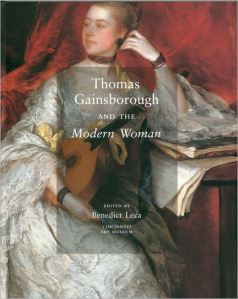 After a visit to Thomas Gainsborough’s studio in October 1760, the socially and culturally accomplished Mary Delany wrote, “There I saw Miss Ford’s picture—a whole length with her guitar, a most extraordinary figure, handsome and bold; but I should be sorry to have any one I loved set forth in such a manner.” The picture in question, Gainsborough’s Ann Ford of 1760, and the ambivalent reactions (like Mrs. Delany’s) it has engendered, is the central focus of Thomas Gainsborough and the Modern Woman. This lavishly illustrated catalogue, published to accompany an exhibition of the same name that originated at the Cincinnati Art Museum in 2010 before traveling to the San Diego Museum of Art earlier this year, was edited by Benedict Leca, Curator of European Painting, Sculpture, and Drawings at the Cincinnati Art Museum.
The portrait of Ann Ford—an eighteenth-century woman who garnered an ambiguous reputation by daring to organize public performances of her talent at the viola da gamba (unusual for a woman at the time)—was acquired by the Cincinnati Art Museum in 1927 and remains a highlight of the Museum’s collection. Leca has cleverly constructed an exhibition around the portrait, enriching our understanding of it through the juxtaposition of several well-selected loans. These include some of Gainsborough’s portraits of other “demireps”—women whose “social and sexual assertiveness combined with their flair for personal style and public exposure ran counter to propriety,” as defined by Leca. The catalogue’s three essays—by Leca, Aileen Ribeiro, and Amber Ludwig—all seem to be underpinned, implicitly, by the question: to what extent were these “demireps” in control of the constructed identities mediated through their painted portraits?
Leca’s approach to this question is decidedly optimistic. Drawing on compelling evidence such as Ann Ford’s published writings on the merits of the female sex, Leca argues that Gainsborough and Ford, in addition to some of his other female sitters, were equal partners in the production of images that challenged circumscribed gender codes and asserted female liberation from masculine control. Leca reads the correlation of Gainsborough’s signature loose brushwork—deemed “feminine” by his contemporaries—with painted passages of conventionally feminine accessories adorning sexually assertive women as the artist’s ironic and progressive rejection of masculinist norms. As Leca writes, Gainsborough’s portraits present “provocative women provocatively painted.”
Ribeiro’s essay considers how the costumes worn by Gainsborough’s demireps participated in the negotiation of reputation, class, and status. Ribeiro subtly complicates Leca’s reading of Ann Ford by evoking scholars who have suggested that paintings of accomplished women like Ford could be seen as relatively traditional presentations of ideal and precious objects of beauty, served up for the viewer’s delectation. Although Ribeiro ultimately disagrees with these readings, her essay nonetheless gestures toward the plurality of interpretations that can be gleaned from images of demireps.
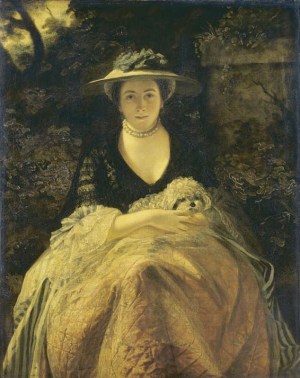
Joshua Reynolds, "Portrait of Nelly O'Brien," ca. 1762-64 (London: Wallace Collection)
Leca and Ribeiro mobilize two different portraits by Joshua Reynolds of the courtesan Nelly O’Brien to make divergent points about Ann Ford. Leca emphasizes the “subversive femininity” and “suggestiveness” of Ford’s pose by contrasting it to Reynolds’s 1762-4 portrait of O’Brien (The Wallace Collection). Whereas Reynolds dissembles the unsavory profession of O’Brien through the imposition of a pyramidal, closed, Marian pose onto her body, Gainsborough flaunts the immodesty and impropriety of Ford’s dynamic, crossed-leg attitude. Ribeiro, however, juxtaposes Ann Ford with a 1763-7 Reynolds portrait of O’Brien (The Hunterian Museum & Art Gallery, University of Glasgow) in order to underscore the formality of Ford’s dress in contrast to O’Brien’s “loose bed-gown.” The latter is far more scandalous than Ford’s costume, which would have been chosen precisely to shore up Ford’s ambiguous reputation. Conflicting readings like these do not detract from the overall thrust of the book; instead, they strengthen it, attesting to the complexity of the images under examination.

Joshua Reynolds, "Portrait of Nelly O'Brien," ca. 1763-67 (Glasgow: Hunterian Museum)
Indeed, complexity characterizes the images addressed by Amber Ludwig in her essay on how portraiture could attach the appearance of virtue to women with dubious reputations. Addressing pictures of Emma Hamilton, she underscores, for instance, tensions between the desires and personality of the sitter and the desires for propriety imposed by her husband or lover.
Thomas Gainsborough and the Modern Woman would be a welcome addition to the libraries of scholars and general readers alike. The catalogue’s clear prose is supplemented by sumptuous, full-color plates and extraordinarily high-resolution details, offering a worthy substitute for individuals who did not see the exhibition, or a handsome aide-mémoire for those who did.
◊ ◊ ◊ ◊ ◊
Susan M. Wager is a Ph.D. candidate in Art History & Archaeology at Columbia University. Her research examines eighteenth-century reproductions after François Boucher in the mediums of gems, porcelain, and tapestries at the intersection of consumer culture, natural history, antiquarianism and connoisseurship, and global exchange.
2011 Berger Prize for British Art History
This year’s long list for the Berger Prize includes several HECAA members. Bravo! From The British Art Blog:
Berger Prize 2011 Long List
Books published 1 January-31 December 2010
The Short List of six will be announced in mid-June 2011, and the Award of the William MB Berger Prize for British Art History (worth £5000 to the winner) will be awarded by A.N. Wilson at a ceremony in London UK on the evening of 5 July 2011.
Assessors Timothy J. Standring, Gates Foundation Curator of Painting & Sculpture, Denver Art Museum; Robin Simon, Editor, The British Art Journal; Katharine Eustace, Editor, Sculpture Journal; Rosemary Hill, Fellow, All Souls’ College, Oxford; Desmond Shawe-Taylor, Surveyor of The Queen’s Pictures; Angus Trumble, Senior Curator of Paintings and Sculpture, Yale Center for British Art
◊ ◊ ◊ ◊ ◊
Of the 38 titles on the long list, here’s an assortment of those dealing with the eighteenth century:
 • David Nolan and Carolyn Starren, On Public View – A Journey around the Sculptures in the Royal Borough of Kensington and Chelsea, NOTE published online. Please visit www.rbkc.gov.uk/onpublicview; Chapters download as pdfs with a video introduction to watch on the site
• Celina Fox, The Arts of Industry In the Age of Enlightenment, [2009] 18 February 2010, YUP, ISBN: 9780300160420, £50, pp576, 200 bw, 60 col
• Cherry Ann Knott, George Vernon 1636-1702 ‘Who built this House’. Sudbury Hall Derbyshire, 1 June 2010 Tun House Publishing, ISBN: 9780956524003, £75 (signed limited edition of 500), pp782, illus bw & col
• Katharine Baetjer, British Paintings in the Metropolitan Museum of Art, 1575-1875, 30 March 2010 Metropolitan Museum/YUP, ISBN: 9781588393487 (Met Mus), ISBN: 9780300155099 (YUP), £55, pp308, 215 bw, 140 col
 • John Ingamells, National Portrait Gallery. Later Stuart Portraits 1685-1714, 8 February 2010 National Portrait Gallery, ISBN: 9781855144101, £125, pp460, 358 bw, 305 col
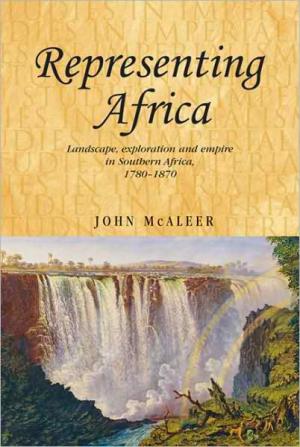
• John McAleer, Representing Africa: Landscape, Exploration and Empire in Southern Africa, 1780-1870, 1 March 2010 Manchester University Press, ISBN: 9780719081040, £60pp, 241, 16 bw, 9 col
• Cassandra Albinson, Peter Funnell & Lucy Peltz, eds, Thomas Lawrence: Regency Power and Brilliance, Exh cat. 21 October 10 YUP, ISBN: 9780300167184, £40, pp280, 20 bw, 160 col
• Cecilia Powell & Stephen Hebron, Savage Grandeur & Noblest Thoughts: Discovering the Lake District 1750-1820, Exh cat. 2010 Wordsworth Trust, ISBN: 9781905256426, £19.95, many illus in colour
 • Mireille Galinou, Cottages & Villas: The Birth of the Garden Suburb, 19 October 2010 YUP, ISBN: 9780300167269, £40, pp480, 55 bw, col 250
• Douglas Fordham, British Art and the Seven Years’ War: Allegiance and Autonomy, 2010 University of Pennsylvania Press, ISBN: 9780812242430, £42.50, pp334, 87 bw
• Charlotte Yeldham, Maria Spilsbury (1776-1820), Artist and Evangelical, 1 February 2010 Ashgate, ISBN: 9780754669913, £65, pp230, 73 bw,
• Bernd W Krysmanski, Hogarth’s Hidden Parts, Georg Holms Verlag, Hildesheim, ISBN: 9783487144719, Euros 48, pp514, 304 bw
• Elisabeth Soulier Detis, Guess at the Rest: Cracking the Hogarth Code, 27 May 2010 James Clarke & Co Ltd, ISBN: 139780718892159, £35, 183 bw, pp233
 • Jason Kelly, The Society of Dilettanti: Archaeology and Identity in the British Enlightenment, [2009] 28 January 2010 YUP, ISBN: 9780300152197, £40, pp366, 100 bw, 20 col
• Julian Mitchell, The Wye Tour and its Artists, Exh cat. 2010 Logaston Press, ISBN: 9781906663322, £12.95, pp168, illus bw & col
• Jennifer Scott, The Royal Portrait. Image and Impact, 2010 Royal Collection Enterprises, ISBN: 9781905686131, £19.95, pp200, 157 col
• Ilaria Bignamini and Clare Hornsby, Digging and Dealing in Eighteenth-century Rome, 25 February 2010 YUP, ISBN: 9780300160437, £45, 2 vols, pp630, 200 bw, 50 col
◊ ◊ ◊ ◊ ◊
Update (added 14 July 2011) — As announced on July 5, this year’s winner is
• Charlotte Gere and Judy Rudoe, Jewellery in the Age of Queen Victoria: A Mirror to the World (London: British Museum Press), 552 pages, ISBN 978-0714128191, £50.
The short list of six titles included these eighteenth-century offerings:
• Celina Fox, The Arts of Industry In the Age of Enlightenment (New Haven: Yale University Press, 2010), ISBN: 9780300160420, £50.
• Cecilia Powell & Stephen Hebron, Savage Grandeur & Noblest Thoughts: Discovering the Lake District 1750-1820 (Wordsworth Trust, 2010), ISBN: 9781905256426, £19.95
• Ilaria Bignamini and Clare Hornsby, Digging and Dealing in Eighteenth-century Rome (New Haven: Yale University Press, 2010), ISBN: 9780300160437, £45.
June 2011 Issue of ‘The Art Bulletin’ — In Memory of Anne Schroder

Fragonard, "The Meeting," from the Progress of Love, 1771-73 (NY: The Frick Collection)
The June issue of The Art Bulletin is dedicated to the memory of Anne L. Schroder, who passed away suddenly in December 2010. The issue includes her article, “Fragonard’s Later Career: The Contes et Nouvelles and the Progress of Love Revisited,” pp. 150-177.
◊ ◊ ◊ ◊ ◊
Abstract: Late in his career, which spanned the Revolution and beyond, Honoré Fragonard revived two major projects in limbo since 1773. His unsuccessful effort to have engraved his illustrations for La Fontaine’s Contes et nouvelles (17880-1809) demonstrates the dramatic upheavals in the post-Revolutionary print market and publishing industries and shifting reactions to his art. The unfinished series Progress of Love, expanded and recontextualized by the artist during the late 1790s and early 1800s, reveals Fragonard’s adaptation of his perennial subjects — flirtation, love, and picturesque nature — to changing cultural attitudes regarding the sexual power of women in the aftermath of the Revolution.
New Title: ‘Roma Britannica: Art Patronage and Cultural Exchange’
David Marshall, Susan Russell, and Karin Wolfe, eds., Roma Britannica: Art Patronage and Cultural Exchange in Eighteenth-Century Rome (London: British School at Rome, 2011), 374 pages, ISBN 9780904152555, £35.00.
 Important as the Grand Tour was, there was much more to the cultural relationship between Britain and Rome in the eighteenth century than this. The contributions to this volume look at this relationship from the perspective of the Italian, as well as the British and other European visitors: Rome in the eighteenth century stood for cosmopolitanism rather than national rivalry, and had moved beyond being the centre for the renaissance of antiquity to being a place where the cross-pollination of the modern with the ancient allowed the culture of Europe to flower in new and unexpected ways.
Introduction
- David R. Marshall and Karin Wolfe, Roma Britannica
- Christopher M.S. Johns, Visual Culture and the Triumph of Cosmopolitanism in Eighteenth-Century Rome
Art for Religion: Catholic Britain and Jacobites in Rome
- Carol M. Richardson, Andrea Pozzo and the Venerable English College, Rome
- Edward Corp, The Stuart Court and the Patronage of Portrait-Painters in Rome, 1717–57
- David R. Marshall, The Cardinal’s Clothes: The Temporary Façade for the Investiture Celebration of Cardinal York in 1747
- Peter Björn Kerber, The Art of Catholic Recusancy: Lord Arundell and Pompeo Batoni
Culture for Sale: British Patrons, Collectors, Agents, and the Roman Art Market
- Karin Wolfe, Acquisitive Tourism: Francesco Trevisani’s Roman Studio and British Visitors
- James Holloway, John Urquhart of Cromarty: A Jacobite Patron in Rome
- Alastair Laing, Giovanni Paolo Panini’s English Clients
- Francis Russell, John, 3rd Earl of Bute and James Byres: A Postscript
Confrontations with the Antique: The British Reception of Egypt and Rome
- Edward Chaney, Roma Britannica and the Cultural Memory of Egypt: Lord Arundel and the Obelisk of Domitian
- Elizabeth Bartman, Egypt, Rome and the Concept of Universal History
- Edgar Peters Bowron, From Homer to Faustina the Younger: Representations of Antiquity in Batoni’s British Grand Tour Portraits
- Andrew Wallace-Hadrill, Romanizing Frescoes: From the Villa Negroni to Ickworth
Constructing the Future on the Ruins of the Past: The British and the Roman Practice of Architecture
- Tommaso Manfredi, Roma Communis Patria: Filippo Juvarra and the British
- Katrina Grant, Planting ‘Italian Gusto’ in a ‘Gothick Country’: The Influence of Filippo Juvarra on William Kent
- John Wilton-Ely, ‘My Holy See of Pleasurable Antiquity’: Robert Adam and His Contemporaries in Rome
- Letizia Tedeschi, Vincenzo Brenna and His Drawings from the Antique for Charles Townley
Universal Neoclassicism: Old Rome and New Britain
- Malcolm Baker, Commemoration ‘in a More Durable and Grave Manner’: Portrait Busts for the British in Early Eighteenth-Century Rome
- Desmond Shawe-Taylor, ‘The Modern … Who Recommends Himself’: Italian Painters and British Taste in Eighteenth-Century Rome
- Wendy Wassyng Roworth, Between ‘Old Tiber’ and ‘Envious Thames’: The Angelica Kauffman Connection
- Kevin Salatino, Fuseli’s Phallus: Art and Erotic Imagination in Eighteenth-Century Rome
◊ ◊ ◊ ◊ ◊
Orders should be sent to: The British School at Rome, at The British Academy, 10 Carlton House Terrace, London, SW1Y 5AH.










 Enfilade
leave a comment