Spanish Drawings at The Frick This Fall
Press release (PDF) from The Frick:
The Spanish Manner: Drawings from Ribera to Goya
The Frick Collection, New York, 5 October 2010 — 9 January 2011

Catalogue by Jonathan Brown, Lisa Banner, Susan Grace Galassi, Reva Wolf, and Andrew Schulz (Scala, 2010), ISBN: 9781857596519, $65
The greatest Spanish draftsmen from the seventeenth through the nineteenth century—Ribera, Murillo, and Goya, among them—created works of dazzling idiosyncrasy. These diverse drawings, which may be broadly characterized as possessing a specifically “Spanish manner,” will be the subject of an exclusive exhibition at The Frick Collection in the fall of 2010. The presentation will feature more than fifty of the finest Spanish drawings from public and private collections in the Northeast, among them The Metropolitan Museum of Art, The Hispanic Society of America, The Morgan Library & Museum, the Princeton University Art Museum, and the Philadelphia Museum of Art. Opening the show are rare sheets by the early seventeenth-century masters Francisco Pacheco and Vicente Carducho, followed by a number of spectacular red chalk drawings by the celebrated draftsman Jusepe de Ribera. The exhibition continues with rapid sketches and painting-like wash drawings from the rich oeuvre of the Andalusian master Bartolomé Esteban Murillo, along with lively drawings by Francisco de Herrera the Elder and his son and the Madrid court artist Juan Carreño de Miranda, among others.
The second part of the exhibition will present twenty-two sheets by the great draftsman Francisco de Goya, whose drawings are rarely studied in the illuminating context of the Spanish draftsmen who came before him. These works, mostly drawings from his private albums, attest to the continuity between his thematic interests and those of his Spanish forebears, as well as to Goya’s own enormously fertile imagination. The exhibition is organized by Jonathan Brown, Carroll and Milton Petrie Professor of Fine Arts, New York University; Lisa A. Banner, independent scholar; and Susan Grace Galassi, Senior Curator at The Frick Collection. It will be accompanied by a fully illustrated catalogue with entries by the show’s organizers and by Reva Wolf, Professor of Art History, State University of New York at New Paltz, and author of Goya and the Satirical Print in England and on the Continent, 1730–1850, and by Andrew Schulz, Associate Professor of Art History and Department Head at the University of Oregon and author of Goya’s Caprichos: Aesthetics, Perception, and the Body. The exhibition is made possible, in part, by the David L. Klein Jr. Foundation, Elizabeth and Jean-Marie Eveillard, and the Samuel H. Kress Foundation. The accompanying catalogue has been generously underwritten by the Center for Spain in America.
Exhibition: Gainsborough and the Modern Woman
From Art Daily (19 July 2010) . . .
Thomas Gainsborough and the Modern Woman
Cincinnati Art Museum, 18 September 2010 — 2 January 2011
San Diego Museum of Art, 29 January — 1 May 2011
Curated by Benedict Leca
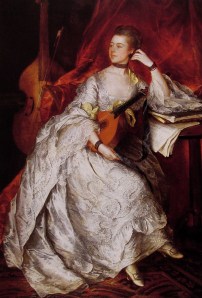
Thomas Gainsborough, "Portrait of Ann Ford" (later Mrs. Philip Thicknesse), 1760 (Cincinnati Art Museum)
The portraits of Thomas Gainsborough (1727-1788) made him perhaps the most famous British artist of the late eighteenth century. Nobles, statesmen, musicians and the range of men and women of the period’s merchant class all sat for him. But it is his portraits of notorious society women—widely considered among the greatest of the Western tradition—which attracted the most attention.
Eighteenth-century viewers appreciated these paintings differently than we do today. In his own time, Gainsborough’s portraits of actresses, performers and courtesans were seen as unconventional, if not radical, not only because of the type of woman they portrayed but also because of the unconventional way they were painted. “These stunning portraits not only give us a perspective on the history of portrait painting and celebrity, but also on the history of women’s progressive self-fashioning, which equally deserves art historical recognition. These are provocative women provocatively painted,” explains exhibition curator Benedict Leca.
Organized by the Cincinnati Art Museum in association with the San Diego Museum of Art, Thomas Gainsborough and the Modern Woman is the first exhibition devoted to Thomas Gainsborough’s feminine portraiture, and the first to focus specifically on modernity and femininity in Georgian England from the perspective of Gainsborough’s groundbreaking portraits of women. Coinciding with the comprehensive cleaning and restoration of the Cincinnati Art Museum’s iconic Ann Ford (Mrs. Thicknesse), this exhibition unites a choice selection of thirteen paintings from renowned museum collections in the United States and Britain to illuminate the role that Gainsborough ’s extraordinary portraiture played in defining new, progressive feminine identities. Among others on view at the Cincinnati Art Museum, September 18, 2010 – January 2, 2011 will be Mrs. Siddons (National Gallery, London), Mrs Richard Brinsley Sheridan (National Gallery, Washington), Giovanna Baccelli (Tate Britain), Grace Dalrymple (Metropolitan Museum of Art), Viscountess Ligonier (Huntington Library, Art Collections and Botanical Gardens). The exhibition will also feature a small selection of period dresses from the Cincinnati Art Museum’s rich fashion arts and textile collection, thereby further contextualizing Gainsborough’s portraits while affording visitors a view of the material accessories of the “modern woman.” . . .
The Art Daily article is available here»
◊ ◊ ◊ ◊ ◊
Exhibition catalogue: Benedict Leca, Aileen Ribeiro, and Amber Ludwig, Thomas Gainsborough and the Modern Woman (London: Giles, 2010), ISBN: 9781904832850, $49.95.
 This beautifully illustrated volume focuses specifically on Thomas Gainsborough’s portraits of well-known, “liberated,” society women, and the way in which the artist executed these special commissions. Thomas Gainsborough and the Modern Woman draws us away from his predominant reputation as a landscape painter, and shows how such portraits were both an affirmation by Gainsborough of his own position in the artistic world of Georgian England, and of the desire of his sitters (including leading artists, musicians, actresses and intellectuals) to be seen as self-assured progressive women.
Author Benedict Leca takes as his starting point the Cincinnati Art Museum’s famous and newly restored portrait of Ann Ford (1760), widely considered the finest of the masterpiece portraits created by Gainsborough at Bath in the early 1760s. He addresses this early portrait as typifying Gainsborough’s comparatively permissive attitude with regard to how notorious women should be presented, and offers a compelling view of Gainsborough’s peculiar manner of painting, one that established the artist as the foremost portraitist of modern life. Featuring portraits from international collections, including Tate Britain, the Metropolitan Museum of Art, the J Paul Getty Museum and the National Gallery, London, this ground-breaking new volume also includes an essay by Aileen Ribeiro examining the portrait of Ann Ford in detail, and by Amber Ludwig discussing the role of feminine identity in 18th-century London.
New Title: Cultural Aesthetics of Porcelain

ISBN: 978-0-7546-6386-7
Alden Cavanaugh and Michael E. Yonan, eds., The Cultural Aesthetics of Eighteenth-Century Porcelain (Aldershot: Ashgate, 2010), ISBN: 9780754663867, $99.95
During the eighteenth century, porcelain held significant cultural and artistic importance. This collection represents one of the first thorough scholarly attempts to explore the diversity of the medium’s cultural meanings. Among the volume’s purposes is to expose porcelain objects to the analytical and theoretical rigor which is routinely applied to painting, sculpture and architecture, and thereby to reposition eighteenth-century porcelain within new and more fruitful interpretative frameworks. The authors also analyze the aesthetics of porcelain and its physical characteristics, particularly the way its tactile and visual qualities reinforced and challenged the social processes within which porcelain objects were viewed, collected, and used.
The essays in this volume treat objects such as figurines representing British theatrical celebrities, a boxwood and ebony figural porcelain stand, works of architecture meant to approximate porcelain visually, porcelain flowers adorning objects such as candelabra and perfume burners, and tea sets decorated with unusual designs. The geographical areas covered in the collection include China, North Africa, Spain, France, Italy, Britain, America, Japan, Austria, and Holland.
Contents: “Introduction,” Alden Cavanaugh and Michael E. Yonan; “Rethinking the Arcanum: porcelain, secrecy, and the 18th-century culture of invention,” Glenn Adamson; “The nature of artifice: French porcelain flowers and the rhetoric of the garnish,” Mimi Hellman; “Igneous architecture: porcelain, natural philosophy, and the rococo cabinet chinois,” Michael Yonan; “Marketing celebrity: porcelain and theatrical display,” Heather McPherson; “Balancing act: Andrea Brustolon’s ‘La Forza’ and the display of imported porcelain in 18th-century Venice,” Erin J. Campbell; “The Queen’s nécessaire,” Alden Cavanaugh; “Porcelain, print culture and mercantile aesthetics,” Dawn Odell; “Sugar boxes and blackamoors: ornamental blackness in early Meissen porcelain,” Adrienne L. Childs; “Ties that bind: relations between the Royal Academy of San Fernando and the royal porcelain factory of the BuenRetiro,” Andrew Schulz; Selected bibliography; Index.
About the Editors: Alden Cavanaugh is Associate Professor of Art History at Indiana State University; Michael E. Yonan is Assistant Professor of Eighteenth- and Nineteenth-Century Art at the University of Missouri-Columbia.
New Title: Summer is for Fireworks
Simon Werrett, Fireworks: Pyrotechnic Arts and Sciences in European History (University of Chicago Press, 2010), ISBN: 978-0226893778, $45.
 Fireworks are synonymous with celebration in the twenty-first century. But pyrotechnics—in the form of rockets, crackers, wheels, and bombs—have exploded in sparks and noise to delight audiences in Europe ever since the Renaissance. Here, Simon Werrett shows that, far from being only a means of entertainment, fireworks helped foster advances in natural philosophy, chemistry, mathematics, and many other branches of the sciences.
Fireworks brings to vibrant life the many artful practices of pyrotechnicians, as well as the elegant compositions of the architects, poets, painters, and musicians they inspired. At the same time, it uncovers the dynamic relationships that developed between the many artists and scientists who produced pyrotechnics. In so doing, the book demonstrates the critical role that pyrotechnics played in the development of physics, astronomy, chemistry and physiology, meteorology, and electrical science. Richly illustrated and drawing on a wide range of new
sources, Fireworks takes readers back to a world where pyrotechnics were both
divine and magical and reveals for the first time their vital contribution to the
modernization of European ideas.
Conference on Salvator Rosa in Eighteenth-Century Britain
From The Paul Mellon Centre:
Salvator Rosa in Britain
A Conference at Dulwich Picture Gallery, London, 18 October 2010
 This conference, organized by Dr Helen Langdon, accompanies the exhibition at Dulwich Picture Gallery, Salvator Rosa (1615-1673): Bandits, Wilderness and Magic (15 September–28 November 2010) which concentrates on the quality and variety of Rosa’s works – savage landscapes, fanciful portraits of romantic figures, intriguing philosopher-paintings, witches and dragons. The conference explores the impact of this many-sided art on British painting, literature and art theory.
9:30 Registration
Morning Session introduced and chaired by Claire Pace (Honorary Research Fellow, University of Glasgow); Wendy Wassyng Roworth (Professor of Art History, University of Rhode Island), ‘The Legacy of Genius: Salvator Rosa, Joshua Reynolds and Painting in Britain’; Elinor Shaffer (Senior Research Fellow, Institute of Germanic & Romance Studies, University of London), ‘The Lives of Artists: William Beckford and Salvator Rosa’.
Visit to the exhibition, Salvator Rosa (1615-1673): Bandits, Wilderness and Magic, led by Helen Langdon and Xavier F. Salomon, Arturo and Holly Melosi Chief Curator at Dulwich Picture Gallery.
Afternoon Session I introduced and chaired by Susan Jenkins (Senior Curator, English Heritage); Cinzia Maria Sicca (Associate Professor of the History of European Art, University of Pisa), ‘“One of the most excellent Masters that Italy has produced in this century”: The circulation of Salvator Rosa’s works through the English community in Leghorn’; Alexis Ashot, Associate Specialist, Old Master and British Pictures, Christie’s, ‘“Unbounded capacity”: a 1778 vita of Salvator Rosa by the London connoisseur, Charles Rogers’.
Afternoon Session II introduced and chaired by Christoph Vogtherr (Curator of Pictures, pre-1800, The Wallace Collection); Jonathan Yarker (PhD candidate, University of Cambridge), ‘Joseph Goupy and the imitation of Rosa in early eighteenth-century England’; Helen Langdon (curator of the exhibition), ‘Belisarius in Norfolk’.
17.00 Panel and audience discussion chaired by Claire Pace, followed by wine reception.
Full conference fee, including coffee, lunch, tea, private view of the exhibition, and wine reception: £40. Student and Senior concessions £20. To register for the conference please check availability with Ella Fleming at The Paul Mellon Centre: Email: events@paul-mellon-centre.ac.uk, Tel: 020 7580 0311, Fax: 020 7636 6730.
Current Issue of ‘Eighteenth-Century Studies’
Selections from Eighteenth-Century Studies 43 (Summer 2010):
Stacey Sloboda, “Displaying Materials: Porcelain and Natural History in the Duchess of Portland’s Museum,” pp. 455-72.
Abstract: Porcelain in eighteenth-century aristocratic collections was associated with both the curious and the foreign. The Duchess of Portland’s Museum contained large amounts of porcelain along with thousands of natural history specimens. The material and geographic plurality of the collection mirrored its totalizing claims to have a comprehensive display of the world’s natural and artificial materials. This essay explores the relationship between porcelain and natural history, arguing that Portland’s collection attempted to bridge conceptual distinctions between science and art in the eighteenth century, and that this project was particularly important to making sense of eighteenth-century female collecting practices and their sociable display.
Dorothy Johnson, “Review Article — The Matter of Sculpture,” pp. 505-08.
- Erika Naginski, Sculpture and Enlightenment (Los Angeles: Getty Research Institute, 2009).
- Martina Droth and Penelope Curtis, eds., Taking Shape: Finding Sculpture in the Decorative Arts (Leeds and Los Angeles: Henry Moore Institute and the J. Paul Getty Museum, 2008-09).
- Anne Betty Weinshenker, A God or a Bench: Sculpture as a Problematic Art during the Ancien Régime (Bern: Peter Lang, 2008).
Clorinda Donato, “Review Article — Fresh Legacies: Giovanni Battista Piranesi’s Enduring Style and Grand Tour Appeal,” 508-11.
- Mario Vevilacqua, Fabio Barry, and Heather Hyde Minor, eds., The Serpent and the Stylus: Essays on G. B. Piranesi (Ann Arbor: University of Michigan Press, 2006).
- Andelka Galic and Vladimir Malekovic, eds. Piranesi: Vasi candelabri cippi sarcofagi tripodi lucerne ed ornamenti antichi, exhibition catalogue, translated into Italian by William Klinger (Zagreb: Museum of Arts and Crafts, 2007).
Scholar Profile: Mary Sheriff
To introduce some of the names and faces of HECAA, Craig and I have decided to begin a new Enfilade series that will profile scholars from diverse institutions and varying areas of expertise. We hope that this will not only illustrate the wealth of knowledge shared among the HECAA community at large but also provide individualized snapshots of upcoming projects, common interests, and new directions of research. If you would like to nominate someone to be interviewed or share thoughts on the series, we would be happy to hear from you; send an email to jennifer.ferng@gmail.com.
◊ ◊ ◊ ◊ ◊
Mary Sheriff is the W.R. Kenan, Jr. Distinguished Professor of Art History and Department Chair at the University of North Carolina at Chapel Hill. Her research focuses on eighteenth and nineteenth-century art and culture, with an emphasis on issues of creativity, sexuality, gender, and most recently, travel and cultural exchange. She has published three books with the University of Chicago Press J.-H. Fragonard: Art and Eroticism (1990), The Exceptional Woman: Elisabeth Vigée-Lebrun and the Cultural Politics of Art (1996), and Moved by Love: Inspired Artists and Deviant Women in Eighteenth-Century France (2004). This spring, her edited collection of essays, Cultural Contact and the Making of European Art, was published by the University of North Carolina Press.
◊ ◊ ◊ ◊ ◊
Jennifer Ferng: You were awarded the prestigious Guggenheim Fellowship earlier this year. Has this acknowledgment validated, sustained, or altered certain conceptions of what you believed about your approaches to the study of art history? What has this recognition personally meant to you?
MS: The fellowship could not have come at a better time. I have just completed seven years as department chair, and I am anxious to devote myself full-time to writing. The fellowship and the time off it represents means that I can now return to my research—which is what brought me to the profession in the first place! Administration was an afterthought and, unfortunately, a necessary evil.
I think the recognition of my work has helped me see that the discipline of art history, like other disciplines, has not only become more open to different approaches and methods, but also to work that engages and interprets material traditionally thought to be outside the domain of the discipline. I’m thinking here not only of diverse texts (novels, plays, travel writing, science treatises, etc.) but also of, for example, material culture, theatrical and operatic performance, contemporary theory. At the same time, I believe that art historians are now more open to different forms of interpretation.
JF: How do you feel eighteenth-century studies has recently changed (in relation to other sub-fields including feminist studies, material culture, and visual culture studies)?
MS : Let me answer this question from a slightly different angle. What I think has changed most about the field of eighteenth-century studies in art history is the number of practitioners. Two decades ago there were precious few of us in the sub-field and even fewer of us in ASECS. New scholars have brought into the field many different perspectives, approaches, and even disciplinary formations – and many of those perspectives, approaches, and formations have mirrored the changes in the discipline at large. Although some of the new scholars studied with those eighteenth-century specialists who had already changed the field – many others did not. When I and others entered the field it was a risk, and I believe it still is. Twenty years ago there was no recognized specialization in «Eighteenth-Century Art» and I think today the CAA categories of specialization still jump from «Baroque» to «Nineteenth-Century».
Now to take things from a different direction: I think that because we were never a venerable old field (like Renaissance Studies), we did not have venerable old ways of doing things; nor did we have the issues that arise from what I might call dynastic succession. So as a field, we have been able to change and adapt more easily to the changes in the discipline. I also like to believe – although it may be a personal myth – that folks who take the risk of specializing in the eighteenth century are also willing to take risks in their work – by which I mean they are willing to use a novel approach, ask a new question, interpret a «frivolous» object, bring together different archives of knowledge, and ultimately to admit the contingency of meaning.
JF: What are some of your upcoming projects and some of the new directions you will be pursuing?
MS: My new project is entitled Enchanted Islands: Picturing the Allure of Conquest in Eighteenth-Century France. I have been working on issues of cultural contact for a while now in my teaching and research. I’ve edited a volume just out from UNC Press called Cultural Contact and the Making of European Art, which is actually designed to be a complementary text for teaching the history of Western art. The volume has essays that range in time from 1429 to 1930, and all the essay consider the effects of cultural contact – from oppressive colonialism to mutually profitable trade – on European art. The volume argues that European art has always been shaped from the outside as well as from the inside, and is never a «pure product». The authors include ASECS members Christopher Johns and Elisabeth Fraser, as well as Claire Farago, Julie Hochstrasser, Carol Mavor, and Lyneise Williams.
My new project on enchanted islands develops in different ways issues of cultural contact and continues my studies of gender and sexuality, in this case as related to royal power and «Frenchness». The «allure of conquest» I mean as both martial and sexual. As the title of the project also suggests, I am interested in the hold that islands and «island-ness» have had on the Western (and especially French eighteenth-century) imagination. The project focuses on a particular sort of island imagined to be ruled by an enchantress, which is a staple of epic literature. A prime example is the island of the Saracen sorceress Armida in Tasso’s Jerusalem Delivered. The story of Rinaldo and Armida on the enchanted island was represented repeatedly in painting, opera, book illustration, and the decorative arts throughout the eighteenth century. Armida’s island is particularly significant for me because it is at once an enchanted, real, and mythical space. Tasso places Armida’s realm in what he calls the Fortunate Islands, which we know as the Canary Islands, and which were in antiquity the imagined site of the Elysian Fields. The whole project, in fact, takes up the larger questions of how mythical paradigms are mapped onto real persons and spaces; how real persons and spaces engender mythical paradigms; how paradigms change over time; and to what ends such paradigms are deployed.
What’s newer, perhaps, is that this project also engages with notions of «enchantment» as a feature of art, love, power, and magic. I’m interested in how the relation between art and enchantment was theorized in the eighteenth century and how it has been theorized today, especially in the work of anthropologist Alfred Gell.
I am also involved in a new project co-authored with Melissa Hyde, currently entitled French Women Artists: Rococo to Romanticism. We envision a book that will be not only a collective history of women artists from the mid-eighteenth century through the mid-nineteenth century, but also a history that considers these artists within their social, personal, institutional, and professional networks. In other words, this project is a history focused on women artists, but one that presents the art world as peopled by women and men together. Histories of that period in French art inevitably focus on select male painters and thus present what one could call the one-sex model. Our history contests that model by putting women back into the picture.
JF: Regarding pedagogical techniques inside and outside the classroom, how do you encourage your graduate students to pursue individual research and dissertation topics? What are some outstanding areas of unstudied eighteenth-century art?
MS: From the beginning of their studies, I encourage my students to find their own areas of special interest. I see my job not as telling them what to pursue but as helping them get where they want to go. My graduate seminars often define an area of research very broadly and offer as group reading some basic theoretical material. I ask students to find their own specialized topics within that area. I stress that finding a good topic is half the game of writing an outstanding essay – and by a good topic I mean one that is both focused and complex: one that can sustain different avenues of interpretation while remaining coherent. Of course, this is a tall order, especially for first-year students, but I meet with them and try to guide them toward an appropriate topic once I know their interests. And I will dissuade them if I think a topic is unworkable. I often suggest focusing on a single object or image that will open itself up to different interpretative strategies or that seems to condense several contemporaneous aesthetic and/or cultural issues.
There is so much understudied in the eighteenth century that I can hardly begin to prioritize. But in no particular order. . . Religious art and ecclesiastical architecture need sustained attention (this is especially true for French art). There are individual artists whose work deserves more study even though the monograph seems to be out of fashion; I’m sure everyone has his or her list, but mine would include Falconet and Meissonnier. France, England, and to a lesser extent Italy are fairly well worked – at least for major artists – but how about Sweden, Russia, and other areas in Europe?
Among the subjects that are the focus of current work, I think that there are many areas of material culture that need attention (here a personal favorite would be the miniature and the idea of miniaturization). Cultural contact in all its forms is now getting attention, but there is still a lot of work to be done. I would also like to see more work on optical devices and displays such as phantasmagoria and magic lanterns. I would add that while we are interrogating these newer areas, we should not ignore all the other, perhaps more traditional, areas of eighteenth-century art that also need work.
JF: In looking back at your development as a senior scholar, who and what were some of the most influential intellectuals and books, which affected the ongoing evolution of your ideas?
MS : I have from the beginning been influenced by my mentor, Barbara Stafford, not so much in terms of any particular method, but in terms of her openness to new ideas, her omnivorous intellectual tastes, and her willingness to let her students go their own way. When I was a beginning assistant professor, and especially in my first years at UNC, I read voraciously in high French theory and French feminist theory, often in informal reading groups with colleagues from art history, literature, languages, and history. We read all the usual suspects – Barthes, Foucault, Lacan, Derrida, Irigaray, Cixous – but we also read the likes of Plato and Augustine for the history of ideas. Over the years I’ve been inspired and influenced by ongoing exchanges with colleagues and students, and participating in ASECS has been extremely important to me as a venue for the exchange and sharing of ideas.
JF: Back in Chapel Hill, what object that you own describes you best as a personality and scholar?
MS: My buoyancy control device (or BCD). I love to scuba dive. Diving is a very visual activit ; the way I dive there is a lot of looking at all sorts of interesting and beautiful things, so it feeds my scopophilia. There is a lot of diversity on the reef, so I like that, and I learn a lot by just observing. The reef is truly another world – for me an enchanted world. Diving, moreover, is an activity that offers solitude and quiet, which is how I work best. No email, no mobile phone, only the sound of your breathing and, for equipment, a computer that tells you how deep you are and a gauge that registers how much air you have left! But at the same time, since in diving you are always with a buddy, there is solitude but not loneliness. I like the physical challenge of diving and buoyancy control. And I like that diving means I am on a real vacation. Too many academics only take busman’s holidays. I think that’s a mistake. I need down time to do my work.
JF: What are some of your favorite places to visit while in Paris, whether for work or leisure?
MS: Musée des arts décoratifs (and the café there), Les Gobelins, Bagatelle gardens and especially the rose garden, Arsenal Library, Club Med Gym, Le Sirocco (my favorite Moroccan resto); any church that’s open and uncrowded.
Fellowships and Grants from the Paul Mellon Centre Announced
Fellowship and Grants pertaining to eighteenth-century projects as announced in the June 2010 issue of The Paul Mellon Centre for Studies in British Art Newsletter:
SENIOR FELLOWSHIPS
Mark Laird to prepare his book The Environment of English Gardening, 1650-1800
Sam Smiles to prepare his book Turner’s Last Paintings: The Artist in Old Age and the Idea of Late Style
David Solkin to prepare his book Art in Britain 1660-1837
POSTDOCTORAL FELLOWSHIPS
Adriano Aymonino to prepare his book A Mirror of the Enlightenment: The Patronage, Collections and Cultural World of the 1st Duke and Duchess of Northumberland in Georgian Britain
Madhuri Desai to prepare her book Resurrecting Banaras: Urban Space, Architecture and Colonial Mediation (1781-1936)
Kate Grandjouan to prepare her book Close Encounters: French Identities in English Graphic Satire c.1730-1799
Helen McCormack to prepare a series of articles on A Collector of the Fine Arts in Eighteenth-Century Britain: Dr William Hunter (1718-1783)
EDUCATIONAL PROGRAMME GRANTS
English Heritage grant towards a one day symposium, 1 December 2010, Robert Adam Furniture: Designs for Kenwood and Osterley
University of Kent grant towards a one day conference, 5 November 2010, The Visual and the Verbal in the Eighteenth Century
RESEARCH SUPPORT GRANTS
Alena Artamonova for research in the United Kingdom on ‘Sir Thomas Lawrence and the British portrait tradition’
Zirwat Chowdhury to conduct research in the United Kingdom on ‘Anglo-Indian Encounters: British Art and Architecture, 1780-1836’
Renate Dohmen for research in the United Kingdom on ‘Painting with Colour and Light: The Art of the Amateur Artist in British India: Madras, Bombay and the “Hindoo Patriot”’
Sibylle Erle for research in the United Kingdom on ‘Seeing the Face Read: the Role of the Silhouette in Johann Caspar Lavater’s Physiognomy’
Polina Ermakova for research in the United Kingdom on ‘Laurence Sterne’s A Sentimental Journey through France and Italy. Poetics of the Novel and the Visual Culture of the Enlightenment’
Meredith Gamer for research in the United Kingdom on her ‘Criminal and Martyr: Art and Religion in Britain’s Early Modern Eighteenth Century’
Yvonne Gaspar for research in the United Kingdom on ‘Richard Bradley (1688?-1732): English Botany in Transition’
Ann Gunn for research in the United Kingdom on ‘The Prints of Paul Sandby (1731-1809): A Catalogue Raisonné’
Clare Haynes for research in the United Kingdom on ‘Idol or Ornament? Art in the Church of England 1660-1830’
Katherine Isard for research in the United Kingdom on ‘Architectural Commonplaces; Books, Reading and Building Practice in the Early Modern Period’
Eleonora Pistis for research in the United Kingdom on ‘Architectural Culture in Early Eighteenth-Century Oxford’
Banmali Tandan for research in the United Kingdom on ‘British Architecture in Calcutta during the Georgian Age’
Tatyana Tyutvinova for research in the United Kingdom on ‘British Drawings of the 18th to the early 20th century from the Pushkin State Fine Arts Museum Collection’
Stubbs and the Politics of Nature
Recently published in The Oxford Art Journal:
Douglas Fordham, “George Stubbs’s Zoon Politikon,” Oxford Art Journal 33 (March 2010): 1-23.
 Abstract: Returning to Alex Potts’s assertion that Georgian animal paintings were conceived ‘as extensions of the social world’, this essay examines two unprecedented canvases that George Stubbs painted for the Second Marquess of Rockingham in the 1760s. I argue that the massive Lion Attacking a Stag and Lion Attacking a Horse are richly coded allegories, in the sense articulated by Walter Benjamin in The Origin of German Tragic Drama, which combine iconographic codes from heraldry, the aristocratic menagerie, thoroughbred breeding, oppositional satire, and Enlightenment science to produce a unique form of ‘heraldic naturalism’. Through a reconstruction of Rockingham’s politics as well as the room in his London townhouse where the paintings were displayed, this article attempts to recover the political implications of George Stubbs’s ‘natural order’ as well as its relation to Edmund Burke’s sublime aesthetic ideology. Ultimately, this article argues that the Rockingham lions
naturalize the claims of landed authority through an innovative response
to immediate domestic and imperial pressures.
Recent Work from Sarah Cohen on Chardin and the Animal Psyche
The Ninth Annual Bloomington Eighteenth-Century Studies Workshop
Forms of Life in the Eighteenth-Century
Indiana University, Bloomington, 12-14 May 2010
Sarah Cohen speaks on Chardin’s work on Thursday, 13 May. The full schedule for this invitation event can be found here»
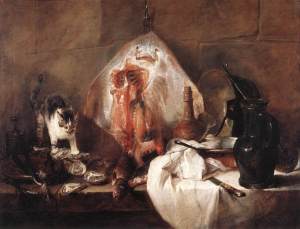
Jean-Siméon Chardin, "The Ray," 1728 (Paris: Louvre)
Sarah Cohen (History of Art, SUNY Albany), “Chardin’s Vitalist Still Lifes” — This paper addresses four paintings by Jean-Siméon Chardin that feature a calico cat marauding recently killed or butchered creatures within an array of objects laid out for the preparation of a human meal. Although Chardin drew generally from Flemish still life traditions, I argue that early vitalist theories of animal life offer a compelling means of assessing the action of his cats, who paw, snatch, and prepare to spring at the inanimate matter of their fallen fellow creatures. I propose that Chardin’s still lives are vitalist not through any direct link between the science and the art, but through a deeper commonality of aims and means: his cats show us, through their tactile explorations of animal
bodies, what it feels like to be alive.
◊ ◊ ◊ ◊ ◊
In addition, Cohen’s article, “Searching the Animal Psyche with Charles Le Brun,” will appear in a special issue of Annals of Science 76 (July 2010), dedicated to the representation of animals in the seventeenth century. The issue is edited by Domenico Bertoloni Meli and Anita Guerrini.










 Enfilade
leave a comment