The Prado Launches New Online Platform
◊ ◊ ◊ ◊ ◊
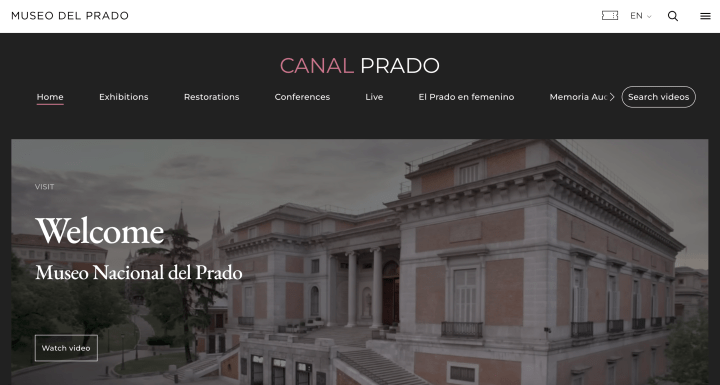
From the press release for the new platform Canal Prado. The social media clip with Michael Yonan is a perfect example of content that will now be easier to find!
The Museo Nacional del Prado has unveiled Canal Prado, a new online platform designed to gather and organize the institution’s growing library of audiovisual content. Accessible through the museum’s website, the channel brings together everything from interviews and lectures to educational videos and documentary-style features, offering visitors a new way to explore the Prado beyond the gallery walls. The launch represents a significant step in the museum’s digital strategy. For years, the Prado has produced a wide range of videos tied to exhibitions, research, and public programs. Canal Prado now places all of that material in one curated space, making it easier for audiences around the world to discover, revisit, and explore the museum’s knowledge resources. The platform emphasizes content that remains relevant over time—conversations about art, scholarship, and the enduring questions that paintings and artists continue to raise.
One of the highlights of the launch is “Thinking the Prado,” a new series created and presented by art historian Alejandro Vergara, who invites viewers to consider some of the fundamental questions that surround works of art. Why do we value certain paintings? What kind of knowledge can art offer us? How have artistic judgments changed over the centuries? And, in practical terms, how long does it actually take to paint a masterpiece? Rather than presenting quick answers, the series takes a reflective approach, encouraging viewers to think about art as historians and curators do. The goal is not to promote the museum’s latest exhibition, but to create a thoughtful, lasting resource for anyone curious about art history. Vergara, who has worked at the Prado since 1999, has played a key role in shaping the museum’s understanding of Flemish painting and Northern European schools, and has curated numerous exhibitions during his career. He holds a doctorate in art history from the Institute of Fine Arts at New York University and has taught at institutions including Columbia University and Universidad Carlos III in Madrid.
The new platform also integrates “Stories of Art,” the extensive audiovisual archive created by the Fundación Amigos del Museo del Prado. The archive includes more than 1,300 videos and audio recordings, documenting decades of lectures, courses, and cultural programming dedicated to the study of art. Many of these materials were originally produced for members and participants in the foundation’s educational initiatives.
Now, through Canal Prado, the public can explore collections such as:
• Courses on art history
• “Sundays at the Prado” lecture programs
• Educational series like “Art Lessons”
Together, these recordings represent more than forty years of intellectual life connected to the Prado, turning the platform into an evolving archive of art scholarship. To make such a large body of material easier to explore, Canal Prado organizes videos into clear thematic categories. Visitors can browse content based on their interests—whether that means restoration projects, exhibition insights, behind-the-scenes stories, or expert conversations. The platform will also highlight special thematic selections throughout the year. In March, for example, the focus is on material related to women connected to the Prado, from artists to scholars and historical figures. The museum plans to continue expanding the channel with new episodes, interviews, and original series, gradually building a rich audiovisual archive.
The launch of Canal Prado coincides with a broader update to the museum’s website through the Plataforma Prado digital initiative. Among the most notable improvements is a new semantic search engine that allows users to explore the museum’s information system more intuitively. Instead of searching only by titles or keywords, visitors can now navigate by connections such as:
• artists
• techniques
• themes
• places
• historical figures depicted in artworks
The redesign also includes improved mobile navigation, updated menus, and newly structured pages that make the site easier to use on smartphones and tablets. Another new feature allows visitors to revisit exhibition itineraries even after exhibitions have closed, preserving the educational value of past shows. With Canal Prado, the Prado continues expanding its presence beyond Madrid, transforming decades of lectures, scholarship, and research into a resource accessible worldwide. For art lovers, students, and researchers alike, the platform offers something rare: direct access to the voices and ideas that shape one of the world’s great museums.
Installation | Tradition and Celebration across the Jewish Calendar
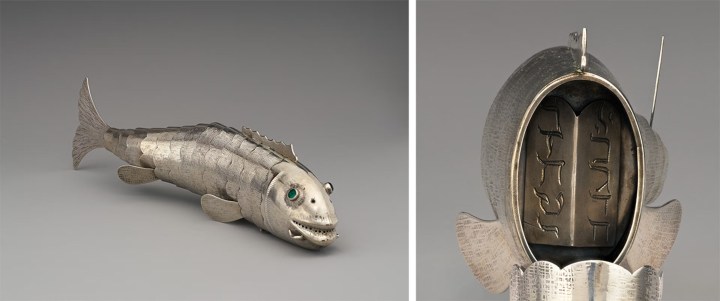
Fish-form Spice Container (Besamim), 1813, Vienna, silver, foil-backed glass, 8 × 34 × 7.6 cm, 450g
(New York: The Metropolitan Museum of Art, New York, 2025.104)
◊ ◊ ◊ ◊ ◊
Riva Arnold describes the seven works in this installation from The Met’s Department of European Sculpture and Decorative Arts:
Tradition and Celebration across the Jewish Calendar
The Metropolitan Museum of Art, New York, on view until 3 March 2026
Tucked within the galleries of the Department of European Sculpture and Decorative Arts (ESDA) is a special display of new acquisitions and objects that have never been on view before. The seven works in this temporary installation are part of a rotating exhibit of case studies organized by the department’s curators, fellows, and researchers. The current selection—on view until March 3, 2026—highlights craftsmanship, materials, and community celebrations from the Jewish populations of Austria, Italy, France, and the Netherlands between the sixteenth and nineteenth centuries.
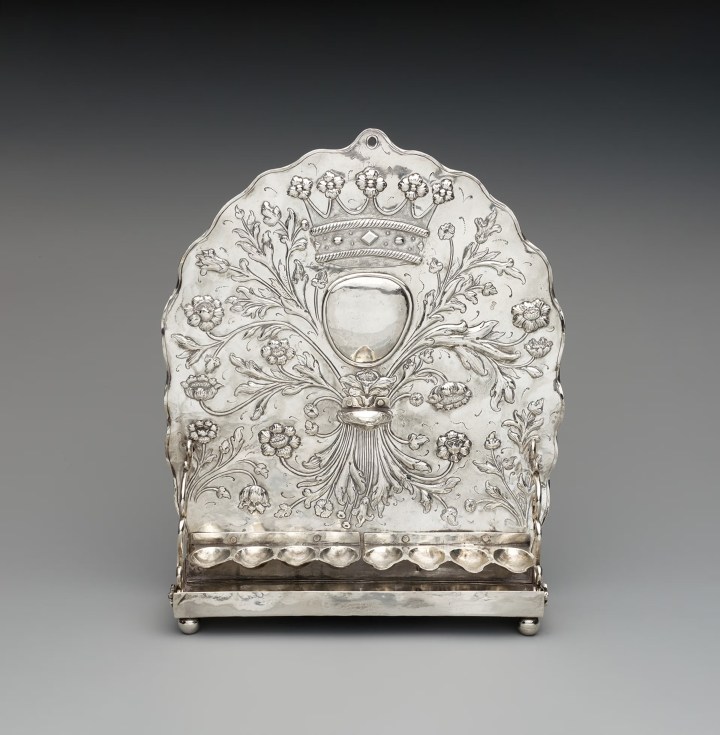
Johannes van der Lely, Hanukkah Lamp, 1706, Leeuwarden, silver, 31 × 26 cm (New York: The Metropolitan Museum of Art, 2025.585).
For over a decade, ESDA has been acquiring Judaica objects connected to Jewish life, culture, and religion. The selected items represent universal themes related to special days in the Jewish calendar, which follows a lunisolar cycle. This means that the days and months are based on the cycles of the moon, with each day beginning at sunset;[1] a leap month is added every few years to ensure that holidays are observed in their correct season. For example, Rosh Hashanah, associated with the new year, is celebrated in the fall, and Passover, associated with renewal, is in the spring.
Joyful holiday traditions and domestic milestones, such as the birth of a new baby or a wedding, kept communities together despite societal upheaval and economic fluctuations. Judaica produced in the Rococo or Baroque periods displayed extravagant decorative motifs typical of that era, with outstanding craftsmanship that evidences a material culture spanning metalwork, porcelain, leather, and enamel. . .
The full essay is available here»
The Frick Appoints Aaron Wile as John Updike Curator
From the press release:
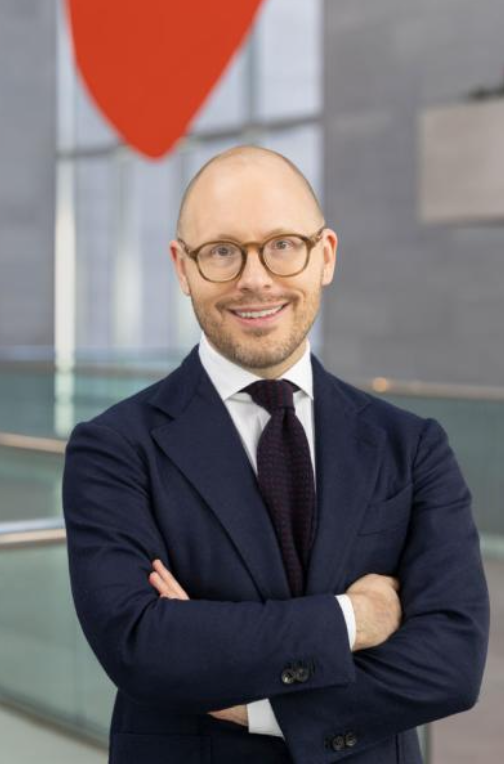 The Frick Collection announces the appointment of Dr. Aaron Wile as its new John Updike Curator. He will take up the post on 6 April 2026. In this senior curatorial role, Wile succeeds Dr. Aimee Ng, who became the museum’s Peter Jay Sharp Chief Curator last fall. Wile returns to the Frick having held a formative position as Anne L. Poulet Curatorial Fellow from 2014–16, during which he organized the acclaimed exhibition Watteau’s Soldiers: Scenes of Military Life in Eighteenth-Century France. For his work on the show’s catalogue, he received the 2017 Award for Outstanding Article, Essay, or Extended Catalogue Entry from the Association of Art Museum Curators—an appropriate accolade for his new position, which is named in memory of the American novelist, poet, and critic John Updike.
Since 2019, Wile has served as Associate Curator of French Paintings at the National Gallery of Art in Washington, D.C. In this position, he has co-curated innovative installations such as Back and Forth: Rozeal., Titian, Cezanne (2025). He also helped design the Department of French Painting’s first comprehensive collection plan; spearheaded acquisitions, particularly of works by women artists; cultivated donor and collector relationships; and contributed to cross-departmental initiatives related to reinstallations and the presentation of scholarship on digital platforms.
Commented Axel Rüger, the Frick’s Anna-Maria and Stephen Kellen Director, “We are excited for Aaron to contribute his expertise and experience in support of the Curatorial Department as its next chapter unfolds. He joins us at a remarkable time, as this April we celebrate one year since the museum’s historic reopening following the renovation and enhancement of our buildings.”
Added Aimee Ng, “Aaron brings a fresh perspective to the Frick’s collection, especially to its foundational holdings of French paintings. Since he served as a fellow over a decade ago, his curatorial and academic experiences have enhanced his considerable talents, and he returns to the museum with exceptional scholarly rigor, expert communication and interpretive skills, and seasoned and versatile professionalism. We could not be more thrilled to welcome Aaron back to the Frick as John Updike Curator.”
Prior to the National Gallery, Wile held a Postdoctoral Fellowship at the Society of Fellows in the Humanities at the University of Southern California (2017–19) and a Chester Dale Fellowship at The Metropolitan Museum of Art (2016–17). He earned a BA in History from Haverford College and an MA and PhD in the History of Art and Architecture from Harvard University, specializing in seventeenth- and eighteenth-century French art.
Esther Bell Named Next Director of the Clark Art Institute
From the press release (29 January 2026) from The Clark, with coverage in the The New York Times:
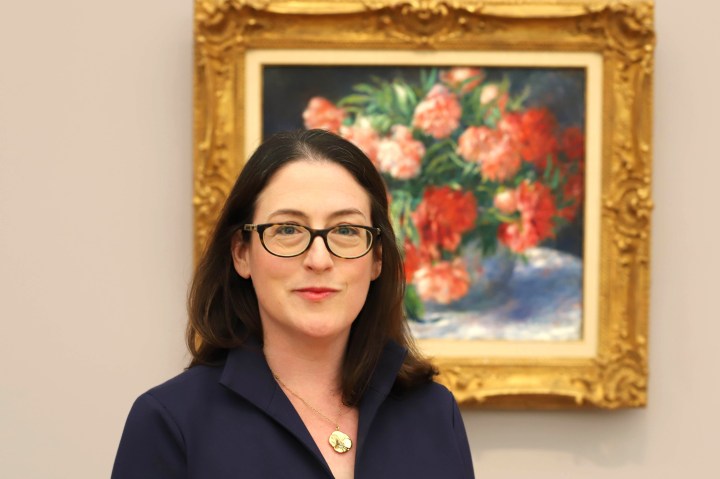 The Board of Trustees of the Clark Art Institute today announced the appointment of Esther Bell as the Institute’s Hardymon Director. Currently serving as the Clark’s Deputy Director and Robert and Martha Berman Lipp Chief Curator, Bell will become the Clark’s sixth director when she assumes her new role on July 1.
The Board unanimously elected Bell to the position following an extensive international search. Bell will be the first woman in the Clark’s seventy-year history to serve as its director. She succeeds Olivier Meslay, who announced last September that he would be leaving the Clark and returning to his native France in 2026.
“We are proud and deeply gratified to announce Esther Bell as our new director, based on her countless achievements at the Clark and a career of recognized excellence in the field,” said Denise Littlefield Sobel, chairman of the Institute’s Board of Trustees. “She is a consummate professional, a collaborative member of the Clark’s senior staff, and has honed her directorial acumen through sharp executive decision-making and a talent for forging close working relationships throughout the museum world. We look forward to her leading the Clark to even greater success in her new position.”
Of his successor, Meslay noted that “I first met Esther Bell in 2003 when she was pursuing a Fulbright Fellowship at the Musée du Louvre. I knew then that she was an exceptional art historian and I have watched her forge a brilliant career. I am delighted to know that the Clark’s next chapter will be entrusted to Esther’s exceedingly capable hands. She is a respected museum leader, an impressive scholar, and a passionate advocate for the arts. I congratulate Esther on her appointment and look forward to celebrating the continued growth and success she is sure to bring to the Clark.”
Bell is a key member of the Clark’s senior leadership team. In addition to leading the Institute’s curatorial staff and directing the care and growth of its collections, Bell oversees the work of the Clark’s library, its education and public programming teams, and its visitor services efforts. She also plays a central role in fulfilling the Clark’s commitment to visitor engagement, while representing the Clark on a number of community-based service organizations.
“I am honored by the opportunity to become the Clark’s Hardymon Director and extraordinarily inspired to imagine where we can take this beloved and celebrated institution in the years ahead,” said Bell. “With the support of my esteemed colleagues, I look forward to being a part of an exciting future for the Clark as we dedicate ourselves to ensuring that the Institute will always be a welcoming place of contemplation, inspiration, and education for all. As we continue to grow our campus and our collections, we recognize the significance of ensuring that we steward the Clark’s remarkable resources with care, consideration, and commitment to fulfill our mission of extending the public’s appreciation of art.”
Esther Bell joined the Clark’s staff in 2017 and was appointed Deputy Director in 2022. Her first engagement with the Institute came in 2001 when she came to Williamstown to pursue her Master’s degree in Williams College’s Graduate Program in the History of Art, which is jointly administered by and housed at the Clark.
In her time at the Clark, Bell has spearheaded the Institute’s embrace of a broader array of artists and genres, making ambitious acquisitions and encouraging critical scholarly research of the objects in the collection. Bell has been deeply involved in the Clark’s special exhibitions program and has organized several of its most important recent exhibitions, including:
• An Exquisite Eye: Introducing the Aso O. Tavitian Collection (13 June 2026 — 21 February 2027), celebrating the transformative gift to the Clark from the foundation of the late collector and connoisseur Aso O. Tavitian. The exhibition will present some 150 of the works recently added to the Clark’s permanent collection, including rare Renaissance and Early Modern masterpieces by artists including Jan Van Eyck, Andrea della Robbia, Gian Lorenzo Bernini, Peter Paul Rubens, Jean-Antoine Watteau, and Elizabeth Vigée-Lebrun. Bell played a central role in the Clark’s acquisition of the Tavitian gift and conceptualized this exhibition, curated along with Lara Yeager-Crasselt, the Clark’s newly appointed Aso O. Tavitian Curator of Early Modern European Painting and Sculpture.
• Guillaume Lethière (15 June — 14 October 2024), the first monographic exhibition ever presented on the Neoclassical artist. Forging new scholarship on an artist who played a central role in eighteenth and nineteenth century French art, the exhibition introduced Lethière’s work to contemporary audiences. Following its debut at the Clark, the exhibition traveled to Paris where it was presented at the Musée du Louvre, and is now on view at the Mémorial ACTe in Pointe-à-Pitre, Guadeloupe. Bell co-curated the exhibition at the Clark with Olivier Meslay and at the Louvre with Marie-Pierre Salé, chief curator in the Department of Drawings.
• Promenades on Paper: Eighteenth-Century French Drawings from the Bibliothèque Nationale de France (17 December 2022 — 12 March 2023), the first American presentation of works from the esteemed collection of France’s national library and the first public exhibition of many of the rare drawings in the library’s vast holdings. The exhibition was organized by the Clark in partnership with the Bibliothèque nationale de France, and was jointly curated by a Clark team including Bell, Sarah Grandin, the Clark-Getty Curatorial Fellow, and Anne Leonard, Manton Curator of Prints, Drawings, and Photographs, in collaboration with Corinne Le Bitouzé, Conservateur general, Pauline Chougnet, Conservateur en charge des dessins, and Chloé Perrot, Conservateur des bibliothèques, from the Bibliothèque nationale.
• Renoir: The Body, The Senses (8 June — 22 September 2019), the critically acclaimed exhibition was the first major exploration of Renoir’s unceasing interest in the human form. Bell and George T.M. Shackleford, deputy director of the Kimbell Art Museum, co-curated the exhibition and authored the accompanying catalogue. Following its premiere at the Clark, Renoir: The Body, The Senses traveled to Fort Worth for its presentation at the Kimbell.
Bell also played an integral role in the inaugural presentation of the Clark’s first outdoor exhibition, Ground/work (6 October 2020 — 17 October 2021) and its second iteration, which is currently on view until 12 October 2026 on the Clark’s 140-acre campus. Featuring monumental sculptural works, both presentations underscore the relationship between art and nature that are so central to the experience of the Clark.
In addition to her curatorial efforts, Bell was responsible for a major expansion of the Clark’s education and public programming activities, culminating in the 2025 establishment of its Division of Learning and Engagement. This project established a framework to more completely integrate the Clark’s educational activities, school and community outreach, and public programming initiatives in support of the Clark’s commitment to fostering meaningful engagements with art and nature. Bell regularly teaches courses in the Williams College/Clark Graduate Program in the History of Art and frequently lectures in the United States and Europe. She has co-edited and contributed to numerous scholarly exhibition catalogues.
Before joining the Clark, Bell served as the curator in charge of European paintings at the Fine Arts Museums of San Francisco, where she organized important exhibitions including Degas, Impressionism, and the Paris Millinery Trade and The Brothers Le Nain: Painters of Seventeenth-Century France. Prior to that, Bell was the curator of European paintings, drawings, and sculpture at the Cincinnati Art Museum. She began her career in New York, holding positions as a research assistant and curatorial fellow at both the Metropolitan Museum of Art and the Morgan Library & Museum.
Bell holds a doctorate in the history of art from the Institute of Fine Arts, New York University, with a specialization in seventeenth- and eighteenth-century European art. She earned a master’s degree from the Williams College/Clark Graduate Program in the History of Art, and a bachelor’s degree in the history of art from the University of Virginia. She completed a Fulbright Fellowship at the Musée du Louvre in 2003 and has held several other fellowships. In 2020, Bell completed a fellowship at the Center for Curatorial Leadership in New York. In 2015, Apollo magazine named her one of the top curators in North America under the age of forty. Bell is active in the Williamstown community and is a member of the boards of both the Williamstown Community Chest and the Williamstown Chamber of Commerce.
Russell Reynolds Associates, New York, coordinated the search for the Clark, working closely with a committee comprised of members of the Institute’s Board of Trustees.
The Clark Art Institute, located in the Berkshires of western Massachusetts, is one of a small number of institutions globally that is both an art museum and a center for research, critical discussion, and higher education in the visual arts. Opened in 1955, the Clark houses exceptional European and American paintings and sculpture, extensive collections of master prints and drawings, English silver, and early photography. Acting as convener through its Research and Academic Program, the Clark gathers an international community of scholars to participate in a lively program of conferences, colloquia, and workshops on topics of vital importance to the visual arts. The Clark library, consisting of nearly 300,000 volumes, is one of the nation’s premier art history libraries. The Clark also houses and co-sponsors the Williams College Graduate Program in the History of Art.
The Louvre Opens Renovated Galleries of Italian and Spanish Paintings
From the press release, via Art Daily and the American Friends of the Louvre:
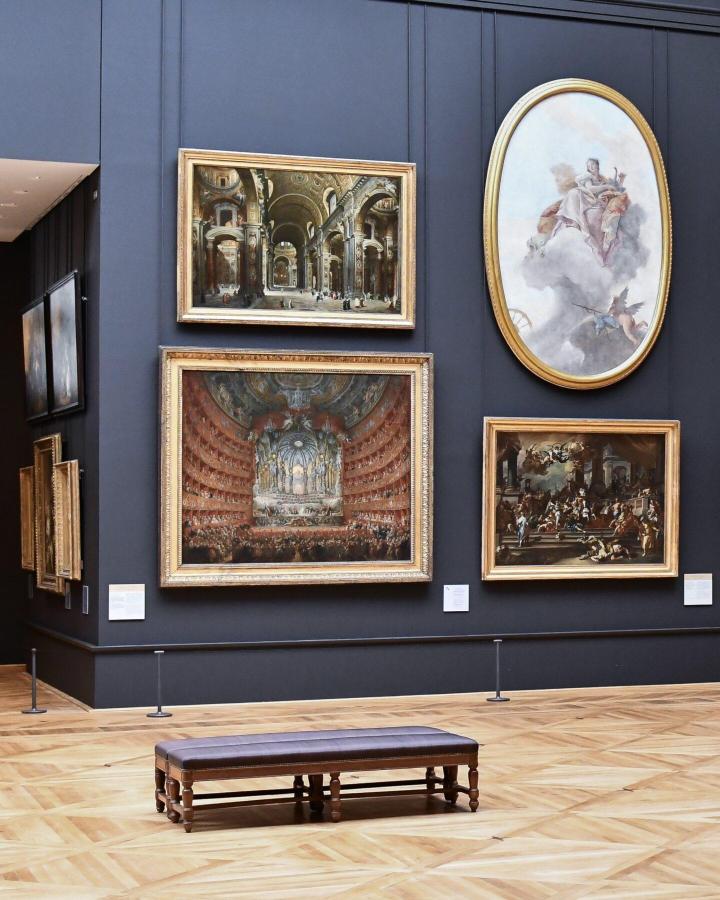 The Louvre has reopened its renovated galleries of Italian and Spanish painting from the 17th and 18th centuries, offering visitors a refreshed way to experience some of the museum’s most important works. After a year-long renovation, the galleries—located on the first floor of the Denon Wing—now feature a redesigned layout, updated lighting, newly painted walls, and improved interpretive materials that bring renewed clarity and depth to the collection.
The reopening marks more than a cosmetic update. It also reflects a major behind-the-scenes effort to reassess, conserve, and, in some cases, restore the paintings themselves. Many works had remained hung high on the walls since the galleries were first installed in 1999, limiting close inspection. During the renovation, each painting was examined, cleaned, and carefully evaluated for conservation needs. Several works benefited from substantial restoration campaigns, while frames and gilded surfaces were also treated by the Louvre’s specialist workshops. A new configuration of the Porte des Lions now provides faster access to these galleries, creating a more fluid connection between the Grande Galerie and the newly opened Gallery of the Five Continents on the ground floor.
Italian Painting: From Rome to Venice
In the Italian painting galleries, visitors can once again encounter works produced in Rome during the later 17th century, alongside paintings from Naples, Genoa, Florence, Milan, and Venice. Three canvases by Salvator Rosa introduce the Neapolitan school and lead into works by artists such as Luca Giordano, while the diversity of regional styles underscores the richness of Italian painting during this period.
The adjoining gallery dedicated to large-scale 18th-century works places Giambattista Piazzetta’s Assumption of the Virgin in dialogue with Giambattista Tiepolo’s Juno Amid the Clouds, acquired by the Louvre in 2020. Monumental canvases by Giovanni Paolo Panini complete the display, evoking the fascination that Rome exerted over artists and travelers across Europe.
Spanish Painting: From Devotion to Modernity
The first phase of the renovation of the Spanish painting galleries has also been completed, with a renewed focus on both conservation and interpretation. In the Murillo Gallery, restored monumental works from the 17th century return to view, including powerful scenes from the life of Saint Bonaventure by Francisco de Herrera the Elder and Francisco de Zurbarán. Their renewed color and scale reassert the dramatic impact these works once had in their original religious settings.
Beyond this space, the gallery devoted to Spanish painting from 1750 to 1850 highlights one of the Louvre’s greatest strengths: its collection of works by Francisco de Goya. Full-length portraits of Spanish aristocrats sit alongside more intimate images of figures close to the artist. The centerpiece remains Goya’s striking portrait of Ferdinand Guillemardet, painted in 1798 during the turbulent years of the French Republic. For the first time in this gallery, visitors can also encounter Goya’s engraved Disparates, whose unsettling imagery reveals a darker, more experimental side of the artist. These works offer a sharp contrast to his luminous portraits and expand the understanding of his technical and thematic range.
Looking Ahead
Not all works have yet returned to the walls. Murillo’s The Angels’ Kitchen, a monumental canvas currently undergoing major restoration, is expected to rejoin the galleries in autumn 2026. Further renovations are also planned: beginning in 2026, adjacent rooms will be refurbished to present Spanish and Portuguese paintings in smaller formats, spanning the 14th to the 19th centuries. With these renewed galleries, the Louvre offers visitors not only a refreshed visual experience, but also a deeper engagement with the history, materiality, and ongoing care of its collections—reminding audiences that museums are living institutions, constantly revisiting and rethinking the works they preserve.
The renovation was made possible through the generous support of the American Friends of the Louvre and the Sada Melo Family, in memory of Federico Sada González. Additional support was provided by Lionel and Ariane Sauvage and Naoma Tate.
The Prado Acquires Its First Sculpture by Luisa Roldán
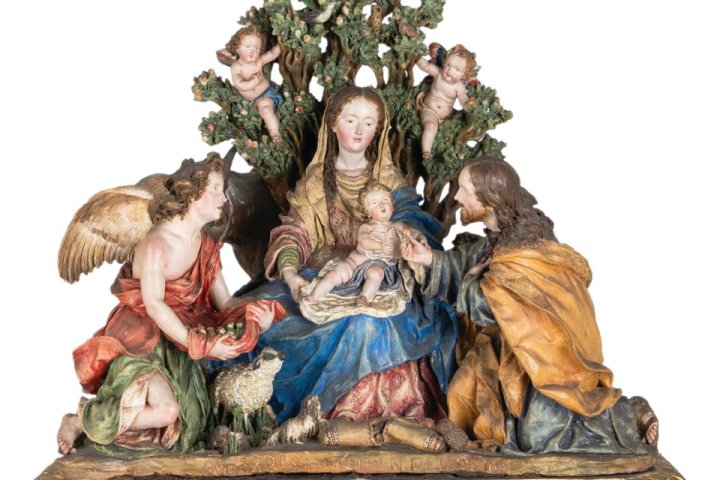
Luisa Roldán, The Rest on the Flight into Egypt, 1691, polychrome terracotta and wood
(Madrid: Museo Nacional del Prado)
◊ ◊ ◊ ◊ ◊
From the press release (18 December 2025) . . .
The Museo del Prado has taken an important step in reshaping the story of Spanish Baroque art with the acquisition of The Rest on the Flight into Egypt by Luisa Roldán, known as La Roldana. Signed and dated 1691, the sculpture marks the first time one of Roldán’s works enters the Prado’s collection—despite her name having long appeared on the museum’s façade alongside Spain’s great masters.
Luisa Roldán (1652–1706) was a remarkable figure in her time: the first woman to be appointed sculptor to the Spanish court, serving under both Charles II and Philip V. Yet, like many women artists of her era, her work has remained underrepresented in major museum collections. This newly acquired sculpture helps to correct that absence and brings her artistry into direct dialogue with the Prado’s holdings of Baroque painting and sculpture.
The work, made of polychrome terracotta and wood, depicts the Holy Family pausing to rest during their flight into Egypt. At first glance, the scene feels intimate and serene, but a closer look reveals Roldán’s extraordinary technical skill. The modeling is delicate and expressive, the gestures natural and carefully observed. The polychromy—exceptionally well preserved—adds warmth and immediacy, while details such as the tree framing the composition give the scene a quiet narrative depth.
The sculpture comes from the renowned Güell collection, long considered a reference point for Spanish sculpture, and was recently acquired at an Abalarte auction for €275,000. Purchased by Spain’s Ministry of Culture and assigned to the Prado, the piece now joins a collection that includes major devotional works by artists such as Gregorio Fernández, Pedro de Mena, Juan de Mesa, and Luis Salvador Carmona. Its arrival strengthens the Prado’s exploration of the relationship between sculpture and painting in Baroque Spain; Roldán’s work resonates with contemporaries such as Luca Giordano, whose paintings are already represented in the museum, highlighting shared interests in movement, emotion, and theatricality across artistic media.
Beyond its artistic importance, the acquisition carries symbolic weight. By welcoming Roldán’s sculpture into its galleries, the Museo del Prado publicly acknowledges the central role women artists played in shaping Spain’s artistic heritage. It is not simply a matter of adding one work to the collection, but of expanding the narrative of art history to better reflect its true complexity. With The Rest on the Flight into Egypt, Luisa Roldan finally takes her place inside the Prado—not just in name, but in substance—offering visitors a fuller, richer view of the Spanish Baroque and the artists who defined it.
Notre Dame’s Raclin Murphy Museum of Art Announces New Gift
From the press release (8 December 2025) . . .

Virgin Immaculata, 1730–33, Meissen Porcelain Manufactory, hard-paste porcelain, 8 inches high (South Bend: Raclin Murphy Museum of Art, University of Notre Dame, Virginia A. Marten Endowment for Decorative Art 2022.014).
The Raclin Murphy Museum of Art at the University of Notre Dame announces a major gift from the Marten Charitable Foundation through the stewardship of Gini Marten Hupfer, Foundation leader and member of the Museum’s Advisory Council. The tandem naming and endowment gift was inspired by the legacy of Virginia Marten (1925–2022), a long-standing, former member of the Advisory Council and devoted Museum supporter.
The gift will confer the name ‘Marten Family Gallery’ on the current east gallery of European Art before 1700. Works by Vicenzo Spisanelli, Claude Lorrain, Giuseppe Ribera, and Bartolomeo Veneto, among others, are featured in the gallery. With naming the gallery, a permanent feature, centered in the gallery, will be installed; to be called the ‘Marian Court’, it will be a permanent display featuring Marian imagery from the Raclin Murphy’s extensive holdings to honor Virginia Marten’s particular devotion to Mary, the Mother of Christ, and her love of art. Currently, images based on Marian iconography, ranging from paintings by Francesco Francia to Hans Memling to Giorgio Vasari, are highlighted in this space.
Complementing the named gallery, the second part of the gift establishes the Marten Family Endowment for Marian Art. The new endowment will provide support for research, conservation, acquisitions, interpretation, and programming to advance scholarship and appreciation of the traditions of Marian Art. A unique endowment to the institution, it underscores both the Museum’s and the University’s commitment to research and inquiry.
“This gift is meant to honor my sweet mother, Virginia Marten’s love for both Notre Dame, the Blessed Mother, and her passion for the arts. We believe we found the perfect space in which to do just that at the Raclin Murphy Museum of Art. I know my mother would be thrilled and humbled by this,” states Gini Marten Hupfer.
“The support of the Marten Family, beginning with Virginia and steadfastly followed by her children, is truly remarkable and inspiring,” states Joseph Antenucci Becherer, Director and Curator of Sculpture. “The Raclin Murphy Museum of Art and the University of Notre Dame are uniquely positioned to facilitate and celebrate the study and appreciation of Marian imagery, thus truly honoring the legacy of Virginia and her family. Their gift and endowment mark an exceptional moment when love, devotion, and scholarship converge.”
Columbia Museum of Art Receives Key Gift of New Hall Porcelain
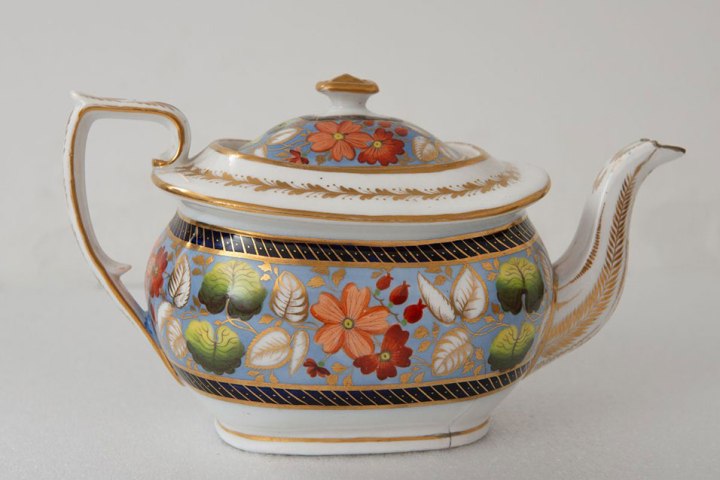
New Hall (manufacturer), British, active 1781–1835, teapot and lid, ca. 1812–19, bone china painted in enamels and gilt (Columbia Museum of Art, seventy-fifth anniversary acquisition, gift of the Joseph Bruce Collection of Georgian Porcelain, 2025.5.125a-b; photo by Drew Baron).
◊ ◊ ◊ ◊ ◊
From the press release:
The Columbia Museum of Art in South Carolina announced a major gift of the Joseph Bruce Collection of Georgian Porcelain, one of the most comprehensive private holdings of New Hall porcelain in the United States. The gift, made in celebration of the museum’s 75th anniversary, ultimately totals nearly 200 pieces, representing 58 patterns produced by New Hall between the late 18th and early 19th centuries.
Founded in 1781, New Hall was England’s first successful manufacturer of hard-paste porcelain. After decades of experimentation to replicate the prized porcelains of China, New Hall developed the first formula ideally suited for commercial production. Its early wares blended Chinese-inspired decoration with distinctly English shapes, reflecting a moment when global trade, shifting tastes, and advances in technology transformed English domestic life. The manufactory’s later bat-printed designs, many adapted from works by leading artists, link high art and mass production, making New Hall an essential chapter in British decorative arts and cultural history. Comparable collections of this depth are rare outside the United Kingdom, and no other museum in the United States holds a New Hall collection of this scale or significance.
“This extraordinary gift transforms how we can present the story of British decorative arts,” says CMA Senior Curator Michael Neumeister. “The Joseph Bruce Collection offers both depth and range, enabling visitors to experience the full evolution of New Hall porcelain in one place, an experience heretofore possible only at the Victoria & Albert Museum in London. It will be a touchstone for scholarship and a source of inspiration for years to come.”
The Joseph Bruce Collection charts the full aesthetic and technical evolution of New Hall porcelain, with carefully chosen examples illustrating major design phases, patterns, and innovations. Bruce, a CMA board trustee, has spent more than 40 years assembling this collection, beginning in New York with guidance from two major dealers of antique porcelain. He later acquired works through noted porcelain specialists in England, most notably Robert Hawker, through whom he acquired a number of pieces from the holdings of noted New Hall scholar Patricia Preller.
“New Hall porcelain has been my passion for decades,” says Bruce. “In its new home at the Columbia Museum of Art, I hope this collection will spark curiosity, inspire scholarship, and bring the beauty of Georgian England to life.”
In mid-January 2026, the CMA unveils all 20 newly refreshed galleries devoted to the CMA Collection. The Joseph Bruce Collection will be a highlight of a new British gallery, outfitted with period-correct wallpaper, furniture, and a newly conserved painting attributed to Benjamin Wilson, offering visitors an immersive late 18th- and early 19th-century experience.
“As we celebrate our 75th anniversary, we are absolutely thrilled to receive this spectacular gift, a shining example of how passionate collectors shape museum collections for generations to come,” says CMA Executive Director Della Watkins. “We are deeply grateful to Joseph for entrusting us with such a remarkable legacy, one that will inspire and delight our community and the world.”
Prado Honors Its Founding Queen, María Isabel, with Dedicated Gallery
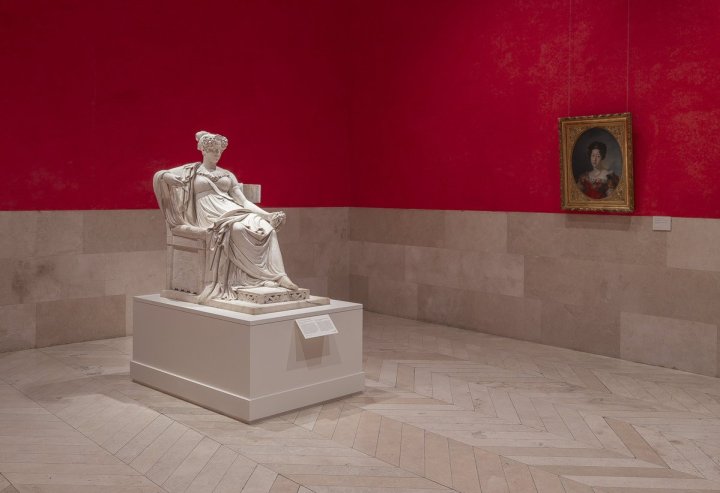
Gallery 54 of Museo Nacional del Prado with José Álvarez Cubero’s marble sculpture of Queen María Isabel de Braganza.
◊ ◊ ◊ ◊ ◊
From the press release:
The Museo Nacional del Prado has opened a new gallery that brings long-overdue attention to one of the most decisive yet often overlooked figures in its history: Queen María Isabel de Braganza. Gallery 54, inaugurated on 11 December 2025, is dedicated to the queen consort of Spain whose vision, influence, and personal commitment were instrumental in the creation of what would become one of the world’s great art museums.
María Isabel de Braganza (1797–1818), second wife of King Ferdinand VII, was deeply engaged with the arts at a time when royal patronage was crucial to cultural development. An honorary member of the Royal Academy of Fine Arts of San Fernando and an amateur painter herself, she championed the transformation of Juan de Villanueva’s unfinished building on the Paseo del Prado into the Royal Museum of Paintings and Sculptures. Although she died prematurely at the age of 21 and never saw the museum open in 1819, historical records—including funerary eulogies and a key annotation by Pedro de Madrazo in the museum’s 1854 catalogue—confirm her central role in the Prado’s foundation.
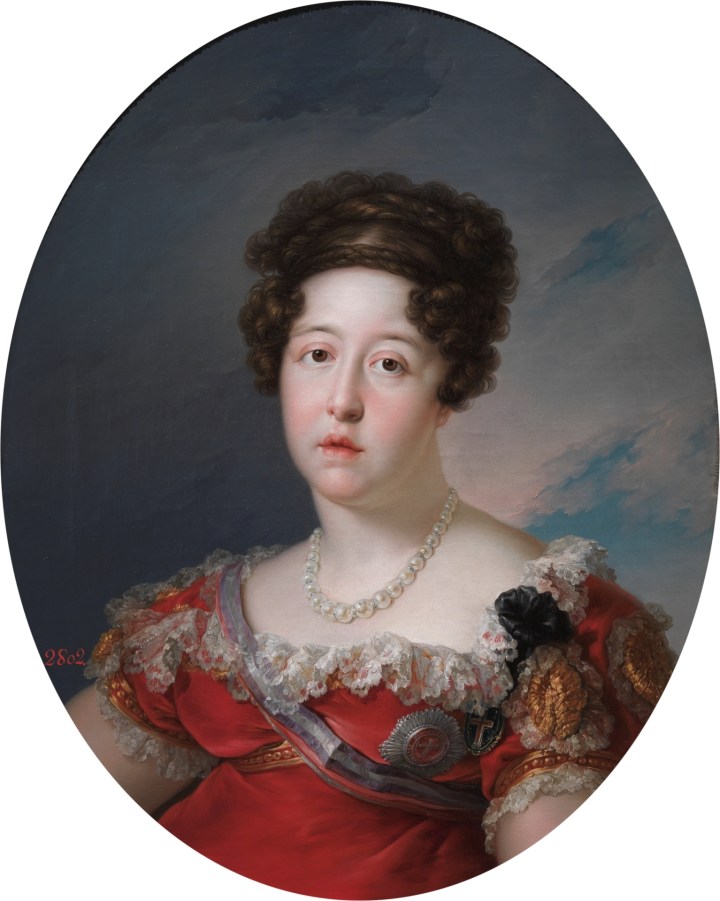
Vicente López Portaña, Queen María Isabel de Braganza, ca. 1816, oil on canvas (Madrid, Museo Nacional del Prado).
The newly inaugurated gallery presents a focused yet powerful tribute. At its core are two historic portraits that trace the construction of the queen’s image between tradition and modernity. The first, painted around 1816 by Vicente López Portaña shortly before her marriage, follows the Empire-style portrait conventions popularized by Joséphine Bonaparte: a bust-length composition, rich red dress, and pearl necklace. This image became the definitive likeness of the queen and later served as the model for Bernardo López’s depiction of her as the founding queen of the Prado.
The second work, a posthumous marble sculpture by José Álvarez Cubero completed between 1826 and 1827, presents Maria Isabel as a Roman matron. Drawing on classical models such as Agrippina and filtered through Neoclassical aesthetics associated with artists like Canova, the sculpture transforms the queen into a timeless symbol of civic virtue and cultural legacy.
Together, these works form the basis of a museographic narrative that positions María Isabel de Braganza not merely as a historical figure, but as a founder and patron whose personal wealth and determination helped shape the Prado’s identity. By dedicating Gallery 54 to her memory, the museum reinforces its commitment to telling its own institutional history—and to recognizing the individuals who made its existence possible. This new space invites visitors to reflect not only on the origins of the Prado, but also on the power of cultural vision, even when cut tragically short.
The Clark Names Lara Yeager-Crasselt as Tavitian Curator
From the press release (5 November 2025) . . .
 The Clark Art Institute, in Williamstown, Massachusetts, announced today that Lara Yeager-Crasselt has been appointed to serve as the first Aso O. Tavitian Curator of Early Modern European Painting and Sculpture.
Dr. Yeager-Crasselt is currently the Curator and Department Head of European Painting and Sculpture at the Baltimore Museum of Art, where she oversees the museum’s collection of fifteenth- through eighteenth-century painting and sculpture, including its research, exhibition, loans, acquisitions, and publication. Prior to her current role, she held prestigious curatorial and research positions at The Leiden Collection in New York and at KU Leuven, Belgium, among others. From 2015 until 2017, Yeager-Crasselt served as the Clark’s Interim Curator of Painting and Sculpture.
“We are delighted to welcome Lara Yeager-Crasselt back to the Clark and we feel incredibly fortunate to be able to entrust the Aso O. Tavitian Collection to her stewardship,” said Olivier Meslay, Hardymon Director of the Clark. “She is an ideal person to manage this collection, and we feel confident that Lara will play a major role in shaping the many ways in which we share these remarkable works of art with our visitors in the years ahead.”
Yeager-Crasselt’s curatorial experience includes a rich array of international exhibitions including Watershed: Transforming the Landscape in Early Modern Dutch Art (Baltimore Museum of Art); Exchanging Words: Women and Letters in Seventeenth-Century Dutch Genre Painting (Timken Museum of Art, San Diego); Rembrandt, Vermeer, and the Dutch Golden Age: Masterpieces of The Leiden Collection and the Musée du Louvre (Louvre Abu Dhabi); The Age of Rembrandt and Vermeer: Masterpieces of The Leiden Collection (Pushkin Museum, Moscow and The State Hermitage Museum, St. Petersburg, Russia), and Splendor, Myth, and Vision: Nudes from the Prado at the Clark.
“Lara is an exceptional scholar and curator and is well-regarded for her expertise in early modern painting and sculpture,” said Esther Bell, the Clark’s Deputy Director and Robert and Martha Berman Lipp Chief Curator. “Her deep knowledge and curatorial acumen will be a phenomenal addition to our team and will be so important to her research on the Tavitian Collection. Lara will also work with the Clark’s full collection of fifteenth- through eighteenth-century paintings and sculpture, and I know that her prior experience with our existing collection will be particularly important as she integrates this transformative gift and develops the plan for its installation in the new Aso O. Tavitian Wing. I look forward to collaborating with Lara on our summer 2026 exhibition An Exquisite Eye: Introducing the Tavitian Collection, which will provide the first opportunity for our visitors to see some of the magnificent treasures in the Tavitian Collection.”
An Exquisite Eye opens on 13 June 2026 and will showcase works by many of the most acclaimed artists of the early modern era—Jan van Eyck, Andrea della Robbia, Gian Lorenzo Bernini, Peter Paul Rubens, Jean-Antoine Watteau, and Jacques Louis David, among others. The exhibition will remain on view at the Clark through 21 February 2027.
The Aso O. Tavitian Collection was gifted to the Clark in 2024 from the foundation of the late collector, philanthropist, and connoisseur, Aso O. Tavitian. Between 2004 and 2020, Mr. Tavitian assembled the most significant private collection of European art assembled in North America in the twenty-first century. Representing one of the largest gifts in the Clark’s history, the Tavitian gift includes 331 works of art from Mr. Tavitian’s personal collection and more than $45 million to endow two new positions on the Clark’s curatorial staff to oversee the collection; provide necessary support for its long-term care; and fund construction of the Aso O. Tavitian Wing at the Clark, which is slated to open in 2028. The gift of art includes 132 paintings, 130 sculptures, thirty-nine drawings, and thirty decorative arts objects, creating an important addition to the Clark’s holdings and more than doubling the size of its sculpture collection.
“It is a tremendous honor to represent Aso O. Tavitian’s collection and his legacy at the Clark, as well as a great privilege and joy to be able to care for these extraordinary objects in my new role,” Yeager-Crasselt said. “I am truly thrilled to be returning to the Clark after these many years, and eager to join the team there in realizing the new Tavitian Wing and the first presentation of the collection this summer.”
In addition to her curatorial activity, Yeager-Crasselt has published widely on the art of the Netherlands, particularly its cross-cultural and artistic exchange with Italy, among which are studies on Michael Sweerts and François Duquesnoy. She is also a dedicated teacher, having taught art history to students at Johns Hopkins University, Baltimore; Vassar College; George Washington University, Washington, D.C., the University of Maryland, College Park; and The Catholic University of America, Washington, D.C. She holds a PhD in Art History from the University of Maryland and a bachelor of arts degree in History from Vassar College.
Yeager-Crasselt will begin work at the Clark in December 2025 and will immediately join the Institute’s cross-departmental team planning the construction of the Tavitian Wing. Designed by Selldorf Architects, New York City, the building project will get underway in early 2027 and will provide a permanent home for the Tavitian Collection.










 Enfilade
leave a comment