Online Talk | Gus Casely-Hayford on Crafting the New V&A East
From The Institute of Fine Arts:
Gus Casely-Hayford | Making a Museum: Crafting a New V&A for East London
Online, The Institute of Fine Arts, New York University, 21 March 2022, 2pm ET
 The Institute of Fine Arts invites you to a lecture by Dr. Gus Casely-Hayford, Director of the V&A East, a new museum and collection center in London. This virtual program takes place on Monday, 21 March 2022, at 2pm (Eastern Time).
Advanced registration is required–and available here.
A curator and historian who writes, lectures, and broadcasts widely on culture, Dr Gus Casely-Hayford, OBE, Prof by Practice, SOAS, University of London (the leading Higher Education institution in Europe specializing in the study of Asia, Africa, and the Near and Middle East), is the founding Director of V&A East, a museum and collection center presently under construction. He was previously the Director of the Smithsonian National Museum of African Art.
Over the course of his career, Casely-Hayford has been a constant champion for the arts. He has presented two television series of The Lost Kingdoms of Africa for the BBC (and wrote the companion book), two television series of Tate Britain: Great Art Walks for Sky, and has worked for every major British TV channel. His TED talk on Islamic culture has been viewed more than a million times. Former Executive Director of Arts Strategy, Arts Council England (Britain’s major arts funder) and ex-Director of the Institute of International Contemporary Art, he has offered leadership to both large and medium scale organizations. Dr Casely-Hayford has lectured widely on art and culture, including periods at Sotheby’s Institute, Goldsmiths, Birkbeck, City University, University of Westminster, and SOAS. He has advised national and international bodies on heritage and culture including the United Nations and the Canadian, Dutch, and Norwegian Arts Councils. In 2005 he deployed these leadership, curatorial, fundraising, and communications skills to organize the biggest celebration of Africa Britain has ever hosted with Africa 2005 when more than 150 organizations put on over 1000 exhibitions and events to showcase African culture.
Amongst a range of honors, he has been awarded a King’s College cultural fellowship for service to the arts and a SOAS Honorary Fellowship for service to Africa. He speaks widely, gave a SOAS Centenary lecture, judged the Art Fund’s British Museum of the Year award, advised the Royal Shakespeare Company on their production of Hamlet, and is a member of English Heritage’s ‘Blue Plaques Group’.
This program is made possible with generous funding from the Paul Lott Lectureship.

Internal render view of the central public collection hall in new V&A East Storehouse at Here East, designed by Diller Scofidio + Renfro. © Diller Scofidio + Renfro, 2018.
◊ ◊ ◊ ◊ ◊
From the V&A:
One of the world’s most significant new museum projects, V&A East will comprise two sister sites currently under construction in Queen Elizabeth Olympic Park, London. Opening at Here East in 2024, V&A East Storehouse offers a new immersive experience, taking visitors behind the scenes and providing unprecedented public access to V&A collections. A short walk across the park, opening in 2025, V&A East Museum celebrates global creativity and making relevant to today’s world. Both sites are part of East Bank, the Mayor of London’s £1.1 billion Olympic legacy project, which will create a new arts, innovation and education hub in Stratford’s Queen Elizabeth Olympic Park. . . .
Additional information is available here»
The Met Acquires Painting by Poussin on Copper
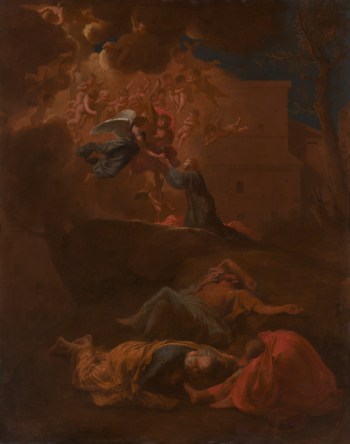
Nicolas Poussin, The Agony in the Garden, 1626–27, oil on copper, 61 × 49 cm (New York: The Met, Gift of Jon and Barbara Landau, in honor of Keith Christiansen, 2021.378).
As reported by Art News (20 January 2022), The Met has recently acquired an exceptional work by Poussin on copper: Agony in the Garden (1626–27), from the collection of Barbara and Jon Landau, one of only two settled works on copper by the painter. As David Pullins notes in his catalogue entry for the piece, this is early Poussin when the artist was still working out his place within line-and-color debates, guided here particularly by the Venetian legacies of Titian and Tintoretto. The painting caught the attention of some of the most artistically attuned visitors to Rome in the seventeenth and eighteenth centuries, including the Swedish diplomat count Nicodemus Tessin; the secretary to Rome’s Accademia di San Luca, Giuseppe Ghezzi; and the director of the Académie de France à Rome, Nicolas Vleughels. The eighteenth- and nineteenth-century provenance is also interesting as the painting moved from Rome to Paris, and then on to London through the American artist John Trumbull (it was part of the Trumbull sale at Christie’s in 1797). That said, the work was—as noted in the press release—rediscovered only in 1985, when it was “heralded as a major addition to Poussin’s corpus.” –CH
IDEAL Internship Grants from Decorative Arts Trust

Hermann-Grima House parlor and dining room, 1831
New Orleans
◊ ◊ ◊ ◊ ◊
From the press release (22 December 2021) . . .
The Decorative Arts Trust announces that four organizations will receive IDEAL Internship Grants for 2022: Drexel’s Lenfest Center for Cultural Partnerships/Atwater Kent Collection and the Museum of the American Revolution in Philadelphia, the Hermann-Grima + Gallier Historic Houses in New Orleans, and the High Museum of Art in Atlanta.
The primary objective of the IDEAL Internship program is to improve access to curatorial careers and mentorship for students of color as a path toward achieving comprehensive change in the museum field. The partners were selected based on the likely impact of the internships, which offer students consequential experience and stipends while providing the host organizations valuable contributions to curatorial projects and to meaningful discussions about inclusion, diversity, and equity.
• Drexel’s Lenfest Center for Cultural Partnerships will receive a second year of internship funding to hire an undergraduate student to assist with the development of two exhibitions highlighting objects from the Atwater Kent Collection.
• The Hermann-Grima + Gallier Historic Houses is creating a year-long internship for a local college student that will focus on the collection at the 1831 Hermann-Grima House, seeking narratives of invisible labor in fine and decorative arts as well as architectural elements to enhance the organization’s successful Urban Enslavement Tours.
• The High Museum will hire a summer intern to develop a gallery rotation after researching objects, rethinking narratives, and drafting labels while also generating a public outreach initiative through a gallery tour, social media campaign, or hosted event.
• The Museum of the American Revolution aims to hire a summer intern to increase awareness of the diverse communities that contributed to the Revolution through research into the permanent collection.
Visit each institution’s website and follow them on social media for updates about internship opportunities. The Trust is committed to offering IDEAL Internship funding in the coming years; visit the Trust’s website for more information.
NGS Acquires Rare Watercolour of a Black Milkmaid by David Allan
From the press release (18 November 2021), via Art Daily:
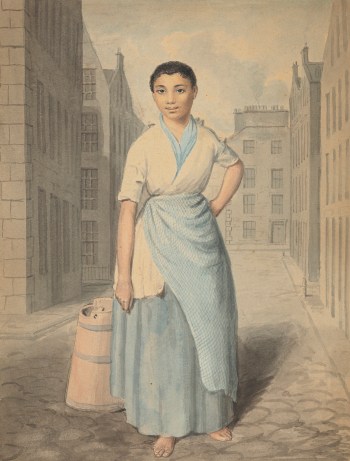
David Allan, Edinburgh Milkmaid with Butter Churn, ca. 1785–95, watercolour on paper, image size: 21 × 16 cm (Edinburgh: National Galleries of Scotland, D 5721, purchased 2019).
One of the earliest known images of a Black person by a Scottish artist has been acquired by the National Galleries of Scotland. Edinburgh Milkmaid with Butter Churn by David Allan (1744–1796) is a beautifully painted watercolour, which is both exceptionally rare and striking. It depicts a Black woman alone and centre stage at a time when Black sitters more often appeared as marginal or subservient figures in group portraits.
Looking directly at the viewer, the woman is shown in working dress, going about her daily duties and set against the backdrop of an elegant Edinburgh street. Her name and life story is unknown, but it is likely that she was a servant, a milkmaid, as suggested by the large vessel or butter churn shown beside her.
Modest in scale, the image is dated to the mid-1780s to early 1790s, a period when Allan created evocative drawings of ordinary people going about their daily lives in Edinburgh, such as soldiers, coalmen, fishwives, sedan chair porters, firemen, and officers of the city guard. These works, known as Allan’s ‘Edinburgh Characters’, suggest a background context for Edinburgh Milkmaid with Butter Churn, but they are generally sketched in a summary way, intended to capture character types, rather than specific personalities, and were often copied and duplicated. The Edinburgh Milkmaid, however, is highly detailed, precisely painted, and clearly a portrait of a specific person. It is hoped that further research may reveal more about the connection between the artist and the young woman and shed some light on her identity.
Director of European and Scottish Art at the National Galleries of Scotland, Christopher Baker, commented: “We are so pleased to bring this remarkable, rare, and extraordinary watercolour into Scotland’s national collection. It is an incredibly striking and special work, one which we believe will be enjoyed by many and, we hope, lead to new research on its background and most importantly the story of the woman depicted.”
Born in Alloa, David Allan was arguably the first Scottish artist to take contemporary life and customs from across the social hierarchy as a subject worthy of art. With the support of his patrons, Lord and Lady Cathcart of Shaw Park, near Alloa, he travelled to Italy around 1767 and remained there for a decade, painting historical pictures and portraits. He became interested in drawing scenes of street life, inspired by the popular print tradition of depicting street criers who called out to advertise their produce or trades. He sketched street vendors, aristocrats on the Grand Tour, coffee house scenes, dances, carnivals, and local costume in Rome and Naples and on a visit to the islands of Procida, Ischia, and Minorca.
These experiences led Allan to take a similar approach after his return to Scotland in 1779. He drew his subject matter from contemporary life, ranging from specific events such as The Ceremony of Laying the Foundation Stone of the New College of Edinburgh (1789) to timeless traditions and customs, such as A Highland Dance and The Penny Wedding. In 1786 Allan was appointed to a teaching post as Master of the Trustees’ Academy and he settled permanently in Edinburgh. The city and its inhabitants became a particular focus for this work. From about 1788 he developed the series of over twenty drawings of workers and traders; often referred to as his ‘Edinburgh Characters’, they typically show an individual or pair of figures with the tools of their trade, set against a simple architectural or rural background.
Allan’s subjects range from higher status figures, such as a Highland officer in uniform and officers of the Town Guard, to those who did the city’s heavy labour, such as the coalmen, chimney sweeps, porters, and water carriers. Female workers are represented by a fishwife, a salt vendor, and a lacemaker. The figures are drawn with strong outlines in ink to enable them to be traced easily, as Allan made multiple versions of his character drawings, several of which are held in the National Galleries of Scotland collection. He also reproduced his Edinburgh characters on a smaller scale as the cast that populate his landscape views of the Royal Mile, such as High Street from the Netherbow, made in 1793. Seen as a group, Allan’s street characters give a broad and fascinating insight into late 1780s Edinburgh as a living, working city.
Edinburgh Milkmaid with Butter Churn is one of several notable acquisitions highlighted in the recently published NGS Annual Review, covering the years 2019–2021. The painting will go on display at a later date following some conservation work, which is currently being prepared. With much still unknown about the painting, the Galleries would welcome information, comments, or feedback about it.
Nationalmuseum Sweden Acquires Gold Box, Gifted by Gustav III

Gold box à deux couleurs, unknown maker, Hanau; guilloché and chased gold in two shades, diamonds, enamel; portrait of Gustav III by Johan Georg Henrichsen, ca. 1778 (Stockholm: Nationalmuseum, NMB 2799). The box sold at Sotheby’s in London on 10 November 2021 as part of the Gold Boxes, Silver and Ceramics sale (Lot 10).
◊ ◊ ◊ ◊ ◊
Press release (8 December 2021) from Sweden’s Nationalmuseum in Stockholm:
Nationalmuseum has acquired a unique gold box bearing a portrait by the court enameller, Johan Georg Henrichsen, of King Gustav III. The box was given by the king as a gift to John Mackenzie, a Scottish officer, when he retired from the Swedish army in 1778. Very few such tokens of royal favour have survived intact, which is what makes this gold box unique.
Jewel-encrusted portraits of the monarch were the most prestigious token of appreciation. The tradition developed at the French court in the 17th century and soon became a model for other European royal houses of the time. These portraits might take the form of a pendant or be mounted in a jewelled setting on the lid of a gold box. Queen Kristina was the first Swedish monarch to adopt this French fashion, which then flourished in the 18th century. Gustav III frequently handed out gold boxes as a sign of royal favour. Contemporary historical sources show that the king took a great personal interest in the design and gave detailed instructions. Sometimes the decoration consisted of his monogram in diamonds, and in other cases his portrait was framed with jewels.
Various specialist craftsmen collaborated to create the boxes. A silversmith would first produce the basic gold box, which would then be decorated by an engraver and adorned with gemstones by a jeweller. A miniaturist then added the portrait, while the case was produced by another specialist, often a bookbinder. There were practitioners of all these crafts in Gustavian Stockholm, but sometimes boxes were imported from Russia, Saxony or France. The gold box in question was made in Hanau, in the present-day German state of Hessen. It is oval in shape and is decorated with a guilloché (engine-turned) wave and circle pattern within a chased (embossed) border. It is also executed à deux couleurs: in a combination of two different gold alloys to produce colour variations. After the box reached Stockholm, the king’s portrait was set on the lid in a frame of diamonds with trailing vines.
The portrait is the work of Johan Georg Henrichsen (1707–1779), the last person in Sweden to hold the position of court enameller, to which he was appointed in 1773. He worked exclusively from originals in pastel or oil created by other artists such as Gustaf Lundberg or, in this case, Lorens Pasch the Younger. The colour palette was often intense, combined with clear use of pointillism. A lesser-known fact is that Henrichsen also produced coats of arms for patents of nobility, painted on parchment using miniature techniques.
The recipient of the gift was a Scottish adventurer: John Mackenzie, Lord Macleod, 4th Earl of Cromartie (1726–1789). He had been loyal to Charles Edward Stuart (Bonnie Prince Charlie), the Young Pretender, and was held prisoner after the British army defeated the Jacobites at the battle of Culloden in 1746. Two years later he was pardoned, but the family had its estates confiscated. In 1750 John Mackenzie joined the Swedish army, ending up as colonel of the Björneborg regiment.
“Mackenzie returned to Britain in 1778, having been granted a full amnesty, and had his estates restored. On the occasion of his departure from Sweden, he received this gold box from King Gustav III. It is one of the very few surviving examples from the time and will soon be on display in Nationalmuseum’s Treasury alongside a miniature portrait of Mackenzie,” explained Magnus Olausson, director of collections at Nationalmuseum.
Nationalmuseum receives no state funds with which to acquire design, applied art and artwork; instead the collections are enriched through donations and gifts from private foundations and trusts. The acquisition has been made possible by a generous donation from the Anna and Hjalmar Wicander Foundation.
Emma’s Songbooks: Rediscovered Music for Nelson

Songbook once owned by Lady Hamilton, which has a cantata composed by G.G. Ferrari and dedicated to Lord Nelson
(Museum of London, 31.17/2)
◊ ◊ ◊ ◊ ◊
From the Museum of London:
Emma’s Songbooks: Rediscovered Music for Nelson
Online, Museum of London Docklands, recording available 21 December 2021 — 11 January 2022
In partnership with the Guildhall School of Music & Drama, the Museum of London Docklands brings to life songs dedicated to Horatio Nelson’s naval victories, recently rediscovered in Emma Hamilton’s songbooks by Museum of London librarian Lluis Tembleque Terés. Terés kicks off the event with a presentation on his finds and their historical context, after which Christopher Suckling, Head of Historical Performance at the Guildhall School of Music & Drama, will give an insight onto the music world at the beginning of the 19th century. Following the talks, performers from the School will play the four rediscovered pieces, along with a number of other relevant scores. Finally, Terés will show items from the Museum collections connected to Lady Hamilton and Lord Nelson—all in the immersive surroundings of the Museum of London Docklands.
Please note that this will be a recording of the live event, which took place on December 11. You will have seven days to access the recording from the date you select as part of the ticket purchase process.

Songbook once owned by Emma Hamilton, here shown by Museum of London librarian Lluis Tembleque Terés
(Museum of London, 31.17/2; photo by John Chase)
◊ ◊ ◊ ◊ ◊
From the press release (via Art Daily) . . .
A recording of an old sea song, one of four recently rediscovered pieces of music paying tribute to Nelson, has been released today by the Museum of London. Brought to life by musicians from Guildhall School of Music & Drama, it marks the first performance of the piece in over 200 years. The extraordinary discovery was made last year by Museum of London librarian Lluis Tembleque Teres who discovered it amongst songbooks belonging to Nelson’s lover, the actress and model Emma Hamilton.
It is thought the song was sung after the battle of Cape St Vincent (1797) and transcribed by Nelson after hearing it chanted by his crew. The lyrics have been known about since a letter from Nelson to William Douglas, 4th Duke of Queensberry, was sold at auction in 2013—the only other known reference to the song. The new discovery points to the addition of new music and a chorus by the Duke, a notorious society figure, whose reputation for gambling and horse racing has long overshadowed his musical ability. A personal friend of Emma Hamilton, his authorship of the piece is recorded in Emma’s own hand.
Lluis Tembleque Teres, librarian, Museum of London, said, “The song was written by Nelson’s crew in one of his early victories. It is fascinating how, some four years later and already a national hero, he recovers the lyrics and sends them to the Duke of Queensberry, almost as if showing off his early successes. The Duke then adds music and a chorus, and gifts the manuscript to Emma Hamilton, thus allowing us exactly 220 years later to relive Nelson’s fame while performing it.”
Dr Christopher Suckling, Head of Historical Performance at the Guildhall School of Music & Drama, said, “Equally as extraordinary is that a man of the Duke of Queensberry’s position should take the time and take the effort to compose at least two pieces of music in Nelson’s honour. That he should choose to express himself through this least gentlemanly of arts speaks to both his strength of feeling for Nelson and his sensibility towards the Admiral’s relationship with Emma Hamilton.”
The original manuscripts reflect the different manner in which music was experienced at the turn of the nineteenth century, its empty staves typical of a time when music could be played by any combination of available musicians. Amongst the upper classes, the function of domestic music was largely seen as a way to kill time and despite some contemporaries considering social music making to be the embodiment of morality, playing and composing was not held in high regard.
The release follows a special one-off live performance of all four songs at the Museum of London Docklands on 11th December, which will be available to watch in full as an online event starting Tuesday, 21 December 2021.
A free copy of the sea song is available for download here»
The Decorative Arts Trust Announces Failey Grant Recipients
From the press release (1 December 2021) . . .
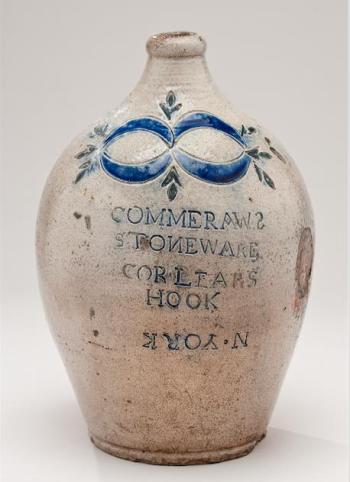
Thomas W. Commeraw, Jug, ca. 1796–1819, stoneware and cobalt oxide. Impressed on front: “COMMERAW’S/STONEWARE / CORLEARS / HOOK / N. YORK” (New-York Historical Society, 1937.820).
The Decorative Arts Trust congratulates author Caitlin Meehye Beach, Historic Rock Ford, and the New-York Historical Society on receiving Failey Grants. The Failey Grant program provides $25,000 in support for noteworthy research, exhibition, publication, and conservation projects through the Dean F. Failey Fund, named in honor of the Trust’s late Governor. Preference is given to projects that employ or are led by emerging professionals in the museum field.
Caitlin Meehye Beach, an assistant professor in the Department of Art History and affiliated faculty in the Department of African and African American Studies at Fordham University, will utilize grant funds for her forthcoming book Sculpture at the Ends of Slavery, which will be published by the University of California Press in 2022. The text will examine how a wide range of works of sculpture and decorative art—from antislavery medallions to statues of bondspeople bearing broken chains—gave visual form to narratives about abolition in the 18th and 19th centuries.
Historic Rock Ford in Lancaster, Pennsylvania, will use grant funding for further research and interpretation of the over 200 objects in their John J. Snyder, Jr. Gallery of Early Lancaster County Decorative Arts. Their goal is to uncover more about the shops, apprentices, laborers, indentured laborers, and enslaved workers who contributed to the Gallery’s collection of furniture, silver, clocks, and paintings from the mid-1700s to the early 1800s.
The New-York Historical Society receives grant funding for the groundbreaking exhibition Crafting Freedom: Uncovering the Life and Legacy of Free Black Potter Thomas Commeraw, to be presented January to June 2023 in their Pam & Scott Schafler Gallery. Crafting Freedom will be the first exhibition focused solely on Commeraw, a free Black craftsman descended from enslaved people, who was active as a master potter from the 1790s through 1819.
The Decorative Arts Trust is a non-profit membership organization that promotes and fosters the appreciation and study of the decorative arts through exchanging information through domestic and international programming; collaborating and partnering with museums and preservation organizations; and underwriting internships, research grants, and scholarships for graduate students and young professionals.
The Snite Receives Long-Term Loans of Spanish Colonial Art
From the press release (26 October 2021) . . .

Unidentified artist, Virgin of the Immaculate Conception with Saints, Angels, and Indigenous Donor, 18th century, oil and gold on canvas (Carl & Marilynn Thoma Art Foundation; photo by Jamie Stukenberg).
The Snite Museum of Art at the University of Notre Dame installed recent loans from the internationally renowned Carl & Marilynn Thoma Art Foundation. Three paintings dating from the seventeenth and eighteenth centuries, drawn from the Foundation’s extraordinary holdings, complement the Museum’s existing collection of Spanish Colonial works to expand our understanding of the period.
This new loan follows an earlier one from the Thoma Foundation of thirteen works that were shown in the 2020 exhibition Divine Illusions: Statue Paintings from Spanish Colonial Peru, organized by Professor Michael Schreffler of the University of Notre Dame’s Department of Art, Art History & Design. In 2023 When the new Raclin Murphy Museum of Art debuts in 2023, the University will receive five different works from the Foundation to replace the three currently exhibited. Those loans are slated to extend through 2026.
“The Thoma family have become very good, trusted friends of the Museum. It is an honor to host masterpieces from their extensive collection that can be appreciated, studied, and nourish us all,” said Joseph Antenucci Becherer, director of the Snite Museum of Art.
“The paintings on loan from the Thoma Art Foundation are windows into a fascinating world of social interaction and Christian devotion in Spanish Colonial South America. Our students and all visitors to the Snite will benefit from the unique opportunity to study and reflect on these visually compelling works of religious art” notes Michael Schreffler, Professor of Art History at the University of Notre Dame.
Most paintings from colonial South America are unsigned. However, a few artists did sign their works, enabling experts to attribute unsigned works to their hands. One such known artist is Gregorio Vásquez de Arce y Ceballos (1638–1711), whose oeuvre is considerable. His Allegory of the Eucharist, which was probably based on an engraving, portrays the Catholic doctrine of transubstantiation in which the bread and wine of the Eucharist is transformed into the body and blood of Christ.
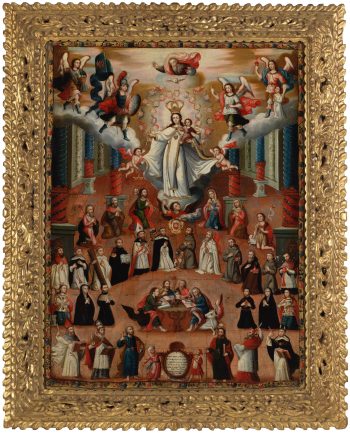
Cipriano de Toledo y Gutiérrez, Our Lady of Mercy with Saints, 1764, oil and gold on canvas (Carl & Marilynn Thoma Art Foundation; photo by Jamie Stukenberg).
This painting of the Virgin of the Immaculate Conception (depicted above) follows the traditional iconography of the central figure by showing the Virgin clothed in a white tunic covered by a blue mantle. Satan, as a serpent with a human face, lies vanquished on the ground. At the top of the canvas are the four Evangelists—Saints Matthew, Mark, Luke, and John—shown holding ribbons inscribed with four of the symbols of the Virgin’s immaculacy: the Tower of David, the Temple of Solomon, the City of God, and the Spotless Mirror. She is accompanied by a variety of saints. At lower right is a portrait of the donor, an indigenous woman who must have been a member of an important clan.
In 1997, the Thoma Foundation acquired a version of this subject, Our Lady of Mercy with Saints, that was dated 1771, but bore no signature. More recently, another version of the subject from 1764 was acquired by the Foundation. That painting, like yet another painting in a French private collection, is signed by Cipriano de Toledo y Gutiérrez. The existence of the three nearly identical paintings—with others possibly extant—tell us a great deal about the workshop practices of Cuzco painters. Although much has been written about works created for the art market, two of these three works were clearly commissioned by devotees of Our Lady of Mercy and the Mercedarian order. This multifigured composition may well have been based on an engraving.
New Book | The Best Address in Town: Henrietta Street
From Four Courts Press:
Melanie Hayes, The Best Address in Town: Henrietta Street, Dublin and Its First Residents, 1720–80 (Dublin: Four Courts Press, 2021), 312 pages, ISBN: 978-1846828478, €30 / $40.
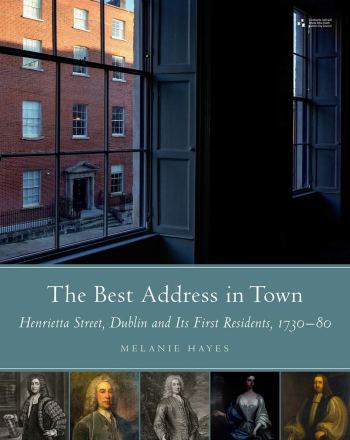 Once Dublin’s most exclusive residential street, Henrietta Street was, throughout the eighteenth century, home to the country’s foremost figures from church, military, and state. Here, in this elegant setting on the north side of the city, peers rubbed shoulders with property tycoons, clerics consorted with social climbers, and celebrated military men mixed with the leading lights of the capital’s beau monde, establishing one the principle arenas of elite power in Georgian Ireland. Looking behind the red-brick facades of the once-grand Georgian town houses, this richly illustrated volume—commissioned by Dublin City Council Heritage Office in conjunction with the 14 Henrietta Street museum—focuses on the people who originally populated these spaces, delineating the rich social and architectural history of Henrietta Street during the first fifty years of its existence. By weaving the fascinating and often colourful histories of the original residents around the framework of the buildings, in repopulating the houses with their original occupants, and by offering a window into the lives carried on within, this book presents a captivating portrait of Dublin’s premier Georgian street, when it was the best address in town.
Melanie Hayes is an architectural historian, specialising in Ireland’s eighteenth-century architectural and social history. She was an academic researcher during the development of the 14 Henrietta Street museum by Dublin City Council, and continues to be involved with the museum. Melanie currently works as a research fellow on an Irish Research Council laureate project, CRAFTVALUE, at Trinity College Dublin, exploring a new skills-based perspective on the architecture of Britain and Ireland from 1680 to 1780.
Frick Announces Its Most Significant Gift of Drawings and Pastels
Press release (30 August 2021) from The Frick:

Elisabeth Vigée Le Brun, Head of a Woman, 1784, pastel on paper, 12 x 10 inches (New York: Frick Collection, promised gift from the Collection of Elizabeth and Jean-Marie Eveillard; photo by Joseph Coscia Jr.).
The Frick Collection announces the largest and most significant gift of drawings and pastels in its history, thanks to the generosity of Elizabeth ‘Betty’ and Jean-Marie Eveillard. Over the past forty-five years, the Eveillards have assembled an outstanding collection of European works on paper, ranging in date from the end of the fifteenth century to the twentieth century and representing artists working in France, Britain, Italy, Spain, and the Netherlands. The Eveillards have made a promised gift to the Frick of twenty-six of these works—eighteen drawings, five pastels, two prints, and one oil sketch—among them some of their finest acquisitions. Along with preparatory figurative sketches and independent studies and portraits are two vivid landscape scenes. Fittingly for the Frick, artists represented include François Boucher, Edgar Degas, Jean-Honoré Fragonard, Francisco José de Goya y Lucientes, Thomas Lawrence, and Jean-François Millet. The group also introduces to the Frick’s holdings works by artists not yet represented in its primary collecting areas, including Gustave Caillebotte, Maurice Quentin de La Tour, Jan Lievens, John Singer Sargent, and Elisabeth Vigée Le Brun. In the fall of 2022, at its temporary Frick Madison location, the museum will present an exhibition of these extraordinary works, to be accompanied by a catalogue and public programs.
François Boucher, Reclining Shepherdess (La bergère au Coeur), ca. 1753; black, red, and white chalk and blue, light blue, red, pink, and yellow pastel with touches of grey watercolor washes and possibly some traces of graphite on paper; 16 × 19 inches (New York: Frick Collection, promised gift from the Collection of Elizabeth and Jean-Marie Eveillard; Photo by Joseph Coscia Jr.).
Comments Xavier F. Salomon, the Frick’s Deputy Director and Peter Jay Sharp Chief Curator, “It has been a pleasure studying and selecting from this remarkable collection of two longtime supporters of the Frick, assembled just as our own holdings have been, according to criteria of beauty, quality, and condition. Each of the twenty-six works either appreciably deepens our holdings of a familiar artist or brings to us the work of one who is not—but should be—represented within our core areas of European Old Master art. In adding five pastels and an oil sketch, the gift also strengthens our examples of these media. We very much look forward to sharing these works with the public next year.” Betty and Jean-Marie Eveillard have been deeply involved with the Frick for many years, both having served as Trustees. Betty is currently the Board’s Chair.
The Eveillards acquired their first important work in 1975, John Singer Sargent’s Virginie Amélie Avegno, Mme. Gautreau (Mme. X), and have been active collectors ever since. This drawing is the most modern work in the promised gift to the Frick and is a particularly satisfying addition to the museum’s holdings: It is known from archival correspondence that Henry Clay Frick desired a portrait by Sargent but did not succeed in securing a sitting with the artist. Dated to about 1884, Sargent’s Mme. Gautreau is one of some dozen studies produced for the famous painted portrait Madame X, a highlight of the collection of The Metropolitan Museum of Art. This sheet shows the artist working out the figure’s pose, representing her lithe figure kneeling on a sofa and looking out a window. Sargent was captivated by Gautreau and strived in studies like this and in the final painting to capture her “unpaintable beauty and hopeless laziness.”
Other later nineteenth-century drawings coming to the Frick are by Degas and Caillebotte, selected to complement the collection’s Impressionist paintings. While the institution owns a quintessential Degas canvas of dancers, the Eveillards’ early drawing of Adelchi Morbilli, created in Naples in 1857, will be the first work on paper by the artist in the Frick’s collection. It is one of—and arguably the best of—his series of drawings of his cousin. When it was drawn, Degas was particularly interested in the work of Jean-Auguste-Dominique Ingres, and the portrait reflects this affinity. Gustave Caillebotte is best known and perhaps most celebrated for his 1877 painting at Chicago’s Art Institute, Paris Street, Rainy Day. A man of wealth, Caillebotte was also a patron and supporter of fellow Impressionist colleagues. His works only rarely appear on the market, most still being in the possession of his descendants. The promised gift includes a preparatory drawing for the iconic Paris street scene.

François Boucher, Reclining Shepherdess (La bergère au Coeur), ca. 1753; black, red, and white chalk and blue, light blue, red, pink, and yellow pastel with touches of grey watercolor washes and possibly some traces of graphite on paper; 16 × 19 inches (New York: Frick Collection, promised gift from the Collection of Elizabeth and Jean-Marie Eveillard; photo by Joseph Coscia Jr.).
Eighteenth-century French art is one of the Frick’s strengths, with holdings by Boucher, Fragonard, Greuze, and Watteau. The gift brings to the museum works in chalk and pastel on paper by these four artists, media in which none of them is currently represented. Among these is a pastel drawing lauded by the influential writers Edmond and Jules Goncourt as one of the most beautiful by Boucher. The image of a reclining woman is associated with a pastoral painting now at the Louvre. Young Woman (La Coquette) by Fragonard is one of a series of spectacular drawings of female models standing outdoors. These were made in the early 1770s, contemporaneous with his creation of the four original canvases of The Progress of Love that today are a highlight of the Frick. The most renowned—and arguably the best—pastelist in eighteenth-century France was the eccentric Maurice Quentin de La Tour. The Eveillards have the finest pastel by him in private hands in the United States, the portrait of Madame Rouillé. It too comes to the Frick along with a sheet by De La Tour’s near contemporary Nicolas Lancret, neither of whom is currently represented at the museum in any medium. Widely traveled and celebrated during her life, Elisabeth Vigée Le Brun was a highly accomplished portraitist and writer. Her work also enters the collection with Head of a Woman, a sketch signed and dated 1784 and likely made in preparation for a history painting that was never executed. The scope of the institution’s French works is broadened further with sheets by Pierre-Paul Prud’hon and Jean-Baptiste Wicar.
Painter Eugène Delacroix was among those artists to herald French Romanticism. In 2010, former Frick Director Charles Ryskamp left to the Frick the artist’s Moroccan Interior, a delicate and personal drawing from one of the sketchbooks Delacroix made in 1832 during a visit to North Africa. The Eveillard gift includes a pastel by the artist depicting two North African figures in a landscape, based on sketches made two decades later. Of the twenty known Delacroix pastels of such subjects, only a dozen can be located today; the Eveillard sheet is the only one in private hands, making this acquisition a particularly rare occurrence.
The Frick is also celebrated for Spanish art, including five works by Goya: four paintings and one drawing, The Anglers. The Eveillards’ Tambourine Player will deepen the institution’s holdings by the artist. This depiction of a dancing Spanish man comes from the same album as the aforementioned drawing and likewise exemplifies the artist’s use of everyday people as subjects, as is also the case with the Frick’s large Goya painting of laborers, The Forge.
Other works in the gift enrich the Frick’s celebrated collection of Italian works, with sheets ranging from a rare anonymous fifteenth-century Venetian drawing to Italian Renaissance and Baroque sheets by Federico Barocci, Guido Reni, and Salvator Rosa and eighteenth-century works by Giovanni Battista Piazzetta and Giovanni Domenico Tiepolo. The group includes two remarkable portraits by Jan Lievens, the Dutch contemporary of Rembrandt, and by Sir Thomas Lawrence, the leading British portraitist of his age. As a young collector, Henry Clay Frick was particularly interested in the Barbizon school, and a drawing by Jean-François Millet, one of the movement’s founding members, will also enter the collection through this generous gift. The landscape joins a genre scene by Millet already in the collection. Crowning this remarkable group of works is an oil sketch by John Constable, made in preparation for the last of the artist’s famous series of ‘six-footer’ paintings, of which The White Horse at the Frick was the first.










 Enfilade
leave a comment