NGS Acquires Rare Watercolour of a Black Milkmaid by David Allan
From the press release (18 November 2021), via Art Daily:
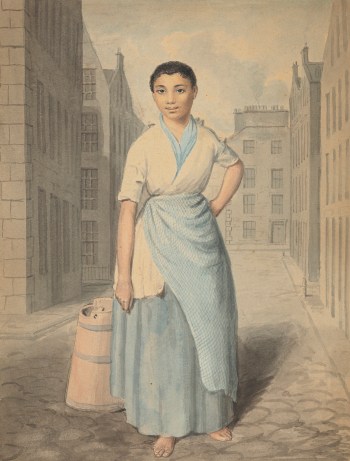
David Allan, Edinburgh Milkmaid with Butter Churn, ca. 1785–95, watercolour on paper, image size: 21 × 16 cm (Edinburgh: National Galleries of Scotland, D 5721, purchased 2019).
One of the earliest known images of a Black person by a Scottish artist has been acquired by the National Galleries of Scotland. Edinburgh Milkmaid with Butter Churn by David Allan (1744–1796) is a beautifully painted watercolour, which is both exceptionally rare and striking. It depicts a Black woman alone and centre stage at a time when Black sitters more often appeared as marginal or subservient figures in group portraits.
Looking directly at the viewer, the woman is shown in working dress, going about her daily duties and set against the backdrop of an elegant Edinburgh street. Her name and life story is unknown, but it is likely that she was a servant, a milkmaid, as suggested by the large vessel or butter churn shown beside her.
Modest in scale, the image is dated to the mid-1780s to early 1790s, a period when Allan created evocative drawings of ordinary people going about their daily lives in Edinburgh, such as soldiers, coalmen, fishwives, sedan chair porters, firemen, and officers of the city guard. These works, known as Allan’s ‘Edinburgh Characters’, suggest a background context for Edinburgh Milkmaid with Butter Churn, but they are generally sketched in a summary way, intended to capture character types, rather than specific personalities, and were often copied and duplicated. The Edinburgh Milkmaid, however, is highly detailed, precisely painted, and clearly a portrait of a specific person. It is hoped that further research may reveal more about the connection between the artist and the young woman and shed some light on her identity.
Director of European and Scottish Art at the National Galleries of Scotland, Christopher Baker, commented: “We are so pleased to bring this remarkable, rare, and extraordinary watercolour into Scotland’s national collection. It is an incredibly striking and special work, one which we believe will be enjoyed by many and, we hope, lead to new research on its background and most importantly the story of the woman depicted.”
Born in Alloa, David Allan was arguably the first Scottish artist to take contemporary life and customs from across the social hierarchy as a subject worthy of art. With the support of his patrons, Lord and Lady Cathcart of Shaw Park, near Alloa, he travelled to Italy around 1767 and remained there for a decade, painting historical pictures and portraits. He became interested in drawing scenes of street life, inspired by the popular print tradition of depicting street criers who called out to advertise their produce or trades. He sketched street vendors, aristocrats on the Grand Tour, coffee house scenes, dances, carnivals, and local costume in Rome and Naples and on a visit to the islands of Procida, Ischia, and Minorca.
These experiences led Allan to take a similar approach after his return to Scotland in 1779. He drew his subject matter from contemporary life, ranging from specific events such as The Ceremony of Laying the Foundation Stone of the New College of Edinburgh (1789) to timeless traditions and customs, such as A Highland Dance and The Penny Wedding. In 1786 Allan was appointed to a teaching post as Master of the Trustees’ Academy and he settled permanently in Edinburgh. The city and its inhabitants became a particular focus for this work. From about 1788 he developed the series of over twenty drawings of workers and traders; often referred to as his ‘Edinburgh Characters’, they typically show an individual or pair of figures with the tools of their trade, set against a simple architectural or rural background.
Allan’s subjects range from higher status figures, such as a Highland officer in uniform and officers of the Town Guard, to those who did the city’s heavy labour, such as the coalmen, chimney sweeps, porters, and water carriers. Female workers are represented by a fishwife, a salt vendor, and a lacemaker. The figures are drawn with strong outlines in ink to enable them to be traced easily, as Allan made multiple versions of his character drawings, several of which are held in the National Galleries of Scotland collection. He also reproduced his Edinburgh characters on a smaller scale as the cast that populate his landscape views of the Royal Mile, such as High Street from the Netherbow, made in 1793. Seen as a group, Allan’s street characters give a broad and fascinating insight into late 1780s Edinburgh as a living, working city.
Edinburgh Milkmaid with Butter Churn is one of several notable acquisitions highlighted in the recently published NGS Annual Review, covering the years 2019–2021. The painting will go on display at a later date following some conservation work, which is currently being prepared. With much still unknown about the painting, the Galleries would welcome information, comments, or feedback about it.
Nationalmuseum Sweden Acquires Gold Box, Gifted by Gustav III

Gold box à deux couleurs, unknown maker, Hanau; guilloché and chased gold in two shades, diamonds, enamel; portrait of Gustav III by Johan Georg Henrichsen, ca. 1778 (Stockholm: Nationalmuseum, NMB 2799). The box sold at Sotheby’s in London on 10 November 2021 as part of the Gold Boxes, Silver and Ceramics sale (Lot 10).
◊ ◊ ◊ ◊ ◊
Press release (8 December 2021) from Sweden’s Nationalmuseum in Stockholm:
Nationalmuseum has acquired a unique gold box bearing a portrait by the court enameller, Johan Georg Henrichsen, of King Gustav III. The box was given by the king as a gift to John Mackenzie, a Scottish officer, when he retired from the Swedish army in 1778. Very few such tokens of royal favour have survived intact, which is what makes this gold box unique.
Jewel-encrusted portraits of the monarch were the most prestigious token of appreciation. The tradition developed at the French court in the 17th century and soon became a model for other European royal houses of the time. These portraits might take the form of a pendant or be mounted in a jewelled setting on the lid of a gold box. Queen Kristina was the first Swedish monarch to adopt this French fashion, which then flourished in the 18th century. Gustav III frequently handed out gold boxes as a sign of royal favour. Contemporary historical sources show that the king took a great personal interest in the design and gave detailed instructions. Sometimes the decoration consisted of his monogram in diamonds, and in other cases his portrait was framed with jewels.
Various specialist craftsmen collaborated to create the boxes. A silversmith would first produce the basic gold box, which would then be decorated by an engraver and adorned with gemstones by a jeweller. A miniaturist then added the portrait, while the case was produced by another specialist, often a bookbinder. There were practitioners of all these crafts in Gustavian Stockholm, but sometimes boxes were imported from Russia, Saxony or France. The gold box in question was made in Hanau, in the present-day German state of Hessen. It is oval in shape and is decorated with a guilloché (engine-turned) wave and circle pattern within a chased (embossed) border. It is also executed à deux couleurs: in a combination of two different gold alloys to produce colour variations. After the box reached Stockholm, the king’s portrait was set on the lid in a frame of diamonds with trailing vines.
The portrait is the work of Johan Georg Henrichsen (1707–1779), the last person in Sweden to hold the position of court enameller, to which he was appointed in 1773. He worked exclusively from originals in pastel or oil created by other artists such as Gustaf Lundberg or, in this case, Lorens Pasch the Younger. The colour palette was often intense, combined with clear use of pointillism. A lesser-known fact is that Henrichsen also produced coats of arms for patents of nobility, painted on parchment using miniature techniques.
The recipient of the gift was a Scottish adventurer: John Mackenzie, Lord Macleod, 4th Earl of Cromartie (1726–1789). He had been loyal to Charles Edward Stuart (Bonnie Prince Charlie), the Young Pretender, and was held prisoner after the British army defeated the Jacobites at the battle of Culloden in 1746. Two years later he was pardoned, but the family had its estates confiscated. In 1750 John Mackenzie joined the Swedish army, ending up as colonel of the Björneborg regiment.
“Mackenzie returned to Britain in 1778, having been granted a full amnesty, and had his estates restored. On the occasion of his departure from Sweden, he received this gold box from King Gustav III. It is one of the very few surviving examples from the time and will soon be on display in Nationalmuseum’s Treasury alongside a miniature portrait of Mackenzie,” explained Magnus Olausson, director of collections at Nationalmuseum.
Nationalmuseum receives no state funds with which to acquire design, applied art and artwork; instead the collections are enriched through donations and gifts from private foundations and trusts. The acquisition has been made possible by a generous donation from the Anna and Hjalmar Wicander Foundation.
Emma’s Songbooks: Rediscovered Music for Nelson

Songbook once owned by Lady Hamilton, which has a cantata composed by G.G. Ferrari and dedicated to Lord Nelson
(Museum of London, 31.17/2)
◊ ◊ ◊ ◊ ◊
From the Museum of London:
Emma’s Songbooks: Rediscovered Music for Nelson
Online, Museum of London Docklands, recording available 21 December 2021 — 11 January 2022
In partnership with the Guildhall School of Music & Drama, the Museum of London Docklands brings to life songs dedicated to Horatio Nelson’s naval victories, recently rediscovered in Emma Hamilton’s songbooks by Museum of London librarian Lluis Tembleque Terés. Terés kicks off the event with a presentation on his finds and their historical context, after which Christopher Suckling, Head of Historical Performance at the Guildhall School of Music & Drama, will give an insight onto the music world at the beginning of the 19th century. Following the talks, performers from the School will play the four rediscovered pieces, along with a number of other relevant scores. Finally, Terés will show items from the Museum collections connected to Lady Hamilton and Lord Nelson—all in the immersive surroundings of the Museum of London Docklands.
Please note that this will be a recording of the live event, which took place on December 11. You will have seven days to access the recording from the date you select as part of the ticket purchase process.

Songbook once owned by Emma Hamilton, here shown by Museum of London librarian Lluis Tembleque Terés
(Museum of London, 31.17/2; photo by John Chase)
◊ ◊ ◊ ◊ ◊
From the press release (via Art Daily) . . .
A recording of an old sea song, one of four recently rediscovered pieces of music paying tribute to Nelson, has been released today by the Museum of London. Brought to life by musicians from Guildhall School of Music & Drama, it marks the first performance of the piece in over 200 years. The extraordinary discovery was made last year by Museum of London librarian Lluis Tembleque Teres who discovered it amongst songbooks belonging to Nelson’s lover, the actress and model Emma Hamilton.
It is thought the song was sung after the battle of Cape St Vincent (1797) and transcribed by Nelson after hearing it chanted by his crew. The lyrics have been known about since a letter from Nelson to William Douglas, 4th Duke of Queensberry, was sold at auction in 2013—the only other known reference to the song. The new discovery points to the addition of new music and a chorus by the Duke, a notorious society figure, whose reputation for gambling and horse racing has long overshadowed his musical ability. A personal friend of Emma Hamilton, his authorship of the piece is recorded in Emma’s own hand.
Lluis Tembleque Teres, librarian, Museum of London, said, “The song was written by Nelson’s crew in one of his early victories. It is fascinating how, some four years later and already a national hero, he recovers the lyrics and sends them to the Duke of Queensberry, almost as if showing off his early successes. The Duke then adds music and a chorus, and gifts the manuscript to Emma Hamilton, thus allowing us exactly 220 years later to relive Nelson’s fame while performing it.”
Dr Christopher Suckling, Head of Historical Performance at the Guildhall School of Music & Drama, said, “Equally as extraordinary is that a man of the Duke of Queensberry’s position should take the time and take the effort to compose at least two pieces of music in Nelson’s honour. That he should choose to express himself through this least gentlemanly of arts speaks to both his strength of feeling for Nelson and his sensibility towards the Admiral’s relationship with Emma Hamilton.”
The original manuscripts reflect the different manner in which music was experienced at the turn of the nineteenth century, its empty staves typical of a time when music could be played by any combination of available musicians. Amongst the upper classes, the function of domestic music was largely seen as a way to kill time and despite some contemporaries considering social music making to be the embodiment of morality, playing and composing was not held in high regard.
The release follows a special one-off live performance of all four songs at the Museum of London Docklands on 11th December, which will be available to watch in full as an online event starting Tuesday, 21 December 2021.
A free copy of the sea song is available for download here»
The Decorative Arts Trust Announces Failey Grant Recipients
From the press release (1 December 2021) . . .
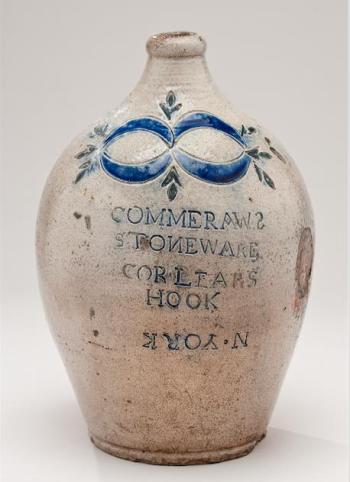
Thomas W. Commeraw, Jug, ca. 1796–1819, stoneware and cobalt oxide. Impressed on front: “COMMERAW’S/STONEWARE / CORLEARS / HOOK / N. YORK” (New-York Historical Society, 1937.820).
The Decorative Arts Trust congratulates author Caitlin Meehye Beach, Historic Rock Ford, and the New-York Historical Society on receiving Failey Grants. The Failey Grant program provides $25,000 in support for noteworthy research, exhibition, publication, and conservation projects through the Dean F. Failey Fund, named in honor of the Trust’s late Governor. Preference is given to projects that employ or are led by emerging professionals in the museum field.
Caitlin Meehye Beach, an assistant professor in the Department of Art History and affiliated faculty in the Department of African and African American Studies at Fordham University, will utilize grant funds for her forthcoming book Sculpture at the Ends of Slavery, which will be published by the University of California Press in 2022. The text will examine how a wide range of works of sculpture and decorative art—from antislavery medallions to statues of bondspeople bearing broken chains—gave visual form to narratives about abolition in the 18th and 19th centuries.
Historic Rock Ford in Lancaster, Pennsylvania, will use grant funding for further research and interpretation of the over 200 objects in their John J. Snyder, Jr. Gallery of Early Lancaster County Decorative Arts. Their goal is to uncover more about the shops, apprentices, laborers, indentured laborers, and enslaved workers who contributed to the Gallery’s collection of furniture, silver, clocks, and paintings from the mid-1700s to the early 1800s.
The New-York Historical Society receives grant funding for the groundbreaking exhibition Crafting Freedom: Uncovering the Life and Legacy of Free Black Potter Thomas Commeraw, to be presented January to June 2023 in their Pam & Scott Schafler Gallery. Crafting Freedom will be the first exhibition focused solely on Commeraw, a free Black craftsman descended from enslaved people, who was active as a master potter from the 1790s through 1819.
The Decorative Arts Trust is a non-profit membership organization that promotes and fosters the appreciation and study of the decorative arts through exchanging information through domestic and international programming; collaborating and partnering with museums and preservation organizations; and underwriting internships, research grants, and scholarships for graduate students and young professionals.
The Snite Receives Long-Term Loans of Spanish Colonial Art
From the press release (26 October 2021) . . .

Unidentified artist, Virgin of the Immaculate Conception with Saints, Angels, and Indigenous Donor, 18th century, oil and gold on canvas (Carl & Marilynn Thoma Art Foundation; photo by Jamie Stukenberg).
The Snite Museum of Art at the University of Notre Dame installed recent loans from the internationally renowned Carl & Marilynn Thoma Art Foundation. Three paintings dating from the seventeenth and eighteenth centuries, drawn from the Foundation’s extraordinary holdings, complement the Museum’s existing collection of Spanish Colonial works to expand our understanding of the period.
This new loan follows an earlier one from the Thoma Foundation of thirteen works that were shown in the 2020 exhibition Divine Illusions: Statue Paintings from Spanish Colonial Peru, organized by Professor Michael Schreffler of the University of Notre Dame’s Department of Art, Art History & Design. In 2023 When the new Raclin Murphy Museum of Art debuts in 2023, the University will receive five different works from the Foundation to replace the three currently exhibited. Those loans are slated to extend through 2026.
“The Thoma family have become very good, trusted friends of the Museum. It is an honor to host masterpieces from their extensive collection that can be appreciated, studied, and nourish us all,” said Joseph Antenucci Becherer, director of the Snite Museum of Art.
“The paintings on loan from the Thoma Art Foundation are windows into a fascinating world of social interaction and Christian devotion in Spanish Colonial South America. Our students and all visitors to the Snite will benefit from the unique opportunity to study and reflect on these visually compelling works of religious art” notes Michael Schreffler, Professor of Art History at the University of Notre Dame.
Most paintings from colonial South America are unsigned. However, a few artists did sign their works, enabling experts to attribute unsigned works to their hands. One such known artist is Gregorio Vásquez de Arce y Ceballos (1638–1711), whose oeuvre is considerable. His Allegory of the Eucharist, which was probably based on an engraving, portrays the Catholic doctrine of transubstantiation in which the bread and wine of the Eucharist is transformed into the body and blood of Christ.
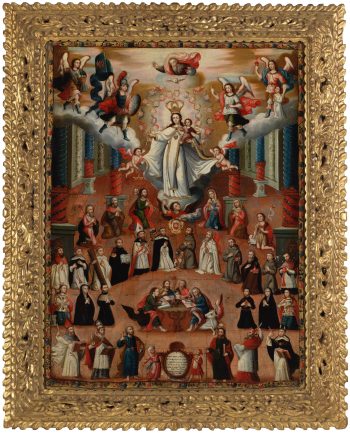
Cipriano de Toledo y Gutiérrez, Our Lady of Mercy with Saints, 1764, oil and gold on canvas (Carl & Marilynn Thoma Art Foundation; photo by Jamie Stukenberg).
This painting of the Virgin of the Immaculate Conception (depicted above) follows the traditional iconography of the central figure by showing the Virgin clothed in a white tunic covered by a blue mantle. Satan, as a serpent with a human face, lies vanquished on the ground. At the top of the canvas are the four Evangelists—Saints Matthew, Mark, Luke, and John—shown holding ribbons inscribed with four of the symbols of the Virgin’s immaculacy: the Tower of David, the Temple of Solomon, the City of God, and the Spotless Mirror. She is accompanied by a variety of saints. At lower right is a portrait of the donor, an indigenous woman who must have been a member of an important clan.
In 1997, the Thoma Foundation acquired a version of this subject, Our Lady of Mercy with Saints, that was dated 1771, but bore no signature. More recently, another version of the subject from 1764 was acquired by the Foundation. That painting, like yet another painting in a French private collection, is signed by Cipriano de Toledo y Gutiérrez. The existence of the three nearly identical paintings—with others possibly extant—tell us a great deal about the workshop practices of Cuzco painters. Although much has been written about works created for the art market, two of these three works were clearly commissioned by devotees of Our Lady of Mercy and the Mercedarian order. This multifigured composition may well have been based on an engraving.
New Book | The Best Address in Town: Henrietta Street
From Four Courts Press:
Melanie Hayes, The Best Address in Town: Henrietta Street, Dublin and Its First Residents, 1720–80 (Dublin: Four Courts Press, 2021), 312 pages, ISBN: 978-1846828478, €30 / $40.
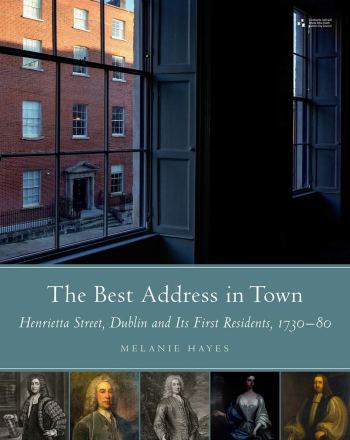 Once Dublin’s most exclusive residential street, Henrietta Street was, throughout the eighteenth century, home to the country’s foremost figures from church, military, and state. Here, in this elegant setting on the north side of the city, peers rubbed shoulders with property tycoons, clerics consorted with social climbers, and celebrated military men mixed with the leading lights of the capital’s beau monde, establishing one the principle arenas of elite power in Georgian Ireland. Looking behind the red-brick facades of the once-grand Georgian town houses, this richly illustrated volume—commissioned by Dublin City Council Heritage Office in conjunction with the 14 Henrietta Street museum—focuses on the people who originally populated these spaces, delineating the rich social and architectural history of Henrietta Street during the first fifty years of its existence. By weaving the fascinating and often colourful histories of the original residents around the framework of the buildings, in repopulating the houses with their original occupants, and by offering a window into the lives carried on within, this book presents a captivating portrait of Dublin’s premier Georgian street, when it was the best address in town.
Melanie Hayes is an architectural historian, specialising in Ireland’s eighteenth-century architectural and social history. She was an academic researcher during the development of the 14 Henrietta Street museum by Dublin City Council, and continues to be involved with the museum. Melanie currently works as a research fellow on an Irish Research Council laureate project, CRAFTVALUE, at Trinity College Dublin, exploring a new skills-based perspective on the architecture of Britain and Ireland from 1680 to 1780.
Frick Announces Its Most Significant Gift of Drawings and Pastels
Press release (30 August 2021) from The Frick:

Elisabeth Vigée Le Brun, Head of a Woman, 1784, pastel on paper, 12 x 10 inches (New York: Frick Collection, promised gift from the Collection of Elizabeth and Jean-Marie Eveillard; photo by Joseph Coscia Jr.).
The Frick Collection announces the largest and most significant gift of drawings and pastels in its history, thanks to the generosity of Elizabeth ‘Betty’ and Jean-Marie Eveillard. Over the past forty-five years, the Eveillards have assembled an outstanding collection of European works on paper, ranging in date from the end of the fifteenth century to the twentieth century and representing artists working in France, Britain, Italy, Spain, and the Netherlands. The Eveillards have made a promised gift to the Frick of twenty-six of these works—eighteen drawings, five pastels, two prints, and one oil sketch—among them some of their finest acquisitions. Along with preparatory figurative sketches and independent studies and portraits are two vivid landscape scenes. Fittingly for the Frick, artists represented include François Boucher, Edgar Degas, Jean-Honoré Fragonard, Francisco José de Goya y Lucientes, Thomas Lawrence, and Jean-François Millet. The group also introduces to the Frick’s holdings works by artists not yet represented in its primary collecting areas, including Gustave Caillebotte, Maurice Quentin de La Tour, Jan Lievens, John Singer Sargent, and Elisabeth Vigée Le Brun. In the fall of 2022, at its temporary Frick Madison location, the museum will present an exhibition of these extraordinary works, to be accompanied by a catalogue and public programs.
François Boucher, Reclining Shepherdess (La bergère au Coeur), ca. 1753; black, red, and white chalk and blue, light blue, red, pink, and yellow pastel with touches of grey watercolor washes and possibly some traces of graphite on paper; 16 × 19 inches (New York: Frick Collection, promised gift from the Collection of Elizabeth and Jean-Marie Eveillard; Photo by Joseph Coscia Jr.).
Comments Xavier F. Salomon, the Frick’s Deputy Director and Peter Jay Sharp Chief Curator, “It has been a pleasure studying and selecting from this remarkable collection of two longtime supporters of the Frick, assembled just as our own holdings have been, according to criteria of beauty, quality, and condition. Each of the twenty-six works either appreciably deepens our holdings of a familiar artist or brings to us the work of one who is not—but should be—represented within our core areas of European Old Master art. In adding five pastels and an oil sketch, the gift also strengthens our examples of these media. We very much look forward to sharing these works with the public next year.” Betty and Jean-Marie Eveillard have been deeply involved with the Frick for many years, both having served as Trustees. Betty is currently the Board’s Chair.
The Eveillards acquired their first important work in 1975, John Singer Sargent’s Virginie Amélie Avegno, Mme. Gautreau (Mme. X), and have been active collectors ever since. This drawing is the most modern work in the promised gift to the Frick and is a particularly satisfying addition to the museum’s holdings: It is known from archival correspondence that Henry Clay Frick desired a portrait by Sargent but did not succeed in securing a sitting with the artist. Dated to about 1884, Sargent’s Mme. Gautreau is one of some dozen studies produced for the famous painted portrait Madame X, a highlight of the collection of The Metropolitan Museum of Art. This sheet shows the artist working out the figure’s pose, representing her lithe figure kneeling on a sofa and looking out a window. Sargent was captivated by Gautreau and strived in studies like this and in the final painting to capture her “unpaintable beauty and hopeless laziness.”
Other later nineteenth-century drawings coming to the Frick are by Degas and Caillebotte, selected to complement the collection’s Impressionist paintings. While the institution owns a quintessential Degas canvas of dancers, the Eveillards’ early drawing of Adelchi Morbilli, created in Naples in 1857, will be the first work on paper by the artist in the Frick’s collection. It is one of—and arguably the best of—his series of drawings of his cousin. When it was drawn, Degas was particularly interested in the work of Jean-Auguste-Dominique Ingres, and the portrait reflects this affinity. Gustave Caillebotte is best known and perhaps most celebrated for his 1877 painting at Chicago’s Art Institute, Paris Street, Rainy Day. A man of wealth, Caillebotte was also a patron and supporter of fellow Impressionist colleagues. His works only rarely appear on the market, most still being in the possession of his descendants. The promised gift includes a preparatory drawing for the iconic Paris street scene.

François Boucher, Reclining Shepherdess (La bergère au Coeur), ca. 1753; black, red, and white chalk and blue, light blue, red, pink, and yellow pastel with touches of grey watercolor washes and possibly some traces of graphite on paper; 16 × 19 inches (New York: Frick Collection, promised gift from the Collection of Elizabeth and Jean-Marie Eveillard; photo by Joseph Coscia Jr.).
Eighteenth-century French art is one of the Frick’s strengths, with holdings by Boucher, Fragonard, Greuze, and Watteau. The gift brings to the museum works in chalk and pastel on paper by these four artists, media in which none of them is currently represented. Among these is a pastel drawing lauded by the influential writers Edmond and Jules Goncourt as one of the most beautiful by Boucher. The image of a reclining woman is associated with a pastoral painting now at the Louvre. Young Woman (La Coquette) by Fragonard is one of a series of spectacular drawings of female models standing outdoors. These were made in the early 1770s, contemporaneous with his creation of the four original canvases of The Progress of Love that today are a highlight of the Frick. The most renowned—and arguably the best—pastelist in eighteenth-century France was the eccentric Maurice Quentin de La Tour. The Eveillards have the finest pastel by him in private hands in the United States, the portrait of Madame Rouillé. It too comes to the Frick along with a sheet by De La Tour’s near contemporary Nicolas Lancret, neither of whom is currently represented at the museum in any medium. Widely traveled and celebrated during her life, Elisabeth Vigée Le Brun was a highly accomplished portraitist and writer. Her work also enters the collection with Head of a Woman, a sketch signed and dated 1784 and likely made in preparation for a history painting that was never executed. The scope of the institution’s French works is broadened further with sheets by Pierre-Paul Prud’hon and Jean-Baptiste Wicar.
Painter Eugène Delacroix was among those artists to herald French Romanticism. In 2010, former Frick Director Charles Ryskamp left to the Frick the artist’s Moroccan Interior, a delicate and personal drawing from one of the sketchbooks Delacroix made in 1832 during a visit to North Africa. The Eveillard gift includes a pastel by the artist depicting two North African figures in a landscape, based on sketches made two decades later. Of the twenty known Delacroix pastels of such subjects, only a dozen can be located today; the Eveillard sheet is the only one in private hands, making this acquisition a particularly rare occurrence.
The Frick is also celebrated for Spanish art, including five works by Goya: four paintings and one drawing, The Anglers. The Eveillards’ Tambourine Player will deepen the institution’s holdings by the artist. This depiction of a dancing Spanish man comes from the same album as the aforementioned drawing and likewise exemplifies the artist’s use of everyday people as subjects, as is also the case with the Frick’s large Goya painting of laborers, The Forge.
Other works in the gift enrich the Frick’s celebrated collection of Italian works, with sheets ranging from a rare anonymous fifteenth-century Venetian drawing to Italian Renaissance and Baroque sheets by Federico Barocci, Guido Reni, and Salvator Rosa and eighteenth-century works by Giovanni Battista Piazzetta and Giovanni Domenico Tiepolo. The group includes two remarkable portraits by Jan Lievens, the Dutch contemporary of Rembrandt, and by Sir Thomas Lawrence, the leading British portraitist of his age. As a young collector, Henry Clay Frick was particularly interested in the Barbizon school, and a drawing by Jean-François Millet, one of the movement’s founding members, will also enter the collection through this generous gift. The landscape joins a genre scene by Millet already in the collection. Crowning this remarkable group of works is an oil sketch by John Constable, made in preparation for the last of the artist’s famous series of ‘six-footer’ paintings, of which The White Horse at the Frick was the first.
Sweden Nationalmuseum Acquires Louis Masreliez’s Allegory of War

Louis Masreliez, An Allegory of War, ca.1790–92, oil on canvas, 93 × 132 cm
(Stockholm: Nationalmuseum)
◊ ◊ ◊ ◊ ◊
The American war in Afghanistan ends after two decades. This painting sold at Christie’s New York in April of this year (Sale 19739, Lot 63). From the Nationalmuseum press release (26 August 2021) . . .
Nationalmuseum has acquired An Allegory of War, a painting by Louis Masreliez originally intended to be one of two overdoor pieces for King Gustav III’s bedchamber in the royal palace in Stockholm. The work is of major significance, marking a transition in the artist’s oeuvre from epic historical scenes to more decorative works.
As one of the leading painters and interior designers of the Gustavian period, Louis Masreliez (1748–1810) was equal to the task. Born in Paris, he arrived in Stockholm at the age of five when his father, the ornamental sculptor Adrien Masreliez, was hired to work on the new palace. Young Louis soon proved to be something of an artistic child prodigy. He received the best possible education, which culminated in 1769 in a travel scholarship. Via Paris he travelled to Rome, where he studied for the next 12 years. In this cosmopolitan environment Masreliez mixed with the leading artists of the time, found his niche in the emerging neoclassical style, and drew many studies of Classical and Renaissance motifs to serve as reference material.
On returning to Stockholm in 1782, Masreliez was well equipped to oversee the redecoration of Gustav III’s private apartment at the palace in keeping with contemporary neoclassical interior design trends. Neoclassicism blended the grotesque decorative style of the Renaissance with features inspired by ancient Rome. The best-known example in Sweden today is the interior decoration of Gustav III’s pavilion at Haga. Meanwhile, Masreliez also had a solid grounding in historical painting, the task he was originally destined for in the service of the crown. Here too, he combined various influences from the great masters, all packaged in an elegant neoclassical form. This can be clearly seen in An Allegory of War.
It is conceivable that Gustav III himself chose the subject matter for the two overdoor paintings in his bedchamber. The king was heavily involved and had his own ideas regarding the interior decoration of royal properties, as contemporary sources attest. An Allegory of War and its counterpart, An Allegory of Peace, would promote the image of the king as defender of the realm and ultimate guarantor of peace. The topic was highly relevant, as the works were created in the immediate aftermath of Sweden’s 1788–90 war against Russia. An Allegory of War depicts Minerva alighting from her horse-drawn chariot, holding a shield in one hand and the lightning bolt of Zeus in the other. Above her hovers Boreas, god of the north wind, accompanied by winged zephyrs with snowflakes emanating from their mouths. It is both a dramatic composition and an unusually powerful painting with its grand, sweeping lines. The somewhat explosive colour palette, dominated by earth tones and martial red, reinforces the subject matter.
From an inscription on a preliminary sketch by Masreliez, we know that this image represented the Swedish victory at the battle of Narva in 1700, an event to which Gustav III frequently alluded, since it had secured Sweden’s position as a great power for some years. If Karl XII was explicitly presented here as the warrior king, then Gustav III would implicitly be the prince of peace in the counterpart image. A preliminary study in oils for An Allegory of Peace has been in Nationalmuseum’s collection since 1917. It is believed the ensemble was never completed following the king’s death in 1792, and instead the artist retained ownership of the works.
Nationalmuseum receives no state funds with which to acquire design, applied art and artwork; instead the collections are enriched through donations and gifts from private foundations and trusts. Thanks to a generous donation from the Friends of Nationalmuseum, the museum has been able to repatriate the magnificent Masreliez work to Sweden.
NEH Announces $28.4 Million for 239 Projects
Selections from the press release (17 August 2021):
The National Endowment for the Humanities (NEH) today announced $28.4 million in grants for 239 humanities projects across the country. . . .This round of funding will support vital research, education, preservation, digital, and public programs. These peer-reviewed grants were awarded in addition to $53.2 million in annual operating support provided to the national network of state and jurisdictional humanities councils. . . .
Several projects receiving grants today will help preserve fragile historical and cultural collections and make them more accessible to the broader public, such as grants to safeguard the Providence Atheneum’s collection of rare books, pamphlets, and artwork—which includes rare first editions of works by Walt Whitman, Louisa May Alcott, and Herman Melville, nineteenth-century antislavery and temperance pamphlets, and a 25-volume reference work on Egypt commissioned by Napoleon Bonaparte.
A grant to the Oneida Indian Nation will help preserve tribal archives containing textiles, artifacts, and historical records documenting the Nation’s history, including the personal papers of Chief William Rockwell, who played a pivotal role in a U.S. Supreme Court case preserving the Oneida Reservation, and the pipe of Chief Skenondoa, an American Revolutionary War hero involved in the 1794 Canandaigua Treaty recognizing Oneida sovereignty and land rights.
NEH Preservation Assistance Grants will improve preservation conditions for valuable humanities collections at seventy-one smaller museums, archives, and historical societies across the country. . . .
Forty institutions received grants to support professional development and research opportunities for K–12 and college teachers through summer workshops and institutes on humanities topics such as: the social and cultural history of the space race on Florida’s ‘Space Coast’; the role of books in circulating the ideals of the American Revolution; the twelfth-century migration of Pueblo communities from Chaco Canyon, the hub of Puebloan civilization in northwestern New Mexico, to the Mesa Verde region of southwestern Colorado; the overlooked histories of ten influential African-American women who helped define American ideals from the Revolutionary Era to the early twentieth century; and accounts of the 1918 influenza pandemic in history and literature.
This round of funding also marks the addition of the Boston Public Library as a hub for the National Digital Newspaper project, expanding the reach of the Chronicling America online database of historical American newspapers to include newspapers published in Massachusetts between 1690 and 1963. Additional funding awarded in this round will support ongoing newspaper digitization work in Arkansas, Connecticut, Florida, Georgia, Montana, Rhode Island, Texas, Wisconsin, and Wyoming.
A number of newly funded projects received grant support through NEH’s A More Perfect Union initiative, designed to demonstrate and enhance the critical role the humanities play in our nation and support projects that will help Americans commemorate the 250th anniversary of the Declaration of Independence in 2026. Among these are grants to fund new episodes of the PBS series Poetry in America, a collection of essays on the architecture of the African diaspora in the United States, and preservation planning for the Digital Library of Appalachia.
A full list of the 239 grants by geographic location is available here (these particularly caught my eye -CH) . . .
The Revolution in Books (Adrian Finucane and Victoria Thur), $141,929
A three-week, residential institute for 25 college and university faculty on the history of the book in the American Revolution.
◊ ◊ ◊ ◊ ◊
Bringing Old North to the 21st Century (Nikki Stewart), $75,000
A planning grant to reinterpret the colonial Old North Church in Boston and its congregation’s ties to slavery from the American Revolution to the Civil War.
◊ ◊ ◊ ◊ ◊
Preserving Works on Paper at Historic Deerfield (Amanda Lange), $10,000
Conservation assessment of 350 works of art on paper, including eighteenth-century British portraits, silhouettes, political prints, military and other maps, and other pieces that represent New England life and tastes in the nineteenth and twentieth centuries. The project would also include a workshop on object handling and storage best practices that would be open to staff and volunteers of other local museums and historical societies, as well as the development of a rotation schedule for the light-sensitive pieces in the collection.
◊ ◊ ◊ ◊ ◊
Recovering Black Performance in Early Modern Iberia, 1500–1800 (Nicholas Jones and Elizabeth Wright), $96,347
Planning and holding a conference on Black performance in early modern Iberia and preparation of conference papers for publication in a journal special issue.
◊ ◊ ◊ ◊ ◊
Rehousing and Cataloging the RISD Museum’s Eighteenth- and Nineteenth-Century Wallpaper Collection (Ingrid Neuman), $10,000
The rehousing of approximately 700 historical European and American wallpapers from the late eighteenth century to the mid nineteenth, 500 of which were collected by French artist Charles Huard and his wife, American writer Frances Wilson Huard. The collection includes examples from manufacturers Zuber, Joseph Dufour, and Jean-Baptiste Réveillon that are representations of highly skilled and time-intensive production techniques, including the use of hand-drawn and hand-carved woodblocks for printing.
◊ ◊ ◊ ◊ ◊
Collections Monitoring and Housing Improvement Project at the Old Stone House Museum (Mahala Nyberg), $9,300
Purchases to improve preservation conditions and environmental monitoring at the Old Stone House Museum and Historic Village. The museum, on Vermont’s African-American Heritage Trail, includes buildings significant to the history of Orleans County from the mid eighteenth century through the nineteenth, including the home of Alexander Twilight, an African-American educator and minister and first African American to graduate college in the United States.
◊ ◊ ◊ ◊ ◊
First Family: George Washington’s Heirs and the Making of America (Cassandra Good), $30,000
Research and writing of a history of the heirs of George and Martha Washington between the American Revolution and the Civil War.
◊ ◊ ◊ ◊ ◊
A Plague in New York City: How the City Confronted—and Survived—the Yellow Fever Epidemic in the Founding Era (Carolyn Eastman), $60,000
Research and writing of a book on the yellow fever epidemics of 1795 and 1798 in New York City, emphasizing the experience of doctors and other caregivers, including African Americans.
Colonial Williamsburg Acquires Tankard by Paul Revere
Press release from Colonial Williamsburg (17 August 2021) . . .

Tankard, Marked by Paul Revere, Jr. (1734–1818), Boston, ca. 1795, silver (Colonial Williamsburg Collections Fund, 2021-45).
The Colonial Williamsburg Foundation has added to its renowned American and British silver collection a rare tankard made ca. 1795 by America’s best-known colonial silversmith, Paul Revere (1734–1818) of Boston, Massachusetts. Originally used as communal drinking vessels, tankards are among the largest forms produced in Revere’s shop. Approximately three dozen Revere tankards are known, and this one is typical of those from the 1790s, with tapering sides, midband, tall domed lid, and pinecone form finials.
“Colonial Williamsburg has long sought a significant example of Revere’s work,” said Ronald Hurst, the Foundation’s Carlisle H. Humelsine chief curator and vice president for museums, preservation, and historic resources. “With its impressive size, fine detail, and excellent condition, this tankard fills a significant void in our American silver holdings.”
A beloved American patriot, Revere is well known for his activities during the Revolutionary War. Widely recognized as an exceptional colonial silversmith, Revere also engraved prints and bookplates, ran an import business, established a bell and cannon foundry, and started the first successful copper rolling mills in the new nation. Many of the objects made in his silver shop are well documented today due to the survival of his record books.
Colonial Williamsburg’s Revere tankard stands nearly 10 inches tall and holds 48 ounces of liquid (usually wine, ale or cider), making it weighty to lift when full. Its apparent size is enhanced by a stepped domed lid and an elongated finial. The tankard has a lighter appearance thanks to its scrolled openwork thumbpiece. It lacks engraving, which leaves the identity of the original owner a mystery. Details such as the decorative features and the substantial weight (nearly 34 troy ounces) may one day provide ownership clues through careful study of Revere’s shop records.
“Paul Revere is the best-known and most celebrated American silversmith,” said Janine Skerry, Colonial Williamsburg’s senior curator of metals. “A large, eye-catching object such as this tankard is a great way to connect with the public and draw both children and adults into the story of this amazing material and its role in our early history.”
This Revere tankard was acquired entirely through the generosity of The Friends of Colonial Williamsburg Collections. It is now on view along with a ca. 1765 Revere silver porringer, another recent acquisition from the Joseph H. and June S. Hennage bequest announced earlier this year. Both objects are found in the exhibition Silver from Mine to Masterpiece in the Margaret Moore Hall Gallery at the DeWitt Wallace Decorative Arts Museum, one of the newly expanded Art Museums of Colonial Williamsburg.










leave a comment