Daniel Weiss Named as Director of Philadelphia Art Museum
From the press release:
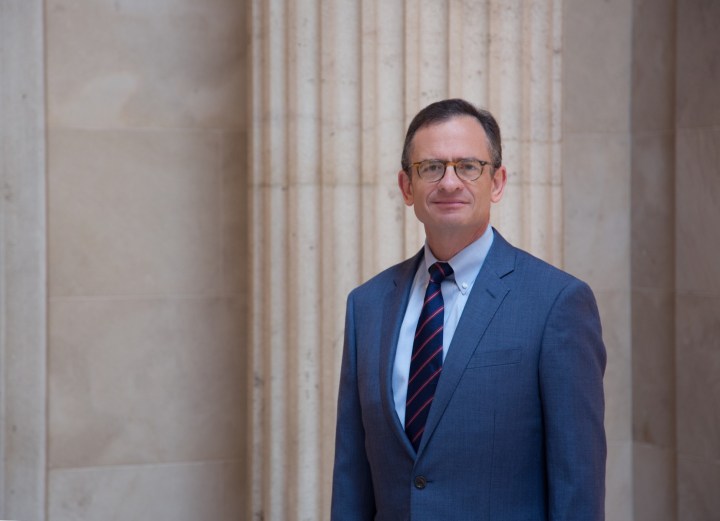 The Board of Trustees of the Philadelphia Art Museum announced the appointment of Daniel H. Weiss as the George D. Widener Director and CEO, effective 1 December 2025. Weiss, an accomplished museum executive with extensive leadership experience at major educational and cultural institutions, will guide the art museum through at least 2028, providing stability for staff, stakeholders, and the community.
“We are extraordinarily fortunate to have someone of Dan Weiss’s caliber and experience step into this critical role,” said Ellen Caplan, Chair of the Board of Trustees. “Dan’s proven track record of museum leadership, his deep understanding of the field, and his ability to navigate complex institutional challenges make him ideally suited to provide stability and strategic direction during this critical period for the art museum.”
Weiss brings decades of distinguished service in museum and educational leadership. Most recently, he served as President and CEO of The Metropolitan Museum of Art from 2015 to 2023, where he oversaw one of the world’s largest and most respected art museums. Prior to The Met, he served as President of Haverford College (2013–15) and of Lafayette College (2005–13). Weiss has spent the past two years as a Homewood Professor of the Humanities and Senior Advisor to the Provost for the Arts at Johns Hopkins University, where he received his PhD and served as chair of the Art History department and Dean of the Krieger School of Arts and Sciences earlier in his career.
“The Philadelphia Art Museum is one of America’s great cultural treasures, with an extraordinary collection, a dedicated staff, and deep connections to its community,” said Weiss. “It is a privilege and an honor to serve during this important moment, and I look forward to working with the Board, staff, and stakeholders to ensure the art museum continues its vital mission and advances its strategic priorities.”
During Weiss’s tenure at The Met, he led the institution through significant operational improvements, including addressing financial challenges, enhancing visitor experience, and strengthening the museum’s organizational effectiveness and building its infrastructure. Under his leadership, The Met completed a comprehensive facilities master plan, expanded its digital initiatives, and deepened community engagement.
As Director and CEO of the Philadelphia Art Museum, Weiss will oversee all aspects of the art museum’s operations, including curatorial programming, education initiatives, collection stewardship, fundraising, and strategic planning. He will work closely with the Board of Trustees and senior leadership team to maintain institutional momentum.
The Philadelphia Art Museum ranks among the largest art museums in the United States, with a collection of more than 240,000 objects spanning 2,000 years. The art museum serves approximately 700,000 visitors annually and plays a vital role in Philadelphia’s cultural and civic life.
Weiss holds a PhD in western medieval and Byzantine art from Johns Hopkins University, an MBA from Yale University, and a bachelor’s degree from George Washington University. The author of numerous books, Weiss has published extensively on medieval art, higher education, museums, and American culture. An elected member of the American Academy of Arts and Sciences, he serves on numerous cultural and civic boards and is widely recognized as one of the museum field’s most respected leaders.
American Numismatic Society Moving to Toledo Museum of Art
As someone who collected coins as a kid, who has lived proudly in the Midwest for three decades, and who really cares about antiquarian traditions, I’m so excited about this news from the American Numismatic Society! –CH
Dan Barry wrote about the move for The New York Times. From the press release (via Coin Week) . . .

Tolford and Lange, Professional Arts Building, 1939. Located on the campus of the Toledo Museum of Art, the Art Deco building will be home to the American Numismatic Society, starting in 2028.
The American Numismatic Society—a nearly 170-year-old organization dedicated to the public appreciation and research of coins, currency, and medals and holding the most comprehensive collection of numismatic objects in the United States—today announced its strategic relocation from its current leased location at 75 Varick Street in New York City to Toledo, Ohio, where it will take up residence on the campus of the Toledo Museum of Art. This major relocation, taking place in the first half of 2028, will enable the ANS to better serve its American and international audiences while developing a strong relationship with the local community in the former major industrial city now undergoing a cultural revival.
“The American Numismatic Society’s move to Toledo marks a transformative new chapter in our long history,” says Dr. Ute Wartenberg Kagan, Sydney F. Martin Executive Director, The American Numismatic Society. “Partnering with the renowned Toledo Museum of Art, we will create innovative museum displays that highlight our remarkable collection of coins and medals. We are eager to reach new audiences and develop an affordable, state-of-the-art museum space that supports our mission of research, education, and public engagement. We also anticipate strengthening our academic partnerships with local universities, making Toledo a vibrant hub for numismatic study and research.”
Founded in 1858 by a group of passionate collectors in New York City, the ANS has grown from modest beginnings as a coin club into a prominent museum and research institution. Its extensive collection—ranking among the top four of its kind worldwide—includes nearly 800,000 coins, monetary objects, art medals, military orders, and decorations, which collectively serve as a gateway to history, providing profound insight into the cultural, economic, political, and art of societies around the world and across the centuries. Home to the best numismatic library anywhere, the ANS is also a major publisher of books on coins and medals, while leading the way in the digital transformation of numismatics by developing open-access online tools and databases that connect coins and currency globally to broader historical and humanities research.
A four-story Art Deco building adjacent to and acquired from TMA will serve as the ANS’s new home, where a dedicated museum hall and flexible gallery spaces will enable the organization to host world-class exhibitions and to showcase a wider array of its extraordinary treasures, many of which have never been publicly displayed. Offering more space to properly care for, study, and display its ever-growing collections—of which more than 100,000 numismatic objects were added in the past twenty years alone, including the extensive archives of the Medallic Art Company acquired in 2017—the ANS’s Toledo building will house a library, an auditorium, and an education center. Together these vastly expanded resources will serve to cement the organization’s position as a leading research center, while reaching a wider audience. As numismatics is one of the largest fields of collecting interest, with approximately 150 million enthusiasts in the U.S. alone, the ANS will become an unmatched destination not just for local audiences and the 300,000-plus visitors TMA welcomes to its campus each year, but also for international travelers, with the Detroit Metro Airport less than an hour away.
Through a new institutional partnership, objects from the ANS collection will be integrated into several of TMA’s permanent collection galleries, which are currently undergoing a major chronological reinstallation to be unveiled in late 2027. TMA’s permanent collection exhibits will be conceptually and materially enhanced by these additions from the ANS, providing unique insight into and a direct connection with each historical era since coins represent tangible, everyday reflections of events, social norms, and economic behaviors.
“We could not be more excited as a Museum or as a community to welcome the American Numismatic Society to the city as our neighbor,” comments Adam Levine, TMA’s Edward Drummond and Florence Scott Libbey President, Director and CEO. “TMA’s collection spans human history but is distinguished by a commitment to presenting works of only outstanding quality, which makes ANS the perfect partner to enrich our collection displays with the integration of numismatic items while enhancing both the art historical experience for all visitors to our shared campus and research opportunities for scholars.”
In addition to this close partnership with TMA, the ANS intends to partner with other local organizations and venues, furthering the organization’s ability to mount interdisciplinary exhibitions, conduct new research, and host events that the current facilities in New York City cannot support, such as major academic conferences and hands-on programs that demonstrate how money functions and help attendees develop practical financial skills for everyday life.
Exhibition | Collections-Collection
Open since July, the Musée de la Mode et du Costume is the latest cultural project by the Costa family, which owns the perfume company Fragonard (named for the 18th-century painter). The 18th-century mansion was restored by Paris-based Studio KO (as noted by The New York Times and The World of Interiors).
Collections-Collection
Musée de la Mode et du Costume, Arles, 6 July 2025 — 4 January 2026
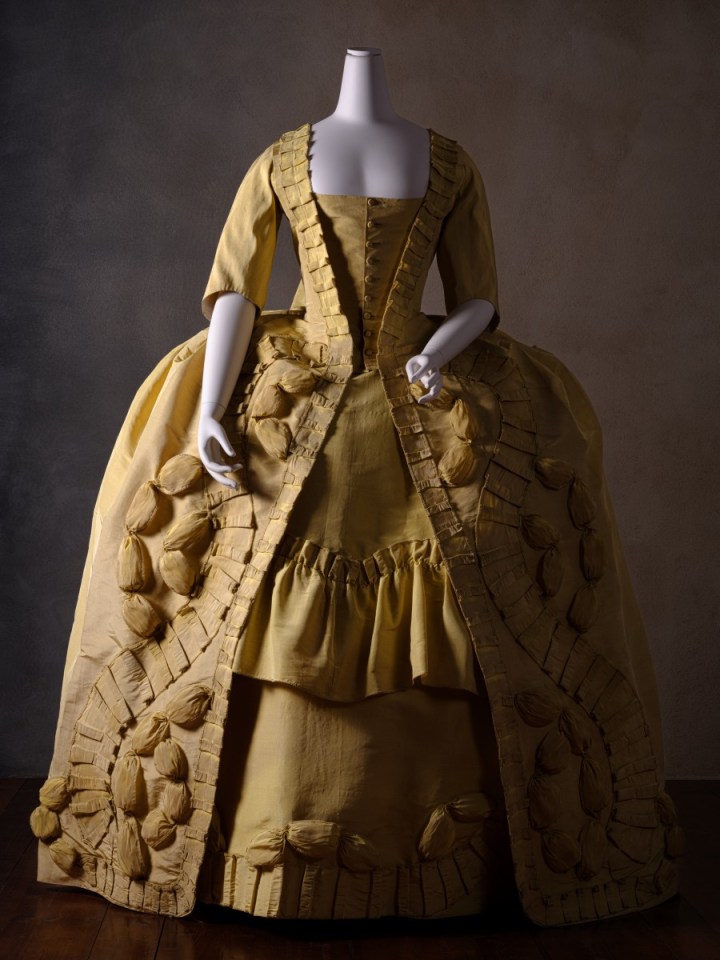
Robe à la française, ca. 1785–90 (Musée de la Mode et du Costume).
After five years of renovations and restoration, the Musée de la Mode et du Costume (Museum of Fashion and Costume at the Hôtel Bouchaud de Bussy ) finally opens its doors. This exceptional venue invites the public to discover custom-designed exhibition spaces at the heart of the building, including a large gallery on the first floor.
For its first exhibition, Collections-Collection, the museum brings together two collections located at the extreme ends of Provence. This fusion lends exceptional richness to the celebration of the history of costume from the French Mediterranean region and the history of textiles. Through a chronological journey, this exhibition offers the public a comprehensive overview of fashion in Provence since the 18th century. Emblematic costumes and major pieces from the Costa and Pascal collections are finally taking their place in the display cases of this long-awaited new museum.
At the request of the Fragonard house, Charles Fréger created for the future Musée de la Mode et du Costume, the only permanent work, depicting Arlesiennes against the light. Between reality and imagination, this internationally renowned photographer devotes himself to groups of belonging and their external symbols. Insatiable, he travels the globe and produces series of flamboyant portraits that capture the individual in his environment and question the creation of archetypal figures. Between poetry and pictorial rigor, his work gives pride of place to the collective: whether in uniforms, work clothes, or colorful masquerade costumes.
Kit Maxwell to Lead Applied Arts of Europe at the Art Institute of Chicago
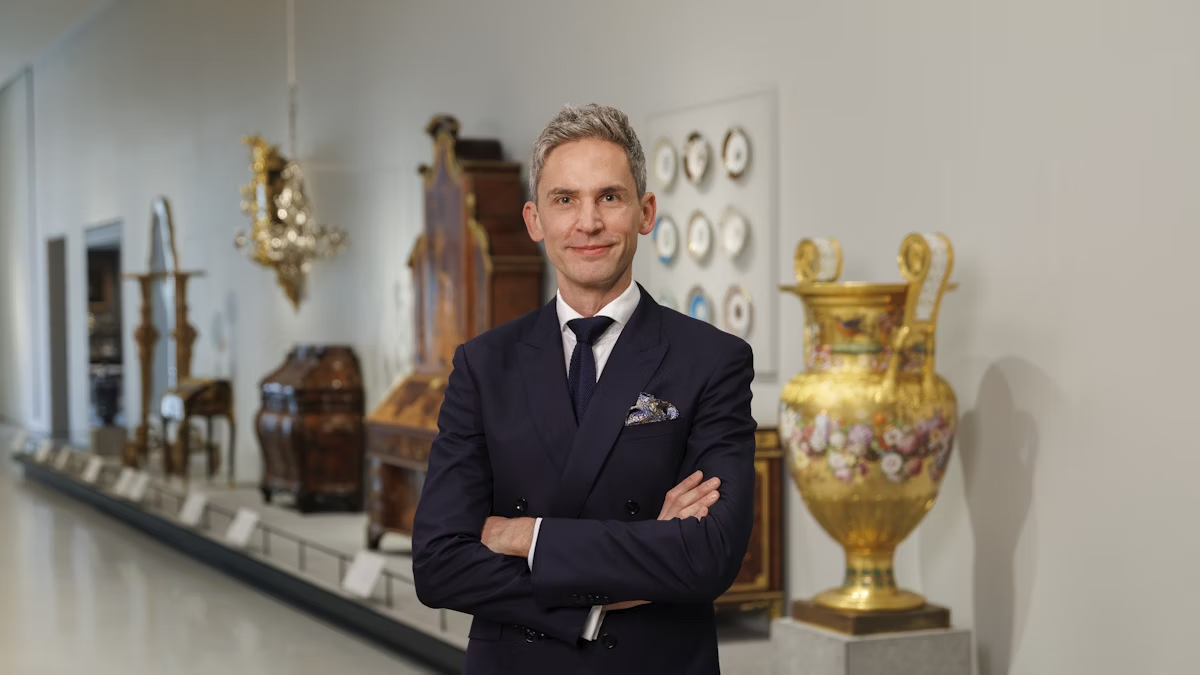
Kit Maxwell is the new Chair and Eloise W. Martin Curator of Applied Arts of Europe at the Art Institute of Chicago.
◊ ◊ ◊ ◊ ◊
From the AIC press release (13 October 2025) . . .
The Art Institute of Chicago is pleased to announce the appointment of Dr. Christopher (Kit) Maxwell to the position of Chair and Eloise W. Martin Curator of Applied Arts of Europe. In his role, Kit will lead the Applied Arts of Europe Department through continued gallery enhancements, strategic acquisitions, and dynamic gallery rotations. He has taken on this role upon Ellenor Alcorn’s retirement from the position.
Kit joined the museum in 2022 as the Samuel and M. Patricia Grober Curator of the department. He brought expertise in European ceramics and glass with a special interest in the impacts of global trade and colonial expansion on the development of European design. Through his work, Kit has contributed to the growth and development of the Applied Arts of Europe department, expanding the stories we tell through acquisitions and collection research.
“In just a few years, Kit has had a significant impact on the museum and the department,” said James Rondeau, President and Eloise W. Martin Director at the Art Institute of Chicago. “His work and collaboration played an essential role in the spectacular redesign of the recently opened Eloise W. Martin Galleries. We look forward to how his vision, expertise, and dedication will continue to build on the momentum of the department.”
The new Applied Arts of Europe galleries opened in July after a multi-year redesign project. The galleries present more than 300 objects from the Art Institute’s outstanding collection of furniture, silver, ceramics, and glass made between 1600 and 1900 and feature a new design vocabulary with cutting-edge casework and lighting. Working closely with Ellenor Alcorn, renowned Barcelona-based architectural firm Barozzi Veiga, and other colleagues, Kit co-curated this elegant installation to showcase the creativity and innovation that defined European design during an era of extraordinary transformation.
“I feel honored to have had the opportunity to work with Ellenor during her time at the museum and benefitted enormously from her incredible experience and generous collegiality,” said Kit Maxwell. “This department has so much to offer visitors—from the Thorne Miniature Rooms to the newly designed ceramics gallery—and I’m thrilled to have the opportunity to engage with our audiences in new and exciting ways.”
Prior to the Art Institute, Kit served as curator of early modern glass at the Corning Museum of Glass where he was responsible for collections from about 1250 to 1820, and researched innovations of 18th-century British glass and its relationship to global trade and colonial expansion. His 2021 exhibition at Corning, In Sparkling Company: Glass and the Costs of Social Life in Britain during the 1700s shed new light on the significance of glass in domestic, court, commercial, and scientific settings. Before the Corning Museum of Glass, Kit worked in several different capacities at the Royal Collection Trust, and from 2005 through 2010 he held the position of assistant curator in the Ceramics and Glass Section at the Victoria and Albert Museum.
Kit received his BA in the History of Art from University of Cambridge, his MA in Decorative Arts from University of London, and his PhD from University of Glasgow. His recent post-doctoral work includes a research degree in Nazi-era Provenance at the University of Glasgow, and another in Caribbean Studies at the University of Warwick.
Expanded V&A Gilbert Galleries to Open in March 2026
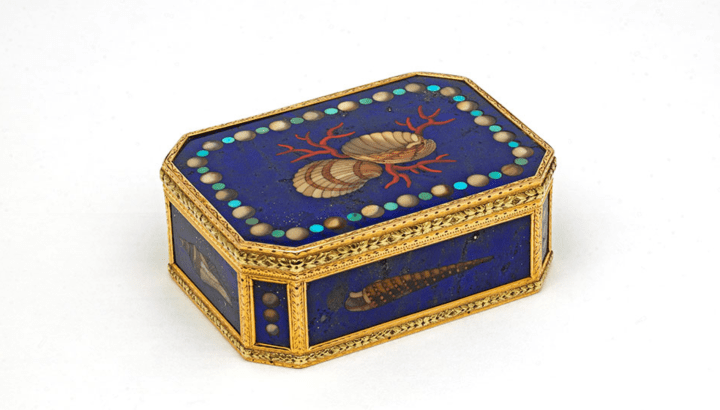
Rectangular, gold-mounted commessi di pietre dure (stone mosaics) snuffbox depicting shells and coral, Florence, Grand Ducal workshops, ca.1800
(The Rosalinde and Arthur Gilbert Collection on loan to the V&A)
◊ ◊ ◊ ◊ ◊
From the press release:
The Victoria and Albert Museum will double the size of its Gilbert Galleries in March 2026, unveiling seven newly transformed rooms dedicated to one of the world’s most dazzling collections of decorative arts. The free galleries will showcase masterpieces of silver, enamel, gold boxes, stone and glass micromosaics—including a monumental table-top made by Michelangelo Barberi for Tsar Nicholas I of Russia, newly revealed after pioneering laser cleaning by V&A conservators.
The transformation of the original gallery space will create the museum’s first double aspect gallery, overlooking both the John Madejski Garden and the Exhibition Road Quarter. The new gallery spaces have been achieved by incorporating adjacent former offices, re-opening historic brick archways and embracing natural sustainability through the reinstatement of original Victorian solar shading. As the only permanent V&A galleries devoted to a private collection the Gilbert Galleries offer a rare insight into the art of collecting and its role in shaping museums.
The new Gilbert Galleries have been designed by Citizens Design Bureau, the award-winning practice founded by Katy Marks, in their first collaboration with the V&A. The reopening marks the latest milestone in FuturePlan, the V&A’s ambitious programme of development at the South Kensington site which has transformed over 85% of the Museum’s public spaces in the past 15 years. FuturePlan combines world-class design with the restoration of the original building, creating inspiring new settings for the collections and ensuring greater access for all.
The galleries will showcase one of the world’s largest collections of glass micromosaics, now with a dedicated space allowing the majority of the objects in the Gilbert Collection to be seen together for the first time. Going on display for the very first time at the V&A are two large scale views of Rome by the master, Domenico Moglia. The large-scale format plaques, first shown in the UK at the Great Exhibition of 1851, depict views of the ruined Colosseum and the Roman Forum, intricately made with tiny pieces of coloured glass, some of only a few millimetres square. The glass micromosaic technique was developed in the 18th century in the Vatican Mosaic Workshop, which is still active today.
Over 200 gold boxes will take centre stage in a new room, displayed in the round to showcase their exquisite three-dimensional craftsmanship. Highlights include diamond-set snuffboxes commissioned by Frederick ‘the Great’ II of Prussia, including a mother-of-pearl box selected for the collection by Rosalinde Gilbert herself—offering a new lens on her role as collector and her career as a couture designer in London. Across the galleries, multisensory experiences will bring the collection to life—from touchable samples of rare stones to custom-blended scents—with extensive consultation ensuring inclusive design for neurodiverse visitors and those living with dementia. The galleries will also spotlight important new research into provenance. A dedicated room explores Nazi and Soviet looting, including the redisplay of two pairs of silver-gilt gates once taken from Kyiv-Pechersk Lavra monastery—the only examples of their kind outside the Orthodox world.
Tristram Hunt, Director of the V&A, said: “The Gilbert Galleries honour the transformative philanthropy of Rosalinde and Arthur Gilbert, celebrate some of the most exquisite works of art ever made, and now also explore the fascinating and sometimes complex histories behind them. As part of our FuturePlan transformation, this project combines cutting-edge design, pioneering conservation and the restoration of V&A South Kensington’s historic spaces to inspire creativity in every visitor.”
Alice Minter, Senior Curator of the Rosalinde & Arthur Gilbert Collection, said: “The Gilbert Collection is a feast for the eyes—from dazzling stone and glass mosaics and jewelled gold boxes to masterpieces of silver and enamel. With these new galleries, we can share the artistry of these extraordinary objects in more depth than ever before, while also asking important questions about their histories and journeys. It’s a chance for visitors to get closer to beauty, brilliance and craftsmanship on an intimate scale, but also to discover the personal stories of Rosalinde and Arthur Gilbert as collectors.”
Sir Arthur Gilbert (1913–2001, knighted in 2001) and his first wife Rosalinde (1913–1995) began their careers as fashion entrepreneurs in wartime London, showing at the V&A’s Britain Can Make It! exhibition in 1946 before moving to Los Angeles in 1949, where Arthur became a successful property developer. Their Beverly Hills home inspired a passion for historic objects, and from the 1960s they built an extraordinary collection of silver, gold boxes, enamel portrait miniatures and stone and glass mosaics, many once owned by figures such as Queen Charlotte, Tsarina/ Empress Catherine II of Russia, Frederick ‘the Great’ II of Prussia, Napoleon Bonaparte, Sir Robert and Horace Walpole, the Churchill and the Rothschild families. The collection was transferred to Great Britain in 1996 and has been in the care of the V&A since 2008.
Turner’s ‘Battle of Trafalgar’ Back on Display at Greenwich
◊ ◊ ◊ ◊ ◊
From the press release (via Art Daily) . . .
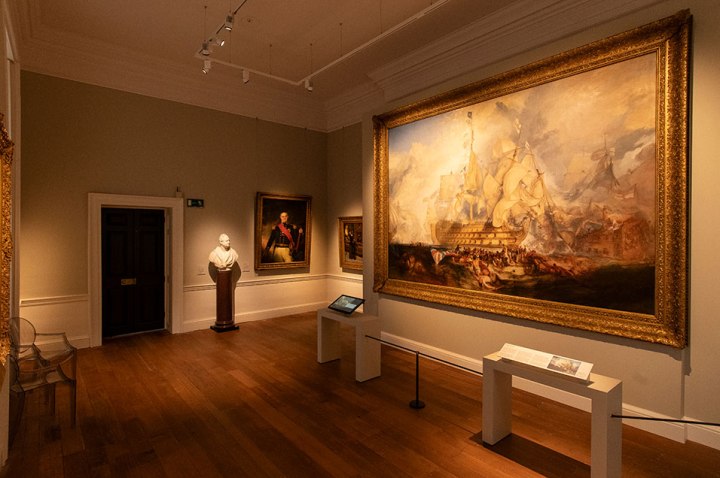
2025 marks the 250th anniversary of the birth of Joseph Mallord William Turner (1775–1851), one of Britain’s most admired Romantic painters. To commemorate this landmark anniversary, the National Maritime Museum is returning one of Turner’s most important masterpieces to display in the Queen’s House. The Battle of Trafalgar will be on public display from 21 October 2025, 220 years to the day since the Battle of Trafalgar.
Measuring more than three metres across, The Battle of Trafalgar is the largest painting that Turner ever completed. It commemorates the most decisive naval action of the Napoleonic Wars, the victory of the British Royal Navy over a combined French and Spanish fleet off Cape Trafalgar on 21 October 1805. The painting was made for King George IV in 1824—Turner’s only royal commission. It initially attracted criticism from naval officials, who complained about factual inaccuracies, but it was later acclaimed as a highlight of the Naval Gallery—a popular public art gallery set within the grounds of the Royal Hospital for Seamen at Greenwich.
In The Battle of Trafalgar, Turner captures the human drama of the action, from the struggles of the ordinary sailors to the fatal wounding of their commander, Vice-Admiral Horatio Nelson. The finished composition is a symbolic amalgamation of different moments in the battle. Nelson’s flagship, Victory, is depicted on an exaggerated scale, an artistic decision intended to emphasise the might of British naval power. The ship’s falling foremast, bearing the vice-admiral’s flag, symbolises Nelson’s demise. The signal flags spell the final three letters of ‘duty’, referencing both Nelson’s famous order, “England expects every man to do his duty,” and some of his dying words, “Thank God I have done my duty.”
The French ship Redoubtable, from which the fatal shot came, foundered in a storm after the battle but is depicted sinking in the thick of the action. In compressing the timeline, Turner emphasised the defeat of the Franco-Spanish fleet. However, while celebrating Britain’s triumph, Turner did not shy away from the brutal realities of naval warfare and encouraged respect and sympathy for sailors manning the ships on both sides of the conflict. In the centre of the image, at what would have been eye level when the painting was first displayed in St James’s Palace, the lifeless eyes of a dead seafarer gaze out. The Latin word ‘ferat’ appears in the water beside him, recalling Nelson’s motto, Palam qui meruit ferat (‘Let him who has earned it bear the Palm’). The palm referenced in the motto was a traditional symbol of victory, but the sailor’s suffering undermines this noble ideal of glory.
 In 1829, George IV had Turner’s The Battle of Trafalgar transferred from St James’s Palace to the Naval Gallery. Greenwich Hospital, where the gallery was situated, provided accommodation for elderly and disabled naval veterans, many of whom had served at Trafalgar. This made it a fitting home for Turner’s painting, given its emphasis on the labour and suffering of common sailors.
The painting was taken off display in March 2024 to protect it during a capital project at the National Maritime Museum. Its new home places it within the heart of the Museum’s fine art collection in the Queen’s House art gallery. It will be displayed alongside artworks from the Museum’s collection that tell the story of its journey from St James’s Palace to the Naval Gallery at Greenwich.
A new book has also been published celebrating this exceptional artwork. J.M.W. Turner’s The Battle of Trafalgar: Commemoration and Controversy is part of Royal Museums Greenwich’s new Spotlight series. Curator Katherine Gazzard considers the challenges that Turner faced during the creation of the painting, the public response to it and the fascinating history that led to its place at the centre of a national art collection.
Katherine Gazzard, J.M.W. The Battle of Trafalgar: Commemoration and Controversy (Greenwich: Royal Museums Greenwich, 2025), 96 pages, ISBN: 978-1068765995, £13.
Prado Acquires Pendant Paintings by François Boucher
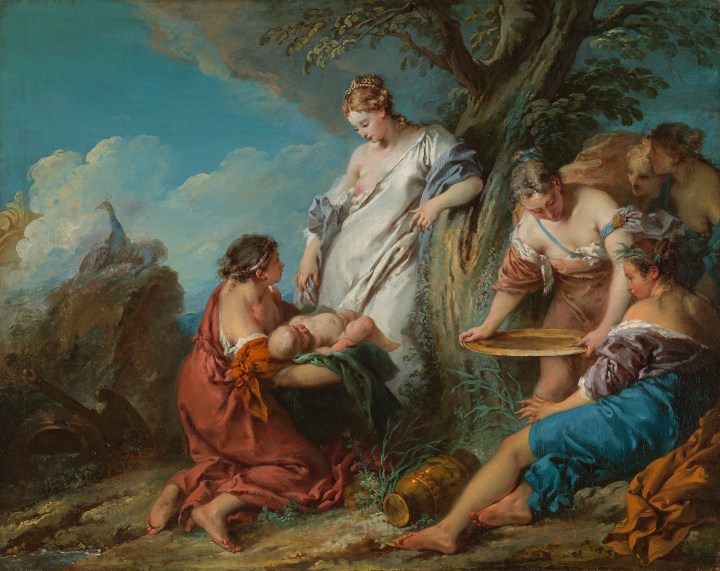
François Boucher, The Birth of Adonis, early 1730s, oil on canvas
(Prado: Museo Nacional del Prado)
◊ ◊ ◊ ◊ ◊
From the press release, via Art Daily:
The lavish, sensual world of French Rococo just got brighter in Madrid. The Museo Nacional del Prado has announced a major acquisition that cements its standing as a premier destination for 18th-century art: two exceptional mythological paintings by François Boucher, the undisputed star of the era. The newly acquired works, The Birth of Adonis and The Death of Adonis, offer a crucial glimpse into the early genius of Boucher (1703–1770), who would later become the court decorator par excellence for Louis XV and the favorite painter of Madame de Pompadour.
The two canvases, which cost €2.2 million, were purchased using funds generated by the generous bequest of Juan José Luna Fernández, a beloved former Prado curator and a pivotal scholar of French painting who passed away in 2020. His legacy—a Madrid home auctioned for €3.2 million—now beautifully bridges a research past with the museum’s artistic future.
Boucher’s interpretation of the Adonis myth—which blends love, tragedy, and eroticism in delicate pastoral settings—was perfectly suited to the refined taste of the Rococo. With the acquisition, the Prado can now tell a richer, more complete story of the artist. In The Birth of Adonis, Boucher captures the myth’s genesis, showing the sorrowful transformation of Myrrha into a tree, from which Adonis is born. The Death of Adonis, conversely, develops the tragic farewell scene between the goddess Venus and her lover after he is fatally wounded by a wild boar.
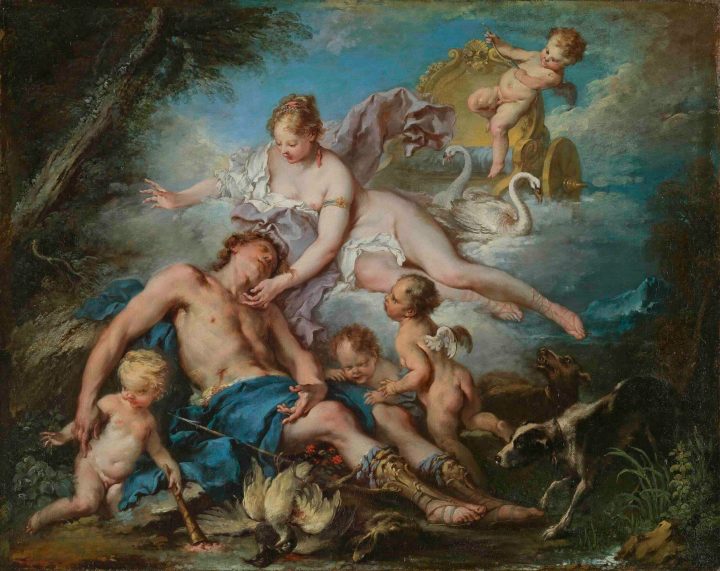
François Boucher, The Death of Adonis, early 1730s, oil on canvas
(Prado: Museo Nacional del Prado)
◊ ◊ ◊ ◊ ◊
These pieces were painted on the same bolt of canvas early in Boucher’s career, shortly after his return from Italy in 1731. They display a technical fluidity influenced by his predecessors Antoine Watteau and Sebastiano Ricci. The recent restoration not only brightened the luminous colors characteristic of Boucher but also revealed visible changes and the artist’s signature, confirming the works’ authenticity and offering a window into his creative process. The new paintings join another important Boucher work in the collection, Pan and Syrinx, which Luna was instrumental in acquiring in 1985. The newest additions powerfully expand the Prado’s representation of the Rococo master, complementing his mature style with a view of his formative years.
While Boucher’s glamorous, optimistic style—characterized by graceful lines and light color—was the height of courtly fashion across Europe, his works are comparatively scarce in Spanish collections. Historically, the Spanish Bourbon court favored Italian art or the stricter Neoclassicism championed by artists like Mengs. Boucher’s focus on gallant and mythological themes simply contrasted with the predominantly religious and historical tastes of the Spanish monarchy, meaning his major works largely remained tied to French aristocratic commissions. This acquisition, therefore, is not just a triumph of taste but an important historical correction. It gives the Spanish public access to the visual language of the 18th century’s great narrator and pays a final, fitting tribute to the curator who tirelessly championed his work.
To mark the occasion, Françoise Joulie, the world’s leading specialist on Boucher, will deliver a conference on November 12th at the Prado auditorium, inviting the public to delve deeper into the seductive genius of the artist who truly defined the spirit of the Ancien Régime.
V&A East Storehouse Opens
◊ ◊ ◊ ◊ ◊
The V&A Storehouse has now been open six weeks. The East London building, designed by Diller Scofidio + Renfro, houses some 250,000 objects, 350,000 books, and nearly 1,000 separate archives (with the David Bowie Collection scheduled to open in September). With costs undisclosed, estimates range from £64 to £100million (or more). I found the above video by Jessica ‘The Museum Guide’ to be helpful for conceiving of the space from afar. The storehouse is being compared to a cabinet of curiosities and IKEA. I’ll look forward to critical responses that aim to understand the project in terms of what a museum is now expected to be or do. There are obviously plenty of new things in play here; one would seem to be a new way of navigating the individual vs. group experience of a museum. –CH
From the V&A press release (28 May) . . .
• For the first time, visitors can step inside V&A East Storehouse—the V&A’s unique museum experience and busy working store designed by architects Diller Scofidio + Renfro.
• Visitors can now get closer to their national collections than ever before through the V&A’s radical new Order and Object experience—now live.
• Over 1,000 objects ordered so far—with the most-ordered object a 1954 Balenciaga evening dress.
• The largest Pablo Picasso work in the world—the rarely displayed Ballets Russes Le Train Bleu stage cloth—is now display for the first time in over a decade alongside a series of monumental objects from architect Frank Lloyd Wright’s 1930s Kaufmann Office to the 15th-century Spanish Torrijos ceiling.
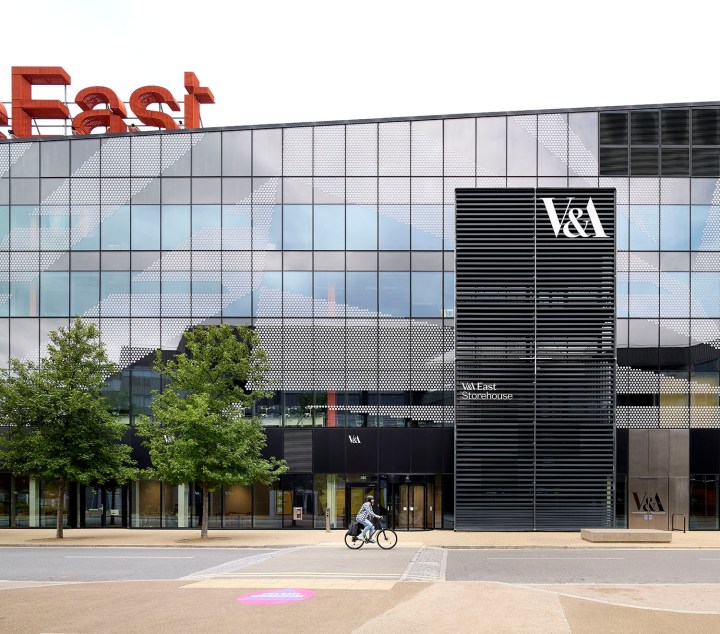 On Saturday, 31 May 2025, the V&A’s new working store and visitor attraction, V&A East Storehouse, opens its doors to the public for the first time following 10 years of planning and extensive audience consultation, with input from V&A East’s Youth Collective. Designed by world-renowned architects Diller, Scofidio + Renfro, it opens as part of East Bank, the new cultural quarter in the Queen Elizabeth Olympic Park supported by the Mayor of London.
A ground-breaking new museum experience spanning four levels, and at 16,000m2—bigger than 30+ basketball courts—V&A East Storehouse takes over a large section of the former London 2012 Olympics Media and Broadcast Centre (now Here East). It is a new purpose-built home for over 250,000 objects, 350,000 books, and 1,000 archives. A world-first in size, scale, and ambition, V&A East Storehouse immerses visitors in over half a million works spanning every creative discipline from fashion to theatre, streetwear to sculpture, design icons to pop pioneers. A busy and dynamic working museum store with an extensive self-guided experience, visitors can now get up-close to their national collections on a scale and in ways not possible before.
Tim Reeve, Deputy Director and COO, V&A, who developed the concept for V&A East Storehouse, said: “V&A East Storehouse is a completely new cultural experience and backstage pass to the V&A, transforming how people can access their national collections on a scale unimaginable until now. From conservation and how we care for our collections and cultural heritage around the world, to the artistry of our Museum Technicians and new research—there’s so much to discover. I hope our ground-breaking V&A East Storehouse opens to the public on Saturday 31 May visitors enjoy finding their creative inspiration and immersing themselves in the full theatre and wonder of the V&A as a dynamic working museum.”
Through the V&A’s radical new Order an Object service, anyone can now book to access any object at V&A East Storehouse, for free, seven-days-a-week. From mid-century furniture to ancient Egyptian shoes and Roman frescoes, an early 14th-century Simone Martini painting, Leigh Bowery costumes, Althea McNish fabrics, vintage band t-shirts and performance posters, and avant-garde fashion and couture from Balenciaga, Schiaparelli, Comme des Garcons, Issey Miyake and Vivienne Westwood, there’s something for everyone to explore. Since going live on 13 May, over 250 appointments have been booked to see over 1,000 objects from 14th-century and contemporary ceramics to a 17th-century carpet from Iran, 1930s wedding dresses and Julia Margaret Cameron photographs. So far, the most popular item ordered is a 1954 pink silk taffeta evening dress by Cristóbal Balenciaga.
Elizabeth Diller, Founding Partner, Diller Scofidio + Renfro, the firm that designed the architecture for V&A East Storehouse, said: “To celebrate the heterogeneity of the V&A’s collection of collections—spanning a broad variety of mediums, scales, and historical periods—visitors will experience a sense of being immersed in a vast cabinet of curiosities. The Collections Hall invites visitors to explore pre-curated works surrounding them, not according to conventional curatorial logics or standard storage taxonomies, but guided instead by their own curiosities. It has been a joy to work with the V&A’s curators and conservators in creating this new kind of institution: neither warehouse nor museum, but rather a hybrid shared by staff and the public with expanded opportunities for access and exchange.”
Museums Minister, Sir Chris Bryant said: “It’s great to see the V&A innovating in this way—V&A East Storehouse makes it possible for everyone to delve into a massive treasure trove of art, design and performance history in ways never seen before.”
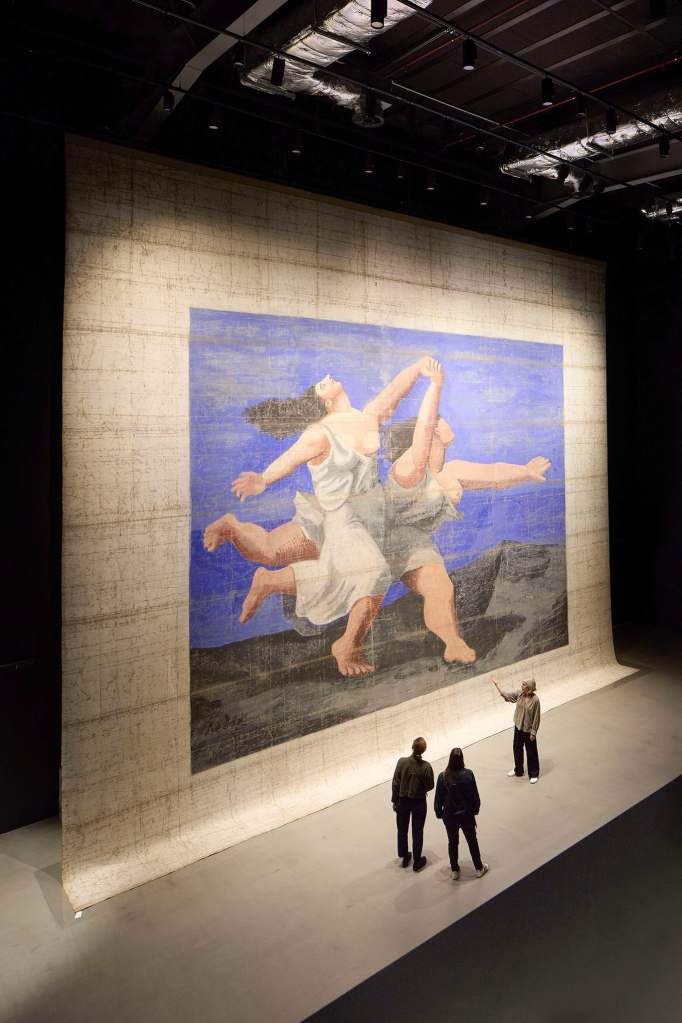 The Mayor of London, Sadiq Khan, said: “V&A East Storehouse is a brand-new, groundbreaking museum experience in East Bank, London’s new educational and cultural district, that will revolutionise access to the world’s leading collection of art, design and performance. I’m proud to be supporting this landmark project, which will allow Londoners and visitors to go behind the scenes for the first time ever and explore some incredible treasures, from Roman artefacts and modern-day music archives to the largest Picasso work in the world, all for free. It’s the next building to open at East Bank and marks a hugely significant moment in our work to create the most ambitious cultural development in decades, helping us to ensure London stays the creative capital of the world.”
From the moment they emerge into the central Weston Collections Hall, visitors will be captivated by stunning vistas across all levels, surrounded by a cross-section of the V&A’s collections. Spanning ancient Buddhist sculpture to PJ Harvey’s guitar, paintings by Angelica Kauffman’s circle, costumes worn by Vivien Leigh, works by Sir Frank Bowling and Hew Locke, items from the Glastonbury Music Festival, Suffragette scarves, vintage football shirts, Thomas Heatherwick’s model for the London 2012 Olympic Cauldron and road signs designed by Margaret Calvert, visitors can take their own path through over 100 mini curated displays hacked into the ends and sides of the storage racking.
Six large-scale objects anchor the space, on display for the first time in decades. Highlights include the 1930s Kaufmann Office, the only complete Frank Lloyd Wright interior outside of the US, an exquisite 15th-century carved and gilded wooden ceiling from the now lost Torrijos Palace in Spain, and a full-scale 20th-century Frankfurt Kitchen designed by Margarete Schütte-Lihotzky.
Also on show is a building section from Robin Hood Gardens, a former residential estate in east London, the 17th-century Agra Colonnade, an extraordinary example of Mughal architecture from the bathhouse at the fort of Agra, and the largest Picasso work in the world—a monumental Ballets Russes Le Train Bleu theatre stage cloth. At 10 metres high and 11 metres wide, the Picasso-signed stage cloth has been rarely seen since its debut in 1924. It is on display in the new David and Molly Lowell Borthwick Gallery of epic proportions, built to show the V&A’s striking collection of large-scale textiles and theatre stage cloths on rotation. These large objects are brought further to life with a series of co-production projects in collaboration with young east Londoners, communities, and creatives, highlighting multiple new voices and perspectives across the space, including oral histories, new films, publications, and artworks in response.
V&A East Storehouse is the first of V&A East’s two new cultural destinations to open in east London. The second, V&A East Museum, is scheduled to open in spring 2026 and celebrates making and creativity’s power to bring change. Created with young people and rooted in east London’s heritage, V&A East Museum spotlights the people, ideas, and creativity shaping global culture right now.
Newly Designed Galleries for Applied Arts of Europe Open in Chicago
◊ ◊ ◊ ◊ ◊
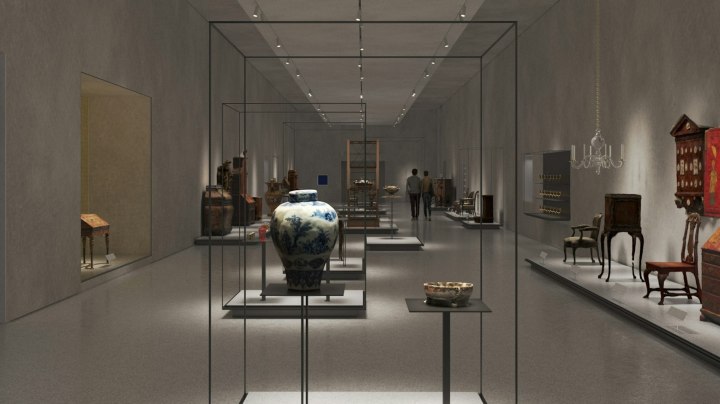
The new AIC galleries were designed by Barcelona-based architects Barozzi Veiga, who were hired in 2019 to produce a master plan for the museum campus, with future work funded in part by a $75million donation made in 2024 by Aaron Fleischman and Lin Lougheed. The new galleries are named for Eloise Wright Martin (1914–2008), a Life Trustee of the museum who endowed both the Museum Director and Curator of European Decorative Arts positions. From the press release:
Eloise W. Martin Galleries for the Applied Arts of Europe
Art Institute of Chicago, new installation open from 11 July 2025
Curated by Ellenor Alcorn, Christopher Maxwell, and Jonathan Tavares, with the assistance of Mairead Horton
The Art Institute of Chicago is pleased to open the newly designed Eloise W. Martin Galleries for the Applied Arts of Europe on 11 July 2025. The elegant space will present more than 300 objects from the Art Institute’s distinguished collections of furniture, silver, ceramics, and glass made between 1600 and 1900. The expanded presentation will allow 40% more objects to be on view than our previously installed galleries, and offer visitors a deeper and more nuanced exploration of European design during a period of extraordinary transformation.
This 4,500-square-foot space follows a chronological narrative and examines the dynamic intersection of design, craftsmanship, and commerce against a backdrop of geopolitical shifts, colonialism, and innovation. This setting provided fertile ground for designers, craftspeople, and consumers to embrace new technologies and respond to the allure of newly imported materials, such as Asian porcelain and lacquer and tropical hardwoods. Iconic works from the Art Institute’s collection as well as rarely seen pieces appear alongside new acquisitions and select loans from private collections, all presented with interpretive materials that emphasize the ingenuity of European makers working in increasingly global markets.
“We hope that this ambitious reinstallation allows visitors to consider the daring innovations of European designers during this vibrant period,” said Ellenor Alcorn, chair and Eloise W. Martin Curator of Applied Arts of Europe. “We are thrilled to present these objects in a space that invites close looking, deep reflection, and renewed appreciation for the craftsmanship and global influence that shaped design from the 17th through the 19th centuries.”
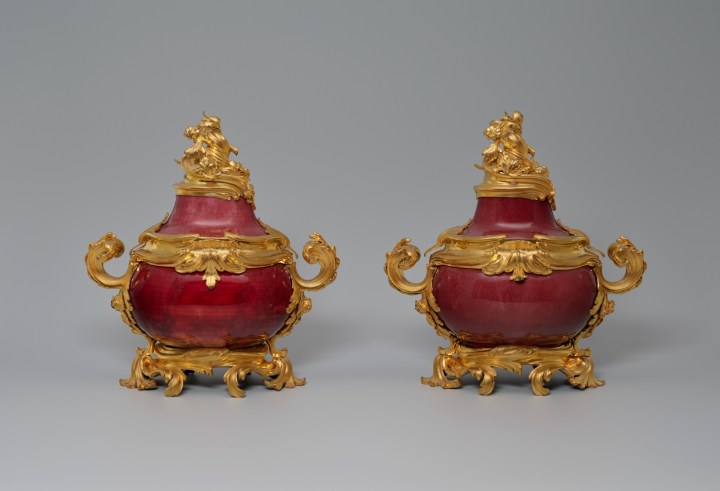
Pair of Chinese porcelain vases, with mounts attributed to Jean-Claude Duplessis, ca. 1750, hard paste porcelain and gilt bronze, 14 inches high
(Art Institute of Chicago, purchased with funds provided by the Antiquarian Society, 2021.135.1-2)
◊ ◊ ◊ ◊ ◊
Highlights of the collection on view include a finely carved chair crafted by Indian artisans for a European merchant in Madras (present day Chennai) in the late 1600s, a pair of rare red-glazed Chinese porcelain vases imported to Paris in the mid-1700s where they were mounted in exuberant gilded bronze, and a striking English neo-Gothic sideboard designed by William Burges in the mid-1800s, painted with witty wine-themed references. A dramatic new room is also dedicated to the Art Institute’s outstanding collection of European ceramics, including one of the country’s finest groupings of Meissen and Du Paquier porcelain.
The renowned Barcelona-based architects Barozzi Veiga have designed a striking contemporary space integrating state-of-the-art casework and lighting. The galleries offer a stunning setting for the creativity and innovation that defined European design during this dynamic period.
The reinstallation is curated by the department of Applied Arts of Europe: Ellenor Alcorn, chair and Eloise W. Martin Curator; Christopher Maxwell, Samuel and M. Patricia Grober Curator; and Jonathan Tavares, Amy and Paul Carbone Curator, with the assistance of Mairead Horton, research associate.
Eight New Acquisitions at Mia
From the press release (26 June 2025) . . .
The Minneapolis Institute of Art (Mia) announces the acquisition of eight exceptional works spanning nearly eight centuries, from a rare 13th-century Limoges enameled gemellion to contemporary photography by Carrie Mae Weems. These diverse acquisitions significantly strengthen key areas of the museum’s collection while addressing important gaps in others. Highlights include: a pair of monumental pedestals by Giacomo Raffaelli featuring the largest micromosaic compositions the artist ever attempted; an early Sèvres porcelain vase in the legendary ‘bleu nouveau’ glaze; a winter landscape by Blanche Hoschedé-Monet marking a pivotal moment in the artist’s emergence from Claude Monet’s tutelage; and a technically masterful Oribe tea bowl from early 17th-century Japan. Also acquired is the museum’s first Latin American colonial religious painting—a Virgin of Guadalupe painting attributed to the circle of artist Manuel de Arellano—that continues building one of Mia’s newer collecting areas.
“These remarkable acquisitions demonstrate our ongoing commitment to building a truly global collection that honors artistic excellence across time periods and cultures,” said Katie Luber, Nivin and Duncan MacMillan Director and President of Mia. “These works will enhance our visitors’ understanding of the diverse artistic traditions that have shaped human expression, from 13th-century France to 17th-century Japan, to the United States in the 2020s. Whether we are filling crucial gaps in our holdings—like our first colonial Latin American religious painting—or strengthening existing collections, our goal remains the same: to present the most compelling and comprehensive story of art’s power to illuminate the human experience across centuries and continents.”
Carrie Mae Weems (American, born 1953), Painting the Town #4, 2021 (printed 2024).
This pigment print by Carrie Mae Weems exemplifies the artist’s masterful ability to transform documentary photography into profound social commentary and significantly strengthens Mia’s contemporary photography holdings. At first glance, Painting the Town #4 appears to be an abstract composition of vibrant painted rectangles, reminiscent of Mark Rothko or Robert Motherwell. Closer examination reveals it to be a boarded-up Portland storefront—complete with knotty plywood and covered graffiti—photographed in 2021, during the aftermath of the 2020 protests following George Floyd’s murder. Weems’ art historical references are deliberate. By evoking abstract expressionist aesthetics in this pandemic-era streetscape, she lures in viewers but then confronts them with the raw signifiers of contemporary social upheaval. Part of her acclaimed Painting the Town series, this work represents the rare pandemic project that transcends mere documentation. One of America’s most influential living artists, Weems’ four-decade career has consistently given voice to silenced stories while investigating the intersections of history, identity, and power.
Circle of Manuel de Arellano, Virgen de Guadalupe, 1700–50.
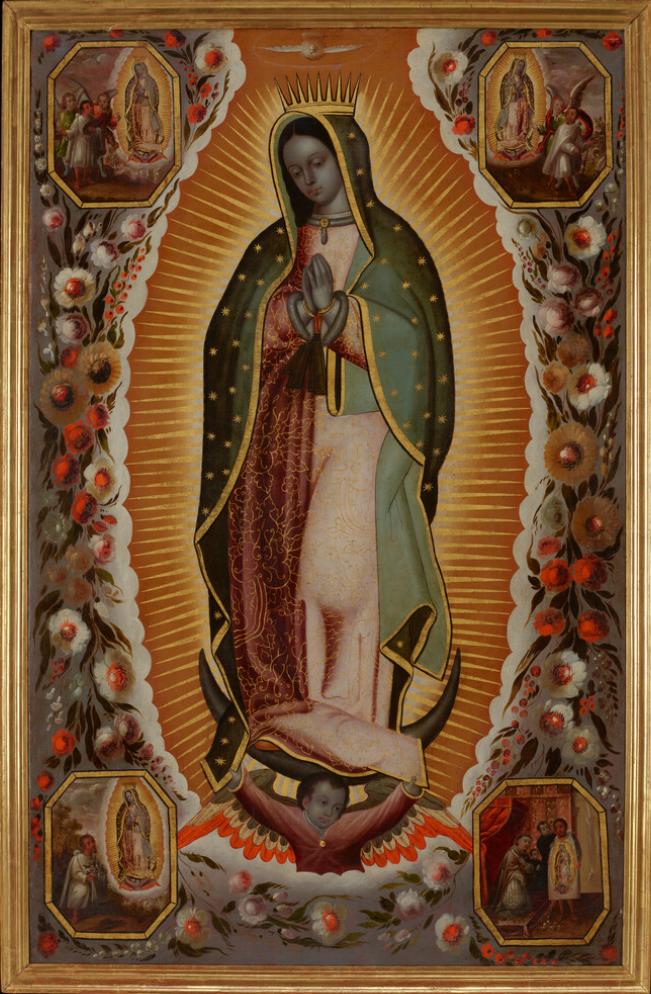
Circle of Manuel de Arellano, Virgen de Guadalupe (detail), 1700–50, oil on canvas (Minneapolis: Mia, The William Hood Dunwoody Fund, 2025.39).
This exceptional oil on canvas represents a pivotal addition to Mia’s collection as the first Latin American religious image from the colonial period, from which distinctive artistic traditions emerged with the Spanish imposition of Catholicism blending with Indigenous religions. Attributed to the circle of Manuel de Arellano, the renowned Mexican artist who, along with his father Antonio, operated a prominent studio in Mexico City during the late 17th and early 18th centuries, this work exemplifies the innovative approach the Arellanos brought to traditional Guadalupe iconography.
The Virgin of Guadalupe depicted here represents one of the most widely recognized and culturally significant religious images in the Americas—an enduring symbol, declared patroness of New Spain in 1746 and later empress of the Americas in 1933. The painting synthesizes diverse iconographic traditions: The dark-skinned Virgin wears a light-pink tunic with golden floral motifs and a star-covered blue mantle, standing on a crescent moon supported by an angel whose wings bear the colors of the Mexican flag. This blends the Virgin of the Apocalypse imagery from Revelation with Immaculate Conception iconography, while incorporating Indigenous elements that reflect the legend of the Virgin’s appearance to Juan Diego at Tepeyac Hill, a site sacred to the Aztec goddess Tonantzin.
Enameled gemellion with horse and rider, ca. 1250–75, Limoges, France.
This exceptional enameled gemellion represents a significant addition to the museum’s medieval collection and showcases the full splendor of Limoges champlevé enamel technique on gilded copper, demonstrating the workshop traditions that made this French city renowned throughout medieval Europe. Moreover, the rarity of this gemellion cannot be overstated—fewer than 110 examples of these Limousin hand-washing vessels are known to survive from the Middle Ages.
As a catch basin lacking the characteristic pouring spout, it represents half of what would have originally been a paired set, used for the ritualized washing of hands in both religious and secular contexts. The vessel’s secular iconography of horse and rider reflects the sophisticated courtly culture of the 13th century, when such imagery proliferated on luxury objects—many of which eventually found their way into ecclesiastical treasuries as pious donations. The object highlights the technical mastery of champlevé enameling, where colored glass is fused into carved copper channels and enhanced with precious gilding.
Giacomo Raffaelli (Italian, 1753–1836), Pair of marble, micromosaic, and gilt-bronze pedestals, 1790s.
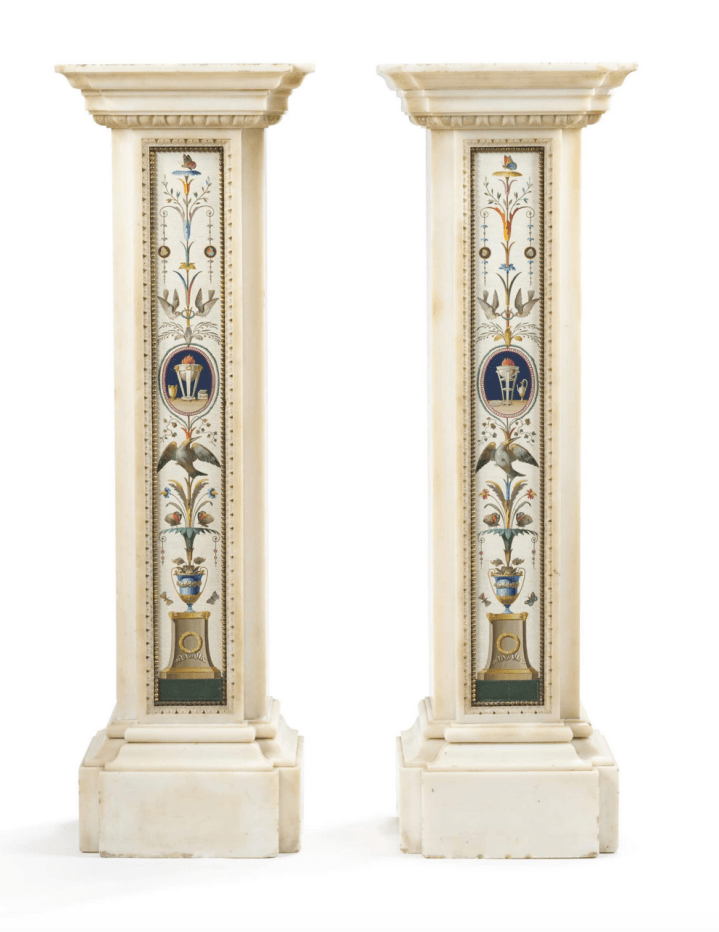
Giacomo Raffaelli, Pair of Italian marble, micromosaic, and gilt-bronze pedestals, 1790s, each 114 × 37 × 29 cm (Minneapolis: Mia, The Walter C. and Mary C. Briggs Trust Fund and gift of funds from John Lindahl, 2025.37.1.1, 2).
These pedestals by Giacomo Raffaelli represent the pinnacle of 18th-century Italian decorative arts by the undisputed master of micromosaic technique. The pedestals showcase his revolutionary approach to the ancient art of mosaic, employing tesserae so minutely crafted that hundreds—even thousands—fit within a single square inch, refining the art form to a new level that dates back to classical antiquity. Constructed from Carrara marble and enhanced with gilt bronze, these pedestals elevate the functional object of the pedestal to the realm of high art through their integration of precious materials and extraordinary craftsmanship. Moreover, the micromosaic panels on these pedestals are among the largest continuous compositions Raffaelli ever attempted, far exceeding the intimate scale of the snuffboxes and bonbonnières for which he is best known. The iconography—featuring birds, flowers, vases, and butterflies symbolizing Psyche and the soul—connects to the most prestigious commission of 18th-century Rome: Palazzo Braschi, the lavishly decorated residence of Pope Pius VI’s nephew. These objects reinforce Mia’s already strong collections of Italian 18th-century decorative arts—and will provide visitors with an unparalleled example of how Roman workshops operated during this golden age of decorative arts.
Sèvres Porcelain Factory (Paris, 1756–present), Greek vase with medallions, ca. 1765.
In the 1760s, the Manufacture Royale de Sèvres—the supreme expression of French state-sponsored artistry—moved away from Rococo frivolity toward the clarity of neoclassicism. This exceptional—and exceptionally rare—Greek vase exemplifies this dramatic shift, with its bold rectilinear Greek meander pattern encircling a form derived from a fluted column base. It also showcases the legendary ‘bleu nouveau’, the lapis lazuli imitation glaze that became an iconic color in French design. Only nine of these vases were ever produced. This pristine example strengthens Mia’s neoclassical collections, documenting a transformative period when European decorative arts shifted focus to the simplicity of classical antiquity. It is the earliest Sèvres porcelain in Mia’s collection and the museum’s first example of this celebrated 18th-century blue glaze technique.
Blanche Hoschedé-Monet (French, 1865–1947), Snowy Country Road, Le Val near Giverny, 1888.
This winter landscape by Blanche Hoschedé-Monet represents a pivotal moment in both the artist’s career and the broader story of Impressionism at Giverny. Painted in early 1888 when the artist was just 23, this oil on canvas captures the snowy country road leading to the family home she shared with her stepfather, Claude Monet. The work has been newly identified as her likely first submission to the Paris Salon, marking her emergence as an independent artist after five years of accompanying Monet on his daily painting excursions.
Hoschedé-Monet was Monet’s only true pupil and later became instrumental in completing his monumental Water Lilies cycles. Executed during Monet’s absence in Antibes, the painting embodies his hopes for her artistic development, as he wrote to her mother: “I hope that Blanche, left to her own devices, will make a serious effort.” The artist demonstrates remarkable technical sophistication in her handling of snow effects, balancing bold white impasto with subtle shadows of blue, gray, and green, while injecting warmth through delicate touches of pink and yellow. For Mia, this acquisition builds on the museum’s already strong collection of Giverny-related works, joining masterpieces by Claude Monet, Theodore Robinson, and Frederick Carl Frieseke.
Louis Welden Hawkins (French / born Germany, 1849–1910), Sa demeure, ca. 1899.
Louis Weldon Hawkins began his career as a naturalist painter before aligning himself with more radical symbolist circles in the 1890s. This enigmatic garden scene captures a moment of synthesis between these two styles: the composition is of a scene of nature, yet is filled with mysterious objects—a broom, bucket, rope, table, chairs, and blue cloth draped over a branch—that function as symbolic clues without revealing their meaning. The curving apple tree branch reflects the influence of Japanese prints on symbolist artists of the period, while two sensitively rendered chickadees perch as though engaged in secret conversation, adding to the work’s air of quiet mystery. Kept with its original frame, this mid-career work provides Mia’s visitors an exceptional opportunity to encounter the sophisticated visual poetry that defined symbolist painting at its height. Executed in an unusual, nearly square format that enhances its contemplative quality, Hawkins created a scene that is simultaneously specific and timeless. And the painting’s elusive title—Sa demeure (‘his home’, or ‘its home’)—further compounds its mysterious allegory.
Clog-shaped tea bowl with wisteria motif, early 17th century, Japan, Edo period (1603–1868).
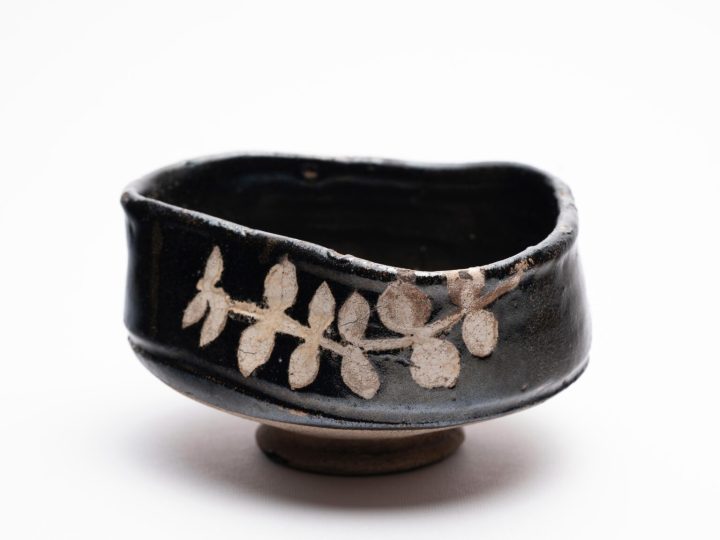
Clog-shaped tea bowl with wisteria motif, Japan, early 17th century. Mino ware, black Oribe type; glazed stoneware with glaze inlays (Minneapolis: Mia, The Mary Griggs Burke Endowment Fund established by the Mary Livingston Griggs and Mary Griggs Burke Foundation. 2025.45).
This clog-shaped tea bowl represents one of the most complex and labor-intensive examples of black Oribe ceramics, embodying the radical aesthetic experimentation that defined early 17th century Japanese tea culture. Named after the influential tea master and samurai Furuta Oribe, this style emerged from the Mino kilns of Gifu Prefecture during a brief but revolutionary period when tea practitioners pushed novelty to its limits, seeking what contemporaries described as the ‘warped’ (hizumitaru) aesthetic. The bowl’s sophisticated decoration—where black glaze was selectively scraped away and exposed areas were then filled with white clay slip, requiring each motif to be glazed separately rather than uniformly—demonstrates the extraordinary precision demanded by Oribe ware production. The horizontal spray of wisteria flowers, traditionally associated with early summer and typically depicted in vertical clusters, suggests this work may have been a special seasonal commission.
While Mia has an extensive Japanese ceramics collection, this work is a significant addition reflecting Japan’s enduring tea culture. The bowl’s deliberately triangular profile defies conventional ceramic forms. At the same time, its construction showcases exceptional technical mastery: after wheel-throwing and shaping, artisans omitted the traditional foot rim in favor of an intricately crafted, separately fabricated high-splayed foot with hollow interior, possibly influenced by imported glass or metalware bases. It captures a pivotal moment when Japanese tea masters embraced deliberate irregularity and bold innovation, forever changing the aesthetic landscape of ceremonial tea culture.










 Enfilade
leave a comment