After Restoration Tiepolo’s Bacchus and Ariadne Back on View in DC
Press release (25 May 2018) from the National Gallery in Washington:

Giovanni Battista Tiepolo, Bacchus and Ariadne, ca. 1743/1745, oil on canvas (Washington, DC: National Gallery of Art, Timken Collection).
Following a four-year-long conservation treatment, Giovanni Battista Tiepolo’s Bacchus and Ariadne (ca. 1743/1745) returns to public view at the National Gallery of Art, Washington, on 14 June 2018. The comprehensive restoration has revealed elements by the Venetian master hidden from view since the work was removed from its original location at the end of the 18th century. The dramatic results provide viewers with a new sense of the immense painting’s appearance at the time of its creation.
“The conservation of this remarkable work reveals significant discoveries about Tiepolo’s process and clues to the painting’s original home,” said Earl A. Powell III, director, National Gallery of Art. “This project also represents one of the many instances of rich collaboration between the Gallery’s team of conservators, scientists, and curators, all leaders in their field.”
Bacchus and Ariadne is believed to have been created to decorate the staircase of an unknown Venetian palace, only identified in a (now-lost) letter from 1764 by Tiepolo as the palace of “V.E.” The painting was probably one of four works—only three of which are known to survive—that each depicted a natural element. Bacchus and Ariadne represents earth, The Triumph of Amphitrite (Gemäldegalerie Alte Meister, Dresden) represents water, and Juno and Luna (Sarah Campbell Blaffer Foundation, the Museum of Fine Arts, Houston) represents air. The location of the fourth painting—which likely depicted Vulcan, the god of fire, and his wife, Venus—is unknown. A smaller example by Tiepolo of the same subject at the Philadelphia Museum of Art does, however, give a sense of what the painting may have looked like. All three of the extant paintings are connected by similar architectural motifs that would have tied them to their original locations, such as stone volutes at the top corners and long-necked, griffin-like forms in the bottom left and right corners. These architectural elements were likely painted over when the works were removed from their original setting, which according to curatorial records was done by 1798.
Treatment Details
The project’s painting conservator, Sarah Gowen Murray, worked closely with colleagues in painting conservation, scientific research, and preventive conservation to treat the painting and conduct analysis of the work. Overpaint removal uncovered tall vertical leaves on the left and right sides of the composition. Infrared imaging—conducted by John Delaney, senior imaging scientist—and analysis of cross-section samples of those areas—examined and interpreted by Barbara Berrie, head of the scientific research department—indicated that the leaves were originally bound together by gold ribbons. A precedent for the ribbons was established in another work by Tiepolo, Castigo dei Serpenti (The Scourge of the Snakes) (1732–1735) at the Gallerie dell’Accademia in Venice. These findings, archived documentation images, and other works by the artist were then consulted to reconstruct the missing elements with inpainting.
Other discoveries made during the treatment include indications of significant compositional changes made by Tiepolo, suggesting that Bacchus and Ariadne may have been the first painting of the series. X-radiographs exposed curved forms at the lower-right corner extending beneath the griffin and the jaguar—perhaps initial attempts by the artist to incorporate the composition into the work’s surrounding architecture.
Bacchus and Ariadne
Tiepolo’s painting magnificently depicts the moment before Bacchus, the god of wine, crowns Ariadne after falling in love with her. According to the myth, Bacchus discovered Ariadne on the shore of the island of Naxos where she was left behind by her lover, Theseus. Following this scene, Ariadne ascended to Mount Olympus, gaining immortality. Tiepolo’s rendering of the myth shows Bacchus sitting unsteadily atop a barrel with the glittering crown in hand. Bacchus is surrounded by revelers holding jugs of wine and grapevines, representing the fecundity of earth, while one of the jaguars that led his chariot rests beneath him. The wheat Ariadne wears in her hair and reeds held in her hand further symbolize the earth.
Following its removal from its original setting, Bacchus and Ariadne remained in private collections in Italy and Vienna before being sold in the late 1920s to William Robert Timken and Lillian Guyer Timken. The painting came to the Gallery in 1960 as part of the Timken Collection. Oliver Tostmann, now curator of European paintings at Wadsworth Atheneum, Hartford, contributed significantly to the understanding of Baccchus and Ariadne and its counterparts when he was a Joseph McCrindle Fellow and then Andrew W. Mellon Fellow at the National Gallery from 2007 to 2011.
New Exhibitions at Monticello Include Life of Sally Hemings
Sarah Stockman reports on the Sally Hemings exhibition for The New York Times (16 June 2018), and the Monticello website now provides extensive information on Hemings. From the press release (7 June 2018) from Monticello:
 On June 16, in conjunction with national Juneteenth events, Thomas Jefferson’s Monticello will welcome a gathering of descendants of enslaved families, commemorate 25 years of its Getting Word Oral History Project, and unveil new exhibits and restored spaces, including a groundbreaking exhibit on Sally Hemings.
The opening marks the conclusion of a five-year restoration initiative, known as The Mountaintop Project. Initiated by a transformational gift from David M. Rubenstein in 2013, the project has made possible a total of nearly 30 new restored or recreated spaces and exhibits. Iconic rooms, on every level of the house, received updated interpretation or were restored for the first time. On Mulberry Row, buildings were physically and virtually restored or reconstructed. Together, these spaces illuminate the stories of individuals and families, and reveal how the lives of the free and enslaved were interwoven.
“In Jefferson’s words, we ‘follow truth wherever it may lead,’” said Leslie Greene Bowman, president and CEO of the Thomas Jefferson Foundation. “This transformation of Monticello—made possible by decades of research, hundreds of descendants, and thousands of donors—brings forward a more honest, relevant, and inclusive view of our history.”
On June 16, six new exhibits and restored spaces will open for the first time, including:
• The Life of Sally Hemings — an immersive digital exhibit, anchored in the South Wing where she once lived, that relies on the words of her son, Madison, to explore her life and legacy;
• The Getting Word Oral History Project — an exhibit on the enslaved families of Monticello and their descendants;
• Martha Wayles Skelton Jefferson — an exhibit which provides fresh insights into the life of Jefferson’s wife, located in the first building erected at Monticello;
• The Granger-Hemings Kitchen — an exhibit on Monticello’s first kitchen and new archaeological discoveries that reveal the stories of enslaved cooks, Ursula Granger, James Hemings, and Peter Hemings;
• The Dairy — a restored, period room where enslaved workers made cream, butter and soft cheese for the household; and
• The Textile Workshop — a restored ca. 1775 structure featuring an exhibit about Mulberry Row and a room depicting the factory where enslaved women and children turned cotton, hemp, and wool into cloth for enslaved people and enterprise.
For years, visitors have learned about Sally Hemings on tours of Monticello. Now, for the first time, her story will have a dedicated physical space on the mountaintop.
“It represents a different chapter in public history at Monticello,” said Annette Gordon-Reed, author of The Hemingses of Monticello: An American Family and professor of history at Harvard University. “It will have a ripple effect on the way people think about slavery on the mountain overall and that’s actually very exciting.”
To commemorate the occasion and celebrate 25 years of the Getting Word Oral History Project, Monticello is hosting a free public event and a gathering for descendants of enslaved families. The gathering is expected to be the largest reunion of descendants of enslaved families in modern history.
The Look Closer opening event will feature Pulitzer Prize-winning authors Annette Gordon-Reed and Jon Meacham, violinist Karen Briggs, patriotic philanthropist David M. Rubenstein, national policy analyst Melody Barnes, and more. Visitors will also have the opportunity to see a rare version of the Emancipation Proclamation, signed by Abraham Lincoln and generously loaned by David M. Rubenstein. It will be on view in the Robert H. and Clarice Smith Gallery at the David M. Rubenstein Visitor Center from June 11 through July 11, 2018.
London Art Week, Summer 2018 / Launch of Tomasso XXV
From London Art Week:
London Art Week, Summer 2018
28 June — 6 July 2018
London Art Week is a twice-yearly event, offering the best of pre-contemporary art in London’s traditional fine art district. From Ancient sculptures to Old Master drawings and post-Impressionist paintings, London Art Week offers visitors the chance to see, and buy, extraordinary works. For seasoned collectors as well as those simply curious to learn more about art, London Art Week dealers are always on hand and delighted to share their knowledge and expertise. Talks and events are scheduled throughout the week, delivered by some of the UK’s most distinguished art historians and curators. There is no tent: visitors have the luxury of discovering masterpieces within our beautiful gallery spaces, all situated within walking distance.
From the press release for Tomasso Brothers Fine Art:
Catalogue Launch of Tomasso XXV: A Celebration of Notable Sales
Tomasso Brothers, London, 28 June — 6 July 2018
 For the summer edition of London Art Week 2018, Tomasso Brothers Fine Art is proud to present a new publication, Tomasso XXV, a celebratory catalogue marking the many notable sales made in 25 years of activity. London Art Week runs from 29 June to 6 July 2018, and copies will be available at Marquis House, 67 Jermyn Street, St. James’s, the London gallery of Tomasso Brothers.
The catalogue features more than 50 works ranging from bronze sculptures to oil paintings, and dating from antiquity to the late Neoclassical periods, demonstrating the breadth and quality of works sold by Tomasso Brothers to museums and private collectors the world over. Tomasso Brothers Fine Art is recognised internationally for specializing in important European sculpture, thus works in wood, terracotta, marble, and bronze feature prominently; however, Dino and Raffaello Tomasso are also passionate about fields such as Old Master paintings and objets d’art, represented here by fabulous examples.
The historic sales illustrated in the catalogue range from distinctive sketches, such as Joseph Nollekens’s (1737–1823) terracotta rendering of a pensiero of Eve Bewailing the Death of Abel, now in the Metropolitan Museum of Art, New York, to rare bronzes, such as the Pacing Bull from a ‘Rape of Europa’ group, executed in Padua around 1520–25, re-united with its original figure of Europa thanks to Tomasso Brothers, at the Kunsthistorisches Museum, Vienna; and from the powerful, such as the triumphant Julius Caesar carved in limewood by Giambologna (1529–1608), a statuette now known to be not only the earliest recorded work by the master but also the only surviving sculpture that he executed in wood (today in a private collection, Antwerp), to the intimate, such as Nymph Entering a Bath by Richard James Wyatt (1795–1850) one of the foremost British heirs of Canova, which sold last year from Tomasso Brothers’ Canova and his Legacy exhibition to the Yale Center for British Art, New Haven.
Other highlights in the catalogue are a pair of portraits by the master of miniatures Jean-Étienne Liotard (1702–1789) depicting Prince Charles Edward Stuart (1720–1788) and Prince Henry Benedict Stuart (1725–1807) which, subsequent to their presentation and sale (to a private collection, Germany) by Tomasso Brothers at TEFAF 2015, were shown in the Liotard exhibition at London’s Royal Academy, 2015/2016; a white marble Farnese type bust of Emperor Caracalla by Joseph Claus (1718–1788), a milestone in the development of early Neoclassicism in Rome and a signature work by one of the most accomplished German sculptors of the eighteenth century, now with the Saint Louis Art Museum; and a high-relief, boxwood panel by Grinling Gibbons (1648–1721), a magnificent demonstration of sculptural bravura on a reduced scale and one of the earliest known works by Gibbons, who is widely considered to be Britain’s greatest woodcarver. As attested by the presence of the coat of arms of the Barwick family from Yorkshire, which is visible on a harp in the foreground, the panel, likely carved in York (where Gibbons trained under John Etty after arriving from Rotterdam around 1667) now resides at Fairfax House Museum, York, United Kingdom.
The catalogue also illustrates some major rediscoveries by Tomasso Brothers Fine Art, including The Triumph of Autumn by Jacob Hoefnagel (1573–1632/35), an exquisite oil on copper, signed and dated 1605, painted in Rome for the Holy Roman Emperor Rudolf II (1552–1612), and The Death of Saint Peter Martyr by Giovanni Girolamo Savoldo (c.1480–c.1548), a protagonist of Venetian Renaissance painting, renowned for the hushed brilliance of his palette and uniquely atmospheric quality of his compositions, now in the Art Institute of Chicago.
Bilbao Acquires Paret’s ‘Triumph of Love over War’

Luis Paret y Alcázar, The Triumph of Love over War (Mars), 1784, oil on canvas, 82 × 160 cm (Bilbao Fine Arts Museum). One of a pair of lunettes, this latest acquisition is reunited with its pendant, which entered the museum’s collection in 1999.
◊ ◊ ◊ ◊ ◊
Press release (29 May 2018) from the Bilbao Fine Arts Museum:
The collector Alicia Koplowitz has donated a painting by Luis Paret y Alcázar (Madrid, 1746–1799) to the Bilbao Fine Arts Museum. It will be presented to the public within the context of the exhibition 110 Works 110 Years as a tribute to the generosity and philanthropic spirit of the individuals whose donations have contributed over the years to the creation and growth of the collection.
With this donation the museum has increased its already outstanding representation of the artist’s work, comprising eight paintings: The Divine Shepherd (1782), View of Bermeo (1783), The Triumph of Love over War (two lunettes forming a pair) (1784), View of El Arenal in Bilbao (1783–84), Scene with Villagers (fragment) (1786), View of Fuenterrabía (fragment) (1786), and The Virgin Mary with the Infant Christ and Saint James the Greater (1786).
These works by Paret entered the collection by different means: through the founding donations made by the City Council of Bilbao (The Divine Shepherd and The Virgin Mary with the Infant Christ and Saint James the Greater in 1913); acquisitions made by the museum (View of Fuenterrabía in 1986 and The Triumph of Love over War in 1999); donations (Scene with Villagers donated by Plácido Arango in 1996—which has been reunited with the other fragment of the same composition, View of Fuenterrabía—and the present donation by Alicia Koplowitz); the donation in lieu of tax by BBVA presented to the museum by the Provincial Council of Bizkaia (View of El Arenal in Bilbao in 1996); and the acquisition made with funding from BBK and from contributions by the Friends of the Museum (View of Bermeo in 2017).
Luis Paret y Alcázar lived in Bilbao between 1779 and 1789 during part of his exile ordered by Charles III as a consequence of his participation in the licentious lifestyle of the King’s younger brother, the Infante don Luis de Borbón. During that time Paret produced a body of mature work that included religious commissions, allegorical compositions, and the series of views of Cantabrian ports, which began with View of Bermeo (1783)—acquired by the museum in December 2017—and continued from 1786 with a commission from Charles III.

Luis Paret y Alcázar, The Triumph of Love over War (Venus), 1784, oil on canvas, 82 × 160 cm (Bilbao Fine Arts Museum).
This period saw the execution of The Triumph of Love over War, which now enters the museum as a donation and will once again form a pair with another work of the same title and characteristics. Both were previously in a private English collection. The one that entered the museum first was sold on the art market in the late 1990s, shortly after which it was acquired by the museum. In 2017 its pendant, now donated by Alicia Koplowitz, went on the market. The two lunettes are now reunited after two decades, “in one of those happy coincidences that are rare in the museum world” in the words of Manuela Mena in the book published by the museum to mark this donation.
The two paintings are unusual within Paret’s output due to their format and dimensions (two lunette-shaped canvases each measuring approximately 81 × 160 cm), which are notably different to his easel paintings, all of small size. The recent cleaning undertaken in the museum’s Conservation and Restoration Department has revealed a grey strip added around all sides of the canvas in a previous restoration. It would seem that it was probably added when the lunettes were separated from their first location as it seems likely that they were originally set into the wall in a room within white stucco frames with decorative gilt motifs in the 18th-century taste.
The pictorial technique also differs from that of the artist’s small, Rococo-style paintings which are characterised by a delicate, transparent brushstroke and an emphasis on detail. Here Paret’s handling is much freer and more energetic, undoubtedly because the lunettes were conceived to be hung high up, facing each other and with a di sotto in sù (from below to above) perspective. The use of similar tonalities and pictorial devices in the two works (such as the modelling of the volumes through small brushstrokes) confirms that they were executed at the same time, were intended for the same space, and thus had a complementary iconographic programme. With regard to their subject matter, both compositions depict infant nudes framed by garlands of flowers and on the point of undertaking actions that will connect them: the one on the right is about to let loose a dove which will ‘fly’ towards the sleeping boy in the lunette on the left. On waking, he in turn will ‘shoot’ his arrow with three roses strung on it. The skin colour and more decorous pose of the first figure suggests that she is a depiction of the infant Venus wearing a laurel wreath as a symbol of the triumph of Love over Mars, represented by the boy in the other lunette.
More information is available in this article:
Manuela B. Mena Marqués, “The Triumph of Love,” online available at http://www.museobilbao.com/pro/uploads/salas_lecturas/archivo_in-81.pdf. Original text in Spanish in Luis Paret y Alcázar [1746–1799]: El triunfo del Amor sobre la Guerra: Donación Alicia Koplowitz (Bilbao: Bilboko Arte Ederren Museoa = Museo de Bellas Artes de Bilbao, 2018), pp. 6–33.
The Clark Acquires Lethière’s ‘Brutus Condemning His Sons’
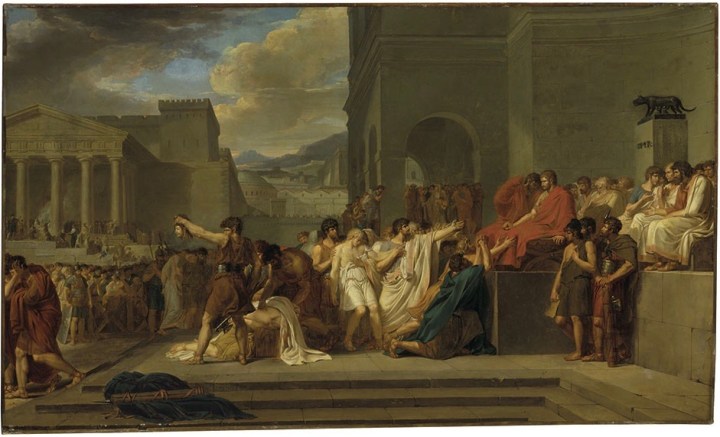
Guillaume Guillon Lethière, Brutus Condemning His Sons to Death, 1788, oil on canvas, 23 × 39 inches
(Williamstown: The Clark Art Institute)
◊ ◊ ◊ ◊ ◊
Press release (22 May 2018) from The Clark:
The Clark Art Institute today announced the recent acquisition of Brutus Condemning His Sons to Death, an important early work by neoclassical French artist Guillaume Guillon Lethière (1760–1832), marking a significant addition to its permanent collection.
Completed in 1788 when Lethière was at the French Academy in Rome, and subsequently displayed at the Salons of 1795 and 1801, the painting depicts a dramatic scene featuring the decapitation of one of the sons of Lucius Junius Brutus. Brutus led the 509 BC revolt to overthrow the last king of Rome and establish the Roman Republic, swearing a sacred oath before its citizens that Rome would never again be subject to the rule of a king. When his two sons were later discovered to be among the conspirators attempting to restore the monarchy, Brutus demonstrated his commitment to the Republic by ordering and then witnessing the execution of his own children. Painted before the onslaught of the French Revolution, Lethière’s composition is eerily prescient in its moralizing message and its brutal iconography. Brutus’s willingness to prioritize the interests of his country above his own made him an exemplar of Republican duty and stoicism. The tale inspired Voltaire and other leaders of the French Enlightenment to establish Brutus as a foundational hero of the French Republic. Brutus Condemning His Sons to Death is the first of two paintings on the subject executed by Lethière. The second version is in the collection of the Musée du Louvre, Paris.
“We are truly thrilled to add this magnificent painting to our permanent collection,” said Olivier Meslay, the Hardymon Director of the Clark. “This is Guillaume Guillon Lethière’s masterpiece, and it is a transformative moment for our collection. Brutus Condemning His Sons to Death is important both for its masterful execution and for its place in the canon of world and art history. It is an iconic and prophetic painting that struck a chord with the French public at a moment when history’s role in understanding and interpreting contemporary issues was perhaps never more instructive or imperative.”
The painting has been in private hands for more than two centuries. A preparatory drawing by Lethière (ca. 1788) and a stipple engraving dated 1794 by Pierre Charles Coqueret (Paris 1761–1832) after Lethière’s painting were also acquired. The purchase, made at auction, was approved by the Clark’s Board of Trustees according to the Institute’s acquisitions policies, and funded through a special art acquisition fund.
Noted scholar Henry Louis Gates, the Alphonse Fletcher University Professor and Director of the Hutchins Center for African and African American Research at Harvard University, said of the acquisition, “I was delighted to hear that the Clark has acquired an important painting by Guillaume Guillon Lethière, who is widely recognized as the first major French artist of African descent. His celebration as an artist of great skill and significance is long past due.” Gates edits The Image of the Black in Western Art (Harvard University Press and the W. E. B. Du Bois Research Institute at the Hutchins Center for African and African American Research) along with David Bindman, professor emeritus of art history at University College London. The landmark research project and publication series is devoted to the systematic investigation of how people of African descent have been perceived and represented in art. A synopsis of Lethière’s career is featured in Vol. 3.3 of the publication.
“The significance of this painting cannot be overstated,” said Esther Bell, the Clark’s Robert and Martha Berman Lipp Senior Curator of Painting and Sculpture. “Completed early in Lethière’s career, this is an icon of French painting and French history. By 1788, the twenty-eight-year-old Lethière was already in full command of his talent. Lethiere likely could not have imagined it at the time, but his painting would be publicly exhibited during the height of the French Revolution, and would inspire his contemporaries to contemplate the democratic principles at the heart of their tumultuous society. Like his contemporary, Jacques-Louis David, Lethière played a critical role in promoting the artistic tenets of the Enlightenment.”
Bell led the Clark’s effort in pursuing the acquisition of the Lethière painting and related works on paper.
“It is an exhilarating moment for the Clark,” Bell noted. “I look forward to installing the Lethière in our galleries and sharing the story of this painting and this important artist with our visitors.”
While the unlined painting is “in remarkably good condition,” Bell said the objects will undergo examination and conservation before going on view in the Clark’s galleries later this year.
Future programmatic plans include an exhibition related to Lethière’s work and an introductory lecture by Bell when the painting goes on view in the Clark’s galleries.
About Guillaume Guillon Lethière
The life and career of Guillaume Guillon Lethière (1760–1832) are extraordinary. Born in the French colony of Guadeloupe, he was the son of Pierre Guillon, a French government official, and Marie-Françoise Pepayë, an emancipated African slave. He was called “Le Thière,” a reference to his status as his father’s third illegitimate child. Lethière moved to France with his father at the age of fourteen, studying with Jean-Baptiste Descamps in Rouen for three years before entering the studio of Gabriel-François Doyen at the Académie Royale de Peinture et de Sculpture in Paris. He submitted works for the Prix de Rome in 1784 and 1786 and secured a Roman pension in 1786.
Lethière remained in Rome until 1791 before returning to Paris, where he opened a studio that competed with that of Jacques-Louis David. His ethnicity caused Lethière’s contemporaries to refer to him as a “man of color” and “l’Americain.” Napoleon’s brother Lucien Bonaparte was his close supporter, and he was rumored to have fathered an illegitimate child with Lethière’s wife while on a group trip to Spain in 1801. On his return to Paris, Lethière killed a soldier during a dispute, and as a result, his studio was closed by government officials. Despite this, Lucien Bonaparte interceded on the artist’s behalf, helping him to secure an appointment as the Director of the Académie de France in Rome at the Villa Medici. Pensionnaires at the academy during Lethière’s tenure as director from 1807–1814 included Jean-Auguste-Dominique Ingres, Merry-Joseph Blondel, and David d’Angers, among others. During this time, Ingres sketched Lethière (Morgan Library & Museum) as well as members of his family, as evidenced in the beautiful sheet, Madame Guillaume Guillon Lethière and her son Lucien Lethière (Metropolitan Museum of Art).
With the Bourbon Restoration, Lethière lost his position as director in Rome and returned to Paris, where he took on private students. After initially being rejected—likely on the basis of either his race or his political alignments—Lethière was admitted to the Institut de France in 1818. He was awarded the Légion d’honneur in the same year. In 1819, he became a professor at the École des Beaux-Arts, where he worked until his death. His studio included several students from Guadeloupe, notably Jean-Baptiste Gibert and Benjamin Rolland. Despite living the majority of his life in France, Lethière’s strong identification with his place of birth never diminished.
In 1822 Lethière sent a monumental canvas measuring thirteen by ten feet, Oath of the Ancestors, as a gift to the Haitian people commemorating the nation’s independence and resistance to colonization. The painting represents the alliance of a black officer and a slave leader standing under God; it hung in the cathedral of Port-au-Prince until it was moved to the presidential residence. Although the painting sustained significant damage as a result of the 2010 Haitian earthquake, it has since been restored and is one of Haiti’s most celebrated cultural assets. Lethière signed this work with his name and dual-national identities, noting both his birthplace as Guadeloupe and his then-current residence in Paris.
Lethière, along with Jacques-Louis David and Jean Germain Drouais, ranks as one of the most important neoclassical artists of the late eighteenth- and early nineteenth-centuries.
About the Acquisition
The Clark’s acquisition includes three works:
Guillaume Guillon Lethière (Sainte-Anne, Guadeloupe 1760–1832 Paris)
Brutus Condemning His Sons to Death, 1788
Oil on canvas
23 × 39 inches (59.4 × 99.1 cm)
Guillaume Guillon Lethière (Sainte-Anne, Guadeloupe 1760–1832 Paris)
Brutus Condemning His Sons to Death, c. 1788
Black chalk, brush with brown and gray washes
14 × 24.5 inches
Pierre Charles Coqueret (Paris 1761–1832) after Guillaume Lethière
Brutus Condemning His Sons to Death
Stipple engraving on laid paper, 1794
Image: 22.5 × 39 inches, Sheet: 27 × 42.5 inches
Provenance
Raymond collection, 1801
Private collection, Paris, from whom acquired by the present owner
Newly Redeveloped RA Campus Opens on 19 May 2018
From the press release:
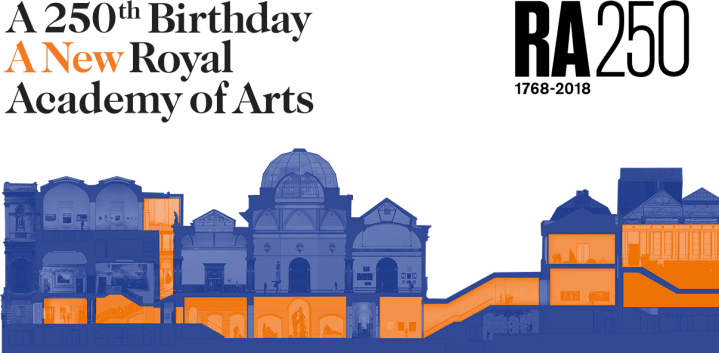
The Royal Academy of Arts, the world’s foremost artist and architect-led institution, will open its new campus to the public on Saturday 19 May 2018 as part of the celebrations of its 250th anniversary year. Following a transformational redevelopment, designed by internationally- acclaimed architect Sir David Chipperfield CBE RA and supported by the National Lottery, the new Royal Academy will open up and reveal more of the elements that make the RA unique—sharing with the public historic treasures from its Collection, the work of its Royal Academicians and the Royal Academy Schools, alongside its world-class exhibitions programme.
One of the most significant outcomes of the redevelopment is the link between Burlington House and Burlington Gardens, uniting the two-acre campus. This will provide 70% more space than the RA’s original Burlington House footprint, enabling the RA to expand its exhibition programme and to create new and free displays of art and architecture across the campus for visitors year-round. From dedicated galleries to surprising interventions, a dynamic series of changing exhibits and installations will present the living heritage of the Royal Academy; exploring its foundation and history in training artists as well as showcasing contemporary works by Royal Academicians and students at the RA Schools. To animate the displays, a new range of free tours, taster talks and object handling stations will be available to visitors.
Tacita Dean: LANDSCAPE (19 May — 12 August 2018) will inaugurate the new Gabrielle Jungels-Winkler Galleries in Burlington Gardens. With Art Fund support, the exhibition is part of an unprecedented collaboration with the National Portrait Gallery and the National Gallery in London. It will showcase the internationally-renowned visual artist and Royal Academician Tacita Dean who will explore the genre of landscape in its broadest sense: intimate collections of natural found objects, a mountainous blackboard drawing and a major new, two screen 35mm film installation, Antigone, that uses multiple exposures to combine places, people and seasons into the single cinematographic frame. Antigone was funded in part through the support of the Laurenz Foundation-Schaulager and its founder Maja Oeri; and VIA Art Fund.
The magnificent new Royal Academy Collection Gallery will present The Making of an Artist: The Great Tradition highlighting works from the RA Collection, including the Taddei Tondo by Michelangelo and the RA’s almost full-size sixteenth-century copy of Leonardo da Vinci’s The Last Supper, along with paintings by Reynolds, Kauffman, Thornhill, Constable, Gainsborough, and Turner. Selected by the President of the Royal Academy, Christopher Le Brun, it will focus on the first sixty years of the RA, juxtaposing masterpieces from the RA’s teaching collection with Diploma Works by past Royal Academicians. The display of the RA Collection has been supported by the Blavatnik Family Foundation.
The Architecture Studio within The Dorfman Senate Rooms will provide a creative space that invites audience engagement with innovative and critical ideas on architecture and its intersection with the arts. It will open with Invisible Landscapes (19 May 2018 — March 2019), explored in three ‘Acts’ of immersive interventions looking at the impact and future of technology in people’s environments. In contrast, recently conserved historical architectural casts on display in The Dorfman Architecture Court will convey the history of teaching architecture: the tradition of learning to draw from casts of buildings.
Located at the entrance to the Weston Bridge, which connects Burlington Gardens into Burlington House, The Ronald and Rita McAulay Gallery will stage site-specific installations by Royal Academicians. The first major work will be Tips for a Good Life by Bob and Roberta Smith RA (September 2018 – September 2019), on the subject of gender in the history of the RA.
Moving through to Burlington House, visitors will arrive at the Weston Studio. Located within the heart of the Royal Academy Schools, the Weston Studio will bring the ethos and thinking of the RA Schools’ postgraduate programme to a changing contemporary series of two displays a year and projects developed by students and graduates. It will open with a group exhibition of works by first year students, revealing their rich use of subjects, approaches, methods, and materials.
Going back in time, The Vaults will exhibit The Making of an Artist: Learning to Draw a formidable selection of plaster casts from the early years of the RA Schools displayed together with works on paper from the RA’s teaching collection, illustrating the RA’s role in the teaching of art since the RA Schools’ foundation in 1769. Works will include anatomical casts and casts of antique sculptures, such as the Venus de Milo and Farnese Hercules, juxtaposed with recent works on related themes by RA Schools graduates. Works on paper include a special display From the Child to the President by John Everett Millais PRA, who aged 11 started in the RA Schools where he was known as ‘The Child’.
Further interventions in Burlington House will include:
• An impressive installation of three dimensional details from buildings designed by current architect Academicians, curated by Spencer de Grey RA, which will be displayed across a three-story vertical wall, an affirmation of British architecture both today and in the future.
• Yinka Shonibare’s Cheeky Little Astronomer, 2013, which will take pride of place in the sculpture niche outside the Grand Café.
• An Allegory of Painting: A Project by Sarah Pickstone, which will feature two new wall and ceiling paintings by Sarah Pickstone (September 2018 – September 2019). A graduate of the RA Schools, she will celebrate the work of Angelica Kauffman RA, one of the two female founding members of the Academy.
• Already open to the public, Richard Deacon RA Selects presents his own selection of sculptures by Royal Academicians from the RA Collection, spanning over 200 years.
Alongside the transformation of the RA’s physical space, the first phase of a new online platform has launched to open up the RA Collection to be more accessible to audiences worldwide. Comprising paintings, sculptures, artists’ letters and books from the RA Collection, over 10,000 items have been newly digitised with the support of the National Lottery. The RA worked with Fabrique, the award-winning designers of the Rijksmuseum’s website.
Nationalmuseum Sweden Acquires Mirror from the 1690s
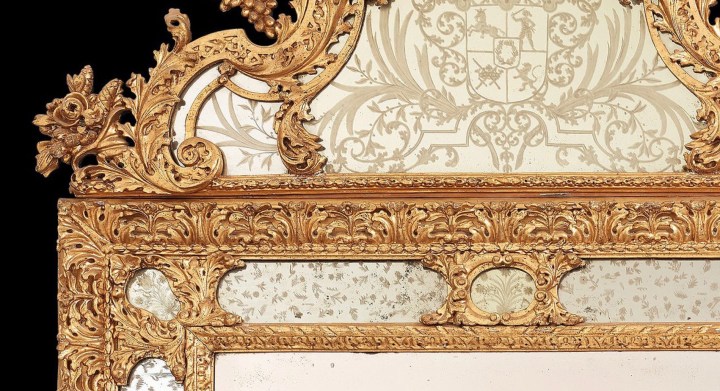
Attributed to Burchard Precht, mirror, 1690s (Stockholm: Nationalmuseum, NMK 114/2017; photo by Bukowskis).
◊ ◊ ◊ ◊ ◊
Press release (17 April 2018) from the Nationalmuseum in Stockholm:
A mirror just acquired by Nationalmuseum is among the most magnificent examples of Swedish Baroque ever produced. The ornately carved and gilded frame contains engraved, inset plate glass. The mirror’s unusually well-documented origins go back to the initial commission.
Count Wrede (1641–1712) was a top official who had earned the unwavering trust of King Karl XI. Following a career as Viborg County Governor, he contributed to preparations for the compulsory restitution of alienated estates in 1680. He was the Lord Marshall for the 1682 session of the Parliament. He subsequently held a number of prominent official positions. Promoting mercantilism in the private sector was among Wrede’s obsessions. It wasn’t long before he was elevated to countship and became one of the wealthiest Swedes alive. His political fortunes declined, however, after he advocated a more defensive military policy than Karl XII was pursuing. In 1711, he was pushed out of nearly all his positions.

Attributed to Burchard Precht, mirror, 1690s (Stockholm: Nationalmuseum, NMK 114/2017; photo by Bukowskis).
The frame of the large, 195-centimetre mirror features a lace border, acanthus, cornucopia, grape clusters and flowers. The inset plate glass is adorned with engraved, scattered flowers. The top of the mirror brandishes a meticulously engraved coat of arms for the Wrede lineage. Though not signed, the mirror is most certainly the handiwork of Burchard Precht (1651–1738). As the leading sculptor of his day, he received many royal and ecclesiastical projects, often in collaboration with court architect Nicodemus Tessin the Younger. Born in Bremen and educated in Hamburg, he emigrated to Stockholm in the 1670s. His workshop produced furniture, frames and crests for the court and nobility. The evidence strongly suggests that he was able to polish and silver glass. No wonder he is regarded as one of the first Swedish mirror craftsmen. The high quality of plate glass is due to the requirement back then that mirrors be imported.
Engraving the glass with an artistic touch was a daunting challenge. The technique had been resurrected in Europe during the early seventeenth century and had become a coveted skill. A handful of engravers passed through Sweden from the 1650s to 1680s. After Kristoffer Elstermann arrived in the 1690s, engraving assumed its rightful place in the Swedish glassmaking tradition. The first time Elstermann shows up in the accounts is 1691, when he received an order from Queen Dowager Hedvig Eleonora for the new royal chapel at the Tre Kronor castle. He had his own workshop and later obtained projects from the Kungsholm Glassworks as well. He was skilful at engraving various motifs that went well with the surface and shape of the particular object. He exerted a major influence on Swedish engraving until his death in 1721. The glassworks have never produced such high-quality engravings as during that period.
The panels in the frame of the Wrede mirror have the same types of scattered flowers as the glasswork used, but their placement is less standardized than later on. The noble coat of arms at the top typifies the dexterity of Elstermann’s works. More than likely, he engraved it himself. Precht’s mirrors also became more streamlined and formulaic as time went on. Cast pewter strips replaced sculptured wood, and the engraved adornment of the frame was painted white. No portents of such austerity are visible in this mirror, which is why it can be dated with so much exactitude to the 1690s.
Wrede’s impact on the appearance of the mirror cannot be overestimated. It’s hard to miss signs of his close association with the court and contemporary vogues, including new ornamentation techniques and Precht’s carved, gilded furniture. He had the financial resources to purchase such an exquisite object, and the cornucopia is a nod to his mercantilist inclinations. The same mindset no doubt convinced him that the mirror should be produced in Sweden to the extent possible.
The records clearly show that his daughter Sophia inherited the mirror when she married Erik Axelsson Sparre in 1707. It has been passed down from generation to generation ever since.
Acquisition of the mirror by Nationalmuseum was made possible by an Axel Hirsch endowment. The museum has no funds with which to purchase handicrafts and works of art but is wholly reliant on donations and private foundations.
Reading and Conference | Walpole’s ‘The Mysterious Mother’
Presented by the Lewis Walpole Library and the YCBA:
Horace Walpole’s The Mysterious Mother: A Staged Reading
Yale Center for British Art, New Haven, 2 May 2018
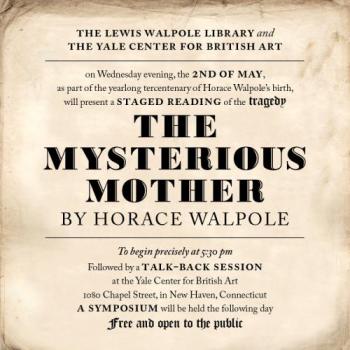 As part of the year-long celebrations of the tercentenary of Horace Walpole’s birth, the Lewis Walpole Library and the Yale Center for British Art are collaborating to present a staged reading of The Mysterious Mother—abridged by David Worrall (Emeritus Professor of English at Nottingham Trent University) and directed by Misty G. Anderson (ReLindsay Young Professor of English, University of Tennessee). Completed just a few years after Walpole’s celebrated gothic novel The Castle of Otranto (1764), this under-appreciated tale of incest and intrigue was initially circulated only among the author’s friends. Walpole never permitted it to be performed during his lifetime except as a private theatrical. Following the reading there will be a talk-back session moderated by Catherine Sheehy (Professor of the Practice of Dramaturgy and Dramatic Criticism, Yale University). This event is free and open to the public. Wednesday, 2 May 2018, 5:30pm, Yale Center for British Art.
◊ ◊ ◊ ◊ ◊
Horace Walpole’s The Mysterious Mother: A Mini-Conference
Yale Center for British Art, New Haven, 3 May 2018
Organized by Jill Campbell and Cynthia Roman

Diana Beauclerk (1724–1808), The Mysterious Mother, Act 3d, Scene 3, 1776 (The Lewis Walpole Library, Yale University).
10:00 Reading The Mysterious Mother
Chair: Jill Campbell, Professor of English, Yale University
• Nicole Garret, Lecturer, Department of English, SUNY Stony Brook
• Cheryl Nixon, Associate Provost, Associate Professor, Department of English, University of Massachusetts, Boston
•Matthew Reeve, Associate Professor Art History, Queen’s University
• Dale Townshend, Professor of Gothic Literature, Manchester Metropolitan University
• Nicole Wright, Assistant Professor, University of Colorado, Boulder
12:00 Lunch
1:15 Breakout session with Cynthia Roman, Curator of Prints, Drawings, and Paintings, The Lewis Walpole Library, to view Diana Beauclerk’s drawings of The Mysterious Mother. Attendance is limited, and advance registration is required.
2:00 Staging The Mysterious Mother
Chair: Misty Anderson, Lindsay Young Professor of English, University of Tennessee
• Al Coppola, Associate Professor of English, John Jay College, CUNY
• Marcie Frank, Professor of English, Concordia University
• Judith Hawley, Professor of English, Royal Holloway, University of London
• Jean Marsden, Professor of English, University of Connecticut
• David Worrall, Professor Emeritus, Nottingham Trent University
Portrait by Nicolas de Largillierre Returns to Hillwood
Press release via Art Daily:
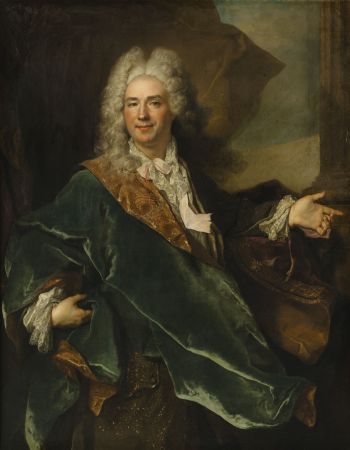
Nicolas de Largillierre, Portrait of Monsieur de Puysegur, likely Jacques-François de Chastenet, Marquis de Puysegur, oil on canvas, 136 × 105.5 cm (Washington, D.C.: Hillwood Estate, Museum & Gardens). The painting was purchased at Sotheby’s in Paris in December 2017 for 345,000€, surpassing its high estimate of 80,000€ (Lot 609 of sale PF1730).
Hillwood Estate, Museum & Gardens in Washington, D.C. announces the acquisition of the painting Portrait of Monsieur de Puysegur, likely Jacques-François de Chastenet, Marquis de Puysegur, by Nicolas de Largillierre (1656–1746) from Sotheby’s sale of the collection of Eleanor Post Close (1909–2006), Marjorie Merriweather Post’s daughter, and her son Antal Post de Bekessy (1943–2015) in December 2017. The 54 × 42 inch oil on canvas painting, lot 609 of the auction, is a three-quarter length portrait of Monsieur de Puysegur, likely Jacques-François de Chastenet, Marquis de Puysegur.
“Like her mother, Eleanor Post Close was a discerning collector of remarkable objects,” said Hillwood executive director Kate Markert. “The sale of her collection, and this work in particular, presented a rare opportunity for Hillwood to acquire an excellent example of French portraiture, particularly because of its alignment with Hillwood’s collection and particularly because it was once in Marjorie Post’s collection.” Marjorie Merriweather Post was the founder of Hillwood, who left her Washington, D.C. home as a museum to benefit future generations.
Born in France, Largillierre was trained in Peter Lely’s atelier in England and became a renowned portraitist. Upon his return to Paris in 1679, he served as First Painter to King Louis XIV and depicted many royals and members of the European and French aristocracy, among them the Marquis de Puysegur. The sitter, framed by a classical column, is depicted wearing abundant drapery of shimmering fabrics while elegantly gesturing to his left, a testament to Largillierre’s technique and virtuosity.
First documented in France in 1902, the portrait was acquired at auction by Marjorie Post-Hutton in New York in 1922. In 1937, the portrait was recorded in the draft catalogue of Post’s art collection. It was first displayed in Post’s library in New York, then in the entrance hall at Tregaron, her first home in Washington, D.C., and finally in the second floor hall at Hillwood.
In 1964, Post sent the portrait to her daughter, Eleanor Close Barzin, in Paris, in exchange for the return of Nattier’s Portrait of the Duchess of Parma (acc. no. 51.4), which Marjorie had presented to Eleanor as a wedding present. In June 1984, Hillwood’s curator, Katrina V. H. Taylor, stated about the portrait of Monsieur de Puysegur that “the return of this painting would add to the interest of the collection at Hillwood.”
Thanks to the persistence and generosity of Ellen Charles, Post’s grand-daughter and president emerita at Hillwood, who attended the sale in person and memorably surpassed Hillwood’s maximum bid, the painting will return to Hillwood for good. “It was no surprise that this important portrait exceeded the estimated auction price,” said Charles. “I am thrilled and honored that I could be there in person and contribute to Hillwood’s important acquisition. I just felt that I had to bring it home.”
The painting will go through moderate conservation work, after which it will be displayed in the entry hall at Hillwood.
Hillwood Announces Two New Curatorial Appointments

The paneling in the French Drawing Room of Hillwood dates to the reign of Louis XVI (1774–92) and now serves as a backdrop for a portion of Marjorie Merriweather Post’s collection of eighteenth-century French decorative arts.
◊ ◊ ◊ ◊ ◊
From the press release (20 February 2018) . . .
Hillwood Estate, Museum & Gardens in Washington, D.C. has appointed two new curators to manage, research, and publish on areas of Hillwood’s collection and further develop the dynamic special exhibitions program. Associate curator of 18th-century French and Western European fine and decorative arts, Rebecca Tilles will spearhead exhibitions, publications, and acquisitions related to Hillwood’s collection of 18th-century French and Western European art. Megan Martinelli Campbell, as the new assistant curator of apparel, jewelry, and accessories, will manage and research Hillwood’s collection of more than 175 dresses and over 300 accessories, all acquired and left to Hillwood by Marjorie Merriweather Post. Both curators began their work at HIllwood in February.
“Marjorie Post had a discerning eye for the finest and most important works of 18th-century France and imperial Russia and left them for the benefit of the public at Hillwood,” explained Dr. Wilfried Zeisler, Hillwood’s chief curator. “With great insight, she also left to Hillwood the most important examples of apparel and accessories she acquired over the years and today they offer added perspective into her life as a collector and connoisseur. We’re always learning more about these important areas of Hillwood’s collection, so we are thrilled that Rebecca and Megan will apply their exceptional backgrounds and talents to ensure the public continues to be educated and inspired as Post intended.”
Tilles is currently a doctoral candidate in art history at the University of Sussex, with a dissertation on the collection and collecting partnership of German-born banker and collector George Blumenthal (1858–1941) and his wife Florence Meyer (1873–1930) who together amassed an important collection of medieval, Renaissance, and 18th-century French works of art in both New York and France. Tilles completed substantial original research at the Metropolitan Museum of Art, the Library of Congress, and the Archives de Paris and Bibliothèque Nationale de France. Prior to her Ph.D. studies, Tilles was a curatorial research fellow in the art of Europe department at the Museum of Fine Arts, Boston, where she assisted with the exhibitions Splendor and Elegance: European Decorative Arts and Drawings from the Horace Wood Brock Collection (2009) and Symbols of Power: Art of the Empire Style, 1800–1815 (2007). In 2007, she received a Master of Arts degree in European decorative arts from the Bard Graduate Center, where she completed her thesis on the reconstruction of Marie-Antoinette’s corbeille de marriage. She has a bachelor’s degree in French and French cultural studies from Wellesley College and has completed the third year of the Premier Cycle at the Ecole du Louvre, which included coursework in 17th-to 20th-century painting, decorative art, sculpture, and architecture.
Coming to Hillwood from the Costume Institute at The Metropolitan Museum of Art, Campbell was previously a research assistant there, where she assisted with a complete assessment of the institute’s 19th- and 20th-century collections, researching and presenting hundreds of garments and accessories for curatorial consideration. She assisted with the installation of the special exhibitions Manus X Machina: Fashion in the Age of Technology (2016) and China: Through the Looking Glass (2015). Prior to the Costume Institute, Campbell worked with the historic textiles and costumes collection at The University of Rhode Island, where she selected and interpreted a rotation of objects for display. Her work in highlighting the influence of menswear on women’s clothing was incorporated into the exhibition, Subject to Change: Art and Design in the Twentieth Century. At the University of Rhode Island, she was also the co-curator and designer for the special exhibitions The Other White Dress: Non-Wedding Gowns of the Nineteenth and Twentieth Centuries (2014) and Five Rhode Island Families (2011). Campbell holds a Master of Arts and Sciences degree in textiles, fashion merchandising, and design from the University of Rhode Island and received her bachelor’s degree in English literature from Providence College.
In addition to conducting new research on their areas of Hillwood’s collection, the new curators are organizing upcoming exhibitions. Tilles’s first project at Hillwood is the exhibition Perfume and Seduction (working title). Opening February 2019, the special exhibition will showcase the finest examples of 18th-century perfume bottles, gold boxes, porcelain, figurines, and other luxury items from Hillwood’s collection, in conjunction with fine objects from the private European collection of Givaudan, the Swiss manufacturer of flavors, fragrances, and active cosmetic ingredients, founded in 1898 by the French brothers, Xavier (1867–1966) and Léon Givaudan (1875–1936). Campbell has taken over the organization of an exhibition of works by photographer Alfred Eisenstaedt, who famously photographed Marjorie Merriweather Post, in addition to a host of other important 20th-century figures, to open in June 2019.










 Enfilade
leave a comment