At Sotheby’s | Americana from the Caxambas Foundation
From Sotheby’s:
The Americana Collection of George S. Parker II from the Caxambas Foundation, Sale N09605
Sotheby’s New York, 19 January 2017
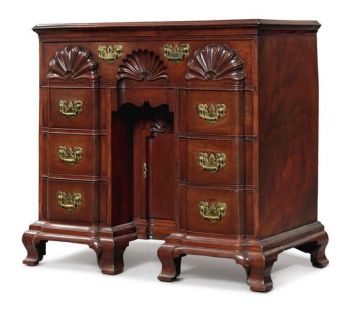
Lot 2089 — Queen Anne Carved and Figured Mahogany Block-and-Shell Kneehole Bureau Table, Providence, Rhode Island, ca. 1765 (estimate 300,000–500,000 USD).
The Collection of George S. Parker II from the Caxambas Foundation, previously on loan at the Chazen Museum of Art at the University of Wisconsin-Madison, will be offered on Thursday, 19 January 2017. The notable collection includes American and English furniture, silver, paintings and prints, with examples from some of the most distinguished artisans. Furniture highlights include a pair of Philadelphia side chairs attributed to Martin Jugiez; a rare Rhode Island Queen Anne shell-carved, block-front dressing table; an exceptional Philadelphia high chest of drawers attributed to John Pollard; and an important armchair by the same maker once owned by Charles Thomson. Great American portrait painters represented in the collection include John Singleton Copley, Gilbert Stuart, Thomas Sully, and John Trumbull among others. Finally, Mr. Parker’s silver collection comprises several examples from London silversmith Paul Storr and other English makers, including Ebenezer Coker and David Willaume.
Barograph Clock Acquired by London’s Science Museum
One of 2016’s notable acquisitions; press release (July 2016) from the Science Museum:
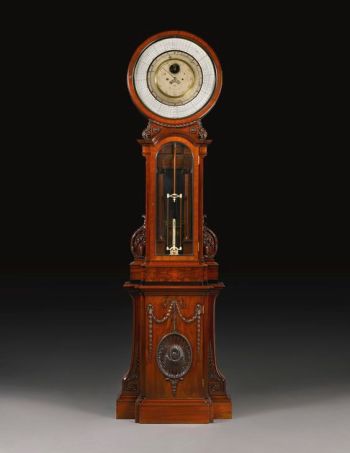
Alexander Cumming, George III Mahogany Longcase Barograph Regulator, London, 1766, with a case likely by Thomas Chippendale (London: Science Museum).
A rare Georgian clock, capable of recording changes in air pressure and used at the dawn of climate science, has been acquired for the nation by the Science Museum. The acquisition of this exceptional clock was made possible by a grant from Art Fund and was purchased through Sotheby’s. Dated 1766, the barograph clock is one of only four of its type that highly-regarded London clockmaker Alexander Cumming is known to have constructed. It was used by renowned meteorologist Luke Howard to conduct some of the world’s first urban climate studies.
Following Cumming’s death in 1814, Luke Howard purchased the clock and used it for observations of atmospheric pressure at his homes in London and Ackworth, a crucial project in the emergence of climate science. The data from the barograph traces, accompanied by notes on global weather events and descriptions of the clock, were published in the book Barometrographia in 1847. Howard’s life’s work has earned him the nickname ‘the father of scientific meteorology’.
Inside the imposing 7ft 2in-high decorated case, thought to be made by famed London cabinet maker Thomas Chippendale, is a barograph mechanism used for measuring air pressure. The barograph comprises two tubes of mercury in which a float rises and falls as atmospheric pressure changes. This data is recorded on the clock dial, which rotates once a year. A fine example of the technical innovations of the Georgian period, the clock was designed by Cumming using ideas first outlined by Royal Society founding member Robert Hooke. It has featured in previous exhibitions at the Science Museum as a loan and curators are now planning a permanent display.
Ian Blatchford, Director of the Science Museum Group, said of the acquisition “Nothing beats the marriage of an exquisite object and an enquiring mind. We are delighted to have been able to save the barograph clock so that we can share the story of Luke Howard’s contribution to climate science with future generations.”
During the Georgian period, scientific practice was often presented in public as a high-status activity expressed through ornately decorated and very finely constructed instruments such as this, and in fact the first barograph clock that Cumming constructed was commissioned by King George III as a prime example of his pursuit of Enlightenment.
MFA, Boston Displays Newly Acquired Altarpiece by Benjamin West
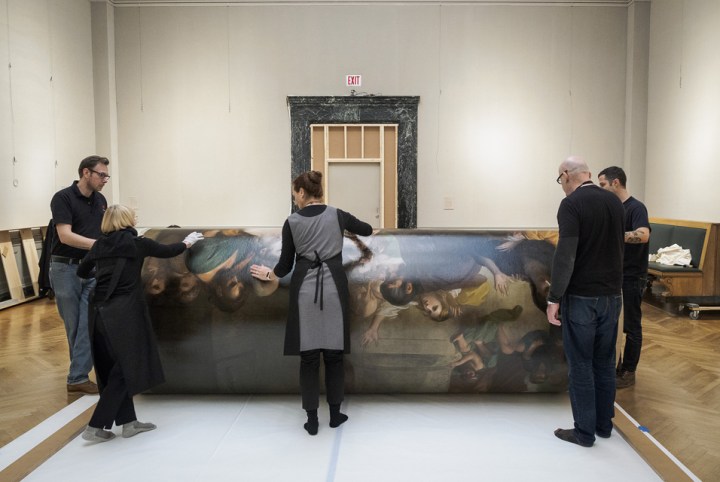
MFA staff members install Benjamin West’s large painting Devout Men Taking the Body of Saint Stephen (1776) in the Ruth and Carl J. Shapiro Gallery. Fidelity Investments chairman Edward ‘Ned’ Johnson III acquired the painting in 2014 for $2.9million from St. Stephen Walbrook (the export license was issued in March of that year). He donated it, anonymously, to the MFA in 2015 in honor of Malcolm Rogers to celebrate the museum director’s twenty years of leadership. Details and more on Johnson’s collections are available from Beth Healy’s article, “The Quiet Man of Boston’s Art Scene,” in The Boston Globe (22 August 2015).
◊ ◊ ◊ ◊ ◊
From the Museum of Fine Arts, Boston (via Art Daily), and good timing: it’s St Stephen’s Day! . . .
The recently acquired Devout Men Taking the Body of Saint Stephen (1776) by Benjamin West (1738–1820) is one of the largest paintings in the MFA’s collection—together with its towering frame, it measures more than 18 1/2 feet tall. Over the past two years, the monumental altarpiece was treated in the Conservation in Action studio, where Museum visitors were able to witness the gradual process of cleaning and restoring the work. The painting and its original gilded wood frame, which was also conserved, are now reunited as the dramatic centerpiece of a new installation that explores how 18th-century artworks and artists traveled across both intellectual and geographical borders.

Thomas Malton (1748–1804), St Stephen Walbrook, London, watercolour over pencil, 26 × 18 inches (London: Lowell Libson LTD). West’s painting is visible at the altar.
West was the first American-born painter to study abroad, second president of the Royal Academy of Arts, and painter to the English king. Devout Men Taking Away the Body of Saint Stephen, among the largest works he ever produced, was commissioned for London’s St. Stephen’s Walbrook, a church designed by Christopher Wren, and showcases West’s profound understanding of Italian Renaissance art. Italy likewise held special allure for well-to-do travelers on the Grand Tour, such as the American couple in John Singleton Copley’s portrait of Mr. and Mrs. Ralph Izard (1775), painted in Rome. Meanwhile, Italian painters ventured abroad as well—the gallery includes Canaletto’s Bacino di San Marco, Venice (about 1738), a trademark view of his home city, and Capriccio: A Sluice on a River with a Chapel (1754), painted in England, where he spent nine years catering to an enthusiastic clientele. Adding to the rich mix of works by American, English, and Italian painters are sculpture and decorative arts by French and German artists.
The 18th century was a cosmopolitan age. Artists and patrons traveled widely: in pursuit of artistic training or opportunity, political service, or social refinement. And as people moved, so too did ideas, styles, and tastes, in art and beyond. Across Europe (and America), Italy held special allure: artists traveled there to absorb its millennia of artistic traditions, as did well-heeled visitors on the Grand Tour. The fashion for Italian art was especially strong in England, where American-born painter Benjamin West created this towering altarpiece, influenced by his study of Renaissance masters Titian and Raphael. Italian artists also often ventured abroad. Canaletto, famous for his view paintings of his home city of Venice, spent nearly a decade in England, catering to an enthusiastic clientele.
Rijksmuseum Acquires Painting by Liotard
Press release (21 December 2016) from the Rijskmuseum (as announced by The Burlington Magazine via Twitter, the magazine will publish an article on the painting in February).

Jean-Etienne Liotard, A Dutch Girl at Breakfast, ca. 1756–57, oil on canvas, 47 × 39 cm (Amsterdam: Rijksmuseum).
The British government today granted an export license for the painting A Dutch Girl at Breakfast by Jean-Etienne Liotard, which the Rijksmuseum has recently purchased from a private collection in which it had remained for more than 240 years. The painting is an intimate ode to Dutch Golden Age painting. The peripatetic Genevan pastellist Jean-Etienne Liotard (1702–1789) created the work in the style of Dutch seventeenth-century masters during a long sojourn in Holland around 1756. As one of his few oil-paintings, A Dutch Girl at Breakfast is an important addition to the famous group of pastels by Liotard that have been in the Rijksmuseum since 1885. This stunning new acquisition will be shown in the Rijksmuseum’s Gallery of Honour from mid-January.
Taco Dibbits, General Director of the Rijksmuseum, states: “A Dutch Girl at Breakfast radiates the same atmosphere of peace and simplicity as Vermeer’s Milkmaid. In this sensitive representation, the painter allows us to get very close to his subject. As the girl carefully opens the tap of the coffee-pot, she won’t allow herself to be disturbed by the millions of visitors who will come to see her. We are extremely grateful to the funds and private donors who made it possible to acquire this masterpiece for The Netherlands.”
With the support of the BankGiro Loterij, Rembrandt Association through its ‘Nationaal Fonds Kunstbezit’, Mondriaan Fund, VSBfonds, Rijksmuseum Fonds, and many private donors, the Rijksmuseum was able to purchase this work at auction in London for nearly €5.2 million (commission included) [Sotheby’s London, Old Masters Evening Sale (6 July 2016), Sale L16033, Lot #36].
A Dutch Girl at Breakfast is one of Jean-Etienne Liotard’s most beautiful works. In it, he reveals himself as one of the earliest eighteenth-century artists from abroad to put his fascination with Dutch painting of the seventeenth century into practice. On this small canvas (47 × 39 cm) he portrays a young woman sitting in a typically Dutch interior. All the characteristics of Dutch seventeenth-century ‘genre’ are present: the everyday scene, the intimate ambiance, the sober colours, the sophisticated rendering of textures, and the painted church-interior in the background. Nevertheless the furnishings and tableware are all from Liotard’s own time. The mise-en-scène is strongly reminiscent of the well-known interiors of his predecessors Johannes Vermeer, Gerard Dou, and Frans van Mieris.
After long sojourns in Vienna, Paris, and London—where he enjoyed great success as a portraitist—Liotard travelled to Holland in 1755 to pursue this lucrative career. A Dutch Girl at Breakfast was clearly inspired by his experiences in the country. As a connoisseur of Dutch Golden Age painting, he also managed to assemble a collection of over 60 works by Old Masters. In 1756 at Amsterdam he married Marie Fargues, born and bred in Holland but a Huguenot like himself. His splendid pastel portrait of her is in the Rijksmuseum’s collection. Their eldest son later settled in Amsterdam, bringing many of this father’s works with him.
Eighteenth-century European painting is not particularly well represented in the Netherlands. The subject of this painting, the way it is presented, and the work’s close historical connection with the Netherlands will give iconic status to A Dutch Girl at Breakfast within the Dutch national collections. After its presentation in the Gallery of Honour it will take pride of place in the Rijksmuseum galleries for the arts of the eighteenth century. It will also be reunited there with the remarkable group of Liotard’s pastels donated by his Dutch descendants at the end of the nineteenth century. Only some 30 oil paintings by Liotard are known—as opposed to 540 pastels. Genre pieces by him are even scarcer, though this is a type of art for which he is well known, especially in works such as The Belle Chocolatière at Dresden. With this acquisition, the Rijksmuseum’s representation of Liotard’s oeuvre has been considerably strengthened.
Liotard appears to have kept the A Dutch Girl at Breakfast for himself until 1774, when he included it in a sale of his collection in London. It was bought there by his principal British patron, the 2nd Earl of Bessborough (1704–1793), with whose descendants it has remained until now.
◊ ◊ ◊ ◊ ◊
And if the acquisition weren’t enough reason by itself to visit the Rijksmuseum, there’s also the news that RIJKS, the Rijksmuseum restaurant led by chef Joris Bijdendijk, has just been awarded a Michelin star, as announced during the launch of the Dutch edition of Michelin’s 2017 hotel-and-restaurant guide in Amsterdam.

Barbara Jatta Appointed Director of the Vatican Museums

As reported by Lorena Muñoz-Alonso for ArtNet News (21 December 2016) . . .
On Tuesday, Pope Francis announced that the new director of the Vatican Museums will be the Italian art historian Barbara Jatta. This is a momentous occasion as it marks the first time in history that a woman will helm the art institution, one of the most important in the art world. The new director will take up the post in January 1, 2017, succeeding Antonio Paolucci, an art historian and former Italian culture minister who’s held the position since 2007. Previously to this appointment, Jatta worked at the Vatican Library, overseeing its collection of prints . . .
The full article is available here»
◊ ◊ ◊ ◊ ◊
Hannah McGivern and Arianna Antoniutti report on Jatta’s appointment for The Art Newspaper (21 December 2016)
Born in Rome, Jatta worked as conservator and cataloguer for Italy’s Istituto Nazionale per la Grafica (national institute for graphic arts) from 1981 to 1996. She has been in charge of the Vatican Library’s works on paper since 1996, with responsibility for its exhibitions, acquisitions and archives. Jatta has also published extensively on the Vatican’s prints and drawings collections, including the first catalogue of drawings by Bernini and his school in 2015.
Her appointment anticipates the reopening of the Vatican Museums’ New Wing (Braccio Nuovo) on 22 December. Commissioned by Pope Pius VII, the 19th-century gallery was designed by the sculptor Antonio Canova to house the repatriated papal collections of classical sculpture, which had been plundered by Napoleon during his Italian campaign . . .
The full article is available here»
Betsy Wieseman Appointed New Curator at Cleveland
Press release (15 December 2016) from The Cleveland Museum of Art:
 The Cleveland Museum of Art (CMA) has announced the appointment of Marjorie E. (Betsy) Wieseman as the Paul J. and Edith Ingalls Vignos Jr. Curator of European Paintings and Sculpture, 1500–1800. The museum’s collection of Old Master European paintings and sculpture is of international importance, ranging from works created in the early years of the Renaissance through the Rococo period. Wieseman’s appointment follows an international search. She will assume her responsibilities at the CMA sometime this spring.
“Betsy is an extraordinarily accomplished and productive curator and an elegant writer. The exhibitions she has curated for the National Gallery, London, have been celebrated for their scholarship, sensitivity, and beauty,” said Director William Griswold.
As Curator of European Paintings and Sculpture, 1500–1800, Wieseman will oversee the care and development of the collection and work closely with the Director and Chief Curator on the identification and acquisition of artworks to augment the collection. She will oversee special exhibitions exploring all aspects of European painting and sculpture from 1500 to 1800. The collections for which Wieseman will be responsible span three hundred years of artistic production throughout Europe and encompass paintings on panel and canvas and sculpture in wood, terracotta, bronze, and marble. Areas of particular strength are the museum’s Italian and Spanish Baroque paintings and German and Austrian Baroque sculpture. The collection also has a number of internationally significant Italian Renaissance paintings and French and Flemish paintings of the 16th and 17th centuries. The museum’s holdings of portrait miniatures are among the most outstanding in the world.
“I am thrilled to have been chosen to be the next Paul J. and Edith Ingalls Vignos Jr. Curator of European Paintings and Sculpture, 1500–1800. I look forward to working with my new colleagues at the CMA to share the museum’s world-class collection with even wider audiences. The collection offers an endless source of inspiration, and I am honored to have the opportunity to bring these beautiful works to life for museum visitors,” said Betsy Wieseman.
Wieseman brings more than twenty-five years of curatorial work and museum experience to the CMA. She has been Curator of Dutch Paintings, 1600–1800, at the National Gallery, London, since 2006; 17th- and 18th-century Flemish paintings were added to her purview in 2012. At the National Gallery she curated and co-curated acclaimed exhibitions such as Dutch Flowers (2016); Rembrandt: The Late Works (2014–15); Vermeer and Music: The Art of Love and Leisure (2013); Close Examinations: Fakes, Mistakes, and Discoveries (2010); and Dutch Portraits: The Age of Rembrandt and Frans Hals (2007). Also, while at the National Gallery, she curated an exhibition at the Fitzwilliam Museum, Cambridge: Vermeer’s Women: Secrets and Silence (2011–12).
Before moving to London, Wieseman held curatorial positions in two Ohio museums. As Curator of European Paintings and Sculpture at the Cincinnati Art Museum, she curated a wide variety of exhibitions including Perfect Likeness: European and American Portrait Miniatures from the Cincinnati Art Museum (2006); Drawn by the Brush: Oil Sketches by Peter Paul Rubens (Bruce Museum of Arts and Science, Berkeley Art Museum/Pacific Film Archive, and Cincinnati Art Museum, 2004); and A Brush with Nature: The Gere Collection of Landscape Oil Sketches (2003). As Curator of Western Art before 1850 at the Allen Memorial Art Museum, Oberlin College, she spearheaded projects that focused on her area of specialization—17th-century Dutch painting—as well as working on exhibitions that featured (among other topics) American landscapes, German Expressionist paintings, and portrait miniatures.
Wieseman is a prolific scholar. Recent work has included contributions to numerous exhibition catalogues including: Vermeer and the Masters of Genre Painting: Inspiration and Rivalry (Musée du Louvre, Paris; National Gallery of Ireland, Dublin; and National Gallery of Art, Washington DC, 2017); Beyond Caravaggio (The National Gallery, London; National Gallery of Ireland, Dublin; and The Royal Scottish Academy, Edinburgh, 2016); and Vermeer and Rembrandt: The Masters of the 17th Century Dutch Golden Age (Kyoto, and Tokyo: Mori Arts Centre Gallery and Fukushima Prefectural Museum of Art, 2016). Among her many other contributions to the literature on 17th-century Dutch art are essays such as “A Courtly Art Comes to The Hague: Portrait Miniatures at the Court of Elizabeth of Bohemia,” in Face Book: Studies on Dutch and Flemish Portraiture of the 16th–18th Centuries, edited by Edwin Buijsen, Charles Dumas, and Volker Manuth (Leiden: Primavera Pers, 2012); “Rembrandt’s Portrait(s?) of Frederick Rihel,” National Gallery Technical Bulletin 31 (2010); and “Paper Trails: Drawing in the Work of Caspar Netscher, his Pupils and Followers,” in Collected Opinions: Essays on Netherlandish Art in Honour of Alfred Bader, edited by Volker Manuth and Axel Rüger (London: Holberton, 2004).
Holding a PhD from Columbia University, Wieseman has been the recipient of numerous awards including a Robert H. and Clarice Smith Fellowship from CASVA, a Theodore Rousseau Fellowship from The Metropolitan Museum of Art, as well as a Fulbright Grant for Graduate Study Abroad.
Betsy Wieseman will be moving to Cleveland with her husband, Allen Wright.
Jennifer Scott Appointed New Director of Dulwich Picture Gallery
Press release from Dulwich (as noted by The Guardian, Scott will be the first woman to lead the Gallery). . .
 Dulwich Picture Gallery has announced that Jennifer Scott has been appointed to the position of Sackler Director of Dulwich Picture Gallery, succeeding Ian A. C. Dejardin after his 12-year leadership. Scott will take up her new position in April 2017.
Professor Evelyn Welch MBE, Chair of Trustees at Dulwich, said: “I am delighted to be able to announce Jennifer’s appointment to this important role. Her passion for the Gallery is clear and her achievements at The Holburne Museum and at the Royal Collection are an excellent foundation for joining Dulwich. We look forward to welcoming her on board as we look towards the Gallery’s future ambitions.”
Scott is currently Director of The Holburne Museum, Bath, having joined in August 2014. During this time she has played a significant role in shaping the Museum’s centenary celebrations, with a series of critically acclaimed exhibitions in 2016. In addition, she led a successful £450,000 acquisition campaign with linked community engagement programme, and initiated conservation and research leading to major new attributions of the Museum’s Flemish paintings. Scott has also developed a number of national and international partnerships. Prior to joining The Holburne Museum, she was Curator of Paintings at Royal Collection Trust (2004–14).
Jennifer Scott said: “I am honoured to be appointed as Sackler Director of Dulwich Picture Gallery. Through its exceptional collection and pioneering programme, Dulwich has an enduring appeal grounded in its 200-year history. Ian Dejardin’s dynamic leadership has placed the Gallery in a strong position for the future. I look forward to working with Evelyn, the Board and the team to continue to develop the Gallery as the perfect place for people to experience the inspirational potential of art.”
2017 will welcome an exhibition line-up featuring Vanessa Bell, John Singer Sargent, and Tove Jansson. The year will also see the opening of the Gallery’s first pavilion building in June as well as a series of displays celebrating 200 years since the Gallery first opened its doors to the public. Jennifer Scott will be the Gallery’s fourth Director.
CV Highlights
• August 2014–present, Director, The Holburne Museum. Responsible for £1.4m budget, 21 staff (f/t), and 320 volunteers; led successful acquisition campaign for Sir Thomas Lawrence’s Arthur Atherley; recent discoveries of previously overlooked works by Brueghel the Younger and Teniers; achieved significant grants for outreach and community engagement work.
• Curator of Impressionism: Capturing Life (2016) and Bruegel: Defining a Dynasty (2017). Restructured staff, introduced a SMT at Deputy Director level, devised and implemented a 3-year forward plan, managed capital project of new car park / café terrace.
• January 2004–August 2014, Curator of Paintings at Royal Collection Trust. Responsible for curating exhibitions and displays and project management of loans to museums and galleries worldwide. Established academic authority on royal portraiture and British, Flemish, Spanish, and Dutch painting 1450–1900.
• Author of numerous publications including The Royal Portrait: Image and Impact (2010), Dutch Landscapes (2010), and Bruegel to Rubens: Masters of Flemish Painting (2007). Previously worked in the curatorial department of The National Gallery, London and National Museums Liverpool.
• 1998–2002, BA and MA, History of Art, The Courtauld Institute of Art. Fellow of the Society of Antiquaries and Fellow Commoner of Lucy Cavendish College, University of Cambridge.
2017 Scholar-in-Residence Program, Hillwood Estate in D.C.
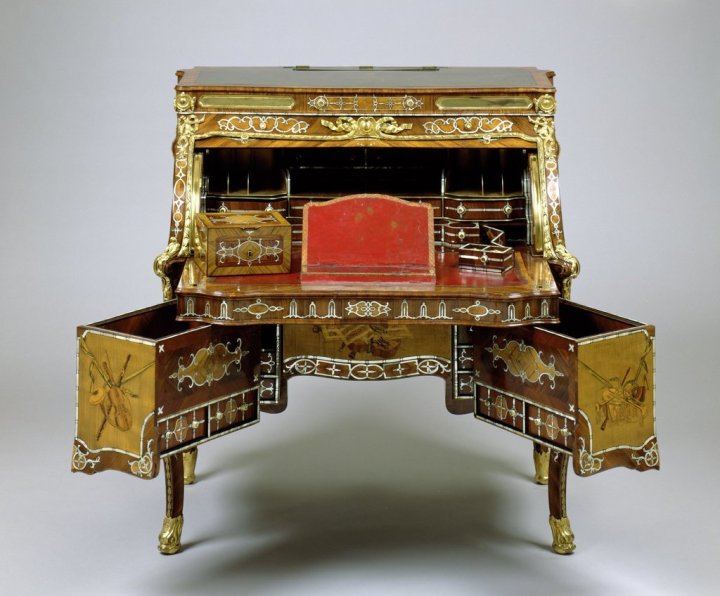
Abraham and David Roentgen, Rolltop Desk, 1765–70, wood marquetry, mother-of-pearl, gilt bronze, steel, leather, glass, 46 × 42 × 25 inches (Washington, D.C., Hillwood Estate, Museum & Gardens).
◊ ◊ ◊ ◊ ◊
2017 Scholar-in-Residence Program
Hillwood Estate, Museum & Gardens, Washington, D.C.
Applications due by 15 February 2017
PhD candidates and other highly qualified scholars conducting research that may benefit from Hillwood’s holdings are encouraged to apply. Applicants should submit a curriculum vitae and a proposal—not to exceed 500 words—stating the necessary length of residence, materials to be used, and the project’s relevance to Hillwood’s collections or exhibition program, including, but not limited to: art and architecture, landscape design, conservation and restoration, archives, library or special collections, as well as broader study areas such as the history of collecting or material culture. The project description should be accompanied by two letters of recommendation. Materials will be reviewed by the selection committee. There are three types of awards:
1 Week
Hillwood will arrange and pay for travel costs to and from the museum; housing near campus; shop and café discounts; free access to all public programs.
2–3 Weeks
Hillwood will arrange and pay for travel costs to and from the museum; shop and café discounts; free access to all public programs; a stipend of up to $1,200 depending on length of stay.
1–2 Months
Hillwood will arrange and pay for travel costs to and from the museum; shop and café discounts; free access to all public programs; a stipend of up to $1,500 per month depending on length of stay.
Founded by Marjorie Merriweather Post (1887–1973), heir to the Post Cereal Company, which later became General Foods, the Hillwood Estate, Museum & Gardens houses over 17,000 works of art. Hillwood is in a special class of cultural heritage institution as a historic site, testament to the life of an important 20th-century figure, an estate campus, magnificent garden, and a museum with world renowned special collections. It includes one of the largest and most important collections of Russian art outside of Russia, comprising pieces from the pre-Petrine to early Soviet periods, an outstanding collection of French and European art, and jewelry, textile, fashion, and accessories collections. Scholars will have access to Hillwood’s art and research collections based on accessibility and staff availability. The Library has over 38,000 volumes including monographs, serials, annotated and early auction catalogues, and electronic resources; the Archives contain the papers of Marjorie Merriweather Post, her staff, and family members. Please submit applications or inquiries to Scholarinresidence@hillwoodmuseum.org by 15 February 2017 (applicants will be notified by 13 March 2017).
Shonibare’s ‘Wind Sculpture VIII’ Installed in D.C.

Yinka Shonibare MBE, Wind Sculpture VII (detail), 2016, steel armature with hand-painted fiberglass resin cast and gold leaf (Smithsonian National Museum of African Art, purchased with funds from Amelia Quist-Ogunlesi and Adebayo Ogunlesi and the Sakana Foundation, 2016-11-1).
◊ ◊ ◊ ◊ ◊
Press release (via Art Daily) from the National Museum of African Art:
The Smithsonian’s National Museum of African Art announced the acquisition and permanent installation of sculpture Wind Sculpture VII by celebrated contemporary artist Yinka Shonibare MBE. Wind Sculpture VII made its Smithsonian debut Saturday, December 3; it has been installed in front of the National Museum of African Art.

A rendering of Shonibare’s sculpture as envisioned outside the National Museum of African Art (James Cohan Gallery).
Part of a series of seven individually designed sculptures, Wind Sculpture VII is the first artwork installed permanently in front of the museum. Constructed from fiberglass, this unique, gold-leaf version of Shonibare’s Wind Sculptures series evokes the sails of ships that have crossed the Atlantic and other oceans, connecting nations through the exchange of ideas, products, and people. In its form, it captures histories that can be inspiring or brutal but always complex. It suggests that the opening of the seas led not only to the slave trade and colonization but also to the dynamic contributions of Africans and African heritage worldwide. Using yellow, blue, rose, and gold, Shonibare celebrates the African men, women, and children who have shaped the United States, Great Britain, and other nations of today and for the future.
“The museum is proud to present this stunning and monumental public sculpture at the museum,” said Karen Milbourne, curator and project lead. “This work of art will transform the façade of our museum and pay tribute to the connections between Africa and America. The patterns emblazoned on this sculpture replicate so-called ‘African print cloth,’ which are in fact based on Indonesian batiks manufactured in the Netherlands and United Kingdom and then exported to West Africa where they have become synonymous with African identity. Shonibare draws on this entangled history to direct attention to the global connections that unite individuals and communities worldwide. Africa’s global connections and the vision of its artists are the focus of this national museum; this sculpture will inspire visitors and spark conversation.”
Facts about Wind Sculpture VII:
• The work weighs 899 pounds
• It took seven people one month to paint and gild the sculpture
• The structure is 20 feet tall and 10 feet, 6 inches wide
• Only about a 7-inch-diameter point of the sculpture touches the ground
Throughout the past decade, Shonibare has become well known for his exploration of colonialism and post-colonialism within the context of globalization. Working in painting, sculpture, photography, film, and performance, Shonibare’s work examines race, class, and the construction of cultural identity. Through sharp political commentary of the interrelationships between Africa and Europe’s economic and political histories and wry citations of Western art history and literature, Shonibare questions the validity of contemporary cultural and national identities.
Shonibare was born in the United Kingdom in 1962 and moved to Lagos, Nigeria, at the age of 3. He returned to London to receive his MFA from Goldsmiths College, a part of the ‘Young British Artists’ generation. He gained notoriety on the international stage via his commission for Okwui Enwezor’s Documenta 10 and was a Turner Prize nominee in 2004. In 2005 he was awarded the decoration of Member of the Most Excellent Order of the British Empire, a title that he officially added on his professional name. His works were featured in the 52nd Venice Biennale and a major mid-career survey toured 2008–09. In 2011, the artist’s sculpture Nelson’s Ship in a Bottle was selected for Trafalgar Square’s prestigious commission series. Shonibare’s works are included in many prestigious public collections spanning the globe. He currently lives and works in London’s East End.
Brian Sewell Bequeaths a Painting by Lagrenée to the National Gallery
Press release (17 November 2016) from the National Gallery in London:

Louis Jean François Lagrenée, Maternal Affection, 1773, oil on copper, 43.5 × 34.5 cm (London: The National Gallery, gift from the estate of Brian Sewell, 2016).
“As a child, there was not a major museum or art gallery in London I didn’t know, and the National Gallery was my favourite.” –Brian Sewell, interview for The Daily Telegraph (June 2012)
The legendary Evening Standard art critic would often talk about the weekly visits he made to the National Gallery as a child imbuing him with his love of art; indeed, he once quipped, “I’m leaving my body to science, and if there’s anything left, they can burn it, mix the ashes with bird food and scatter them on the steps of the National Gallery” (Mail on Sunday, April 2014). Therefore, it is fitting that a much-loved work from his private art collection will go on display in the National Gallery, presented as a gift to the Gallery following his death in September 2015.
Maternal Affection is a small oil on copper work from 1773 by the French artist Louis-Jean-François Lagrenée. The subject cannot be precisely identified. It takes place in a loggia and shows a woman nursing a child, with another infant held towards her by one of her female companions. Another woman is placing (or removing) bedding in the form of a pillow in or from a wooden crib. In this picture of quiet contentment, Lagrenee has sought balance—balance in the colours of the costumes both of, and between, the individual figures and balance in composition. Maternal Affection is highly typical of the small-scale paintings that the artist made for private collectors.
There are currently eleven paintings by Lagrenée in Great Britain: seven at Stourhead (National Trust) and four at the Bowes Museum, Barnard Castle. Maternal Affection is, therefore, the only one by the artist on public display in a national collection. Eighteenth-century French paintings are sparsely represented in Trafalgar Square, and this generous gift helps to extend the National Gallery’s collection in this area. Maternal Affection also adds to our understanding of the reception of 17th-century Bolognese painting in 18th-century Europe: Lagrenée’s style was greatly influenced by his admiration of the great Bolognese painters of the previous century, in particular the work of Guido Reni.
Christopher Riopelle, National Gallery Curator of Post-1800 Paintings said: “The painting is a beautifully preserved oil on copper of exquisite refinement which allows the National Gallery for the first time to show the work of an artist who was hugely admired by the most discriminating connoisseurs and collectors of contemporary French art, both French and foreign, in the final decades of the 18th century.”
National Gallery Director, Dr Gabriele Finaldi said: “Brian Sewell had a profound love for the National Gallery as well as a connoisseur’s passion for lesser known masters; so it is especially pleasing that Lagrenée’s beautiful and refined Maternal Affection, which he owned, has come to the Gallery as a gift from his estate.”
Maternal Affection can now be seen in Room 33 of the National Gallery hanging alongside other French 18th-century paintings by artists such as Boucher, Vigée Le Brun, Boilly, Nattier, Detroy, and Vernet.










 Enfilade
leave a comment