Getty Research Institute Director Thomas Gaehtgens to Retire in 2018
Press release (9 May 2017) from The Getty:
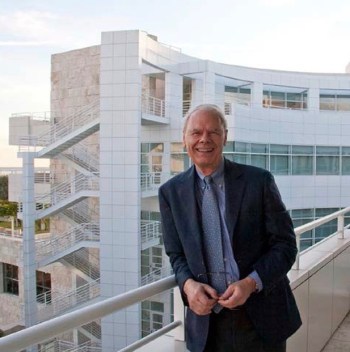 The J. Paul Getty Trust announced today that Thomas W. Gaehtgens, director of the Getty Research Institute, will retire in early spring 2018 after more than a decade of leading one of the world’s foremost institutions for art historical research. After his retirement, Gaehtgens, who is 77, will return to Germany, where he plans to continue to write and conduct independent research.
“Thomas Gaehtgens’s international standing as a leading scholar has enabled him to significantly broaden the vision and reputation of the Getty Research Institute,” said James Cuno, president and CEO of the J. Paul Getty Trust. “The GRI has always been known as one of the world’s largest and finest arts and architecture libraries, but under Thomas’s leadership the GRI has become a robust, international center of original scholarship. In addition to groundbreaking exhibitions and publications, Thomas’s commitment to the digitization of the GRI’s collection, and his enthusiasm for open access tools and research databases, has put the GRI, and by extension the Getty, at the forefront of the digital humanities. He is an energizing and inspiring leader who has created a culture of collaboration and spearheaded tremendous growth in research, collecting and innovating at the GRI. I’m grateful to him for his contribution and I know we will all miss him.”
Since becoming director of the Getty Research Institute (GRI) in 2007 Gaehtgens has overseen a dramatic expansion in the Institute’s research projects, scholars department, exhibitions program, and digital initiatives in addition to the robust growth of the GRI’s Special Collections. One of his important accomplishments was to move the GRI from an institution focused primarily on Western art to one with a more global approach, supporting collaborations with Chinese, Japanese, Indian, African, and above all Latin American institutions.
Under his stewardship, the GRI acquired many significant collections of archival material relating to art and architecture, including the archives of important artists, architects, art historians, dealers, curators, and scholars. Max Lieberman, Kathe Kollwitz, Man Ray, Robert Mapplethorpe, Harmony Hammond, Frederick Hammersley, Harry Smith, Lewis Baltz, Allan Sekula, Barbara T. Smith, and Ed Ruscha are among the many artists now represented in the GRI’s special collections. Architects in the collection now include John Lautner, Ray Kappe, Welton Beckett, and most recently Frank Gehry, whose archive was acquired in 2017. Dealer archives acquired under his tenure include the tremendously important Knoedler Gallery archives, which chronicles the flow of Western art between Europe and the US throughout the 19th and early 20th centuries. Recently, the GRI acquired the archive of the notable Margo Leavin Gallery. Scholar/writer/curator archives are an especially important collecting area, with archives from Svetlana Alpers, Annette Michelson, Ada Louise Huxtable, and Thomas Hines recently added to the GRI’s collections.
Among these acquisitions, the Harald Szeemann Archive and Library, acquired in 2011, stands out for its sheer scale (it is more than 1,500 linear feet of archival documents and photographs) and its great art historical significance. As the largest single archival collection ever acquired by the Getty Research Institute, the Harald Szeemann Archive and Library is the massive collection of letters, papers, books, and research of the most famous curator of the post-World War II era, who was an ardent advocate of modern and contemporary art, from Dada, surrealism, and futurism, to conceptualism, postminimalism, performance art, and new forms of installation and video art. It is this essential resource for the study of 20th century art and art history that will cap Gaehtgens’ time at the Getty Research Institute; he will stay at the GRI to oversee the completion of the bulk of the digitization and organization of the archive and the presentation of the major scholarly exhibition derived from Szeemann’s archive presented at the GRI in 2018.
“It has been an outstanding privilege to serve for so many years the philanthropic mission of the Getty, as the donor himself expressed it, to extend ‘the advancement of knowledge and appreciation of the fine art’ at this unique ensemble of collaborating institutions,” said Gaehtgens. “There is no way I could express my gratitude to the Trustees for their confidence and to the whole Getty community, this exceptionally devoted, lively and multilingual staff. And I would like to acknowledge the members of the GRI council who were so wonderfully supportive during my tenure.”
“Of course, I especially want to praise my colleagues at the GRI, for participating and sharing with me 10 years of unforgettable common adventures and accomplishments in a spirit of energetic advancement and serene collegiality,” Gaehtgens continued. “I will miss my Getty colleagues in Berlin. But I am sure we will stay in contact to continue our scholarly exchanges and keep the grown friendship alive. ”
Gaehtgens transformed the GRI from an institution that primarily hosted scholars to one that employs its major resources to advance an exceptionally active scholarly program and supports staff to participate in projects and publications. In recent years GRI’s scholar program—with themes such as ‘Connecting Seas’, ‘Display of Art’, ‘Art and Anthropology’, ‘Art and Materiality’, and ‘Object, Value, Canon’—has attracted an unexpectedly high number of applications, opened a new field of research, and often inspired other institutions internationally. In 2009 Gaehtgens directed the creation of the Getty Research Journal, an annual publication by the Getty Research Institute that presents scholarship by members of the GRI’s research community. Featuring the work of established and emerging art historians, museum curators, and conservators from around the world, the articles present original research related to the Getty’s collections, initiatives, and projects. Shorter texts highlight acquisitions and tools for scholarship under development at the Getty. In addition to the Getty Research Journal, the GRI publishes about 10 art historical books and exhibition catalogs a year.
Digital initiatives have been especially important to Gaehtgens in his time at the Getty. In 2011 the GRI launched the Getty Research Portal, which offers free access to the world’s art libraries. The GRI has also created the Scholars’ Workspace, a digital tool for art historical collaboration and publication. The GRI further leads the way in online provenance research and provides widely used tools such as the Getty Vocabularies in linked-open data. And hundreds of thousands of GRI images and publications are available online through the GRI’s standard-setting open access practices.
Since the Getty Center opened in 1997, the Getty Research Institute galleries have presented a robust schedule of exhibitions drawn from or relating to the GRI’s collections. In 2013, Gaehtgens oversaw the addition of a larger gallery in the Getty Research Institute, tripling the GRI’s exhibition space. In recent years, the GRI exhibitions program has also expanded to include off-site exhibitions, traveling exhibitions, and collaborations with other institutions, including the J. Paul Getty Museum and the Getty Conservation Institute. Last year, the GRI collaborated with the Getty Conservation Institute to present Cave Temples of Dunhuang: Buddhist Art on China’s Silk Road, which featured life-size recreations of the caves of Magao as well as rare international loans such as the Diamond Sutra.
Pacific Standard Time: Art in L.A., 1945–1980, an unprecedented multi-institution collaboration launched in 2011, established the Getty, and especially the Getty Research Institute, as leading experts in 20th-century Los Angeles art. The subsequent Pacific Standard Time Presents: Modern Architecture in L.A. was made possible by the Getty Research Institute’s unparalleled collections and research on Los Angeles architecture. And the upcoming Pacific Standard Time: LA/LA positions the Getty and the GRI at the forefront of new scholarship on Latin American art from the ancient to the contemporary. The GRI will participate with four exhibitions, one of which, Golden Kingdoms: Luxury and Legacy in the Ancient Americas, together with the Getty Museum and the Metropolitan Museum in New York, got Gaehtgens’s special support. The exhibition is dedicated to the Pre-Columbian period and will provide new ways of thinking about materials, luxury, and the visual arts in a global perspective.
An international search for a new director of the Getty Research Institute will be conducted by the J. Paul Getty Trust.
About Thomas Gaehtgens
Thomas W. Gaehtgens received his doctorate in 1966 at the Institute of Art History at the Universität Bonn and his habilitation in 1972 at the Universität Göttingen. In 1979, he was a Fellow at the Institute for Advanced Studies in Princeton. Between 1980 and 2006 he served as professor at the Freie Universität in Berlin. He was a Getty Scholar at the J. Paul Getty Center for the History of Art and the Humanities, Santa Monica, from 1985 to 1986. In 1992, he organized the 26th International Congress of Art History in Berlin and served as the president of the Comité International d’Histoire de l’Art (CIHA) from 1992 to 1996. Professor Gaehtgens taught at the Collège de France in 1995 and held the position of European Chair at the Collège de France between 1998 and 1999. He was director of the Deutsches Forum für Kunstgeschichte/Centre allemand d’histoire de l’art in Paris, an organization he founded in 1997. In 2004, he received an honorary doctorate at the Courtauld Institute of Art. Since 2007, he has been the director of the Getty Research Institute in Los Angeles. Professor Gaehtgens was awarded the Grand Prix de l’Académie Française pour la Francophonie in 2009. In 2011, he received an honorary doctorate from the Paris-Sorbonne, and was elected a fellow of the American Academy of Arts and Sciences. In recognition of his influential scholarship, Gaehtgens was awarded the prestigious Prix Mondial Cino del Duca 2015 by the Institut de France. His research interests include eighteenth- to twentieth-century French and German art history, as well as the history of the museum.
Summary of Publications by Thomas Gaehtgens
Versailles als Nationaldenkmal (1984); with Jacques Lugand, Joseph-Marie Vien: Peintre du Roi (1988); Anton von Werner: Die Proklamierung des Deutschen Kaiserreiches, ein Historienbild im Wandel preußischer Politik (1990); Die Berliner Museumsinsel im Deutschen Kaiserreich: Zur Kulturpolitik der Museen in der wilhelminischen Epoche (1992); with Krzystof Pomian, Le XVIIIe siècle (1998); L’art sans frontières, Paris-Berlin: Les relations artistiques franco-allemandes (1999); and L’art, l’histoire, l’histoire de l’art (2011). He has also edited a wide range of books and authored many articles about French and German history of art from the eighteenth, nineteenth, and twentieth centuries and is currently completing a book manuscript on the shelling of Reims cathedral and the intellectual conflict between Germany and France during the First World War.
MFA Reaches Agreement to Retain Seven Rare Pieces of Porcelain
Press release (4 May 2017) from Boston’s MFA:

Figure of Harlequine, Höchst Manufactory, ca. 1752; hard-paste porcelain (Boston: Museum of Fine Arts).
The Museum of Fine Arts, Boston (MFA), has reached an agreement with the Estate of Emma Budge, allowing the Museum to retain seven pieces of rare 18th-century German porcelain that were sold in Berlin in 1937. As the direct result of Nazi persecution, the proceeds from the sale were never realized by Budge’s heirs. The Italian comedy figures (commedia dell’arte), made by the porcelain manufactories Höchst, Fürstenburg, and Fulda, all belonged to Emma Lazarus Budge (1852–1937), who built a large collection of decorative arts in her home in Hamburg. These seven objects combine with works from the MFA collection to represent the only complete sets of these figures known to exist.
Upon Budge’s death in 1937, she left the disposition of her art collection to her estate executors. Emma Budge, who was Jewish, had specified that she did not wish her collection to be sold within National Socialist Germany. Nevertheless, on October 4–6, 1937, a large portion of her collection was sold by her estate at auction in Berlin. The proceeds from the sale were credited to the account of the Budge estate at M. M. Warburg Bank in Hamburg, but the ultimate settlement of the estate was delayed until 1939. In the meantime, Warburg Bank was Aryanized, or sold to non-Jewish owners, and several of Mrs. Budge’s estate executors, who were also Jewish, were dismissed from their roles. Many of her heirs fled Germany, and those who remained were subject to persecution. The estate funds that were ultimately disbursed were placed into tightly controlled, blocked accounts to which those heirs did not have free access.
Mel Urbach and Lothar Fremy, the lawyers representing the Budge Estate, thanked the MFA for efforts in reaching a “just and fair” solution. “The MFA has set another example of how provenance issues can be resolved through mutual cooperation, respect and recognition.”
The seven pieces of porcelain at the MFA were purchased at the 1937 auction by Otto and Magdalena Blohm, also porcelain collectors from Hamburg, and probably acquaintances of Emma Budge. Mrs. Blohm moved to New York after World War II, bringing the porcelain collection with her. Edward and Kiyi Pflueger acquired the figures from the Blohm collection and bequeathed them to the MFA in 2006. The series of Italian Comedy figures assembled by the Pfluegers formed part of their internationally known collection of European ceramics. Over the course of several years, the MFA acquired the Pflueger Collection, which offered a rare comprehensive survey of the art and technology of porcelain and pottery production in Europe from the late 15th to the 18th century.
The Budge figures belong to three distinct sets that were produced by German porcelain manufactories that flourished in the 1750s and ‘60s. The Höchst figures are unusual for standing on architectural plinths that were probably inspired by the ‘Comedy parterre’ garden at Schönborn Palace in Vienna. Their Fürstenberg counterparts, probably made a year or two later, stand on the ground. The single figure of Harlequin from the Fulda factory may be the rarest of all, since it was made a decade later at a much smaller, short-lived factory.
Objects included in the settlement:
• Harlequin, Höchst Manufactory, ca. 1752
• Harlequine, Höchst Manufactory, ca. 1752
• Il Capitano, Höchst Manufactory, ca. 1752
• Scaramouche, modeled by Simon Feilner, Fürstenberg Manufactory, ca. 1754
• Ragonda, modeled by Simon Feilner, Fürstenberg Manufactory, ca. 1754
• Columbine, modeled by Simon Feilner, Fürstenberg Manufactory, ca. 1754
• Harlequin, Fulda Manufactory, ca 1765
The MFA is a leader in the field of provenance research, employing a full-time Curator for Provenance, who works with curators throughout the Museum to research and document the MFA’s collection on an ongoing basis. Findings are included in the Museum’s online collections database. The MFA follows the highest standards of professional practice in regards to issues of ownership and in its response to claims for works in the collection. If research demonstrates that a work of art has been stolen, confiscated or unlawfully appropriated without subsequent restitution, then the Museum will notify potential claimants, and seek to resolve the matter in an equitable, appropriate and mutually agreeable manner. A list of ownership resolutions at the Museum since the late 1990s can be found here.
Royal Museums Greenwich Rebrands

As Sarah Dawood writes for Design Week (18 April 2017) . . .
The Royal Museums Greenwich has new branding which aims to better represent all of its London museums, rather than focusing on those dedicated to the sea. The parent group encompasses sea and space exploration attractions, including the National Maritime Museum, historical ship the Cutty Sark, and planetarium the Royal Observatory, alongside 400-year-old art gallery the Queen’s House.
The previous brand was introduced in 2011.
The branding has been created by consultancies Jane Wentworth Associates (JWA) and Intro, with the first leading on strategy and the second on design. . . .
The new visual identity will be used by the museum parent group’s four attractions, with each one adopting the redesigned logo and replacing ‘Royal Museums Greenwich’ with its name. It features a sans-serif, all-caps logotype set in Talbot Type Karben typeface alongside a two-dimensional, line-drawn ‘G’ symbol, which aims to depict Greenwich and also symbolise different icons associated with the museums, says JWA.
The full article is available here»
Additional coverage by Patrick Burgoyne for Creative Review is available here»
Information on the previous brand is available here»
Williamsburg Acquires Wooldridge Collection of Virginia Maps
Press release (19 April 2017) from the Colonial Williamsburg Foundation:
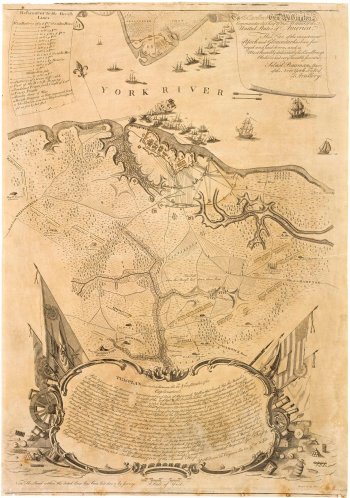
Sebastian Bauman, Plan of the Investment of York and Gloucester, 1781 (Colonial Williamsburg Foundation).
The Colonial Williamsburg Foundation has acquired one of the finest collections of early Virginia-related maps ever assembled. Through a part gift/part purchase agreement, the Foundation has added more than 220 maps, charts, atlases and documents to its collection, all dating between 1540 and 1835. Collected over four decades by William C. Wooldridge of Suffolk, Virginia, the maps were until recently owned by the Virginia Cartographical Society, a private, Norfolk, Virginia-based consortium. The addition of the Wooldridge Collection gives Colonial Williamsburg the most comprehensive assemblage of Virginia maps outside of the Library of Congress. These objects will be displayed in multiple future exhibitions at the Art Museums of Colonial Williamsburg and will be made available this spring through the Foundation’s online database.
“We are thrilled to announce this landmark acquisition, which represents a critical investment in the Foundation’s core mission to advance the public’s understanding of early America and its inhabitants,” said Mitchell B. Reiss, president and CEO of Colonial Williamsburg. “The maps contained in the Wooldridge Collection—in addition to being true works of art in their own right—offer extraordinary insight into the exploration, settlement and development of Virginia.”
“Maps are among the most illuminating of artifacts because they reveal the interests, aspirations, and even biases of those who made and used them,” said Ronald Hurst, Colonial Williamsburg’s Carlisle Humelsine chief curator and vice president for collections, conservation, and museums. “When paired with the Foundation’s early Virginia maps, the Wooldridge Collection gives us an unparalleled ability to understand and share Virginia’s role in our national story.”
Maps were made for a variety of reasons: to document new discoveries, facilitate travel, claim land and record military activity. This collection contains numerous examples of each type. One visually unique map in the Wooldridge collection was made to facilitate travel. Carta particolare dela Virginia Vecchia e Nuova by Sir Robert Dudley was published in Florence, Italy, in 1647, and was the first map to depict the region using Mercator’s projection (to flatten the spherical shape of the Earth on paper required increasingly distorting the lines of longitude the farther they were from the equator so that lines of longitude and latitude were at 90° angles. Although the land formations were altered, navigators could draw a straight line between any two points), which provided a practical aid for navigators.
Also in the Wooldridge Collection is a rare copy of Thomas Harriot’s 1590 publication, Admiranda Narratio fida tamen, de Commodis et Incolarum Ritibus Virginiae, with engravings by Theodore de Bry after John White in original color. De Bry’s engravings portray Virginia as a latter-day Eden, perhaps to stimulate interest in settlement. The Native American “Town of Secota” depicts such a scene, showing an abundance of thriving crops in neatly ordered gardens carefully manicured by a Native population. The map of Americae Pars, Nume Virginia drawn by John White and engraved by de Bry provides the first printed English record of Sir Walter Raleigh’s attempts to plant a colony in the New World. Although described in the title as Virginia, it delineates the region between the mouth of the Chesapeake Bay and Cape Lookout, North Carolina.
Another highlight among the new acquisitions dates to the close of the American Revolution in 1781. Immediately after the British surrender at Yorktown, each of the generals enlisted their engineers to create surveys of the battlefield. The most engaging of these, Plan of the Investment of York and Gloucester, was produced by George Washington’s engineer, Major Sebastian Bauman (who served as artillery commander at West Point in 1779 after emigrating from Austria). In addition to providing substantial, detailed military information, this map is interesting for its artistic composition. Yorktown, Gloucester Point, and troop positions are confined primarily to the top half of the map. The lower half is dominated by an explanation embellished with ornaments of war. The shape of the scrollwork cartouche surrounding the explanation, with flags and banners that thrust upward from both sides, forces the eye to the center of the image. Here, in an open space, is the very heart of the map: “The Field where the British laid down their Arms.”
Map aficionados, American history scholars and students in addition to anyone interested in early Virginia will find this newly combined collection a must-see resource. The addition of the Wooldridge Collection to Colonial Williamsburg’s existing holdings cements the significance of the Art Museums of Colonial Williamsburg as the premier destination for the study and appreciation of early American artifacts.
Opening Wednesday: Museum of the American Revolution
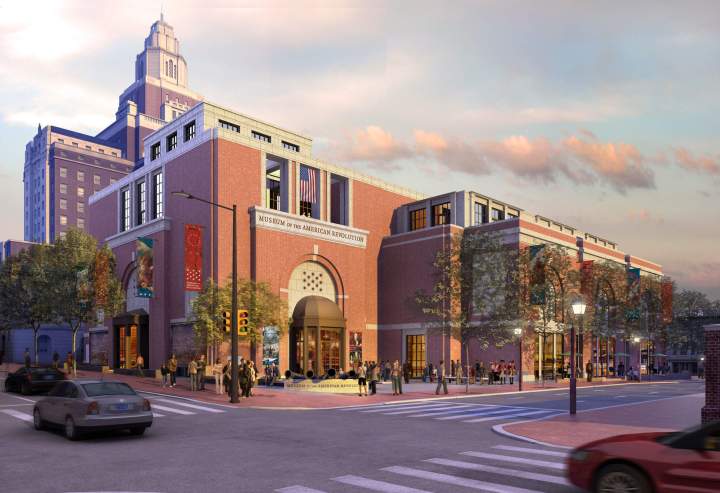
Museum of the American Revolution, Philadelphia. Robert A.M. Stern Architects LLP
◊ ◊ ◊ ◊ ◊
From the Museum:
The Museum of the American Revolution, which opens in the heart of historic Philadelphia on April 19, 2017, will explore the dynamic story of the American Revolution using its rich collection of Revolutionary-era weapons, personal items, letters, diaries, and works of art. Immersive galleries, theater experiences, and recreated historical environments will bring to life the events, people, and ideals of our nation’s founding and engage people in the history and continuing relevance of the American Revolution. The Museum is a private, non-profit, and non-partisan organization.
The Museum of the American Revolution will bring to life the events, people, and ideals of the founding of the United States and inspire a deep appreciation of the importance of the struggle that established a nation. With original artifacts, immersive galleries, dynamic theaters, and recreated historical environments, the experience will take visitors on a chronological journey from the roots of conflict in the 1760s through the creation of the American republic. Along the way, visitors will learn about the rise of the armed resistance to British taxation, the creation of the Declaration of Independence, the long years of warfare that achieved victory, and the Revolution’s continuing relevance.
The Museum rises three stories above the street, encompassing 118,000 total square feet, including permanent and temporary exhibit galleries, theaters, education spaces, collection storage, a café, a retail store, offices, and a welcoming rotunda. Located at the corner of Third and Chestnut Streets, the state-of-the-art building was designed by Robert A.M. Stern Architects. Visitors enter the Museum through a domed bronze-cladded entrance on Third Street into the rotunda, which features a dramatic window looking out to the activity on Chestnut Street. The cross-vaulted ceiling features an illuminated laylight representing the six-pointed star from Washington’s Standard flag, which is in the Museum’s collection.
The ground floor interior is organized around a skylit central interior court featuring terrazzo floors and an elliptical staircase, which provides a dramatic pathway to the Museum’s second floor exhibition galleries. Serving as the crossroads of the Museum, the Main Court also provides access to a 190-seat theater where visitors will view the Museum’s orientation film; 5,000 square feet of temporary exhibition and program space; a retail shop; and a café with seating on a terrace that opens to the sidewalk on Third Street.
At the top of the sweeping Grand Staircase, the second floor features 18,000 square feet of galleries and a 100-seat theater dedicated to George Washington’s Headquarters Tent. The third floor includes staff offices and an elegant special event and programs space with views of Carpenters’ Hall, the First Bank of the United States, and Independence Hall through nearly floor-to-ceiling windows and an open-air balcony.
The Museum’s lower level includes classrooms for students and other groups, collection storage, and will later include a discovery center, where children can explore their own role in making history.
Now Open: American Revolution Museum at Yorktown
From the Jamestown-Yorktown Foundation:
 2017 is a pivotal year at Jamestown Settlement and the American Revolution Museum at Yorktown, two premier living-history museums in two corners of America’s Historic Triangle that offer year-round experiences, compelling special exhibitions, events, and programs that immerse visitors into the story of America’s beginnings.
The Grand Opening Celebration of the American Revolution Museum at Yorktown March 23–April 4 culminates the museum’s 10-year transformation from the Yorktown Victory Center. The American Revolution Museum at Yorktown presents a renewed national perspective on the meaning and impact of the Revolution through introductory film, timeline, expansive gallery exhibits with nearly 500 artifacts, interactive displays and experiential theaters, and new settings for hands-on interpretive experiences in expanded re-creations of a Continental Army encampment and Revolution-era farm. The celebration launches the new museum with daily highlights of one of America’s 13 original states in the order that they ratified the Constitution, with a dedication ceremony on April 1. Patriotic festivities include gallery tours, living-history programs, artillery firings, flag-raising ceremonies, military musical performances, military re-enactments, lectures, and children’s activities.
 Located next to Yorktown National Battlefield, the Yorktown Victory Center opened in 1976 as one of three Virginia visitor centers for the Bicentennial of the American Revolution. Structural and exhibit improvements were implemented in the 1990s, broadening the museum’s focus to encompass the entire Revolution. The American Revolution Museum at Yorktown is the realization of a master plan adopted in 2007. The plan called for replacing the 1976 facility, with the new building positioned on the 22-acre site to allow for continued operation throughout construction, and repositioning and reconstructing the encampment and farm. A new 80,000-square-foot building opened in March 2015, with a theater for showings of Revolution-theme films, an illustrated timeline spanning the second half of the 18th century, and a gift shop and cafe. An important element of the new building is an education center, with five classrooms and a separate entrance, to serve student groups and the general public with dynamic, interactive learning experiences.
The museum’s inaugural special exhibition—AfterWARd: The Revolutionary Veterans Who Built America—debuts June 10 and follows the post-war stories of veterans of the Siege of Yorktown and how they went on after the war to shape the America we know today. A series of plays, performances and public lectures June through November feature Revolutionary War veterans James Lafayette, Alexander Hamilton, the Marquis de Lafayette and Henry Knox as well as issues facing modern-day veterans.
At Jamestown Settlement, a museum of 17th-century Virginia history and culture, visitors this spring can experience new interactive gallery exhibits exploring the Powhatan Indian, English and west central African cultures that converged in the 1600s. As part of a phased gallery enhancement, touch-screen panels allow visitors to compare and contrast each culture’s language, religion, government, economy and family structure. Jamestown Settlement’s expansive gallery exhibits debuted in 2006 in time for America’s 400th Anniversary commemoration in 2007, and are now being refreshed a decade later with new technology.
Four hundred years after the 1617 death of Pocahontas in England, her image and legend live on. Using depictions of Pocahontas from across the centuries, Jamestown Settlement presents Pocahontas Imagined, a special exhibition opening July 15 that illuminates the reasons behind her enduring legacy as well as her impression on popular culture and art. The six-month exhibition features Pocahontas memorabilia, advertisements, and interactive experiences.
Outdoors, visitors can examine artistic patterns, lines, and colors in objects found in Jamestown Settlement’s re-created Powhatan Indian village, ships and fort. Public lectures in partnership with the Virginia Museum of Fine Arts take place September 5, September 13, and October 3.
Jamestown Settlement is located on Route 31 at the Colonial Parkway next to Historic Jamestowne, administered by the National Park Service and Jamestown Rediscovery (on behalf of Preservation Virginia). The American Revolution Museum at Yorktown is located on Route 1020 in Yorktown near Yorktown Battlefield, administered by the National Park Service.
UK Government Art Collection To Set Up Its Own Gallery

Selections from the UK’s Government Art Collection as displayed in its current storage facility off Tottenham Court Road; photo from a blog posting (5 March 2014) at Please Don’t Touch The Dinosaurs, which noted the introduction of lunchtime tours of the GAC.
◊ ◊ ◊ ◊ ◊
As reported by The Art Newspaper (February 2017), p. 10.
The UK’s Government Art Collection (GAC) plans to set up its own gallery. This will open up a huge collection of 14,000 works, mainly by British artists, which is not easily accessible.
A spokeswoman for the Department for Culture, Media and Sport, which oversees the GAC, says that the collection’s offices and stores will be moved to new premises in London which should include a “display space that everyone will be able to enjoy.” Entry will presumably be free. The location and timing have not yet been announced.
At present, the collection is stored in Queen’s Yard, just off Tottenham Court Road, in central London. The stores are not environmentally controlled to museum standards, which is another reason for the move. . .
Of the 14,000 works, around one-third are in store, with most of the remainder hanging in 100 government offices in the UK and 270 offices abroad, where there is very limited public access. . .
The works are nearly all by British artists, although there are a few paintings made by foreigners of British subjects. They date from the 16th century to the present. . .
The Clark Art Institute Opens New American Decorative Arts Gallery
Press release (14 February 2017) from The Clark:
The Clark Art Institute in Williamstown, Massachusetts opened the Henry Morris and Elizabeth H. Burrows Gallery on Sunday, February 19. The American decorative arts gallery—housed in 3,275 square feet of newly renovated space in the Manton Research Center—contains the Clark’s important collection of early American paintings and furniture in addition to its exceptional Burrows collection of American silver. Designed by Selldorf Architects, the gallery includes new exhibition cases and an improved layout that enhance the experience of viewing the Clark’s important collection of colonial to early-nineteenth-century American art.
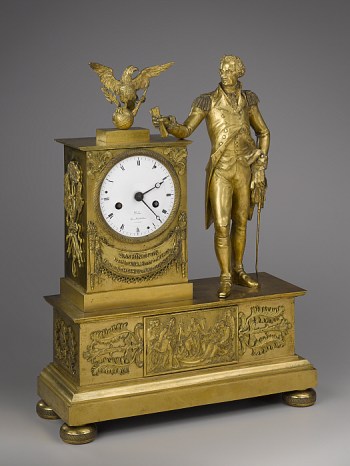
Jacques Nicolas Pierre François Dubuc, Mantel Clock with a Standing Figure of George Washington, ca. 1815–19; gilded brass, iron, and glass, 47.1 × 37.1 × 14.3 cm (Williamstown, Massachusetts: Clark Art Institute).
The gallery features more than 300 objects, many which have been off view since 2012 and some of which have never been exhibited. Highlights of the display include an iconic portrait of George Washington (1796–1803) by Gilbert Stuart (1755–1828); a beautifully scaled sugar bowl and cover (c. 1795) by Paul Revere, Jr. (1735–1818); and a graceful Sheraton-style secretary (c. 1800) attributed to Nehemiah Adams (1769–1840). The gallery also includes a study center containing additional displays of silver, a computer station, and a small library of books on American silver and furniture, allowing scholars and visitors to further their study of the works on view.
“The Clark’s collection of American decorative arts has been assembled largely through generous donations of important collections,” said Olivier Meslay, Felda and Dena Hardymon Director of the Clark. “We are so pleased to be able to honor the Burrowses, whose keen eyes and collecting acumen built an exemplary collection, and are indebted to them for their generosity in making such an important gift to the Clark. This new gallery, named in their honor, allows us to provide well-deserved prominence to this lesser-known facet of our collection.”
Very little of the Clark’s early American collections stems from the Institute’s founders. It has been developed over time through gifts, most significantly the 2003 Burrows bequest of more than 272 pieces of American silver. In 2001 thirty pieces of colonial and Federal furniture and small decorative arts assembled by distinguished collector George Cluett were received through a bequest from his daughter Florence Cluett Chambers. In 2010 and 2013, Phoebe Prime Swain donated twenty-eight pieces of Chinese export porcelain from the George Washington Memorial Service, each decorated with a memorial to the first president. While several museums own one or two pieces from this noted service, the Clark now has the largest holding of any public institution, featuring diverse forms such as platters, bowls, sauceboats, and custard cups.
“With the leadership of Selldorf Architects, we have converted our former temporary exhibition space into a suite of permanent collection galleries,” said Kathleen Morris, Sylvia and Leonard Marx Director of Exhibitions and Curator of Decorative Arts. “It is exciting to see these objects, many of which were formerly in storage due to lack of space, assembled in such a warm and welcoming environment.”
The reinstallation project included extensive object research conducted by Morris and Curatorial Research Associate Alexis Goodin. This research revealed important information about the collections. For example, a looking glass purchased by Cluett, thought to be a rare example from New York, was actually made in Bremen, Germany. Most likely made for the American market, the looking glass was the subject of an intensive research and conservation project in 2015.
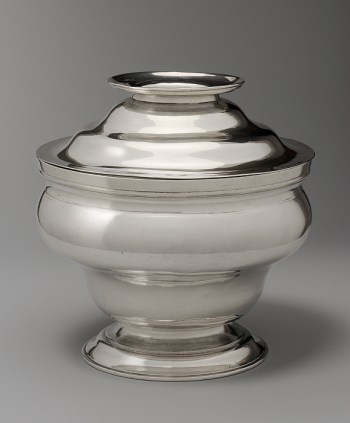
Myer Myers, Sugar Bowl and Cover, New York, ca. 1750–60; silver, 10.8 × 10.7 × 10.7 cm (Williamstown, Massachusetts: Clark Art Institute, bequest of Henry Morris and Elizabeth H. Burrows, 2003.4.100a-b).
The items housed in the Burrows Gallery reflect how early American artists and craftsman created a new artistic identity for the fledgling nation through the creation of beautiful, but functional, objects. Their designs demonstrate a knowledge and appreciation of luxury objects being made at the time in Europe, especially in England, but also show a tendency toward a greater simplicity in form and decoration. The Burrows collection provides a rich overview of silver production in the colonial and Federal periods. The collection is installed with three themes in mind: historic connections; the development of distinct styles in the major centers of silver production (Boston, New York, and Philadelphia); and social uses of silver for serving tea and coffee, drinking alcoholic beverages, dining, presentation, and personal use. Major silversmiths such as Paul Revere, Jr., Myer Myers (1723–1795), and the Richardson family of Philadelphia are well represented, as are many silversmiths working in smaller cities. The installation features nearly the entire Burrows collection.
The Cluett Chambers collection of furniture and decorative arts includes fine examples of case furniture, looking glasses, and clocks. Notable pieces include an imposing desk and bookcase (c. 1770) made in Massachusetts with exuberantly carved ‘hairy-paw’ feet and some fifty-two interior drawers and pigeonhole dividers. An elegant Sheraton-style secretary (1800–1810) attributed to Nehemiah Adams represents the most expensive type of furniture sold in Salem, Massachusetts furniture shops of the time, designed to emphasize the wealth, taste, and erudition of its owner. The Cluett Chambers collection also reveals that imported goods continued to have a place even as the furniture industry in America developed. The collection features, for example, looking glasses made for the American market in England and Germany, a gilded bronze clock made in Paris celebrating George Washington, and porcelain and silver imported from China.
The installation is enriched by loans from four private collections. Among these works is the portrait of Catherine Couenhoven Clark (1819–20) of Troy, New York by Ammi Phillips (1788–1865), which complements the Clark’s portrait of Harriet Campbell (c. 1815). The painting is on loan from Nathan Kernan (Couenhoven’s great-great-grandson) and Thomas Whitridge. Another loan object, an elegant pie-crust tea table, stands near a large display of silver made for serving tea and coffee. Additional loans include a mid-eighteenth-century Connecticut side chair; a high chest of drawers (c. 1780–85) attributed to Eliphalet Chapin (1741–1807) and also from Connecticut; another high chest of drawers from Philadelphia of the late 1750s with carving attributed to Nicholas Bernard (d. 1789); and a pair of c. 1789 portraits by Christian Gullager (1759–1826), depicting Major Benjamin Shaw and Mehitable Shaw.
The installation of the Henry Morris and Elizabeth H. Burrows Gallery is supported by a grant from the Henry Luce Foundation.
Mia Jackson Appointed Curator of Decorative Arts at Waddesdon
Waddesdon Manor is delighted to announce the appointment of Dr Mia Jackson as Curator of Decorative Arts. She joined Waddesdon on 1 February 2017.
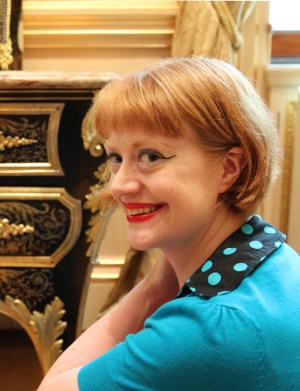 Jackson’s experience would seem tailor-made for Waddesdon. It was whilst finishing her undergraduate degree in French and philosophy that she noticed books on ceramics in her college library at Oxford. These included books on French porcelain that sparked a fascination. Jackson tracked down their author, Dr Aileen Dawson, and volunteered with her one day a week at The British Museum while studying for her MA in eighteenth-century French decorative arts at the Courtauld (2005). When a museum assistant job came open in the Prints and Drawings Department, Jackson was advised to apply. Of her four years at The British Museum, she notes, “I think I got the best art-historical education I could have dreamt of from Solander boxes and boxes of the most amazing prints and drawings.”
Returning to the decorative arts, Jackson was hired in 2008 as a museum assistant at The Wallace Collection. She spent three happy years under the directorship of Rosalind Savill, and at Savill’s encouragement, she embarked on a doctoral thesis at Queen Mary University of London on the French furniture maker André Charles Boulle and his collection of prints and drawings, finishing her PhD in 2016.
Also during her time at The Wallace Collection, Jackson participated in the Attingham Summer School, which opened her eyes to historic houses. She became Curator of Collections at English Heritage in January 2015 with curatorial responsibility for the collections at Audley End House in Essex and Wrest Park in Bedfordshire. Jackson was named the Art Fund curator of the month in November 2016.
Jackson notes, “I am hugely excited about joining the curatorial team at Waddesdon Manor, where I will be able to return to the French decorative arts that I love with such passion.”
Michael Twitty Named Williamsburg’s First ‘Revolutionary in Residence’
Press release (20 January 2017) from Colonial Williamsburg:
Michael Twitty Launches Williamsburg’s ‘Revolutionaries in Residence’ Program

Michael Twitty at work in the Peyton Randolph House kitchen in the Historic Area of Colonial Williamsburg (Photo: Joe Straw).
Acclaimed culinary historian, author, interpreter and Afroculinaria blogger Michael Twitty launches Colonial Williamsburg’s new Revolutionaries in Residence program, in which Virginia’s 18th-century capital hosts modern-day innovators to engage the nation with fresh perspectives that capture the spirit and relevance of its founding era. As part of the Revolutionaries in Residence program, Twitty delivers Colonial Williamsburg’s inaugural REV Talk at 5:30pm on February 11, 2017. The event, in which he shares insights and fields audience questions, coincides with Colonial Williamsburg Black History Month 2017 programs including the Films of Faith and Freedom series and original live dramatic programming like Journey to Redemption, all at the Kimball Theatre in Merchants Square. During Revolutionary City visits through February, Twitty is also scheduled to provide demonstrations and training for Historic Foodways staff and historical interpreters, to engage guests, and to collaborate with Colonial Williamsburg’s hospitality team on authentic new culinary offerings in the Historic Taverns and at Traditions Restaurant in the Williamsburg Lodge.
“Colonial Williamsburg explores the events and ideas of the 18th century that continue to define our lives and challenge us today,” said Colonial Williamsburg President and CEO Mitchell B. Reiss. “With the Revolutionaries in Residence program, we engage thinkers who question convention and capture the disruptive spirit of America’s founding generation. I can think of no one better suited to begin that journey than Michael Twitty, who illuminates huge aspects of our shared history that too often have been overlooked.”
Twitty’s work takes him throughout the country to preserve, prepare and promote African-American foodways along with the culinary traditions of Africa, the African diaspora and the American South. His past projects include a presentation with the Center for the Study of Southern Culture and the Southern Foodways Alliance, and as a 2016 TED fellow he delivered the TED Talk “Gastronomy and the Social Justice Reality of Food.” He is the author of The Cooking Gene: A Journey through African-American Culinary History in the Old South, scheduled for release later this year by HarperCollins.
“Colonial Williamsburg has been a part of my life for almost four decades. I hope my presence will attract a wider audience to the pleasures of lifelong learning, exploring our past and moving forward into the future with purposeful vision,” Twitty said. “As we approach the incredible 400th year anniversary of African arrival in mainland British America, there needs to be a homecoming of all African Americans to this very sacred place. The Historic Triangle has incredible stories to tell and Colonial Williamsburg is at its heart and I’m excited to help illuminate those stories.”
The Revolutionaries in Residence program is generously sponsored by The Grainger Foundation of Lake Forest, Illinois.
Other events to mark Black History Month include the reopening of the Historic Area’s newly renovated African-American Religion exhibit on Nassau Street, programs including A Gathering of Hair and the ongoing exhibit A Century of African-American Quilts at the Abby Aldrich Rockefeller Folk Art Museum.
Highlights of the Films of Faith and Freedom series include Golden Globe winner Moonlight and Golden Globe nominee Loving as well as the Virginia premiere of the documentary Maya Angelou: And Still I Rise at 7pm on February 10 before its national broadcast premiere on PBS. Also in February, Colonial Williamsburg continues its partnership with the city’s historic First Baptist Church at 727 Scotland St., which again calls on the community and nation to ring the congregation’s restored Freedom Bell for justice, peace and healing.
◊ ◊ ◊ ◊ ◊
Here’s a recent video addressing the history of okra, which Twitty made with John Townsend (of Jas. Townsend and Son) at George Mason’s Gunston Hall Plantation in Virginia. Twitty’s book The Cooking Gene: A Journey through African-American Culinary History in the Old South is scheduled for August publication from Harper Collins.










leave a comment