Acquisitions at Williamsburg Highlight African American Experiences
Press release (31 January 2017) from Colonial Williamsburg:
With its mission to tell America’s enduring story through its material culture, the Art Museums of Colonial Williamsburg has actively diversified its collections over recent years and has bolstered efforts to increase its holdings of African-American works of art and artifacts. In the past six months, the Art Museums have acquired by purchase, gift, or loan several significant pieces that further this goal.
“Colonial Williamsburg has long believed that art and artifacts speak loudly about the people, places, and events of the past. Because we strive to tell the broader American story, it is important that we continue to seek out those objects that speak to the African-American experience during the colonial and early national periods. These newly acquired works address that mission handsomely,” said Ronald L. Hurst, the foundation’s Carlisle Humelsine Chief curator and vice president for collections, conservation, and museums.

Cesar Chelor, A ‘plow plane’ (Colonial Williamsburg Foundation).
While it is noteworthy to discuss individual objects that a museum acquires, it is especially so when an entire collection joins its existing holdings. Such is the case with one recent acquisition. The Art Museums have just received the country’s most extensive collection of pre-Revolutionary woodworking planes made by African-American artisan Cesar Chelor. Prior to receiving his freedom, Chelor was owned by the earliest documented American plane maker, Francis Nicholson (1683–1753) of Wrentham, Massachusetts, and eventually became his apprentice. Chelor later became a plane maker in his own right as did Nicholson’s son John. Upon the elder Nicholson’s death, he willed Chelor his freedom, 10 acres of land and the tools and materials to continue his work on his own, thus making him the earliest known African-American tool maker in North America. Of the more than 700 Chelor and Nicholson planes known to exist, the Colonial Williamsburg collection now owns more than one third of them. This new group of almost 250 planes was amassed over several decades by the late David V. Englund of Seattle; it was Englund’s longtime vision that his collection should go to Colonial Williamsburg where the tools could be shared and studied. The example illustrated here, called a ‘plow plane’ for its resemblance to the farming tool, was perfect for cutting long grooves in a board. Since the handy wooden adjusting screws first appeared in New England, these became known as ‘Yankee plow’ planes.
“The Englund collection encompasses the spectrum of woodworking planes crafted by the first dynasty of truly American tool-makers,” said Erik Goldstein, senior curator of mechanical arts and numismatics. “Spanning the middle quarters of the 18th century, it is highlighted by the products of Caesar Chelor, Francis Nicholson’s manumitted slave, and latter free tradesman. This unique assemblage of colonial planes will serve as a core of Colonial Williamsburg’s woodworking tool collection.”

Peter Bentzon, pair of silver teaspons, marked ‘P. BENTZON’., made in either Philadelphia or St. Croix between 1815 and 1830 (Colonial Williamsburg Foundation).
Another exceedingly rare addition to the Art Museums’ collections this month is this pair of silver teaspoons marked by Peter Bentzon, examples from the less than two dozen known objects bearing his touchmarks (of either his initials or ‘P. BENTZON’, as seen here). Bentzon, a free man of color, was born about 1783 in the Danish West Indies (now the United States Virgin Islands) to a mother of African and European descent and a Norwegian father. Trained as a silversmith in Philadelphia, he worked both there and in St. Croix, moving several times between these locations prior to his death sometime after 1850. These two teaspoons were made in either Philadelphia or St. Croix between 1815 and 1830.
“Few objects survive to bear testament to the work of enslaved and free people of color as silversmiths in early America. We are very pleased to share these spoons as examples of the diversity of craftsmanship on these shores,” said Janine E. Skerry, senior curator of metals.
Another exciting addition to the collections is this pale pink silk drawstring workbag made in 1827 by the Birmingham (England) Female Society for the Relief of British Negro Slaves. English and American women of the day carried workbags as a fashionable accessory to hold their pocketbooks, handkerchiefs, and even keys.
While often embroidered with floral motifs, this workbag takes a more political and moral conviction. The Female Society for the Relief of British Negro Slaves, established on April 8, 1825, produced literature, printed albums, purses, and workbags for sale to help raise awareness of the cruelty toward enslaved Africans and to provide money for their relief. Identical objects and literature crossed the Atlantic and helped to fuel the American abolitionist movement.

Pink silk work bag, made in England in 1827 by the Birmingham Female Society for the Relief of British Negro Slaves (Colonial Williamsburg Foundation).
The workbag’s central roundel is printed with a copper plate image of a slave kneeling and chained to the ground. The foreground shows a group of slaves being whipped by their master. The reverse is also printed, but with a stanza from William Cowper’s poem on slavery printed in The Task in 1784. The stanza reads:
Thus man devotes his brother, and destroys;
And worse than all, and most to be deplored,
As human nature’s broadest, foulest blot,
Chains him, and tasks him, and exacts his sweat.
With stripes, that mercy, with a bleeding heart,
Weeps when she sees inflicted on a beast.
“This small work bag shows the very active role that Female Societies took in working towards the abolition of slavery during the nineteenth-century. While many fancy workbags survive from this time period, these politically and morally charged women’s accessories are seldom found and make this piece a unique acquisition to the Colonial Williamsburg’s collection,” said Neal Hurst, associate curator of costumes and textiles.
From roughly the same time period as the workbag, comes another extraordinary acquisition: a signed, ash-glazed stoneware storage jar made in 1849 by the enslaved African American potter, David Drake, often known as ‘Dave’, who worked for various owners in the Edgefield district of South Carolina for more than 50 years. This is the first signed piece of Drake pottery to join the collection. At a time when it was illegal for slaves to be literate, David Drake not only signed many of his pieces but also was known to inscribe verses on them. Although this jar, which stands almost 17 inches in height and includes distinctive features, such as five incised punctuates to indicate its five-gallon capacity, does not include any of Drake’s poetry, it is, however, signed ‘Mr. Miles Dave’ and dated October 15, 1849. Miles refers to Lewis J. Miles, who owned David Drake from about 1840 to 1843 and again from 1849 until Emancipation.
“The work of David Drake is important for many reasons: It speaks to the role enslaved labor played in the manufacture of utilitarian wares in 19th-century South Carolina; it helps to illuminate some of the complexities of that system; and most of all it gives us a glimpse into the life of this man and the world he inhabited,” said Suzanne Findlen Hood, curator of ceramics and glass. “This storage jar relates directly to the attributed, but unsigned example that has been in the collection since the 1930s and will allow us to more fully interpret the life and work of David Drake.”
Although Drake’s stoneware vessels were made for strictly functional purposes, often for storing large amounts of food, they were refined works of art in their own right. To make some of these containers, he combined turning and coiling techniques in which he turned the bottom portion of the pot on a wheel and then coiled clay ropes around the top of its walls. This enabled him to create vessels of remarkable height and diameter.
In 2016, A Century of African-American Quilts opened in the Abby Aldrich Rockefeller Folk Art Museum to great acclaim and features twelve quilts created by African-American quilt makers in the years following the abolition of slavery (from the 1870s to approximately 1990), half of which had never before been exhibited. By generous loan, this colorful variation on the typical ‘schoolhouse’ pattern joins the exhibition, which remains on view through April 2018. According to family tradition, Margaret Carr (b. ca. 1909), an African-American school teacher in Rogersville, Tennessee, made the quilt or inherited it from her mother, Lema Carr, between 1940 and 1960. The quilt features eight houses facing each other on either side of a central vertical band. Shiny synthetic fabrics in bright solid colors create the houses, each of which is further embellished with charming embroidered flowers around the foundations and bordering the windows, doors and rooflines.
“Margaret Carr’s quilt is a wonderful addition to the exhibition of African-American quilts. The charming ‘schoolhouse’ pattern seems especially appropriate for a woman who was a teacher,” said Linda Baumgarten, senior curator of textiles and costumes. “We are indebted to collector and scholar Mary Jo Case for lending us this bold and colorful example of Tennessee quiltmaking.”
As the Art Museums of Colonial Williamsburg continue to acquire important pieces to its collections, the priority will remain to expand the scope of them to reflect the cultural diversity of our country both past and present.
Esther Bell Named Senior Curator of Clark Art Institute
Press release (January 2017) from The Clark:
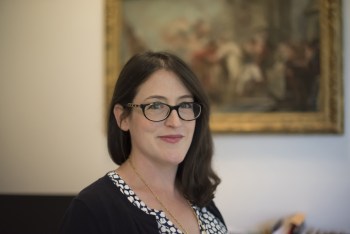 Esther Bell has been selected to serve as the Robert and Martha Berman Lipp Senior Curator of the Clark Art Institute in Williamstown, Massachusetts. Her appointment was announced today by Olivier Meslay, Felda and Dena Hardymon Director of the Clark.
Bell currently serves as the curator in charge of European paintings at the Fine Arts Museums of San Francisco, where she has organized a number of important exhibitions, including the recent critically acclaimed The Brothers Le Nain: Painters of Seventeenth-Century France, presented in partnership with the Kimbell Art Museum, Fort Worth, Texas and the Musée du Louvre. On February 25, Bell will open Monet: The Early Years at San Francisco’s Legion of Honor, an exhibition organized by the Kimbell in collaboration with the Fine Arts Museums of San Francisco.
“Esther Bell is one of the brightest curators working today,” said Meslay. “Her creativity, intellect, and scholarship are only equaled by her passion and energy for the diverse demands of curatorial work. Esther’s international experience and her deep expertise in French paintings will be of great importance in her work here at the Clark. We are delighted to welcome her as a colleague.”
Prior to joining the staff of the Fine Arts Museums in 2014, Bell was the curator of European paintings, drawings, and sculpture at the Cincinnati Art Museum. She began her career in New York, serving as a research assistant at the Metropolitan Museum of Art and as both a research assistant and curatorial fellow at the Morgan Museum and Library. In 2015, Apollo magazine named Bell as one of the top ten curators in North America under the age of forty.
Bell received her doctorate in the history of art from the Institute of Fine Arts, New York University, with a specialization in seventeenth- and eighteenth-century European art. She earned a master’s degree from the Williams College/Clark Graduate Program in the History of Art, and a bachelor’s degree in the history of art from the University of Virginia. She completed a Fulbright Fellowship at the Musée du Louvre in 2003, and held numerous fellowships, including those at New York University and the Metropolitan Museum of Art.
“I am honored to join the Clark Art Institute at this important moment in its history,” said Bell. “I have deep admiration for the Clark’s talented staff, world-class collections, its highly regarded Research and Academic Program, and, of course, the new and beautiful campus. While it is hard to leave the outstanding program and people at the Fine Arts Museums of San Francisco after such good years, the opportunity to return to Williamstown and be a part of the excitement of the new Clark was irresistible.”
During her tenure at the Fine Arts Museums of San Francisco, Bell has been responsible for a diverse array of exhibitions, including Botticelli to Braque: Masterpieces from the National Galleries of Scotland; J.M.W. Turner: Painting Set Free; and Pierre Bonnard: Painting Arcadia. She is the co-curator for Degas, Impressionism, and the Paris Millinery Trade, currently on view at the Saint Louis Art Museum and opening in San Francisco in June 2017. At the Cincinnati Art Museum, Bell’s curatorial work included the recently completed Van Gogh: Into the Undergrowth, as well as exhibitions on Peter Paul Rubens, Jacob Ruisdael, Edgar Degas, Pierre-Auguste Renoir, and François Boucher.
An accomplished scholar and author, Bell is a member of the editorial board of Journal18, a scholarly journal focused on eighteenth-century studies. She is the author and editor of a number of publications related to the exhibitions she has organized, and is regularly published in academic journals. Bell has delivered lectures in distinguished international venues such as the University of St. Andrews, Scotland; the Musée des Beaux-Arts, Nantes; the Institut National d’Histoire de l’Art, Paris; and the Metropolitan Museum of Art, New York.
Bell currently resides in San Francisco. She will begin her work at the Clark in July 2017.
Funding Streams for New Museum of London in West Smithfield

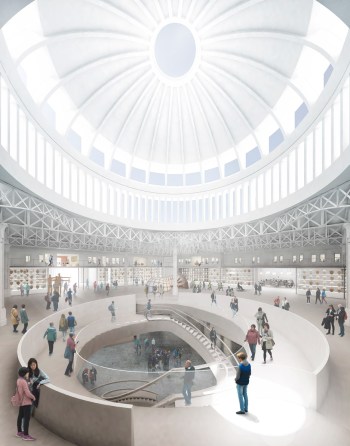
Architects Stanton Williams and Asif Khan were selected in July 2016 to design the new Museum of London; the design team also includes conservation architect Julian Harrap and landscape design consultant J&L Gibbons.
◊ ◊ ◊ ◊ ◊
Press release (24 January 2017) from the Museum of London:
The Museum of London’s plans for a new museum in West Smithfield were today given a major boost thanks to huge support from the City of London Corporation and the Mayor of London, who have pledged £110 million and £70 million respectively. This marks an important next step for the project, which will save one of the last remaining derelict Victorian buildings in central London and transform an area of the capital with a rich and fascinating history. The support from Sadiq Khan is the largest cultural investment made by any Mayor of London, and together with City of London Corporation’s unprecedented investment, provides a £180 million package of confirmed funding towards its approximate £250 million cost.
In addition to conserving this historically important West Smithfield site, this ambitious project will deliver significant economic and social benefits for London and Londoners. This includes traineeship opportunities across London and approximately 1,700 new jobs. Located right next to the major new transport hub to be created at Farringdon, the new museum will be ideally situated to make the most of London’s biggest infrastructure project, Crossrail, and help to turn the area into a dynamic destination. As part of a burgeoning cultural hub within the City, the new museum will aim to broaden its visitor profile and double its visitor attendance from one million to more than two million, displaying much more of its rich collection of over 6 million items, telling the 2,000-year story of London, in 8,000m2 of permanent gallery space plus 1,500m2 of temporary exhibition space.

Sadiq Khan, Mayor of London, who was touring the West Smithfield site, said: “From the outset of my Mayoralty, I pledged to make culture a core priority and I’m proud that this is the biggest ever cultural investment made by any Mayor of London to date. The world’s greatest city deserves the world’s greatest museum, which is why I’m delighted to announce £70 million of funding for the new Museum of London. This is on top of the £110m funding announced by the City of London Corporation. This major landmark project will be a jewel in our crown. It will reveal 2,000 years of fascinating London history for Londoners, visitors, and every schoolchild in the capital. It will rejuvenate West Smithfield, protecting its heritage while also creating a dynamic new public space—strengthening London’s credentials as an international powerhouse for culture.”
 Mark Boleat, Chairman of the Policy and Resources Committee at the City of London Corporation, said: “It is widely recognised that the current building at London Wall does not allow the Museum to expand and flourish, and that the former market buildings are in a poor state of repair. The approval of this significant contribution makes good business sense and is a major step forward towards the creation of a new Museum of London, both iconic in design and unparalleled in the way in which it tells the capital’s vibrant history.”
Sharon Ament, Director of the Museum of London, said: “This is simply fantastic news and a great way to start 2017. The £180m funding package from the City of London Corporation and Mayor of London provides us with the perfect springboard for the fundraising drive for the new Museum of London at West Smithfield. It also shows that, like us and many others, the Mayor of London and City of London Corporation recognise the huge benefits for London that a new Museum of London at a rejuvenated West Smithfield will deliver. Working with our design team we can now move forward confidently with detailed plans for the new museum and remain firmly on target to open the new Museum in 2022.”
This funding milestone follows the appointment of the architects Stanton Williams and Asif Khan in July 2016. The design team, which also includes conservation architect Julian Harrap and landscape design consultant J&L Gibbons, is now working to turn the initial concepts into a fully formed vision for the new museum alongside the City of London Corporation and the GLA. This includes further analysis of the complex West Smithfield site, a critical piece of work that will feed into the design process. Following a full and extensive public consultation process, a planning application is expected in 2018 to enable the delivery of the new museum by 2022. Further appointments to the project team are due to be announced over the next few months.
UK Export Ban Placed on Mughal Flask and Huqqa Set
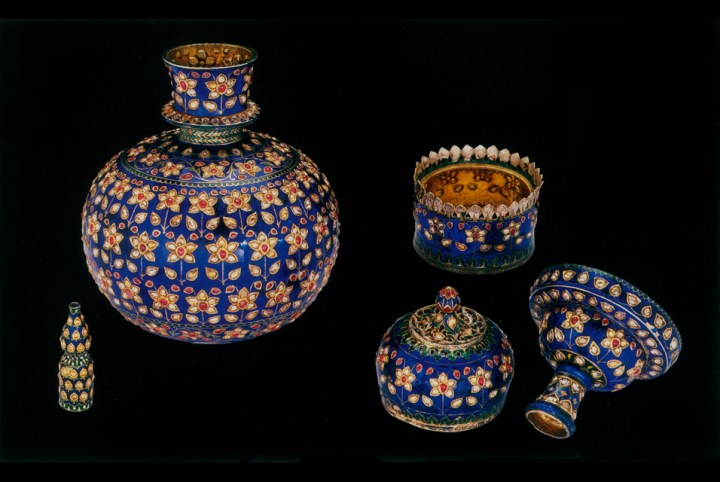
Silver huqqa set made up of five separate parts: 1) globular base, ht. 16.9 cm; 2) tobacco bowl, ht. 9 cm and 3) its cover, ht. 7 cm; 4) ring, ht. 5 cm; 5) mouthpiece, ht. 6.5 cm, North India, ca. 1750.
◊ ◊ ◊ ◊ ◊
Press release (18 January 2017) from Gov.UK’s Department for Culture, Media & Sport:
Culture Minister Matt Hancock has placed a temporary export bar on Clive of India’s huqqa set and flask to provide an opportunity to keep them in the country. The Mughal ruby and emerald flask and the sapphire and ruby huqqa set are both at risk of being exported from the UK unless a buyer can be found to match the asking price of £6,000,000 for the flask or £240,000 for the huqqa set.

Wine flask made of jade, lined with silver and set with rubies and emeralds; 25.3 × 11.2 cm, India, 17th century.
It is believed that Robert Clive, also known as Clive of India, was presented with the flask as a gift following the Battle of Plassey. Clive was governor and commander-in-chief of India and became famous for his victory over the Nawab of Bengal during the battle in 1757. The flask itself is incredibly rare and there is no other object like it anywhere in the world, let alone in Britain. It has a silver interior and a gold exterior decorated in jade, emeralds and rubies. Clive of India also brought the huqqa set back to the UK from India. Set with white sapphires and rubies, it was part of an original collection at the imperial court in Delhi. The huqqa set is considered to be an extremely rare survival as such lavish courtly objects were often broken down for their component parts. It isn’t known how Clive of India acquired the set, but smoking was widespread in India at the time and had become popular amongst the British living there as well. In fact, the British often had themselves portrayed in paintings reclining against brocade-covered bolsters on a terrace, peacefully smoking.
Minister of State for Digital and Culture Matt Hancock said: “These treasures are not only exquisite, they provide us with a glimpse into the fascinating lifestyle and traditions of the Mughal Court and the British presence in India at the time. I hope that we are able to keep these unique artefacts in the country to learn more about this extraordinary history.”
The decision to defer the export licence follows a recommendation by the Reviewing Committee on the Export of Works of Art and Objects of Cultural Interest (RCEWA), administered by The Arts Council. The RCEWA made its recommendation on the flask on the grounds of its close connection with our history and national life, its aesthetic importance and its outstanding significance for the study of Mughal political and technical history, the consumption of wine and gift-giving in Mughal India, Clive of India and the British expansion in India. The RCEWA made its recommendation on the huqqa set on the grounds of its close connection with our history and national life and on the grounds of its outstanding significance for the study of Mughal court arts, gold and silver-smithing, jewel-setting, enamelling, and the place of tobacco in the social etiquette of early modern India and its adoption by British administrators in the later 18th century.
Sir Hayden Phillips, Chairman of the RCEWA said: “Apart from the intrinsic quality of these objects, and their outstanding importance for scholarship, the Reviewing Committee was unanimous in its recognition of their emblematic significance for our history and national life. Robert Clive was an outstanding and, indeed, controversial figure, but absolutely central to the creation of British rule in India. His statue, gazing out towards St James’s Park, stands guard at Clive Steps as they lead to the Foreign Office and The Treasury; a tellingly symbolic location for what he contributed to our history.”
The decision on the export licence application for the flask will be deferred until 17 May 2017. This may be extended until 17 November 2017 if a serious intention to raise funds to purchase it is made at the recommended price of £6,000,000 (plus VAT of £1,200,000). The decision on the export licence application for the huqqa set will be deferred until 17 April 2017. This may be extended until 17 July 2017 if a serious intention to raise funds to purchase it is made at the recommended price of £240,000 (plus VAT of £48,000). Organisations or individuals interested in purchasing the flask or huqqa set should contact the RCEWA.
◊ ◊ ◊ ◊ ◊
Note (added 24 February 2017) — This ban comes thirteen years after “an earlier attempt to send” the objects “from the UK to Qatar,” as reported by The Art Newspaper (February 2017), p. 10. “After the Qataris withdrew the export licence applications in 2005, they were required to keep the objects in the UK and so lent the flask and huqqa to the V&A. Last year, the museum learned that the loan agreement would not be renewed. Qatar Museums wants to display them in Doha’s Museum of Islamic Art.”
Emily Peters Appointed Curator of Prints & Drawings at Cleveland
Press release (23 January 2017) from the CMA:
 The Cleveland Museum of Art (CMA) has announced the appointment of Emily J. Peters as Curator of Prints and Drawings. The museum’s renowned collection of prints and drawings, ranging from the Renaissance to the early 21st century, is distinguished by the quality and rarity of its holdings. Peters’s appointment follows an international search. She will assume her responsibilities at the CMA in April.
“Emily is an exceptional curator with a remarkable eye and creative approach. Her range of expertise and scholarly interests—which span five centuries and a panoply of graphic mediums—are admirable. We very much look forward to having Emily as a colleague in Cleveland,” said Director William M. Griswold.
As Curator of Prints and Drawings, Peters will oversee the care and development of the collection, working closely with the Director and Chief Curator on the identification and acquisition of works of art to augment the collection. Together with an Assistant or Associate Curator of Prints and Drawings—who will be appointed later this year—Peters will be responsible for exhibitions in the James and Hanna Bartlett Prints and Drawings Galleries; she will also curate special exhibitions in the Smith Foundation Hall and Gallery that highlight all aspects of European and American graphic art. Peters will also develop interpretive and didactic materials designed to appeal to broad audiences, helping to deepen visitors’ appreciation and understanding of graphic art.
The collections for which Peters will be responsible span more than 500 years of artistic production throughout Europe and the United States. Consisting of approximately 22,000 prints and 4,000 drawings, the collection is internationally known for its rarity and high quality. Areas of particular strength include Italian Renaissance drawings by Michelangelo and Raphael as well as a strong group of engravings and woodcuts by Albrecht Dürer. Highlights of the 17th century include drawings and a range of etched subjects by Rembrandt van Rijn, while an impressive group of early lithographs and celebrated drawings by Ingres and Degas stand out among the 19th-century holdings. The drawings collection is admired for watercolors by Blake, Turner and Palmer, and for luminous pastels by Cassatt and Redon. Among the highlights of modernism is a group of more than 50 German Expressionist prints and drawings by Miró, Picasso, and Winslow Homer.
“I am honored to be joining the Cleveland Museum of Art at this exciting time,” said Peters. “Cleveland’s collection of prints and drawings is one of the finest in the United States, and I have long admired its many treasures as well as the important exhibitions and acquisitions presented by my predecessors at the museum. I look forward to thinking about new ways to present the collection and to working with my colleagues to augment its holdings in keeping with the CMA’s rich history of collecting. I am particularly looking forward to getting to know the vibrant community of prints and drawings supporters in Cleveland via the Print Club and the Painting and Drawing Society.”
Peters brings more than a decade of curatorial work and museum experience to the CMA. In 2005, she joined the curatorial team at the RISD Museum as Assistant Curator of Prints, Drawings and Photographs; in 2008, she was promoted to Associate Curator. A specialist of 15th- and 16th-century Netherlandish prints and drawings, Peters has mounted at RISD such diverse exhibitions as Design and Description: Renaissance and Baroque Drawings (2006); Urban America, 1930–1970 (2007); The Brilliant Line: Following the Early Modern Engraver 1480–1650 (2009); and The Festive City (2014); and Landscape and Leisure: 19th-Century American Drawings from the Collection (2015). Along with organizing exhibitions, Peters has collaborated closely with her curatorial colleagues at RISD in planning the reinstallation of the museum’s European galleries, set to open in the fall of 2017.
In addition to her curatorial work, Peters has extensive experience teaching. While at the RISD Museum, she has worked closely with professors and students at Rhode Island School of Design and Brown University, collaborating with professors on exhibitions and publications and supervising undergraduate and graduate students who research the museum’s collection and curate exhibitions. Peters has also taught art history at Rhode Island College and the University of California, Santa Barbara.
Peters’s scholarship has been widely praised. Her exhibition catalogue The Brilliant Line: Following the Early Modern Engraver 1480–1650 (2009) received a first-place award from the New England Museum Association, and her catalogue essay, “Systems and Swells: The Collective Lineage of Engraved Lines” was deemed runner-up for essay of the year by the Association of Art Museum Curators. Research for The Brilliant Line was funded by grants from the Samuel Kress Foundation, the International Fine Prints Dealers Association, and the Foundation for the American Institute for Conservation of Historic and Artistic Works. Peters has authored numerous scholarly articles including “Processional Print Series in Antwerp during the Dutch Revolt,” Print Quarterly 32 (September 2015): 259–70; “Treasures from the Vault: Leaf e from the Biblia Pauperum, ca. 1460s,” in Art in Print 3 (November/December 2013): 28–31; and “Printing Ritual: The Performance of Community in Christopher Plantin’s La Joyeuse & Magnifique Entrée de Monseigneur Francoys . . . d’Anjou (Antwerp, 1592)” Renaissance Quarterly 61 (2008): 61–2.
Holding a PhD from the University of California, Santa Barbara, Peters has been the recipient of several fellowships from institutions including the Interdisciplinary Humanities Center at UCSB, the Belgian American Educational Foundation, and the American Association of Netherlandic Studies. In 2002–03, she was awarded a Fulbright Fellowship for dissertation research in Antwerp. Emily J. Peters will be moving to Cleveland with her family.
Sweden Nationalmuseum Acquires Oil Studies by Valenciennes and Denis

Pierre Henri de Valenciennes, View of the Roman Campagna near Subiaco, ca.1782
(Stockholm: Nationalmuseum, 7359)
◊ ◊ ◊ ◊ ◊
Press release (January 2017) from Sweden’s Nationalmuseum:
Sweden’s Nationalmuseum has acquired three landscape studies from Italy in oil by Pierre Henri de Valenciennes and Simon Denis. Views of Rome and the surrounding countryside have a distinguished pedigree. For a long time, they remained true to the 17th-century landscape ideal and were painted in the studio. Valenciennes and Denis broke new ground by making sketches in oil, often on paper, on location. The light and weather conditions were as important as the subject, so the works were produced quickly. Despite being preparatory studies, these oil sketches laid the foundations for much of the 19th-century’s plein air painting.

Simon Denis, Study of the Roman Campagna, ca. 1800 (Stockholm: Nationalmuseum, 7336).
Pierre Henri de Valenciennes (1750–1819) is considered a pioneer who had a major influence on French art as both a theorist and a teacher. He was elected to the academy of fine arts in Paris in 1787, and served as professor of perspective theory from 1812 onward. Élémens de perspective pratique à l’usage des artistes (1800), his treatise on practical landscape painting with a focus on perspective, was particularly significant. Eventually his efforts led the academy to establish a dedicated prize for historical landscape painting. The recently acquired View of the Roman Campagna near Subiaco shows Valenciennes’s skill in capturing the lighting conditions and cloud shadows through brushwork that is both sensitive and vivid. The painting depicts the movement of the wind and its effects rather more than the landscape itself. Oil sketches of this kind, painted on location, differ radically from the works Valenciennes created in his studio. The latter portray an idealised version of nature, with scenes from classical mythology, but thanks to the introduction of oil sketches to the process, the lighting and colouring are markedly different from those seen in 17th-century landscape painting.

Simon Denis, The Waterfall in Neptune’s Grotto at Tivoli, ca. 1790 (Stockholm: Nationalmuseum, 7358).
Simon Denis (1755–1813), a native of Antwerp, travelled via Paris to Italy, where he stayed for the rest of his life. Long overlooked, Denis was rediscovered in 1992 when a large number of his oil sketches were put up for sale. These had been passed down through generations of the artist’s descendants, so had stayed out of the public eye. His technique is reminiscent of Valenciennes, with similarly economical brushwork and a focus on the lighting and weather conditions. Unlike the idealised landscapes, the oil sketches portray nature as changeable, which the recently acquired pieces exemplify superbly. The view of the Roman Campagna, in particular, shows Denis’s skill in capturing atmospheric phenomena with great simplicity. The results are magnificent and the effect almost illusory. The smaller oil sketch depicts Neptune’s Grotto at Tivoli. With masterful simplicity, Denis captures the play of light in the waterfall and the foliage in the foreground contrasted with the dark cliff. The work appears to have been painted in haste, with thinly applied colours that dried rapidly, allowing the artist to move on to the next layer. A crouching figure at lower right serves to illustrate the scale of the subject.
When Nationalmuseum reopens after renovations, these three new acquisitions will enable the museum to better chart the beginnings of plein air painting. This would not have been possible without the generous support of the Wiros Fund, the Sophia Giesecke Fund, and the Hedda and N D Qvist Memorial Fund. Nationalmuseum has no budget of its own for new acquisitions, but relies on gifting and financial support from private funds and foundations to enhance its collections of fine art and craft.
Former Labour MP Tristram Hunt To Direct the V&A
Press release (13 January 2017) from the V&A:
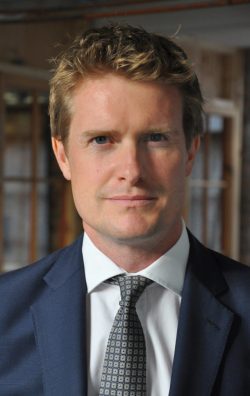 The V&A Trustees have today appointed Dr Tristram Hunt as the new Director of the V&A. Hunt has served as Labour MP for Stoke-on-Trent Central since 2010 and was previously the Shadow Secretary of State and Shadow Minister for Education. A historian, politician, writer, and broadcaster, Hunt is an expert on the eighteenth and nineteenth centuries, with a particular focus on Victorian urban history. He is the author of several books, including The English Civil War: At First Hand and most recently Ten Cities That Made An Empire. A regular history broadcaster on BBC and Channel 4, Hunt has made more than a dozen series on subjects including Elgar and Empire, Isaac Newton, and the English Civil War. Hunt lectures on modern British history at Queen Mary University of London. He is a Fellow of the Royal Historical Society, a founder of the Stoke-on-Trent Literary Festival and a Patron of the British Ceramics Biennial, and was previously a Trustee of both the Heritage Lottery Fund and the National Heritage Memorial Fund, and a Curator of the Mayor of London’s History Festival.
Hunt’s support of the ceramics industry, together with the Art Fund, played an important role in saving the Wedgwood Collection in 2014. The collection was gifted to the V&A and is on long-term loan to the Wedgwood Museum in Barlaston, Stoke-on-Trent. He brings widespread expertise across education, industry, and politics to the V&A and a keen awareness of the important role of major public institutions in the UK, having been at the forefront of political, cultural and public life for the last decade. Hunt’s appointment has been confirmed by the Prime Minister and the Secretary of State for Culture, Media and Sport, and he will join the Museum in the coming months.
Announcing the appointment, V&A Chairman Nicholas Coleridge said: “On behalf of the Trustees, I am delighted to announce the appointment of Dr Tristram Hunt as Director of the Victoria and Albert Museum. He has a highly compelling mixture of experience across public life, the arts, history, education and academia, and knows our collections well from his writing and broadcasting. In addition, he is an informed and articulate leader and communicator on numerous facets of culture, both historic and contemporary, and I greatly look forward to working with him at the V&A.”
Dr Tristram Hunt said: “I am delighted and honoured to have been appointed Director of the V&A. I have loved the V&A since I was a boy, and today it is a global leader in its unrivalled collections, special exhibitions, academic research, and visitor experience. It is a moment of transformation and renewal for the V&A, with the upcoming opening of the new Exhibition Road entrance and new sites and galleries in Dundee, China, and Stratford. I am particularly pleased that, through the V&A ownership of the Wedgwood Collection, my passion for education in Stoke-on-Trent can continue. The combination of the power of the collections and expertise of an inspirational team is what makes the V&A the world’s greatest museum of art, design, and performance. I am honoured to take on this exciting opportunity.”
Hunt has a First Class degree in history from the University of Cambridge (1995), before serving as an Exchange Fellow at The University of Chicago (1996). Hunt also has a PhD from the University of Cambridge on “Civil Thought in Britain, 1820–1860.” He has lectured on British and international culture at the Centre for European Studies, University of California, Berkeley; the Centre for European Studies at Harvard; Princeton University; and the National University of Singapore.
After working on the 1997 General Election campaign, he became a Special Adviser to Science Minister Lord Sainsbury (1997–2000), Associate Fellow at the Centre for History and Economics, King’s College, Cambridge and Senior Fellow at the Institute for Public Policy Research.
Between 2001 and 2010, Hunt combined his post as Senior Lecturer in British History at Queen Mary, University of London with work as a history broadcaster, presenting over fifteen radio and television programmes for the BBC and Channel 4 on subjects including Elgar and Empire, Isaac Newton, and the English Civil War. In addition to making regular contributions to The Guardian and The Observer, he is also the author of The English Civil War: At First Hand (2002), Building Jerusalem: The Rise and Fall of the Victorian City (2004), and the award-winning biography, The Frock-coated Communist: The Revolutionary Life of Friedrich Engels (2009), and Ten Cities That Made an Empire (2014). During this period, Hunt also served as a Trustee of the National Heritage Memorial Fund, the Heritage Lottery Fund, and the Centre for Cities think-tank.
Since entering Parliament, Hunt has focused on educational excellence, the regeneration needs of Stoke-on-Trent, the ceramics industry, and energy intensive sector. He is a Trustee of the History of Parliament Trust and fellow of the Royal Historical Society. From October 2013 until September 2015, Hunt served as Labour’s Shadow Education Secretary focusing on developing Labour’s policy on teachers’ professional development, vocational education and early years education.
At Sotheby’s | Americana from the Caxambas Foundation
From Sotheby’s:
The Americana Collection of George S. Parker II from the Caxambas Foundation, Sale N09605
Sotheby’s New York, 19 January 2017
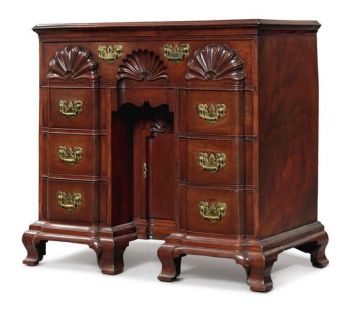
Lot 2089 — Queen Anne Carved and Figured Mahogany Block-and-Shell Kneehole Bureau Table, Providence, Rhode Island, ca. 1765 (estimate 300,000–500,000 USD).
The Collection of George S. Parker II from the Caxambas Foundation, previously on loan at the Chazen Museum of Art at the University of Wisconsin-Madison, will be offered on Thursday, 19 January 2017. The notable collection includes American and English furniture, silver, paintings and prints, with examples from some of the most distinguished artisans. Furniture highlights include a pair of Philadelphia side chairs attributed to Martin Jugiez; a rare Rhode Island Queen Anne shell-carved, block-front dressing table; an exceptional Philadelphia high chest of drawers attributed to John Pollard; and an important armchair by the same maker once owned by Charles Thomson. Great American portrait painters represented in the collection include John Singleton Copley, Gilbert Stuart, Thomas Sully, and John Trumbull among others. Finally, Mr. Parker’s silver collection comprises several examples from London silversmith Paul Storr and other English makers, including Ebenezer Coker and David Willaume.
Barograph Clock Acquired by London’s Science Museum
One of 2016’s notable acquisitions; press release (July 2016) from the Science Museum:
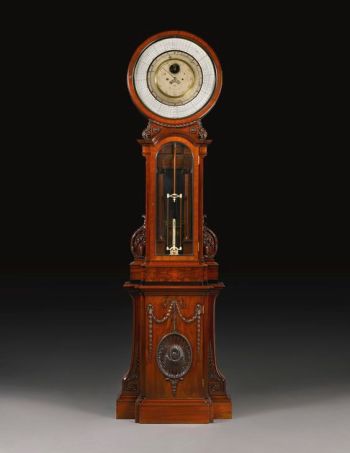
Alexander Cumming, George III Mahogany Longcase Barograph Regulator, London, 1766, with a case likely by Thomas Chippendale (London: Science Museum).
A rare Georgian clock, capable of recording changes in air pressure and used at the dawn of climate science, has been acquired for the nation by the Science Museum. The acquisition of this exceptional clock was made possible by a grant from Art Fund and was purchased through Sotheby’s. Dated 1766, the barograph clock is one of only four of its type that highly-regarded London clockmaker Alexander Cumming is known to have constructed. It was used by renowned meteorologist Luke Howard to conduct some of the world’s first urban climate studies.
Following Cumming’s death in 1814, Luke Howard purchased the clock and used it for observations of atmospheric pressure at his homes in London and Ackworth, a crucial project in the emergence of climate science. The data from the barograph traces, accompanied by notes on global weather events and descriptions of the clock, were published in the book Barometrographia in 1847. Howard’s life’s work has earned him the nickname ‘the father of scientific meteorology’.
Inside the imposing 7ft 2in-high decorated case, thought to be made by famed London cabinet maker Thomas Chippendale, is a barograph mechanism used for measuring air pressure. The barograph comprises two tubes of mercury in which a float rises and falls as atmospheric pressure changes. This data is recorded on the clock dial, which rotates once a year. A fine example of the technical innovations of the Georgian period, the clock was designed by Cumming using ideas first outlined by Royal Society founding member Robert Hooke. It has featured in previous exhibitions at the Science Museum as a loan and curators are now planning a permanent display.
Ian Blatchford, Director of the Science Museum Group, said of the acquisition “Nothing beats the marriage of an exquisite object and an enquiring mind. We are delighted to have been able to save the barograph clock so that we can share the story of Luke Howard’s contribution to climate science with future generations.”
During the Georgian period, scientific practice was often presented in public as a high-status activity expressed through ornately decorated and very finely constructed instruments such as this, and in fact the first barograph clock that Cumming constructed was commissioned by King George III as a prime example of his pursuit of Enlightenment.
MFA, Boston Displays Newly Acquired Altarpiece by Benjamin West
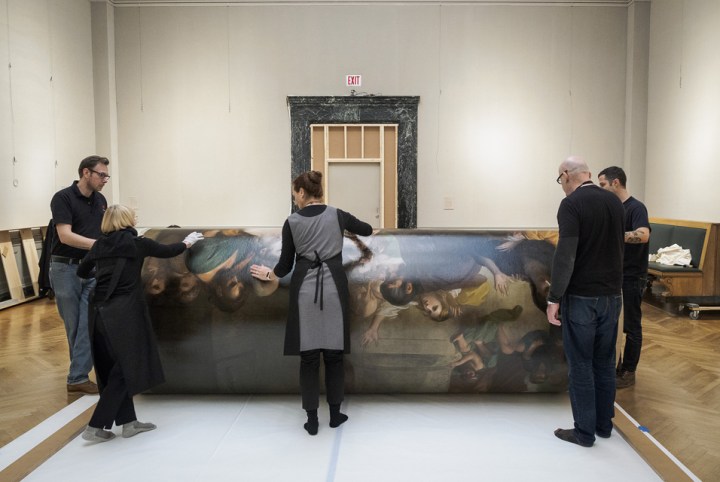
MFA staff members install Benjamin West’s large painting Devout Men Taking the Body of Saint Stephen (1776) in the Ruth and Carl J. Shapiro Gallery. Fidelity Investments chairman Edward ‘Ned’ Johnson III acquired the painting in 2014 for $2.9million from St. Stephen Walbrook (the export license was issued in March of that year). He donated it, anonymously, to the MFA in 2015 in honor of Malcolm Rogers to celebrate the museum director’s twenty years of leadership. Details and more on Johnson’s collections are available from Beth Healy’s article, “The Quiet Man of Boston’s Art Scene,” in The Boston Globe (22 August 2015).
◊ ◊ ◊ ◊ ◊
From the Museum of Fine Arts, Boston (via Art Daily), and good timing: it’s St Stephen’s Day! . . .
The recently acquired Devout Men Taking the Body of Saint Stephen (1776) by Benjamin West (1738–1820) is one of the largest paintings in the MFA’s collection—together with its towering frame, it measures more than 18 1/2 feet tall. Over the past two years, the monumental altarpiece was treated in the Conservation in Action studio, where Museum visitors were able to witness the gradual process of cleaning and restoring the work. The painting and its original gilded wood frame, which was also conserved, are now reunited as the dramatic centerpiece of a new installation that explores how 18th-century artworks and artists traveled across both intellectual and geographical borders.

Thomas Malton (1748–1804), St Stephen Walbrook, London, watercolour over pencil, 26 × 18 inches (London: Lowell Libson LTD). West’s painting is visible at the altar.
West was the first American-born painter to study abroad, second president of the Royal Academy of Arts, and painter to the English king. Devout Men Taking Away the Body of Saint Stephen, among the largest works he ever produced, was commissioned for London’s St. Stephen’s Walbrook, a church designed by Christopher Wren, and showcases West’s profound understanding of Italian Renaissance art. Italy likewise held special allure for well-to-do travelers on the Grand Tour, such as the American couple in John Singleton Copley’s portrait of Mr. and Mrs. Ralph Izard (1775), painted in Rome. Meanwhile, Italian painters ventured abroad as well—the gallery includes Canaletto’s Bacino di San Marco, Venice (about 1738), a trademark view of his home city, and Capriccio: A Sluice on a River with a Chapel (1754), painted in England, where he spent nine years catering to an enthusiastic clientele. Adding to the rich mix of works by American, English, and Italian painters are sculpture and decorative arts by French and German artists.
The 18th century was a cosmopolitan age. Artists and patrons traveled widely: in pursuit of artistic training or opportunity, political service, or social refinement. And as people moved, so too did ideas, styles, and tastes, in art and beyond. Across Europe (and America), Italy held special allure: artists traveled there to absorb its millennia of artistic traditions, as did well-heeled visitors on the Grand Tour. The fashion for Italian art was especially strong in England, where American-born painter Benjamin West created this towering altarpiece, influenced by his study of Renaissance masters Titian and Raphael. Italian artists also often ventured abroad. Canaletto, famous for his view paintings of his home city of Venice, spent nearly a decade in England, catering to an enthusiastic clientele.










leave a comment