Workshop | Etching for Curators and Researchers

From the workshop flyer:
Etching: A Practice-Based Workshop for Curators and Researchers
Gainsborough’s House, Sudbury, Suffolk, 29–30 March 2017
Convened by Jason Hicklin and Peter Moore
Join us for a two-day workshop at Gainsborough’s House that will bring together professionals whose work deals with prints—and in particular, etchings. Through a series of practical sessions in the Gainsborough’s House Print Workshop, accompanied by discussions around works from the collection, participants will gain a better appreciation of the materiality of etchings and a more nuanced understanding of how these processes have been applied and adapted by different artists at different times. The conception of this workshop represents a methodological shift in the academic study of prints, in which object-led and practice-based forms of research are increasingly recognised as valuable components of an art-historical education—especially for those who care for or interpret prints in a curatorial capacity.
Day one (Wednesday) will explore the processes of hard ground and soft ground etching. The first of these techniques, developed in the early sixteenth century, was mastered by artists such as Dürer and Rembrandt and came to occupy a central role in the history of western European art. The innovation of soft ground etching occurred later, in the second half of the eighteenth century, and was particularly popular in Britain; Gainsborough was among its earliest pioneers.
Day two (Thursday) will focus on aquatint, developed in the 1770s. As a tonal method, aquatint presented printmakers with a range of new possibilities for image making. Since its conception, it has been considered as a complementary technique to soft ground etching, and Gainsborough often used it in this way. The popularity of aquatint has continued into the modern era, with the sugar-lift process being favoured by Picasso.
The course will be jointly convened by Jason Hicklin, Lead Tutor and Head of Printmaking at the City & Guilds of London Art School, and Dr Peter Moore, Research Curator at Gainsborough’s House. Each day will run from 10am to 4pm. The cost is £180 (inc. VAT) and includes lunch and refreshments, but not accommodation. For further enquiries and to reserve your place, please contact peter@gainsborough.org. Limited places are available, so early booking is advised.
New Book | Chinese and Japanese Works of Art in the Royal Collection
Published by the Royal Collection Trust and distributed in the U.S. and Canada by Chicago:
John Ayers, Chinese and Japanese Works of Art in the Collection of Her Majesty The Queen, 3 volumes (London: Royal Collection Trust, 2016), 1296 pages, ISBN: 978-1905686490, £150 / $250.
 The Royal Collection includes some of the most important examples of Eastern applied art in the Western world, reflecting the West’s long-standing appetite for rarities from distant lands. With more than 2,000 objects distributed across the royal residences in England and Scotland, the collection represents a rich cross-section of Chinese and Japanese porcelains, jades, lacquers, and other works of art.
This three-volume catalogue raisonné covers this substantial and important collection in comprehensive detail. It includes for the first time the many eighteenth- and nineteenth-century bronze mounts that are such a striking feature of the collection. Made in French and British workshops to enhance the objects they display, the mounts themselves are often of superb quality and of great historical importance.
More than 2,400 colour images are used to illustrate the collection, including intricate decorative details and makers’ marks. Introductory essays cover the history and development of the collection and the ways in which these works of art have been displayed in the royal palaces and adapted according to the fashions of the day.
Volume One presents the Chinese ceramics of the Ming and Qing dynasties in chronological order (continued in Volume Two). In addition, due to their unique historical significance, the contents of the collection at Hampton Court Palace are presented here separately. Volume Two continues the works of the Qing dynasty, and ends with the Japanese works; the volume also contains a special focus on the European mounts that were added to works of Chinese and Japanese porcelain during the eighteenth and early nineteenth centuries. Volume Three contains non-porcelain works, namely lacquer, jade and other hardstones, carved ivories, textiles and metalwork. Many of these works came into the Royal Collection as Imperial gifts, to George III, Queen Victoria, King Edward VII, and Queen Alexandra, with the exception of the Japanese lacquer wares, which were acquired for George IV to furnish the Royal Pavilion at Brighton. Although not much studied, these pieces were admired by the royal family, and Chinese rooms were created at Windsor and Sandringham House, decorated with an eclectic mixture of European chinoiserie and authentic works of Asian art.
Buckingham Palace Slated for £369Million Renovation

Buckingham Palace, London. The East Front, originally constructed by Edward Blore and completed in 1850, acquired its present appearance following a remodeling in 1913 by Sir Aston Webb (Photo by David Iliff, April 2009, License: CC-BY-SA 3.0, Wikimedia Commons).
◊ ◊ ◊ ◊ ◊
As reported by Stephen Castle for The New York Times (19 November 2016) . . .
The boilers are shot, the water pipes sag, and the 60-year-old cabling is a fire hazard. Buckingham Palace, home to Queen Elizabeth II, may not exactly be falling down, but it badly needs refurbishing, the British government said on Friday, citing “a serious risk of fire, flood and damage.” Renovations on the building will start in April and will take a decade to complete, at a cost of £369 million ($456 million). The announcement adds to the list of prestigious structures in Britain that need work, including the crumbling Palace of Westminster, home of the British Parliament.
The building that would become Buckingham Palace was built in the early 1700s and became a royal residence when George III bought it in 1761. The queen carries out most of her official ceremonial and diplomatic duties as head of state in the palace. She would not have to move out while the work was in progress, officials said. . . .
The full article is available here»
Writing for The Guardian, Caroline Davies addresses in more detail the financial arrangements, including the controversies around spending £369 million in a time of austerity.
The Morgan Launches Refreshed Website

Press release (17 November 2016) from The Morgan:
The Morgan Library & Museum today announced the launch of a refreshed website. The updated look for themorgan.org offers a sleek, contemporary design, and also introduces features that make the site more compatible across platforms: mobile, tablet, and desktop computers. The unveiling of the new design coincides with the ten-year anniversary of the Morgan’s 2006 expansion, and is the first major makeover since then.
Digital initiatives at the Morgan are part of a larger strategic undertaking to expand access to the institution’s holdings. The upgrades to the Morgan’s website represent a significant development for scholars, students, and members of the general public interested in accessing the Morgan’s vast collections. Prior to undertaking digitization initiatives, the Morgan’s collection had been available on a select basis onsite at the museum’s New York headquarters, while some of the works have been published in various museum catalogs. Digitization efforts enable access to the collection from anywhere in the world and includes a zoom feature to study individual works in detail.
In recent years, almost 700 music manuscripts from its extraordinary collection—represented by such masters as Mozart, Beethoven, Bach, and Handel—have been digitized and made available on its website. The museum’s most ambitious undertaking—the digitization of its collection of over 14,500 drawings —began in Fall 2013, and as of today over 95% of this undertaking is complete, including a cache of over 500 Rembrandt prints and etchings. Additionally, the Morgan offers online access to illuminations from 823 Medieval and Renaissance manuscripts (including over 20,000 illuminations) and thousands of highlights from literary and historical manuscripts, rare books, and ancient near eastern seals and tablets, which can be rotated and zoomed. In the past six months, highlights that have been added include the entire collection of the Morgan’s Coptic bindings and the Lindau Gospels.
Looking ahead, the Morgan plans to continue sharing more objects from its vast collections through the website. Collections ranging from early Mesopotamian and Egyptian through Greco-Roman culture, the Middle Ages, the Renaissance, and beyond, will be further represented on the website. The music manuscripts pages will also be upgraded to provide more download options and improved navigation.
◊ ◊ ◊ ◊ ◊

Luigi Valadier, Drawing of an inkstand in Rococo Style, 1764, pen and brown ink, with brown and red wash, over graphite, on paper, 37.5 × 52.4 cm (New York: The Morgan Library & Museum, 1991.15, purchased on the Sunny Crawford von Bülow Fund 1978). Multiple filters (including ‘centuries’) accommodate collection searches.
British Miniatures on View at Compton Verney
As noted at Art Daily (15 November 2016). . .
The Dumas Collection of British Portrait Miniatures
Compton Verney Art Gallery and Park, Warwickshire
Over forty miniature paintings, not previously seen in public, have now gone on show at Compton Verney Art Gallery and Park in Warwickshire. The works are part one of the most important collections of this art form held anywhere in the world. The collection consists of 842 works in total and has been generously loaned on a permanent basis by Simon Dumas following the death of his father in 2013.
Simon Dumas said: “We wanted Dad’s exceptionally broad and, in the context of miniatures, important collection to be in the Midlands and not in London, Cambridge, or Oxford—since the Victoria and Albert Museum and National Portrait Gallery, the Fitzwilliam and the Ashmolean already have such wonderfully rich resources to display. We approached Compton Verney because they already have a fine collection of English portraits, which we thought Dad’s mainly English collection would complement well.”
Upon his retirement from a successful career in the City, Dumas’s firm, ED&F Man Capital Markets, gave him and his wife a round-the-world trip as a leaving present. It was on a wet day in Canada that the couple visited an art gallery that happened to be staging an exhibition of miniatures.
“They captivated Dad, who at the time was vaguely looking around for an indoor hobby for his retirement. He asked a curator where these little paintings were from, only to learn that they were from his own country, England. He started collecting almost immediately on their return from their trip in 1975, with the objective—impossible to achieve, but still a reference point—of acquiring an example, signed if possible, by every artist who ever worked in the British Isles,” Simon explained.
With his enthusiasm fired, Dumas developed and added to his collection over the next thirty years.
The advent of photography and its ability to capture people’s likenesses relatively cheaply and led to the rapid decline of the portrait miniature from about 1850 onwards. Miniatures were often carried around or worn as a necklace or brooch but, because of the skill required to create them, were expensive to commission. Deeply personal and available only to the wealthier echelons of society, miniatures were rarely seen by the greater public; consequently, miniature painting is not a well-known aspect of art—albeit that it flourished for some three centuries.
Steven Parissien, Director of Compton Verney, believes the Dumas loan makes a significant contribution to our understanding of the British tradition of miniature portraits: “We are delighted that this world-class collection of outstanding British portrait miniatures has finally come back to England from Scotland, allowing us to share in the hidden delights of this most intimate and touching form of portraiture—as well as to learn much about their Stuart and Georgian sitters.”
Highlights include Lucas Horenbout’s Unknown Lady, painted ca. 1543. Sir Roy Strong has suggested that the sitter was King Henry VIII’s sixth and last wife, Queen Catherine (Parr). Horenbout worked for Henry VIII from 1525 and is said to have taught Holbein how to paint miniatures—thus introducing this skill into Britain. Catherine herself died aged 36, five years after this portrait was painted, giving birth to a child by her fourth husband.
The celebrated Elizabethan and Jacobean painter Nicholas Hilliard is also represented, with Unknown Gentleman (1589). Hilliard made portrait miniatures popular in Britain, largely due to the patronage of Queen Elizabeth I herself. Having helped create fashionable images of the Virgin Queen and her court—one of whose members may be depicted here—Hilliard became the royal miniaturist (‘court limner’) to her successor, James I.
Also of note are the works of six female artists, including the exceptional Sarah Biffin (1784–1850). Born without hands, arms, or feet, Sarah taught herself to paint and write by using her mouth. Apprenticed by her family to a man who exhibited her round the country as a sideshow freak, she simultaneously taught herself how to paint miniatures. She was rescued by the Earl of Morton, who sponsored formal painting lessons for her at the Royal Academy, and she built up a large practice painting miniatures as a result of Queen Victoria’s patronage.
Having just visited the national gallery in Warwickshire to see the first selection from the collection on display, Simon Dumas says he is very pleased that his father’s collection has found the ideal place for members of the public to enjoy them: “I hope the miniatures stay for many years in the beautiful surroundings of Compton Verney, where they are displayed so very well in the newly-made cabinet alongside the British paintings of the permanent collection. The display is far better than those in some of the London galleries in my opinion!”
The Dumas Loan can be seen in the British Portraits gallery at Compton Verney, along with remarkable collections such as the nationally-designated Chinese Bronzes and Britain’s best collection of British Folk Art.
Anna Marie Roos on a Portrait of Martin Folkes
From The Societies of Antiquaries of London:
Anna Marie Roos on a Portrait of Martin Folkes
Society of Antiquaries of London, Unlocking Our Collections, added 1 November 2016

Jonathan Richardson the Elder, Portrait of Martin Folkes, 1718, oil on canvas (Society of Antiquaries of London).
This is a portrait of Martin Folkes (1690–1754), the only person to have been President of both the Society of Antiquaries of London and of the Royal Society. What would being President of a society dedicated to the material past have to do with leading a society dedicated to science? In the 18th century, the ability to observe nature was thought to make scientists ideal to understand the empirical details of ancient artefacts and how they were created. Science and archaeology were seen as one, the Society of Antiquaries and the Royal Society had many common members and held their meetings on the same day, and Folkes tried to unite the two groups into one organisation. If he had succeeded, the humanities and sciences would perhaps be more united today. . . .
Anna Marie Roos is Reader at College of Arts, University of Lincoln.
The full essay, with a video and suggestions for further reading, is available here»
Acquisition Appeal | Thomas Lawrence’s Unfinished Portrait Wellington
An appeal from the NPG:
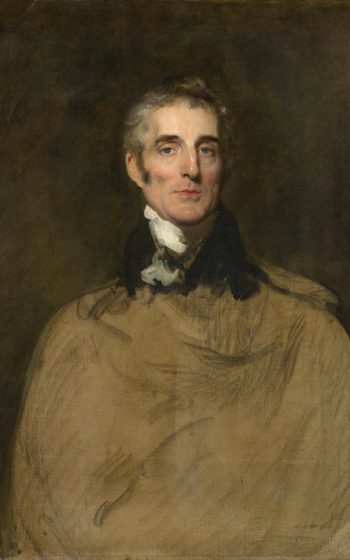
Sir Thomas Lawrence, Unfinished Portrait of Arthur Wellesley, 1st Duke of Wellington, 1829, oil on canvas, 94.3 × 74.3 cm (Private Collection).
The National Portrait Gallery has launched a public appeal to acquire Sir Thomas Lawrence’s unfinished final portrait of Arthur Wellesley, 1st Duke of Wellington, it was announced today, Thursday 3 November 2016. The portrait has been offered to the National Portrait Gallery for £1.3 million. The appeal was kick started today by a donation of £350,000 from the Art Fund, whose generous support means that alongside the Gallery’s own funds, £1 million of the total has already been raised. The Gallery has £300,000 to raise by spring 2017.
The Gallery has no other significant portrait of the Duke in its Collection, an omission of one of the most iconic and popular figures in British history. The Gallery has been seeking to secure such a portrait since it opened in 1856. This work is one of only two world-class portraits of Wellington ever likely to come up for sale. The leading artist of his age Sir Thomas Lawrence made eight portraits of Wellington and was the Duke’s definitive image maker.
Started in 1829, the year Wellington was appointed Lord Warden of the Cinque Ports and in which he fought a duel with Lord Winchilsea over the issue of Catholic emancipation, the unfinished portrait shows him in civilian dress with only his black collar and white stock visible. It was commissioned at the height of Wellington’s political career when he was Prime Minister. At the time he was closely involved in the legislation around catholic emancipation and deeply opposed to the reform of the House of Commons. Earlier in the decade he had been involved in the delicate negotiations between the Prince Regent and the Prince’s estranged wife, Queen Caroline. He also represented British interests at the Congress of Verona in 1822, one of a series of conferences on European affairs after the Napoleonic Wars.
The large oil-on-canvas portrait was commissioned a year after Wellington had become Tory Prime Minister by Sarah, Countess of Jersey, a leading political hostess and supporter of the Tories in the 1820s. Initially dedicating her social gatherings to the cause of the Whig party, in the late 1820s Lady Jersey switched her allegiance to the Tories, with Wellington becoming one of her favourites. She believed herself to be one of his confidantes, but he mistrusted her ability to keep a secret: earlier in life her loquacity had earned her the nickname ‘Silence’.
At Lawrence’s death in 1830 the portrait remained unfinished. But unlike many other clients, Lady Jersey refused to have it finished by a studio assistant. On hearing that the Duke of Wellington had fallen from power in 1830, Lady Jersey burst into tears in public. She reportedly ‘moved heaven and earth’ against the Reform Act 1832 which Wellington had also opposed.
Dr Nicholas Cullinan, Director of the National Portrait Gallery, London, says: “We have been searching for a portrait that can do justice to this iconic British hero since 1856. The lack of a suitable depiction of the Duke of Wellington has long been identified as the biggest gap in our collection. If we can raise the funds this remarkable painting by Sir Thomas Lawrence will be on permanent display and free for over two million visitors to enjoy each year.”
Dr Stephen Deuchar, Art Fund Director, says: “The National Portrait Gallery will make a fine home for this intensely compelling portrait of Wellington. We are pleased to have made a major grant towards its purchase, and hope the public will support the appeal to raise the remaining funds. This is a very important national acquisition.”
Dr Lucy Peltz, Senior Curator, 18th-Century Portraits and Head of Collections Displays (Tudor to Regency), National Portrait Gallery, London, says: “This is a compelling portrait of one of the most famous figures in early nineteenth-century Britain. Lawrence was a superlative portrait painter with the flair and talent to capture surface glamour and deeper currents. This unfinished portrait is shot with psychological insight.”
Dan Snow, historian, broadcaster and co-author of The Battle of Waterloo Experience, says: “The ‘Iron Duke’ is one of the towering figures of British history. He never lost a battle, reshaped Europe, and dominated Britain until his death. His career and legacy are intimately involved with the development of the United Kingdom. Now, more than 200 years after his most famous victory at the Battle of Waterloo it’s time we helped the National Portrait Gallery win the day.”
The painting was lent to the National Portrait Gallery’s exhibition Wellington: Triumphs, Politics and Passions staged in 2015 to mark the bicentenary year of the Battle of Waterloo. Prior to its loan to the Gallery from a private collection for a short period of display just before the exhibition opened, the portrait, which is in excellent condition, had not been on public view for any significant period since it was painted.
Acquisition Appeal | Admiral Russell’s Frame, 1690s
An appeal from The Fitzwilliam in Cambridge:
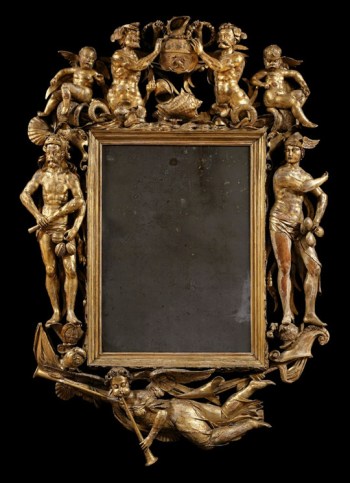
Giltwood frame bearing the arms of Admiral Edward Russell, later 1st Earl of Orford, Admiral of the Fleet; England, ca. 1690s; carved and gilded lime wood with central mirror plate, 182 × 129.5 × 13.5 cm. Provenance: Admiral Russell; private collection, Paris.
To commemorate The Fitzwilliam Museum’s bicentenary, we invite you to support the acquisition of Admiral Russell’s Frame, currently on display at the Museum. The Friends of the Fitzwilliam Museum are able to purchase this magnificent frame at a negotiated price of £345,000. We have until 31st December 2016 to raise the funds. Through the Friends’ acquisition fund, a £50,000 V&A Purchase Grant, and other generous donations, we have raised 80% of the total required. Your support with a personal donation would be truly appreciated as we aim to raise the final £70,000. Please join us in saving this work of local, national and international importance and bring it home to Cambridgeshire for good.
With its local Cambridgeshire connection, highly sophisticated carving and intriguing iconography, this splendid frame will enhance the Museum’s collections for future generations to study and enjoy. The Museum’s Learning Team also sees the great potential of this object’s provenance, mythological figures and Stuart-era history to engage school and community groups alike.
This elaborate mirror frame is a unique survivor from the golden age of English wood carving. It was commissioned by Admiral Edward Russell (1653–1727), the celebrated naval hero best known for his triumphs at the battles of Barfleur and La Hogue in 1692. Russell was a generous patron of architecture and the arts. His Cambridgeshire estate, Chippenham Park, was luxuriously furnished and featured intricately carved woodwork throughout. Almost certainly made between 1693 and 1697 to honour Russell’s achievements and to celebrate his appointment as Admiral of the Fleet and First Lord of the Admiralty, the frame is decorated with symbols representing eternal glory. A personification of Fame with two trumpets flies beneath the mirror, which is flanked by two ancient gods: Mercury representing trade, commerce, and financial gain and Hercules symbolising military strength and triumph.
Sadly, the carvers are unknown. They were probably Dutch or French Huguenots based at Deptford’s naval dockyard, more used to carving elaborate ship prows and interiors than decorative pieces for a country estate.
This magnificent object was probably inherited in 1727 by Admiral Russell’s great-niece, Letitia, who had married the 1st Lord Sandys in 1724. Later the frame was part of M. Michel Dezarnaud’s collection in Neuilly-sur-Seine, Paris, from whom it was bought by a dealer in Belgium in ca. 2015
The frame bears the arms of Admiral Edward Russell, 1st Earl of Orford of the first creation (1653–1727). The marine equivalent of the 1st Duke of Marlborough, Russell is chiefly remembered today for his triumphs at the naval battles of Barfleur and La Hogue on 29 May and 4 June 1692 respectively. These confrontations irreparably damaged the French Atlantic fleet and made the proposed invasion of Britain by Louis XIV and the deposed English King, James II, impossible, thereby securing the position of William III. The scale of this double battle was enormous: 126 ships in total—over twice the size of the Battle of Trafalgar. It was this victory that led to Russell’s promotion to Admiral of the Fleet in November 1693, First Lord of the Admiralty in April 1694, and creation as 1st Earl of Orford in 1697. The imagery of the frame clearly celebrates Russell’s remarkable and unsurpassed naval career.
Edward Russell was a sophisticated and extravagant patron of the arts. This was especially the case at his country estate, Chippenham Park in Cambridgeshire, halfway between Bury St Edmunds and Ely, for which he paid £16,250 in 1689. The house was probably designed by his relative, the architect Thomas Archer (1668–1743) who later designed Russell’s (still surviving) town house in Covent Garden Piazza in 1716–17. Chippenham Park was demolished in 1790 and replaced with a succession of later houses. Drawings of the exterior or interior of the house do not survive, but a map of the estate shows how the trees in the park were planted to evoke the battle formations at La Hogue and Barfleur.
Russell had no direct offspring, and his property was divided between his nieces and nephews. Yet Russell did leave a political legacy; his political protégé Robert Walpole (1676–1745) would become Britain’s first and longest-serving Prime Minister. It was in memory of Russell that Walpole decided to adopt the title of Earl of Orford of the second creation in 1742.
Aimee Marcereau DeGalan Appointed Curator at The Nelson-Atkins
Press release (25 October 2016) from The Nelson-Atkins:
The Nelson-Atkins Museum of Art in Kansas City has hired Dr. Aimee Marcereau DeGalan as the Louis L. and Adelaide C. Ward Senior Curator of European Art. Marcereau DeGalan comes to the Nelson-Atkins from The Dayton Art Institute (DAI), where she was Chief Curator and Curator of European Art.

Aimee Marcereau DeGalan, photo by Chris Dissinger.
“The timing of this important addition to our staff could not be better,” said Julián Zugazagoitia, Menefee D. and Mary Louise Blackwell CEO & Director of the Nelson-Atkins. “Aimee’s scholarship will be immediately called upon as we prepare to open the Bloch Galleries in the spring, and she will continue the important work that has begun on our catalogue of French paintings.”
A specialist in British and French 18th- and 19th-century art, Marcereau DeGalan will lead the European Arts division, which includes the departments of Ancient Art, European Paintings & Sculpture and Architecture, Design and Decorative Arts. She will pursue senior-level research exhibition and catalogue projects, and be responsible for acquisitions, interpretation and presentation of the European collections.
“Aimee’s experience at institutions of varying scale and type has been excellent training for the job at the Nelson-Atkins,” said Catherine Futter, Director of Curatorial Affairs. “A 2014 Center for Curatorial Leadership Fellow, she has worked across many disciplines to engage a wide range of audiences and is also an amazing leader.”
Marcereau DeGalan was hired at the DAI in 2012 as Curator of Collections and Exhibitions. Previously, she held curatorial posts at the Fleming Museum of Art at the University of Vermont, The Cleveland Museum of Art, and The Detroit Institute of Arts. While in Dayton, Marcereau DeGalan raised major funds for conservation treatments to seven significant European paintings, accessioned more than 400 objects, regularly brought scholars into the museum to advise on its different collections, and presented 24 exhibitions during her tenure. Importantly, she worked to broaden the DAI’s engagement with the Dayton community.
“The DAI will forever be grateful for Aimee’s meaningful contributions to the museum and the community,” says Dayton Art Institute Director and CEO Michael R. Roediger. “During her time at the museum, she has led the Curatorial Department and the Collections Committee, been a valued member of the museum’s leadership team, and been an integral part of the development of the museum’s Centennial Plan. The Dayton Art Institute can be proud that one of our own is moving on to such a prestigious organization.”
“I am thrilled to be joining the curatorial team at the Nelson-Atkins,” said Marcereau DeGalan. “It has long been an institution I have admired not only for the scope and depth of its collections, but also for its commitment to research, scholarship, and to broadening its reach within the regional community and on the national and international stage.”
Marcereau DeGalan will begin her position on November 1st.
Aimee Marcereau Degalan completed her PhD in 2007 with Anne Helmreich at Case Western Reserve University with a dissertation entitled “Dangerous Beauty: Painted Canvases and Painted Faces in Eighteenth-Century Britain.”
UK Export Bar Placed on Mazarind Tapestry, ca. 1700

Michael Mazarind Workshop, Chinoiserie Tapestry with Courtly and Hunting Scenes, made in London,
ca. 1696–1702.
◊ ◊ ◊ ◊ ◊
Press release (20 October 2016) from Gov.UK’s Department for Culture, Media & Sport:
Culture Minister Matt Hancock has placed a temporary export bar on a rare tapestry by Michael Mazarind to provide an opportunity to keep it in the country. The tapestry is at risk of being exported from the UK unless a buyer can be found to match the asking price of £67,500. Inspired by Indian, Chinese, and Japanese design, it is the only surviving tapestry to feature Michael Mazarind’s workshop mark [lower right-hand corner]. Little is known of his workshop, but it is believed he was based in Portugal Street, London, between 1696 and 1702. Mazarind was relatively unknown, but is said to have connections to John Vanderbank, the Soho-based weaver. The tapestry includes small groups of oriental figures, buildings, exotic creatures, and plants. This combination of elements was described as ‘in the Indian manner’ and was one of the most popular decorative fashions of the period.
Minister of State for Digital and Culture Matt Hancock said: “This intricate design provides us with a unique opportunity to explore the tapestry workshops of 1600s London. I hope we are able to keep it in the country so we can learn more about our nation’s textile industry, and of the decorative fashions of the time.”
The decision to defer the export licence follows a recommendation by the Reviewing Committee on the Export of Works of Art and Objects of Cultural Interest (RCEWA), administered by The Arts Council. The RCEWA made its recommendation on the grounds of significance for the study of Mazarind’s work, English tapestry of the period, and London’s history.
RCEWA member Christopher Rowell said: “This beautiful blue ground tapestry, with an equally unusual border of Chinese inspiration, dates from the late 1600s and is the only one to bear the woven signature of the mysterious Michael Mazarind, who was a rival of the more well-known London tapestry weaver, John Vanderbank. This type of ‘Indian’ tapestry depicting a Chinoiserie fantasy paradise in Cathay, with courtly and hunting scenes, was devised for the court but soon became more broadly popular. Saving the tapestry for the nation will allow specialists to study it in detail and help to reconstruct Mazarind’s contribution to tapestry production in early-Georgian London.”
The decision on the export licence application for the tapestry will be deferred until 19 January 2017. This may be extended until 19 April 2017 if a serious intention to raise funds to purchase it is made at the recommended price of £67,500. Offers from public bodies for less than the recommended price through the private treaty sale arrangements, where appropriate, may also be considered by Matt Hancock. Such purchases frequently offer substantial financial benefit to a public institution wishing to acquire the item.










leave a comment