Reynolds’s Portrait Accepted in Lieu of £4.7m Inheritance Tax
Press release (10 August 2016) from Arts Council England:

Sir Joshua Reynolds, Portrait of Frederick, 5th Earl of Carlisle, 1769, oil on canvas, 241.4 × 150 cm (Tate Britain)
A major full-length portrait by Sir Joshua Reynolds (1723–1792) of the 5th Earl of Carlisle (1748–1825), aged 20, has been accepted in lieu of inheritance tax for the nation. This important painting has been allocated to Tate and will remain on public display in its original setting at Castle Howard in North Yorkshire and in the future will be shown elsewhere around the country including Tate Britain.
The portrait, which has long been recognised as one of Reynolds’s masterpieces, was commissioned by the sitter and completed in 1769 when Reynolds was at the height of his powers, having just been elected the first President of the Royal Academy. The painting has always been central to the collection at Castle Howard and has hung there for over 200 years.
The 5th Earl was a key patron and collector of the arts in the North of England in the 18th century. Dressed in formal robes surrounded by classical architecture and his beloved dog Rover at his feet, Carlisle was captured by Reynolds in a lively and highly skilled manner, marking his entry into society following his Grand Tour and his position as head of this important family dynasty. The complex composition, paintwork and use of colour illustrates perfectly why Reynolds was the leading British portrait painter of the 18th century. Reynolds’s composition alludes to the architecture of Castle Howard, designed by Sir John Vanbrugh (1664–1726). The building of Castle Howard was completed under the supervision of the 5th Earl who filled the great house with his fine collection of Old Masters.
Edward Harley, Chairman of the AIL Panel, said: “The Acceptance in Lieu scheme has been enriching our heritage for over a century; I am delighted that this masterpiece by Reynolds, one of the most important painters of the day, has entered our national collection under the scheme.”
Alex Farquharson, Director, Tate Britain said: “The magnificent painting of Frederick Howard, 5th Earl of Carlisle 1769 is the first full-length male portrait by Joshua Reynolds to join the Tate collection. A glamorous portrait in oil of the earl and his beloved dog Rover, it is an outstanding example of the type of painting for which Reynolds is most highly acclaimed. I am delighted that this work will now enter the national collection, the greatest collection of British art in the world, and that it will be shown both in its original setting in Castle Howard and, in future, at Tate Britain and elsewhere.”
◊ ◊ ◊ ◊ ◊
As Mark Brown reports for The Guardian (10 August 2016).
An important 18th-century portrait of the 5th Earl of Carlisle by Sir Joshua Reynolds has been accepted for the nation in lieu of £4.7m inheritance tax. . .
The Reynolds painting has been passed down through the family and its offer to the acceptance in lieu scheme (AIL) follows the sale last year of art works and furniture by the castle’s present custodians to help secure the estate’s long-term future [Sotheby’s, July 2015]. The sale raised £12m.
The acceptance in lieu scheme was created in David Lloyd George’s people’s budget of 1910, with hundreds of outstanding objects and collections given as a way of settling tax bills.
The Fitzwilliam Acquires Pair of Pietre Dure Roman Cabinets

Pair of ebony and rosewood cabinets, inlaid with pietre dure, and mounted with gilt-bronze; made in Rome, ca. 1625, likely for a member of the powerful Borghese family. The gilt-wood stands were made in England, ca. 1800, probably to the designs of the influential Regency designer, Charles Heathcote Tatham, in order to display the cabinets in the spectacular Long Gallery at Castle Howard, Yorkshire (Cambridge: The Fitzwilliam Museum).
◊ ◊ ◊ ◊ ◊
Press release from The Fitzwilliam:
The Fitzwilliam Museum announced today (Monday, 8 August 2016) its successful bid to raise the £1.2 million needed to save an important pair of pietre dure Roman cabinets for the nation. No other pair of Roman hardstone cabinets exist in a public collection in Britain.
The Fitzwilliam is grateful for the support of The National Heritage Memorial Fund (NHMF) for their generous grant of £700,000 and to the Art Fund for their early adoption of this project with a £200,000 grant. The Fitzwilliam also received generous support from numerous other benefactors, including the Pilgrim Trust, to prevent these treasures from leaving the UK.
These unique and highly prized cabinets have been part of the private collection at Castle Howard, Yorkshire, since their purchase by Henry Howard, the 4th Earl of Carlisle, most likely in Rome during his second ‘Grand Tour’ of Italy (1738–39). They were offered for auction at Sotheby’s London, last summer by the Trustees of Castle Howard and sold to a foreign buyer for £1.2 million.
A member of the Reviewing Committee on the Export of Works of Art, (RCEWA), Christopher Rowell, stated that the cabinets, represent “the high watermark of the British taste for Italian princely furniture” and that “with the exception of the National Trust’s cabinet at Stourhead, made in Rome around 1585 for Pope Sixtus V, these are the most significant cabinets of this type in Britain.”
Their historic and cultural value was such that the then Culture Minister Ed Vaizey placed a temporary export bar on the 400-year-old Italian cabinets to provide an opportunity to save them for the nation.

One of the cabinets as installed at Castle Howard.
The cabinets were made in Rome in the first quarter of the 17th century almost certainly for a member of the papal Borghese dynasty, one of the most powerful and wealthy families of their day, and represent the highest quality of furniture-making in 17th century Italy. Veneered with ebony and rosewood, they have been further embellished with inlays of expensive, exotic and vividly coloured semi-precious hardstones (such as lapis lazuli and jasper) and with gilt-bronze statuettes and escutcheons. They are among the most significant cabinets of this type left in Britain, dating back to 1625.
Each cabinet sits on a Neo-classical stand, probably made ca. 1800 to the designs of the influential Regency designer, Charles Heathcote Tatham, for display in the just-completed spectacular Long Gallery at Castle Howard, Yorkshire. Fashioned from mahogany, they boast gilded caryatid supports and other classical ornaments. Showpiece cabinets, like these, were the most prestigious display furniture in 17th-century Europe and were lavishly decorated to reflect the status and taste of their owners and have been eagerly collected ever since.
Tim Knox, Director of the Fitzwilliam Museum, remarked “Splendid hardstone mounted cabinets such as these were the ultimate trophy of British Grand Tour collectors in the 18th century. With their lavish inlay of electric blue lapis lazuli, and glowing jaspers, and later English stands with gilded caryatids (supports in the form of antique maidens), they are a perfect combination of Italian pomp and English splendour. Nowhere in the UK is it possible to see a pair of Roman cabinets of quite this swagger and splendour. I am thrilled that we have saved these remarkable objects from export and that they can take their place amidst the Fitzwilliam’s world-class collections. They are a fitting acquisition to celebrate the 200th birthday of our founder, Lord Fitzwilliam.”
Sir Peter Luff, Chair of NHMF, said: “Exquisitely beautiful and exceptionally rare, it is when you consider these cabinets in their original context at Castle Howard, one of our finest country house interiors, that they become very important to the UK’s heritage.”
Stephen Deuchar, Art Fund Director, said: “We are very happy to support the Fitzwilliam in acquiring this captivating pair of cabinets, a fantastic addition to the permanent collection in its bicentenary year.”
Sir Mark Jones, Chair, The Pilgrim Trust said “It is great news that these spectacular cabinets, so important for understanding the history of taste in Britain, are to stay in the country.”
The pair of cabinets will go on display at the Museum on Wednesday 10th August, when they will be unveiled as part of the celebrations in honour of the Founder’s Birthday.
Sotheby’s Museum Network to Launch in August
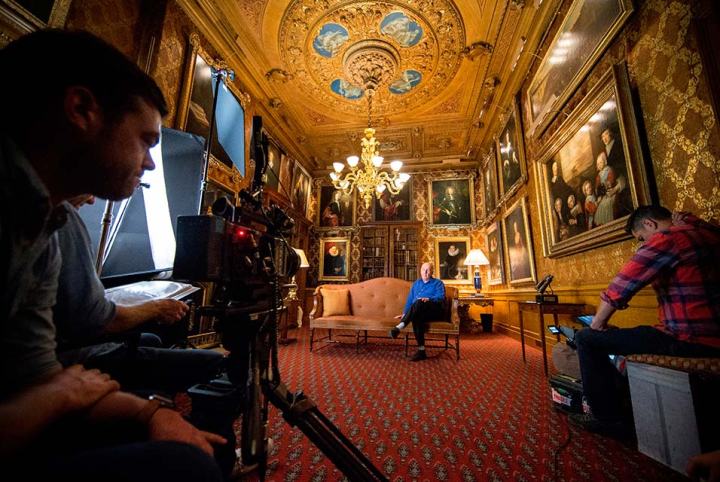
The 13-part series The Treasures of Chatsworth is currently in production and will debut in Autumn 2016
(Photo: Sotheby’s)
◊ ◊ ◊ ◊ ◊
Press release (5 August 2016) from Sotheby’s:
Sotheby’s announces the upcoming launch [scheduled for August 29] of an online destination to discover video content created by and about the world’s leading museums. The digital hub will be called Sotheby’s Museum Network, and it will be featured prominently on Sothebys.com as well as Sotheby’s Apple TV channel. The museums in this network will include internationally-renowned public institutions, such as The Metropolitan Museum of Art, Tate, and the National Palace Museum in Taiwan, as well as well as newer institutions founded by private collectors, including the Garage Museum of Contemporary Art in Moscow.
In addition to syndicating museums’ own content, the Sotheby’s Museum Network will be the home of original programming conceived and produced by Sotheby’s. The Treasures of Chatsworth, a 13-part series on one of Europe’s greatest private houses and most significant art collections, is currently in production and will debut this autumn. Further information will be shared in the coming months.
Recent years have seen the opening of numerous private museums by passionate patrons, as well as record attendance at major exhibitions worldwide, reflecting a seemingly insatiable public interest in great art and collections. Sotheby’s Museum Network will reach a global audience for whom museums and foundations are a new entry point into the world of art, as well as seasoned collectors and connoisseurs who look upon these institutions as the ultimate source of authority on art and culture. It will ultimately encompass thousands of existing museum videos, which have never before been aggregated into one channel, making it easier for people to discover what they love as well as introducing new audiences to the great work that these institutions are creating worldwide.
“We are thrilled to host the extraordinary videos produced by our museum partners around the world,” commented David Goodman, Executive Vice President, Digital Development & Marketing. “The Museum Network is a response to a growing global audience that wants to experience the world of art and collecting. The network is a natural evolution of the existing ties we have with museums through programs like Sotheby’s Preferred, and we can now deepen those relationships with institutions and their benefactors as we expose their outstanding collections to millions of art lovers who engage via digital channels. The Treasures of Chatsworth is the perfect way to launch our drive into original video content creation centered on the arts and will be the first of many original films that will reveal the wonder of art and collecting.”
V&A Named ‘Art Fund Museum of the Year’ for 2016
From The Art Fund:

The southern entrance of the Victoria and Albert Museum in London (Photo by David Iliff, 24 March 2014, Wikimedia Commons)
On Wednesday evening [6 July], the Victoria and Albert Museum was announced as the £100,000 winner of the Art Fund Museum of the Year 2016 by HRH The Duchess of Cambridge at a dinner and ceremony at London’s Natural History Museum.
Stephen Deuchar, Art Fund director and chair of the judges, said: “The V&A experience is an unforgettable one. Its recent exhibitions, from Alexander McQueen to The Fabric of India, and the opening of its new Europe 1600–1815 galleries, were all exceptional accomplishments—at once entertaining and challenging, rooted in contemporary scholarship and designed to reach and affect the lives of a large and diverse national audience. It was already one of the best-loved museums in the country: this year it has indisputably become one of the best museums in the world.”
The winner was chosen from five remarkable finalists, including Arnolfini (Bristol), Bethlem Museum of the Mind (London), Jupiter Artland (West Lothian), and York Art Gallery (Yorkshire). Art Fund awards the Museum of the Year prize annually to one outstanding museum, which, in the opinion of the judges, has shown exceptional imagination, innovation and achievement across the previous twelve months. It is the biggest museum prize in the world and the largest arts award in Britain.
2015 saw a remarkable transformation for the V&A. It attracted nearly 3.9 million visitors to its sites, 14.5 million visitors online and 90,000 V&A members, the highest in the museum’s 164-year history. December 2015 saw the Europe 1600–1815 galleries opening to great acclaim. 2015 also heralded one of their most popular exhibition programmes. Alexander McQueen: Savage Beauty became the V&A’s most-visited exhibition, attracting a record breaking 493,043 visitors from 87 countries, while the India Festival of exhibitions engaged visitors in the rich and varied culture of South Asia. Also, a major fundraising appeal reunited four angels originally created for the tomb of Cardinal Wolsey, one of the most powerful men in Tudor England.
Martin Roth, director of the V&A, said: “We are truly honoured to be awarded the Art Fund Museum of the Year 2016. It is fantastic to be recognised for our many achievements last year, from the Europe 1600–1815 Galleries—the £12.5m project which completed the restoration of the entire front section of the museum—to the cutting edge public programme, headlined of course by the record-breaking Alexander McQueen: Savage Beauty exhibition. Winning this award is a perfect way to thank everyone who has made these successes possible: our staff, visitors, funders, and our many partners and colleagues across organisations around the world. I would like to thank the judges for acknowledging the V&A during this truly exciting period of our growth, and I congratulate all the other shortlisted museums who so ably demonstrate the richness and variety of the UK’s unique arts and culture scene. The V&A is thriving as a world-class museum and centre of excellence for research and expertise. This award not only allows us to celebrate our achievements over the past year, but it will progress our ambitions to continue to transform our building and make our unparalleled collections of art and design accessible to the widest possible audiences in the UK and overseas. With this prize we plan to revive the Museum’s legendary Circulation department, which collected and shared the best of contemporary design with regional museums, galleries and art colleges, but which closed in 1976. We will ‘re-circulate’ our collections, taking them beyond our usual metropolitan partners and engaging in a more intimate way with the communities we reach so that we can continue to deliver on our ambition to be both a national museum for a local audience and a local museum for a national audience.”
Among the 370 guests at the ceremony were artists Antony Gormley, Grayson Perry, Michael Craig-Martin, Cornelia Parker, Mat Collishaw, Gavin Turk and Yinka Shonibare; museum directors Nicholas Cullinan, (National Portrait Gallery), Sir Nicholas Serota (Tate); Martin Roth (V&A); Sir Michael Dixon (Natural History Museum); Charles Saumarez-Smith (Royal Academy of Arts); Axel Rüger (Van Gogh Museum, Amsterdam); and Ed Vaizey, Minister of State for Culture, Communications & Creative Industries.
The judges for Museum of the Year 2016 were Gus Casely-Hayford, curator and art historian; Will Gompertz, BBC Arts editor; Ludmilla Jordanova, professor of History and Visual Culture, Durham University; Cornelia Parker, artist; and Stephen Deuchar (chair of the panel), director, Art Fund.
Olivier Meslay Named Next Director of the Clark Art Institute
Press release (13 June 2016) from The Clark:
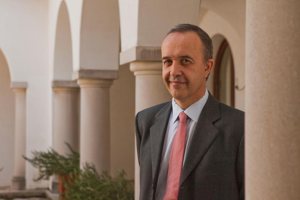 The Board of Trustees of The Clark Art Institute in Williamstown, Massachusetts has selected Olivier Meslay to serve as its Dena and Felda Hardymon Director. Meslay, an accomplished museum professional and noted scholar, will become The Clark’s fifth director when he assumes his new role on August 22. He currently serves as associate director of curatorial affairs, senior curator of European and American art, and The Barbara Thomas Lemmon Curator of European Art at the Dallas Museum of Art (DMA) and brings more than thirty-five years of international experience to his role. Meslay was unanimously elected to the position during a special session of The Clark’s board.
“We are thrilled to welcome Olivier Meslay as our new director,” said Andreas Halvorsen, chairman of the Institute’s Board of Trustees. “Olivier’s vision, international experience, and exceptional academic and curatorial qualifications match The Clark’s ambitious aspirations. He comes to the Clark with a deep appreciation for our academic mission, an expert understanding of our museum program, and an energetic perspective on ways to enhance our dual mission and extend The Clark’s reach and impact.”
Since assuming his current position in 2012, Meslay has overseen the DMA’s European and American art collection of more than 4,000 paintings, sculptures, and works on paper, and has managed the museum’s curatorial department, conservation program, and art research library. He has also served as the DMA’s curatorial representative with the French American Museum Exchange (FRAME), a collaborative organization of thirty American and French museums. Meslay served as the DMA’s interim director from 2011 to 2012, managing a staff of 250 employees, directing an extensive fundraising program, and coordinating donor relations that have provided continuing support for the museum. He joined the DMA staff in 2009 after a distinguished career at the Musée du Louvre in Paris.
“Olivier first came to know The Clark as a Fellow in our Research and Academic Program in 2000, and it was clear from the very beginning that he had a deep affinity for The Clark and for the unique relationship between our museum and research programs,” said Francis Oakley, The Clark’s interim director. “It is heartening to see such a long relationship culminate in this way. Olivier’s passion for The Clark and for Williamstown and the Berkshires, combined with his extraordinary scholarship and leadership, hold great promise for the future.”
Meslay is the author of the recent publication From Chanel to Reves: La Pausa and Its Collections at the Dallas Museum of Art (2015). He served as the co-organizing curator for Mind’s Eye: Masterworks on Paper from David to Cézanne (2014) and co-organized the exhibition Chagall: Beyond Color (2013) for the DMA. Meslay was the organizing curator of an exhibition commemorating the fiftieth anniversary of the assassination of President John F. Kennedy, Hotel Texas: An Art Exhibition for the President and Mrs. John F. Kennedy (2013). The exhibition brought together works of art installed in the presidential suite at Hotel Texas during Kennedy’s November 1963 trip to Dallas.
The European art collection at the DMA is recognized for the strength of its holdings of eighteenth-, nineteenth-, and twentieth-century paintings, sculpture, and works on paper. During his tenure, Meslay has been instrumental in leading the acquisition of several important works including paintings by Gustave Caillebotte, Ernest Ludwig Kirchner, Paul Signac, Ramon Casas, Guillaume Guillon Lethière, Antoine Giroust, and Edouard Vuillard, as well as sculptures by Anne Whitney and Auguste Préault.
Meslay held a variety of leadership positions at the Musée du Louvre over a period of seventeen years, from 1993 to 2009. He served as curator in charge of British, American, and Spanish paintings from 1993 to 2006; as chief curator of Louvre–Atlanta, a collaborative project with the High Museum, from 2003 to 2006; and as chief curator in charge of the Louvre–Lens project, the first regional branch of the Louvre. During his tenure at the Louvre, Meslay organized such exhibitions as William Hogarth (2006‒07), American Artists and the Louvre (2006), L’art anglais dans les collections de l’Institut (2004), Constable, Le choix de Lucian Freud (2002) and La collection de Sir Edmund Davis (1999). Meslay also served as a professor at the École du Louvre from 1997 to 2000 and from 2003 to 2006.
“The Clark Art Institute has always been, for me, a unique institution blending in perfect balance a refined, strong, and seductive museum; a forum shaping the present and the future of art history through its Research and Academic Program; and a teaching institution thanks to its unique partnership with the Williams College Graduate Program in the History of Art,” said Meslay. “Adding to all of this is the beauty of The Clark’s natural environment, which is undoubtedly integral to its identity. My longstanding relationship with The Clark now comes to fruition as if in a dream-come-true, but also as a great opportunity to maintain, at the highest level of excellence, what this institution brings to the art world.”
In 2009, the French government honored Meslay as a Chevalier des Arts et Lettres in recognition of his contributions to furthering French arts and culture throughout the world. A graduate of the Institut National du Patrimoine (1992–93), the French State School for Curators, Meslay received an MA from the École du Louvre in 1983, having previously received an MA from the Sorbonne in 1982, where he also earned his BA in 1981. He is a member of the editorial board of The British Art Journal, London, and is a member of the Société d’Histoire de l’Art Français, Paris.
Meslay is the author of several books, including Mind’s Eye: Masterworks on Paper from David to Cezanne (2014); Turner, Life and Landscape (2005); and J.M.W. Turner, The Man Who Set Painting on Fire (2005). He has published extensively on the Franco-British artistic relationship in both the United States and Europe, and has contributed essays to numerous exhibition catalogues.
Meslay’s wife, Laure de Margerie, is a noted scholar on French sculpture and was also a Clark Fellow in 2000–01. She spent most of her career at the Musée d’Orsay before becoming the founding director of the French Sculpture Census—a comprehensive survey of French sculpture in American public collections—in 2009. Meslay and de Margerie are the parents of three adult children.
Chosen after an international search conducted with the assistance of Korn Ferry, New York, Meslay replaces Michael Conforti, who retired from The Clark in August 2015.
Exhibition | Olafur Eliasson at Versailles
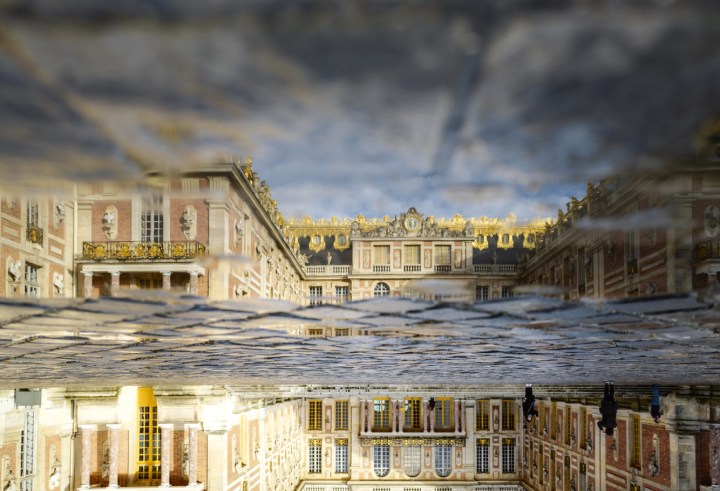
Olafur Eliasson, Versailles 2016 © Olafur Eliasson
◊ ◊ ◊ ◊ ◊
Press release from Versailles:
Olafur Eliasson at the Palace of Versailles
Château de Versailles, 7 June — 30 October 2016
Curated by Alfred Pacquement
The work of internationally acclaimed visual artist Olafur Eliasson investigates perception, movement, embodied experience, and feelings of self. He is best known for striking installations such as the hugely popular The Weather Project (2003) in the Turbine Hall of Tate Modern, London, which was seen by more than two million people, and The New York City Waterfalls (2008), four large-scale artificial waterfalls which were installed on the shorelines of Manhattan and Brooklyn.
Since 2008 the Palace of Versailles has put on a number of exhibitions dedicated to French or foreign artists, each one lasting a few months. Jeff Koons in 2008, Xavier Veilhan in 2009, Takashi Murakami in 2010, Bernar Venet in 2011, Joana Vasconcelos in 2012, Giuseppe Penone in 2013, Lee Ufan in 2014, and Anish Kapoor in 2015: these artists have all created a special dialogue between their works and the Palace and Gardens of Versailles. Since 2013 Alfred Pacquement is the curator of these exhibitions.
“With Olafur Eliasson, stars collide, the horizon slips away, and our perception blurs. The man who plays with light will make the contours of the Sun-King’s palace dance” says Catherine Pegard, President of the Château de Versailles.
“I am thrilled to be working with an iconic site like Versailles,” explains Olifur Eliasson. “As the palace and its gardens are so rich in history and meaning, in politics, dreams, and visions, it is an exciting challenge to create an artistic intervention that shifts visitors’ feeling of the place and offers a contemporary perspective on its strong tradition. I consider art to be a co-producer of reality, of our sense of now, society, and global togetherness. It is truly inspiring to have the opportunity to co-produce through art today’s perception of Versailles.”
Over the years, Eliasson has had significant exhibitions in France, from Chaque matin je me sens différent, chaque soir je me sens le même (2002) at the Musée d’art moderne de la ville de Paris, to Contact (2014), the first solo exhibition at the newly built Fondation Louis Vuitton, where Eliasson also created the permanent installation Inside the Horizon (2014). On the occasion of the COP21 United Nations Conference on Climate Change in Paris in December 2015, Eliasson made climate change tangible by leaving twelve massive blocks of Greenlandic glacial ice to melt in the Place du Panthéon for the installation Ice Watch.
In 2012, Eliasson and engineer Frederik Ottesen founded Little Sun. This social business and global project provides clean, affordable light to communities without access to electricity; encourages sustainable development through sales of the Little Sun solar-powered lamp and mobile charger, designed by Eliasson and Ottesen; and raises global awareness of the need for equal access to energy and light. Earlier this month in Davos, Eliasson received the prestigious Crystal Award for “creating inclusive communities”—a tribute to his work with Little Sun.
From 2009 to 2014, Eliasson ran the Institut für Raumexperimente (Institute for Spatial Experiments), an innovative model for art education affiliated with the Berlin University of the Arts. A comprehensive archive of the institute’s activities can be found online. In 2014, together with architect Sebastian Behmann, Eliasson founded Studio Other Spaces, an international office for art and architecture. As an architectural counterpart to Studio Olafur Eliasson, Studio Other Spaces focuses on interdisciplinary and experimental building projects and works in public space. Established in 1995, Eliasson’s studio today employs ninety craftsmen, specialised technicians, architects, archivists, administrators, and cooks. They work with Eliasson to develop and produce artworks and exhibitions, as well as to archive and communicate his work, digitally and in print. In addition to realising artworks in-house, the studio contracts with structural engineers and other specialists and collaborates worldwide with cultural practitioners, policy makers, and scientists.
A plan is available as a PDF file here»

The Coach Gallery at Versailles Open Once Again

Baptism Sedan of the Duc of Bordeaux
(Château de Versailles)
◊ ◊ ◊ ◊ ◊
The coaches at Versailles are once again on view:
The Coach Gallery of the Palace of Versailles, situated in the King’s Great Stables and closed to the public since 2007, will once again be opening its doors in the spring of 2016, thanks to sponsorship by the Michelin Corporate Foundation. This recently restored collection of coaches is one of the largest in Europe but is still very little known by the general public, and will be on display in a new and fully redesigned space.
Designed to be noticed, the carriages of Versailles are artistic masterpieces. Ostentatiously luxurious and extravagantly decorated with gold and sculpted detail, they were produced by the best artists of the French Court, including architects, carpenters, sculptors, cabinet-makers, bronze workers, chasers, gilders, upholsterers, embroiderers, and trimmings suppliers.
Besides its artistic quality, the collection is also a sort of ‘Vehicle Exhibition from the 18th and 19th centuries’, containing the finest prototypes and cutting-edge advances in French coach-making in terms of comfort, level of performance, and technique including traction, steering and suspension, and the first coupés and convertibles.
In addition, each coach tells a bit of French history through dynastic or political events such as christenings, marriages, coronations or funeral ceremonies. Above all else, the collection is a living testimony to life in the French Court and sumptuousness during the Ancien Régime, the French Empire, and the Restoration.
Visitors will discover these magnificent vehicles up close, such as the Berlins from the marriage of Napoleon I, the coach from the coronation of Charles X and the funeral carriage for Louis XVIII. They will also see finely decorated harnesses with gilded bronze, litters, the small coaches belonging to Marie-Antoinette’s children and an incredible collection of fantastical sledges made during the reign of Louis XV.
During the Ancien Régime the royal stables were located in the King’s Small Stables and Great Stables, a pair of buildings built opposite the Palace of Versailles by Jules Hardouin-Mansart. Pearls of classic French architecture, these two constructions were designed to house the horses and coaches of the King and the Court as well as the thousand or so people who formed the Institution, including horsemen, drivers, blacksmiths, wheelwrights, saddlers, doctors and even musicians.
At the time of the revolution, hundreds of vehicles that once served the King and Court were sold and dispersed, and then re-used during the War in the Vendée and to serve the needs of the revolutionary government. In 1837, when Louis-Philippe turned the Palace of Versailles into a museum dedicated to ‘All the glory of France’, he re-assembled the collection of historical Coaches.
The success of the exhibition Roulez Carrosses! in 2011–13 at the Arras Musée des Beaux-Arts revealed both the richness of the exhibition and the public’s interest in these works of art. It also brought to light the need to exhibit them in the Palace of Versailles and make them permanently available to the public.
The exhibition space is composed of two galleries and currently covers nearly 1000 m², allowing the collection to be comfortably spread out. The scenography will respect the spirit and architecture of the setting: the Royal Stables built by Jules Hardouin-Mansart between 1679 and 1682.
YCBA Reopens on Wednesday
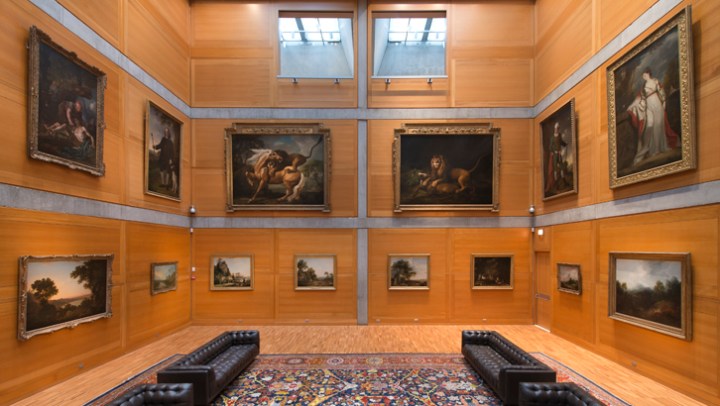
Yale Center for British Art, Library Court following reinstallation facing west, March 2016
Photo by Richard Caspole
◊ ◊ ◊ ◊ ◊
Press release for the reopening of the Yale Center for British Art upon the completion of the interior conservation of its landmark Louis Kahn building:
The Yale Center for British Art will reopen to the public on May 11, 2016, after completing the third phase of a major building conservation project. Visitors to the renovated building will experience a stimulating new installation of the Center’s unparalleled collection of more than five centuries of British art, largely the gift of the institution’s founder, Paul Mellon (Yale College, Class of 1929).
The Long Gallery, located on the fourth floor, will be wholly reconfigured, restoring the original conception of the space as a teaching and study gallery, as formulated by the Center’s founding director, Jules Prown, and as designed by Kahn. Over two hundred works will be installed from floor to ceiling across seven bays. Adjacent to this gallery, in a space that formerly served as an office, will be a new seminar room for faculty, students, and visiting scholars to engage in the close study of collection objects. In addition to the reinstallation of the collection, which explores the theme of “Britain in the World,” the reopening will also feature two special exhibitions.

Yale Center for British Art, fourth floor, Long Gallery following reinstallation, January 2016
Photo by Richard Caspole
◊ ◊ ◊ ◊ ◊
The Center first opened to the public in April 1977, and this project marks the most complex and comprehensive interior conservation work undertaken to date, affecting the entire structure, including the basement and roof. The project features significant mechanical, electrical, plumbing, and telecommunications upgrades, as well as important improvements to accessibility, re prevention systems, and patron amenities.
During the closure, construction crews have been busily restoring the galleries to pristine condition. Old linen and plywood were removed from the permanent walls, the former donated to the Yale School of Art and the latter given to the Hartford Area Habitat for Humanity. After insulation was removed from the exterior walls, the inside of the exterior stainless steel panels was revealed, allowing areas of corrosion to be treated and the interior of the walls to be rebuilt. Two layers of mineral wool insulation were covered with galvanized steel, re-rated plywood, and fresh Belgian linen. Worn synthetic carpet was replaced with new wool carpet, refinished wood trim was installed, and some travertine floor tiles were repaired or replaced. The existing moveable gallery partitions, known as “pogo” walls, were also dismantled, and will be replaced by new ‘pogo’ panels based closely on a drawing produced by Kahn shortly before his death in March 1974.
Extensive renovations also have also been undertaken in the Lecture Hall, which is the only remaining space that has never been refurbished. New seats have been configured in the center of the room, flanked by new steps and railings along each side wall. Five seats for disabled patrons have been installed, each with a companion seat. Audio/visual and lighting upgrades will enable better broadcasting and performance capabilities, including integrated video conferencing. There are also two new accessible public restrooms on the basement level, as well as a bank of new lockers for use by Center visitors.
As with past building conservation projects, the Center has benefited from the expertise and dedication of its partners in the Yale Office of Facilities; Knight Architecture LLC, New Haven; Peter Inskip + Peter Jenkins Architects, London; and Turner Construction Company; as well as the talents and hard work of numerous other collaborators.
This project follows more than a decade of research on the history of the design, construction, and renovation of the Center’s landmark building, as well as the publication in 2011 of Louis Kahn and the Yale Center for British Art: A Conservation Plan by the Center in association with Yale University Press. Written by Peter Inskip and Stephen Gee, in association with Constance Clement, the Center’s deputy director, this book details the conservation plan and proposes a series of policies for the building’s care and maintenance in the years ahead. The first of its kind in the United States, the conservation plan addresses the evolution and appropriate upkeep of a modern building, rather than the preservation of an historic structure, by identifying the key features characterizing its cultural significance and determining those which should be protected and others that could be allowed to change.
The first phase of work to be guided by the conservation plan involved the rehabilitation of the Center’s exterior Lower Court and extensive repairs to the adjacent Lecture Hall Lobby in 2010–2013. This was followed by two additional projects addressing the building’s interior spaces: The second phase, in 2013, focused on refurbishment of the department of Prints & Drawings and Rare Books & Manuscripts. Along with vitally increasing storage capacity for works on paper, behind-the-scenes renovations included the replacement of carpeting and wall coverings; the renewal of the finish on white oak storage cabinets; and the reconfiguration of offices to better accommodate the needs of staff. The third phase, begun in 2015, concentrated primarily on enhancing the Center’s public spaces, while also addressing extensive building-wide mechanical and electrical upgrades, as well as improvements to safety and accessibility.
The Yale Center for British Art houses the largest collection of British art outside the United Kingdom. Presented to the university by Paul Mellon, the collection reflects the development of British art and culture from the Elizabethan period onward. The Center’s collections include more than 2,000 paintings and 200 sculptures, 20,000 drawings and watercolors, 30,000 prints and 35,000 rare books and manuscripts. More than 30,000 volumes supporting research in British art and related fields are available in the Center’s library.
In celebration of the reopening, the Center will host extended hours on Wednesday, May 11, and Thursday, May 12, with special behind-the-scenes tours on opening day. On Saturday, May 14, the Center will welcome the community with a full day of programs and activities. Screenings of a brief documentary on the architecture of the institution’s iconic building, designed by Louis I. Kahn, will be shown in the newly refurbished Lecture Hall. The film will provide insight into the architecture, the building conservation project, and the relationship of the building to the collections. Visitors will be able to tour the reinstallation, which interprets the museum’s extraordinary collections of five centuries of British art in the context of the larger world. The reinstallation is presented in the galleries on the fourth and second floors. The special exhibitions Modernism and Memory: Rhoda Pritzker and the Art of Collecting (May 11–August 21, 2016) and Art in Focus: Relics of Old London (May 11–August 14, 2016) are located on the third-floor galleries. Everyone is welcome. Admission is free.
Jonathan Bober Named Senior Curator of Prints and Drawing at NGA
Press release (6 May 2016) from the NGA:

Jonathan Bober in the prints and drawings study room at the National Gallery of Art, Washington (Photo by Division of Imaging and Visual Services)
Jonathan Bober has been named the National Gallery of Art’s Andrew W. Mellon Senior Curator of Prints and Drawings. Bober’s appointment becomes effective on October 1, 2016, when he succeeds Andrew Robison, who retires from the position on September 30, 2016. Bober will oversee the continuing work and growth of the Gallery’s three departments of prints and drawings that Robison cultivated and nurtured for more than 40 years.
“Jonathan Bober is a brilliant curator and connoisseur with an outstanding track record of exhibitions and publications, and a remarkable degree of knowledge about both prints and drawings,” said Earl A. Powell III, director, National Gallery of Art. “We are delighted that he is assuming this prestigious role in our curatorial ranks.”
Since 2011 Bober has served as curator and head of old master prints at the National Gallery of Art and has played a very active role across the institution, from key acquisitions to mentoring emerging scholars. Bober led the acquisition of some 2,000 prints by purchase, gift, and promised gift, most notably 18th-century Venetian and 19th-century Italian, making the Gallery’s holdings the most significant in the U.S. During his tenure at the Gallery, Bober organized four Gallery exhibitions: The Baroque Genius of Giovanni Benedetto Castiglione (2012), Northern Mannerist Prints from the Kainen Collection (2013), From Neoclassicism to Futurism: Italian Prints and Drawings, 1800–1925 (2014), and Recent Acquisitions of Italian Renaissance Prints: Ideas Made Flesh (2015). Since 2015, Bober has been the Gallery’s curatorial liaison to the Center for Advanced Study in the Visual Arts (CASVA).
The Gallery’s division of old master and modern prints and drawings, with nine curators, oversees one of the nation’s finest collections of works on paper. In total, the Gallery’s collection of prints, drawings, and illustrated books contains approximately 121,000 Western European and American works on paper and vellum dating from the 11th century to the present day.
Bober came to the Gallery in 2011 from the Blanton Museum at the University of Texas at Austin, where he served as a curator since 1987, first as curator of prints and drawings; from 1998 as curator of prints, drawings, and European painting; and from 2010 as senior curator of European art. Prior to his work at the Blanton Museum, he was curatorial associate in the print department of the Fogg Art Museum, Harvard University, from 1984 to 1987, where he completed his graduate work with Sydney Freedberg and Henri Zerner.
Over the course of Bober’s career his exhibitions and publications have focused on old master paintings and old master and modern prints and drawings. They include Luca Cambiaso, 1527–1585, the international loan exhibition of the paintings, drawings, and prints of Luca Cambiaso and his Genoese contemporaries, (co-organized with the Palazzo Ducale, Genoa; Austin, September 2006–January 2007, and Genoa, March–July 2007), and Capolavori della Suida-Manning Collection (co-organized with Giulio Bora, Museo Civico, Cremona, October 2001–April 2002). In addition to catalogs of the Italian drawings in the Fogg Art Museum (1988) and Blanton Museum (2001), and numerous exhibition catalogs at the Blanton, Bober is the author of many catalog essays and scholarly articles appearing in such periodicals as Master Drawings, The Burlington Magazine, and Arte Lombarda. These concern painting and drawing as well as printmaking in 16th- and 17th-century Milan, Cremona, Venice, and Genoa.
Bober acquired for the Blanton Museum 11,000 of its 18,000 works (most with private support), including the extraordinary Suida-Manning Collection of old master paintings and drawings, art critic Leo Steinberg’s extensive collection of old master prints, and many outstanding individual works in the field, including modern and contemporary. In addition to organizing exhibitions from the Blanton Museum’s collection, such as Prints of the Ancien Régime (1996) and The Language of Prints (2008), Bober maintained a rotation of prints and drawings from the permanent collection in seven dedicated galleries. He helped develop the design of the new Blanton Museum and oversaw the creation of a new center for prints and drawings, which opened in April 2006.
Andrew Robison joined the curatorial staff of the National Gallery of Art in 1974, becoming Senior Curator in 1983 and A. W. Mellon Senior Curator in 1991. Over four decades Robison has curated dozens of exhibitions on art from the 15th through the 20th centuries, especially drawings and prints by early German artists, Rembrandt, 18th-century Venetian artists, German expressionists, and Pablo Picasso, as well as the multimedia exhibitions Art for the Nation: Gifts in Honor of the 50th Anniversary of the National Gallery of Art (1991), The Glory of Venice: Art in the Eighteenth Century (1994–1995), Ernst Ludwig Kirchner: 1880–1938 (2003), and Albrecht Dürer: Master Drawings, Watercolors, and Prints from the Albertina (2013).
National Gallery of Denmark’s Plans for Digitizing Its Collection
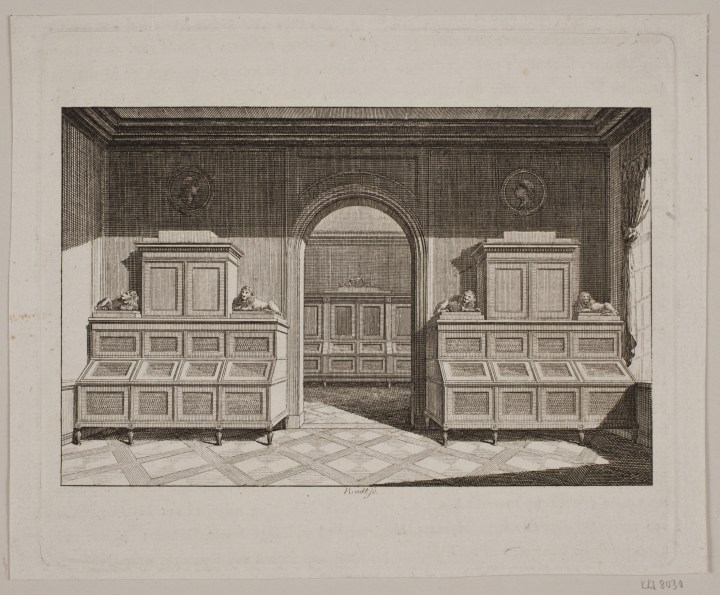
Frederik Ludvig Bradt (1747–1829), Coin Cabinet at Rosenborg, etching, 1791
(Copenhagen: SMK / The National Gallery of Denmark, KKS8030)
◊ ◊ ◊ ◊ ◊
As of today, a search of the SMK collection with the filter for 1700 to 1800 turns up 8204 works. From the press release (2 May 2016). . .
The SMK, The National Gallery of Denmark, launches a digital project that will, over the course of the next four years, make the National Gallery’s art collection freely available to everyone—for any purpose, ranging from fun to serious production. The objective is to make art relevant to more people. The project is made possible by a generous donation from the Nordea Foundation of DKK 11.7 million (EUR 1.6 million).
In countries such as The Netherlands, the USA and the UK, large museums have digitised their collections and made them available to everyone for years now, thereby endeavouring to meet the demands of present and future consumers of art and culture who are no longer satisfied with being spectators. They want to participate actively, and they want to put culture to use in their own lives. The lessons learned from these efforts are clear: being able to actively select, re-purpose, remix, and share works means that far more people access and use the collections. Including people who would not usually have visited or used the museum.
The SMK collection comprises more than 250,000 works of art. Approximately one per cent of that collection is on display and can be accessed by visitors to the museum in Copenhagen. In recent years the SMK has launched a range of pilot projects to explore how the museum’s digital treasures can be used in new ways, in new contexts and by all users. These initiatives have progressed by increments and been modest in scale, but the results have shown that there is demand for such activities. In fact, the findings proved so promising that the SMK will now, thanks to a generous donation of DKK 11.7 million (EUR 1.6 million) from the Nordea Foundation, embark on a new project: SMK Open. Scheduled to run until 2020, the SMK Open project will pave the way for truly democratic use of the museum’s art collections.
The history and many stories of art will continue to be explored and presented by the museum’s in-house experts. At the same time the SMK will open up its collection in digital form, offering a huge toolbox full of building blocks in the form of high-quality image files that can be used by anyone for any purpose—for example for books, education materials, online blogs, Wikipedia articles, film and TV productions, interior design and outdoor decoration—the only limit is the users’ imagination.
“SMK Open makes the National Gallery of Denmark’s art collection—which belongs to us all—available to anyone at all times. There will be no admission fee, but plenty of excellent and informative presentation materials and a warm invitation to have fun, play around and explore the wondrous world of art. The project will make even more people co-owners and co-producers of our shared art heritage,” says Henrik Lehmann Andersen, director of the Nordea Foundation, which aims to support and enhance ‘the good life’ for everyone.
The SMK Open project gives each work its own digital webpage that can also contain materials such as film footage, articles, audio tracks, x-rays of the work, and information on any future events or exhibitions at the museum which feature that work. In addition to this, thousands of photographs of art works will be made available in the highest possible resolution and quality. All works on which no copyright restrictions apply can be used by anyone for any purpose.
Users can also comment on each work, contribute their own information and insights or enter into a dialogue with the museum staff. Users are also invited to take part in the project’s development and will be involved in shaping and defining the end result right from the outset.
“In recent years we at the SMK have worked to offer many different gateways to the world of art. Our experience tells us that art becomes relevant to more people when they can approach it in their own way. Many wish to actively use art in their own lives. SMK Open will make it possible to download and use a wealth of information from the SMK toolbox—and at the same time we want to incorporate the users’ insights and information about the collection in that toolbox. This is because we want to forge closer links between our collection—which belongs to public—and the greatest possible number of people we can—of any age, gender, level of education and social or cultural background,” says Mikkel Bogh, director of the SMK.










 Enfilade
leave a comment