Eve Straussman-Pflanzer to Head European Art at the DIA
Press release (2 March 2016) from the DIA:

Eve Straussman-Pflanzer © E. Rothstein.
The Detroit Institute of Arts (DIA) has hired Eve Straussman-Pflanzer as head of the European art department and Elizabeth and Allan Shelden curator of European paintings. Straussman-Pflanzer comes to the DIA from Wellesley College, where she is assistant director of curatorial affairs and senior curator of collections at Wellesley’s Davis Museum. She begins at the DIA on May 2, 2016.
“Eve brings exceptional connoisseurship, scholarship and administrative skills to our curatorial team,” said Salvador Salort-Pons, DIA director. “Her leadership, community engagement and highly collaborative abilities will bring our prestigious European art department and collection to the next level of accomplishment and accessibility. Eve’s expertise includes southern Baroque art and women artists and patrons. Her interest in gender studies will provide a fresh perspective to learning more about our world-class collection, acquiring new works and creating innovative exhibitions in conjunction with our Learning and Interpretation department.”
Straussman-Pflanzer previously held positions at the Metropolitan Museum of Art in New York and the Art Institute of Chicago (AIC), where she researched and published on European painting and sculpture from the Renaissance to the 18th century. At the AIC, she curated the exhibition Violence and Virtue: Artemisia Gentileschi’s ‘Judith Slaying Holofernes’ as well as installations on Ludovico Carracci and Picasso’s relationship to Spanish Golden Age painting. She contributed to the exhibition catalogues Kings, Queens and Courtiers: Art in Early Renaissance France and Capturing the Sublime: Five Centuries of Italian Drawing. Straussman-Pflanzer also taught courses on early modern art at the School of the Art Institute of Chicago and the University of Chicago.
At the Davis Museum, Straussman-Pflanzer led the curatorial team and organized special exhibitions, including Figment of the Past: Venetian Works on Paper, Hanging with the Old Masters, and Warhol@Wellesley. She also shepherded the reinstallation of the permanent collection and is curating the first monographic exhibition in America on the Florentine 17th-century painter Carlo Dolci to open at the Davis on February 8, 2017 with a second venue at the Nasher Museum of Art at Duke University in Durham, North Carolina, later that year.
Straussman-Pflanzer earned her BA from Smith College and her MA and PhD from the Institute of Fine Arts, New York University. Her dissertation focused on the art patronage of Grand Duchess Vittoria della Rovere, an illustrious member of the Medici family. Eve is a native New Yorker, an avid walker and an aficionado of all things edible.
The Fitzwilliam Turns 200, with Exhibition and Book to Celebrate
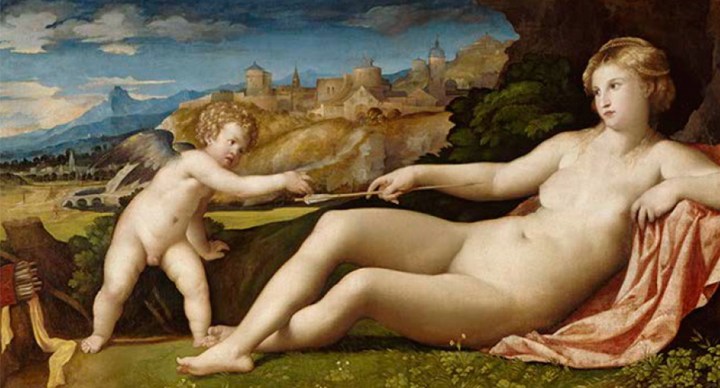
Palma Vecchio, Venus and Cupid, 1523–24 (Cambridge: The Fitzwilliam Museum). The painting was purchased by Lord Fitzwilliam from the London sale of the Duc d’Orléans collection in 1798. He first saw the collection at the Palais Royale during his visits to Paris.
◊ ◊ ◊ ◊ ◊
Press release from The Fitzwilliam:
Today (Thursday, 4 February 2016) one of the great collections of art in the UK celebrates its bicentenary. 200 years to the day of his death, the Fitzwilliam Museum has revealed previously unknown details of the life of its mysterious founder, Richard 7th Viscount Fitzwilliam of Merrion. Research for a new book has shown how his beloved library may have contributed to his death, and how his passion for music led him to the love of his life: a French dancer with whom he had two children, Fitz and Billy.
The Fitzwilliam Museum: A History is written by Lucilla Burn, Assistant Director for Collections at the Fitzwilliam. The book explores the full 200 year story of the Museum and the first chapter focuses on the founder. She comments: “Lord Fitzwilliam’s life has been described as ‘deeply obscure’. Many men of his class and period, who sought neither fame nor notoriety, nor wrote copious letters or diaries, do not leave a conspicuous record. But by going through the archives and letters that relate to him, for the first time we can paint a fuller picture of his history, including aspects of his life that have previously been unknown, even to staff here at the Fitzwilliam.”
Lord Fitzwilliam died on the 4th of February 1816, and founded the Fitzwilliam Museum through the bequest to the University of Cambridge of his splendid collection of art, books and manuscripts, along with £100,000 to build the Museum. This generous gift began the story of one of the finest museums in Britain, which now houses over half a million artworks and antiquities. Other than his close connection to Cambridge and his love of art and books, a motivation for Fitzwilliam’s bequest may have been his lack of legitimate heirs. The new details of his mistress help to explain why he never married.

Joseph Wright, The Hon. Richard Fitzwilliam, 7th Viscount Fitzwilliam of Merrion, 1764 (Cambridge: The Fitzwilliam Museum)
In 1761 Richard Fitzwilliam entered Trinity Hall, Cambridge, and in 1763 his Latin ode, ‘Ad Pacem’, was published in a volume of loyal addresses to George III printed by the University of Cambridge. He made a strong impression on his tutor, the fiercely ambitious Samuel Hallifax, who commissioned Joseph Wright of Derby to paint a fine portrait of Fitzwilliam on his graduation with an MA degree in 1764. Fitzwilliam’s studies continued after Cambridge; he travelled widely on the continent, perfecting his harpsichord technique in Paris with Jacques Duphly, an eminent composer, teacher and performer. A number of Fitzwilliam’s own harpsichord compositions have survived, indicating he was a gifted musician.
But from 1784 he was also drawn to Paris by his passionate attachment to Marie Anne Bernard, a dancer at the Opéra whose stage name was Zacharie. With Zacharie, Fitzwilliam fathered three children, two of whom survived infancy—little boys known to their parents as ‘Fitz’ and ‘Billy’. How the love affair ended is unknown, but its fate was clouded, if not doomed, by the French Revolution. We do not know what happened to Zacharie after her last surviving letter, written to Lord Fitzwilliam late in December 1790. Her health was poor, so it is possible that she died in France. However, the elder son, Fitz (Henry Fitzwilliam Bernard), his wife Frances, and their daughter Catherine were living in Richmond with Lord Fitzwilliam at the time of the latter’s death in 1816. It is not known what happened to Billy.
At the age of seventy, early in August 1815, Lord Fitzwilliam fell from a ladder in his library and broke his knee. This accident may have contributed to his death the following spring, and on 18 August that year Fitzwilliam drew up his last will and testament. Over the course of his life he had travelled extensively in Europe. By the time of his death he had amassed around 144 paintings (including masterpieces by Titian, Veronese, and Palma Vecchio), 300 carefully ordered albums of Old Master prints, and a magnificent library containing illuminated manuscripts, musical autographs by Europe’s greatest composers, and 10,000 fine printed books.
His estates were left to his cousin’s son, George Augustus Herbert, eleventh Earl of Pembroke and eighth Earl of Montgomery. But he also carefully provided for his relatives and dearest friends. The family of Fitzwilliam’s illegitimate son, Henry Fitzwilliam Bernard (‘Fitz’)—including Fitz’s wife and daughter—received annuities for life totalling £2,100 a year. On Fitzwilliam’s motivation for leaving all his works of art to the University, he wrote: “And I do hereby declare that the bequests so by me made to the said Chancellor Masters and Scholars of the said University are so made to them for the purpose of promoting the Increase of Learning and the other great objects of that Noble Foundation.”
Director of the Fitzwilliam Museum, Tim Knox commented: “The gift Viscount Fitzwilliam left to the nation was one of the most important of his age. This was the period when public museums were just beginning to emerge. Being a connoisseur of art, books and music, our founder saw the importance of public collections for the benefit of all. But we are also lucky that his life circumstances enabled him to do so—had there been a legitimate heir, he might not have been able to give with such liberality. From the records we have discovered, he appears to have been as generous as he was learned: he arranged music concerts to raise funds for charity and helped many people escaping the bloodiest moments of the French Revolution. We are delighted to commemorate our founder in our bicentenary year.”
◊ ◊ ◊ ◊ ◊
Celebrating the First 200 Years: The Fitzwilliam Museum, 1816–2016
The Fitzwilliam Museum, Cambridge, 4 February — 30 December 2016
Running throughout 2016, this exhibition will explore the Fitzwilliam’s past, present and future. A timeline of the first 200 years will introduce key themes and characters, while displays of objects will show how the collections have developed over two centuries. The exhibition runs alongside a new book The Fitzwilliam Museum: A History. For the very first time, this will tell the full 200 year story of the Museum. The triumphs and challenges of successive Directors, the changing nature of the Museum’s relationship with its parent University, and its dogged survival through the two World Wars. It will also shed light on the colourful, but previously little-known, personal life of Viscount Fitzwilliam himself.
◊ ◊ ◊ ◊ ◊
Lucilla Burn, The Fitzwilliam Museum: A History (London: Philip Wilson Publishers, 2016), 224 pages, ISBN: 978-1781300343, £25.
 The Fitzwilliam Museum: A History traces the full story from the Museum’s origins in the 1816 bequest of Richard, 7th Viscount Fitzwilliam of Merrion, up to the present day. It sets the Fitzwilliam’s individual story against the larger context of the growth and development of museums and galleries in the UK and further afield. The text and illustrations draw primarily on the rich and largely unpublished archives of the Fitzwilliam Museum, including the Syndicate Minutes, the reports of University debates published in the Cambridge University Reporter from 1870 onwards, compilations of earlier nineteenth-century documents, architectural plans and drawings, newspaper reports, letters, diaries, exhibition catalogues, photographs and other miscellaneous documents. With this material a substantial proportion of the narrative is told through contemporary voices, not least those of the Museum’s thirteen directors to date, each one a strong and influential character.
Starting with the obscure life of the 7th Viscount and concluding with a portrait of the Museum today, the narrative explores not just the Fitzwilliam’s own establishment and development, but also such wider issues as the changing purpose and character of museums and collections over the last 200 years, and in particular the role of the university museum. Many of the illustrations appear in the book for the first time, and include views of the galleries over the centuries as well as portraits of members of staff.
Art Institute of Chicago Receives $35Million Gift
Dorothy Braude Edinburg, a life-long collector and longtime supporter of the Art Institute of Chicago died last year at the age of 94. Her estate has just given more than $35million dollars to the museum, building upon earlier donations that established the Harry B. and Bessie K. Braude Memorial Collection in honor of her parents, who themselves were collectors—initially of eighteenth-century French furniture, Chinese porcelain, and artists books (additional information is available at Crain’s).
From Art Daily:
Douglas Druick, President and Eloise W. Martin Director of the Art Institute of Chicago announced today the largest bequest of funds in the museum’s history. The gift from long-time, generous benefactor and collector Dorothy Braude Edinburg provides more than $35 million to acquire new works of art to build on the Art Institute’s strong holdings in Prints and Drawings and Asian Art. Coming on the heels of the largest gift of art in the museum’s history, the Edlis/Neeson Collection in April 2015, the Edinburg gift offers exciting new momentum and opportunity to realize the museum’s ambitious long-range plan.

Dorothy Braude Edinburg (1920–2014)
“It was my great privilege to know and work with Dorothy for more than two decades, and we are thrilled and immensely grateful to receive this unparalleled bequest,” said Druick. “Together, with the leadership of Chair and Curator of Prints and Drawings Suzanne Folds McCullagh and our curatorial teams, we proudly embraced Dorothy’s extraordinary collection, and we will use this incredible funding to carry Dorothy’s vision forward—to inspire, educate, and delight future generations through the collection and presentation of exceptional art.”
David Hilliard, long-time Trustee of the Art Institute of Chicago and collector and connoisseur of prints and drawings, shared, “It was inspiring to see Dorothy build such an important and world-class collection—over the course of 23 years, Dorothy gifted the museum more than 1,500 works across six centuries and from many fields. This generous bequest ensures her collection will continue to inspire and educate the public, and embodies the excellence and mission of the Art Institute. It’s an honor to support the stewardship of her legacy.”
In 2013, through a landmark gift of more than 1000 works of art to the museum, Dorothy Braude Edinburg established the Harry B. and Bessie K. Braude Memorial Collection in her parents’ honor. The collection’s breadth and scope of European prints and drawings, Chinese and Korean stonewares and porcelains, and Japanese printed books, continues to spark a deeper artistic dialogue across and within the museum’s permanent collection.
The Holburne Museum Buys a Sketch by Thomas Lawrence
Press release (15 January 2015) from the UK’s Art Fund:
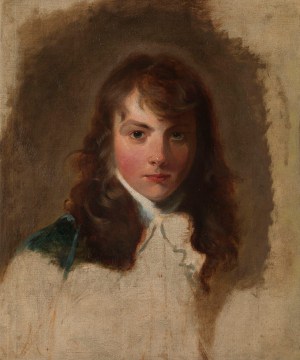
Thomas Lawrence, Sketch of Arthur Atherley, 1791
(Bath: The Holburne Museum)
The Holburne Museum in Bath has acquired a preparatory oil sketch of Arthur Atherley by Thomas Lawrence that has never been displayed in a public museum. Lawrence was commissioned to paint Arthur Atherley, who had recently left Eton College and who would later become an MP for the Southampton constituency. The artist was just three years older than his 19-year-old sitter.
In autumn 2015 the Holburne set out to raise £450,000, including a public appeal target of £61,209, for the acquisition of the sketch and the delivery of a learning programme. Following the successful campaign to raise the funds, Jennifer Scott, the Holburne’s director said: “The response from our visitors, friends, patrons and supporters at all levels has been overwhelming, enabling us to raise this large amount in a short time period. It is a reflection of both the quality of the painting itself, and the relevance of an outstanding early Lawrence portrait coming to the southwest.”
Thomas Lawrence was a child prodigy. He was born in Bristol, but after several of his father’s ventures failed to prosper, the family moved to Bath. From the age of ten he supported his family through the money he earned from painting portraits. Talented, charming, handsome and surprisingly modest, the young Lawrence was popular with Bath residents and visitors.
Just before his 18th birthday, he relocated his family to London and soon established his reputation as a portrait painter. From his arrival in London in 1787 until his death in 1830, Lawrence showed work at almost every annual Royal Academy Summer Exhibition, with two exceptions. In the 1792 exhibition, he exhibited his three-quarter length portrait of Arthur Atherley. It is one of his best-known works and now hangs at the Los Angeles County Museum of Art.
Stephen Deuchar, director of the Art Fund, said: “We are so pleased to support the acquisition of this important portrait, an excellent addition to the museum’s fine collection of 18th-century art. Heartfelt thanks to everyone else who helped through the public appeal to make this happen—a sign of widespread support for the Holburne’s admirable collecting ambitions.”
The work was acquired with support from the Art Fund, the Heritage Lottery Fund, and ACE/V&A Purchase Grant Fund, along with members of the public.
Goya’s Portrait of Don Pedro, Duque de Osuna on Loan at The Prado
Press release (18 January 2016) from The Prado:
Goya’s Portrait of Don Pedro de Alcántara Téllez-Girón y Pacheco, 9th Duke of Osuna
Museo Nacional del Prado, Madrid, 19 January — 24 April 2016
The Museo del Prado and the Fundación Amigos del Museo del Prado are presenting Goya’s Portrait of Don Pedro de Alcántara Téllez-Girón y Pacheco, 9th Duke of Osuna. Through the collaboration of The Frick Collection in New York, where it is normally housed, the painting will be on display in Room 34 of the Villanueva Building until 24 April this year.

Francisco de Goya y Lucientes, Portrait of Don Pedro, Duque de Osuna, oil on canvas, 137.8 x 109.2 x 10.2 cm (New York: The Frick Collection; photo by Michael Bodycomb).
Traditionally dated to around 1798, the recent cleaning of the portrait at The Metropolitan Museum in New York has revealed a complexity of technique and use of colour that may allow it to be dated later, possibly even to after the Duke’s death in 1807. While the sitter’s clothing corresponds to the late 1790s, the dark tonality and manner of painting the dress coat and hands are closer to Goya’s technique during the period of the Peninsular War. This hypothesis is supported by the fact that the work does not appear in the records of the Osuna residence in which purchases made in the 18th century are rigorously recorded, but it does however appear in the sale of the Osuna collection in 1896. It is also possible that this is the portrait referred to in an inventory of the collection of around 1834 as an oil painting “of half-length of the Duke of Osuna, grandfather.” This information seems to indicate that the portrait was commissioned during a turbulent period, possibly at the time when the Osuna family moved to Cadiz after the Duke’s death and prior to the French invasion.
In Goya’s image the Duke transmits the sensitive, enthusiastic personality that made him a popular figure among intellectuals of the time. The dimensions of the work, which are similar to those of the portrait of the Duchess of 1786 (Marita March collection), the Duke’s pose and the direction of his gaze all suggest that Goya probably painted it from a miniature and that it was used as a pair to the portrait of the Duchess.

Francisco de Goya y Lucientes, Portrait of the Duke and Duchess of Osuna and Their Children, oil on unlined canvas, 225 x 174 cm (Madrid: The Prado).
Don Pedro de Alcántara Téllez-Girón y Pacheco, 9th Duke of Osuna (1755–1807) was one of Goya’s earliest and most eminent patrons from the mid-1780s onwards. After his death the artist continued to work for his wife and children until 1817. The Prado has various works painted by Goya for the Osunas, including the group portrait of the entire family of 1785, those of the Marchioness of Santa Cruz (1805) and the Duchess of Abrantes (1816), and the unique Witches’ Flight, one of the ‘scenes of witches’ from the series that Goya sold to the Duke in 1798.
The special loan of this portrait of the Duke falls within the context of the Museum’s ‘Invited Work’ programme, an activity sponsored by the Fundación Amigos del Museo del Prado since 2010 with the aim of further enriching a visit to the Museum and establishing points of comparison that allow for a reflection on the works in the Prado’s Permanent Collection.
◊ ◊ ◊ ◊ ◊
The painting was exhibited two years ago at the Norton Simon Museum in Pasadena (6 December 2013 — 3 March
2014); more information is available here.
Chistoph Vogtherr Named Director of the Hamburg Kunsthalle
From The Wallace (14 January 2016) . . .
Director, Dr Christoph Vogtherr, to leave the Wallace Collection
We at the Wallace are sad to hear about his departure, he has been an inspiration to his staff and we wish him well in his new role at Hamburger Kunsthalle.
 Dr Vogtherr joined the Wallace Collection as the Curator of Old Master Paintings and was appointed as Director in October 2011. During his tenure Dr Vogtherr has been responsible for the acclaimed refurbishment of the museum’s Great Gallery, seen visitor numbers increased by 20% and has established the museum as an international research centre for French seventeenth and eighteenth century art and European arms and armour.
Dr Vogtherr said: “It has been a great privilege to be part of the Wallace Collection team over the past nine years and its Director for the past five. I am proud to have been associated with such an outstanding collection and to have made a contribution to ensuring its enduring appeal for future generations. The refurbishment of the Great Gallery has been a once-in-a-lifetime project. The Hamburg Kunsthalle has played a crucial role in the history of the art museum and current museum practice, which explains the timing of this decision but I know I leave the Collection in good hands under the Chairmanship of António Horta-Osório, who I know will lead the Collection from strength to strength”.
António Horta Osório, the Chairman of the Wallace Collection, said: “We are very sorry to learn of Dr Vogtherr’s decision. We are immensely grateful to him for the very substantial contribution he has made to the Wallace Collection. He will leave the museum in a position of great strength artistically and intellectually.”
Dr Vogtherr will take up his post in Hamburg in October and the Wallace Collection will begin the search for a new Director in due course.
◊ ◊ ◊ ◊ ◊
From the Hamburg Kunsthalle (13 January 2016). . .
Dr. Christoph Martin Vogtherr wird Direktor der Hamburger Kunsthalle
Der Stiftungsrat der Hamburger Kunsthalle hat heute beschlossen, Dr. Christoph Martin Vogtherr die künstlerische und wissenschaftliche Leitung der Hamburger Kunsthalle zu übertragen. Vogtherr ist seit 2011 Direktor der Wallace Collection in London, einem der weltweit renommierten Museen für ältere, insbesondere französische Kunst. Er tritt zum 1. Oktober 2016 in der Hamburger Kunsthalle die Nachfolge von Prof. Dr. Hubertus Gaßner an, der in den Ruhestand geht.
Kultursenatorin Prof. Barabara Kisseler: „Mit Christoph Martin Vogtherr geben wir die Leitung der Hamburger Kunsthalle in die Hände eines ebenso erfahrenen wie innovativen Museumsdirektors. Vogtherr ist ein international anerkannter Kunsthistoriker. Als Direktor der Wallace Collection in London ist es ihm gelungen, mit neuen Sammlungspräsentationen und aktuellen Perspektiven ein neues Publikum für das Museum zu begeistern. Wir haben mit ihm eine Persönlichkeit gefunden, die dem Rang der Hamburger Kunsthalle gerecht wird und neue internationale Impulse setzen wird.“
Christoph Martin Vogtherr: „Die Hamburger Kunsthalle ist eines der herausragenden Kunstmuseen in Deutschland. Mit ihrer beeindruckenden und inspirierenden Tradition in der kunsthistorischen Arbeit und der Kunstvermittlung hat sie immer wieder die internationale Museumswelt geprägt und herausgefordert. Ich freue mich sehr über das große Vertrauen der Freien und Hansestadt Hamburg und möchte gemeinsam mit allen Mitarbeiterinnen und Mitarbeitern des Museums die künstlerische und gesellschaftliche Bedeutung der Kunsthalle weiter entwickeln.“
Christoph Martin Vogtherr ist seit 2011 Direktor der Wallace Collection in London. Seit 2007 war er dort zunächst als Kurator, später als Sammlungsleiter tätig. Von 2003 bis 2007 leitete er ein interdisziplinäres Forschungsprojekt der Getty Stiftung.
Seine derzeitige Wirkungsstätte, die Wallace Collection, ist eines von mehreren britischen Nationalmuseen und verfügt über eine hochkarätige Sammlung. Für Christoph Martin Vogtherr haben Museen eine wichtige Funktion als Teil der Zivilgesellschaft. Dabei ist es ihm ein besonderes Anliegen, ein junges und internationales Publikum durch innovative Vermittlungsangebote zu gewinnen.
Christoph Martin Vogtherr wurde 1965 in Uelzen geboren und studierte Kunstgeschichte, mittelalterliche Geschichte und klassische Archäologie in Berlin, Heidelberg und Cambridge. 1996 promovierte er an der Freien Universität Berlin mit einer Dissertation über die Gründung der Berliner Museen 1797-1835. Er verfügt über hervorragende internationale Beziehungen im anglo-amerikanischen Raum sowie in Frankreich. Seit 2014 ist er Mitglied im Wissenschaftsrat des Institut national d’histoire de l’art in Paris.
Winterthur’s Online Collections Reaches 60,000 Entries
As noted recently at Art Daily:
In an effort that began ten years ago, Winterthur Museum, Garden & Library has accomplished a significant milestone: 60,000 objects in the Winterthur collection have been catalogued or re-catalogued and made available to the public through Winterthur’s Online Collections.
In late summer of 2005, Winterthur welcomed new collections management software, and more than 70 staff and volunteer cataloguers began the process of cataloguing or re-cataloguing the entire collection of nearly 90,000 objects. With the help of many grants, approximately 16,000 ceramics, 14,500 metals, 11,000 textiles and needlework 3,500 prints and maps, 3,200 glass objects, 3,000 pieces of furniture, as well as architectural elements, paintings, tools, toys and games, works on paper, and more have been catalogued. In addition, nearly 152,000 digital images have been added to Winterthur’s collection database.
“We are incredibly grateful to all of our cataloguers over the years, as well as to those agencies, organizations, and individuals who have contributed to this project. Creating our Online Collections has given the public and scholars important access to the Winterthur collection and the wealth of information it has to offer, and in doing so, the Museum has been able to engage new audiences with its collection,” said Linda Eaton, John L. & Marjorie P. McGraw Director of Collections & Senior Curator of Textiles.
The original grant that started this process was given by the Jane du Pont Lunger Residual Trust Fund, which also funded the purchase of digital photographic equipment. Several other grants from federal agencies, foundations, and generous private supporters have helped Winterthur reach this achievement. Four grants from the Institute of Museum and Library Services made possible cataloguing discrete parts of Winterthur’s diverse collections of decorative and fine arts. The textile collection, an important resource for historians internationally, was partially catalogued through two grants for furnishing textiles and printed textiles. Winterthur’s collection of tools used by artisans in trades ranging from carpentry to silversmithing to needlework is the focus of the most recent grant that will be completed June 2016. An additional grant from the National Endowment for the Arts scanned and photographed half of the maps and prints in the collection, which are now available online. A grant from The Coby Foundation catalogued quilts and other bed covers, while a grant from the Museum Loan Network was used to catalogue and photograph 100 pre-1800 English ceramics that were then made available for loan on the MLN website. The generosity of Leslie B. Durst has made it possible to catalogue and photograph the needlework collection.
The Getty Acquires 31 Pieces of French Decorative Arts
Press release (12 January 2016) from The Getty:

Wall Clock, with clock movement probably by Nicolas Thomas, ca. 1785; gilt bronze, enameled metal, glass, 49.5 x 55.9 cm (Los Angeles: The J. Paul Getty Museum)
The J. Paul Getty Museum today announced the acquisition of an important collection of eighteenth-century French decorative arts assembled by Dr. Horace Wood (Woody) Brock, one of the world’s foremost economists. The acquisition is a combined gift and purchase. The thirty-one works of art include seven clocks; six gilt-bronze mounted porcelain, feldspar and porphyry objects; five works in gilt bronze including a pair of candelabra, two sets of firedogs, and two sets of decorative vases; a carved gilt-wood console table; a porcelain inkstand; and a leather portrait medallion of Louis XIV. The collection substantially enhances the Getty Museum’s extraordinary holdings of French decorative arts, renowned as one of the most important outside France.
“These exquisite objects constitute the most significant acquisition of French decorative arts made by the Museum in many years,” said Timothy Potts, director of the J. Paul Getty Museum. “Produced in the sophisticated artistic culture of eighteenth-century Paris, these extraordinary works epitomize the skill and artistry that made the French court and aristocratic life the epitome of elegant extravagance, and the envy of collectors throughout Europe. We are deeply grateful to Dr. Brock for his generosity in enriching our collection with this important gift and purchase.”

Mantel Clock, ca. 1789. Clock case attributed to Pierre-Philippe Thomire; clock movement by Charles-Guillaume Manière; patinated bronze, gilt bronze, enameled metal, glass, white marble, griotte marble, 55.2 × 64.5 × 19.1 cm (Los Angeles: The J. Paul Getty Museum, Los Angeles)
Dr. Brock has been collecting French and English decorative arts and Old Master drawings for the last thirty years. He began lending decorative arts objects to the Getty Museum in 1997 and made several long-term loans through 2008. Since being lent to the Getty, these objects have been on continuous display in the European decorative arts galleries in the South Pavilion Plaza Level at the Getty Center.
“The objects collected by Dr. Brock are sumptuous and refined pieces of the highest quality that have significantly enriched the French Decorative Arts galleries since the opening of the Getty Center in 1997,” said Anne-Lise Desmas, curator and department head of Sculpture and of Decorative Arts. “They have become key components in the Museum’s recreation of French eighteenth-century interiors and have played an essential role in our visitors’ experience and understanding of this critical period of European art.”
The newly-acquired works were created as luxury objects that would have decorated the lavishly furnished residences of the French aristocracy and bourgeoisie. Many, such as the clocks, candelabra, and the inkstand, were made for practical use, but their sophisticated design and rare materials were also meant to demonstrate the wealth, prestige, and refined taste of their owners. The objects represent the full range of decorative styles practiced during the eighteenth century, from the grandeur and opulence of late Baroque and Régence, through the intimate brilliance of the Rococo, to the severe restraint of the Neoclassical.
Highlights of the collection include a pair of gilt-bronze candelabra (2015.60.1) attributed to the prominent Baroque cabinetmaker André-Charles Boulle, called during his lifetime “the most skillful artisan in Paris.” Two early Rococo lidded jars (2015.70) include exotic motifs from the Far East; porcelain and hardstones were avidly collected and prominently displayed, mounted with gilt bronze to highlight the beauty and rarity of porphyry and feldspar.
A passionate collector of decorative arts, Dr. Brock knows the Getty Museum’s outstanding collection intimately. Consequently, he has given works that fit exceptionally well in the context of the Museum. For example, the extraordinary gilt-bronze wall clock in the form of a winged clock face (2015.67) adds an important model not currently represented in the collection and the imposing Neoclassical mantel clock with Vestal Virgins (2015.64) attributed to Pierre-Philippe Thomire joins a significant group of objects from early in that artist’s career already belonging to the Museum.
Most of the donations have been made in honor of Theodore Dell, an important scholar who catalogued the French furniture and gilt bronzes at The Frick Collection in New York. Dell was a consultant to Gillian Wilson, former Getty Museum curator of decorative arts, and helped Dr. Brock in the formation of his collection. Dell assembled an important library of sales catalogues, journals, magazines, books, and museum catalogues, all focused on French decorative arts, which he donated to the Bard Graduate Center Library in 2012. Other objects have been donated to the Getty in honor of Gillian Wilson as well as knowledgeable dealers in decorative arts such as Leon Dalva, Will Iselin, Pascal Izarn, Laurent and Olivier Kraemer, and Martin Zimet; and, in memory of Frank Berendt, Philippe Kraemer, and François Léage.
“The J. Paul Getty Museum contains a superb collection of the decorative arts of eighteenth-century France, a period in which the quality of design and craftsman ship arguably reached its historical zenith. My hope is that the objects I have collected will permanently enhance this already remarkable collection,” says Dr. Horace Wood Brock.
Dr. Horace Brock earned his B.A., M.B.A., and M.S. in Mathematics from Harvard University, and his M.A. and Ph.D. from Princeton University (Mathematical Economics and Political Philosophy). He is the former president and founder of Strategic Economic Decisions (SED), Inc., and specializes in applications of the modern economics of uncertainty to forecasting and risk assessment in the international economy and its asset markets. He has developed a new theory of rational beliefs that disputes the classical theory of efficient markets and is the author of American Gridlock: Why the Right and the Left Are Both Wrong — Commonsense 101 Solution to the Economic Crises (Wiley: 2012).
New Acquisition | MFA Acquires Extraordinary Desk and Bookcase
Press release via Art Daily (30 December 2015). . .
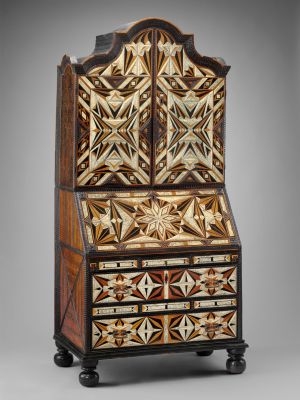
Desk and bookcase, mid-18th century, Mexico. Inlaid woods and incised and painted bone, maque, gold and polychrome paint, metal hardware (Museum of Fine Arts, Boston).
The Museum of Fine Arts, Boston, has acquired a rare and important desk and bookcase (mid-18th century, Mexico) from the Ann and Gordon Getty Collection. Originally made in Puebla de los Ángeles, this work is a remarkable piece of furniture that displays influences from Europe, Asia, Africa and the Americas. The striking geometric exterior looks toward Europe with its wood-and-bone Mudéjar designs—a Hispano-Moresque style popular during the era. Opening the doors reveals a dramatic interior of chinoiserie-style painting in gold on a red background. The inside recalls early colonial mapping traditions of Nahuatl-speaking artists, showing views of an extensive hacienda in Veracruz drawn in an indigenous style. The estate, once owned by a wealthy Spaniard, was the site of one of the earliest free African settlements in Mexico; the maps may depict descendants of these early African slaves or free blacks. This truly global mix of sources extends to the object’s material: the red background is likely maque (from the Japanese word for lacquer, maki-e), a resin created using local materials in the style of Asian painting.
The work is among the most rare pieces of furniture currently on view in the exhibition, Made in the Americas: The New World Discovers Asia, the first major, pan-American exhibition to examine the profound influence of Asia on the arts of the colonial Americas (on view through February 15).
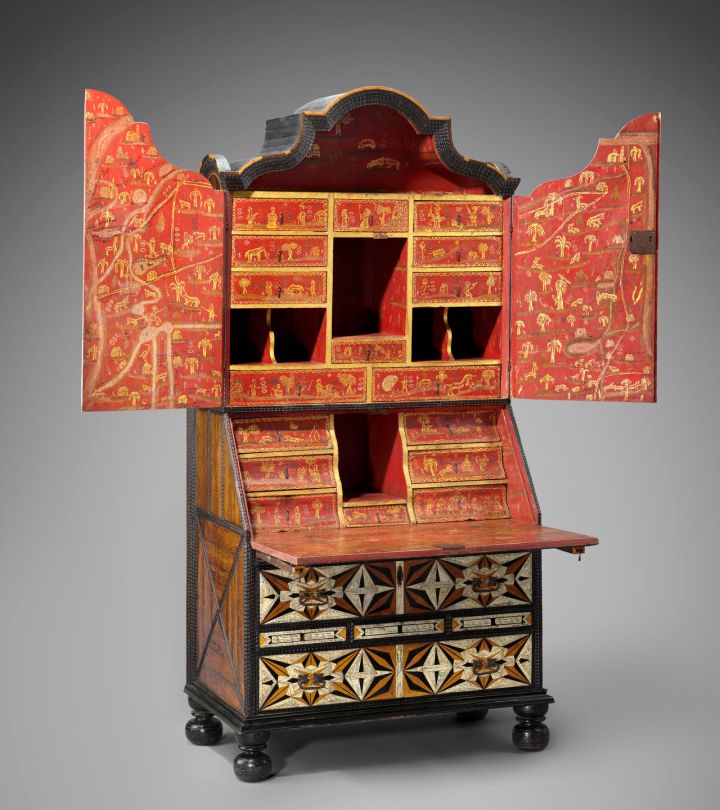
Desk and bookcase, mid-18th century, Mexico. Inlaid woods and incised and painted bone, maque, gold and polychrome paint, metal hardware (Museum of Fine Arts, Boston)
New Acquisition | Portrait of Yarrow Mamout (Muhammad Yaro)
With cultural and religious ignorance and intolerance finding new, ever uglier modes of expression here in the United States, on what seems a daily basis, this remarkable portrait (a 2011 acquisition by the Philadelphia Museum of Art) usefully speaks to how diverse and complex American history has always been. –CH
◊ ◊ ◊ ◊ ◊
From the Philadelphia Museum of Art:
Charles Willson Peale, Portrait of Yarrow Mamout (Muhammad Yaro), 1819, oil on canvas, 24 x 20 inches (Philadelphia Museum of Art, 2011-87-1).
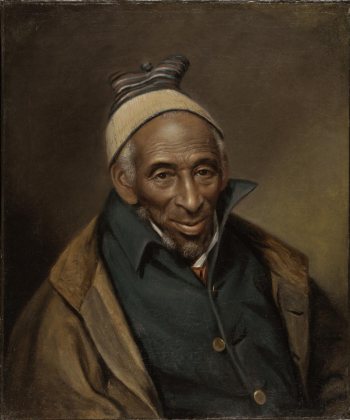 Yarrow Mamout, an African American Muslim who won his freedom from slavery, was reputedly 140 years old in 1819, when Charles Willson Peale painted this portrait for display in his Philadelphia Museum. Although Peale learned this was a miscalculation, the story of eighty-three-year-old Yarrow (c. 1736–1823), a native of the West African country of Guinea who was literate in Arabic, was still remarkable. As Peale noted, Yarrow was “comfortable in his Situation having Bank stock and [he] lives in his own house.”
A rare representation of ethnic and religious diversity in early America, and an outstanding example of Peale’s late naturalistic style, the picture is distinguished by the direct and sympathetic encounter between the artist and his subject and the skilled rendering of the details of physiognomy and age. Yarrow’s knit cap suggests a kufi, a hat traditionally worn by African Muslim men to assert their religion or African identity, but Peale artfully employs its yellow band to highlight his steady gaze with its glint of humor and wisdom.
Seventy-seven years old when he created this portrait, Peale was seeking a record of the personal traits that he believed supported a long life. In his writings and museum displays Peale celebrated making wise choices to maintain good health and a positive attitude, and he perceived Yarrow’s perseverance through his difficult life as a model of resourcefulness, industriousness, sobriety, and an unwillingness to become dispirited.
◊ ◊ ◊ ◊ ◊
More information about Mamout is available from this piece by Colbert King for The Washington Post (13 February 2015). For Mamout’s biography, see James Johnston, From Slave Ship to Harvard: Yarrow Mamout and the History of an African American Family (Fordham University Press, 2012). This past summer, the Historic Preservation Office dug shovel test pits in Georgetown in connection with the Yarrow Mamout Archaeology Project, led by Mia Carey (as reported by WAMU 88.5).










 Enfilade
leave a comment