Painting Restoration on View at The National Gallery of Denmark
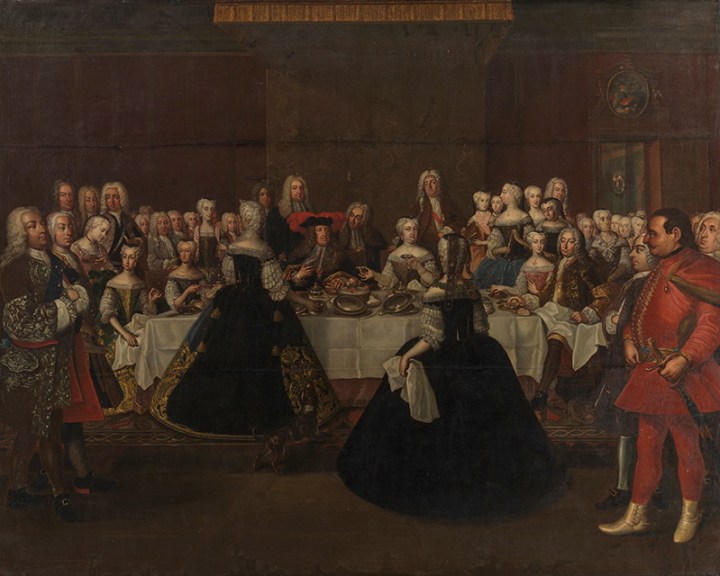
Johann Salomon Wahl, after an original by Martin van Meytens, A Banquet at the Court of the German Emperor Charles VI, 1741 (Danish Royal Collection)
◊ ◊ ◊ ◊ ◊
On view at the National Gallery of Denmark:
Open Studio: A Birthday Present for the Queen
Statens Museum for Kunst, Copenhagen, 29 October 2015 — 28 February 2016
For a four-month period, visitors to the SMK can watch the museum’s conservators at work, wielding scalpels and pigments to restore a painting that usually hangs on the wall of Her Majesty Queen Margrethe II’s private quarters. The restoration of J.S. Wahl’s painting A Banquet at the Court of the German Emperor Charles VI (1741) is the New Carlsberg Foundation’s gift to the Queen on the occasion of her 75th birthday.
 This large-scale painting has hung on the walls of Fredensborg Palace—now the private residence of H.M. Queen Margrethe II—since 1872. Painted by Johann Salomon Wahl in 1741, after an original by Martin van Meytens, the painting was acquired for the Royal Danish Kunstkammer in the year of its making and has been part of the royal collections ever since. With the passage of the years, the painting deteriorated to the point where it could no longer withstand being on display. A lack of adhesion between the paint layer and the canvas has caused paint to peel off in many areas, and even more paint threatens to fall off across the entire canvas. The painting is in need of thorough conservation and restoration.
Such restoration has now been made possible by a donation from the New Carlsberg Foundation, a birthday present to the Queen. The treatment requires more than 2,200 hours of painstaking work where the conservators will reattach unstable paint, laminate the canvas onto a new one and carry out extensive retouching of the damage sustained over the years. When the extensive conservation process is complete, the painting will once again be on display at Fredensborg Palace.
The SMK has many years of experience with opening up its conservators’ workshops to visitors. Doing so offers the general public a chance to gain insight into the work done behind the scenes at the museum. From 29 October 2015 to 28 February 2016 the SMK’s conservators will allow all visitors to peep into the museum’s engine room. During this period, visitors can follow the conservators’ work on this extensive restoration project—and will also have the opportunity to ask questions.
A Banquet at the Court of the German Emperor Charles VI was painted as a copy after an original by Martin van Meytens, created for the Viennese court in 1736. In the years that followed, several different versions were painted by a range of artists. The original work was probably painted in connection with either the wedding or the engagement between the emperor’s eldest daughter, Maria Theresa, and Francis Stefan of Lorraine. Their union was an important event in European history; upon her father’s death a few years later Maria Theresa became sovereign of the Austrian and Hungarian lands as the Habsburg family’s first female successor to the throne. When Francis Stefan was subsequently elected Holy Roman Emperor as Francis I, their marriage expanded and reaffirmed the Habsburg family’s power in Europe.
The ruling emperor and empress, Charles VI and Elisabeth Christine, are seated underneath a canopy at the centre of the table, whereas the bride and groom are seated at the end of the table to the right. To the left are the emperor’s sister, Maria Magdalena, and his second-eldest daughter, Maria Anna. They are surrounded by courtiers, members of the aristocracy and persons of prominent military rank.
Peggy Fogelman Named Director of the Gardner Museum
From the Gardner:
Peggy Fogelman Named Next Director of Isabella Stewart Gardner Museum
 The Isabella Stewart Gardner Museum announced today that Peggy Fogelman is the next Norma Jean Calderwood Director, succeeding Anne Hawley as the fifth director in the Museum’s history. Hawley will step down after 26 years at the end of the year, and Fogelman will assume the directorship in January 2016.
“I am overjoyed to be entrusted with leading the Gardner, a unique and treasured museum where visitors feel so closely connected to the collection,” Fogelman said. “Being located in this creative and intellectual hub makes the potential enormously exciting as we continue to reach the next generation of museum-goers. It is truly a privilege to apply all my experience to a place that is beloved by so many.”
Since 2013, Peggy has been Director of Collections at the Morgan Library & Museum in New York, overseeing eight curatorial departments, conservation, registration, and 16 to 20 exhibitions per year. Earlier this year, Peggy served for 12 months as Acting Director while the Morgan searched for a new Director. She previously worked at the Metropolitan Museum of Art as Chairman of Education, the Peabody Essex Museum as Director of Education and Interpretation, and the J. Paul Getty Museum as Associate Curator of European Sculpture and later Assistant Director and Head of Education and Interpretive Programs.
“Peggy is the perfect fit for the Gardner with her impressive background ranging from work in large prestigious institutions to small, intimate museums,” said Steve Kidder, the Gardner Museum’s Board President. “She brings us the best intersection of creativity, vision, and successful execution. We look forward to seeing what she dreams up for this very special Museum.”
Longtime Gardner Museum Trustee and former Board President, Barbara Hostetter chaired the committee that conducted an international search to find Hawley’s successor. “We are overjoyed that the Museum has found a new director with the vision and expertise to take it to new heights,” she said “Peggy comes to us with a seasoned perspective, honed by working at some of the nation’s finest museums, and with a freshness of spirit that makes being part of the Gardner leadership so rewarding.”
The Morgan began much like the Gardner Museum as a private collection that evolved into a vibrant cultural institution offering exhibitions, musical concerts, public lectures and special events. Fogelman has been instrumental in building a larger audience, developing the exhibition program, and forging meaningful collaborations with other institutions, foundations, and private collectors.
From 2009 to 2013, Fogelman was the Met’s Frederick P. and Sandra P. Rose Chairman of Education where she oversaw education, concert, and lecture programs. She took on the challenge of restructuring the education department to advance visitor engagement and to create more collaboration in the large institution. She spearheaded first time artist-based residencies and commissioned performances, fellowships in education and public practice, studio classes, gallery talks, artists’ study days, and digital art-making activities.
Before being recruited to the Met, Fogelman was Director of Education and Interpretation at the Peabody Essex Museum in Salem. She began her career at the J. Paul Getty Museum with a curatorial focus, and over the next 13 years, rose to Associate Curator in the Department of Sculpture and Works of Art. She was then appointed Senior Project Specialist to the Director, and transitioned to become Assistant Director and Head of Education and Interpretative Programs, achieving a major restructuring of the museum education program at the Getty. She holds a Bachelor of Arts from Johns Hopkins University and a Master of Arts from Brown University. Her work has been published widely for both general and specialized audiences.
As Anne Hawley prepares for her next chapter, she said she is delighted that the Museum will be in such capable hands. “I trust the magic and uniqueness of the Gardner Museum will continue to soar under Peggy’s leadership,” she said.
Acquisition Campaigns | Jacques Saly’s Cupid Testing One of His Arrows
From The Louvre:
Be a Patron of Love
Louvre Launches Campaign to Acquire
Jacques Saly’s Cupid Testing One of His Arrows
 In 1753, sculptor Jacques Saly signed and dated his masterpiece, the marble statue Cupid Testing One of His Arrows (L’Amour essayant une de ses flèches). The piece had been commissioned a year earlier by the Marquise de Pompadour, royal mistress of Louis XV, and was presented to the king in person on August 11, 1753, before being installed at the Salon de l’Académie at the Louvre to be shown to the public for one month.
Jacques Saly was made royal sculptor in 1750, when he became a member of the Royal Academy of Painting and Sculpture. Recommended by renowned sculptor Edme Bouchardon, Saly was called to Denmark in 1753 to work on the equestrian statue of Frederick V and help establish the Royal Danish Academy of Fine Arts in Copenhagen. He did not return to France until 1774, two years before his death.
Despite his short artistic career in France, Saly received a number of prestigious commissions. His masterpiece remains Cupid Testing One of His Arrows, which Madame de Pompadour presented in her three favorite residences: the Château de Crécy and the Château de Bellevue, on the outskirts of Paris, and the Hôtel d’Evreux, future site of the Palais de l’Elysée. Hidden from view in private collections for over two centuries, Saly’s sculpture of Cupid was revealed to the public in 2002 for the exhibition Madame de Pompadour and the Arts at the Château de Versailles. It was listed as a National Treasure by the French state in 2006.
A masterpiece of French art by its delicateness of composition and virtuosity of marblework, the statue is also outstanding for the pedestal that has remained with it since the beginning. It was executed by the great sculptor and ornamentalist Jacques Verberckt, who produced sumptuous wood paneling for the Château de Versailles and the Château de Fontainebleau, and who was also a friend of Saly’s. It is indeed quite remarkable that the two royal sculptors worked together on the same commission.
To execute this spectacular work of art, Saly gave of his best and applied all of his expertise. Its reappearance in France is an unhoped-for opportunity to shine light on the artist, a highly skilled sculptor who was sensitive to the art of his time.
The Société des Amis du Louvre has already provided half of the amount required for this major acquisition. In order for the exceptional work of art to enter the national collections, the Musée du Louvre is calling upon the generosity of the public to raise a minimum of €600,000 before February 14, 2016.
Renuka Reddy’s Search for Traditional Chintz Techniques
Writing for the the V&A’s blog for the museum’s fall exhibition The Fabric of India, Renuka Reddy, “a contemporary chintz-maker,” recounts “the story of her search for lost techniques, the challenges she’s faced as a designer-cum-maker, and how the V&A’s collection has inspired her work. Renuka’s studio, Red Tree, is based in Bengaluru.”
◊ ◊ ◊ ◊ ◊
“Guest Post: Renuka Reddy’s Adventures in Chintz,” V&A Blog (6 October 2015).
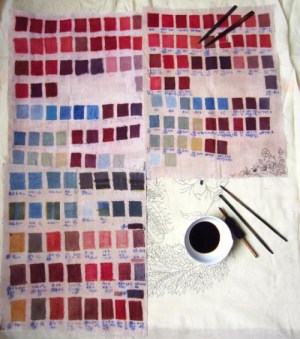
Color swatches. © RedTree Textile Studio
If only I could time travel…
It was nearly two years after its publication that I got my hands on the book Chintz: Indian Textiles for the West written by Rosemary Crill and published by the V&A. I vividly remember my response to the spectacular plates, the desire to make something so beautiful. Little did I know how this reaction would change my life in ways I could not imagine.
By chintz, I refer to hand-painted resist-and-mordant dyed cottons. I am particularly interested in the intricate resist work of chintz exported from India to the West between the seventeenth and the eighteenth century. This is where I draw my inspiration from.
My goal was to produce chintz, which at that time meant working with craftsmen. So I went in search of one in Machilipatnam and Srikalahasti, two historic towns in the state of Andhra Pradesh where kalamkari (literally ‘pen-work’)
is practiced today. . .
The full posting is available here»
Dutch Royal Barge Returns to Het Scheepvaartmuseum

◊ ◊ ◊ ◊ ◊
Press release (14 October 2015) from Amsterdam’s National Maritime Museum:
After an eight-year absence, the Royal Barge will once again be on display at Het Scheepvaartmuseum. At a spectacular opening event on Wednesday evening, framed by the pipers and drummers of the Marine Corps, the Royal Barge was presented to more than 300 guests. Just one week before this event, the 200-year old barge and its new boathouse were transported across land and water. In the home port of Amsterdam, the doors will be opened to visitors every morning.
The director-general of Het Scheepvaartmuseum, Pauline Krikke, is overjoyed at the return of the crown jewel of the museum’s collection. “It is a momentous occasion to celebrate the return of the barge after such a long absence,” she says. “The Royal Barge is restored and seaworthy. The museum is incredibly grateful to all the people who helped to make this possible.”
The Royal Barge, also referred to as the ‘Golden Coach of the water’ (‘de gouden koets te water’), was given a thorough overhaul. With a donation of one million euros from the BankGiro Lottery, the Cultuur Lottery, and specialist input from AkzoNobel, this unique barge was completely renovated and restored to once again be admired in all its magnificence. Now, this public favourite has finally returned to Het Scheepvaartmuseum. With the new set-up in the boathouse, the beautiful golden ornaments are closer than ever before and can be admired in detail by the visitors.
The Royal Barge is a rowing barge that was built at the Navy shipyard in Rotterdam in 1816 for King William I. Since then, the Royal Barge has been used by the head of state for official events such as state visits, jubilees, naval reviews, and the launching of new ships. The barge marked its final voyage in 1962 with the silver wedding anniversary of Queen Juliana and Prince Bernhard, and was then retired from service.
The National Maritime Museum (Het Scheepvaartmuseum) tells the story of how the sea has defined Dutch culture. Visitors follow their own paths through twelve exciting and interactive exhibitions to discover 500 years of maritime history. Highlights of world-class collections are displayed in unforgettable exhibitions. A few of the exhibitions (like The Tale of the Whale and Life Onboard) are specially designed for families. The museum draws approximately 330,000 visitors per year, putting it among the top ten Amsterdam museums and making it a major attraction for both domestic and foreign tourism. Het Scheepvaartmuseum is located in ‘s Lands Zeemagazijn, an historic Golden Age building dating from 1656.
AIC Director Douglas Druick Announces Retirement

Douglas Druick, photo by Robert Carl
◊ ◊ ◊ ◊ ◊
Press release from the Art Institute of Chicago, via ArtDaily (8 October 2015). . .
Douglas Druick, President and Eloise W. Martin Director announced today his plans to retire from the Art Institute of Chicago. An internationally recognized scholar and curator who joined the Art Institute in 1985, during his distinguished 30 years of service Druick chaired two of the museum’s eleven curatorial departments and led the institution as its president and director since 2011, overseeing many milestones in the museum’s illustrious history.
“Douglas is one of the most respected, thoughtful, and innovative museum leaders in the world. He has made extraordinary contributions to the development of the Art Institute—ushering the museum into the digital age, achieving an unparalleled ranking among the world’s top three museums on TripAdvisor for three years running, and managing the largest gift of art since the museum’s founding with the contemporary works from Stefan Edlis and Gael Neeson,” said Bob Levy, Chairman of the Board of Trustees of the Art Institute of Chicago. “Douglas’s initiatives to place a stronger emphasis than ever before on visitor access and engagement, and to champion global diversity as it is reflected in the museum’s audiences, collections, and programs, will only continue to advance the Art Institute’s global reach and reputation for excellence.”
“It has been my honor to serve as the Art Institute’s president and director,” said Druick. “I have been deeply proud to lead one of the finest museums in the world, and to work for three decades with an exceptional cadre of remarkably talented museum colleagues. It is my hope that together we have ensured a solid footing for the Art Institute to continue to grow stronger and more vibrant, financially stable and internationally renowned, with a future filled with more opportunities than challenges.”
Under Druick’s leadership, since 2011, the Art Institute has offered more than 100 internationally recognized and innovative exhibitions that have inspired and educated millions of visitors who count on the museum to encourage the individual experience of exceptional works of art. During Druick’s tenure, the museum achieved-and continues to record-the highest attendance numbers in its history. He managed the largest gift of art to the Art Institute since its founding, in the generous and extraordinary collection of Stefan Edlis and Gael Neeson, affirming the museum’s legacy as an international leader in contemporary art and realizing the promise of the Modern Wing.
Druick’s commitment to bring the museum fully into the digital age-overseeing a comprehensive plan to install wireless internet in the galleries and public spaces, launching a pioneering Online Scholarly Catalogue Initiative, and recalibrating the museum’s culture to prioritize visitor access and engagement-has ensured the Art Institute’s continued preeminence as one of the world’s most exceptional museums.
Druick noted, “The next chapter in the life and legacy of the Art Institute hinges on an all-important five to seven year endeavor to realize the museum’s long range plan that I believe requires uninterrupted leadership. I will retire with confidence, knowing that the foundation for the museum’s future is firmly in place and that we will energetically pursue our ambitious vision. For decades, the Art Institute’s life has been my own, but I need now to draw a distinction between my professional and personal life. I am doing so to realize long held plans with my partner and frequent collaborator Peter Zegers to actively pursue new directions and experiences together, here and abroad.”
Douglas Druick, 70, received a B.A. in English and Philosophy from McGill University in Montreal in 1966, and an M.A. in English from the University of Toronto in 1967. In 1972, he received his M.Phil. in the History of Art from Yale University, followed by his Ph.D., also from Yale, in 1979. From 1973 to 1984, Druick was the Curator of European and American Prints at the National Gallery of Canada in Ottawa.
He first came to the Art Institute in 1985 as the Chair and Prince Trust Curator of Prints and Drawings. Four years later, in 1989, he also became the Searle Curator of European Painting at the Art Institute. In 2006, while remaining the Chair of the Department of Prints and Drawings, he was named the Chair of the Department of Medieval to Modern European Painting and Sculpture, deftly stewarding the Art Institute’s renowned Impressionist, Post-Impressionist, and Modern collections.
As chair of two of the museum’s largest departments Druick oversaw the acquisition of thousands of notable prints and drawings of all schools and many important European paintings, both building on the collections’ strengths and expanding the geographical representation of nineteenth- and twentieth-century art.
During his tenure at the Art Institute, Druick conceived and organized or contributed to some of the most significant exhibitions in the museum’s history. These exhibitions include Odilon Redon: Prince of Dreams, 1840–1916 (1994); Gustave Caillebotte: Urban Impressionist (1994) with Gloria Groom; Van Gogh and Gauguin: The Studio of the South (2001) with Peter Zegers; Cézanne to Picasso: Ambroise Vollard, Patron of the Avant-Garde (2006) with Gloria Groom; and, in contemporary art, Jasper Johns: Gray (2007) with James Rondeau-named ‘Best Monographic Museum Show Nationally’ by the American section of the International Art Critics Association.
Druick has published and lectured extensively, with 15 exhibition catalogues to his credit, numerous essays and articles, and talks and lectures from Vienna to London and from Amsterdam to San Francisco.
He has been awarded many professional honors and has served on various advisory councils and boards, including as the Chairman of the Arts and Artifacts Indemnity Advisory Panel, National Endowment for the Arts (2002–2004); a Founding Board Member of the Association of Art Museum Curators (2002–2008); and the National Committee for the History of Art (2003–2009). The Government of France named him an ‘Officier des Arts et Lettres’ in 2012, and he was elected as a Fellow to the American Academy of Arts & Sciences in 2013.
Douglas Druick will remain fully engaged in his duties as President and Eloise W. Martin Director until his successor has been appointed and installed. The Board of Trustees of the Art Institute of Chicago deeply respects and has enormous gratitude for Druick’s service and his stewardship of the museum, and will begin the important work to formulate an approach to his succession.
VMFA Acquires Royal Portrait by Benjamin West

Benjamin West, Portrait of Prince William and his Elder Sister, Princess Sophia, 1779, oil on canvas, 61 x 85 inches
(Richmond: VMFA).
◊ ◊ ◊ ◊ ◊
From the VMFA press release (1 October 2015) . . .
At the Virginia Museum of Fine Arts, an important work by American painter Benjamin West was recently installed in the McGlothlin American Galleries. The portrait was acquired during the June 18 meeting of the VMFA Board of Trustees and is among the most valuable acquisitions in VMFA history.
Benjamin West, known as the ‘father of American painting’, was at one point the most prominent painter in the British Empire. He served as President of the Royal Academy, History Painter to the King, and Surveyor of the King’s Pictures until his death in 1820. While in London, he also mentored American artists Charles Wilson Peale, Gilbert Stuart, and John Trumball—each of whom is represented in VMFA’s American Galleries. This is one of six group portraits commissioned by King George III during the American Revolution. Intended as a gift for the king’s brother, HRH Prince William Henry, Duke of Gloucester and Edinburgh, it is the only one of the six outside the Royal Collection. Descended in the family of George III, whose daughter HRH Princess Mary wed the sitter, Prince William, the painting celebrates the king’s protection of his niece and nephew at a moment during their father’s ill-health. In acknowledgement of the king’s generosity, the children and father—symbolized by the robe and crown—signal their obedience to the king, symbolized by the lion. This patriarchal narrative of duty and protection served a dual purpose as wartime propaganda. As the king served to protect his subjects, so his subjects—the colonists—owed their obedience to the king.
The acquisition of Portrait of Prince William and his Elder Sister, Princess Sophia was made possible by the J. Harwood and Louise B. Cochrane Fund for American Art. Since 1988, this permanent endowment has provided support for the acquisition of historic American paintings, sculpture, works on paper, and decorative arts, ca. 1700–1945, including those native to Virginia. It has been funded with outright gifts, 220 parcels of real estate in Manchester, and their former home and farm in Hanover County. Proceeds from the sales of the real estate have been added to the Cochrane endowment principal. The endowment is now nearly 30 years old and has underwritten 79 important American acquisitions
Hartwig Fischer Appointed as Director of The British Museum
Press release (29 September 2015) from The British Museum:
 Sir Richard Lambert, Chair of the Trustees of the British Museum, this morning announced to staff that Hartwig Fischer had been appointed Director of the British Museum. Dr Fischer, who is currently the Director General of the Staatliche Kunstsammlungen Dresden, will take up the post in Spring 2016. The current Director, Neil MacGregor, will retire from the Museum at Christmas. The appointment has been confirmed by the Prime Minister, the Rt Hon David Cameron.
Chairman of the Trustees Sir Richard Lambert said, “On behalf of the Trustees I am very happy to announce the appointment of Hartwig Fischer—currently Director General of the Staatliche Kunstsammlungen Dresden—as Director of the British Museum. He is one of the outstanding museum directors in the world. He is not only a great scholar, but an experienced administrator and a gifted linguist with a global reputation for rethinking and representing great collections. In Essen he directed one of the leading museums of 20th-century art in Germany and in Dresden he directs a museum whose collections are amongst the greatest in the world. Neil MacGregor has been a brilliant Director of the British Museum and has transformed its presence across the world. The Trustees are confident Dr Fischer will be a worthy successor.”
Hartwig Fischer said: “When I was growing up in Hamburg, Britain was always present in my family life. It has remained so ever since. I never dreamt that I would be invited to be responsible for this great British institution and I am conscious that nobody could fail to grasp what the British Museum represents not only for the UK but for the whole world. For many years I have looked to the British Museum as a model of public engagement, critical scholarship, and international outreach. I am of course daunted by such a responsibility but I know that nobody directs such a museum alone and the colleagues of the British Museum are admired and envied around the world. I am greatly looking forward to working with them. I have visited the British Museum on many occasions as a member of the public and have always admired the way every member of the team plays their part in making the collection available to the public all over the world. It’s an honour to be asked to become the Director of the British Museum and to follow in the footsteps of Neil MacGregor, who has done more than anybody else to position the Museum as one of modern society’s key institutions, fostering knowledge, understanding, and global citizenship.”
Neil MacGregor said “Hartwig Fischer is the perfect choice to run the British Museum. The Museum, its staff, its Trustees and its unparalleled collection is truly international. It therefore makes absolute sense for the new Director to reflect this global outlook. Dr Fischer is a well-respected scholar with extensive experience. He will, I am sure, build on the British Museum’s recent successes to ensure the Museum remains one of the world’s greatest museums.”
Hartwig Fischer is currently the Director General of the Dresden State Art Collections (Staatliche Kunstsammlungen Dresden) where he is responsible for fourteen museums and four separate institutions in four cities. His focus since his appointment in 2012 has been on modernizing and developing the State Art Collections, which date back to the 16th century. The collections are some of Germany’s finest, spanning more than 5,000 years of art, archaeology, anthropology and cultural history. Prior to that appointment, Fischer was Director of the Folkwang Museum in Essen (2006–2012). Whilst in post he oversaw the fundraising and restoration of the historic museum and the construction of a new building, and presided over a period of increasing visitor figures and popularity. He began his museum career at the Kunstmuseum in Basel, where he was curator of 19th-century and Modern Art from 2001–2006. Fischer has studied the History of Art, History and Classical Archaeology in Bonn, Berlin, Rome and Paris and holds a Doctorate in Philosophy from the University of Bonn. He speaks German, English, French and Italian. He was born in Hamburg 14 December 1962 and is married to psychoanalyst Ilaria Piqueras Fischer.
V&A Names Antonia Boström as Keeper of SMCG Department
V&A press release (15 September 2015). . .
 The V&A is pleased to announce that Antonia Boström, currently Director of Curatorial Affairs at the Nelson-Atkins Museum in Kansas City, USA, will join the Museum in January 2016 as Keeper of the Sculpture, Metalwork, Ceramics and Glass Department.
Paul Williamson, Keeper of the Sculpture, Metalwork, Ceramics and Glass (SMCG) Department since 2001, retires from the V&A in early 2016. This will follow a distinguished 37-year career at the Museum during which he also took on the roles of Director of Collections (2004–7) and Acting Deputy Director (2013).
As one of the six most senior curatorial roles in the Museum, the Keeper manages the Sculpture, Metalwork, Ceramics and Glass Department, and is responsible for promoting research, knowledge and enjoyment of the collection of over 110,000 objects reflecting European history and design. The department is in charge of several of the most visited and important galleries in the V&A, including the Medieval & Renaissance Galleries, The Cast Courts, the Hintze Galleries of British Sculpture, the Jewellery Gallery, the Sacred Silver and Stained Glass Gallery, the Silver Galleries, and the Ceramics and Glass Galleries.
Martin Roth, Director of the V&A said: “Paul Williamson has made a magnificent contribution to the V&A during his impressive career here. His loyalty in serving the Museum is unparalleled and we thank him warmly for all that he has done. We look forward to welcoming another world-leading expert, Antonia Boström, who brings with her significant scholarship and a wealth of experience across world-class collections including the J. Paul Getty Museum in Los Angeles, the Nelson-Atkins Museum in Kansas and the Detroit Institute of Arts back to the V&A where she began her career.”
Paul Williamson said: “I’ve been hugely privileged to work at the V&A for so long, to be responsible for a large part of its internationally-important collections and to be surrounded by brilliant and committed colleagues, both inside and outside the Museum; and it will be a great pleasure to continue this connection as Keeper Emeritus and Honorary Senior Research Fellow. I’m delighted to welcome Antonia Boström as my successor, and wish her every success in the years ahead.”
Antonia Boström said: “Having spent the last 19 years in the United States, I am extremely excited to be returning to the V&A, the museum where I first trained as a curator and whose collections are so meaningful to me. The V&A is at an important moment in its history; it is thrilling to witness its astonishing achievements over the last several years and to look forward to future projects. I look forward to contributing to those important initiatives and to leading a department of curators widely recognized as among the foremost experts in their fields.”
Paul Williamson has been Keeper of the Sculpture, Metalwork, Ceramics & Glass Department at the V&A since 2001 and was Director of Collections, 2004–7, and Acting Deputy Director in 2013. He joined the Museum in 1979 and was Chief Curator of Sculpture 1989–2001. He has published widely, principally on medieval art including the Pelican History of Art volume Gothic Sculpture 1140–1300 (Yale University Press, 1995) and, most recently, the V&A catalogues Medieval Ivory Carvings: Early Christian to Romanesque (2010) and Medieval Ivory Carvings 1200–1550 (the latter with Glyn Davies). He has been involved in the organisation of numerous exhibitions, including English Romanesque Art 1066–1200 (Hayward Gallery, 1984), Age of Chivalry: Art in Plantagenet England 1200–1400 (Royal Academy of Arts, 1987–88), Images in Ivory: Precious Objects of the Gothic Age (Detroit and Baltimore, 1997), Gothic: Art for England 1400–1547 (V&A, 2003–4), and Object of Devotion: Medieval English Alabaster Sculpture from the Victoria and Albert Museum, which toured to ten U.S. venues, 2010–14. He has served on many committees both inside and outside the V&A, has been Expert Adviser on Sculpture to the Reviewing Committee on the Export of Works of Art since 1989, was Vice-President of the Society of Antiquaries of London 1999–2003, and is a Trustee and Director of The Burlington Magazine. He is a Fellow of the Royal Historical Society.
Antonia Boström has been Director of Curatorial Affairs at the Nelson-Atkins Museum of Art, Kansas City, Missouri, USA since 2013. She was Senior Curator & Department Head, Sculpture & Decorative Arts Department, J. Paul Getty Museum, Los Angeles from 2004 to 2013, Assistant Curator, Department of European Sculpture and Decorative Art and research scholar at the Detroit Institute of Arts from 1996 to 2004 and previously held curatorial posts at the Royal Academy, London, 1995–96, V&A, 1980–85, and National Portrait Gallery in 1980. She has been involved with many exhibitions including Messerschmidt and Modernity (J. Paul Getty Museum, 2012); Cast in Bronze: French Sculpture from Renaissance to Revolution (J. Paul Getty Museum, Musée du Louvre and Metropolitan Museum of Art, 2009) and Magnificenza! The Medici, Michelangelo, and Art of Late Renaissance Florence (Florence, Palazzo Strozzi, Chicago, AIC, and Detroit Institute of Arts, 2002–4) as well as gallery installations including the sculpture and decorative arts galleries (J. Paul Getty Museum, 2006–10). She has written, edited and contributed to publications including Messerschmidt and Modernity (Getty Publications: Los Angeles, 2012), The Fran and Ray Stark Collection of 20th-Century Sculpture at the J. Paul Getty Museum (Getty Publications: Los Angeles, 2008) and The Encyclopedia of Sculpture, 3 vols. (Fitzroy Dearborn/Routledge: New York, 2004). She is fluent in five languages.
New Appointments Announced at the Harvard Art Museums
Press release (via Art Daily, 20 September 2015). . .
The Harvard Art Museums has announced the appointment of two new curators to the Division of European and American Art and the Division of Asian and Mediterranean Art, as well as the internal promotion of two curators in the Division of European and American Art.
Ethan Lasser has been named Head of the Division of European and American Art and was promoted to Theodore E. Stebbins, Jr., Curator of American Art—the first person to hold this endowed position at the museums. Lasser had served as acting head of the division since December 2014.
A. Cassandra Albinson has been appointed the new Margaret S. Winthrop Curator of European Art, and Elizabeth M. Rudy, who has been at the museums since 2011, was named the new Carl A. Weyerhaeuser Associate Curator of Prints.
In the Division of Asian and Mediterranean Art, Rachel Saunders has been named the Abby Aldrich Rockefeller Associate Curator of Asian Art; she is the first to hold this endowed position at the museums.
Comprised of the Fogg Museum, the Busch-Reisinger Museum, and the Arthur M. Sackler Museum, the Harvard Art Museums reopened to the public last November after a six-year renovation and expansion project. These curatorial appointments, with deep expertise in key areas of the museums’ world-class collections, will help fulfill the promise of the new facility.
“Last year, we unveiled a new model for a 21st-century university art museum—one that broke down barriers between traditional curatorial areas of expertise to create new opportunities for research, teaching and learning with the collections,” said Deborah Martin Kao, the Landon and Lavinia Clay Chief Curator and Interim Co-Director of the Harvard Art Museums. “These new curatorial appointments go to four extraordinary scholars who share our belief in the intrinsic power of original works of art, and who are committed to unlocking the full potential of Harvard’s great collections for all audiences. As representatives of a new generation of curators, they will bring energy, fresh ideas, and an intellectual dynamism that will help us grow into our future.”
The appointments, which begin this fall, were initiated and completed before Thomas W. Lentz, the former Elizabeth and John Moors Cabot Director of the Harvard Art Museums, stepped down in July.
 Lasser joined the Harvard Art Museums in 2012 as the Margaret S. Winthrop Associate Curator of American Art and played a key role in the Division of European and American Art as the museums prepared for reopening. Lasser developed a compelling cross-media and transnational approach to the European and American galleries, posing exciting and imaginative new questions that have propelled the field forward and contributed to the further refinement of the broader Collection Galleries program for European and American art. He also led the development of the Silver Cabinet and the galleries devoted to the Atlantic World and the interplay between painting and photography in the 19th century.
In 2017, the museums will open Lasser’s special exhibition, From the Philosophy Chamber: Harvard’s Lost Collection, 1766–1831, developed in collaboration with Harvard faculty partner Jennifer Roberts. For the first time since the early 19th century, an astounding collection of portraits, prints, scientific instruments, and various ‘curios’ obtained abroad by Harvard graduates will be reunited for display and study. The reassembled Philosophy Chamber will examine the role that images and objects can play in building, organizing, and transmitting new knowledge.
 Albinson brings more than a decade of curatorial experience and a commitment to teaching with original works of art. She comes from the Yale Center for British Art, where she was curator of paintings and sculpture and acting head of the department. Albinson also served as a lecturer at Yale, teaching courses on portraiture and on British and French art from the Rococo period through 1850. She has curated multiple exhibitions including The Critique of Reason: Romantic Art, 1760–1860 and Thomas Lawrence: Regency Power and Brilliance. The catalogue for the latter was awarded the Historians of British Art Book Prize for a multi-authored volume in 2011. Albinson was drawn to the Harvard Art Museums’ rich collections—notably, portraiture, works by Géricault, and Pre-Raphaelite art—and the museums’ new collaborative curatorial model, with experts across specializations working together to advance teaching, learning, and research. She is currently working on a project on the importance of the color pink in the 18th century in Britain and France, and is writing a book on portraits of aristocratic women in Victorian Britain.
As the former Cunningham Assistant Curator of European Art at the Harvard Art Museums, Rudy has in-depth knowledge of both Harvard and the Harvard Art Museums. She received her Ph.D. in art history at Harvard, with a dissertation titled “Pierre-Paul Prud’hon and the Problem of Allegory.” Rudy played a vital role in the reinstallation of the European and American galleries, and served as lead curator for the romanticism, impressionist, and Wertheim Collection galleries. She is currently working with Professor Ewa Lajer-Burcharth on a forthcoming show of French drawings, which involves multiple graduate and undergraduate collaborators. In addition to her experience at Harvard, Rudy also served as a curatorial fellow in the Department of Drawings and Prints at the Metropolitan Museum of Art in New York, and has maintained an impressive record of lectures and publications.
Saunders has just completed her Harvard dissertation on a fourteenth-century Japanese handscroll illustrating the journey to India of the Chinese monk Xuanzang. She joins the Harvard Art Museums from the Center for Advanced Study in the Visual Arts at the National Gallery of Art in Washington, D.C., where she was the Ittleson Fellow. From 2004 to 2011, Saunders was a research associate in Japanese art at the Museum of Fine Arts, Boston. There, she curated the exhibition Pursuits of Power: Falconry and the Samurai and led efforts to catalogue numerous rare, woodblock-printed books. Saunders specializes in Japanese art and maintains great interest in the larger framework of the entire East Asian cultural region. She will help unlock the museums’ powerful Asian art collections, buttressed by the extensive promised gift of Japanese works of art from the collection of Robert and Betsy Feinberg, through exhibitions and programs that will benefit Harvard students, faculty, and the wider public.










 Enfilade
leave a comment