Helen Jacobsen on The Wallace Collection’s Sphinx Clock, 1781

◊ ◊ ◊ ◊ ◊
This afternoon at The Wallace Collection:
The Wallace Collection Treasure of the Month, April 2015 | Sphinx Clock, France, 1781
Gallery Talk by Helen Jacobsen, The Wallace Collection, London, 27 April 2015
In the late summer of 1777, Queen Marie-Antoinette wagered her brother-in-law 100,000 livres that he could not build a ‘pleasure house’ in less than 100 days; she lost the bet and the charming Pavillon de Bagatelle in the Bois de Boulogne was the result, although the interiors took several years to complete. Designed by the comte’s architect, François-Joseph Bélanger (1744–1818), it was intended for parties and enjoyment, with a billiard room, a dining room and a salon on the ground floor. Everything was in the latest neo-classical taste, executed by the group of talented decorators, sculptors and cabinet-makers around Bélanger and d’Artois.
The walls of the circular salon were decorated with panels of painted and gilded stucco decoration in the Antique style made fashionable by English and French architects such as Robert Adam and Charles-Louis Clérisseau, while the silk curtains and velvet chairs were of ‘English green’. Bélanger designed a clock for the room that reflected this decoration and when it was finally delivered in 1781 it was considered to be of such superb workmanship that it sat under a glass shade on the chimneypiece. The king’s clock-maker, Jean-Baptiste Lepaute (1727–1801), charged d’Artois the enormous sum of 7,500 livres for the clock, and also made one for his older brother, the comte de Provence. This clock is most likely the one made for Bagatelle. . . .
More information about the clock is available here»
A gallery talk on the clock by Helen Jacobsen, Senior Curator and Curator of 18th-Century Decorative Arts will take place Monday, 27 April 2015, at 1:00pm.
Edouard Kopp Appointed Curator of Drawings, Harvard Art Museums
Press Release (21 April 2015) from the Harvard Art Museums:
 The Harvard Art Museums are pleased to announce the appointment of Edouard Kopp as the Maida and George Abrams Associate Curator of Drawings in the museums’ Division of European and American Art. Kopp comes to the museums from the J. Paul Getty Museum in Los Angeles, where he was associate curator of drawings and was responsible for French and later Germanic drawings. At the Getty, Kopp organized exhibitions devoted to French landscape, Germanic drawings, the artist Gustav Klimt, and 18th-century French drawings from Los Angeles collections. He has recently co-curated two international loan shows: The Work of Nature: The Landscapes of Théodore Rousseau, which will be displayed at the Getty and the Ny Carlsberg Glyptotek in Copenhagen, in 2016–17; and an exhibition focused on the sculptor and draftsman Edme Bouchardon, which will be on view at the Musée du Louvre and the Getty in 2016–17.
Kopp has published widely on the drawings of French sculptor Edme Bouchardon, and on the 18th- century French collector Pierre-Jean Mariette, in journals such as Master Drawings and The Burlington Magazine. He has contributed to exhibition catalogues on French prints from the age of Louis XIV, Edgar Degas and his method, and French landscapes, and he is co-author of the forthcoming catalogues for the Théodore Rousseau and Edme Bouchardon exhibitions described above. He is currently revising his doctoral dissertation for publication by Getty Publications in 2016.
In his role at the Harvard Art Museums, Kopp will oversee the museums’ collection of drawings dating from before the 20th century. This collection is considered to be the finest and most comprehensive of any university art museum in the United States, and ranks among the most important public collections in the country. He will be actively engaged in the development of exhibitions, public lectures, and other programming, and will play an integral role in the regular rotation of works on paper within many of the museums’ galleries. He is also responsible for the stewardship of the drawings collection, including identifying key works for acquisition.
“We are thrilled to welcome such an accomplished scholar and art historian to the Harvard Art Museums,” said Ethan Lasser, interim head of the Division of European and American Art, and the Margaret S. Winthrop Associate Curator of American Art. “Edouard brings a fresh perspective and rigorous eye to the storied collection of drawings, and his enthusiasm will engage audiences across the University and visitors from around the world.”
“I am thrilled to have the invaluable opportunity to work with one of the finest drawings collections in the United States—and especially to do so within the unique and stimulating context of a university art museum,” said Kopp. “This is a living collection at a major institution with a strong tradition of encouraging firsthand, up-close study of original works of art. I look forward to interacting with students, faculty, and the wider community of scholars, collectors, and art lovers.”
Before his time at the Getty, Kopp worked as a researcher for the Weiss Gallery in London, and also for Waddeson Manor, a National Trust estate in Buckinghamshire, England. He served as a teaching assistant while a graduate student at the Courtauld Institute of Art in London, where he received his Ph.D. with a dissertation entitled “Edme Bouchardon: Learned Draughtsman of the Eighteenth Century (1698–1762).” He has a master’s degree in modern art, also from the Courtauld, and wrote his thesis on the Austrian graphic artist Alfred Kubin (1877–1959). He also holds a master of science in management from the Grenoble Graduate School of Business.
The Harvard Art Museums’ collection of approximately 12,000 drawings (from before the year 1900) includes major masterpieces from American and principal European schools. Among the strengths are 17th- and early 19th-century French works, including the most extensive holding of drawings by Ingres, Géricault, and David outside of France. The collection also excels in Italian Renaissance works by Carpaccio, Perugino, and Michelangelo, among others. Works by German and Netherlandish masters such as Dürer, Holbein, Bruegel, and Rembrandt are well represented, as are 19th-century British works by Blake, Beardsley, and the Pre-Raphaelites. In the American school, the collection includes more than 20 Homer watercolors, drawings and pastels by Whistler, and an incomparable grouping of more than 500 drawings and sketches by Sargent.
Colin Bailey Named as New Director of the Morgan
Press release (16 April 2015) from the Morgan:
The Board of Trustees of the Morgan Library & Museum today announced the appointment of Colin B. Bailey, director of the Fine Arts Museums of San Francisco, as the Morgan’s new director. He succeeds William M. Griswold who left last year to head the Cleveland Museum of Art.

Colin B. Bailey, Photography by Randy Dodson, © FAMSF
“We are delighted that Colin Bailey has agreed to become the new director of the Morgan,” said Lawrence Ricciardi, president of the museum’s board. “He is a scholar of the highest order with an impressive record of leadership at a number of outstanding museums. Moreover, he has extensive knowledge of New York cultural institutions and of the philanthropic world, and also brings to the Morgan valuable international experience.”
Bailey is a highly regarded specialist on 18th-century French art and a recognized authority on the work of Pierre-Auguste Renoir. He earned his Doctor of Philosophy in Art History from the University of Oxford. Prior to joining the Fine Arts Museums of San Francisco, Bailey held a variety of positions over thirteen years at New York’s Frick Collection, including serving as deputy director and the Peter Jay Sharp Chief Curator.
“To direct the Fine Arts Museums of San Francisco has been an extraordinary privilege,” Bailey said, in accepting the position at the Morgan. “But the opportunity to return to New York and lead an institution with the reputation of the Morgan was irresistible. Its collections are not only among the most recognized internationally, but also among the most diverse, touching on so many forms of creative expression, from drawing and literature to music, photography, and the arts of the ancient and medieval worlds. There is no place quite like it in the United States, and I look forward to working with its staff, trustees, and supporters to maintain and deepen the Morgan’s preeminent role as a cultural institution—one with the highest standards and a commitment to making its holdings widely accessible.”
Bailey has previously been deputy director and chief curator at the National Gallery of Canada, in Ottawa, senior curator at the Kimbell Art Museum in Ft. Worth, Texas, and held curatorial posts at the Philadelphia Museum of Art and the J. Paul Getty Museum in Los Angeles earlier in his career.
He has been responsible for many celebrated exhibitions. These include Renoir, Impressionism, and Full-Length Painting (2012); Watteau to Degas: French Drawings from the Frits Lugt Collection (2009); and Gabriel de Saint-Aubin (1724–1780) (2007), all mounted at the Frick Collection in New York; Renoir Landscapes, 1865–1883 (2007), The Age of Watteau, Chardin and Fragonard: Masterpieces of 18th-century French Genre Painting (2003), and Renoir’s Portraits: Impressions of an Age (1997), at the National Gallery of Canada; and The Loves of the Gods: Mythological Painting from Watteau to David (1992), at the Philadelphia Museum of Art. His book, Patriotic Taste: Collecting Modern Art in Pre-Revolutionary Paris, was awarded the Mitchell Prize for the best art history book of 2002–2003, and in 2011 he authored the well-received Fragonard’s Progress of Love at The Frick Collection.
Bailey has taught graduate seminars in 18th-century French art at Bryn Mawr College, Columbia University, and the City University of New York Graduate Center, and has acted as a spokesperson in video, podcast, and broadcast media nationally and internationally. An Officier de L’Ordre des Arts et des Lettres since 2010, Bailey has been recognized by the Foundation for Italian Art and Culture with its 2013 FIAC Excellency Award. He is also a board member of the Burlington Magazine Foundation and the Scientific Committee of Arthéna.
The Morgan Library & Museum’s holdings, which number well over a half million objects, are principally in the western European and American traditions. Its collections of drawings and prints, books and bindings, and illuminated manuscripts are preeminent among U.S. institutions. Literary, historical, and music manuscripts holdings, as well as other specialized collections, are also considered among the world’s greatest. The museum’s critically acclaimed 2006 addition by award-winning architect Renzo Piano deftly connected three historic buildings dating to the 19th and early 20th centuries around a central, glass-enclosed court. The expansion also doubled the museum’s gallery space, allowing the institution to mount over a dozen special exhibitions a year. In 2010, the Morgan restored for the first time its landmark 1906 McKim building, which was the personal library of the museum’s founder, financier and philanthropist Pierpont Morgan.
Bailey becomes the Morgan’s sixth director. Belle da Costa Greene became the first director of the newly public institution in 1924, having presided over the private Morgan library since 1906. She was succeeded by Frederick B. Adams, Jr. in 1948, Charles Ryskamp in 1969, Charles E. Pierce, Jr. in 1987, and William M. Griswold in 2008.
Australia’s NPG Acquire Portrait of William Bligh
Press release from the National Portrait Gallery in Canberra:

Attributed to John Webber, Portrait of William Bligh, in Master’s Uniform ca. 1776 (Canberra: National Portrait Gallery)
On Tuesday, 31 March 2015, the National Portrait Gallery unveiled an exciting new acquisition of irrefutable importance to all Australians. Portrait of William Bligh, in Master’s Uniform (c. 1776), attributed to John Webber, is one of the earliest portraits of the contentious, historical figure and extends the Gallery’s remarkable collection of early colonial portraits.
On the occasion of the launch of the National Portrait Gallery Foundation, President Sid Myer announced the acquisition, made possible by a most generous act of benefaction. He paid special tribute to Canberra philanthropists, Sotiria Liangis and John Liangis, for their assistance in funding the purchase of this striking and masterful work. Director, Angus Trumble, said he was overjoyed with the purchase, one which the Gallery had been contemplating for some time. “The work, purchased by the Gallery through Christie’s in London, has a very high level of indisputable national significance to Australia, and the Gallery is immensely appreciative to the Liangis family for their support,” he said.
Portrait of William Bligh, in Master’s Uniform will take its place alongside another John Webber painting: the Portrait of Captain James Cook RN (1782), acquired in 2000 by the Commonwealth Government with the generous benefaction of Robert Oatley and John Schaeffer. Webber spent three years at sea with Cook and was the artist on the Resolution.
The life of William Bligh (1754‒1817) offers up a handful of the most remarkable episodes in the history of Britain’s maritime empire. Bligh’s epic journey to Timor with his companions in a small open boat the 3,600 miles whence they were ejected from H.M.S. Bounty remains an astonishing feat of navigation by the stars. Bligh’s misfortune was not merely to have gone through the ordeal of mutiny aboard the Bounty, but to have faced insurrection in Sydney during his tenure as fourth Governor of New South Wales. The Rum Rebellion of 1808 damaged Bligh’s reputation, but he was vindicated in London and promoted to vice-admiral of the blue. He ended his enormously eventful career by mapping Dublin Bay.
Bligh has become for Australians a mythic figure. There has been a bellwether William Bligh in every phase of Australian history—the martinet versus the brilliant cartographer and genius of navigation; the deeply misunderstood versus the merely blinkered man; the blackguard versus the gentleman and officer of the Royal Navy, steeped in its sometimes brutal disciplinary code; the angry tyrant versus the lonely husband and victim of circumstance, stoutly defended again and again, as a matter of principle, by their Lordships of the Admiralty.
Trumble said, “This portrait represents a different William Bligh. Here he is represented at the age of about 25, several years before his marriage, wearing the uniform of sailing master, already skilled in navigation and seamanship, no doubt ambitious for himself, his men and his vessel, shortly before he was hand-picked by James Cook to go aboard H.M.S. Resolution, on which the artist John Webber also sailed.”
British Museum Director, Neil MacGregor, to Retire
From The British Museum:
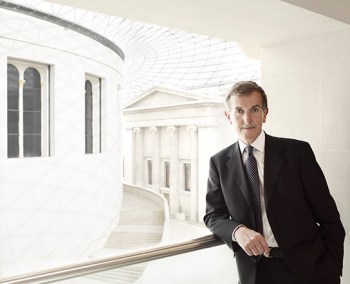
Neil MacGregor, Director of the British Museum. Copyright Jason Bell.
Neil MacGregor announced to his colleagues at the British Museum this morning [8 April 2015] that he has decided to step down as Director at the end of December 2015.
MacGregor said, “It’s a very difficult thing to leave the British Museum. Working with this collection and above all with the colleagues here has been the greatest privilege of my professional life. But I’ve decided that now is the time to retire from full-time employment and the end of this year seems a good time to go. The new building has been completed, so we at last have proper exhibition space, new conservation and scientific facilities, and first class accommodation for our growing research activities. We have built strong partnerships with fellow museums across the UK, and are rapidly expanding our programme of loans and training around the world.
The Museum is now ready to embark on a new phase—deploying the collection to present different histories of the world. It is an exhilarating prospect, and it will start with the new Islamic Galleries and with plans for the future of the Old Reading Room.
The Museum is in a strong position to respond to these energising challenges. It has a distinguished international Board under a new Chairman Sir Richard Lambert. To everything it does the BM brings the highest levels of professionalism. Around the world it is a valued partner and the Board has clearly defined the British Museum’s role as a worldwide resource for the understanding of humanity, to be made available as widely and as freely as possible.”
MacGregor added, “Although I shall no longer be working full-time I shall be involved in a number of projects. I shall be working with the BBC and the BM on a new Radio 4 series on Faith and Society. I shall be chairing an Advisory Board to make recommendations to the German Minister of Culture, Monika Grütters, on how the Humboldt-Forum, drawing on the outstanding resources of the Berlin collections, can become a place where different narratives of world cultures can be explored and debated. In Mumbai, I look forward to working on the presentation of world cultures with the CSMVS Museum and its Director Mr Sabyasachi Mukherjee under whose tenure it has emerged as one of the finest and most active museums in South/South East Asia.”
The full press release is available here»
Researchers Revisit Fragonard’s ‘Young Girl Reading’
Press release (2 April 2015) from Washington’s NGA:
Researchers were able to establish that Portrait of a Woman with a Book existed as a ‘complete’ painting for at least six months before it was changed into Young Girl Reading. The composition once showed a woman with her head turned outwards, looking at the spectator. She wore a large feathered headdress dotted with colored beads, a thinner neck ruffle than in the subsequent painting, and she was illuminated by a frontal light source. An amorphous folding shape in the background behind her was suggested to be a curtain on the basis of precedents in 17th- and 18th-century French portraiture.

Details of Young Girl Reading, the near infrared hyperspectral image (HSI) and the x-ray florescence (XRF) scan for the element mercury (thought to show the presence of vermilion) are shown alongside a simulation of Portrait of a Woman with a Book, generated by cross-referencing various imaging techniques (simulated image by Becca Goodman and Denis Doorly).
One of the most beloved paintings in the National Gallery’s permanent collection, Young Girl Reading (c. 1770) by Jean-Honoré Fragonard, shows a young woman in profile, reading the book in her hand. It is now clear that a completely different face was painted underneath, that of an older woman looking out towards the viewer. Using groundbreaking imaging techniques and new art historical investigation, Yuriko Jackall, assistant curator of French paintings, John Delaney, senior imaging scientist, and Michael Swicklik, senior paintings conservator, all at the National Gallery of Art, recovered and reconstructed this first composition, a fully-realized, ‘lost’ painting newly referred to as Portrait of a Woman with a Book.
Their research was sparked by the discovery, at a June 2012 Paris auction, of a drawing by Fragonard showing the Washington picture as a woman looking out at the viewer. The drawing further indicated that the Gallery’s painting once belonged to a series of 18 so-called ‘fantasy figures’, an ensemble painted for a single commission about which many details are still unknown. Today, these works have been dispersed among distinguished private collections and public institutions such as the Musée du Louvre, the Clark Art Institute, and The Metropolitan Museum of Art.
In the 1980s, x-radiography had indicated the presence of another composition beneath Young Girl Reading, but many details including the extent to which the artist had altered his canvas remained unknown. In the last decade, innovations in imaging technologies have provided completely new ways to examine paintings. Using a diverse range of methodologies combining traditional high-resolution color imaging, digital x-radiography, and cross-sectional analysis with chemical information from Delaney’s newly developed, high sensitivity, near infrared hyperspectral imaging (HSI) camera and x-ray fluorescence (XRF) scanning sensor, Jackall, Delaney, and Swicklik investigated the process by which Fragonard changed one composition into the other. The technology was developed recently at the Gallery as part of an ongoing initiative to create new analytical imaging tools for conservation led by Delaney. Funding was provided by the Andrew W. Mellon and Samuel S. Kress Foundations and a grant from the National Science Foundation to the Gallery and George Washington University (GWU). Image-registration algorithms designed by GWU’s Murray Loew and his team aided in the reconstruction of the prior composition.
At crucial points in their work, Jackall, Delaney, and Swicklik relied upon the expertise of colleagues across the Gallery, particularly in the departments of science, conservation, and imaging and visual services. Swicklik, who had previously written a pioneering article on the use of varnish in French painting, was critical in making sense of Fragonard’s painting technique. Jackall, an expert in 18th-century French painting, brought to the project an unusually deep network of contacts in France, having studied and worked there for a decade prior to her move to Washington, DC. In addition to conducting archival research, she consulted the Paris-based Fragonard specialist, Marie-Anne Dupuy-Vachey, one of the first to discover the drawing when it appeared at the Paris auction.
Moving forward on their research on the ‘fantasy figures’ and Young Girl Reading, Jackall, Delaney, and Swicklik plan to investigate other works in Fragonard’s series, in cooperation with institutions and individuals. Young Girl Reading was a gift of Mrs. Ailsa Mellon Bruce in memory of her father, Mr. Andrew W. Mellon, in 1961. The National Gallery owns 13 paintings, 21 drawings, and 17 prints by Fragonard.
The findings of Jackall, Delaney, and Swicklik, as well as Dupuy-Vachey’s preliminary study of the place of the drawing in Fragonard’s artistic practice (translated from the French by Jackall), appear in the April 2015 issue of The Burlington Magazine.
The Huntington to Open New Education and Visitor Center
Press release (5 March 2015) from The Huntington:
The new Steven S. Koblik Education and Visitor Center will open to the public on April 4, 2015, offering the 600,000 annual visitors to The Huntington Library, Art Collections, and Botanical Gardens a dramatically improved experience, replete with six and a half acres of gardens interspersed with beautiful facilities for dining, shopping, meeting, seeing a lecture or performance, or attending a class.

The Rose Hills Foundation Garden Court in the new Steven S. Koblik Education and Visitor Center at The Huntington Library, Art Collections, and Botanical Gardens. Photo: Tim Street-Porter
The front, northernmost section of the complex opened to the public in January, making available to visitors a new and substantially larger Huntington Store, a new specialty coffee shop, and a new full-service admissions and membership area. The rest of the visitor center, opening on April 4, features a 400-seat auditorium, a large café with indoor/outdoor seating and garden views, four multi-use classrooms, meeting and event spaces, and an orientation gallery—all arranged amid new, beautifully landscaped, drought-tolerant gardens.
The $68 million project broke ground in April 2013. An additional $10 million has been raised to endow the new facilities’ operations. Designed by Architectural Resources Group, the Education and Visitor Center consists of 52,000 square feet of educational facilities and visitor amenities. The design of the complex of buildings and gardens harmonizes with the original early 20th-century Beaux-Arts architecture on the property (once the estate of Gilded Age railroad magnate, real estate developer, and collector Henry E. Huntington). The landscape, designed in concert with the architecture by the Office of Cheryl Barton, reflects the local Mediterranean climate as well as both the agricultural and elegant estate history of the 207-acre Huntington grounds. Much of the new construction replaces existing facilities built in 1980 that no longer accommodated the needs of Huntington visitors, scholars, or staff. The project also includes the addition of 42,000 square feet of underground space to house The Huntington’s growing collections of original historical research materials as well as provide institutional storage.
The Steven S. Koblik Education and Visitor Center was funded entirely with private contributions, with a lead gift from Charles T. Munger.
Snite Museum Acquires Pressly Collection of James Barry Prints
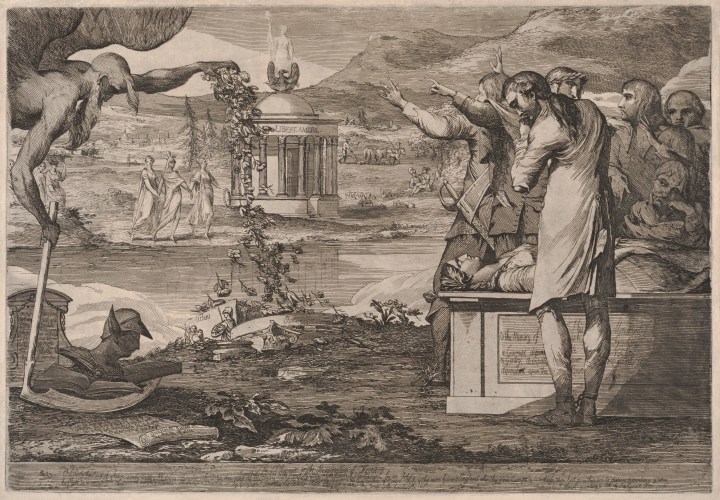
James Barry, The Phoenix or The Resurrection of Freedom, 1775/ca. 1790, etching and engraving with traces of aquatint, 17 x 24.1 inches (plate). Snite Museum of Art, gift of William and Nancy Pressly in honor of the Stent Family, 2015.002.001.
Click here to enlarge
◊ ◊ ◊ ◊ ◊
Press release (30 January 2015) from the Snite Museum of Art:
Snite Museum Expands Irish Art Collection at the University of Notre Dame with the William and Nancy Pressly Collection of James Barry Prints
The Snite Museum of Art announces the acquisition of a significant portfolio of 28 prints by the quixotic Irish artist James Barry (1741–1806). Rich in symbolism and technically inventive, these new additions to the collection promise to enhance the University of Notre Dame’s position as a leading center for Irish, eighteenth-century, art historical, and trans-Atlantic studies. The artist’s dramatic compositions, grand scale, and heroic subjects offer visitors, connoisseurs, students, and scholars much to contemplate and enjoy.
“This is a first-rate acquisition of one of the most influential artists of the eighteenth-century British Atlantic world. It will be thrilling to see how our students in early American, Irish, and British history interpret such a rich and complex set of materials,” said Patrick Griffin, chair and Madden-Hennebry Professor of History at the University of Notre Dame.
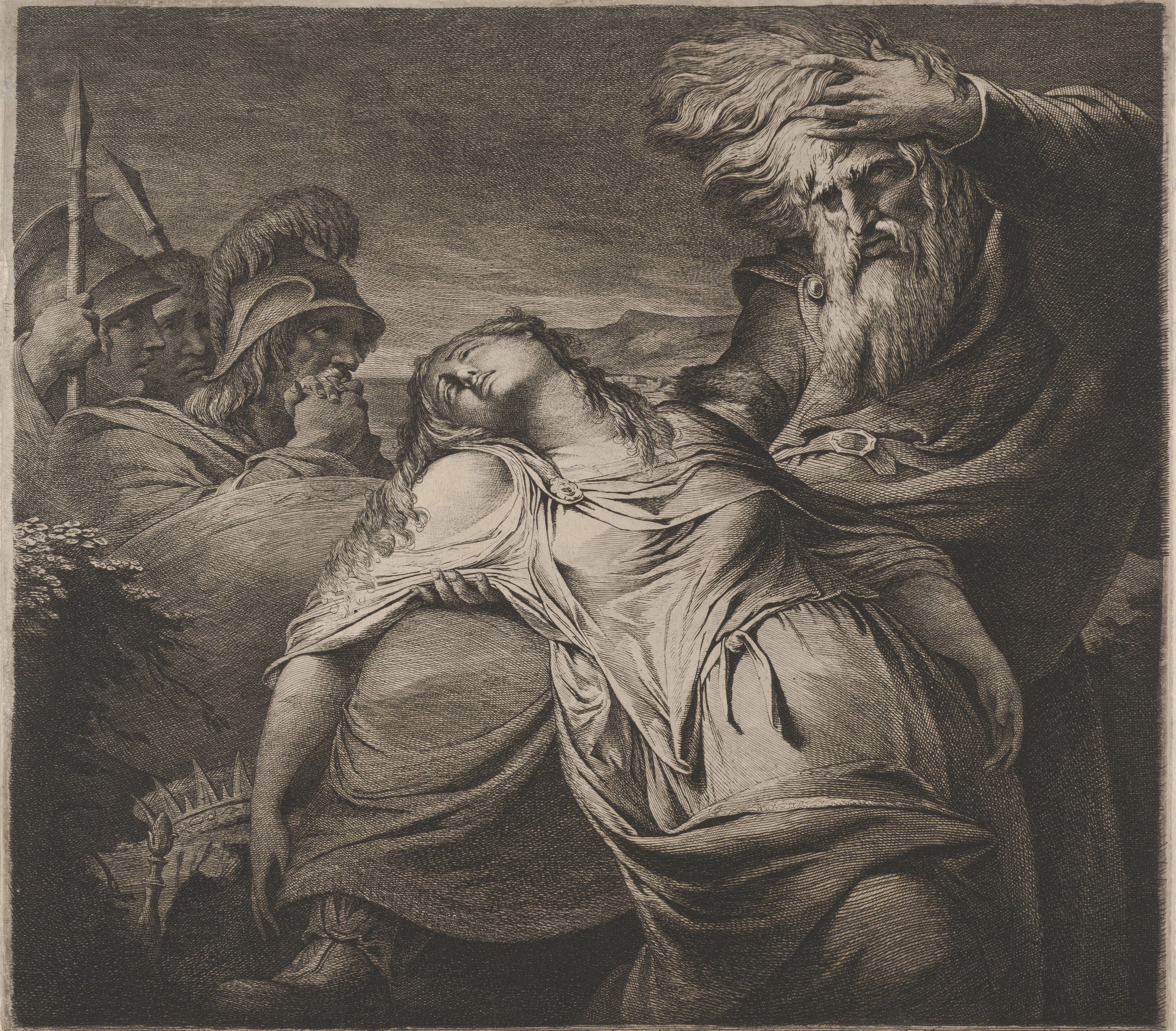
James Barry, King Lear and Cordelia, etching and engraving, 1776/1791, 19.5 x 22.2 inches (sheet). Snite Museum of Art, The William and Nancy Pressly Collection acquired with funds made available by the F. T. Stent Family, 2015.001.001.
Included in the portfolio are many rare, lifetime impressions of some of the Catholic artist’s most provocative images skewering British society or weighing in on contentious current events, such as the war in the American colonies. Barry was a member of the Royal Academy but was eventually expelled for his belligerence and acrimony.
Printmaking for Barry was more than just an opportunity to market his ideas to a wide audience. Self-taught in the arts of printmaking, he used it to work out iconographical and compositional problems. It was part of his creative process, and the prints can be used to chart his ever-evolving positions on political issues and his increasing technical acumen. Multiple states of the same print in which the more experimental aquatint technique was effaced in favor of conventional engraving suggest the artist’s lamentable concession to a market that did not appreciate his innovations. He was one of the earliest practitioners of lithography shortly after its invention around 1800, a singular example of which is also part of this portfolio.
This remarkable collection was built over four decades by Nancy and William Pressly, the foremost scholar on James Barry and professor emeritus of eighteenth- and nineteenth-century European art at the University of Maryland. Pressly said, “Over the years, as I looked and relooked at these prints, I was amazed at both the subtlety and richness of Barry’s process, but he never pursued virtuosity for its own sake: all is in the service of his passion to transform his audience, a transformation, however, that places great demands on his viewer.”
Barry produced over 40 prints during his career. The William and Nancy Pressly Collection represents more than half of that production, making the University of Notre Dame and the Yale Center for British Art the two largest repositories of his work in the United States.
The acquisition of eighteen of the prints was made possible by a generous gift from the F. T. Stent Family with ten additional prints donated by the Presslys themselves.
LACMA’s New Vicente Albán Paintings

Vicente Albán, Indian Woman in Special Attire (India en traje de gala), ca. 1783, Los Angeles County Museum of Art, purchased with funds provided by the Bernard and Edith Lewin Collection of Mexican Art Deaccession Fund.
◊ ◊ ◊ ◊ ◊
From LACMA’s Unframed (28 January 2015) . . .
LACMA’s New Vicente Albán Paintings from Ecuador Now on View
Ilona Katzew, Curator and Department Head, Latin American Art
Back in 1996, when I organized my first exhibition of Spanish colonial art in New York City, I included a group of fascinating works portraying racial types from Ecuador. The paintings were part of a set of six canvases, four of which had just been acquired by a private collector. The whereabouts of the two missing canvases was at the time unknown. Inscribed with the numeral 1 in the lower center, it was clear that this set was the first of two. The other series (bearing the numeral 2) is now in the Museo de América in Madrid and was shipped to Spain’s Royal Cabinet of Natural History in the late 18th century. It is signed by the Quito master Vicente Albán (active 1767–96). LACMA’s recent acquisition of the two missing paintings from the first set is thrilling. What makes these paintings exceptional? To start, there were only two sets created of Ecuadorean racial types (in contrast to the over 120 sets of the popular Mexican casta paintings that I have identified to date). Striking for their meticulous portrayal of local bounty and combination of indigenous and European textiles and jewels, the works are also eloquent documents of the Hispanic Enlightenment.

Vicente Albán, Noble Woman with Her Black Slave (Sra. principal con su negra esclava), ca. 1783, Los Angeles County Museum of Art, purchased with funds provided by the Bernard and Edith Lewin Collection of Mexican Art Deaccession Fund.
In Noble Woman with Her Black Slave, the white (or Spanish) woman wears an array of exquisite textiles, a string of pearls, and other jewels such as a gold crucifix and oval reliquary to signal that she is Catholic (and hence ‘civilized’). Her black slave (a conventional status symbol) is more modestly, if still lavishly, bedecked and is depicted barefoot. Worth noting are the ‘black’ flowers of the noblewoman’s skirt and hat. Scientific analysis has shown that they were originally painted in silver—a feature that would have bolstered the image of the colony as a land of unsurpassable riches. Though now irreversibly tarnished, it is not hard to imagine the impact that the painting once caused, peppered with abundant touches of gold and silver.
In Indian Woman in Special Attire, ancient indigenous costume elements—including a tupu (metal pin) fastening her lliclla (shoulder mantle), a belt with tocapus (geometric motifs associated with rank), which was an essential part of a coya, or queen’s dress, and a small chu’spa (a bag to carry coca leaves that gave energy and staved off hunger)—are combined with elements of European dress, such as the lavishly ornamented lace collar and sleeves of her blouse. Noticeable, too, is the black fabric laid over her skirt, fastened with a black sash. The X-radiograph clearly shows the large-sized pin, which is difficult to see due to the tarnishing of the metallic silver paint. It also reveals a delicate herringbone pattern on the woman’s mantle, now virtually undetectable to the naked eye. The pattern may suggest that this is a textile type known as tornasol (literally meaning ‘turns to the sun’). These shimmering silk fabrics were highly coveted in Europe and favored by the Spanish nobility. Colonial Andean weavers skillfully adapted them to their ancient textile traditions by combining a dark fiber warp (usually made of alpaca) and brighter contrasting weft (commonly silk). When the fabrics moved, they caught the light and created a glimmering two-tone effect. Contemporaneous travelers described this kind of pleated mantle as a distinct costume element worn by noble Indians.
One of the most salient elements of the paintings is the gigantic fruit placed next to the figures, making an explicit connection between the region’s inhabitants and its flora. The works convey a sense of American nature as extravagantly fertile. In Europe there existed the widespread idea that the Americas were an unusually hot place where nature and people—regardless of their racial makeup—ripened and spoiled quickly. These paintings counter such notion by representing local types from Ecuador dressed in lavish clothing and standing next to an assortment of giant tropical fruits, emphasizing the abundance of the land. An elaborate key in the lower section describes the trees and fruits, directing the viewer to selected parts of the canvases. This technology of production and reception of meaning was amply used in New World pictures (though it was by no means exclusive to it) to render ‘difference’ clear, transmit specific information, and reinforce the overall efficacy of messages.
Several scholars have linked the set at the Museo de América in Madrid with the Spanish botanist José Celestino Mutis (1732–1808), who led an important royal-sponsored expedition to the viceroyalty of Nueva Granada (1783–1816), and produced thousands of images of the region’s flora. (Nueva Granada refers to the Spanish colonial jurisdiction in northern South America, corresponding mainly to modern Colombia, Ecuador, Panama, and Venezuela.) This would explain the equal emphasis lavished on the racial types of the region and the precise botanical renditions that show both the exterior and the interior of local fruits. Throughout the 18th century, the Spanish Crown sponsored a number of expeditions to the Americas to gain better knowledge of their natural resources and exploit them for commercial ends. The production of images became an inherent part of these Enlightenment-era imperial taxonomic projects.
Despite the scant information about Vicente Albán (who signed the Madrid set), we know that he often collaborated with his brother, Francisco (1742–88), and that they both were regarded among the most prominent Quito painters of the day. Mutis may have commissioned Vicente to paint the Madrid set as a gift for Madrid’s Royal Natural History Cabinet, which was established in 1771. LACMA’s paintings, which are not signed, are very similar to the works in Madrid. But they also present intriguing formal and stylistic differences. The Madrid set, for example, is painted more freely and possibly by more than one hand, suggesting that it was created with workshop assistance. The figures in the LACMA pictures, on the other hand, seem to sit better in space and are more restrained in their handling of details (check back next week on Unframed to read more about the conservation process of these paintings). It is likely that Mutis also commissioned the set to which LACMA’s paintings belong as a gift for another important patron who supported his expedition. It is important to keep in mind, however, that LACMA’s set also could have been commissioned by another Enlightened royal functionary that remains unidentified. Commissioning replicas was part and parcel of the culture of image making at the time, and it was not uncommon among Spanish functionaries to request copies of the same image. In addition, artists often copied their own paintings, which had an important place in their workshops. Rich in detail, these two extraordinary pictures add an important dimension to our collection of viceregal art. A more complete study of the works will soon be published in a handbook of LACMA’s growing Spanish colonial collection.
The Prado Acquires the Juan Bordes Library
Press release (27 January 2015) from the Prado:

Trattato della Pittura di Leonardo da Vinci . . . di Stefano della Bella (Florence, 1792).
The Museo del Prado is providing detailed information on the content of one of its most recent acquisitions: the Juan Bordes Library. This is one of the most important bibliographical holdings in the world for the study of the human figure, consisting of treatises and drawing manuals from the 16th to the 20th centuries. Within this acquisition, the Museum has received as a donation a sketchbook by the studio of Rubens. It is currently considered the closest to the lost original by the master and also includes two original works by his hand.
The Juan Bordes Library is a unique example of a bibliographical holding specialised in the key areas within artists’ training and the theory of the human figure. Comprising around 600 volumes assembled by Bordes, the library focuses on texts and manuscripts that were used in the training of artists from the 16th to the 20th centuries. Due to their functional nature, these texts have not in the past merited the attention of bibliophiles or art historians. As Gombrich noted in his book Art and Illusion: “it is no mere paradox to say that the rarity of these books in our libraries is symptomatic of their past importance. They were simply, used, torn and handled in workshops and studios, and even surviving ones are often poorly bound and incomplete.” As a result, these manuals and treatises constitute an extremely valuable holding for a knowledge of the methods employed in the training of artists and amateurs in studios and academies. They also tell us about the evolution of aesthetics and the dissemination of artistic models.
 The Bordes Library is structured into six large sections, organised to reflect the key disciplines in an artist’s training, in addition to a group of manuscripts of different types, notably the sketchbook by Rubens received as a donation. The importance of this library is reflected in Juan Bordes’s own 2003 book, Historia de las teorías de la figura humana. El dibujo, la anatomía, la proporción, la fisionomía (History of the Theories of the Human Figure: Drawing, Anatomy, Proportion and Physiognomy), in which he studied the function and history of these books and their role and significance in artists’ training.
This bibliographic holding now joins other specialist libraries acquired by the Prado in recent years: the Cervelló Library, specialising in art theory and celebrations; the Correa Library, which focuses on the art of printmaking and the illustrated book; the Madrazo Library, an example of a library belonging to a dynasty of artists; the libraries of José Álvarez Lopera and Julian Gallego, which are characteristics libraries of art historians who primarily specialised in Spanish art; and the library of Félix de Azúa, centred on aesthetics and the philosophy of art. Through this strategy of acquiring specialist libraries, the Museo del Prado is not only helping to preserve the Spanish bibliographical heritage but also to provide its Study Centre with the research tools necessary for fulfilling its primary mission.
◊ ◊ ◊ ◊ ◊
S T R U C T U R E O F T H E B O R D E S L I B R A R Y
1. Drawing Manuals
This is undoubtedly one of the most important and valuable areas within the Bordes Library, both for the number of items and their rarity. The eminently functional nature of these manuals means that very few of them survived, on occasions only as single copies. Given that they were copied or republished in response to the different requirements of each moment, on many occasions they varied from one edition to another, so that each surviving copy is now almost unique. As a whole this group is extremely important as the study of it will reveal not only differences in the way of teaching drawing at different historical periods but also the models selected,thus reflecting taste of the time. It can be said that this group represents the systematic assembly of the largest surviving group of drawing manuals. Among its contents are three of the founding texts of this type by Fialetti, Cousin and Carracci, as well as examples of the most important ones from later centuries by Rubens, Ribera, Bloemaert etc.
2. Artistic Anatomies
Combining scientific knowledge and art, from Vesalius’s pioneering text onwards, treatises on anatomy reveal the key role of the study of the human figure in artists’ training. Together with life drawing and the copying of plaster casts, the study of anatomy through printed treatises, with particular attention to the study of bones and muscles, was one of the basic principles of an artist’s training. The increasing availability of images in the 19th century made high quality visual media available to students, encouraging a naturalistic approach to the representation of the human body in art. The Bordes Library is particularly rich in treatises from that century, copiously illustrated and with colour assuming a key role. Their relationship with the art of their time is striking, as evident, for example,in the numerous drawings by José Madrazo in the Prado’s collection. Particularly important was the interest in “anatomising classical sculptures,” in other words, anatomical models based on the great paradigms of classical sculpture, once again indicating the close links between science and art.
3. Proportion
As Michelangelo noted, having a compass in one’s eye for constructing harmonious, well-proportioned figures was one of the basic principles of artistic creation. Since Alberti and Dürer’s fundamental treatises, the quest for ideal human proportions within the variety of the human body has been an ongoing interest of artists, evolving in parallel to aesthetic changes. As a result, over the course of the centuries numerous treatises were published that offered artists a repertoire of proportions, either of real human models or of classical sculptures, determining the principles that should govern the construction of the human figure. Although fewer in number than the works in the previous sections, the Bordes Library has examples from different periods and centres, ranging from the 17th to the 20th centuries and from Europe to South America. These texts reveal the spread of a teaching model based on mathematics.
4. Physiognomy
Facial expressions were the subject of the fourth area of an artist’s training. Starting in the Renaissance with Della Porta’s Della Fisionomia dell’ Huomo, followed by the works of Le Brun and Lavater (also represented in this library by a manuscript) and concluding with 19th-century treatises such as Duchenne’s, physiognomy has been a subject of interest both to artists and writers. The Bordes Library contains a notable group of these works, with the principal authors represented by several different editions, allowing for an understanding of the evolution of artistic concerns.
5. Treatises on Painting and Drawing
Complementing the four fundamental areas outlined above, the Bordes Library also has treatises on the practice of drawing and painting, in which these disciplines are related to anatomy, proportion and physiognomy. These varied treatises were widely disseminated and of enormous theoretical importance. Leonardo, Alberti and Hogarth are among the authors represented in different editions. In other cases these treatises, published in different European countries, have hardly been the subject of study, although they must have provided the theoretical bases for many artists. The importance placed on art theory in recent years means that not only the major treatises but other works represented by fine copies in the Bordes Library are of enormous scholarly value.
6. Iconography
Repertoires of portraits and works of art, both paintings and sculptures, make up the smallest section within the library although one that represents a type of publication which was widely disseminated in the past. The fact that repertoires of this type were normally costly, large-format publications and thus not within the reach of all artists led Juan Bordes to focus on books which were more accessible to them, normally in small format and simply illustrated. Nonetheless, the library contains notable examples of visual repertoires, including Perrier’s on classical sculpture and Padre Nadal’s Imágines de la Historia Evangélica, which was exceptionally important for the dissemination of Counter-Reformation models.
7. Manuscripts
The Bordes Library includes a small but exceptional group of manuscript treaties. They are of equal rarity to many of the manuals referred to in the first section and can be classified into two principal groups: manuscripts that constitute the original of a subsequently published or unpublished text (Lavater and his treatise on physiognomy), and those that take the form of notebooks made in the context of the artist’s studio, copying sketches or other notebooks by the master.
Outstanding among them is the above-mentioned notebook by Rubens, known as the Bordes Manuscript. This is a remarkably important example as it constitutes the first proof of the existence of a lost notebook by Rubens in which he set out his ideas on anatomy, proportion, symmetry, optics, architecture and physiognomy and also made numerous drawings. The Bordes Manuscript is the most important of the four known copies, given that in addition to being a direct copy of the original it contains two drawings by Rubens himself. The Museo del Prado houses the largest and finest collection of paintings by Rubens.










 Enfilade
leave a comment