Huguenot Heritage Centre Scheduled to Open in 2015
The recipient of a £1.2m grant from the Heritage Lottery Fund, the French Hospital in Rochester, Kent is on schedule to open in 2015 the first museum dedicated to the history and legacy of the Huguenots in Great Britain.
From the project description:
The story so far
95 High Street, Rochester, Kent
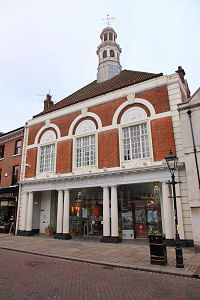 In 2010 the Directors (Trustees) of the 295-year-old Huguenot-founded French Hospital in Rochester High Street, were presented with a once-in-a-lifetime opportunity. This was afforded by Medway Council which gave them the opportunity to purchase the two storey building which would allow, not only an increase in the number of flats for people of Huguenot descent from 59 to 63, but also the establishment of the first Huguenot Heritage Centre in the UK.
The building stretches from the High Street to the line of the Roman Wall, from its fine, art deco-style rooms at the front through to more functional facilities. It also lies opposite and very close to the proposed, new railway station and within a very short walk of the Cathedral and Castle. This offer fulfilled the wish of the Directors to increase the number of almshouse flats, creating secure state-of-the-art facilities for the storage of Huguenot family archives, books and historical material of great significance, in an air-conditioned and temperature controlled environment. Importantly it also provides new spaces and an existing 96-seat theatre for creating the first ever museum and education centre covering the extraordinary role played by French Protestant immigrants to this country.
To take full advantage of the large number of visitors to Rochester, the French Hospital has leased back the ground floor to Medway Council for the next 20 years, so that it can continue to provide the existing Visitor Information Centre and café for its 320,000 visitors per annum.
The past and the future
Successful integration of immigrants into a community is a skill. There is much that can be learnt today to the country’s benefit from the practices and initiatives of both the Huguenot immigrants and their welcoming nation. The Huguenot Heritage Centre will be the first and only visitor centre in Britain focussed specifically on this sizeable immigrant population, demonstrating the positive benefits well-managed immigration can bring to Britain and providing a useful comparator with later influxes of immigrants. To achieve these aims a dedicated Huguenot Heritage Centre Committee is working on the plans for conversion of the building and the raising of the money to complete this exciting project.
The Huguenot Heritage Centre will provide
• A major focus and source of pride for those of Huguenot descent, with an important opportunity to learn about their heritage and, if desired, to have the opportunity to safeguard their artefacts and papers in the long-term.
• Greater accessibility to the collections and archives for the public, researchers and heritage professionals.
• An expansion of public knowledge about an important part of the history of modern Britain as well as the history of Huguenots and their descendants.
• An improved physical access and condition of display of precious heritage artefacts which will also be better conserved, as well as being digitised.
• Educational courses and research facilities, which will be available with the collections and archives for teachers, students, community groups and individuals. Subjects covered will include important elements of British history, genealogy, family history, immigration, persecution, tolerance and the skills and trades brought to Britain by the Huguenots; and the lessons which can be learnt from these.
• A new opportunity for personal development and growth through volunteering.
Four new flats for the French Hospital Almshouses
To satisfy the increasing need for additional sheltered accommodation for those of Huguenot descent and to reduce its waiting list of some 100 applicants for the French Hospital, four new flats will also be included in the conversion. These well insulated, lift accessible flats with good views across the River Medway and surrounding countryside, will be compliant with the Almshouse Association guidelines and contain a living room, two bedrooms, kitchen and a bathroom.
 A background profile of the French Hospital
The French Hospital, known by generations of residents as La Providence, was founded in London in 1718 as a charity, offering sanctuary to poor French Protestants or Huguenots as they are known. It has had several subsequent locations and currently maintains 59 self-contained, sheltered flats in the ancient Roman City of Rochester in Kent. On the same site, it owns a highly regarded collection of paintings, engravings, furniture, silverware, clocks, books, archival records and other items illustrating the culture and history of the Huguenots. However, the collection is neither readily accessible by the public, nor is it professionally displayed in a museum gallery setting.
Fundraising campaign
The total target for the campaign is approximately £5 million. . . The French Hospital is governed by a board of nearly 40 Directors (Trustees) including a Governor, Deputy Governor, Treasurer and Secretary. The Board has begun a fundraising campaign for the recent purchase of 95 High Street, the development of a Huguenot Heritage Centre and additional almshouse sheltered accommodation. For more information and how to fulfil these aims, please visit the French Hospital’s website or write to us:
The French Hospital
Charity number 219318
41 La Providence, Rochester
Kent ME1 1NB
Living the History of George Washington’s Tent
There were, for me, many stimulating offerings available at this year’s ASECS conference in Williamsburg, including a fine session on “Historical Reenactment,” sponsored by the Society of Early Americanists and chaired by Joy Howard. While I found all seven of the brief contributions thought-provoking (none more so than Michael Twitty’s presentation of his extraordinary work, including the Southern Discomfort Tour), Tyler Rudd Putman’s account of working as an intern on The First Oval Office Project during the summer of 2013 seemed perfectly suited to a posting here at Enfilade. I was thrilled he agreed. -CH

Living the History of George Washington’s Tent
T Y L E R R U D D P U T M AN
I spent the summer of 2013 dressed for work in the 1770s. As a historic trades intern working in costume in a workshop at Colonial Williamsburg, I was part of the First Oval Office Project, an initiative to recreate the sleeping tent, or marquee, used by George Washington during the American Revolution. Amazingly, this 22-foot-long oval tent still exists in the collection of the Museum of the American Revolution. Of thousands of tents made and used during the Revolution, only two survived to 2014; both belonged to Washington, saved for posterity.
Why would people spend years of research and months of sewing to make a big piece of canvas, especially when we already have the original? You can imagine what the old marquee is like after two centuries. It’s fragile. When the new Museum in Philadelphia installs it in Philadelphia in a new building about to begin construction, it will rest on a custom support system, so it doesn’t tear itself apart. But we wanted a tent that could travel, a tent that people could touch, a tent that people could walk into, look up at the ceiling inside, and wonder what it was like to be Washington during the Revolutionary War. Moreover, for all the hours experts have spent scrutinizing Washington’s marquee, there were still all sorts of mysteries we hoped to solve by making an exact copy. There were strange stitches, hints of repairs and adjustments, and other oddities we hoped to explain in the process of sewing a new tent, stitch by stitch, by hand (there were no sewing machines in the 1770s).
We also know almost nothing about the men and women who sewed Washington’s tent in 1777. They left few documentary traces, but recreating labor can help historians recapture lives. What was it like to sit ‘tailor fashion’, cross-legged atop a worktable, for a long day? Documents indicate that some women worked sewing tents during the Revolution as well. How was sewing work different for them? What does regular hand-sewing do to your hands?

The author at work sewing tent canvas.
◊ ◊ ◊ ◊ ◊
Experimental archaeology, or recreating an object or activity from the past to better understand the culture from which it emerged, is not time travel. I don’t know what it’s like to work a fourteen-hour day on a bread and small beer diet, in a body weathered from years of such labor, with an eighteenth-century mind. But I know how it hurts when you break a needle against your thumb, and I’ve felt the jubilation of finishing a hopelessly long seam. If you had been there this summer, you would have felt your back muscles tire and your posture change after only a day of sewing. You would have started to notice things. Linen lint floating in the air. The peculiar, miniscule catching when a steel needle has a small barb growing at its tip. How it’s possible to daydream and almost fall asleep amid the rhythmic motions of sewing a long seam. It’s in these microscopic moments that we connect with people long gone. No matter how much cultural baggage and time separates us, there’s something here we share with our long-ago predecessors.
We could have figured all this out in a warehouse somewhere. That certainly would have made our big experiment more efficient. But we wanted to make the tent in front of the public, so that the process of creation would both answer our questions and educate everyday people. To this end, the Museum of the American Revolution teamed with the Colonial Williamsburg Foundation and, in the summer and fall of 2013, operated a tentmaking shop in Williamsburg.
Washington’s tent was made in Reading, Pennsylvania, in 1777, but we know that artificers and other tradesmen who worked for the army sewed plenty of tents in Williamsburg during the Revolution, so operating such a shop in the city fit well with the Foundation’s interpretive goals. A crew of costumed tradesmen, including myself, spent five days a week sewing common tents used by ordinary soldiers, uniforms, knapsacks, and George Washington’s marquee. We didn’t pretend to be historical characters but instead spoke with visitors as ourselves. The costumes were just another one of our tools, allowing us to understand and discuss things like posture, cleanliness, and fashion from a contemporary viewpoint.
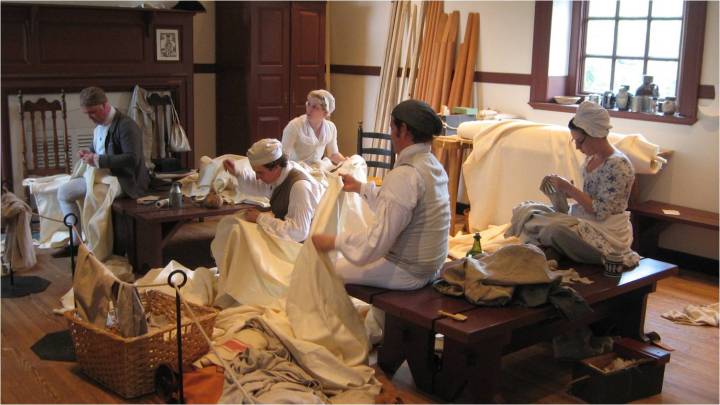
Tailor Mark Hutter and interns Aaron Walker, Nicole Rudolph, Michael Ramsey, and Gwendolyn Basala at work in the tentmaking shop.
◊ ◊ ◊ ◊ ◊
Over eight months, we answered a lot of our questions and came up with all sorts of new ones. We had an exceptional, interdisciplinary crew of sewers, including experts in historic trades, artists, students, and historians. Behind the scenes, we relied on curators, conservators, weavers, woodworkers, and social media workers to keep our project on track. These diverse viewpoints generated valuable insights. In the process, we had to answer persistent visitor questions. “Were these tents waterproof?” many people asked. We wondered that, too, and we were lucky enough to have a rainy summer in Williamsburg, giving everyone the opportunity to see how linen canvas resists even torrential rain, how tightly sewn seams hold up well, and how everything depends on good tent poles, tight ropes, and firmly planted stakes.
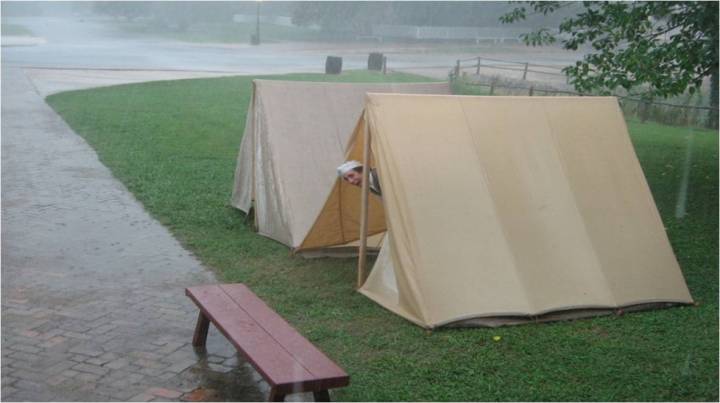
Intern Aaron Walker tests a common tent, home to six Revolutionary soldiers, in a Williamsburg rain.
◊ ◊ ◊ ◊ ◊
I would also argue that we gained at least as much from the public as they did from visiting our workshop. Public interpretation, after all, is just interdisciplinarity in another form. What better way to test explanations of Revolutionary War society and politics than to present them to a banker, an IT specialist, or a med student visiting Colonial Williamsburg? Do the arguments of historians such as Gordon Wood, David Waldstreicher, or Rosemarie Zagarri fly with the average American? This isn’t about dumbing-down information, it’s about translating it. That’s why it’s called interpretation. One of the best conversations I had all summer came after I had been explaining colonial labor and social hierarchy to a middle-aged man. “So,” he asked, pausing in thought, “When did America become a good country for poor people?” As we talked about changing standards of freedom, individual rights, and American ideologies, you could see his eyes light up as he thought about his world, America today, in new ways. Who would have thought you could get all the way there, starting with a tent?
A month ago, a user of the online reddit forum “Ask Historians,” posed this question:
Are there any merits to these ‘doing history’ acts? I’m not a fan of battle reenactments… I see them as telling us more about ourselves now than they do about the past and I think it’s a mistake (detrimental?) to use them as ways in which history/the past is taught to the public and to students.
Perhaps this is a fair criticism of living history. I’ve certainly seen my share of bad costumed interpretation at museums, like the sort of tours led by guides in vaguely historic costumes demonstrating ‘traditional’ activities and repeating tired clichés. But there are also places and people that get it right. Michael Twitty, a historian and interpreter of early African-American foodways, argues that his interpretation is the result of a conversation between historical sources and current practices. Likewise, George Washington’s marquee means different things to retirees, boy scouts, or Midwestern families. But good living history interpretation makes it relevant to each of them in a personalized way. I think the reddit question offers the justification for this sort of quality living history. When it’s well done, when it engages with academic questions as well as public audiences, living history does tell us at least as much about ourselves as about the past. When that works, it’s beautiful—as beautiful as a clean white tent, the work of many hands, sitting on a grassy patch at Colonial Williamsburg.

◊ ◊ ◊ ◊ ◊
Tyler Rudd Putman is a PhD student in the History of American Civilization Program in the Department of History at the University of Delaware. He thanks Scott Stephenson, Mark Hutter, Neal Hurst, Gwendolyn Basala, Jay Howlett, Michael McCarty, Samantha McCarty, Brendan Menz, Joseph Privott, Michael Ramsey, Nicole Rudolph, Aaron Walker, the Museum of the American Revolution, the Colonial Williamsburg Foundation, Nicole Belolan, Joy Howard, and the other members of the “Historical Reenactment, Living History, and Public History” panel at ASECS 2014.
Newly Conserved and Renovated Salon Doré Unveiled

◊ ◊ ◊ ◊ ◊
The newly restored Salon Doré has just opened at the Legion of Honor Museum in San Francisco:
The Salon Doré from the Hôtel de La Trémoille is one of the finest examples of French Neoclassical interior architecture in the United States. Richly carved and ornately gilded, it was designed during the reign of Louis XVI as the main salon de compagnie—a receiving room for guests—of the Hôtel de La Trémoille on the rue Saint-Dominique in Paris.
After being moved not less than seven times between 1877 and today, its appearance and presentation was greatly changed from its original aspect. For a period of 18 months from 2012 to 2014, the Fine Arts Museums of San Francisco closed the Salon Doré and the adjacent British art gallery at the Legion of Honor to allow for the comprehensive conservation and renovation of this important 18th-century period room.
Over the course of the conservation and renovation project, curators, conservators, and architects reinstated the room’s original floor plan, restored the gilding and paint, repaired and replaced key carved elements, and installed an 18th-century parquet floor, a coved ceiling, windows, and new lighting.
In its new installation, a new program of period furnishings bring renewed focus to the room’s character and original purpose by demonstrating the social function of the room as a salon de compagnie, a formal room for receiving guests and conversation. The renovated Salon Doré at the Legion of Honor is a truly groundbreaking museum display that sets a new standard for American period rooms.
◊ ◊ ◊ ◊ ◊
The museum’s website includes several instructive videos explaining the project.
The Style Saloniste, the blog of Diane Dorrans Saeks, includes a report (31 March 2014) by Philip Bewley, who spoke with both the museum curator Martin Chapman and project architect Andrew Skurman.
Renovation and Conservation at the YCBA and the Beinecke
For those of you thinking ahead in terms of fellowships at Yale, bear in mind these planned closures for 2014 and 2015. 2016, however, seems like a fine time to be in New Haven!
◊ ◊ ◊ ◊ ◊
From the Beinecke:
The Beinecke Rare Book & Manuscript Library will undergo a major renovation beginning at the end of May 2015. The renovation will replace the library’s mechanical systems and expand its research, teaching, storage, and exhibition capabilities. The library will reopen in September 2016.
A temporary reading room in the Sterling Memorial Library will provide researchers access to the library’s collections while work is under way. Beginning in April 2014, access to various collections will be limited as we prepare the library for closure. Please consult our closed collections schedule for information about when specific collections will be unavailable.
We invite you to learn more about the project, and follow our progress as we prepare the library for another 50 years as a world-class center of research and scholarship.
◊ ◊ ◊ ◊ ◊
From the YCBA:
. . . Planning is well underway for the second phase of the project, which will take place in 2015. The focus of this next phase will be the renewal of the public galleries on the second, third, and fourth floors, as well as the refurbishment of the Lecture Hall. The project will also address improvements related to life safety and accessibility, and extensive building-wide mechanical and electrical upgrades will be made. Visitors will have limited access to the building and no special exhibitions will be mounted or visiting fellowships awarded. When the Center reopens in January 2016, its collections will be completely reinstalled in the elegant, sky-lit galleries of the fourth floor, and three focused exhibitions, featuring specific aspects of the Center’s collection, will be on view in the second- and third-floor galleries.
◊ ◊ ◊ ◊ ◊
From Yale UP
Peter Inskip and Stephen Gee in association with Constance Clement, Louis I. Kahn and the Yale Center for British Art: A Conservation Plan (New Haven: Yale University Press, 2012), 200 pages, ISBN 978-0300171648, $50.
 The standing of the Yale Center for British Art as one of the world’s great museums and study centers finds expression in its remarkable building, designed by Louis I. Kahn (1901–1974). In this important and innovative volume, two architects offer a plan to ensure the proper stewardship of the building in order to preserve its essence as a great architectural structure. Peter Inskip and Stephen Gee describe the design, construction, and subsequent renovation of the building; assess its cultural significance; analyze the materials that comprise it (steel, concrete, glass, white oak, and travertine); and shed light on its evolution over the four decades since it was built. Drawing on their extensive experience developing conservation plans for both historic sites and modern buildings, they propse a series of policies for the Center’s conservation into the future.
Peter Inskip and Stephen Gee are with the London-based firm Peter Inskip + Peter Jenkins Architects. Constance Clement is Deputy Director of the Yale Center for British Art.
Joshua Lane Appointed Curator of Furniture at Winterthur
As reported at ArtFix Daily (24 February 2014). . .
 Dr. David P. Roselle, Director of Winterthur Musem, Garden & Library, announced the appointment of Joshua W. Lane as the Lois F. and Henry S. McNeil Curator of Furniture at Winterthur Museum.
“Josh Lane is one of the leading scholars in the field of early American furniture,” said Roselle, “and we look forward to welcoming him to Winterthur.” He will start his new position on April 14, 2014.
Lane received his B.A. in American Studies from Amherst College and his M.Phil. from Yale. He worked at the Connecticut Historical Society and the Stamford Historical Society before moving to Historic Deerfield, where he has curated the furniture collection since 2000. In addition, Lane served as the Director of the Summer Fellowship Program at Historic Deerfield between 2005 and 2012.
His most recent exhibitions include Into the Woods: Crafting Early American Furniture, an innovative examination of the materials, tools, and evidence of workmanship in furniture: and Furniture Masterworks: Tradition and Innovation in Western Massachusetts, part of Four Centuries of Massachusetts Furniture, a collaborative project involving eleven institutions including Winterthur Museum.
“Josh is highly regarded for his exhibitions, teaching, research, and scholarship,” said Linda S. Eaton, John L. and Marjorie P. McGraw Director of Collections, “and we are all delighted that he is coming to Winterthur.”
Installation | Molly Hatch’s ‘Physic Garden’ at the High Museum
Warm thanks to Courtney Barnes of Style Court for noting this one. More information and photos are available at her website. -CH
Press release (5 February 2014) from Atlanta’s High Museum of Art:
Two-story tall installation of 450 hand-painted plates were inspired by works in the High Museum’s Frances and Emory Cocke Collection of English Ceramics
◊ ◊ ◊ ◊ ◊
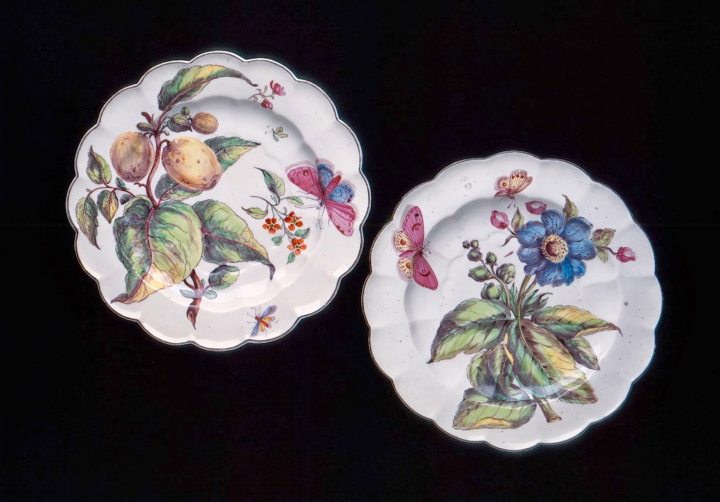
The High Museum of Art has commissioned contemporary ceramicist Molly Hatch to present Physic Garden, a two-story tall, hand-painted ‘plate painting’, which reinterprets works from its renowned decorative arts and design collection. On view starting March 12, the ‘plate painting’ will be installed in the High’s Margaretta Taylor Lobby and will be comprised of 456 plates featuring an original design inspired by two ca. 1755 Chelsea Factory plates from the Museum’s Frances and Emory Cocke Collection of English Ceramics, which totals more than 300 works.
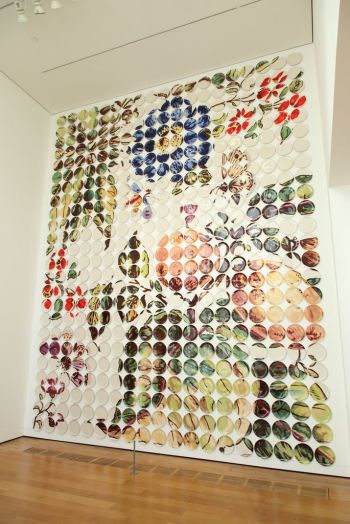 The historic source plates depict realistic flora and fauna in the Chelsea ‘Hans Sloane’ style of the early 1750s. The influential Chelsea Physic Garden, a botanical garden founded by the Society of Apothecaries in London in 1673, was leased by collector Hans Sloane and likely inspired neighboring factory porcelain decorators.
The High’s installation will be the largest ever produced by Hatch. She has created other works based on source material from the Metropolitan Museum of Art and Museum of Fine Arts, Boston. Hatch also designs her own line of products for national retailers such as Anthropologie.
“I am thrilled to work with such a talented contemporary artist as Molly and to have the outcome be such a dynamic and monumental acquisition for the High. One of the most exciting aspects of ‘Physic Garden’ is seeing the historic decorative arts and design collection through the lens of a creative young artist. We can’t wait for our visitors to experience this new work as well as revisit our important and beloved collection of English ceramics,” says Sarah Schleuning, curator of decorative arts and design at the High.
Hatch often sources historic works to make a contemporary counterpart, however this project marks the first time she is sourcing historic decorative arts from a museum collection to create a site-specific ‘plate painting’. To create the ‘plate painting’, Hatch digitally altered high-resolution images of the surface decoration of the source material to draft a new composition. She altered the original color, scale and composition of the Chelsea designs and then projected the new images onto 456 dinner plates (each 9.5 inches in diameter). She then hand-painted each plate using the projected image as a guide.
The complete installation will measure approximately 20 feet high by 17 feet wide. The Chelsea source plates are also on view in the High’s permanent collection Gallery 200, which patrons may visit to view the historic material. The High is acquiring the piece, which can re-installed by the Museum at future dates in smaller incarnations or in other locations.
“I encourage the viewer to see ceramics as a part of the fine art continuum—viewing plates as one would view a painting,” said Hatch. “For this installation, I’ve re-worked the surface imagery to create a new composition that reflects the historic. The artwork becomes an exploration of the relationship between the historic and the contemporary – crossing over categories of decorative art, design and fine art.”
Molly Hatch
Born in 1978, the daughter of a painter and a dairy farmer, Molly Hatch divided her childhood between physical labor, play, and creating art. She studied drawing, painting, printmaking, and ceramics and receiving her bachelor’s degree of fine arts from the Museum School in Boston in 2000. After several ceramic residencies and apprenticeships in the U.S. and abroad, she received her master’s degree of fine arts degree in ceramics at the University of Colorado in Boulder in 2008. In 2009, she was awarded the Arts/Industry Residency in Pottery at the John Michael Kohler Arts Center in Wisconsin, which laid the foundation for her career as an artist designer. Hatch works from her home studio in Northampton, Mass., on everything from designing and illustration to one-of-a-kind pieces. Her work has been widely collected and commissioned and is exhibited nationally and internationally at art fairs and museums. Hatch’s work has also been widely licensed in partnership with Anthropologie, Galison, Chronicle, and other companies for homeware and stationery products. Her work has been featured in numerous publications from House Beautiful magazine to online publications such as Design*Sponge and Apartment Therapy. For the last two years, Hatch has been teaching a tableware course at Rhode Island School of Design. She also teaches ceramic and illustration workshops across the country as well as online courses through Creativebug. Her first book will be released in 2015.
MFA Director Malcolm Rogers Announces Retirement Plans
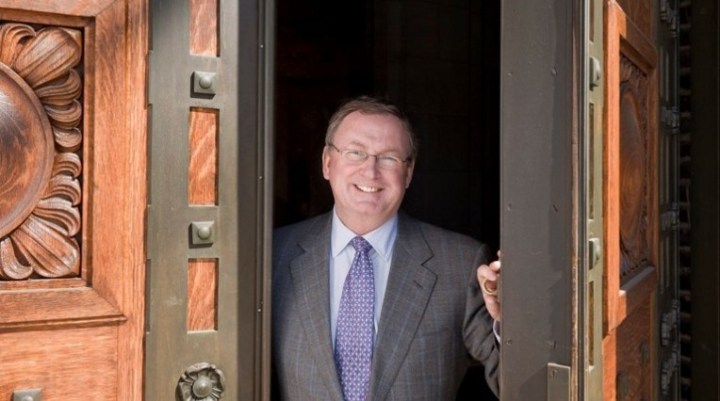
Press release (27 February 2014) from Boston’s MFA:
Today, Malcolm Rogers, Ann and Graham Gund Director of the Museum of Fine Arts, Boston (MFA), announced to the MFA’s Board of Trustees his future plans to retire. Throughout his nearly 20 years at the Museum, Rogers—who in May becomes the longest-serving Director in the MFA’s 144-year history—established a legacy of “opening doors” to communities from Boston and around the world. The Board will establish a committee to oversee a global search for the Museum’s next director, with Rogers remaining at the helm until a successor is identified and appointed…
Keep reading here»
MFA Appoints Frederick Ilchman as Chair, Art of Europe
Press release (27 February 2014) from Boston’s MFA:
Frederick Ilchman has been appointed Chair, Art of Europe at the Museum of Fine Arts, Boston (MFA). Ilchman will continue to serve as the Mrs. Russell W. Baker Curator of Paintings, a position he has held since 2009. Ilchman joined the MFA in 2001 as Assistant Curator of Paintings. A specialist in the art of the Italian Renaissance, he has curated numerous exhibitions, organized international conferences, contributed to scholarly publications and lectured and taught in the United States and abroad. Ilchman’s acclaimed exhibition, Titian, Tintoretto, Veronese: Rivals in Renaissance Venice (2009), organized with the Musée du Louvre, was the first major exhibition dedicated to the competition among these three renowned artists and the emergence of their signature styles. The exhibition won several awards including “Outstanding Exhibition (Eastern Time Zone)” from the Association of Art Museum Curators and was selected as one of the year’s top 10 exhibitions by the Wall Street Journal. In October 2014, an exhibition he is co-curating, Goya: Order and Disorder, will open in the MFA’s Ann and Graham Gund Gallery. In 2003, he served as the Boston curator for the traveling exhibition Thomas Gainsborough, 1727—1788, a major retrospective organized by Tate Britain, and was part of the curatorial team for the exhibition Tintoretto (2007) at the Museo Nacional del Prado in Madrid. Recently, Ilchman curated Visiting Masterpiece: Piero della Francesca’s Senigallia Madonna: An Italian Treasure, Stolen and Recovered (2013), and co-curated the exhibition Paolo Veronese: A Master and his Workshop in Renaissance Venice (2012) at the Ringling Museum in Sarasota.
Ilchman holds a Bachelor of Arts in Art and Archaeology from Princeton University, where he graduated summa cum laude (1990), and a Master of Arts (1992) and Master of Philosophy (1996) in Art History from Columbia University. He will receive his Ph.D. in Art History from Columbia University in May 2014. He has been awarded numerous fellowships, including the Gladys Krieble Delmas Foundation Grant (2006), Save Venice Inc. Art History Fellowship (1999–2001), the Theodore Rousseau Fellowship, Metropolitan Museum of Art (1996–1997, 1998–1999) and a Fulbright Fellowship (IIE), Italy (1997–1998). In 2010, he was a Fellow at the Center for Curatorial Leadership in New York City. Ilchman has been on the board of directors of Save Venice Inc., the largest private organization devoted to preserving the art and architecture of Venice, since 2005, and now is co-Project Director. He also has served as Chair of the Boston Chapter of Save Venice since 2011.
MFA Appoints Benjamin Weiss as Chair, Prints, Drawings, & Photographs
Press release (27 February 2014) from Boston’s MFA:
Benjamin Weiss has been named Chair, Prints, Drawings and Photographs at the Museum of Fine Arts, Boston (MFA). Weiss will continue to serve in his current position, Leonard A. Lauder Curator of Visual Culture, which he has held since 2011. In that role, he co-curated The Postcard Age: Selections from the Leonard A. Lauder Collection (2012) and most recently organized Audubon’s Birds, Audubon’s Words (2013); he is currently preparing further exhibitions and publications drawn from the Leonard A. Lauder Postcard Archive, including an exhibition devoted to “real photo” postcards of the early 20th century. In addition to the Lauder Archive, Weiss has had responsibility for the MFA’s other collections of posters, postcards, illustrated books, graphic design and ephemera of all sorts.
Prior to taking his current position in Prints, Drawings and Photographs, Weiss spent seven years in the MFA’s Education Department as Head of Interpretation (2009–2012) and Manager of Adult Learning Resources (2005–2009). He was integral to the opening of the Art of the Americas Wing in 2010, when he was responsible for interpretation for 5,000 objects on view. He also oversaw the written and educational materials for all special exhibitions and installations of the collection, including brochures, multimedia tours and in-gallery wall texts and labels.
Weiss holds a Master of Arts in History from Princeton University (1991) and a Bachelor of Arts from Harvard College (1989). Before coming to the MFA, he worked at the Burndy Library, of the Dibner Institute for the History of Science and Technology at MIT for seven years, where he was Curator of Rare Books and Head of Exhibitions and Publications. While at Burndy, he curated more than a dozen exhibitions, on subjects as varied as color theory, 19th-century American bridge engineering and the history of obelisks. That last exhibition resulted in the collaborative monograph Obelisk: A History, co-written with Anthony Grafton, Pamela O. Long and Brian Curran, and published by MIT Press. A Renaissance historian by training, with a specialty in the history of cartography, Weiss maintains an interest in the history of maps, and specifically in the history of ancient geographical texts in the 15th and 16th centuries.
Exhibition | Anglo-American Portraiture in an Era of Revolution
From the Louvre:
Anglo-American Portraiture in an Age of Revolution
Musée du Louvre, Paris, 1 February — 28 April 2014
Crystal Bridges Museum of American Art, Bentonville, Arkansas, 17 May — 15 September 2014
High Museum of Art, Atlanta, 28 September 2014 — 18 January 2015
Curated by Guillaume Faroult
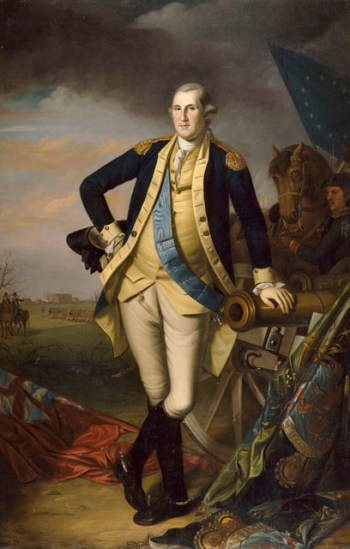
Attributed to Charles Wilson Peale, George Washington after the Battle of Princeton, 3 January 1777, ca. 1779 (National Museum of the Palace of Versailles and the Trianons)
The Louvre continues its exploration of the history of painting in America with a third special exhibition that compares and contrasts five Anglo-American portraits from 1780 to 1800 and slightly later, produced in the midst of a revolution that would lead to the independence and creation of the United States of America. The selected artworks revolve around the guardian and emblematic figure of General George Washington (1732–1799), elected first president of the United States in 1789.
The exhibition features three portraits of the Father of the Country, including one attributed to Charles Wilson Peale (1741–1827) depicting him as Commander in Chief of the Continental Army, on special loan from the Musée du Château de Versailles. Portraits of the opposing belligerents, notably a stunning, newly restored portrait of Captain Robert Hay of Spot by Scottish painter Sir Henry Raeburn (1756–1823), are presented in response to the magnificent portrait of Washington as president of the young nation painted in 1797 by Gilbert Stuart (1755–1828)—one of the most talented American portrait artists—on loan from the Crystal Bridges Museum.
This special exhibition is part of a long-term partnership with the Crystal Bridges Museum of American Art, the High Museum of Art, Atlanta, and the Terra Foundation for American Art, and was made possible through their generous support.










 Enfilade
leave a comment