Thank the Getty for Open Content!
Press release (12 August 2013) from the Getty:

◊ ◊ ◊ ◊ ◊
The Getty announced that it is lifting restrictions on the use of images to which the Getty holds all the rights or are in the public domain. Getty President and CEO Jim Cuno made the announcement in a post on The Iris, the Getty’s blog.
“As of today, the Getty makes available, without charge, all available digital images to which the Getty holds all the rights or that are in the public domain to be used for any purpose,” wrote Cuno, citing the new program.
As a result, there are roughly 4,600 images from the J. Paul Getty Museum available in high resolution on the Getty’s website for use without restriction—representing 4,689 objects (some images show more than one object), including paintings, drawings, manuscripts, photographs, antiquities and sculpture and decorative arts. The Getty plans to add other images, until eventually all applicable Getty-owned or public domain images are available, without restrictions, online.
The Getty Research Institute is currently determining which images from its special collections can be made available under this program, and the Getty Conservation Institute is working to make available images from its projects worldwide.
“The Museum is delighted to make these images available as the first step in a Getty-wide move toward open content,” said J. Paul Getty Museum Director Timothy Potts. “The Getty’s collections are greatly in demand for publications, research and a variety of personal uses, and I am pleased that with this initiative they will be readily available on a global basis to anyone with Internet access.”
Previously, the Getty Museum made images available upon request, for a fee, and granted specific use permissions with terms and conditions. Now, while the Getty requests information about the intended use, it will not restrict use of available images, and no fees apply for any use of images made available for direct download on the website.
“The Getty was founded to promote ‘the diffusion of artistic and general knowledge’ of the visual arts, and this new program arises directly from that mission,” said Cuno. “In a world where, increasingly, the trend is toward freer access to more and more information and resources, it only makes sense to reduce barriers to the public to fully experience our collections. This is part of an ongoing effort to make the work of the Getty freely and universally available.”
Stockholm’s Nationalmuseum Acquires Plate Warmer by Rudolf Wittkopf
From the Nationalmuseum’s press release (as noted at the French Silver Blog , 14 August 2013) . . .
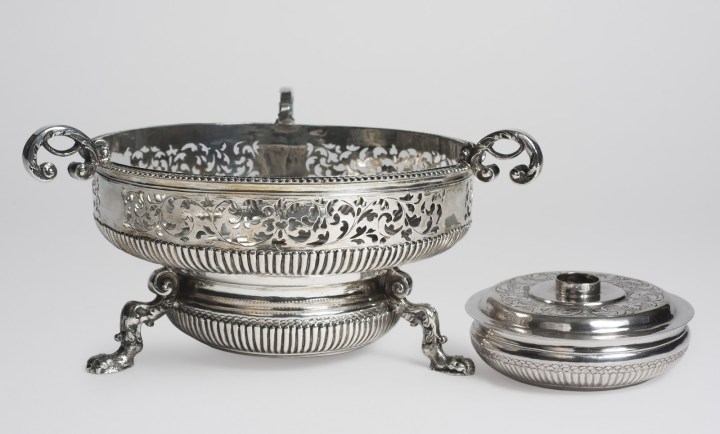
Plate Warmer by Rudolf Wittkopf, 1709. Diameter 20 cm, height 12 cm, weight 830 g. (Stockholm: Nationalmuseum, inventory number: NMK 102/2013) Photograph: Bodil Karlsson / Nationalmuseum)
◊ ◊ ◊ ◊ ◊
A plate warmer manufactured by Rudolf Wittkopf in Stockholm in 1709, believed to be a unique artifact, has been added to Nationalmuseum’s collection of early 18th-century Swedish silver. The piece, the only known surviving example in Sweden of a silver plate warmer, consists of a stand with three cast-metal feet and a removable burner with oil reservoir. The upper section is perforated to improve the airflow to the flame providing the heat, and at the top are three volute-shaped handles that hold the plate of food to be warmed.
The new, refined dining customs that appeared in Swedish upper-class circles in the early 18th century were modelled on French practices. Nationalmuseum’s extensive collection of hand drawings includes depictions from this period of two French réchaudes, or plate warmers, which were intended to serve as models for the modern silverware to be ordered by the Swedish court and aristocracy. The royal household accounts of Queen Hedvig Eleonora show that, in 1705, the fashion-conscious monarch purchased “a silver dish ring that can also be used as a heating dish” from Petter Henning, a Stockholm silversmith. However, little of the royal silverware from this period has survived, and there are no known examples in Sweden apart from the plate warmer now acquired by Nationalmuseum. This suggests that objects of this kind were a rarity even in their day and were probably manufactured only in very limited quantities.
The new acquisition is an important addition to Nationalmuseum’s collection of late baroque silver, illustrating how closely the Swedish court and aristocracy followed contemporary fashion, especially that of France.
Nationalmuseum’s acquisition of the Rudolf Wittkopf plate warmer has been made possible by a donation from the Barbro Osher Fund. Nationalmuseum has no budget of its own for new acquisitions, but relies on gifting and financial support from private funds and foundations to enhance its collections of fine art and craft.
August 23: International Slavery Remembrance Day
Next Friday at the National Maritime Museum in Greenwich:

Yinka Shonibare, Nelson’s Ship in a Bottle, 2010.
The work was displayed on the Fourth Plinth in
Trafalgar Square from 24 May 2010 to February 2012.
Photo from Wikimedia Commons, 2010
◊ ◊ ◊ ◊ ◊
The National Maritime Museum will host a day of remembrance on the anniversary of the first successful slave uprising in the western hemisphere – on 23 August in Haiti in 1791.
This year’s events will explore the Museum’s vast collections relating to the trade of enslaved people, as well as focusing on the many local connections to be found in the Greenwich World Heritage Site. Actor and broadcaster Burt Caesar will act as Master of Ceremonies for the day, which will also see art historian Dr Temi Odumosu discussing the controversial Cruickshank caricature The New Union Club; composer Dominique LeGendre giving a talk on black composers from the period of enslavement; and historian S. I. Martin revealing the hidden impact of the transatlantic slave trade during a walk around Greenwich. Unless otherwise stated, events are suitable for all ages.
Dr Temi Odumosu: The New Union Club | 12.30 | Age: 16+ | Art historian and creative educator Dr Temi Odumosu will explore the themes and attitudes of George Cruickshank’s The New Union Club, which is considered one of the most racist and complex prints of the 19th century.
Dominique LeGendre: Black Composers in the period of Enslavement | 14.00 | Critically acclaimed composer Dominique LeGendre discusses the impact and work of influential black composers during the period of enslavement, including the celebrated Ignatius Sancho.
Life of Ignatius Sancho interactive tour | Age: 10+. Maximum of 30 places on each tour | 12.00, 15.00 | Storyteller Rich Sylvester will lead interactive family learning tours around Greenwich Park, exploring Ignatius Sancho’s early life. Starting at Yinka Shonibare MBE’s eminent Nelson’s Ship in a Bottle, the tour concludes at The Ranger’s House, and with a ceremony investigating the importance of names. Young people are invited to leave their names in remembrance.
Walk to St. Alfege Church | 14.00 | Historian S. I. Martin will lead a walking tour to St. Alfege Church, Greenwich, looking into the impact that the slave trade had on Greenwich families. The walk begins at the Group Entrance of the Museum.
Youth Advisory Group textile workshop | 11.30, 14.00 | Join the Museum’s Youth Advisory Group in creating prints using adinkra symbols. Originally from the Republics of Ghana and Côte d’Ivoire, the symbols are used as both decoration and to represent objects, capturing evocative messages that carry traditional wisdom, aspects of life or the environment.
Songs of Freedom: workshop | Age: All ages and abilities welcome | 13.00, 15.30 | Singing group Ethnovox will lead a workshop exploring how songs were used as a powerful medium of resistance, and for messages of solidarity, hope and freedom.
Alternative Gallery Tour: mobile learning session | 12.30 | Take a tour of The Atlantic: Slavery, Trade, Empire gallery, using a tablet to learn about the movement of people, goods and ideas across and around the Atlantic Ocean, from the 17th century to the 19th century.
What’s in a Name? workshop | 11.00, 13.30 | Uncover the journeys that have brought people’s names to Britain, and discuss what your name means to you.
Tracing History: archive session | Age: 10+ | 11.30 | Join historian S. I. Martin in the Museum’s Compass Lounge to investigate transatlantic slavery through rare and revealing manuscripts; and unlock hidden histories of enslaved people and their struggle for freedom.
Closing ceremony | Age: 14+ | 16.15 | Broadcaster and actor Burt Caesar will lead the closing ceremony, which will take place by the River Thames at the Water Gates at the Old Royal Naval College. Participants are invited to scatter rose petals into the river as an act of silent commemoration.
Maritime Museum’s Appeal to Acquire Two Paintings by Stubbs
Press release (9 August 2013) from the National Maritime Museum in Greenwich . . .
Paintings completed after Cook’s first voyage to Australia are the earliest depictions of a kangaroo and a dingo in Western art.

George Stubbs, Portrait of the Kongouro (Kangaroo)
from New Holland, 1772 (private collection)
◊ ◊ ◊ ◊ ◊
The National Maritime Museum, London has announced a £1.5M appeal to acquire two oil paintings, Portrait of the Kongouro from New Holland and Portrait of a Large Dog, by the celebrated British artist George Stubbs (1724–1806).
The Museum has already secured £3.2M from the Heritage Lottery Fund (HLF) and £200,000 from the Art Fund which will go towards the acquisition of the works as well as much-needed conservation work and a public programme which will bring these remarkable works to the widest audience possible. Due to their significant place within British history and artistic culture, the paintings have been put under an export bar while the appeal is mounted to save them for the nation. Should the appeal be successful they will initially go on display in the Queen’s House, Greenwich in 2014.
The paintings (both of which are oil on panel measuring 24¼ by 28½ inches) were commissioned by the gentleman-scientist Sir Joseph Banks following his participation on Captain James Cook’s first Pacific voyage of ‘discovery’ (1768–71) aboard HMS Endeavour. Stubbs was the pre-eminent animal painter of his day and is now widely appreciated as an 18th-century European master. His paintings of the kangaroo and dingo are the most significant artistic productions directly related to Cook’s seminal voyage and the earliest painted representations of these iconic animals in Western art. They were first exhibited together in London in 1773 and have remained in the UK ever since.
Exploration is a particularly rich area of collection for the National Maritime Museum, which already holds many objects relating to Cook’s voyages, including works by William Hodges (1744–97), who was appointed by the Admiralty to record the places discovered on Cook’s second Pacific voyage (1772–75); and the highly-regarded portrait of Cook by Nathaniel Dance (1775-76), which was also commissioned by Banks and was displayed along with the paintings of the kangaroo and dingo in his house in Soho Square, London.

George Stubbs, Portrait of a Large Dog (Dingo)
from New Holland, 1772 (private collection)
◊ ◊ ◊ ◊ ◊
Lord Sterling, Chairman of Royal Museums Greenwich, said ‘We are delighted that the Heritage Lottery Fund and the Art Fund have formally backed our bid to purchase the works with very generous grants totalling two-thirds of the required funds. This is a fabulous kick-start to our campaign. Royal Museums Greenwich has a once in a lifetime opportunity to complete the acquisition of these two remarkable paintings which will enhance immeasurably the Museum’s role in engaging audiences worldwide with the story of exploration.’
Carole Souter, Chief Executive of HLF, said: “No one captures the movement and magic of animals better than George Stubbs. These two paintings form an extraordinarily important part of the James Cook voyage of ‘discovery’ story. The Heritage Lottery Fund believes they are an integral part of our seafaring nation’s multi-layered heritage, and we hope that our grant of just over £3 million, along with contributions from other funding partners, will enable them to be acquired by the National Maritime Museum. I’m particularly pleased that plans are already taking shape for the less fragile of the pair – Kongouro – to go on tour to a number of other venues with connections to Captain Cook, so it can be seen and enjoyed by as many people as possible.”
Stephen Deuchar, Director of the Art Fund, said “I cannot think of a better home for these two outstandingly important works by Stubbs than the National Maritime Museum, whose collection covers the important interrelationship between art, science and exploration. We are delighted to be supporting both the acquisition and education plans for these paintings, helping audiences to engage with a key episode in the history of exploration. I urge everyone to support the museum in the final leg of their appeal.”
The Museum’s bid to acquire the paintings is supported by the Royal Society and by Sir David Attenborough, who said “I had the privilege of working with the National Maritime Museum when it staged the exhibition of the paintings made on Cook’s Second Voyage and I greatly admired the way it cared for paintings and other artefacts. Its Cook collections, are, of course, of world importance and I have no doubt that these two Stubbs paintings should be placed among them.”
Culture Minister Ed Vaizey said: “Temporary export bars have been instrumental in ensuring many of our national treasures, like these two striking paintings by Stubbs, stay here in the UK where they can be enjoyed by all. I’m delighted that the Maritime Museum, the Heritage Lottery Fund and the Art Fund have joined forces in a campaign to save them for the nation and hope that the necessary funds can be raised to secure them for the Museum.”
 The public can donate to the appeal via mobile phone by texting STUB35 to 70070, online via JustGiving or in person at the Museum. Visitors to the Museum can also see the paintings, which are on public display in the Sammy Ofer Wing throughout the fundraising campaign.
◊ ◊ ◊ ◊ ◊
N.B. — These terrific images are taken from a Flickr set of art works subject to export bars; the set is presented by the UK’s Department for Culture, Media and Sport. Even higher resolution images are, in fact, available for download. The page offers the quickest means I’m aware of for seeing what pieces are currently subject to possible export bans. -CH
◊ ◊ ◊ ◊ ◊
Update (added 20 August 2013) — As reported at Art Daily: “The National Gallery of Australia today strongly reaffirmed its commitment to acquiring two iconic paintings by George Stubbs for Australia’s national art collection.…”
Exhibition | Picturing America
In addition to the exhibition, the Dixon has devised a truly-inspired plan to lure visitors to the museums on Fridays: food trucks in the parking lot!
Picturing America: Signature Works from the Westmoreland Museum of American Art
Dixon Gallery and Gardens, Memphis, 4 August — 6 October 2013
Vero Beach Museum of Art, Vero Beach, Florida, 15 February — 25 May 2014
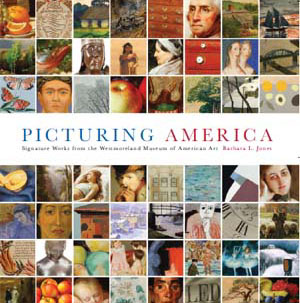 Over the past fifty years, the Westmoreland Museum of American Art, in Greensburg, Pennsylvania, has assembled a collection of works by significant American artists, concentrating on the mid-18th through the mid-20th centuries. Featuring works by John Singleton Copley, Charles Wilson Peale, and Mary Cassatt, Picturing America showcases the signature works from the museum’s collections, from preeminent American artists of the Hudson River School to modernists such as Milton Avery and Doris Lee.
Barbara Jones, Picturing America: Signature Works from the Westmoreland Museum of American Art (Greensburg, PA: Westmoreland Museum of American Art, 2010), 256 pages, ISBN: 978-0931241376, $45.
Westmoreland Museum of Art Embarks on Expansion
Press release (13 July 2013) from The Westmoreland:
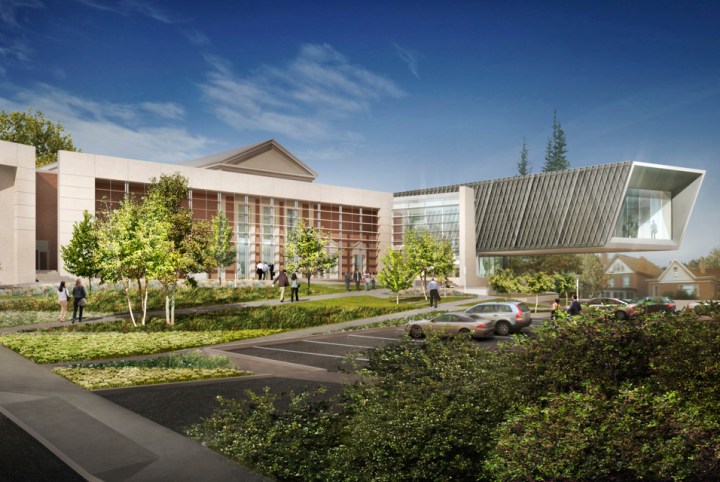 ◊ ◊ ◊ ◊ ◊
The Westmoreland Museum of American Art broke ground Friday [12 July 2013] to celebrate and begin the expansion and renovation of The Future Westmoreland. Ennead Architects of New York City and LaQuatra Bonci Associates: Landscape Architecture of Pittsburgh are working with the museum to create a new experience for visitors including a brand new wing, renovation of the existing building to have LEED silver certification, and a complete re-design of the grounds.
Pennsylvania’s First Lady Susan Corbett, Chairwoman of PA Council on the Arts, was a guest speaker at Friday’s ceremony, “The Westmoreland Museum of American Art has served as a cultural asset to downtown Greensburg and Southwestern Pennsylvania since its establishment in 1959, ” said Corbett, “The renovation and expansion of the museum will provide both visitors and residents with new ways of experiencing our American heritage.” (more…)
82nd & Fifth | Mascarade à la Grecque
The latest installment of The Met’s 82nd & Fifth:
◊ ◊ ◊ ◊ ◊
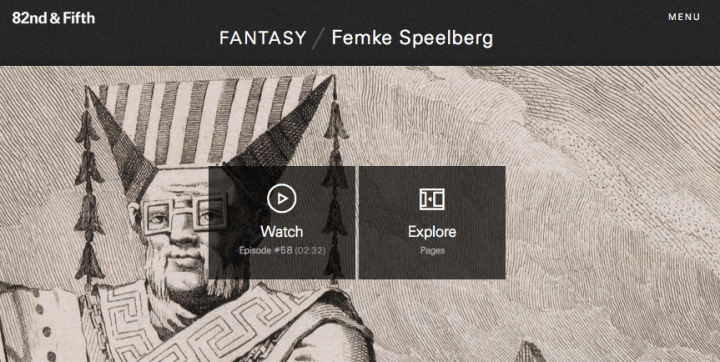
In “Fantasy” (episode #58), Femke Speelberg addresses the Mascarade à la Grecque; Suite des Vases; and [Cheminées], a series of eight etchings designed by Ennemond Alexandre Petitot, and etched and published by Benigno Bossi (1771, 1764).
Exhibition | Paintings by Hubert Robert from the Musée de Valence
Now on view at the Petit Palais:
Tableaux d’Hubert Robert du Musée de Valence
Le Petit Palais, Paris, May — October 2013
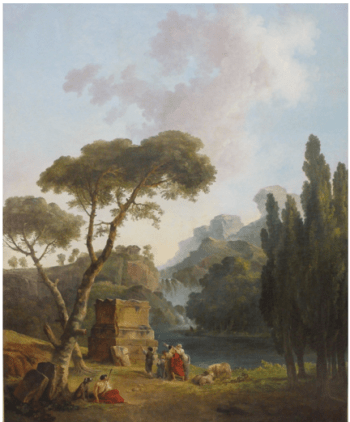
Hubert Robert, Paysage de cascade avec les bergers d’Arcadie
© Musée de Valence, photo Eric Caillet
En avant-première de la réouverture en décembre prochain du musée de Valence (Drôme), quatre des plus beaux tableaux d’Hubert Robert (1733–1808) sont présentés au Petit Palais, aux côtés des dix tableaux de l’artiste des collections permanentes.
Peintre par excellence des ruines de la Rome antique, Hubert Robert séjourna onze ans dans la ville des papes, à partir de 1754. Il en cultiva le souvenir jusqu’à la fin de sa carrière bien qu’il ait été également un chroniqueur inlassable du Paris du XVIIIe siècle. Hubert Robert a enchanté ses contemporains par sa verve, sa poésie et son inventivité – qualités qui ne pouvaient qu’enthousiasmer un critique comme Diderot. Le succès de ses paysages lui valut même la commande de plusieurs jardins qu’il peupla de « fabriques » et de grottes à la manière des tableaux qui avaient fait sa célébrité.
Connu pour sa collection incomparable de dessins d’Hubert Robert offerte par l’amateur Julien-Victor Veyrenc en 1836, le musée de Valence s’est attaché depuis plus d’une vingtaine d’années à étoffer ce fonds par l’acquisition de toiles significatives de l’artiste. L’ensemble formera un des centres de gravité du musée de Valence dont la rénovation, confiée à l’atelier d’architecture Jean-Paul Philippon, est en voie d’achèvement. Le prêt exceptionnel de quelques-uns de ses fleurons à Paris est l’occasion de les faire dialoguer avec les toiles conservées au Petit Palais. Ainsi la vue de la basilique Saint-Pierre du musée de Valence, cadrée de façon audacieuse à travers une baie, rejoint la toile vivement esquissée du Petit Palais montrant un Sculpteur sur un échafaudage dans la nef de Saint-Pierre. Le vaste Paysage de cascade avec les Bergers d’Arcadie, de Valence, est présenté dans la rotonde avec deux grandes toiles tirées des réserves du Petit Palais provenant du décor de l’hôtel Beaumarchais exécutés l’année suivante. A cette occasion, l’ensemble des salles du XVIIIe siècle du musée ont d’ailleurs été réaccrochées et des oeuvres d’autres artistes remises en valeur.
En attendant de parcourir les nouveaux espaces de l’ancien évêché de Valence, ce prêt de quelques mois est aussi une invitation à redécouvrir les galeries du XVIIIe siècle du Petit Palais – musée des Beaux-Arts de la Ville de Paris qui, rappelons-le, sont ouvertes gratuitement au public.
Le Petit Palais est heureux de soutenir la rénovation et l’extension du Musée de Valence. Pour plus d’information, téléchargez le communiqué de presse.
Judge Rules Benjamin West Altarpiece Can Go to Boston
From The Art Newspaper (11 July 2013) . . .
Anglican Court Says Benjamin West Altarpiece Can Go to Boston
City of London church to sell the masterpiece to fund repairs
By Martin Bailey
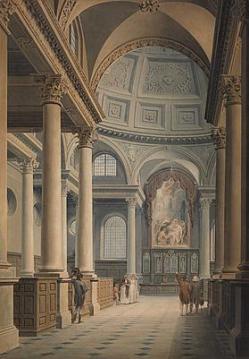
Thomas Malton (1748-1804), St Stephen Walbrook, London, watercolour over pencil, heightened with scratching out, 26 x 18 inches (646 x 447 mm)
Lowell Libson LTD (London).
West’s Devout Men Taking Away the Body of St Stephen is visible at the altar.
A Church of England court has ruled that Benjamin West’s altarpiece, Devout Men Taking Away the Body of St Stephen, 1776, which was made for one of the most important churches in the City of London can be sold for display in the US. The $2.85m painting is being bought by an anonymous foundation, which is due to lend it to the Museum of Fine Arts, Boston (The Art Newspaper, April 2013, pp6–7 and June 2013, p3). West was born in America, but worked in England.
In his judgment, delivered on 10 July, Judge Nigel Seed, chancellor of the consistory court of the Diocese of London, ruled that St Stephen Walbrook should be allowed to sell the masterpiece. The painting had been removed from the church in around 1987, in what he described as “perceived illegal actions”, and has since been kept in storage. . .
The full article is available here»
◊ ◊ ◊ ◊ ◊
As a starting place in the scholarly literature:
Jerry D. Meyer, “Benjamin West’s St Stephen Altar-Piece: A Study
in Late Eighteenth-Century Protestant Church Patronage and English
History Painting,” The Burlington Magazine 118 (September 1976): 634-41.
New Acquisition | Portrait by Adolf Ulrik Wertmüller
Press release (July 2013) from Stockholm’s Nationalmuseum:
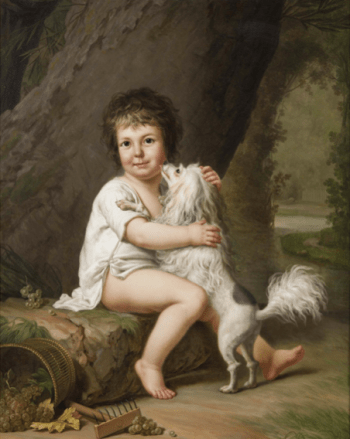
Adolf Ulrik Wertmüller, Henri Bertholet-Campan at Age Two, exhibited at the Salon of 1787 (Stockholm: Nationalmuseum, NM 7133)
Nationalmuseum’s collection of Swedish-French paintings from the 18th century now includes a portrait of the two-year-old Henri Bertholet-Campan (1784–1821), painted by Adolf Ulrik Wertmüller. The boy was the son of Marie Antoinette’s First Lady of the Bedchamber Henriette Genet-Campan. The portrait depicts him with his dog Aline in the English landscape garden at the family’s summer house in Croissy outside Paris. The painting was exhibited at the Salon of 1787, but under the rather anonymous title of A Child Playing with a Dog.
Adolf Ulrik Wertmüller (1751–1811) trained under his second cousin Alexander Roslin in Paris and studied at the French Academy in Rome. When Wertmüller returned to the French capital in spring 1781, he found it difficult to obtain work as a portraitist and instead earned his keep as a copyist at Roslin’s studio. Here he was discovered by the Swedish Ambassador Gustaf Filip Creutz, who made several important commissions. This in turn resulted in Gustav III convincing France’s Queen Marie Antoinette, during his stay in Paris in the summer of 1784, to let Wertmüller paint her portrait as a gift to the Swedish King. The portrait is currently held in the collections of Nationalmuseum.
King Gustav III had intended this to be Wertmüller’s ticket to a successful career in Paris, but jealousies abounded. When the portrait of Marie Antoinette was exhibited in August 1785, it was attacked by the critics. The Queen was also unimpressed. The artist fell into a deep depression, but recovered enough to make the necessary changes before the portrait was dispatched to Sweden the following year. It was Wertmüller’s friend Henriette Genet-Campan who came to his aid. The fact that Wertmüller even got paid was largely down to Mme Campan, since she managed the Queen’s purse and was intimately involved in the royal finances. For security reasons a mutual friend, Gabriel Lindblom, acted as a go-between in contact between the two. Lindblom had been governor to Mme Campan’s younger brother Edmond Genet and served as an interpreter at the French Ministry of Foreign Affairs in Versailles. This explains why Wertmüller was so well informed and why he came to paint almost a dozen portraits of various members of the Genet-Campan family.
As a show of gratitude to his friend Mme Campan, Wertmüller painted a portrait of her two-year-old son Henri in autumn 1786. He had already immortalised the child as a new-born baby and would continue to paint other relatives of Mme Campan. These include the portrait of her sister Adélaïde Auguié dressed as a milkmaid in the royal dairy at Petit Trianon-Le Hameau, painted in 1787. This painting has been part of the museum’s collection since 1951 as a gift from the Friends of Nationalmuseum. A study for the portrait of the French Crown Prince Louis has also since been purchased. Now this latest acquisition adds another piece to the fascinating puzzle of how Wertmüller came to paint his portrait of Queen Marie Antoinette.










 Enfilade
leave a comment