YCBA Building Conservation Project 2013
Yale Center for British Art
Building Conservation Project 2013
This summer and fall the Yale Center for British Art will complete the first phase of a major building conservation project. Beginning in June and continuing through early January 2014, the Center will refurbish its Study Room and areas used by the departments of Prints and Drawings and Rare Books and Manuscripts.
During the renovations, the second- and third-floor galleries will be closed and there will be no access to the Prints and Drawings and Rare Books and Manuscripts collections from June 4 through August 30. Beginning in September, access to the collections, which will remain in the building, will be by appointment only. Requests for appointments and materials will require at least two weeks’ notice. Center staff will make every effort to accommodate the needs of faculty, students, and scholars. The Reference Library will keep normal hours, although there will be periods of disruption.
Records of both departments’ collections are available via an online search on the Center’s website. Orbis, the online catalogue of the Yale Libraries, provides access to material from Rare Books as well as other Yale departments. The Yale Finding Aid Database offers detailed descriptions of the Rare Books Department’s archival collections, along with other archives at Yale.
The permanent collection will remain on view in the fourth-floor galleries. It is expected that normal services in the Study Room will resume by early January 2014. Details will be circulated as they become known.
Contact details
Requests for materials from the departments of Prints and Drawings and Rare Books and Manuscripts should be made at least two weeks in advance by e-mailing ycba.prints@yale.edu
For questions about Prints and Drawings collections:
Gillian Forrester, Curator of Prints and Drawings, gillian.forrester@yale.edu
For questions about Rare Books and Manuscripts collections:
Elisabeth Fairman, Senior Curator of Rare Books and Manuscripts, elisabeth.fairman@yale.edu
Inquiries about the Reference Library:
Kraig Binkowski, Chief Librarian, kraig.binkowski@yale.edu
Darby English to Lead Clark’s Research and Academic Program
Press release (24 April 2013) from The Clark:
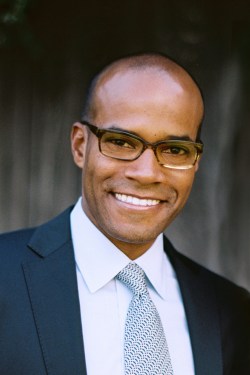 The Sterling and Francine Clark Art Institute today announced the appointment of Darby English, associate professor in the Department of Art History at the University of Chicago, to serve as the next Starr Director of the Research and Academic Program (RAP). English will lead the program’s international agenda of intellectual events and collaborations and will oversee the Clark’s library and its active residential scholars’ program, all based on the Institute’s 140-acre campus.
“Darby English brings a dynamic perspective to the work of the Clark’s Research and Academic Program, rooted in his knowledge of the field of art history—both its traditions and its new critical perspectives,” said Michael Conforti, director of the Clark. “He will build upon the Clark’s extraordinary record of accomplishment achieved during Michael Ann Holly’s fourteen years as director.”
In June 2012, Michael Ann Holly announced plans to conclude her tenure as Starr Director in the summer of 2013. Holly is widely recognized for her leadership in conceptualizing and pioneering RAP’s international series of programs and events. She will remain active in numerous Clark programs and activities in Williamstown and New York.
“The Clark is both a meeting ground and a forum for exchange and debate,” said English. “The Research and Academic Program is fueled by the international scholars who come to Williamstown as Fellows and as participants in its scholarly programs and by its many collaborations with academic programs across the world. I couldn’t be more thrilled by this opportunity to enhance the Clark’s long-established reputation for intellectual leadership in the field.”
Dr. English graduated from Williams College in 1996 with a degree in art history and philosophy and earned a doctorate in visual and cultural studies from the University of Rochester in 2002. He has served on the University of Chicago’s faculty since 2003, teaching modern and contemporary art and cultural studies. He served as the assistant director of the Research and Academic Program from 1999 through 2003. (more…)
Slow Down and Look for the 4th Annual Slow Art Day

◊ ◊ ◊ ◊ ◊
From ARTInfo:
Kyle Chayka, “Slow Art Day Fights Visual Grazing With a Deep Dive into Museums,” ARTInfo (17 August 2012).
A 2001 study showed that visitors to the Metropolitan Museum looked at individual works of art for an average of just 17 seconds at a time, a visual habit called ‘grazing’. Even the most iconic artworks in the world can’t seem to hold our attention: The Louvre discovered that visitors look at the Mona Lisa for just 15 seconds on average [link to James Elkins,”How Long Does It Take to Look at a Painting,” The Huffington Post (6 November 2010).] In the age of the moving image and endlessly updated World Wide Web, works of art in more traditional media don’t get the focus they deserve. Slow Art Day, a three-year-old initiative currently ramping up for its 2013 event, is looking to change all that with an orchestrated long art-viewing session at museums around the world.
The full article is available here»
New Book | Paris 1650-1900: Decorative Arts in the Rijksmuseum
With the Rijksmuseum open once again, this book is especially timely. It’s due out in May from Yale UP:
Reinier Baarsen, Paris 1650-1900: Decorative Arts in the Rijksmuseum (New Haven: Yale University Press, 2013), 608 pages, ISBN: 978-0300191295, $275.
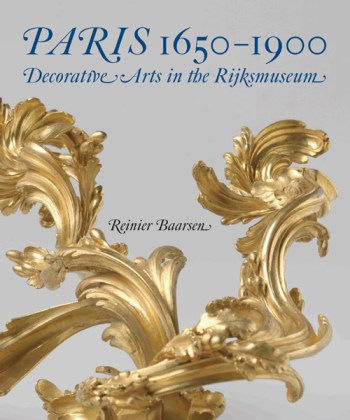 From 1650 to 1900 Paris was the undisputed center of fashion and taste in Europe. Home to a unique concentration of artists, designers, patrons, critics, and a keen buying public, Paris was the city where trends were made and where novel types of objects, devised for new ways of life, were invented. This book traces the wonderful story of Parisian decorative arts from the reign of Louis XIV to the triumph of art nouveau, through a selection of 150 breathtaking, and often little-known, masterpieces from the collection of the Rijksmuseum in Amsterdam. It features an exhilarating mixture of furniture, gilt bronze, tapestries, silver, watches, snuff-boxes, jewellery, Sèvres porcelain, and other ceramics, as well as some design drawings and engravings. Specially taken photographs reveal the daring design and beautiful execution of the work of some of the greatest artists and craftsmen of their time. Reinier Baarsen discusses the history and significance of each object, presenting the findings of much new research.
Reinier Baarsen is senior curator of furniture at the
Rijksmuseum.
Berlusconi’s Interventions Reversed
As reported by the Agence France-Presse (AFP):

AFP Photo by Andreas Solaro
An ancient statue of Mars has lost its fake penis and his counterpart Venus her hands, in the reversal of cosmetic changes ordered by Italy’s ex-prime minister Silvio Berlusconi, a newspaper reported Wednesday.
In 2010 Berlusconi decided the two marble statues adorning the official residence of the prime minister were ‘incomplete’ and ordered a swift intervention to remedy their shortcomings. In a move which horrified the art world, Mars was touched up with a fake penis, shield, hand and the point of his sword and Venus her two hands. The 70,000 euro ($90,000) cost of the changes also sparked ridicule and anger
from the opposition. . .
The full article is available here»
Recreated Ceiling of the Gwoździec Synagogue Unveiled in Warsaw
On Tuesday, 12 March 2013, the Museum of the History of Polish Jews in Warsaw (scheduled to open next year) unveiled the newly completed replica of the ceiling from the Gwoździec Synagogue, which was lost when the building was destroyed during World War II. According to the website of Hands House Studio, the synagogue was largely constructed between 1700 and 1731, with some older portions dating to the seventeenth century. As reported by the Agence France-Presse (AFP):
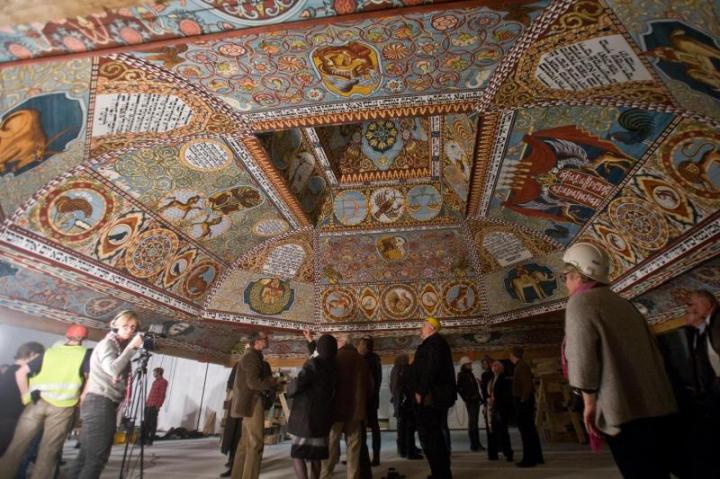
Gwoździec Synagogue Re!construction Project.
Museum of the History of Polish Jews, Warschau
◊ ◊ ◊ ◊ ◊
. . . a life-sized replica of the polychrome ceiling of an 18th-century synagogue inspired awe Tuesday [12 March 2013] as it was unveiled in the Polish capital. Covered in richly coloured Old Testament scenes and lushly stylised floral themes, the original ceiling adorned a wooden synagogue in what was the pre-World War II eastern Polish town of Gwozdziec, near what is now Lviv, western Ukraine. Like thousands of other Jewish religious sites, it was destroyed during the war by Nazi Germany. Its modern replica is the centrepiece of the Polish capital’s new Museum of the History of Polish Jews, due to be formally inaugurated April 19, marking the 70th anniversary of the World War II Warsaw Ghetto Uprising. Its door will open to the public next year. . . .
The replica was handcrafted from wood using traditional tools and techniques and involved nearly 300 craftspeople and artists from around the globe. The new museum is being built in the heart of the Polish capital on the site of the Jewish ghetto that became a symbol of resistance to Nazi Germany’s efforts to eradicate 1,000 years of Jewish presence in Poland. Designed by Finnish architects Rainer Mahlamaeki and Ilmar Lahdelma, the new museum faces the imposing black-stone Warsaw Ghetto Uprising memorial dedicated to those who perished in the doomed 1943 Jewish revolt against the Nazis. . . .
◊ ◊ ◊ ◊ ◊
Note (added 18 January 2023) — More information on the ceiling is available here with Ariel Fein’s essay for SmartHistory (4 April 2022).
Cleveland Museum of Art Acquires Newport Desk and Bookcase
Press release (9 February 2013) from the Cleveland Museum of Art:

Desk and Bookcase, Newport, Rhode Island, ca. 1780-95. Plum pudding mahogany, red cedar, chestnut, white pine and brass; 240 x 108 x 65 cm. (Cleveland Museum of Art)
Donated to the Cleveland Museum of Art by Daniel Harvey Buchanan, a retired Case Western Reserve University professor, in memory of his wife Penelope Draper Buchanan and her mother Dorothy Tuckerman Draper, this desk and bookcase dates from ca. 1780-95, a rich period of cabinetmaking in Newport, Rhode Island, just after the American Revolution. The work is attributed to the master cabinetmaker John Townsend or his brother Thomas Townsend based on stylistic similarities to other known case pieces by this leading cabinetmaking family of Newport. Commissioned by Oliver Wolcott, Sr., a signer of the Declaration of Independence from Connecticut, the desk has an unbroken provenance from its first owner by descent through the Wolcott, Tuckerman, Minturn and Draper families to its final owners, Penelope and Harvey Buchanan.
Dorothy Draper (1889–1969), Penelope Buchanan’s mother, displayed the desk and bookcase in her fashionable New York apartment at the Carlyle Hotel until coming to live in Cleveland in 1965. Dorothy Draper was a world-renowned interior designer and established the first interior design company in the United States in 1923. She had a regular column in Good Housekeeping Magazine and in 2006, Dorothy Draper was honored in a retrospective exhibition of her work by the Museum of the City of New York. According to Stephen Harrison, curator of decorative art and design, “This gift celebrates the extraordinary stewardship of one family in preserving such an important relic of American history from the eighteenth century. Such a gift is transformative in the development of our American collections. We could not have otherwise acquired such a masterpiece in the American furniture market today.” Harrison further stated, “This work will join other colonial-era masterpieces in the museum’s American galleries as a testament to the remarkable craftsmanship of American cabinetmakers in the eighteenth century.”
The quality of the workmanship in this desk and bookcase is superb and displays masterful embellishments known only to the finest Newport case pieces. For example, the use of “plum pudding” mahogany, a type of wood that is extremely rare and named for the blemishes in it that resemble the raisins in a plum pudding along with inset panels with canted corners (a decorative angled corner). Only one other example exhibiting canted corners on the upper panels is known to exist, making this piece extremely rare in the world of Newport furniture. The case also has stop-fluted corner pilasters (columns); carved “cupcake” finials (flattened finial with a corkscrew extending from it); and highly sophisticated drawer details. In addition, it retains its original brass pulls and escutcheons, and there is evidence of original finish inside the desk top. The Oliver Wolcott Desk and Bookcase augments the Cleveland Museum of Art’s small but choice collection of early American furniture and is now on view in the American Colonial Gallery.
Exhibition | Life at the Château de Prangins in the 18th Century
From the museum’s website:
Noblesse Oblige! Life at a Château in the 18th Century
Swiss National Museum, Château de Prangins, beginning 23 March 2013

Château de Prangins, 2005
(Photo from Wikimedia Commons)
◊ ◊ ◊ ◊ ◊
Château de Prangins is bringing its past to life and showcasing its historical heritage. From 23 March 2013 the former reception rooms, comprising the salon, dining rooms and libraries, will be revealed in their original grandeur as the backdrop for the new permanent exhibition. Boiseries in their original colours, textiles with lustrous motifs and false-marble decorations create the perfect surroundings for 600 objects from the era.
 Noblesse Oblige! Life at a Château in the 18th Century is devoted to the everyday life of a noble family in the Vaud region at the end of the 18th century and explores important issues of cultural history. The exhibition offers an insight into the life of a baron and the way in which he manages his estate, his duties and obligations, his family and social life. Each of the nine rooms is devoted to a specific topic that mirrors its original function: hospitality, wealth and lighting in the salon, servants in the butler’s pantry, and the taste for reading in the library.
Two audioguides – one for adults, the other for younger audiences – and specially produced films featuring the voices of the inhabitants allow visitors to immerse themselves in life at a château.
Project manager: Helen Bieri Thomson
The Met and Crystal Bridges to Share Portrait of Alexander Hamilton
Press release (14 March 2013) from Crystal Bridges:

John Trumbull, Portrait of Alexander Hamilton, 1792. Oil on canvas, 86 x 58 inches (219.1 x 146.1 cm)
An iconic full-length portrait by the celebrated Revolutionary-era painter John Trumbull of Alexander Hamilton, then Secretary of the Treasury under President George Washington, will join the permanent collections of both Crystal Bridges Museum of American Art and The Metropolitan Museum of Art, thanks to a gift from the painting’s owner, the global wealth manager and investment bank Credit Suisse.
Each institution will own a half share of Portrait of Alexander Hamilton (1792), which is currently on view at Crystal Bridges and has been on loan from Credit Suisse and on view since the museum opened. The painting will travel to the Metropolitan Museum in summer 2013 and return to Crystal Bridges in 2014. In subsequent years, each museum plans to exhibit the painting for two-year periods, when it will be integrated into the galleries and, on occasion, included in special exhibitions at each museum.
“We are very grateful to Credit Suisse for the generous gift of this distinguished portrait of Alexander Hamilton, whose political and legal acumen put him at the center of the founding of the new American republic, and whose key contributions to business and banking in Federal-era New York City effectively established the financial marketplace in this country,” stated Thomas P. Campbell, Director and CEO of The Metropolitan Museum of Art. “As the greatest known portrait of Hamilton and one of the finest civic portraits from the Federal period, this painting is a splendid addition to our fine collection of portraits of American political leaders. We are pleased and honored to share this remarkable work with Crystal Bridges.” (more…)
The Met Acquires Work by William Theed
As noted at Art Daily (14 March 2013) . . .
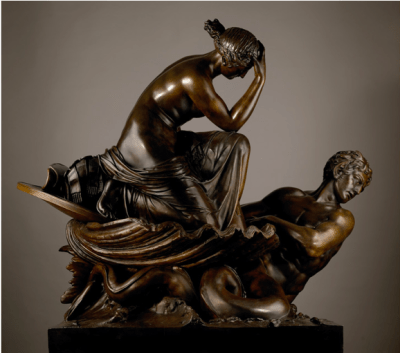
William Theed the Elder (1764-1817), Thetis Returning from Vulcan with the Armour of Achilles. Bronze, cast, chased and patinated, on an integral rectangular plinth. Height: 128 cm; width: 120 cm; length: 143 cm.
For over a year, Tomasso Brothers, the internationally renowned dealers in European sculpture, paintings, furniture and the decorative arts, has been searching for an elegant space in London. Dino and Raffaello are now delighted to announce that from 1 May 2013 they can be found at their new gallery at 12 Duke Street , St James’s. Established in 1993 and based at Bardon Hall, Leeds, Tomasso Brothers is pleased to also have a presence in the heart of London ’s traditional art market where they will showcase exciting pieces from their extensive portfolio.
The two Tomasso brothers are especially renowned for their expertise in European sculpture and boast a number of the world’s greatest museums amongst their clients. Recent sales include a major bronze to the Metropolitan Museum of Art, New York, Thetis Returning from Vulcan with the Armour of Achilles by William Theed the Elder (1764-1817), which was unveiled at the inaugural Frieze Masters in October 2012. This remarkable, almost life-size, bronze depicts the ‘divine Thetis of the silver feet’, most famous of the Nereids in Homer’s Iliad, kneeling by the shield of her son Achilles with the hero’s armour in a giant cockle shell. This spectacular sculpture, described by Sir Timothy Clifford as ‘undoubtedly Theed’s most ambitious work’, was almost certainly originally supplied to the author, philosopher, interior designer and art collector, Thomas Hope (1769-1831) for Duchess Street, London, or his country house Deepdene in Surrey. William Theed was born in London and entered the Royal Academy Schools in 1786. He went to Italy in 1790, returning in 1796. He began his artistic career as a painter but was befriended by the sculptor John Flaxman whilst in Rome and took up sculpture. Flaxman’s designs for Homer’s Iliad clearly made a powerful and lasting impression on the young Theed. Dino Tomasso said: ‘It is hugely gratifying when such a superb sculpture ends up in one of the world’s leading museums’. Dino and Raffaello Tomasso take great pride and pleasure in helping connoisseurs and museums in Europe and America to enhance their collections. In addition the company has promoted and supported through loans and exhibitions major international institutions such as the Fitzwilliam Museum, Cambridge, the Centro Internazionale, Carrara, the National Gallery, Prague, and the Kunsthistorisches Museum, Vienna. Most recently they were one of the sponsors of the landmark show Bronze at the Royal Academy of Arts, London , in 2012.
Tomasso Brothers will be exhibiting at TEFAF, 15 to 24 March 2013, Stand 165, Masterpiece London, 27 June to 3 July 2013, Stand C2, and also joining Master Drawings and Sculpture Week from 28 June to 5 July 2013.










 Enfilade
leave a comment