At Auction | Liberty or Death: Relics from the American Revolution
While I generally refrain from editorializing, it seems to me that there’s something dreadful linguistically and maybe conceptually about the phrase “selling exhibition.” On the other hand, the objects included in the sale and the exhibition look interesting enough, and this is the first I’ve heard of the Museum of the American Revolution (further proof of just how much slips past me!). Robert A. M. Stern’s design plans were unveiled last June, and the museum plans to open in 2016. -CH
◊ ◊ ◊ ◊ ◊
From a Sotheby’s press release (6 June 2013) . . .
Liberty or Death: Relics from the American Revolution
Sotheby’s, New York, 1–28 June 2013

Robert A. M. Stern, Architectural Rendering for the Museum of the American Revolution in Philadelphia
Sotheby’s presents Liberty or Death: Relics from the American Revolution, an exciting cross-platform initiative in collaboration with Philadelphia’s Museum of the American Revolution. The selling exhibition features items for sale by Sotheby’s as well as objects on loan from the museum’s extraordinary collection, creating a fresh, multi-dimensional dialogue on America’s struggle for independence. The exhibition will be open to the public through 28 June 2013.
The Museum of the American Revolution will be a national institution that will chronicle the full sweep of the American Revolution – the deadly struggle between British and American forces as well as the growth of the idea of independence. Located in Philadelphia, Pennsylvania, the museum will be built steps away from where the Declaration of Independence was drafted, debated and adopted. Funds are currently being raised to build the institution. “We are delighted to collaborate with Sotheby’s to display these great treasures from our collection. Through this exhibition, people now have a rare opportunity to view these relics as they await display in the new Museum of the American Revolution,” said Michael C. Quinn, President and CEO of the Museum of the American Revolution.
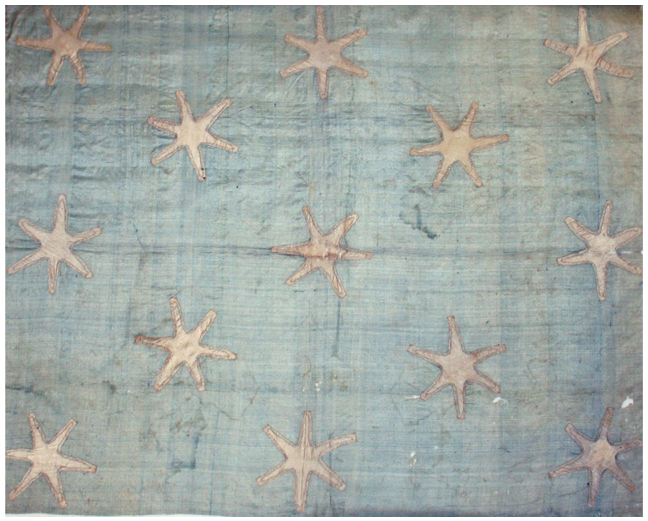
Commander in Chief’s Standard, ca. 1777-83 (Philadelphia: Museum of the American Revolution)
The distinctive thirteen-star blue silk standard circa 1777–83 that marked the presence of the Commander-in-chief on the battlefield and in headquarters is on loan from the museum and currently on view. This rectangular standard has been known for more than a century as George Washington’s Headquarters flag. It descended in the family of Washington’s sister, Betty Washington Lewis, whose son George served as an officer in the Commander-in-Chief’s guard. Also on loan from the museum are ten original silver camp cups from George Washington’s military field equipment with commemorative inscriptions. The original set of twelve cups, used to serve wine to aides and guests at the General’s table, were made in the shop of Philadelphia silversmith Edmund Milne in August 1777.
Sotheby’s selling exhibition will include a rare contemporary printing of the Declaration of Independence, the official printing for Massachusetts Bay, and a fine and rare engraved powder horn from March 22, 1770, owned by Jonathan Leonard Jr. (February 17, 1763 – January 25, 1849), a soldier in the American Revolution. The unique phrase, “Britain to Washington Shall Yield, Freedom Shall Triumph in the Field,” is engraved on the horn, paraphrased from the last verse of the highly popular song of the time, Great News from the Jerseys. Also included in the sale is the William Schuyler American horseman saber with figured maple grip, eagle pommel and original leather scabbard circa 1778–90. Opening hours are Monday – Saturday 10 am – 5pm and Sunday 1 pm – 5pm through 28 June 2013.
The Museum of the American Revolution will tell the complete story of the American Revolution. To be built in historic Philadelphia, just steps from Independence Hall and the Liberty Bell, the museum will feature a distinguished collection of objects, artifacts, artwork, and manuscripts from the period of the American Revolution that will bring to life the original “greatest generation” and engage people in the history and continuing relevance of the American Revolution.
Colonial Williamsburg Collaborates with Benjamin Moore
Up to now, Enfilade has reported on The Met’s relationship with Farrow & Ball and The Cleveland Museum of Art’s relationship with Glidden. The Colonial Williamsburg Foundation has just launched an alliance in the other direction with Benjamin Moore. My hunch is that color consultant Patrick Baty (interviewed for Enfilade in 2011 by Courtney Barnes), will see the range as emphatically leaning toward ‘trend’ rather than ‘tradition’. And yet, there are some lovely drab hues with charming names. -CH
Press release (16 May 2013) from the Colonial Williamsburg Foundation . . .

Benjamin Moore, one of North America’s most respected paint manufacturers and color authorities, has joined with the Colonial Williamsburg Foundation’s Williamsburg brand to launch the Williamsburg® Color Collection by Benjamin Moore – an assortment of paint colors authentically rooted in the history of our nation and its founding. The new, 144-color palette represents a unique intersection of history, science and design that reflects actual colors that existed in the 18th and 19th century, brought to customers through the most advanced paint technology in the industry from Benjamin Moore.
“This work showcases the close collaboration between two firms steeped in a rich heritage, both having passion for bringing history into the home,” said Carl Minchew, Benjamin Moore’s vice president of color innovation and design. “The Williamsburg® Color Collection by Benjamin Moore offers our customers beautiful shades in a palette of amazing, accurate colors that are as stylish today as they were 250 years ago.”
Colonial Williamsburg’s unparalleled research team of historians and conservators examined period documents, paint samples, wallpaper and architectural fragments that led to fresh and unexpected color findings. The Benjamin Moore team then carefully studied pigment compositions in order to precisely match these colors using the latest scientific methods to ensure the highest degree of authenticity to the original hues. As a result, the Williamsburg® Color Collection by Benjamin Moore presents vibrant yet complex shades as they appeared more than 250 years ago that can be effortlessly incorporated into the modern home.
“It has been very exciting to work with Benjamin Moore developing a paint palette based on historic precedent,” said Matthew Webster, director of the Grainger Department of Historic Architectural Resources for the Colonial Williamsburg Foundation. “Together we developed the colors using almost 90 years of paint research and an understanding of historic production methods creating a palette that embodies the Williamsburg ‘trend meets tradition’ theme. It’s personally satisfying to see research become reality with a palette that is consistent with colors that would have been found in the 18th century.”
Meadows Acquires Work Attributed to Juan Alonso Villabrille y Ron
Press release (29 May 2013) from the Meadows Museum in Dallas:
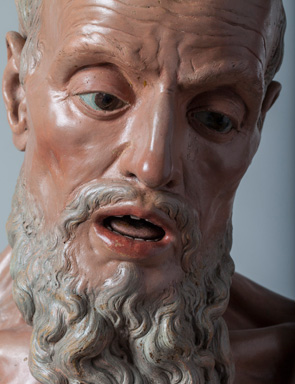
Juan Alonso Villabrille y Ron, St. Paul the Hermit (detail), ca. 1715, terracotta (Dallas: Meadows Museum, SMU)
The Meadows Museum has acquired the first terracotta sculpture attributed to Spanish Baroque master Juan Alonso Villabrille y Ron. In-depth research conducted by museum staff members sheds new light on the identity of the bust-length sculpture’s subject and its historical significance. When the sculpture was initially offered to the Museum it was believed to depict St. Jerome, Doctor of the Church. Meadows curators’ research, however, determined that the subject is in fact St. Paul the Hermit.
Villabrille y Ron is considered one of the most important Spanish sculptors of the Late Baroque period because of his mastery of technique. In addition, he taught another renowned sculptor of the period, Luis Salvador Carmona, and worked for the court in Madrid in the early eighteenth century. The quality of his work was such that he received commissions to create sculptures for some of the most important monuments in the city, such as the Puente de Toledo and the façade of the former Hospicio Provincial (now the Museo Municipal de Madrid). This sculpture is the first terracotta work to be attributed to Villabrille y Ron; not many examples of Spanish terracotta sculptures from the period have survived. Most of the works attributed to Villabrille y Ron are of polychromed wood or stone.
“Villabrille’s sculpture is a work of staggering realism and powerful emotion, and it provides an excellent complement to our already strong collection of works from the Baroque period,” said Mark A. Roglán, director of the Meadows Museum. “The acquisition of this prime example of Late Baroque sculpture will increase our ability to educate our visitors on this rich and versatile era in Spain by using objects that exemplify the style of the period. The students who use our Museum as a learning space and the visitors who come for pleasure will have an enriched experience because of this unique and beautiful example of Spanish sculpture.”
When the sculpture was initially offered to the Museum it was believed to depict St. Jerome, Doctor of the Church, who retired as a hermit to the Syrian Desert for three years’ penance. Meadows’ curators, however, took note of the subject’s prominently positioned woven reed garment, a vestment not present in any of the many other existing depictions of St. Jerome, and concluded the likeness had been misidentified. Their research determined that the subject is in fact St. Paul the Hermit, the first hermit saint of the Christian church, who is always shown as an old man wearing a woven reed garment made of palm leaves sewn together. Various experts in the field of early modern religious iconography, including George Washington University Professor Barbara von Barghahn and Richard P. Townsend, independent art historian, have confirmed the amended identification. (more…)
82nd & Fifth: One work. One curator. Two minutes at a time.
As art historians come around to moving pictures and expanding notions of audience, experiments from the Met (smartly packaged under the label 82nd & Fifth) are particularly interesting. -CH
◊ ◊ ◊ ◊ ◊
As introduced by Thomas Campbell:
[Earlier this year, the Metropolitan Museum of Art] launched 82nd & Fifth, a new Web feature that asks one hundred curators from across the Museum to each talk about a work of art from the Met’s collection that changed the way they see the world. One work. One curator. Two minutes at a time.
82nd & Fifth speaks directly to my interest in linking historical art and culture to a broader conversation. The Met is located at 82nd & Fifth but its relevance is global, allowing people to better understand both themselves and the world around them in the broadest sense.
We live in a sea of constant information, and these two-minute, authoritative commentaries are a welcome way to get powerful and compelling content in quick doses. We hope they will intrigue audiences who love the Met and those who are new to art.
◊ ◊ ◊ ◊ ◊
In “Morning Catch” (episode #38), Jeff Munger addresses a broth bowl from Vincennes, ca. 1740-56.
In “Family” (episode #40), Perrin Stein discusses Jacques-Louis David’s Study for The Lictors Bringing Brutus the Bodies of his Sons, 1787.

New Acquisition | Getty Acquires Runge’s ‘Times of Day’
Press release (23 May 2013) from The Getty:
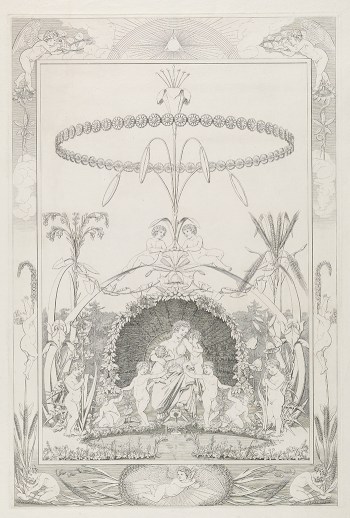
Philipp Otto Runge, Day, from Times of Day, 1805. Printmakers: E.G. Krüger and J. A Darnstedt. Etching and engraving
(Los Angeles: The Getty Research Institute)
The Getty Research Institute (GRI) announced today the acquisition of a rare first edition, Times of Day by Philip Otto Runge (1777–1810). Published in 1805, this suite of four prints representing Morning, Evening, Day, and Night is widely recognized as a monument of German Romantic art.
“This remarkable set of engravings is a radical, personal expression from one of the leaders of the German Romantic movement,” said Thomas W. Gaehtgens, director of the Getty Research Institute. “It is a landmark addition to the Getty Research Institute’s important prints collection.”
Runge, along with Caspar David Friedrich (1774–1840), was one of the leading painters and theorists of the German Romantic movement. He rejected the tradition of academic painting in favor of art that symbolically expressed the essential harmony of nature, humanity, and the divine. The complex iconography of Times of Day, which is very detailed, is meant to express the coming and departing of light—dawn, daytime, dusk, and darkness—and at the same time represents the organic process of conception, growth, decay and death.
“The elegance and purity of these images stands the test of time, expressing universal themes with grace and boldness,” said Louis Marchesano, curator of prints and drawings at the Getty Research Institute. “In his own time, Runge was praised and collected by important cultural figures such as Johann Wolfgang von Goethe.”
From 1802 until his untimely death in 1810 at the age of 33, Runge worked obsessively on these images, carefully articulating every aspect of their compositions and frames. Early in the planning stages, he made four large outline drawings in preparation for the four final images.
This first, small edition of the four engravings, published in 1805, reflects the delicacy of Runge’s carefully constructed preparatory drawings. Although the artist approved the production of a second, significantly larger edition, his original intent was not commercial. Runge shared his first edition with other artists and writers in order to disseminate his new artistic ideas and to announce his plans to create a large painting cycle based upon the designs. Those paintings were never completed; thus the prints are an important record of the artist’s goals.
The prints are now part of the GRI’s Special Collections, which comprise rare and unique collections in art history and visual culture from around the world, including more than 27,000 prints ranging from the Renaissance to the present.
The Frick Announces Loans from Horace Wood Brock
Press release (14 May 2013) from The Frick Collection:
![Mounted Vase, c. 1786–88, Royal Manufactory of Sèvres, hard-paste porcelain with gilt-bronze mounts attributed to Pierre-Philippe Thomire (1751–1843); Horace Wood Brock Collection; photo: Michael Bodycomb. More Information: http://www.artdaily.com/index.asp?int_sec=2&int_new=62577#.UZOed7YzKA8[/url] Copyright © artdaily.org](https://enfilade18thc.com/wp-content/uploads/2013/05/screen-shot-2013-05-15-at-10-49-30-am.png?w=720)
Mounted Vase, ca. 1786–88, Royal Manufactory of Sèvres, hard-paste
porcelain with gilt-bronze mounts attributed to Pierre-Philippe Thomire;
Horace Wood Brock Collection. Photo: Michael Bodycomb
◊ ◊ ◊ ◊ ◊
The Frick Collection announced the extended loan of several important decorative arts objects from Horace Wood Brock, one of America’s most remarkable collectors. Over the last three decades, he has assembled an enviable collection of French and English decorative arts dating from 1675 to 1820, as well as paintings and Old Master drawings. Dr. Brock has also been a generous lender of works of art, loaning objects to the J. Paul Getty Museum in Los Angeles and the Museum of Fine Arts, Boston, and now to the Frick. Five French clocks from his collection are featured in the current special exhibition Precision and Splendor: Clocks and Watches at The Frick Collection, which opened in the Portico Gallery in January and will remain on view until February 2014. In addition to Dr. Brock’s clocks, four important pieces of French eighteenth-century decorative arts from his private collection are now on view in the Frick’s permanent collection galleries, where they can be enjoyed by museum visitors for the next several years. They are a secrétaire by Royal cabinetmaker Jean-Henri Riesener, a longcase clock by Balthazar Lieutaud, and two rare Sèvres porcelain vases. The exhibition of clocks and watches as well as the placement of the four additional loans in the galleries has been coordinated by the Frick’s Associate Curator of Decorative Arts, Charlotte Vignon.
The impressive longcase regulator clock displayed in the East Vestibule near the museum’s Entrance Hall was made in Paris around 1750−55, when the fashion for rococo design was at its peak. A perfect example of this highly decorative style, the clock’s shape avoids straight lines in favor of a fanciful play of curves and counter-curves, adorned by heavy gilt-bronze mounts that call to mind the branches of a tree. Although the mounts take their inspiration from nature, they are not representational but rather a pure fantasy of the rococo style. The clock is topped by the winged figure of Time, made by an unknown craftsman. The figure holds a scythe in one hand and an hourglass in the other as reminders of man’s mortality. The case was made by Balthazar Lieutaud, who became a master cabinetmaker in 1749, only a few years before creating this piece. About a decade later, in 1767, he executed a longcase clock that was purchased by Henry Clay Frick in 1915 and is now displayed at the foot of the Grand Staircase. It was made in the newly fashionable neoclassical style, which evolved in response to the extravagance of the rococo. This later clock is crowned by a gilt-bronze group representing Apollo riding his chariot, made by the bronzemaker Philippe Caffiéri.

Potpourri Vase and Cover, ca. 1763–70, Royal Manufactory of Sèvres, painted and gilded soft-paste porcelain with gilt-bronze mounts, ca. 1785; Horace Wood Brock Collection. Photo: Michael Bodycomb.
The exquisite soft-paste potpourri vase on view in the Fragonard Room was made by the Royal Manufactory of Sèvres around 1763–70. Its gilt-bronze mounts were added later, around 1785. The vase is topped by a finial composed of a cluster of berries nestled inside an acanthus-leaf cup. The support— which incorporates goats’ heads with elaborately curved horns—recalls the Athénienne, a type of pedestal table that was fashionable during the late eighteenth century in France and was loosely based on ancient models. The pierced metal band that separates the bowl of the vase from its cover suggests that it might have been designed to hold potpourri, a fragrant mixture of dried flowers and spices that perfumed the air of aristocratic residences during the eighteenth century. With its references to classical antiquity, it also could have been intended to evoke an incense burner, although it is unlikely that it would have been used in this way. The pendant to Dr. Brock’s vase is in the collection of Queen Elizabeth II.
A second vase made at the Royal Manufactory of Sèvres and lent by Dr. Brock is illustrated above. Between 1786 and 1788, the Sèvres manufactory produced a dozen round and oval vases in dark blue hard-paste porcelain that were fitted with gilt-bronze mounts attributed to the renowned bronzemaker Pierre Philippe Thomire. The oval version was commissioned in November of 1786 by Dominique Daguerre, the preeminent Parisian marchand-mercier (merchant of luxury goods) of the period, and thus was referred to in the factory’s records as a “vase Daguerre ovale.” The vase exemplifies the highly sophisticated luxury items produced in France on the eve of the revolution. The symmetry of the vase recalls ancient models, as do its gilt-bronze mounts, which are in the shape of acanthus and laurel leaves, pine cones, and palmettes.
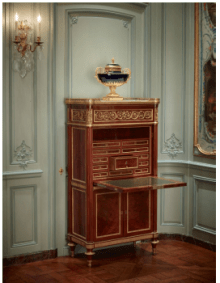
Secrétaire à abbatant, ca. 1785, by Jean-Henri Riesener, oak veneered with mahogany, gilt-bronze mounts, marble, leather writing surface; Horace Wood Brock Collection. Photo: Michael Bodycomb
The vase is displayed in the Boucher Room atop a secrétaire à abbatant, also from Dr. Brock’s collection. The French word secrétaire derives from secret, or secrecy. Such pieces were created to secure private documents. When opened, the fall-front panel provides a leather-covered writing surface and reveals twelve interior drawers of varying sizes and shapes. The lower part of the cabinet (concealed by two doors) provides extra storage, as does the large drawer above the fall-front panel. The desk was made around 1785 by Jean-Henri Riesener, who was appointed cabinetmaker to the king in 1774, the year Louis XVI acceded to the throne. In 1784, when the crown was attempting to reduce its expenditures, Riesener was replaced by a younger (and less expensive) cabinetmaker. Around this time his style changed, shifting away from furniture decorated with marquetry in colorful, exotic woods to veneered mahogany as seen in this secrétaire. Although this change was probably motivated by an effort to eliminate the labor-intensive marquetry work, it also reflected the new taste for simpler furniture that had been inspired by English models. Dr. Brock’s secrétaire epitomizes Riesener’s latest style. The splendid yet sober mahogany veneer panels are adorned with gilt-bronze mounts inspired by classical architecture: a frieze of scrolled acanthus leaves decorates the large drawer above the fall-front panel while a less ornate frieze of smaller acanthus leaves frames the desk’s side and front panels. The result is an elegant, perfectly symmetrical, and harmonious piece of furniture. (more…)
Alan and Simone Hartman Galleries Open at Boston’s MFA
Press release from Boston’s MFA:
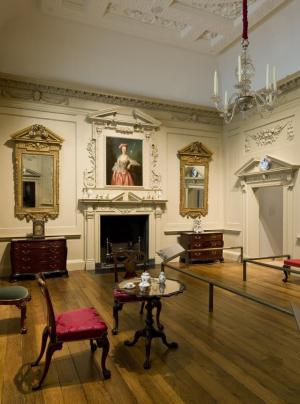 Two 18th-century period rooms from Great Britain have been reinstalled at the Museum of Fine Arts, Boston, as part of a suite of galleries. The Alan and Simone Hartman Galleries comprise the Newland House Drawing Room, Hamilton Palace Dining Room, and British Art 1560–1830. They showcase nearly every facet of British art—paintings, furniture, silver, ceramics, and works on paper—including the Alan and Simone Hartman Collection of English silver, with superb examples made in London by Huguenot craftsmen between 1680 and 1760. The drawing room from Newland House, a manor house in Gloucestershire, England, was acquired by the MFA in 1931 and was last on view at the Museum in the 1970s. The dining room from Hamilton Palace, the vast residence of the Dukes of Hamilton just outside of Glasgow, Scotland, was acquired by the MFA in 1924. It was installed in 1928, but was dismantled during the past decade due to the construction of the adjacent Art of the Americas Wing, which debuted in November 2010. The three adjacent Hartman Galleries are located on Level 2 of the Museum’s Art of Europe wing. Concurrent to their opening, the MFA has unveiled its new Art of the Netherlands in the 17th Century Gallery (the renovation of this gallery was made possible by Rose-Marie and Eijk van Otterloo) and the renovated Leo and Phyllis Beranek Gallery, which together showcase more than 100 works. (more…)
Glidden and The Cleveland Museum of Art
Last month’s ASECS meeting in Cleveland delivered all sorts of intellectual stimulation, including a lovely reception at The Cleveland Museum of Art, where The Last Days of Pompeii is on show until May 19. We can add the museum to the list of institutions making the most of sponsorship opportunities to include installation wall paint, in this case from Glidden. Given that Glidden’s headquarters have been in the Cleveland area since the company’s founding in 1875, the relationship makes sense. Copies of the following card were available at the exhibition, though interestingly not online (at least, I was unable to find it and thus the less than ideal colors and clarity from my scan). -CH

Anne-Marie Eze Appointed Associate Curator at the Gardner
Press release from the Gardner Museum:
 The Isabella Stewart Gardner Museum recently appointed Dr. Anne-Marie Eze as the Associate Curator of the Collection. Eze had been working as the Museum’s first Andrew W. Mellon Postdoctoral Curatorial Fellow since 2010. She began her new position on April 1. “Over the last three years Anne-Marie has contributed significantly to research on the collection and programs and is a great asset to the Gardner,” said Anne Hawley, Norma Jean Calderwood Director of the Isabella Stewart Gardner Museum. “We are pleased to continue to benefit from her vast knowledge and hard work.”
During her time at the Museum, Eze has researched and raised the profile of the museum’s manuscripts and rare books collection through her exhibition Illuminating the Serenissima: Books of the Republic of Venice (2011), scholarly publications and public programs. Eze also assisted the Lia and William Poorvu Curator of the Collection Oliver Tostmann with the exhibition and catalogue Anders Zorn: A European Artist Seduces America (2013), and his predecessor Alan Chong with the publication of Furnishing a Museum: Isabella Stewart Gardner’s Collection of Italian Furniture. “The Gardner Museum is a very exciting place to be right now, so I am delighted to continue working here in a new capacity,” said Eze.
Originally from the United Kingdom, Eze studied classics (B.A.), and library science (M.A.) with a concentration in manuscript studies and historical bibliography, at University College London. A year of her undergraduate degree
was spent at the University of Bologna, Italy, where she became fluent in Italian. From 2003-2006, Eze worked as an assistant curator at the Victoria and Albert Museum, and in 2010 completed a collaborative doctorate in art history at the Courtauld Institute of Art and the department of Western Manuscripts of the British Library.
Wellesley’s Davis Museum Acquires Peruvian Portrait of a Young Woman
Press release from The Davis:
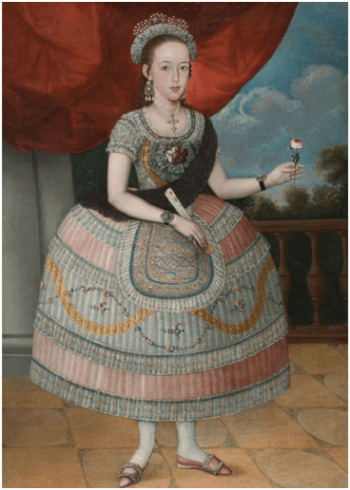
Portrait of a Young Woman, late eighteenth century, oil on canvas,
55 x 39 inches (Davis Museum, Wellesley College)
The Davis Museum at Wellesley College has acquired an extremely rare eighteenth-century Portrait of a Young Woman, nicknamed the ‘Lady from Lima’ that was painted in Lima, Peru. The work, which has never been published or publicly exhibited, went on view at the Davis on Friday, April 26. According to Davis Museum Adjunct Curator of Latin American Art and Senior Lecturer in the Wellesley College Art Department James Oles, “This extraordinary and rare portrait is a stunning addition to the Davis permanent collections, with appeal far beyond its immediate context of Latin American colonial art. The work is not widely known now, but given its rarity, will certainly become an iconic example of Latin American colonial portraiture as it is included in future publications and exhibitions.” The painting was acquired in 2011 with funds from the Wellesley College Friends of Art.
An engaging, if unnamed, woman stands full-length before the viewer; the rather summarily painted backdrop contrasts with her richly-embroidered costume, including a dress with a high hemline, a stylized apron, a dark shawl, silver and pearl jewelry, and fine silk shoes with buckles. The embroidery includes undulating floral garlands and attached ribbons and pleats that together create a dense Baroque field of imagery, although the pastel colors of the dress might indicate the impact of the Rococo. The high hem of the dress is surely an indication of the date of the picture, or perhaps the status of the subject. There is also something strikingly modern about the stiff almost geometrical forms. Her bell-shaped dress and small apron are typical of those worn by women in this period from Peru and Bolivia, where French fashions apparently had less of an impact.
The portrait is closely related to a famous portrait of Doña Mariana Belsunse y Salasar (ca. 1780) at the Brooklyn Museum of Art. Although very little is known about the painting’s early history, it was purchased by Jack Warner (of Warner Studios) and his wife Ann Page in the 1940s, presumably as a prop for Warner Bros, since the back of the painting bears the movie studio’s stamp.
The iconographic complexity of the image is closely tied to what she wears and holds. She delicately holds out a rose in one hand—symbolic of passing beauty, perhaps, and echoed in the rose at the center of her chest—and a closed ivory fan—symbolic of chastity—in the other. The crucifix at her neck reminds us of her faith, and of the Catholic culture that produced the work. She also wears a crest or silver tiara in her hair, and matching bracelets that seem to be of black ribbons with silver ornaments. All this silver reminds us of the source of wealth in this period: silver mining in the Viceroyalty of Peru. Her brown hair cascades down her neck and her features are finely painted. Behind her head a red curtain drapes across the upper left corner; to the right, a sketchily rendered balustrade and garden open out to a bright cloudy sky, to provide some sense of space, even if fictitious.
◊ ◊ ◊ ◊ ◊
From the museum:
A Lady from Lima: Culture, Collecting, Conservation
Davis Museum, Wellesley College, 26 April 2013
A team of experts address many fascinating questions about the work: Who was the artist? Who was the patron? What can this work tell us about art and society in colonial Lima, one of the richest cities in the Spanish Empire? A series of short papers will be presented, including: James Oles on her context in colonial Lima; Pamela A. Parmal, David and Roberta Logie Curator of Textile and Fashion Arts at the Museum of Fine Arts, Boston, on her dress and jewelry; Julie Knight, Co-Director at Hirsch and Associates, New York, on her gilded frame; and Elizabeth Leto Fulton, Conservator, on her condition.










 Enfilade
2 comments