Catalogue of Cleveland’s Portrait Miniatures Published Online
Press release from The Cleveland Museum of Art:
◊ ◊ ◊ ◊ ◊
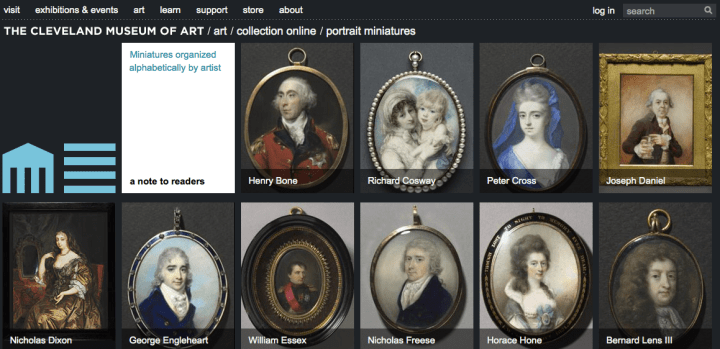
The Cleveland Museum of Art announces its pilot project in digital publishing, British Portrait Miniatures from the Cleveland Museum of Art. This catalogue showcases a substantial portion of the museum’s internationally known collection of around 170 portrait miniatures, one of the most significant in the country. The first stage of this searchable online catalogue includes 54 British portrait miniatures from the 17th, 18th, and 19th centuries, with publication of the remaining British works ongoing though out the year. The catalogue presents new research on the individual miniatures, explores the museum’s collection holistically and incorporates comparative images of works from other public and private collections. The miniatures catalogued online can be viewed at actual size, from the front and the back, and in unprecedented detail.
Authored by Cory Korkow, PhD, a Paintings and Drawings Society curatorial fellow whose initial research was funded by grants from the Samuel H. Kress Foundation, the catalogue includes new research about the artists, sitters, and successive owners of these miniatures, while incorporating conservation photographs and allowing the collection be studied in great detail for the first time. “This innovative project illustrates not only our deep commitment to original scholarly research on our collection, but our creativity in the presentation and dissemination of that knowledge,” said David Franklin, the Sarah S. and Alexander M. Cutler director.
Access to the British Portrait Miniatures catalogue is available here» (more…)
Queen Lovisa Ulrika’s memorial cup
Press release from Sweden’s National Museum:
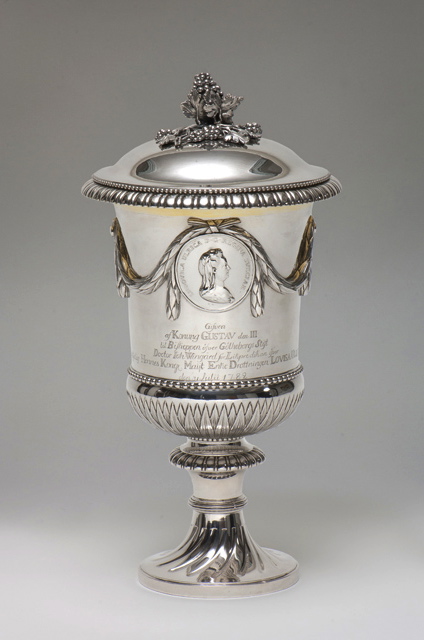
Pehr Zethelius, Queen Lovisa Ulrika’s Memorial Cup, silver, ca. 1782. Photo: Hans Thorwid/Nationalmuseum.
Queen Lovisa Ulrika’s memorial cup was donated to the museum at the annual meeting of the Friends of Nationalmuseum. This unique object was made by silversmith Pehr Zethelius and presented as a memento to Johan Wingård, Bishop of Gothenburg, in thanks for the funeral sermon that he gave for the deceased Queen in 1782.
The existence of Queen Lovisa Ulrika’s memorial cup, donated by the Friends of Nationalmuseum, has been unknown to most people until now. The silver cup is an impressive size and weighs almost three kilos, as befits a sister of King Fredrik the Great of Prussia. The rediscovery of the memorial cup adds an important jigsaw piece to the history of Swedish design at the Nationalmuseum. At the same time, this magnificent piece is an example of the long royal tradition of presenting an expensive gift to the key officials at ceremonies of state such as christenings and funerals.
The Dowager Queen Lovisa Ulrika died at Svartsjö Palace on 16 July 1782 and was buried in Riddarholmen Church on 31 July. The funeral sermon was given by Chaplain to the Queen Johan Wingård, Bishop of Gothenburg. In thanks for this, he was given this specially commissioned cup, which was then passed down through the family. The craftsman who made the memorial cup was Pehr Zethelius (1740-1810), a leading light in Swedish silversmithing during the late 18th century. Pieces from his workshop show both high artistic and technical quality. Zethelius became a real trendsetter and was responsible for introducing new styles from the Continent.
The memorial cup was donated in memory of Henry Montgomery (1927-2010), chairman of the Friends of Nationalmuseum from 1982-1994. The Barbro and Henry Montgomery Donation Fund was established in 1998 and is managed by the Friends of Nationalmuseum.
London’s National Gallery Acquires Portrait by Lawrence
Press release from London’s National Gallery:

Sir Thomas Lawrence, “Portrait of the Hon. Emily Mary Lamb,” 1803 (London: National Gallery)
A portrait by Sir Thomas Lawrence that has never been on public display since it was painted over two hundred years ago is now available for visitors to enjoy at the National Gallery in Room 34. Portrait of the Hon. Emily Mary Lamb (1787–1869), 1803, has been allocated to the National Gallery by Arts Council England under the Acceptance in Lieu scheme, which allows donors to leave major works of art to the nation in lieu of inheritance tax. Sir Thomas Lawrence (1769–1830) is generally regarded as one of the finest European portraitists of the late 18th and early 19th centuries, portraying some of the most important personalities of his day. This work is an important addition to the National Gallery’s British collection. The Gallery currently holds examples of formal and full-length works by Lawrence – John Julius Angerstein, aged about 55, about 1790; John Julius Angerstein, aged over 80, 1824; and Queen Charlotte, 1789 – but this painting exemplifies Lawrence’s influential but more informal depiction of children and families. Its inclusion in the collection will enable Gallery visitors to appreciate the breadth of Lawrence’s repertoire.
The oval portrait depicts the 16-year-old sitter in motion, her head turned towards the viewer in a pose that has a long tradition in the history of portraiture. However, Lawrence brings a freshness to the work, reflected in the informality and economy of his brushwork. The Hon. Emily Lamb went on to become an influential, politically prominent society hostess. She first married Peter Leopold Clavering-Cowper, 5th Earl Cowper. After his death, in 1839 she married Henry John Temple, 3rd Viscount Palmerston, who served twice as Prime Minister between 1855 and 1858 and again from 1859 to 1865. Her brother, Viscount Melbourne, also served as Prime Minister. His wife, Lady Caroline Lamb, was notorious for her affair with Lord Byron.
The work was commissioned by the subject’s father, Peniston Lamb, 1st Earl Melbourne, whose image can also be seen in the Gallery represented in a work by Stubbs, The Milbanke and Melbourne Families, about 1769. Lawrence’s painting has been in the possession of the sitter’s descendants since its completion. Born in Bristol, Lawrence was largely self-taught and a child prodigy; he was already producing accomplished portraits in crayon aged 10. He went on to become a pupil at the Royal Academy at the age of 18 and exhibited his first portrait the following year. He had a distinguished career during which he became a member of the Academy, going on to become its president in 1820. He was appointed Painter-in-Ordinary to King George III and received a knighthood in 1815.
Puzzle Jugs for Fools
I have long thought that museum gift shops would make a mint with good quality reproductions of these vessels, or perhaps even better, commissions for updated versions from local ceramicists. I first encountered the type as a graduate student, at The Smart Museum of Art in Chicago, and have been childishly enamored ever since. The following comes from Kathryn Kane’s posting at The Regency Redingote (3 July 2009). Happy Fool’s Day! -CH
◊ ◊ ◊ ◊ ◊
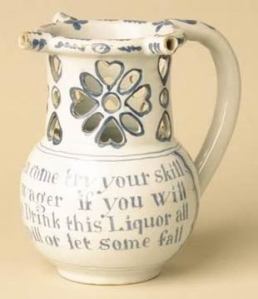
Puzzle Jug, tin-glazed earthenware, Liverpool, ca. 1750 (Liverpool: Walker Art Gallery)
Inscribed: "Here Gentlemen come try your skill, I'll hold a wager if you will, That you don't drink this liquor all, Without you spill and let some fall." For more information, click on the photo.
A diverting drinking vessel which could be found in village inns and public houses for centuries had a resurgence in popularity in the late eighteenth and early nineteenth centuries. These vessels had been made throughout England and northern Europe since at least the fifteenth century. Most commonly called puzzle jugs, they were also sometimes called teasing pitchers or wager jugs. It was a challenge to determine how to drink the liquor which they contained and wagers were often placed on the outcome of the attempt.
By the time of the Regency, puzzle jugs were being made not only for use in inns and taverns, but also for home use. Many gentlemen enjoyed entertaining their male visitors with drinking games using their own puzzle jugs.
Puzzle jugs are a puzzle because it is not obvious how to imbibe the beverage which they contain. The neck of the jug is perforated, often in ornamental patterns, so one cannot simply raise it to one’s lips and drink. Most puzzle jugs also have a hollow rim which can have between three to seven spouts which protrude from it. This hollow rim is connected to either a hollow handle, which opens into the lower part of the jug body, or the inside of the jug has a tube or pipe built into the jug wall. It is through this concealed piping that the liquid contents of the jug flow to the hollow rim. The secret of the puzzle jug is to know which of the spouts on the rim to plug with the fingers, while sucking the liquor out of the jug via the remaining spout. Some puzzle jugs have a small additional opening somewhere below the neck or beneath the handle which will spill the liquid on the hapless drinker if the jug is not held just so. . .
The full posting (including a brief reading list) is available at The Regency Redingote.
Applause for NGA’s Open Access Policy for Images
This open access announcement from the National Gallery of Art, in Washington, D.C., is, to my thinking, fabulous news! How exciting (and refreshing) to hear the museum articulate the policy in terms of the public good: “The Gallery’s open access policy is a natural extension of its mission to serve the United States of America by preserving, collecting, exhibiting, and fostering the understanding of works of art at the highest possible museum and scholarly standards.” Bravo! In addition to making the images available via open access, the museum provides a useful interface complete with lightbox and intuitive links for finding more information about particular images. -CH
National Gallery press release (16 March 2012) . . .
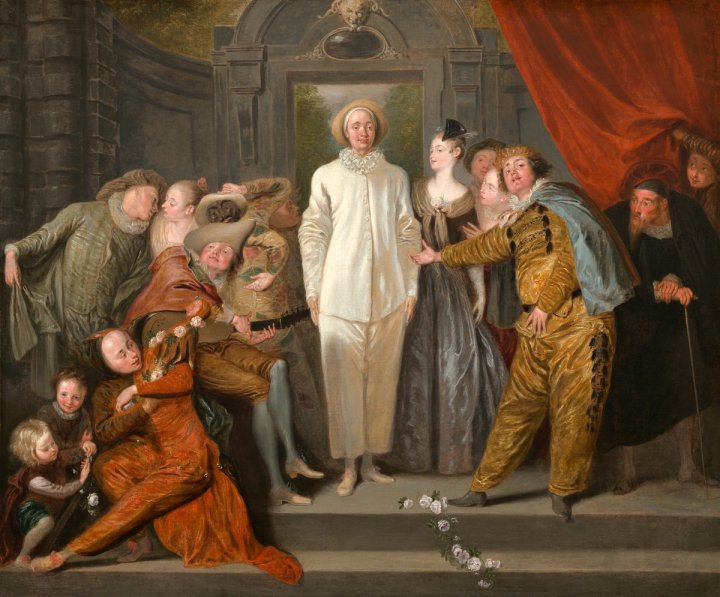
Antoine Watteau, The Italian Comedians, ca. 1720
Washington, D.C., National Gallery, Kress Collection, 1946.7.9
◊ ◊ ◊ ◊ ◊
The National Gallery of Art announces the launch today of NGA Images, a new online resource that revolutionizes the way the public may interact with its world-class collection at http://images.nga.gov. This repository of digital images documenting the National Gallery of Art collections allows users to search, browse, share, and download images believed to be in the public domain.
“As the Gallery marks its 71st anniversary, it is fitting that we introduce NGA Images and an accompanying open access policy, which underscore the Gallery’s mission and national role in making its collection images and information available to scholars, educators, and the general public,” said Earl A. Powell III, director, National Gallery of Art. “In turn this supports research, teaching, and personal enrichment; promotes interdisciplinary research; and nurtures an appreciation of all that inspires great works of art.”
Many of the open access images have been digitized with the generous support of the Samuel H. Kress Foundation.
Designed by Gallery experts to facilitate learning, enrichment, enjoyment, and exploration, NGA Images features more than 20,000 open access digital images, up to 3,000 pixels each, available free of charge for download and use. The resource is easily accessible through the Gallery’s website, and a standards-based reproduction guide and a help section provide advice for both novices and experts. Users may search by keyword in the Quick Search box on the home page of NGA Images, or they may browse the regularly updated “featured” image collections prepared by Gallery staff on topics such as 19th-century French art or frequently requested works. Other features for users include the ability to create one or more “lightboxes,” or images sets, and to save, share, and download multiple images at a time. Users may add individual labels and notes to their lightboxes or to images within them. Links to users’ customized lightboxes may be shared via e-mail or may be copied and pasted to social media sites.
Users may freely browse the NGA Images website and download screen- and lecture-size images without registering an account. Registration is required to use certain features of the NGA Images website, including saving and sharing lightboxes and e-mailing image links to others. Additionally, registration is required to fulfill certain image requests including direct downloads of reproduction-ready images.
With the launch of NGA Images, the National Gallery of Art implements an open access policy for digital images of works of art that the Gallery believes to be in the public domain (those not subject to copyright protection). Under the open access policy, users may download any of these images free of charge and without seeking authorization from the Gallery for any use, commercial or non-commercial. The Gallery’s open access policy is a natural extension of its mission to serve the United States of America by preserving, collecting, exhibiting, and fostering the understanding of works of art at the highest possible museum and scholarly standards. In applying the policy in a global digital environment, the Gallery also expands and enhances its educational and scholarly outreach. The Gallery believes that increased access to high-quality images of its works of art fuels knowledge, scholarship, and innovation, inspiring uses that continually transform the way we see and understand the world of art.
View the full Open Access Policy at http://images.nga.gov/openaccess.
Getty Acquisition | ‘The Italian Comedians’ by Watteau
Press release (15 March 2012) from the Getty:

Antoine Watteau, "The Italian Comedians," ca. 1720 (The J. Paul Getty Museum, 2012.5)
The J. Paul Getty Museum announced today the acquisition of The Italian Comedians (ca. 1720) by Jean-Antoine Watteau (French, 1684–1721). The large oil painting (50 7/8 x 36 3/4 inches) was painted at the height of Watteau’s fame, shortly before his early death at age 36.
“This major, little-known painting is extraordinary. It shows Watteau at the height of his creative genius,” said James Cuno, President and CEO of the J. Paul Getty Trust. “Not only will it enhance our paintings collection, but it complements the Museum’s collection of French decorative arts, which is amongst the finest in the world.”
The Italian Comedians joins 18th-century French paintings already in the Getty Museum’s collection by artists such as Nicolas Lancret (1690 –1743), Jean-Honoré Fragonard (1732–1806), Jean-Baptiste-Siméon Chardin (1699–1779), and Claude-Joseph Vernet (1714–1789), all of which have been acquired in the last decade.
The painting portrays five fairground comedians costumed as characters from the Comédie Italienne. Watteau, who would have seen the travelling performers at fairgrounds on the outskirts of Paris, often depicted members of this popular troupe in his fêtes galantes, small compositions showing conversations or music-making set in a park or landscape. Monumental paintings, in which the performers dominate a larger picture, are extremely rare in Watteau’s oeuvre. His compassionate depictions of the character Pierrot, a white-clad clown, are especially renowned, with one of the most notable being the life-size depiction of him that hangs in the Musée du Louvre in Paris.
In this painting, Pierrot and his troupe have just finished a performance and taken their bows. They have stepped off the makeshift stage and are about to start collecting money. All five of the actors look expectantly at the viewer. The central figure, Pierrot, holds his hat in one hand while his other reaches into a pocket of his baggy white jacket, cueing the audience, and the viewer, that it is time to show their appreciation.
“Watteau was perhaps the greatest French artist of the 18th century,” explains Scott Schaefer, senior curator of paintings at the Getty Museum. “This painting typifies the way that Watteau combined acuity and elegance with poetic powers of description, in equal parts sensitive and humorous.”
The Italian Comedians has been in private collections since the 18th century and has not been publicly exhibited since 1929. Over the last three centuries, its attribution has fluctuated. Until the late 19th century, the painting was attributed to Watteau. It was then assigned to Watteau’s pupil Jean-Baptiste Pater and subsequently to an anonymous painter in the circle of Watteau. Although the attribution has changed over time, the artwork has always been praised for its brilliant composition and emotional power and associated with Watteau’s psychologically profound depictions of the Italian Comedians. (more…)
V&A Crowdsourcing Project: Reading Europe, 1600-1800
From the V&A:
Reading Europe for the V&A
Crowdsourcing Project for the forthcoming 1600-1800 galleries
As part of the development of our new Europe galleries, the Victoria and Albert Museum is collecting quotes from published and unpublished material written in Europe between 1600 and 1815. We are looking for passages that show how people lived during this period, and how they might have used or perceived the objects that are now in our collections. These quotes will inform our work and may also appear in the gallery displays. Please see ‘Quotes & Images’ for some of the passages we have already collected. The new Europe galleries are part of FuturePlan, our major programme of renewal and restoration. The galleries are due to open in 2014.
◊ ◊ ◊ ◊ ◊
Coffee is widely drunk in Paris: there are a great many public establishments where it is served. In some of these establishments news is disseminated; in others, people play chess: there is one place where coffee is prepared in such a manner as to sharpen the wits of those who drink it; at any rate, of those who emerge from there, not a single one fails to be convinced that he is four times cleverer than he was upon entering.
-Charles de Secondat, Baron de Montesquieu, Persian Letters,
written 1717, published 1721 in Holland; translated in 2008.
Stockholm’s Nationalmuseum Acquires Satyr and Nymph by Clodion
Press release (30 November 2011) from the Nationalmuseum in Stockholm:

Claude Michel, known as Clodion, "Satyr and Nymph," terracotta, 1780s (Photo: Linn Ahlgren/Nationalmuseum)
At an ordinary public auction this past April, Nationalmuseum purchased a magnificent terracotta sculpture by French artist Claude Michel, known as Clodion. The piece, thought to date from the 1780s, depicts a satyr embracing a young nymph. Clodion’s superb attention to detail and perfect balancing of the two figures makes this one of his most significant works.
Claude Michel, known as Clodion, was two years the senior and a colleague of the Swedish sculptor Johan Tobias Sergel during his time in Rome. Clodion never completely abandoned the graceful rococo style. Not surprisingly, he was popular with collectors, but he was never elected to the Académie in his native France. The terracotta sculpture of a satyr embracing a nymph, purchased by Nationalmuseum at a public auction held by Stockholms Auktionsverk in April, typifies Clodion’s work in many respects. This piece, which probably dates from the 1780s, is a finished work rather than a prototype. Clodion produced these terracotta pieces for an eager market that could hardly wait for him to finish his works, since they were so popular. He produced several variations on the satyr and nymph theme, but the piece recently acquired by Nationalmuseum is one of the most thoroughly executed. The two figures, perfectly balanced in relation to each other, appear to be fashioned from a single piece of clay. Rather than powerful eroticism, the work exudes a gentle sensualism, which is most evident in the tentative kiss being exchanged between the couple. Clodion makes elegant play with the contrast between the plastic smoothness of the skin and the graphic nature of the nymph’s hair, carved into the clay while it was still wet.
On account of its sensual subject matter, in 1990 the grouping ended up in a private Swedish erotica collection. At different points in its life it had belonged to Henri Rochefort, a prominent French politician, and Jacques Doucet, a legendary art collector, whose collection (auctioned off piecemeal in 1912) included Picasso’s les Demoiselles d’Avignon. A counterpart to Clodion’s Satyr and Nymph can be seen in the Metropolitan Museum of Art in New York. The version now acquired by Nationalmuseum was long believed to be lost.
The acquisition was made possible by a generous donation from the Sophia Giescke Foundation. The Nationalmuseum has no funds of its own with which to acquire art and design, and so relies on gifts and financial support from private foundations and funds to expand its collection.
San Diego Museum of Art Acquires Portrait by Mengs
As noted at ArtDaily

Anton Raphael Mengs, "Don Luis de Borbón," 1750-51 (San Diego Museum of Art)
The San Diego Museum of Art announces its newest addition to the permanent collection. An eighteenth-century painting by Anton Raphael Mengs, a portrait of Don Luis de Borbón, is now displayed among the Museum’s world-renowned collection of Spanish art.
“Although Spanish art is one of the Museum’s strengths, the collection has not had a Spanish painting made between the 1650s—the date of our late Zurbarán and early Murillo—and 1795, the date of our great portrait by Goya. This portrait by Mengs, the leading artist in Spain in the 1760s and 70s, begins to fill that gap. More importantly, the Don Luis de Borbón will hang proudly alongside our works by Goya and Pompeo Batoni, giving us a spectacular display of European portraiture from the later eighteenth century” says John Marciari, Curator of European Art at The San Diego Museum of Art.
Mengs (1728-1779) was famous throughout Europe during his lifetime. In the 1740s and 50s he divided his time between Dresden and Rome, winning major commissions for both portraits and fresco paintings in both cities. In Rome, he was also closely associated with the archaeologist and writer Johann Joseph Winckelmann, and their research into Greek art made them key figures in the rise of Neo-Classicism. Despite his importance as a theoretician and as a history painter, however, Mengs was most accomplished in the field of portraiture; the Don Luis de Borbón displays his delicacy and refined touch in the genre.
From 1761 onward, Mengs spent much of his time in Spain and was eventually named Primer Pintor (First Painter) and executed portraits of the royal family. Don Luis (1727-1785), the younger brother of King Charles III, had been destined for a career in the church and was named Cardinal at age eight, although he later renounced that office and became the Count of Chinchón. Living in semi-exile outside of Madrid, he became an important patron of the arts and was responsible for commissioning, for example, Francisco de Goya’s first major works.
Marciari will lecture on this painting, telling the story behind the acquisition and giving more details of the fascinating lives of both Mengs and Don Luis, on Saturday, February 11th, at 10:30 a.m.
Lemoyne’s Annunciation on Loan to the National Gallery
From the National Gallery:

François Lemoyne, The Annuncation, 1727
François Lemoyne, The Annuncation, 1727
National Gallery, London
On Loan from Winchester College
According to Saint Luke’s Gospel, the archangel Gabriel announces to the Virgin that she will give birth to Jesus. This depiction of the subject is signed and dated 1727, the year the artist was awarded a prize for history painting by Louis XV. It may have been commissioned by the then headmaster of Winchester College where it was installed in 1729. Its painted arched top suggests an arched frame was originally intended.










 Enfilade
leave a comment