Concord Museum Awarded Funding Prize by Decorative Arts Trust

Visitors viewing powder horns on display in the April 19, 1775 gallery at the Concord Museum, the recipient of the 2023 Decorative Arts Trust Prize for Excellence and Innovation, which includes an award of $100,000.
◊ ◊ ◊ ◊ ◊
Press release (16 November 2023) from The Decorative Arts Trust:
The Decorative Arts Trust is thrilled to announce that the 2023 Prize for Excellence and Innovation was awarded to the Concord Museum in Concord, Massachusetts, for their exhibitions and publication commemorating the 250th anniversary of the American Revolution in 2025–26.
The Concord Museum’s initiative will feature a series of three special exhibitions showcasing the stories of individuals, families, and communities during the American Revolution. Focused on the theme of “Whose Revolution,” the special exhibitions will explore themes of liberty, community, and memory, tracing the continued legacy of the Revolution today. The Museum will also create a companion digital exhibition to extend the geographical reach of the exhibitions beyond Concord and promote further education and engagement. Additionally, the Museum will release the first major publication of its American Revolution collection, from flints and powder horns carried by militia soldiers to textiles, furniture, and ceramics that were valued and preserved for their role in witnessing a revolution.
The Concord Museum began in the 1850s as the private collection of local resident Cummings Davis, who gathered and preserved the relics of his friends and neighbors as a record of local history. The collection grew throughout the 19th century and was incorporated as the Concord Antiquarian Society in 1886, moving to a new building in 1930 and later becoming known as the Concord Museum. The Museum now houses a significant collection of over 45,000 objects, with particular strengths in the decorative arts from the 18th and 19th centuries, the American Revolution, transcendentalism, and other areas relating to Concord and New England history. The Museum recently completed a major building expansion and renovation of its permanent galleries, including new spaces for collections, education, and public programs.
The Decorative Arts Trust Prize for Excellence and Innovation, founded in 2020, funds outstanding projects that advance the public’s appreciation of decorative art, fine art, architecture, or landscape. The Prize is awarded to a nonprofit organization in the United States or abroad for a scholarly endeavor, such as museum exhibitions, print and digital publications, and online databases. Past recipients include Cooper Hewitt, Smithsonian Design Museum; the Black Craftspeople Digital Archive; and Craft in America.
New Book | National Museum of Women in the Arts Collection Highlights
Following a two-year closure, the National Museum of Women in Arts, reopened in October (with details available in this press release). Complementing the renovation is this new publication from Hirmer and distributed by The University of Chicago Press:
National Museum of Women in the Arts Collection Highlights (Munich: Hirmer Verlag, 2023), 264 pages, ISBN: 978-3777441696, $60.
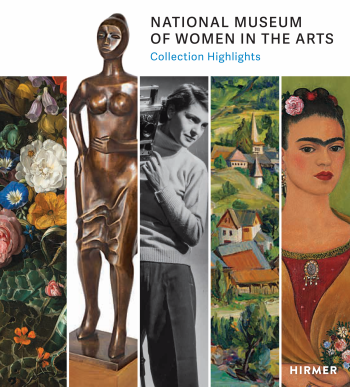 The National Museum of Women in the Arts, Washington, DC, is the first museum in the world solely dedicated to championing women through the arts. Drawing from a collection that spans five centuries and includes artists from six continents, this publication spotlights new additions to the museum as well as longstanding highlights. Vibrant images present over 175 works from the museum’s collections, including key artworks by Louise Bourgeois, Lalla Essaydi, Frida Kahlo, Hung Liu, Clara Peeters, Faith Ringgold, Niki de Saint Phalle, Amy Sherald, Alma Woodsey Thomas, and many others. Thematic chapters weave connections across medium, genre, and time. Essays by museum curators and more than thirty guest artists and scholars illuminate the mission of NMWA and help readers discover great women artists.
NGA Acquires Important Work by Anne Vallayer-Coster
Press release (17 November 2023) from the National Gallery of Art in Washington, DC:

Anne Vallayer-Coster, Still Life with Flowers in an Alabaster Vase and Fruit, 1783, oil on canvas (unlined), overall: 109 × 90 cm (Washington, DC: National Gallery of Art, Chester Dale Fund 2023.40.1).
The National Gallery of Art has acquired an important painting by Anne Vallayer-Coster (1744–1818), Still Life with Flowers in an Alabaster Vase and Fruit (1783). One of the greatest still life painters of 18th-century France, Vallayer-Coster achieved remarkable success in the male-dominated art world of her time. She not only attracted the patronage of some of the most powerful collectors of the time, including Marie Antoinette, but she also became one of the few women to be admitted to the prestigious Royal Academy of Painting and Sculpture and to show her work at its official public exhibition, the Salon.
Still Life with Flowers in an Alabaster Vase and Fruit is the first painting by Vallayer-Coster to enter the National Gallery’s collection. Despite the limited access to training and patronage, women artists achieved unprecedented professional opportunities and success in the latter half of the 18th century. Vallayer-Coster, alongside Élisabeth Louise Vigée Le Brun, is now the second woman artist represented in the National Gallery’s collection of 18th-century French paintings. This masterpiece not only fills out a more complete story of this pivotal period in European art history, but also highlights the accomplishments of one of its most significant artists.
One of Vallayer-Coster’s most ambitious works, this painting showcases her unrivaled ability to capture the soft, delicate textures of flowers and to coordinate their dazzling colors and irregular shapes into a harmonious whole. When it was exhibited at the Salon of 1783, critics hailed Still Life with Flowers in an Alabaster Vase and Fruit as a masterpiece. Vallayer-Coster herself considered it her finest painting, and she kept it until her death. Lost for nearly 200 years, this extraordinary work was recently rediscovered in an almost pristine state of preservation: unlined, on its original stretcher, and in the Louis XVI frame in which it was likely exhibited.
Depicting an opulent bouquet brimming with meticulously studied and exquisitely rendered flowers, this work includes roses, irises, lilacs, carnations, hollyhocks, dahlias, bluebells, and hydrangeas, among others, that create a dazzling display of color against the rich, chocolate brown scumbling of the background. The flowers sit in an alabaster vase adorned with French gilt-bronze mounts, featuring a child satyr supporting a cornucopia of fruits and flowers. Resting on an elaborately carved and gilded mahogany table with a pale gray marble top, the vase and flowers are completed by a bunch of white grapes, a pineapple, and three peaches. Evoking the cool polish of marble and alabaster, the glistening surface of cast-bronze, the translucency of grapes, the spiky form of a pineapple, the velvety skin of peaches, and the delicate freshness of flower petals, the painting epitomizes Vallayer-Coster’s extraordinary skill in portraying colors and textures.
The Met | Look Again: European Paintings 1300–1800

Details of European paintings in The Met Collection.
◊ ◊ ◊ ◊ ◊
After a five-year infrastructure project to replace the skylights, The Met’s newly installed galleries of European paintings will open to the public on Monday. For the 18th century, some significant changes have been made to the French, Italian, and British galleries, addressing issues of race, gender, class, and colonialism. A good time to revisit old friends, formulate fresh questions, and discover new favorites! –CH
From The Met:
Look Again: European Paintings 1300–1800
The Metropolitan Museum of Art, New York, opening 20 November 2023
The reopened galleries dedicated to European Paintings from 1300 to 1800 highlight fresh narratives and dialogues among more than 700 works of art from the Museum’s world-famous holdings. The newly reconfigured galleries—which include recently acquired paintings and prestigious loans, as well as select sculptures and decorative art—will showcase the interconnectedness of cultures, materials, and moments across The Met collection.
The chronologically arranged galleries will feature longstanding strengths of the collection—such as masterpieces by Jan van Eyck, Caravaggio, and Poussin; the most extensive collection of 17th-century Dutch art in the western hemisphere; and the finest holdings of El Greco and Goya outside Spain—while also giving renewed attention to women artists, exploring Europe’s complex relationships with New Spain and the Viceroyalty of Peru, and looking more deeply into histories of class, gender, race, and religion.
The reopening of the suite of 45 galleries at the top of the Great Hall staircase (galleries 600–644) follows a five-year project to replace the skylights. This monumental infrastructure project improves the quality of light and enhances the viewing experience for a new look at this renowned collection.
Major support for Look Again: European Paintings 1300–1800 is provided by Candace K. and Frederick W. Beinecke.
Independence Seaport Museum Acquires Folk Art Watercolor
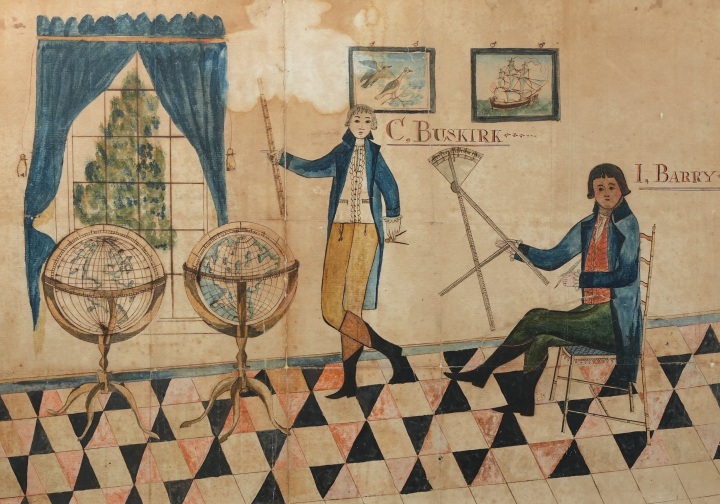
Attributed to Cornelius van Buskirk, Navigation Lesson, ca. 1780s–90s, watercolor and ink on paper
(Philadelphia: Independence Seaport Museum, gift of Maya Muir, 2023.010.001)
◊ ◊ ◊ ◊ ◊
From the press release (17 October 2023) . . .
In the late 1700s, when young boys were taught the art of navigation, it was common that they would have used a workbook to write out their examples and trigonometry equations and to explore navigational theories. An especially rare example—which includes not only these materials needed for study but also exquisitely rendered watercolor drawings of people, ships, charts, and a log from a voyage made in April 1799—was used by a boy named Cornelius van Buskirk (1776–1863). One such watercolor drawing, entitled Navigation Lesson, which had been removed from the workbook and retained by the artist’s descendent family, was recently given to the Independence Seaport Museum in Philadelphia to complement the actual workbook previously given to the museum by a direct descendant’s widow. What makes this already important drawing and larger document all the more extraordinary is that new research conducted by ISM staff shows that the figures in the drawing are of the young artist and his tutor, who is believed to be none other than Commodore John Barry (1745–1803), the man regarded as the father of the United States Navy.
“The Independence Seaport Museum is thrilled to have been given this wonderful watercolor,” said Peter Seibert, president and CEO of ISM. “Not only is it an artistic tour de force but we are also now able to reunite it with the original manuscript copy book in our collection. Together, they tell the story of both the father of the U.S. Navy and the young man who was his student.”
The watercolor, which relates in many ways to similar genre scenes from the Federal period, is especially well drawn. It shows ‘C. Buskirk’ receiving a lesson in navigation from ‘I. Barry’ in what appears to be a parlor or study of what is likely Barry’s home. (Van Buskirk Family tradition states that ‘I. Barry’ is Commodore John Barry as ‘I’ is a classical shorthand for ‘J.’) Typical of genre scenes of the time, the room features a black-and-white painted floor, and the overall symmetry of the piece relates it to coastal New England folk artists such as Joseph H. Davis (1811–1865). Similarly, Van Buskirk paid careful attention to the face and hair of the subjects, as did Pennsylvania German artist Jacob Maentel (1763–1863). The size of the drawing (24.5 × 31.5 inches) along with its accurate artistic attention to detail is impressive. Shown against a boldly colorful, geometric background, the scientific instruments carried by the figures are precisely rendered, suggesting that the artist had more than a passing familiarity with maritime navigational tools. Both subjects are holding instruments often used in 18th-century maritime navigation: Barry holds a radial arm protractor used to measure and draft angles on paper, while Van Buskirk holds a Gunter’s scale, which was used to calculate trigonometric functions. Van Buskirk is also standing next to two globes—one terrestrial and other celestial—showcasing the interplay of the heavens and the earth in early navigation practices, which relied on positions of the stars for seafaring. Another fascinating element of the work is the inclusion of a pair of naval engagement paintings that the artist incorporated into the background. Having a painting within a larger painting is a technique used by skilled artists to showcase and show off their talents. Such elements raise the artistic level of this work from the casual to the masterpiece.
New research conducted by the Independence Seaport Museum’s curatorial and archival staff support the tradition of the artist’s descendent family of ‘Barry’ being Commodore Barry, based upon stylistic comparisons, life events, and family provenance. The darker complexion and size of the older man matches scholarly descriptions of Barry as having a ruddy complexion and a considerably slimmer figure prior to 1790. As he and his fellow officers lost their jobs and were owed back pay after Congress disbanded the Continental Navy, taking small jobs like tutoring a young boy in maritime navigation is not farfetched. Given this, Barry would have been in his 40s and Van Buskirk approximately 10 years old, an ideal age to learn navigation.
“This painting drew me in instantly when the Independence Seaport Museum received it as a donation,” said Sarah Augustine, archivist at the Independence Seaport Museum. “It is a beautiful representation of early American folk art that provides a visual story of the scholarship and mystique surrounding 18th- century maritime navigation. Since we received this donation, I have been heavily involved in researching Van Buskirk, the context of the painting, and the potential connection to Commodore John Barry. I am thrilled that the public will now get to interact with this painting, which was cherished by five generations of Van Buskirk’s descendants.”
While it was previously speculated that the entire workbook was completed together in 1799, ISM research points to the first part of the manuscript, which contains the equations and drawings, to have been made prior to the 1799 voyage as it served as a later practicum for Van Buskirk.
In 1984, the navigation workbook from which this watercolor was removed, was donated to ISM by Mrs. Schuyler Cammann. In 2023, Maya Muir, Mrs. Cammann’s daughter, donated this painting as well as another watercolor and two portraits to the museum, reuniting the book with this work of art. The painting will be on view in ISM’s forthcoming exhibition that will serve as an introduction to the museum.
If true that Van Buskirk is the artist of Navigation Lesson, it would identify a new folk artist of considerable skill and talent whose other works have yet to be identified. Research by ISM staff continues on this important and rare document.
The Independence Seaport Museum (ISM), founded in 1960 as the Philadelphia Maritime Museum, encourages visitors to discover Philadelphia’s river of history and world of connections. Stewards of Cruiser Olympia and World War II-era Submarine Becuna, ISM is home to interactive and award-winning exhibitions, one of the largest collections of historic maritime artifacts in the world and a boatbuilding workshop. Accredited by the American Association of Museums since the 1970s, it is a premier, year-round destination on the Penn’s Landing waterfront.
Cleveland Acquires Works by Zoffany, Delacroix, and Emma Amos

Johann Zoffany, The Dutton Family in the Drawing Room of Sherborne Park, Gloucestershire, ca. 1772, oil on canvas; unframed: 102 × 127 cm
(The Cleveland Museum of Art, Leonard C. Hanna Jr. Fund, 2023.122).
◊ ◊ ◊ ◊ ◊
From the press release (19 October 2023) . . .
Recent acquisitions by the Cleveland Museum of Art (CMA) continue to add to the quality of the collection and to expand its depth and breadth. Visitors will soon be able to view a masterpiece by Johann Zoffany and important watercolors by Eugène Delacroix and Emma Amos.
Johann Zoffany, The Dutton Family in the Drawing Room of Sherborne Park, Gloucestershire
Conversation piece represents the culmination of Zoffany’s achievements in the genre
The Dutton Family in the Drawing Room of Sherborne Park, Gloucestershire is a masterpiece by Johann Zoffany, exemplifying the quintessentially English genre of which he was the most accomplished practitioner—the conversation piece. The Dutton family was painted around 1772, at the height of Zoffany’s career. The painting is in extraordinary condition, extensively published, has been a cornerstone of groundbreaking exhibitions, and twice achieved the record price for the artist at auction.
The CMA’s British paintings collection is distinguished primarily by great landscapes, individual portraits, and miniatures but has lacked that linchpin genre, the conversation piece. During the eighteenth century, these informal group portraits flourished among the newly wealthy middle class, for whom the genre provided the opportunity to perform the coded gestures of polite society and showcase the fashionable interiors that attested to their refinement. But the painting is also a timeless testament to that most intimate and complex network of relationships—the family. Conversation pieces give us an intimate glimpse into how British families socialized and decorated—or as importantly—how they wanted to be remembered as living.
The Dutton Family is among the final great conversation pictures remaining in private hands and represents the culmination of Zoffany’s achievements in the genre. This portrait depicts parents socializing with their son and daughter playing cards in a country house. The family is dressed in mourning following the death of a loved one. Executed with his trademark virtuosity and love of significant detail, this family portrait was so treasured by generations of Dutton heirs that it remained in the family collection for more than 150 years.
Eugène Delacroix, A Young Black Woman Fetching Water
Created in a new style consisting of bold colors and subject matter drawn from contemporary life

Eugène Delacroix, A Young Black Woman Fetching Water, 1832, graphite and watercolor on wove paper; sheet: 23 × 16 cm (The Cleveland Museum of Art, J. H. Wade Trust Fund, 2023.123).
Eugene Delacroix was among the most influential Romantic artists and, in the late 1820s, began to work on Orientalist images, the depiction of non-Western cultures by European artists. Young Black Woman Fetching Water presents a young Moroccan woman wearing a robe and headdress while holding a burnoose—a long, hooded cloak worn in Arab countries. She was almost certainly an enslaved African; from the Middle Ages, Morocco was a center of the international slave trade and continued to be so until the early twentieth century.
The watercolor is one of eighteen drawings that comprised the so-called ‘Mornay Album’ that the artist made during a diplomatic journey to Spain, Morocco, and Algeria in 1832 with the Count de Morney, the French ambassador to the Sultan of Morocco. Upon the completion of their travels together, Delacroix selected eighteen of his most prized watercolors and bound them in an album which he gave to de Mornay as a souvenir of their journey. These works are considered Delacroix’s greatest accomplishment in watercolor, a medium in which he was an avid and skilled practitioner. The drawings in the album were dispersed in 1877 in Mornay’s collection sale and are highly coveted today. Delacroix reconsidered the subject of these watercolor in 1834 in the celebrated painting Women of Algiers (Louvre Museum), which later modern artists from Vincent van Gogh to Paul Cezanne and Pablo Picasso each described as a direct inspiration for their work.
Emma Amos, The Gift
One of the African American artist’s most significant artworks
The Gift, one of the most significant works by the African American artist Emma Amos (1937–2020), comprises 48 individual watercolor portraits of women artists, writers, and curators in Amos’s community in New York in the early 1990s. The women pictured belong to different generations and are from a range of racial and ethnic backgrounds. Some of the subjects are well-known and others are not. Regardless of their status, every sitter is treated by Amos with curiosity, care, and attention that reflects the artist’s admiration of each woman she represents.
What motivated the artist to produce this formidable account of female creativity was a desire to make vivid to her daughter, India, the value of friendship and community. She created the work as a gift for India for her twentieth birthday. Especially remarkable for the confluence of ideas and histories that it brings together, The Gift is a manifestation of intergenerational feminist community building. In its content, it documents a particular cultural milieu. And in its form, it is an arresting work of portraiture. The Gift joins signature works in other media by Amos in the CMA’s collection: the painting Sandy and Her Husband, 1973 (2018.24), and the etching and aquatint Without Feather Boa, 1965 (2021.142).

Emma Amos, The Gift, 1990–94, 48 watercolor portraits; each: 66 × 50 cm; overall: 274 × 640 cm (The Cleveland Museum of Art, J. H. Wade Trust Fund, 2023.126).
Colonial Williamsburg Receives Historic Clothing Collection
From the press release (23 October 2023) . . .

Suit with coat, waistcoat, and breeches, Warsaw, Poland, 1787–95, owned by Lewis Littlepage. Coat: silk, linen, silver, gold, garnets, wood, paper; waistcoat: silk, copper, linen, wool, and paper; breeches: silk, linen, iron, wood, and paper (Colonial Williamsburg, Gift of The Valentine Museum, Richmond, 2023-21,1-3).
Adding to what is already a renowned assemblage of historic dress, The Colonial Williamsburg Foundation has recently received a gift of nearly 330 objects from The Valentine Museum in Richmond, Virginia as part of the redefinition of the museum’s holdings. The collection includes gowns, coats, trousers, breeches, waistcoats, vests, petticoats, underwear, accessories, hats, children’s clothing, and more, all of which predate 1840. Within the larger group is a 20-piece collection of garments that were owned by and descended through the stepfamily of Lewis Littlepage (1762–1802). It is the largest grouping of clothing owned by a single person to come into the Foundation’s collection.
“Historic dress allows us to look closely at the physical natures of people from the past, but we often know little about their lives,” said Ronald Hurst, the Foundation’s senior vice president for education and historic resources. “The Littlepage Collection provides a glimpse into the remarkable experiences of a Virginian whose path placed him in direct contact with world leaders at the end of the 18th century.”
Lewis Littlepage (1762–1802) was a Hanover County native whose story is as colorful as the garments he wore. It is a tale of diplomacy, adventure, war, friendship, enemies, debt, and deceit. Littlepage attended what was then known as the College of William and Mary in Williamsburg and later served with John Jay at the Court of Spain during the American Revolution. Due to problems with debt, he served with the Spanish Army during the attack on Minorca and the Siege of Gibraltar. By 1786 he was admitted to the Court of Poland where he served as a Chamberlain to King Stanislaw II until 1795. With war raging across Europe and the second partition of Poland, Littlepage was forced to leave the court and finally returned home in 1801. Possibly the best summary of Littlepage’s life comes from Lyon Gardiner Tyler, the president of William & Mary (as it is now called) from 1888 to 1919: “Perhaps a mere genius, Lewis Littlepage was the greatest that was ever born in Virginia. His story sounds like a fable taken from Arabian Nights. It far transcends that of Captain John Smith … his voluminous papers were nearly all destroyed by his executor, obedient to his direction. Had they been preserved, what tales of love and adventure at the Courts of Poland and Russia, and about subtle intrigues and secret conspiracies of Kings, Generals, and great diplomats, may have been disclosed.”

Waistcoat: Warsaw, Poland, 1785–95, wool, silk, wood, linen, owned by Lewis Littlepage (Colonial Williamsburg, Gift of The Valentine Museum, Richmond, VA, 2023-26).
When Littlepage died a bachelor in Fredericksburg, only nine months after returning from Europe, the inventory taken of his estate was fairly sparse in the way of the customary furniture, ceramics, and other saleable goods. It contained, however, a two-page, detailed list of his “cloathes [sic] and decorations,” worth $340. Aside from the typical items, such as one hat and 24 pairs of under drawers, the inventory contained objects including one green cloak given to him by the king of Poland, two coats given to him by the king of Spain, a pair of Cossack pistols, a pair of German pistols, and a Spanish sword. His small estate was left to his stepbrother Waller Holladay; the surviving objects passed directly through the Holladay family until gifted to The Valentine in 1952 by Mr. and Mrs. A. Randolph Holladay II.
Among the highlights of the collection to come to Colonial Williamsburg is a three-piece suit that, it is believed, Littlepage wore while at the Court of Catherine II of Russia. The suit—originally constructed in 1787 and comprised of a fully embroidered court coat, a single-breasted waistcoat, and matching breeches—saw continual wear as Littlepage did not become a member of the Order of Saint Stanislaus until 1790, when the badge was probably added to the breast of the coat. Made from a compound woven silk with several stripes of brown, blue, and white with a tiny blue check overtop, the coat was embroidered with a silver bullion edge with grey and white floral sprays down the center front, around and on the pocket flaps, cuffs, collar, the edge of the front pleat, and down the center back vent. The order was made on pasteboard or layers of paper, which shows inked drawings to indicate the pattern the embroiderer was to follow. The central motifs were made from a silvered disc with the royal monogram set in garnets of “SAR” (Stanislaus Augustus Rex). Around the embroidered monogram is the Latin motto “Praemiando Incitat” (Encouraged by Reward), and surrounding the phrase is a laurel wreath from which radiates an eight-pointed star worked in spangles and bullion. The matching waistcoat is embroidered with blue, white, and grey floral sprays. The borders down the center front were worked with copper bullion that is coated to make them blue. This waistcoat is made adjustable by two very large buckles attached at the back; buckles such as these are usually associated with the backs of breeches to make them adjust and are possibly a unique feature of Polish clothing. The breeches are made from a complex woven silk, lined throughout with plain off-white linen. They have a flap front that extends from side seam to side seam with five buttons at the top and two on each side. The waistband of the pocket contains two watch pockets with a button and buttonhole to close it. The back of the waistband retains its original iron buckle for adjustability. Beneath the flap there are two internal white linen pockets. Each knee closes with five buttons and buttonholes and a garter made to fit a set of knee buckles. Each of the garters are embroidered to match the rest of the suit.
“The Littlepage Collection offers a unique opportunity to study an individual’s style and how world politics affected their fashion,” said Neal Hurst, Colonial Williamsburg’s curator of historic dress and textiles. “It is such an amazing collection of clothing that tells an unbelievable story.”

Order of Saint Stanislaus Ribbon, Warsaw, Poland, 1790, silk, copper, enamel, glass, owned by Lewis Littlepage (Colonial Williamsburg, Gift of The Valentine Museum, Richmond, VA, 2023-23).
Another featured garment in this collection is a buff-colored, twilled woolen waistcoat with a tall, standing collar that Littlepage probably wore while he served as a Chamberlain and diplomat to the Court of Poland between 1785 and 1795. It is embroidered with silk threads in geometric patterns that resemble egg- and dart-like motifs. The front has two large cross or welt pockets with pocket bags made from white linen. At some point, the center back was enlarged with a wedge down its middle and the adjustable tapes were removed. The buttons and buttonhole are unusually closely spaced. Fascinatingly, found in the pocket was a piece of paper that reads “Si vous dedaignez mon vin je serais au désespoir,” (If you disdain my wine, I’ll be in despair).
In 1790, King Stanisław August Poniatowski of Poland awarded Lewis Littlepage the Order of Saint Stanislaus. This ribbon is yet another highlight of the recently acquired Littlepage Collection. The sash, a red-and-white silk moiré ribbon, was worn over the shoulder with an enameled badge that hung from the bottom. The badge is in the form of a Maltese cross and is made from paste stones with red foils set behind them. It is mounted around a green-bordered, central white enamel circle showing St. Stanislaus wearing vestments with the letters “SS” to each side of him. Between each of the points of the cross, enameled Polish eagles radiate from the center. The Littlepage Collection contains two surviving ribbons, one with its badge and one with the badge missing.
For a further look at the Littlepage Collection, please visit https://emuseum.history.org/, type “Littlepage” in the search, and all of the objects can be seen in full-color images along with interpreted text for each item.
An 18th-C. Japanese Shōya House Arrives at The Huntington

Shōya House, ca. 1700, moved to The Huntington from Marugame, Kagawa prefecture, Japan
(San Marino: The Huntington Library, Art Museum, and Botanical Gardens, from Los Angeles residents Yohko and Akira Yokoi)
◊ ◊ ◊ ◊ ◊
Opening next month at The Huntington, from the press release (25 July 2023) . . .
Japanese Shōya House
The Huntington Library, Art Museum, and Botanical Gardens, San Marino, opening 21 October 2023
The Huntington Library, Art Museum, and Botanical Gardens will offer visitors a unique opportunity to see a restored residential compound from 18th-century rural Japan. Opening 21 October 2023, the Japanese Heritage Shōya House, a 3,000-square-foot residence built around 1700, served as the center of village life in Marugame, Japan. The compound has been reconstructed on a 2-acre site, which includes a newly constructed gatehouse and courtyard based on the original structures, as well as a small garden with a pond, an irrigation canal, agricultural plots, and other landscape elements that closely resemble the compound’s original setting. Visitors will be able to walk through a portion of the house and see how inhabitants lived their daily lives within the thoughtfully designed and meticulously crafted 320-year-old structure.

Illustrated aerial view of the Shōya House.
Los Angeles residents Yohko and Akira Yokoi offered their historic family home to The Huntington in 2016. Huntington representatives made numerous visits to the structure in Marugame and participated in study sessions with architects in Japan before developing a strategy for moving the house and reconstructing it at The Huntington. Since 2019, artisans from Japan have been working alongside local architects, engineers, and construction workers to assemble the structures and re-create the traditional wood and stonework features, as well as the roof tiles and plaster work, prioritizing the traditions of Japanese carpentry, artisanship, and sensitivity to materials.
“The new Japanese Heritage Shōya House will offer a glimpse into rural Japanese life some 300 years ago and provide insights into that culture and its sustainability practices,” Huntington president Karen Lawrence said. “We are very grateful to the Yokoi family for giving The Huntington the opportunity to tell this important story as an immersive experience for visitors.”
The historic house was the residence for successive generations of the Yokoi family, who served as the shōya, or village leaders, of a small farming community near Marugame, a city in Kagawa prefecture, Japan. Chosen by the feudal lord, a shōya acted as an intermediary between the government and the farmers. His duties included storing the village’s rice yield, collecting taxes, and maintaining census records, as well as settling disputes and enforcing the law. He also ensured that the lands remained productive by preserving seeds and organizing the planting and harvesting. The residence functioned as the local town hall and village square.
Sustainability is a major theme of the interpretive scheme. “We aim to present a working model of Edo period permaculture and regenerative agriculture,” said Robert Hori, the gardens cultural curator and programs director at The Huntington. “It represents real-life circumstances. An authentically constructed Japanese house using natural materials, combined with careful attention to agricultural practices, will demonstrate how a community became self-sufficient. We will show how emphasis was placed on reducing waste and repairing items so they could be reused or repurposed. Visitors will see how this 18th-century Japanese village maintained a symbiotic relationship between humans and the surrounding landscape.”
The compound occupies a recently developed area along the north end of The Huntington’s historic Japanese Garden. While the garden has featured an iconic Japanese House for the last 100 years, this new structure and surrounding elements will provide visitors with a fully immersive experience, allowing them to walk through it and learn about 18th-century rural Japanese life.
◊ ◊ ◊ ◊ ◊
The landscape surrounding the Japanese Heritage Shōya House is based on rural Japan in the preindustrial, mid–Edo period (1700–1760). Before arriving at the main house, visitors will pass through a small orchard of persimmon, citrus, and mulberry trees and a formal gatehouse, featuring black clay roof tiles and exterior walls adorned with a lattice design made of plaster. The original Shōya House was surrounded by solid walls, and the gates were locked at night for privacy and to shield the residents from a possible attack. Most villagers lived outside the gates and would pass through the gatehouse for community gatherings or business dealings with the shōya. The gatekeeper lived in one of the rooms in the structure. Servants and horses occupied the other spaces. A typhoon in the 1970s destroyed the majority of the original gatehouse, so The Huntington re-created the structure, which, in its new iteration, includes office space for Shōya House staff and docents, as well as public restrooms.
After visitors walk past the gatehouse, they will find themselves in a courtyard of compacted soil, where such life events as weddings, funerals, and annual celebrations would have been held; it was also where crops were dried before storage. The exterior of the home is made of wood and plaster that is punctuated by entryways and windows of glass and rice paper. The gradually sloping roof is adorned with clay tiles; around the edge of the roof are decorative tiles illustrated with a symbol representing a seed and sprout. On the corners of the roof, visitors can spot the Yokoi family crest, which includes sword blades and katabami, or wood sorrel, to symbolize their military might, abundance, and continued family line.

Exterior view of the Shōya House.
The house has two main entryways: The formal entrance on the left was originally for samurai and government officials, and the doorway on the right, which Huntington visitors will use, was for daily use by farmers and craftspeople. Inside the main house, visitors will first see the front rooms, which were used for official functions. The shoya carried out duties for the community, met with government officials, and hosted religious ceremonies and celebrations in these rooms. The house has multiple levels: The earthen-floored entryway was used by farmers as a workspace, while the higher levels were for more prestigious guests and used by the shōya for record keeping and tax payments. Sliding doors can divide the space into small rooms or be opened to create one large room.
The Shōya House experience will include interpretive materials, such as a video showing the disassembly and relocation of the house and its integration with the surroundings at The Huntington. In addition, visitors will be able to learn about the traditional skills and tools of Japanese carpentry, such as the wood joinery that was used in constructing the house.

Illustration looking down into the front rooms of the Shōya House.
Wide-open doorways toward the back of the house allow visitors to see the more private rooms where daily family life occurred; these spaces include a rustic kitchen and rooms used for eating, entertaining, and sleeping. Evidence of fine craftsmanship abounds throughout the house: Tatami mats, similar to those used in the original home, will cover the floors; decorative plates hide joinery; and ornate ranmas, or panels made of carved wood, are positioned to allow for ventilation in the home.
The room where special guests were once received, at the front west side of the residence, looks onto a formal garden containing carefully shaped pines and camellias, as well as cycads, a plant that was considered a symbol of luxury in 18th-century Japan. The rocks in the garden came directly from the original property and were placed in the exact same spots in relation to the house and a koi pond.
Outside of the house, visitors can peek into what was once the pit lavatory. A water drainage canal nearby will show how water runs from a reserve to the crops, which include rice, buckwheat, and sesame. Signage about traditional sustainable water systems will illustrate how the residential area connects to the surrounding agricultural plots.
Note: The Shōya House will be open from noon to 4pm.
Sweden Nationalmuseum Acquires Portrait of Axel von Fersen
From the press release (9 August 2023). . .
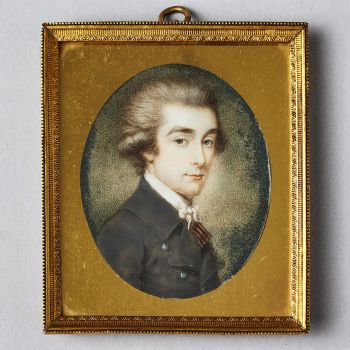
Unknown British artist, Portrait of Axel von Fersen, 1778 (Stockholm: Nationalmuseum; photo by Stockholms Auktionsverk).
Nationalmuseum has acquired a portrait of Axel von Fersen at the age of 23, painted in London in the summer of 1778. The superb miniature by an unknown British artist depicts a self-assured young man, perhaps on account of his intended marriage to a rich heiress. It was unusual for British artists to paint portraits of Swedish subjects in the latter half of the 18th century.
Axel von Fersen (1755–1810) has become known around the world for his close relationship with Queen Marie-Antoinette. As the current exhibition at the Archives Nationales in Paris makes clear, his affections were reciprocated [Louis XVI, Marie-Antoinette et la Révolution: La famille royale aux Tuileries, 1789–1792]. The two first met at a masked ball in January 1774. Some months later, Fersen travelled to London. Although he did not stay long, he learned some English, which was unusual for a Swede in the 18th century. Fersen returned to the British capital in April 1778 for a visit lasting four months, during which time he sat for an unidentified portrait painter. The graphic nature of the portrait, where the hair and face are made up of a combination of lines and dots in brown tones against a gridlike background, is typical of British miniature painting of the time. In contrast to this vibrant depiction, the subject’s grey coat appears somewhat muted, with a few shaded areas.
Why did the young Fersen commission this portrait of himself during his time in London? Did it have something to do with his intended marriage to Catharina, the daughter of Henrik Leijel (Henry Lyell), a wealthy Swedish-British merchant? Nothing came of this prospective marriage of convenience. Instead, Fersen returned to Paris and embarked on a military career. Two years later, he travelled to North America as aide-de-camp to the head of the French expeditionary force, General Count de Rochambeau. Fersen’s knowledge of English proved very useful in this role, since General George Washington did not speak French. For three years, Fersen acted as interpreter between the allies in their war against the British colonial power. On returning to Paris in the summer of 1783, he was appointed colonel of the Royal Suédois regiment, but soon after was ordered to accompany King Gustav III of Sweden on a year-long trip to Italy.
The rest of the story is well known: Fersen’s love affair with Marie-Antoinette, his repeated attempts to save her and other members of the royal family during the French Revolution, and his own tragic death at the hands of a mob on the streets of Stockholm. The portrait of the young Fersen eventually came into the possession of one of his siblings and remained in the family’s ownership for many years before its recent acquisition by Nationalmuseum.
Magnus Olausson, emeritus director of collections at Nationalmuseum, said: “The portrait of the young Axel von Fersen represents a rare interlude in 18th-century Swedish-British relations. As far as we know, few Swedes were immortalised by British artists in those days. This iconic portrait of Fersen is an unusually fine work by an unknown British miniaturist, in a style somewhat reminiscent of stipple engraving, which was the great innovation of the time.”
Nationalmuseum receives no state funds with which to acquire design, applied art and artwork; instead the collections are enriched through donations and gifts from private foundations and trusts. The Axel von Fersen portrait acquisition was generously funded by the Hjalmar and Anna Wicander Foundation.
Museum Tour | Art and Aroma at the Met: 18th-C. France

François Boucher, The Toilette of Venus, detail, 1751, oil on canvas
(New York: The Metropolitan Museum of Art)
◊ ◊ ◊ ◊ ◊
From Eventbrite:
Jessica Murphy, Art and Aroma at the Met: 18th-Century France
The Metropolitan Museum of Art, New York, Saturday, 9 September 2023, 2.00–3.30pm
Engage your senses of sight and smell in a gallery tour that explores the history of French perfumery at the Metropolitan Museum of Art.
Sophisticated … seductive … classic. The phrase ‘French perfume’ often evokes these ideas. But how did France become known as the center of Western perfumery? This genre-blending gallery tour will illustrate France’s fragrant history in the 1700s through works of art and design in the Metropolitan Museum of Art, spotlighting some of the events and individuals behind perfume’s ascendance as one of France’s signature luxury goods. Experiencing these spaces and objects as a small group, we’ll sample and sniff aromatic materials while we simultaneously educate our eyes and noses. A ticket for this 90-minute gallery tour ($45) includes access to the rest of the Met after the event. Please arrive 30 minutes early to allow time for security checkpoints and weekend crowds.
Jessica Murphy is a museum professional with a passion for perfume. She holds a PhD in art history and has worked at the Philadelphia Museum of Art, the Metropolitan Museum of Art, and the Brooklyn Museum. Meanwhile, she has also been writing about fragrance since 2007 at Now Smell This and her own blog Perfume Professor. Since 2015 she has taught and lectured about the history and culture of fragrance through venues including the Brooklyn Brainery, the Institute for Art and Olfaction, the New Jersey Council for the Humanities, the Timken Museum, and the Fashion Institute of Technology. You can follow her on Instagram @tinselcreation.










 Enfilade
leave a comment