Philippe Halbert Named Associate Curator at the Wadsworth Atheneum
From the press release, via Art Daily:
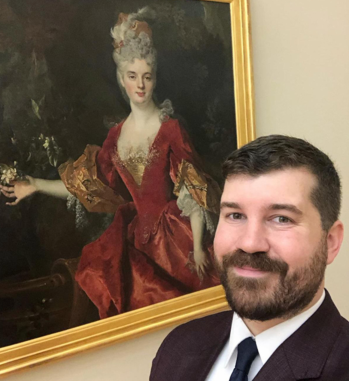 The Wadsworth Atheneum Museum of Art in Hartford, Connecticut has named Dr. Philippe Halbert as Richard Koopman Associate Curator of American Decorative Arts. A graduate of the College of William and Mary and the Winterthur Program in American Material Culture, Halbert earned his PhD in the history of art from Yale University, where he studied the intersections of art, empire, race, and self-fashioning in the Atlantic world. His academic work centers American decorative arts and material culture broadly, from its Indigenous roots to interconnected phenomena of diaspora, creolization, and settler-colonialism. Halbert has served as Interim Curator of American Decorative Arts at the Wadsworth since November 2022.
“I am committed to telling dynamic, object-centered stories of people and place that transcend geographic, ethnic, linguistic, and temporal bounds,” Halbert said, explaining that his academic interdisciplinary research and professional endeavors are grounded in a desire to encourage appreciation of American decorative arts by specialists and general audiences of all ages.
Proficient in French and Spanish, Halbert has been involved in the development of numerous exhibitions and special installations at the Wadsworth. Oversight responsibilities include over 3,000 decorative arts objects (circa 1650–2020) at the Wadsworth, with duties ranging from daily care of the collection and related research to overseeing rotations in the permanent collection galleries, developing special exhibits, volunteer training, and building partnerships with other institutions and constituents in Hartford and beyond.
Special projects underway and upcoming include New Nation, Many Hands, a special exhibition of federal-era decorative arts and material culture drawn from the permanent collection (on view from June 2023 until September 2024); reinterpretation of the Wetmore parlor, a painted and paneled room from a circa 1746 Middletown, Connecticut, house; and reevaluation of the Wadsworth’s American decorative arts holdings in anticipation of their reinstallation in 2025.
“Philippe is an outstanding scholar and curator of the Atlantic world, especially the interaction between France and North America. His passion for the material culture of vast early America is infectious and his love of curatorial work, breadth of knowledge, and extensive scholarship are incredible assets for the Wadsworth,” said Matthew Hargraves, Director of the Wadsworth Atheneum Museum of Art. “We are delighted that he has assumed this new role and look forward to his continued stewardship of our remarkable American Decorative Arts collection.”
Previously in his career, Halbert served as a curatorial intern at various museums, including at the Yale University Art Gallery, the J. Paul Getty Museum in Los Angeles, Philadelphia Museum of Art, and Colonial Williamsburg. He has earned numerous awards and fellowships and been an adjunct lecturer and consultant for various institutions, including at the Embassy of the United States in Paris. He is a resident of West Hartford, CT.
Frick Director Ian Wardropper to Retire in 2025
From the museum press release (3 January 2024) . . .
 The Frick Collection announced today that Ian Wardropper, the institution’s Anna-Maria and Stephen Kellen Director, will retire in 2025 following fourteen years of service to the Frick and a fifty-year museum career. During his tenure as the Frick’s director, Wardropper led the museum and library through a period of strategic and measured growth, which included the first comprehensive renovation and upgrade of the Frick’s historic buildings in nearly ninety years and a focused acquisitions program that has enhanced the institution’s art and library collections. He also prioritized accessibility and public outreach, spearheading innovative strategies and partnerships that enabled audiences to experience the museum and library in new ways. This has ranged from inventive online programs including Cocktails with a Curator to partnerships with the Ghetto Film School to the conceptualization and management of Frick Madison, which enabled the Frick’s collections and programs to be enjoyed throughout the institution’s renovation and enhancement project.
The Board of Trustees is working with an executive search firm to conduct an international search for the Frick’s next director. Wardropper will be honored for his innumerable contributions to the museum and the arts community at large at the institution’s fall 2024 gala, which precedes the public reopening of the museum and library in late 2024. . . .
The full press release is available here»
Robin Pogrebin covered the story yesterday for The New York Times.
Getty Acquisitions Include Portrait of Friedrich Christian by Mengs
From the press release (4 December 2023) . . .
A rare Netherlandish masterpiece, a recently rediscovered German still life, and a magnificent state portrait bolster the Getty’s collection.
The J. Paul Getty Museum announced today the acquisition of three important paintings, enhancing its collection of European art. The works include The Holy Family (ca. 1520) by Netherlandish artist Gerard David; Bouquet of Flowers in a Two-Handed Vase (early 1560s) by German artist Ludger tom Ring the Younger; and Portrait of Friedrich Christian, Prince of Saxony (1751), by German artist Anton Raphael Mengs. The three paintings were purchased individually on the European art market and will go on display at the Getty Center this week.
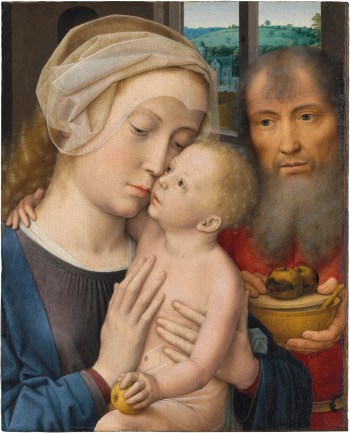
Gerard David, The Holy Family, ca. 1520, oil on panel, 16 × 13 inches (Los Angeles: Getty Museum, 2023.104).
“We rarely are able to acquire three such significant works of art at the same time,” says Timothy Potts, Maria Hummer-Tuttle and Robert Tuttle Director of the Getty Museum. “These paintings will considerably enhance our presentation of northern European paintings, adding depth and variety across the genres of religious imagery, independent still life, and grand portraiture. I have no doubt that all three pictures, representing very different aspects and periods of European art, will engage and delight our visitors.”
An extremely rare work by Gerard David, Holy Family highlights the artist’s use of rich oil colors and delicate brushwork that distinguish his extraordinarily meticulous painting technique. David placed the three figures—Mary, Jesus, and Joseph—close to the viewer, underscoring their warm, familial bond. The Virgin and Child tenderly embrace as Jesus presses his cheek against Mary’s while she holds her son tightly. Joseph holds a spoon and lidded bowl, keeping the porridge-like milk soup warm for the child. Jesus holds an unblemished apple, a symbol of his role as the ‘new Adam’; two decaying apples sitting atop the lidded bowl offer a stark allusion to the future passion of Christ.
Typical for painters of the period, David portrayed the figures in a contemporary environment: the buildings and hilly landscape visible outside the window are characteristic of 16th-century Netherlands. The superb condition of the painting preserves David’s subtle modeling of flesh and many exquisite details, such as the fine gold highlights of the Virgin’s tresses and the tiny swan floating on the pond in the background.
“With its powerful sense of immediacy, this moving and intimate depiction of the Holy Family is a major addition to our collection of Netherlandish paintings,” says Davide Gasparotto, senior curator of paintings at the Getty Museum. “Its exceptional state of preservation allows us to appreciate David’s commanding use of color and delicate brushwork.”

Ludger tom Ring the Younger, Bouquet of Flowers in a Two-Handed Vase, early 1560s, oil on oak panel, 15 × 11 inches (Los Angeles: Getty Museum, 2023.101).
Bouquet of Flowers in a Two-Handed Vase by German artist Ludger tom Ring the Younger becomes the earliest independent still life painting in Getty’s collection. It marks a pivotal moment in Renaissance art, when close artistic observation of European plants, initially expressed through drawn and watercolor studies by German masters Martin Schongauer and Albrecht Dürer around 1500, became worthy subjects of panel painting.
The painting imparts a monumentality despite its relatively modest scale. On a simple shelf or table set against a dark background, the artist depicted a luxurious two-handled vase made of milky Venetian glass decorated with gold and blue enamel. The vibrant bouquet features over 15 species of plants native to northern Europe, including roses, gillyflowers, pot marigolds, pink daisies, violets, and rosemary.
“A pioneer in the history of European still life, Ludger tom Ring was the author of only a handful of panels with bouquet of flowers: this is the first bouquet painting by Ring acquired by a museum in the United States,” says Gasparotto. “With its brilliant palette, exuberant textures, and characterful vase, this work greatly expands our collection of German Renaissance art.”
A magnificent state portrait, created by Anton Raphael Mengs when he was on the cusp of international fame, captures the energy and optimism of a youthful prince. Prince Friedrich Christian commissioned the portrait in 1751, soon after the artist was appointed principal painter to the Saxon court in Dresden, Germany. The painting portrays Christian in three-quarter length, clad in tournament armor under billowing layers of richly colored drapery, sashes, and medals. The prince adopts a self-assured attitude, with one knee bent, his right hand gripping a baton, and his left arm resting upon his helmet. His soft, good-natured features are sharpened by the quick intelligence apparent in his bright, delicate eyes.

Anton Raphael Mengs, Portrait of Friedrich Christian, Prince of Saxony, 1751, oil on canvas, 61 × 43 inches (Getty Museum, 2023.100).
Mengs created a splendidly engaging portrait that asserts the prince’s dynastic legitimacy while concealing the sitter’s disability—likely cerebral palsy—which would have prevented him from assuming the easy, confident stance shown in his portrait. After the prince’s untimely death in 1763, the painting remained with the royal family in an almost unbroken chain of inheritance until its sale in 2022.
“With its burst of color and over-the-top grandeur, this painting is a magnificent addition to our extraordinary collection of early modern portraiture,” says Gasparotto. “The portrait will offer visitors a chance to consider the purpose and potential of the state portrait, the highest form of political image-making in early modern Europe.”
This new painting joins three other works by Mengs in the Getty collection: Portrait of William Burton Conyngham (a pastel); Asclepius (recto) and Study of a Male Youth Bearing Some Leaves (verso) (a drawing); and Portrait of José Nicolás de Azara, Marquis of Nibbiano (a painting).
The Huntington Acquires a Portrait by Goya
From the press release (20 November 2023) . . . .
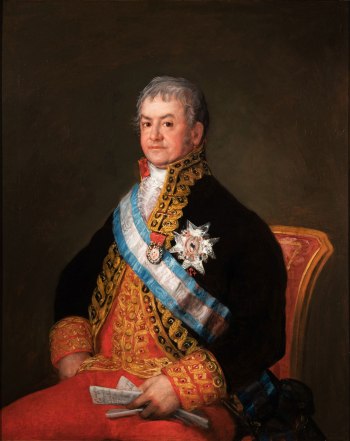
Francisco José de Goya y Lucientes, Portrait of José Antonio Caballero, Second Marqués de Caballero, Secretary of Grace and Justice, 1807, oil on canvas, frame: 135 × 114 × 9 cm (The Huntington Library, Art Museum, and Botanical Gardens, Gift of The Ahmanson Foundation).
The Huntington Library, Art Museum, and Botanical Gardens announced today that it has acquired a historic portrait by Spanish master Francisco José de Goya y Lucientes (1746–1828). Portrait of José Antonio Caballero, Second Marqués de Caballero, Secretary of Grace and Justice was painted in 1807, a time when Goya was renowned for his portraits of the Spanish nobility and just before the Napoleonic invasion of Spain profoundly altered the nature of his later work. While The Huntington holds a number of Goya’s etchings and aquatints, Portrait of José Antonio Caballero is the first Spanish oil painting to join The Huntington’s art collection and will complement its extensive holdings of Library materials on Spanish imperial history. The painting—which will go on view in the Huntington Art Gallery on 29 November 2023—is The Huntington’s third masterpiece acquired through a gift from The Ahmanson Foundation.
“Once again, The Ahmanson Foundation has proven to be an invaluable strategic partner, helping us reach our goals of broadening our collections with significant works and inviting new, interdisciplinary connections,” Huntington President Karen Lawrence said. “We couldn’t be more grateful to them for making possible the acquisition of such a superb and historically significant masterpiece.”
Considered one of the last Old Masters and one of the first and most influential great modern painters, Goya was celebrated during his lifetime for his ability to capture his subjects’ innermost personalities as well as their grandeur and political power—albeit with what has been perceived as an occasional layer of satire. He is also acclaimed for his virtuosic painterly style; flickering, impressionistic brushwork; and, in his later years, revolutionary subject matter.
Trained in Madrid and inspired by travels in Rome, Goya became a Spanish court painter in 1786, and he soon became known for such royal and aristocratic portraits as Portrait of José Antonio Caballero. But after the 1808 French invasion of Spain that began the Napoleonic Wars, Goya turned his artistic attention to portraying the horrors of war in paintings and prints.
“Portrait of José Antonio Caballero is historically fascinating and a prime example of Goya’s genius as a portraitist,” said Christina Nielsen, the Hannah and Russel Kully Director of the Art Museum at The Huntington. “Along with the exquisite French portrait by Élisabeth Louise Vigée Le Brun acquired with The Ahmanson Foundation last year, it will add an important international perspective to our outstanding collection of 17th- and early 18th-century British portraits.”
The Ahmanson Foundation funded The Huntington’s acquisition of Portrait of Joseph Hyacinthe François-de-Paule de Rigaud, comte de Vaudreuil (ca. 1784) by Vigée Le Brun (1755–1842), the most important female artist of 18th-century France, in 2022, and the monumental Portage Falls on the Genesee (ca. 1839) by Anglo American painter Thomas Cole (1801–1848) in 2021.
The sitter in the Goya painting, José Antonio Caballero (1754–1821), was from the minor nobility in Spain. He studied law and went on to a successful career in the royal court, holding four secretary positions. His accomplishments included convincing King Charles IV of Spain to conduct a vaccination campaign against smallpox that extended to the Spanish territories in North and South America and Asia. Goya painted the portrait when Caballero was the secretary of state and had just inherited the title of Marquis de Caballero from his uncle.
In the portrait, Caballero is depicted in a highly decorated ministerial uniform and seated in a red armchair. His black coat and bright red waistcoat are extensively embroidered with gold decoration. He looks directly at the viewer, conveying a sense of stature and power, with his right hand at his waist and his left hand holding papers. A powder-blue-and-white sash is draped across his chest, pinned with the Order of the Grand Cross of Charles III. The bright white insignia of a knight of the Order of Santiago is pinned to his coat.
The portrait will be installed in the Huntington Art Gallery, the former residence of founders Henry E. and Arabella Huntington, in a paneled room that was once Henry Huntington’s private office.
Spain’s Museum of Romanticism to Receive a Pieta by Goya
As noted at Art History News, from Spain’s Ministerio de Cultura:
Spain’s Ministry of Culture [has announced] that they have acquired an early Pieta by Francisco Goya. . . The painting is believed to have been inspired by the artist’s travels in Italy. The work was acquired for €1.5m and will head to the National Museum of Romanticism in Madrid.
◊ ◊ ◊ ◊ ◊

Francisco de Goya y Lucientes, Pietà, 1772–74, 84 × 58 cm (Madrid: Museo Nacional del Romanticismo).
El Ministerio de Cultura ha adquirido La Piedad, una obra fechada en la etapa temprana del pintor aragonés Francisco de Goya (1746–1828), por valor de 1,5 millones de euros. La obra se destinará a la colección permanente del Museo Nacional del Romanticismo, museo de titularidad estatal y gestión del Ministerio.
El cuadro, inédito hasta época reciente, permite conocer mejor la pintura religiosa del artífice. Mide 83,5 × 58 centímetros y conserva su tela y bastidor originales. La obra se ha fechado entre 1772 y 1774, por lo que es un testimonio relevante sobre las fuentes de inspiración que el aragonés recogió de su viaje a Italia, donde pudo conocer La Piedad de Miguel Ángel y otros modelos de Carracci, Maratti y Giaquinto. Tras su regreso a Zaragoza en 1771, Goya pudo expresar su evolución en sus trabajos en la Basílica del Pilar y en la Cartuja Aula Dei, con un estilo comparable con el de La Piedad adquirida por el Ministerio.
En la última década, el lienzo ha sido objeto de distintas solicitudes para su exportación, si bien estas han sido denegadas al tratarse de una obra de gran rareza, representativa del periodo temprano de la producción de su autor y por constituir uno de los pocos ejemplos de su obra religiosa, ayudando así a definir la figura del artista en su contexto.
Con La Piedad, el Museo Nacional del Romanticismo refuerza la presencia del “romántico quizá más glorioso y original,” en palabras del historiador del arte Manuel Bartolomé Cossío (1857–1935). Hasta ahora, la institución sólo contaba con una pieza de Goya, San Gregorio Magno, Papa, una obra monumental que pertenece al museo desde su fundación y que da buena prueba de la importancia que la producción del aragonés tuvo en el periodo romántico. Actualmente, el San Gregorio Magno, Papa preside el Oratorio, un espacio propio de las viviendas acomodadas que se empleaba para la devoción privada y donde se oficiaban los actos religiosos de carácter íntimo, como bodas, bautizos o velatorios. Precisamente, la temática y el tamaño de La Piedad sugieren que fue un encargo de algún eclesiástico o comitente de la burguesía zaragozana para cumplir una función devocional privada o doméstica.
Decorative Arts Trust Announces Failey Grant Recipients for 2024
From the press release:

Page from the African Union Society book of records, recording a land transaction between Arthur Flagg and Cupid Brown for a house and lot on Thames Street (NHS Vol. 1674B, Page 190).
The Decorative Arts Trust is pleased to announce that the 2024 Dean F. Failey Grant recipients are the Andrew Jackson Foundation in Nashville, TN; the Brandywine Conservancy & Museum of Art in Chadds Ford, PA; Fallingwater in Mill Run, PA; Museo de las Americas in Denver, CO; the Newport Historical Society in Newport, RI; and the Tomaquag Museum in Exeter, RI.
The Failey Grant program provides support for noteworthy research, exhibition, and conservation projects through the Dean F. Failey Fund, named in honor of the Trust’s late Governor. Each of these projects also incorporates contributions from an emerging scholar. Failey Grant applications are due October 31 annually.
The Andrew Jackson Foundation will conserve and exhibit Sarah Yorke Jackson’s 1820–30 Spanish guitar attributed to Cabasse-Visnaire L’ainé that is currently on display in the Hermitage Mansion. The project will be led by Collections Manager Jennifer Schmidt and Collections Aide Haley Weltzien.
The Brandywine Conservancy & Museum of Art will publish the catalogue for The Crafted World of Wharton Esherick exhibition. Wharton Esherick Museum (WEM) Director of Curatorial Affairs Emily Zilber will be the catalogue’s primary author, with essays by WEM Director of Interpretation and Research Holly Gore, Philadelphia-based design and culture writer Sarah Archer, and Philadelphia Museum of Art Assistant Curator in the Department of European Decorative Arts Colin Fanning.
Fallingwater will restore 24 oversized blueprints of shop drawings for Frank Lloyd Wright’s built-ins and furniture as well as 28 blueprints of the guest house. Paper conservator Jayne Girold Holt will work with Hannah Cioccho, Fallingwater’s newly appointed Collections Manager and Archivist.
Museo de las Americas plans to launch a digital resource focusing on a collection of Latin American textiles, which includes containers, clothing, and blankets. Curator of Collections Laura Beacom will work with a paid intern to photograph, digitize, and upload content to Bloomberg Connects and Google Arts and Culture.
The Newport Historical Society will develop A Name, a Voice, a Life: The Black Newporters of the 17th–19th Centuries, an exhibition about how the lives of Africans and African Americans have been interpreted from the written record. The exhibition will be led by Collaborating Curator Zoe Hume and Project Director Kaela Bleho.
The Tomaquag Museum will conserve an 1840s Narragansett birchbark canoe, which was crafted by the great uncle of Ferris Dove, the Narragansett Chief Roaring Bull. Conservator Linda Nieuwenhuizen will perform a condition assessment, and Tomaquag Museum Archival Assistant and Narragansett Nation citizen Kathryn Cullen-Fry will document the history and community memories of the canoe, which will serve as a centerpiece of Tomaquag’s new visible storage facility.
Decorative Arts Trust Grant to Support Study of Frames at AGO
From the press release (1 December 2023). . .
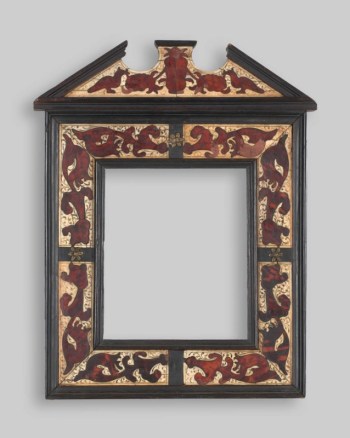
Italian Tabernacle Frame, 1600s, tortoiseshell, bone or ivory, and wood. (Toronto: AGO, gift from a private collector, 94/994).
The Decorative Arts Trust is pleased to announce that the Art Gallery of Ontario (AGO) in Toronto, Canada, will serve as our 2024–26 Curatorial Internship Grant partner. The Decorative Arts Trust underwrites curatorial internships for recent Masters or PhD graduates in collaboration with museums and historical societies. These internships allow host organizations to hire a deserving professional who will learn about the responsibilities and duties common to the curatorial field while working alongside a talented mentor.
This intern will focus on a type of material culture that links the decorative and fine arts: frames. The AGO is home to one of the largest collections of historic frames in the world, currently amounting to well over 1,200 examples. The collection is expansive in terms of both chronology and geography, ranging from the late 1400s to the early 1990s, and with fine frames from France, England, Germany, the Netherlands, Italy, Spain, the Americas, and Asia. The AGO’s goals are twofold: to study the history of frame making to preserve knowledge at a moment when most experts in the field are currently retiring; and to pair paintings and frames to show artwork within a surround that was made in the same region and time period.
Under the mentorship of Caroline Shields, Curator, European Art, and Adam Harris Levine, Associate Curator, European Art, the intern will research and catalogue the AGO’s holdings and assist in making the collection available to the public online. They will work to pair paintings with frames that are chronologically and geographically suited, and they will facilitate the loan of frames to peer museums. The intern’s term will begin in May 2024, when the AGO hosts an international conference, Many Lives: Picture Frames in Context, featuring keynote speakers Hubert Baija, Senior Frames Conservator, and Lynn Roberts, Frame Historian. As part of their tenure at the AGO, the intern will help prepare the conference papers for a digital publication.
A formal call for applications for the internship will be posted early in 2024. Current and recent graduate students who are interested in this opening are encouraged to visit AGO’s website at ago.ca for updates.
Concord Museum Awarded Funding Prize by Decorative Arts Trust

Visitors viewing powder horns on display in the April 19, 1775 gallery at the Concord Museum, the recipient of the 2023 Decorative Arts Trust Prize for Excellence and Innovation, which includes an award of $100,000.
◊ ◊ ◊ ◊ ◊
Press release (16 November 2023) from The Decorative Arts Trust:
The Decorative Arts Trust is thrilled to announce that the 2023 Prize for Excellence and Innovation was awarded to the Concord Museum in Concord, Massachusetts, for their exhibitions and publication commemorating the 250th anniversary of the American Revolution in 2025–26.
The Concord Museum’s initiative will feature a series of three special exhibitions showcasing the stories of individuals, families, and communities during the American Revolution. Focused on the theme of “Whose Revolution,” the special exhibitions will explore themes of liberty, community, and memory, tracing the continued legacy of the Revolution today. The Museum will also create a companion digital exhibition to extend the geographical reach of the exhibitions beyond Concord and promote further education and engagement. Additionally, the Museum will release the first major publication of its American Revolution collection, from flints and powder horns carried by militia soldiers to textiles, furniture, and ceramics that were valued and preserved for their role in witnessing a revolution.
The Concord Museum began in the 1850s as the private collection of local resident Cummings Davis, who gathered and preserved the relics of his friends and neighbors as a record of local history. The collection grew throughout the 19th century and was incorporated as the Concord Antiquarian Society in 1886, moving to a new building in 1930 and later becoming known as the Concord Museum. The Museum now houses a significant collection of over 45,000 objects, with particular strengths in the decorative arts from the 18th and 19th centuries, the American Revolution, transcendentalism, and other areas relating to Concord and New England history. The Museum recently completed a major building expansion and renovation of its permanent galleries, including new spaces for collections, education, and public programs.
The Decorative Arts Trust Prize for Excellence and Innovation, founded in 2020, funds outstanding projects that advance the public’s appreciation of decorative art, fine art, architecture, or landscape. The Prize is awarded to a nonprofit organization in the United States or abroad for a scholarly endeavor, such as museum exhibitions, print and digital publications, and online databases. Past recipients include Cooper Hewitt, Smithsonian Design Museum; the Black Craftspeople Digital Archive; and Craft in America.
New Book | National Museum of Women in the Arts Collection Highlights
Following a two-year closure, the National Museum of Women in Arts, reopened in October (with details available in this press release). Complementing the renovation is this new publication from Hirmer and distributed by The University of Chicago Press:
National Museum of Women in the Arts Collection Highlights (Munich: Hirmer Verlag, 2023), 264 pages, ISBN: 978-3777441696, $60.
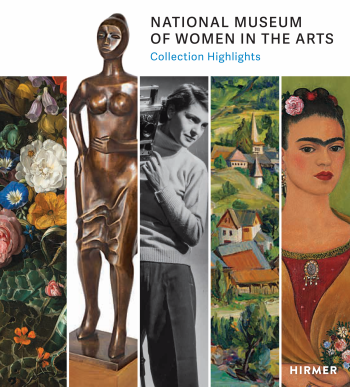 The National Museum of Women in the Arts, Washington, DC, is the first museum in the world solely dedicated to championing women through the arts. Drawing from a collection that spans five centuries and includes artists from six continents, this publication spotlights new additions to the museum as well as longstanding highlights. Vibrant images present over 175 works from the museum’s collections, including key artworks by Louise Bourgeois, Lalla Essaydi, Frida Kahlo, Hung Liu, Clara Peeters, Faith Ringgold, Niki de Saint Phalle, Amy Sherald, Alma Woodsey Thomas, and many others. Thematic chapters weave connections across medium, genre, and time. Essays by museum curators and more than thirty guest artists and scholars illuminate the mission of NMWA and help readers discover great women artists.
NGA Acquires Important Work by Anne Vallayer-Coster
Press release (17 November 2023) from the National Gallery of Art in Washington, DC:

Anne Vallayer-Coster, Still Life with Flowers in an Alabaster Vase and Fruit, 1783, oil on canvas (unlined), overall: 109 × 90 cm (Washington, DC: National Gallery of Art, Chester Dale Fund 2023.40.1).
The National Gallery of Art has acquired an important painting by Anne Vallayer-Coster (1744–1818), Still Life with Flowers in an Alabaster Vase and Fruit (1783). One of the greatest still life painters of 18th-century France, Vallayer-Coster achieved remarkable success in the male-dominated art world of her time. She not only attracted the patronage of some of the most powerful collectors of the time, including Marie Antoinette, but she also became one of the few women to be admitted to the prestigious Royal Academy of Painting and Sculpture and to show her work at its official public exhibition, the Salon.
Still Life with Flowers in an Alabaster Vase and Fruit is the first painting by Vallayer-Coster to enter the National Gallery’s collection. Despite the limited access to training and patronage, women artists achieved unprecedented professional opportunities and success in the latter half of the 18th century. Vallayer-Coster, alongside Élisabeth Louise Vigée Le Brun, is now the second woman artist represented in the National Gallery’s collection of 18th-century French paintings. This masterpiece not only fills out a more complete story of this pivotal period in European art history, but also highlights the accomplishments of one of its most significant artists.
One of Vallayer-Coster’s most ambitious works, this painting showcases her unrivaled ability to capture the soft, delicate textures of flowers and to coordinate their dazzling colors and irregular shapes into a harmonious whole. When it was exhibited at the Salon of 1783, critics hailed Still Life with Flowers in an Alabaster Vase and Fruit as a masterpiece. Vallayer-Coster herself considered it her finest painting, and she kept it until her death. Lost for nearly 200 years, this extraordinary work was recently rediscovered in an almost pristine state of preservation: unlined, on its original stretcher, and in the Louis XVI frame in which it was likely exhibited.
Depicting an opulent bouquet brimming with meticulously studied and exquisitely rendered flowers, this work includes roses, irises, lilacs, carnations, hollyhocks, dahlias, bluebells, and hydrangeas, among others, that create a dazzling display of color against the rich, chocolate brown scumbling of the background. The flowers sit in an alabaster vase adorned with French gilt-bronze mounts, featuring a child satyr supporting a cornucopia of fruits and flowers. Resting on an elaborately carved and gilded mahogany table with a pale gray marble top, the vase and flowers are completed by a bunch of white grapes, a pineapple, and three peaches. Evoking the cool polish of marble and alabaster, the glistening surface of cast-bronze, the translucency of grapes, the spiky form of a pineapple, the velvety skin of peaches, and the delicate freshness of flower petals, the painting epitomizes Vallayer-Coster’s extraordinary skill in portraying colors and textures.










leave a comment