Laure Marest Named Curator of Ancient Coins at Harvard Art Museums
From the press release (4 August 2023) . . .
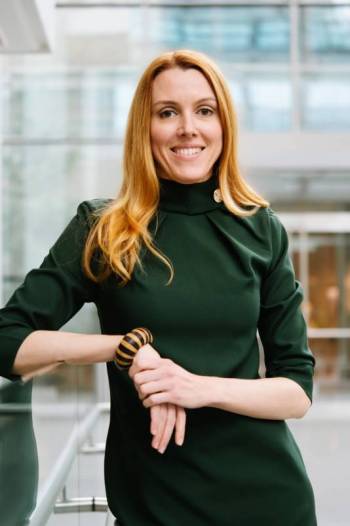
Laure Marest’s research interests include ancient Greek art, especially coins, engraved gems, and Hellenistic portraits, as well as the reception of antiquity in the 18th and 19th centuries. Photo by Mike Ritter.
Martha Tedeschi, the Elizabeth and John Moors Cabot Director of the Harvard Art Museums, today announced the appointment of Laure Marest as the new Damarete Associate Curator of Ancient Coins—one of the few numismatic positions based at a U.S. university museum. Marest will lead the charge in rethinking the presentation of the museums’ sizable collection of ancient Greek, Roman, Byzantine, and other coins, as well as related objects, and in proposing fresh perspectives for the field through programs and publishing. She will begin her new role at Harvard on 18 September 2023.
Marest is currently the Cornelius and Emily Vermeule Associate Curator of Greek and Roman Art at the Museum of Fine Arts, Boston, where she was previously assistant curator from 2017 to 2022. While at the MFA, she co-curated The Marlborough Gem (2023) and worked with colleagues to renovate and install five new permanent collection galleries featuring the art of ancient Greece, Rome, and the Byzantine Empire, which opened in December 2021. Marest was the lead curator for the Gods and Goddesses Gallery, a major display of large-scale sculptures of ancient Greek and Roman deities—including the MFA’s monumental Juno—and more intimate objects used for religious rituals. She also is author of a forthcoming publication on the collection of ancient Greek and Roman engraved gems at the MFA.
In her role at the Harvard Art Museums, Marest will join the Division of Asian and Mediterranean Art and oversee the museums’ numismatic collection. Working with colleagues across the museums and the Harvard campus, as well as with community stakeholders, she will participate in a museum-wide rethinking and reframing of the museums’ permanent collections galleries and contribute to exhibitions and publications. She will research the current numismatic holdings and make acquisitions to diversify the collection. She will also work closely with students and faculty to continue to expand use of the collection in undergraduate and graduate teaching across disciplines; she will mentor students and curatorial fellows, training and nurturing the next generation in her field.
“We are delighted to welcome Laure to the Harvard Art Museums,” said Tedeschi. “Harvard students and our public audiences have long been fascinated with ancient coins, which feature prominently in our collection galleries. Laure’s expertise across different media and her wide-ranging interests and passion for inclusive storytelling will further expand our efforts to connect visitors to the peoples and cultures of the ancient Mediterranean and Middle East.”
“I am excited to join the Harvard community and to work closely with colleagues across the museums and faculty to animate the numismatic collection and rethink the permanent displays,” said Marest. “And it is a great honor to succeed Carmen Arnold-Biucchi, a grande dame in the field, in this position, which itself was named after Damarete, an exemplary female ruler of Syracuse whose deeds were praised in antiquity.”
Marest has previously held teaching positions at the University of California, Berkeley, and California State University, Northridge, as well as curatorial assistant and intern positions in the Department of Antiquities at the J. Paul Getty Museum, Los Angeles. At the Getty, she assisted with several exhibitions, including Modern Antiquity: Picasso, De Chirico, Léger and Picabia in the Presence of the Antique (2011–12), The Art of Ancient Greek Theater (2010–11), Collector’s Choice: J. Paul Getty and His Antiquities (2009–10), and Carvers and Collectors: The Lasting Allure of Ancient Gems (2009).
Marest received her PhD at the University of California, Berkeley, and holds degrees from California State University, Northridge, and the Sorbonne, Paris. She has participated in excavations in Albania and Italy and was previously involved as a researcher and photographer for the Pompeii Artifact Life History Project and as a gem specialist and photographer for the Pompeii Archaeological Research Project: Porta Stabia. Her research interests include ancient Greek art, especially coins, engraved gems, and portraiture of the Hellenistic period, as well as the reception of antiquity in the 18th and 19th centuries. She has presented at numerous conferences throughout the United States and has published in the American Journal of Numismatics and contributed to Hellenistic Sealings & Archives: Proceedings of The Edfu Connection, an International Conference (2021) for the Studies in Classical Archaeology series, and to Proceedings of the XV International Numismatic Congress (2017).
Comprising over 20,000 coins, the numismatic collection of the Harvard Art Museums is comprehensive and ideally suited for teaching. Greek, Roman, and Byzantine coins from c. 630 BCE to 1453 CE form the core of the collection, but it also features examples of (west) Asian, Islamic, western medieval, and later coins. Thanks to the long-term loan of the Arthur Stone Dewing Collection, the museums’ holdings of Greek coinage are particularly strong and include the world’s largest collection of Syracusan decadrachms. The coin collection has grown steadily through bequests, gifts, and purchases over the last 125 years. Among these, the Thomas Whittemore bequest of Byzantine coins is especially notable. The bequest of Frederick M. Watkins contains Greek and Roman coins of exceptional quality. The 2005 acquisition of the collection of Margarete Bieber, the 2008 acquisition of the Zvi Griliches Collection, and the transfer of the Alice Corinne McDaniel Collection from Harvard University’s Department of the Classics have significantly enriched the holdings of ancient Greek, Roman, and Jewish coins.
Display | Works by José Campeche and Francisco Oller at MFA, Boston
From the press release (20 June 2023) . . .
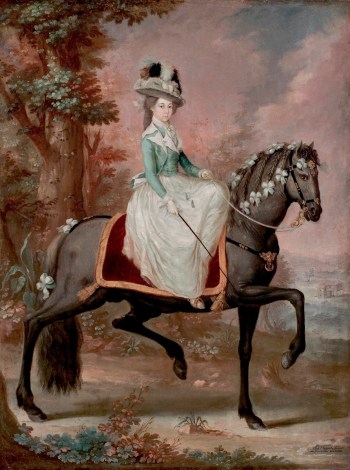
José Campeche y Jordán, Lady on Horseback, 1785, oil on panel, 40 × 30 cm (Museo de Arte de Ponce, Luis A. Ferré Foundation).
Paintings by legendary Puerto Rican artists José Campeche and Francisco Oller are presented in dialogue with art from the same period in the MFA’s collection. The Museo de Arte de Ponce continues to share its collection with museums worldwide as it rebuilds its Edward Durell Stone-designed building damaged by the January 2020 earthquakes.
The Museum of Fine Arts, Boston (MFA) and the Museo de Arte de Ponce (MAP) jointly announce that important works by José Campeche y Jordán (1751–1809) and Francisco Oller y Cestero (1833–1917)—the most influential Puerto Rican artists of the 18th and 19th centuries—are now on display at the MFA (as of 29 June 2023). This special installation features five paintings by Campeche and Oller from MAP’s collection, including one of the most iconic works in the history of Puerto Rican art, Campeche’s Lady on Horseback (1785). Oller’s famed Hacienda Aurora (1898), as well as two rare paintings on ceramic plates, open conversations about histories of the Puerto Rican landscape and artistic exchanges across Europe and the Americas.
“This partnership with the Museo de Arte de Ponce creates an unprecedented opportunity for us to introduce our audiences to Campeche and Oller, two deeply significant Puerto Rican painters who remain understudied outside of the island,” said Matthew Teitelbaum, Ann and Graham Gund Director. “Displayed in our Art of the Americas Wing alongside important works of colonial art and landscape painting from our collection, these special loans from MAP will highlight the contributions of Puerto Rican artists and offer a new point of connection for Boston’s vibrant Puerto Rican community.”
The paintings will be highlighted during tours at the MFA’s annual Latinx Heritage Night on September 21 as well as through additional programs.
The collection of the Museo de Arte de Ponce consists of approximately 4,500 works of art and is recognized for important examples of Baroque, Pre-Raphaelite, and Victorian art. The renowned collection of Puerto Rican art makes up about one-third of the museum’s holdings, including works from the 18th to 21st centuries. Following a catastrophic series of earthquakes in January 2020 that damaged the internationally recognized Edward Durell Stone-designed building, the main galleries of MAP have remained closed to the public.
As the galleries are rebuilt, MAP remains committed to keeping the collection accessible through collaborations with institutions on the island and beyond. In New York City, the Metropolitan Museum of Art is currently displaying five Victorian masterpieces, including Flaming June by Frederic Leighton, John Everet Millais’s The Escape of a Heretic, 1559, and Edward Burne-Jones’s Small Briar Rose series. From September 2022 to June 2023, Chicago’s National Museum of Puerto Rican Arts and Culture exhibited Nostalgia for My Island: Puerto Rican Painting from the Museo do Arte de Ponce (1786–1962). Additional loans are expected to be announced in other major cities in the United States, as well as in Europe.
“Not only is the museum a cultural institution ingrained in the fabric of Puerto Rican society, but it is also internationally renowned because of the extraordinary collections it houses, “said Cheryl Hartup, Director of the Museo de Arte de Ponce. “When the works travel, a conversation is created within the ecosystem of international art institutions and their collections and audiences. We couldn’t be more thrilled to share iconic paintings by Puerto Rican artists with the MFA, Boston as the museum is repaired.”
The Museo de Arte de Ponce expects to fully reopen in 2024.
Sarah Turner Appointed Director of the Paul Mellon Centre
From the press release (29 June 2023) from the Mellon Centre:
 Dr Sarah Victoria Turner has been appointed Director of the Paul Mellon Centre. Sarah Turner has been Acting Director of the Centre since March 2023 and will take up the post from July 2023. She follows Mark Hallett as the sixth Director of the Paul Mellon Centre and will be its first female Director since its founding in 1970.
Sarah Turner’s directorship will build on her eight years at the Centre, first as Assistant Director for Research and lately as Deputy Director, during which time she has overseen many innovative programmes and collaborative projects with partners in the UK and internationally, including establishing the national art writing competition, Write on Art, with Art UK, co-leading the London-Asia research project, and co-writing and co-hosting the Sculpting Lives podcast. She is editor-in-chief of the award-winning, open-access journal British Art Studies (since its founding in 2015). During her time at the Paul Mellon Centre, Dr Turner has had oversight of the archive & library, digital activities, book and online publications, and the research programme.
Sarah Turner read History of Art at Pembroke College, Cambridge. At the University of Leeds, she studied for an MA in Sculpture Studies, run in partnership with the Henry Moore Institute, and then completed her PhD at the Courtauld Institute of Art. She began her academic career at the University of York where she was first a Teaching Fellow and then a Lecturer in the Department of History of Art. As an art historian, she has published widely and has co-curated several major exhibitions, and much of her writing has focused on the entangled relationships between Britain, the British Empire, and South Asia.
Susan Gibbons, Vice Provost for Collections and Scholarly Communication, Yale University, and ex-officio Chief Executive of the Paul Mellon Centre commented: “I am delighted to announce the appointment of Sarah Victoria Turner. Her energy and passion for collaboration as a scholar and curator, and her strong leadership skills, make her an exceptional appointee.”
Sarah Turner said: “I am thrilled to be leading an outstanding team of people at the Paul Mellon Centre. I look forward to working closely with the Yale community, particularly our partner institution, the Yale Center for British Art, to take the Centre forward in its mission to promote activities that expand and enhance understandings of British art. The Paul Mellon Centre offers incredible resources that support research, curating and education activities. One of my aims as Director is to share these as widely as possible and to open up new conversations, ideas and narratives about the histories of British art. I am excited about the future direction of work that the Centre will shape and support. As Director, I will be a vocal champion for the value of art and architectural history and research on visual culture more broadly in helping us navigate some of the most complex questions of our time.”
Portrait at Greenwich Reattributed to Gainsborough
From the press release, via Art Daily:
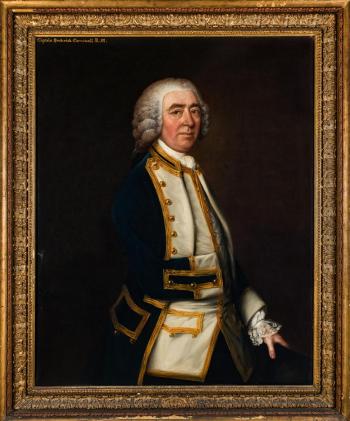
Thomas Gainsborough, Portrait of Captain Frederick Cornewall, ca. 1762 (Greenwich: National Maritime Museum).
Royal Museums Greenwich has announced the discovery of a portrait by famed eighteenth-century artist Thomas Gainsborough (1727–1788). Recent research into the Portrait of Captain Frederick Cornewall (ca. 1762) by Hugh Belsey and RMG curators has led to the exciting reattribution to Gainsborough.
Gainsborough was a leading artist in the second half of the eighteenth century. He is celebrated for his intimate and characterful portraits produced with lively brushwork. He was a founding member of the Royal Academy and has had a lasting influence in British art. The three-quarter-length portrait of Captain Frederick Cornewall (1706–1788) entered the RMG collection in 1960. It was recorded as a Gainsborough, but the curator at the time did not deem it of a high enough quality. It was attributed to an unknown artist and has been in storage for at least three decades.
Hugh Belsey had discovered a photograph of Cornewall’s portrait from the early twentieth century when the painting was owned by the London dealers, Agnew’s. He then traced the painting through several sales to the collector, Edward Peter Jones, but here the trail went cold. Unbeknownst to Belsey, Jones had bequeathed the painting to RMG in 1960. It was not until 2022, when Belsey’s friend was looking through the illustrated catalogue of the National Maritime Museum’s collection, that Belsey became aware that the painting may be in the RMG collection. Belsey requested to see the portrait in the museum stores in February 2022 and, on inspection of the painting, it became clear from the warm palette and unrivalled draughtsmanship that it was a Gainsborough.
Belsey has dated the painting to about 1762 when Gainsborough was working in Bath and sees it as an impressive example of the painter’s work from this period. Cornewall stands against a plain brown background in undress uniform and a bag wig. Gainsborough’s delicate brushwork is especially obvious in the most detailed areas of the picture, such as the lace cuff around Cornewall’s left wrist. Society columns from newspapers of the time show that Cornewall visited Bath in March 1762. The painting was presumably commissioned during this visit. It was perhaps intended to commemorate Cornewall’s retirement from active naval service the previous year. Cornewall had lost his arm during the Battle of Toulon (1744) and Gainsborough highlights the injury, styling Cornewall as a courageous fighter. The sleeve of his coat attached by a small loop to a button on his waistcoat in imitation of the traditional eighteenth-century pose where men were often painted tucking one hand into their waistcoat.
Fundraising has now started to conserve the painting and frame for display. Urgent treatment is needed as the paint layer is loose and there is flaking in some areas. As the painting has not been displayed for some time, there is a layer of dust over the surface of the front and back of the painting, which creates a dull appearance. A layer of conservation grade varnish, which is resistant to yellowing with age, will be applied to re-saturate the pigments. RMG’s crowdfunding campaign will aim to raise £60,000 towards the conservation, which will return the portrait to something closer to Gainsborough’s original intentions in preparation for display at the Queen’s House. The fundraising page went live on Monday, 10 July.
Katherine Gazzard, curator, said: “It is thrilling to be able to rescue this lost masterpiece from obscurity. Those of us lucky enough to see the portrait in the museum stores knew it was something special, but it was only with Hugh’s help that we were able to piece together the full story. We are excited about sharing the painting with the public, but it is currently too fragile for display. The fundraising campaign will enable us to perform the remedial work that the portrait desperately needs. Once the conservation is complete, the painting will hang in the Queen’s House, where our visitors will be able to enjoy this rediscovered masterpiece for themselves.”
Hugh Belsey said: “I have been studying Gainsborough’s works for over forty years, and during that time I have taken every opportunity to look at as many paintings and drawings as possible. I am delighted that this splendid portrait is now identified as a fine early work by Gainsborough. Gainsborough’s work was developing at a very fast pace in the early 1760s, and during the decade and as he attracted more commissions, his style became more assured and his brushwork freer.”
Captain Frederick Cornewall was born in 1706 in Shropshire. He had an active naval career, serving in two high profile battles, the Battle of Toulon (1744) and Battle of Minorca (1756). Both received public scrutiny and criticism with some officers being accused of inaction and cowardice.
At the Battle of Toulon, Cornewall was wounded which resulted in the amputation of his right arm. He served on the Marlborough one of the few British ships that engaged with the Franco-Spanish fleet. In the portrait, Cornewall is positioned with his right arm towards the viewer, emphasising his war wound. The composition could be interpreted as Cornewall distinguishing himself as a participant in the main action thereby portraying himself as a dutiful and willing officer, unlike his colleagues who had failed to engage the enemy at Toulon.
At the Battle of Minorca, fought against the French, the British Navy came under scrutiny once more. The battle ended in failure and ultimately led to Minorca being captured by the French. The British public reacted with outrage. Vice-Admiral John Byng, who commanded the fleet, was court-martialled and sentenced to death. Although the court recommended clemency, the public’s appetite for punishment, political divisions, and George II’s personal reluctance to grant a royal pardon led to Byng’s execution. Cornewall’s testimony played a key role in his sentencing.
Wadsworth Atheneum Acquires a Portrait by Rosalba Carriera
From the press release (10 July 2023). . .
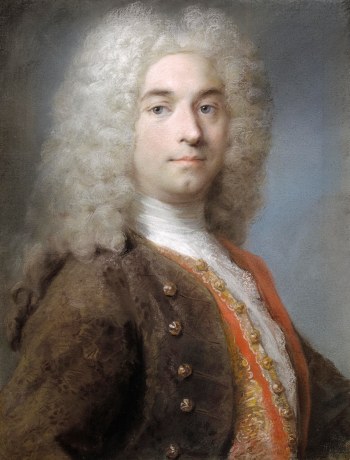
Rosalba Carriera, Portrait of a Gentleman, ca. 1730, pastel on paper, laid down on canvas, 24 × 18 inches (Hartford, CT: Wadsworth Atheneum Museum of Art, Charles H. Schwartz Endowment Fund).
The Wadsworth Atheneum has acquired an outstanding work by Rosalba Carriera (widely known as ‘Rosalba’), the most famous woman artist working in the eighteenth century and admired as a pioneering and brilliant pastellist. Portrait of a Gentleman (ca. 1730), was created when she reached the height of her career, portraying the upper echelons of society with a deft hand and observational sensitivity. It is the first example of the artist’s work in the Wadsworth Atheneum’s collection.
Rosalba (1675–1757) started her career as a miniaturist, but she became best known for her skill with pastels—her technical and artistic innovations elevating the uniquely powdery medium to great popularity among artists and collectors. Royalty, cardinals, and cognoscenti across Europe commissioned portraits and allegories from her. It quickly attracted admirers and younger followers such as Jean-Étienne Liotard and Maurice Quentin de la Tour.
“Portrait of a Gentleman is a work of rare elegance and grace—it is also an exemplary work by Rosalba. The freshness and radiance of the colors as well as the vaporous quality of the surface truly distinguish this work and lend to its liveliness. That we are as yet unable to definitively identify the sitter is secondary to the captivating beauty of this portrait,” said Oliver Tostmann, Susan Morse Hilles Curator of European Art at the Wadsworth.
The figure depicted was first identified as the legendary art collector Pierre Crozat, and later as Louis Armand II de Bourbon, Prince de Conti; neither suggestion, however, has been verified. The sitter poses with torso in profile and his head positioned toward the viewer, nearly achieving contact while maintaining a slight aloofness. With his magnificent shoulder length wig, damask justaucorps coat, and splendid red vest embellished with gold embroidery and buttons, this handsome sitter was clearly someone of status and rank.
“This breathtaking portrait will greatly enrich our growing collection of works on paper. Not only is it a work of the highest quality, but it is also from the hand of the most celebrated pastellist of the eighteenth century. We are proud to welcome Portrait of a Gentleman into the Wadsworth’s collection and look forward to sharing Rosalba Carriera’s brilliance with our visitors very soon,” said Matthew Hargraves, Director of the Wadsworth Atheneum.
Allegorical Painting of Two Ladies Acquired by Compton Verney

Unidentified painter (British School), Allegorical Painting of Two Ladies Wearing Beauty Patches, detail, ca. 1650s, oil on canvas, 64 × 75 cm. The painting sold at Trevanion, Fine Art and Antiques sale on 23 June 2021 (lot 564) for £220,000.
◊ ◊ ◊ ◊ ◊
From the press release from Compton Verney:
An extremely rare 17th-century painting has been acquired by Compton Verney. Allegorical Painting of Two Ladies, an English School work dating to around 1650 was at risk of permanently leaving the UK after being sold at auction in 2021, but now with generous support from the National Heritage Memorial Fund (NHMF) and V&A Purchase Grants, it will go on display at Compton Verney for the public to enjoy.
This almost unique painting shows two women, one Black and one white, side by side, presented as companions and equals, wearing similar dress, hair, and jewellery. The portrayal of a Black female sitter is highly unusual in this period, especially in showing an adult rather than a child in a position of subservience, thereby inviting important debate about race and gender during the period.
Another remarkable aspect of the painting is the depiction of beauty patches on both the women. Although in vogue at the time, the painting appears to condemn wearing these ‘spots’ as the inscription above the two women declares beauty patches to be a sin of pride, a widespread opinion in the 17th century. This style of work gives the painting an affinity with popular woodcut prints at the time, making it clear the work is allegorical and associating it with satirical verse, pamphlets, and sermons.
Following its sale at auction in 2021, the Reviewing Committee on the Export of Works of Art and Objects of Cultural Interest (RCEWA) agreed the work should remain the nation because of its “outstanding significance” to the study of race and gender in 17th-century Britain. The recent resurfacing of the painting has generated new possibilities for exploring the early history of Black culture in Britain.
Purchased with support from the Arts Council England/V&A Purchase Grant Fund and from the National Heritage Memorial Fund, Two Ladies will go on public display in the UK next year. The painting will now undergo conservation, before being unveiled in a display at Compton Verney in 2024, allowing its complicated narratives to be widely studied and understood.
Geraldine Collinge, Compton Verney CEO says: “We are absolutely delighted to be able to add this hugely important painting to the Compton Verney collection. We are also pleased to be able to work with our colleagues at Yale—their world-class conservation facilities and expertise will restore the work to the highest standard for UK display, along with providing further insight and greater understanding of the painting and its context.”
Dr Simon Thurley CBE, Chair of the National Heritage Memorial Fund, said: “We are delighted that the National Heritage Memorial Fund has been able to support the acquisition of this unique painting and that it will become part of the collection at Compton Verney in perpetuity. This dual portrait provides great opportunities to enrich our understanding of race and gender in the 17th century. We look forward to hearing the outcomes of the research that will be undertaken at Yale and, after the conservation work, seeing the painting displayed at Compton Verney for the UK public to admire and enjoy.”
Andrew Hochhauser KC, Chair of the RCEWA, said: “The Committee and I are extremely pleased that Allegorical Painting of Two Ladies has been saved for the nation and will be on display at Compton Verney. This anonymous mid-17th-century painting is a great rarity: it shows two women with beauty patches, one Black and one white, side by side, presented as companions and equals. The painting will delight audiences and encourage debate about and research into race and gender during the period.”
Getty and NPG Jointly Acquire Reynolds’s Portrait of Mai
From the Getty press release (25 April 2023). . .

Sir Joshua Reynolds, Portrait of Mai (Omai), ca. 1776, oil on canvas, 236 × 146 cm.
The innovative collaboration between the National Portrait Gallery and Getty to jointly acquire Joshua Reynolds’ Portrait of Mai (Omai) has been successful. The National Portrait Gallery has raised £25 million which, thanks in huge part to a grant of £10m from the National Heritage Memorial Fund, an Art Fund grant of £2.5m, together with a matching amount from Getty in the U.S., makes up the £50m needed to acquire the painting.
The National Portrait Gallery and Art Fund’s fundraising campaign has been made possible thanks to an extraordinary collaborative effort, including:
• An exceptional grant of £10m from the National Heritage Memorial Fund, one of its most significant awards for saving a heritage treasure for the UK
• An Art Fund grant of £2.5m, the largest in its history
• Major contributions were also received from The Portrait Fund, the Deborah Loeb Brice Foundation and Julia and Hans Rausing, and support also came from the Idan and Batia Ofer Family Foundation and David & Emma Verey Charitable Trust, as well as many other generous trusts, foundations, and individuals.
• Donations from over 2,000 Art Fund members, National Portrait Gallery supporters and members of the public, giving gifts of all sizes
The shared ownership of the work and strategic partnership between the National Portrait Gallery and Getty is the result of an innovative model of international collaboration that enables and maximizes public access to the work in perpetuity. The two institutions will share the painting for public exhibition, research, and conservation care.
The painting will first be exhibited at the National Portrait Gallery when it reopens on June 22, following a major transformation project and will later will be shown at other institutions across the UK. Mai will travel periodically between the two countries, sharing time equally between them. The first Getty presentation will be in 2026, including the period when Los Angeles hosts the 2028 Olympic Games.
Sir Joshua Reynolds’ spectacular Portrait of Mai (Omai) holds a pivotal place in global art history, depicting the first Polynesian to visit Britain, and is widely regarded as the finest portrait by one of Britain’s greatest artists. Known as ‘Omai’ in England, Mai (ca. 1753–1779) was a native of Raiatea, an island now part of French Polynesia, who traveled from Tahiti to England with Captain James Cook. He spent the years 1774–76 in London, where he was received by royalty and the intellectual elite, and indeed became something of a celebrity. Mai returned to his homeland in 1777 and died there two years later.

Elizabeth Peyton, Omai (Afterlife) after Sir Joshua Reynolds’s Portrait of Omai, 1776, 2023, © Elizabeth Peyton.
The National Portrait Gallery would like to thank the former owners for their co-operation in this process, and Christie’s for their support in the negotiations. Support for the campaign also came from leading artists Sir Antony Gormley, Rebecca Salter and Richard Deacon and historians Simon Schama, David Olusoga, and Simon Sebag-Montefiore. Artist Elizabeth Peyton created a new work, Omai (Afterlife) after Sir Joshua Reynolds’s Portrait of Omai, 1776, 2023, inspired by the portrait.
Dr. Nicholas Cullinan, Director, National Portrait Gallery, said: “Reynolds’ majestic Portrait of Mai is by far the most significant acquisition the National Portrait Gallery has ever made, and the largest acquisition the UK has ever made, along with the Titians acquired by the National Gallery and the National Galleries of Scotland in 2009 and 2012. I would like to thank the 2,000 Art Fund members and National Portrait Gallery supporters across the UK and the National Heritage Memorial Fund and Art Fund for their significant and historic grants as well as the many other generous supporters. This includes major contributions from the Portrait Fund, Deborah Loeb Brice Foundation and Julia and Hans Rausing, and support from the Idan and Batia Ofer Family Foundation and the David and Emma Verey Charitable Trust. Together, you have made such an unprecedented endeavour possible. My thanks also to Getty for having the vision to join us in an innovative strategic partnership to ensure this uniquely important painting enters public ownership for the first time, in Reynolds’ 300th anniversary year, so its beauty can be seen and enjoyed by everyone. Heartfelt thanks too to my wonderful colleagues and everyone who worked night and day to make the impossible possible—they have done something extraordinary for all of us.”
Dr. Timothy Potts, Director of the J. Paul Getty Museum, said: “Joshua Reynolds’ Portrait of Mai is not only one of the greatest masterpieces of British art, but also the most tangible and visually compelling manifestation of Europe’s first encounters with the peoples of the Pacific islands. The opportunity for Getty to partner with the Gallery in acquiring and presenting this work to audiences in Britain and California, and from around the world, represents an innovative model that we hope will encourage others to think creatively about how major works of art can most effectively be shared. The myriad artistic, historical, and cultural issues that Mai’s portrait raises for 21st-century viewers and researchers will be the starting point for a joint research project led by the Gallery and Getty in the years ahead.”
Dr. Simon Thurley CBE, Chair of the National Heritage Memorial Fund (NHMF), said: “I am absolutely delighted that we have reached this pivotal moment in the journey of Mai. It has been an incredible effort of public and private fundraising and I am proud that NHMF has been able to play such a vital role in saving it for the UK thanks to our grant of £10m—40% of the amount that the National Portrait Gallery needed to raise. The grant is one of the most substantial awards we have ever given to save a national treasure, and is befitting of this masterpiece, by one of the UK’s greatest artists, as it embodies such great cultural and historical significance.”
“It is wonderful news that the UK public, as well as a wider international audience thanks to the partnership acquisition, will now be able to enjoy the magnificent work of art, its fascinating story and complex themes. NHMF is a vital source of funding for our most important heritage at risk, so it is incredibly exciting that we are able to support the National Portrait Gallery to acquire Mai, to be on display for all to see. We are also delighted that Mai will later embark on a tour allowing visitors from across the UK to marvel at its greatness and explore its heritage.”
Lord Smith of Finsbury, Chairman, Art Fund, said: “When an exceptional work of art comes up for sale, Art Fund stands ready to help museums in the UK bring the work into a public collection, for everyone to enjoy. Joshua Reynolds’ Portrait of Mai (Omai) is just such a painting, and it’s a tribute to the National Portrait Gallery and Getty’s innovative shared ownership model that the painting will now be publicly accessible, forever. Art Fund is delighted to have awarded a grant of £2.5 million—the largest in our 120 year history—and grateful to the incredible generosity of over 2,000 Art Fund members, National Portrait Gallery supporters, individuals and trusts who swiftly gave to our appeal. We also thank the trustees of the National Heritage Memorial Fund for their significant support towards this acquisition, a powerful statement of the importance of bringing this work of art into public view in the UK. The collective effort to save this painting has been remarkable.”
Lord Parkinson of Whitley Bay, Arts & Heritage Minister, said: “I would like to congratulate the National Portrait Gallery and Getty on their fantastic efforts to make this joint acquisition possible and secure this wonderful painting. Thanks to their work and the export bar process, it will now be able to be enjoyed by people across the country for generations to come.”
Sir Nicholas Serota, Chair of Arts Council England, said: “The Arts Council is proud to have supported the recommendation of the Reviewing Committee that this outstanding work of art should continue to be available to the public in the UK. The collaboration between the National Portrait Gallery and Getty will mean that it will be seen in an international context, while also ensuring that we diversify the national collection and open opportunities for research and learning about our national history and culture.”
Sir John Leighton, Director-General, National Galleries of Scotland, said: “There are many great works of art associated with this country and its history but surely only a small number that can be described as truly extraordinary. The Reynolds Portrait of Mai (Omai) belongs in this category and now, thanks to an inspiring and enlightened partnership between the National Portrait Gallery and Getty, a very wide national and international audience will be able to enjoy this superb painting. This is wonderful news and a cause for real celebration.”
Victoria Pomery, Chief Executive Officer, The Box, Plymouth said: “I am thrilled to hear that Reynolds’ Portrait of Mai (Omai) has been acquired in this the 300th anniversary year of the artist’s birth. Plymouth has a long association with Reynolds who was born in Plympton, now part of the modern city, in 1723. Indeed, Reynolds’ first studio was located in Devonport, Plymouth. We are delighted that this important portrait will be shared to places such as The Box enabling further conversations and discussions on Empire, representation and place and for audiences in the south west and across the country to see and understand more about this painting.”
Opinion | Patricia Marroquin Norby on Nuance and Repatriation
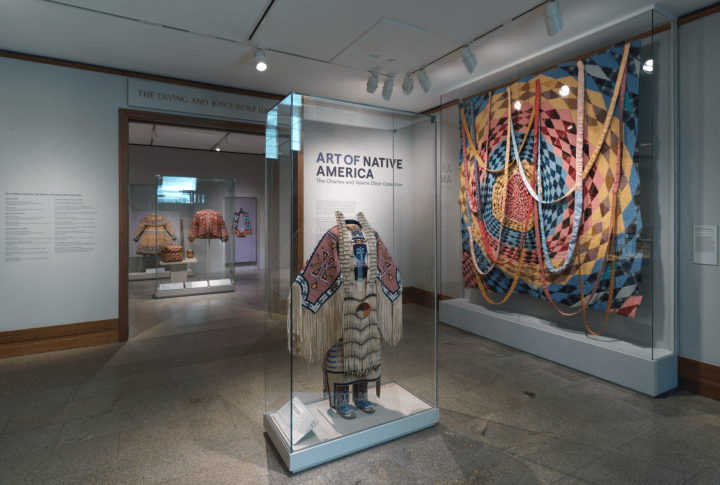
2021–22 entrance to The Met’s long-term exhibition Art of Native America: The Charles and Valerie Diker Collection.
◊ ◊ ◊ ◊ ◊
From Hyperallergic:
Patricia Marroquin Norby, “We Need More Nuance When Talking about Repatriation,” Hyperallergic (19 April 2023). Norby, the Met Museum’s curator of Native American Art, reflects on the lesser-discussed everyday challenges of repatriation work.
. . . The Met and I were both keenly aware that my appointment [as its first curator for Native American Art three years ago] was a milestone moment for the museum and the field. This curatorial position came about because of the promised gift of a prominent Native American collection of works from Charles and Valerie Diker. It’s a collection that had already been well-researched and exhibited at numerous institutions nationwide including the Smithsonian’s National Museum of the American Indian, the Seattle Art Museum, and the Amon Carter Museum of American Art. The gift and landmark curatorial role propelled significant changes at The Met, specifically, foregrounding the voices of Native peoples and presenting their historical and contemporary creative expressions to an international audience in a world-class institution. More important, but less visible to the public, were the much-needed collaborations with Native American source communities regarding the items currently in The Met’s care.
As the museum began exhibiting Native American collections in its American Wing for the first time, we also began working more collaboratively with source communities as exhibition advisors, co-curators, authors, and installation contributors. We listened. We learned. We are still learning.
Native American and Indigenous museum collections necessitate a commitment to long-term relationships with source communities. These relationships have provided some of the most meaningful experiences of my career. When I joined The Met, I emphasized the importance of meeting the needs of Native American communities. I worked to prioritize Indigenous voices in our exhibitions, programs, and collections care. As a woman of Purépecha descent, I understand feeling marginalized. I also understand the simultaneous sense of connection and loss toward items that embody cultural ties to my maternal ancestral community on view in museums. Such experiences are magnified in a historically colonial institution like The Met. . . .
As connections with source communities grew, some colleagues shared their surprise at how repatriation attitudes regarding specific items can differ. Some tribes seek repatriation, while others favor a co-stewardship approach or prefer that works remain at the museum. Community needs are diverse, yet very specific. One commonality across communities and cultures is the desire for a say in how and if works are publicly presented, and how they are cared for. The founding director of the Smithsonian’s National Museum of the American Indian in Washington DC, Richard West Jr., said it best: Indians love and hate museums because “they have our stuff.” For many Indigenous peoples, museums can awaken inner tensions and traumatic histories. For Indigenous museum professionals, these painful pasts are always present. . . .
The full essay is available here»
New Book | Native American Art from the Weisel Collection
From the FAMSF press release for the catalogue, co-published with DelMonico Books:
Bruce Bernstein, Hillary C. Olcott, Christina Hellmich, Deana Dartt, and Jill D’Alessandro, eds., Native American Art from the Thomas W. Weisel Family Collection (New York: DelMonico Books, 2023), 432 pages, ISBN: 978-1636810966, $85.
 The Fine Arts Museums of San Francisco are pleased to announce the publication of Native American Art: From the Thomas W. Weisel Family Collection, co-published with DelMonico Books, and co-edited by Bruce Bernstein, Hillary C. Olcott, Christina Hellmich, and Deana Dartt with Jill D’Alessandro. The expansive 432-page catalogue celebrates a transformative gift to the Museums that spans nearly one thousand years of artistic creativity by Native American artists.
The volume brings together 206 works of art, exemplifying the exquisite artistry and rich cultural histories represented therein. Highlights of objects researched and presented in the book include 19th-century Diné/Navajo weavings, Ancestral and historic Pueblo pottery, Hopi and Zuni carved figures, and Yavapai and Apache basketry, as well as works from the Pacific Northwest and the Plains. Developed in collaboration with cultural advisors, including Joseph R. Aguilar (San Ildefonso), Stewart B. Koyiyumptewa (Hopi), Arden Kucate (Zuni), Christopher Toya (Jemez) and Brian Vallo (Acoma), the catalogue reflects the complex and multilayered nature of the works in the collection and, more broadly, the field of Native American art.
“The publication of Native American Art has been a monumental, five-year undertaking for the Fine Arts Museums of San Francisco,” said Thomas P. Campbell, Director and CEO of FAMSF. “Our team has worked directly with communities of origin represented in the collection, cultural practitioners, artists, art historians, and museum professionals to share different perspectives on the objects in this collection. We are enormously proud of this collaboration and grateful to each of our authors and advisors for the care they have extended to this project and the knowledge they have shared with us.”
Building upon the Fine Arts Museums’ first publication on the Thomas W. Weisel Family Collection, Lines on the Horizon (2014), Native American Art is an expanded scholarly catalogue that features new research, 30 specially commissioned essays, and 100 extended captions. Contributions by more than 80 authors from different disciplines and cultural backgrounds illuminate details about the living histories of the works. The multitude of perspectives and voices offered here embraces the complexity of the dialogue surrounding Native works past and present, ensuring that Native American Art will be a cornerstone publication in the field of Native American art history.
“The gift of the Thomas W. Weisel Family Collection of Native American Art to the Fine Arts Museums of San Francisco provided the extraordinary opportunity for an open-ended, two-year-long conversation between the Museums and Native communities about the display, imaging, care, and disposition of our Ancestral pottery.” write Joseph R. Aguilar, Stewart B. Koyiyumptewa, Arden Kucate, Christopher Toya and Brian Vallo in their introduction. The results of the dialogue are in this catalogue, including a culturally sensitive approach to reproducing Ancestral pottery images. Every pot was individually considered, most generating lively discussions, and others soliciting respectful silence. The work we have been doing together has been an opportunity to learn from one another.”
Among the important scholarly innovations in Native American Art is the representation of Mimbres bowls and other Ancestral Pueblo pottery forms. Working closely with cultural advisors from five Pueblo communities, the editors and advisory group developed three representative styles for the Mimbres bowls and other Ancestral pottery reproduced in the catalogue. A screen of gold dots takes the place of objects that are culturally sensitive; while drawings made by Acoma artist Michelle Lowden represent bowls that were determined to be from burial contexts but do not feature culturally sensitive imagery. Photography is used when objects are not culturally sensitive.
The catalogue was designed by James Brendan Williams of The Common Era.
A free, public launch event celebrating Native American Art was held Saturday, April 22 at the de Young’s Koret Auditorium. The program included an introduction by volume co-editor Deana Dartt (Coastal Band, Chumash), followed by presentations about Ancestral and historic Pueblo pottery by project contributors Bobby Silas (Hopi-Tewa) and Deborah A. Jojola (Isleta/Jemez Pueblo). The program concluded with a panel discussion between members of the book’s Pueblo Advisors group, Governor Arden Kucate (Zuni), Brian Vallo (Acoma), and Joseph R. Aguilar (San Ildefonso), with volume co-editor Bruce Bernstein.
Sweden Nationalmuseum Acquires Self-Portrait by Périn-Salbreux
From the press release (1 March 2023) . . .

Lié-Louis Périn-Salbreux, Self-Portrait, ca. 1800–10, black crayon, stumped and elevated with white crayon, on paper, 26.5 × 22 cm (Stockholm: Nationalmuseum NMB 2819; photo by Anna Danielsson).
Nationalmuseum has acquired a self-portrait by Lié-Louis Périn-Salbreux, a French miniaturist. The piece is one of the artist’s later works and, unlike many of his other self-portraits, is unusually modest and largely free from affectation. Périn was heavily influenced by the Swedish artist Peter Adolf Hall and enjoyed his greatest success during the years immediately before and after the French Revolution.
Lié-Louis Périn-Salbreux (1753–1817) was born in Reims, the son of a wool manufacturer. At the age of 19, he arrived in Paris to be a pupil in the studio of Jean-Baptiste Vien. By the following year, 1773, he had already been admitted to the academy of fine arts as a student, as Vien was the academy’s director. There, Périn encountered other influential artists, including Alexander Roslin, the Swedish-born portrait painter. His friendship with Roslin was to prove crucial to his future success, giving him access to several high-ranking clients, including members of the royal family, of whom Périn painted small, intimate portraits in oils. But it was as a miniature portraitist that Périn was to make his name. His training in this art form was acquired privately rather than at the academy, and the best-known of his teachers was Louis Marie Sicardi.
Roslin was generous with his support, not only referring clients but also commissioning Périn to paint portraits of Roslin himself and his wife, Marie Suzanne Giroust, which are now in the Nationalmuseum collection. The miniaturist also painted other family members, including Roslin’s daughter-in-law Adélaïde and grandson Abraham—a portrait acquired by Nationalmuseum fairly recently. What was more, Roslin entrusted Périn with creating miniature replicas of Roslin’s own oil portraits. Quite frequently, clients simply wanted a reduced version of their existing portrait, and it fell to Roslin’s younger colleague to carry out the job. One such example is a miniature replica of Roslin’s pastel portrait of the ill-fated Crown Prince Louis. Throughout the 1780s, Périn enjoyed a productive and successful career as a miniaturist without being elected to the academy. When the art world became more democratic during the Revolutionary period, he was able to exhibit at the Salon for eight years from 1791.
Périn soon adopted the free style of Swedish miniaturist Peter Adolf Hall, with its vibrating brushwork, and through Roslin he made direct contact with Hall. Like Hall, Périn employed elegant accents in the form of clothing and draperies. Both also liked to place their models in natural or parkland settings. However, Périn’s depiction of the models’ faces was more affected, with distinctive, almond-shaped eyes. Like Hall, Périn suffered when his wealthy clients emigrated during the French Revolution. As a result of monetary depreciation, Périn lost his capital and left Paris in 1799 to take charge of his family’s woollen mill in Reims. The newly married artist appended his wife’s maiden surname, Salbreux, to his own. Back in his hometown, he continued working as a portraitist, but mainly in oils and pastels. Hence his choice of technique for the self-portrait in black crayon, drawn sometime between 1800 and 1810, which was recently acquired by Nationalmuseum. Over many years, Périn produced self-portraits using various techniques, both in oils and in miniature format. These were often somewhat pretentious, indicating that the artist had a good conceit of himself, but in this relatively late work he takes a more restrained approach. The image is drawn with fine gradations in black crayon, stumped with elevations in white. Given the palpably graphic nature of the work, it is not surprising that it later provided the basis for an engraving by Henri-Joseph Dubouchet, many years after Périn’s death.
“In this sensitive self-portrait by Lie-Louis Perin-Salbreux, we see an artist with no great pretensions, with a gentle, understanding expression. This new acquisition joins Nationalmuseum’s collection of self-portraits by miniaturists, which is the only one of its kind in the world. So we are delighted to put this significant artwork on display in the Treasury,” said Magnus Olausson, director of collections.
Nationalmuseum receives no state funds with which to acquire design, applied art and artwork; instead the collections are enriched through donations and gifts from private foundations and trusts. This acquisition has been made possible by a generous donation from the Hjalmar and Anna Wicander Foundation.










 Enfilade
leave a comment