Amanda Dotseth Named Director of SMU’s Meadows Museum
From the press release (10 February 2023) . . .

Amanda W. Dolseth (Photo by Tamytha Cameron).
SMU has named Amanda W. Dotseth Linda P. and William A. Custard Director of the Meadows Museum. Dotseth, who will be the first female director of the Meadows Museum, served as the director ad interim and curator of the Museum since the passing of its previous director, Mark A. Roglán, in 2021. Dotseth assumes the role on 1 March 2023.
“As a scholar, collaborator, and arts leader, Amanda Dotseth brings a unique understanding of the important mission and role of the Meadows Museum,” said SMU President R. Gerald Turner. “In addition, her many years as curator, then interim director has prepared her to position the Museum for the future while understanding its legacy.”
In her combined 19 years of experience with the Museum, Dotseth published extensively on Spanish art, contributed to and curated more than 30 exhibitions, and oversaw the acquisition of major additions to the Meadows collection. Notably, Dotseth was an instrumental participant in the early development of the historic partnership between the Meadows Museum and Madrid’s Museo Nacional del Prado in 2009, in which the Prado loaned three major paintings and exchanged curatorial fellows between the institutions. She played an integral role in the pioneering collaboration with Fundación ARCO in 2019 as well. By initiating and cultivating partnerships with international art institutions from the Rijksmuseum and National Gallery of Ireland to the Museo del Traje in Madrid and the Museo del Arte Abstracto Español (Fundación Juan March), Dotseth has expanded the reach and profile of the Meadows Museum and of SMU. Dotseth’s existing partnerships with academic and art institutions around the world, including the Spanish National Research Council, will be a tremendous asset for the Museum as she continues its mission to advance the knowledge, understanding and appreciation of the arts and culture of Spain in the US.
In addition to her nearly two decades with the Museum, Dotseth is also an alumna of SMU Meadows School of the Arts, receiving her master’s degree in art history from the University in 2006. She later completed her Ph.D. at the Courtauld Institute of Art (University of London) in medieval Spanish art in 2015.
“After an extensive international search, I am thrilled that the best person to serve as the next director of the Meadows Museum is an extremely accomplished member of the SMU Meadows community,” said Samuel S. Holland, Algur H. Meadows Dean for SMU Meadows School of the Arts. “I look forward to seeing the new directions in which Dr. Dotseth will take the Museum, through her collaborative and innovative leadership, and strong curatorial voice.”
“The Meadows Museum has been a part of my professional DNA for two decades; to now be at the helm of the institution as the Linda P. and William A. Custard Director during the next phase of the museum’s life is a great honor,” said Dotseth. “I look forward to building upon and expanding the Museum’s existing strengths as we reach out to the next generation of scholars, students, and museum-goers.”
The Meadows Museum is the leading U.S. institution focused on the study and presentation of the art of Spain. In 1962, Dallas businessman and philanthropist Algur H. Meadows donated his private collection of Spanish paintings, as well as funds to start a museum, to Southern Methodist University. The museum opened to the public in 1965, marking the first step in fulfilling Meadows’s vision to create “a small Prado for Texas.” Today, the Meadows is home to one of the largest and most comprehensive collections of Spanish art outside of Spain. The collection spans from the 10th to the 21st centuries and includes medieval objects, Renaissance and Baroque sculptures, and major paintings by Golden Age and modern masters.
Cleveland Announces New Acquisitions
From the CMA press release (17 January 2023). . .
Recent acquisitions by the Cleveland Museum of Art (CMA) include a Korean abstract expressionist painting by Yun Hyong-keun 윤형근; a ten-panel folding screen by Kim Yoon-bo 김윤보; an early masterpiece by James Tissot from his English period; and a recently discovered full-length pastel portrait by Hugh Douglas Hamilton, the most celebrated Irish portraitist of the Grand Tour. . . .
Hugh Douglas Hamilton’s Portrait of George Clavering Cowper

Hugh Douglas Hamilton, Portrait of George Clavering Cowper, 3rd Earl Cowper, 1785, pastel on paper stretched on linen; sheet: 94 × 69 cm (The Cleveland Museum of Art, Leonard C. Hanna Jr. Fund).
Preserved in remarkable condition, this portrait has remained in the sitter’s family—and was discovered only recently in the collection of the descendants of its sitter, George Clavering Cowper, 3rd Earl Cowper (1738–1789), of Great Britain. The full-length pastel was a type developed during the 18th century that appealed to English tourists on the Grand Tour to Italy. The earl, a cultural paragon in Italy and a patron of artists and composers, sat for the most celebrated Irish portraitist of the Grand Tour, Hugh Douglas Hamilton, in Florence, where he made his home.
Cowper prominently wears the sash and star of the which he had received in March 1785. The Order of Saint Hubertus was founded in 1695, a knightly order of aristocratic hunters from throughout the Hapsburg empire, whose motto was “Honoring God by Honoring his Creatures.” Evoking the emotion of this motto, Hamilton featured Cowper’s hunting dog, who receives a tender pat on the head and wears a collar inscribed with Cowper’s name.
The portrait enhances the CMA’s collection of pastels, a strength of its drawings collection. The acquisition was made possible by the Leonard C. Hanna Jr. Fund.
More information on the portrait is available at Lowell Libson & Jonny Yarker.
The full press release describing the other three acquisitions is available here»
Dulwich Loans over 50 Paintings to Strawberry Hill
From the press release, via Art Daily and Richmond.gov.uk:
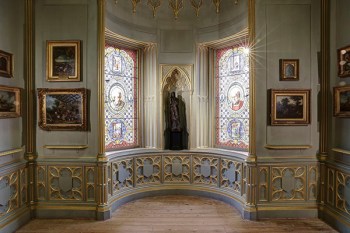
The Tribune, Strawberry Hill House, with loans from Dulwich Picture Gallery (Photo by Matt Chung).
Over fifty Old Master paintings on long-term loan from Dulwich Picture Gallery—and a further eight works from a private English collection—have just gone on display at Strawberry Hill House, helping to recreate the atmosphere of how the house would have appeared over 250 years ago.
As part of an ambitious project—through acquisitions and loan agreements, including the partnership with Dulwich Picture Gallery—Strawberry Hill House, the remarkable former home of the writer, antiquarian, and politician, Horace Walpole (1717–1797) is endeavouring to return some of the 6000 objects from the collection that Walpole amassed during his lifetime and, where possible, to recreate the original atmosphere of the house, when the rooms were filled with fantastic works of art.
In 1842, following Walpole’s death, the contents of the house were dispersed in a famous auction, known as the Great Sale. Since then, it has been a long-held desire of the Strawberry Hill Trust to bring as many pieces possible back to the historic villa in Twickenham. Indeed, its efforts have recently seen the acquisitions of an extraordinary portrait of Catherine de Medici and a celebrated Chinese ceramic fish tub with a macabre past. This appetite to acquire original objects and to display contemporaneous artworks has helped to create an atmosphere that would be familiar to Walpole were he alive today.
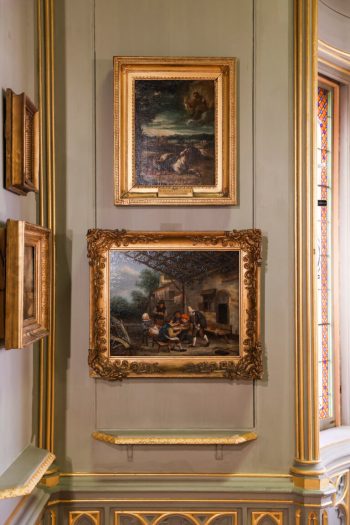
Detail of the Tribune, Strawberry Hill House, with loans from Dulwich Picture Gallery (Photo by Matt Chung).
The relationship between Strawberry Hill House and Dulwich Picture Gallery began in 2011 with the long-term loan of the portrait of Dorothy, Viscountess Townshend, ca. 1718 by Charles Jervas. Dorothy Walpole (1628–1726) was the sister of Sir Robert Walpole, Horace’s father. This portrait of his great aunt now hangs in its original position in the Great Parlour, where Walpole displayed portraits of both his family and some of his closest friends.
Among the paintings from the latest loan is a set of twenty-six British monarchs, assembled by the founder of Dulwich College, Edward Alleyn. These include Henry VIII, ca. 1618; Queen Anne Boleyn, ca. 1618; and Queen Mary, ca. 1618. These royal portraits have been hung in the Holbein Chamber, reflecting Walpole’s passion for history and its protagonists, which also influenced the overall arrangement of the artworks throughout the house. As an antiquarian and writer possessed of a vivid imagination, Walpole had a deep interest in royal and historical figures, evident throughout his collection, as well as in the designs of the house itself. The ceiling in the Holbein Chamber is a copy of the Queen’s Dressing Room in Windsor Castle, while the one in the Library is decorated with heraldic emblems, mythical beasts, coats of arms, and images of mounted crusaders, all reflecting Walpole’s various interests in the medieval period.
Dr Silvia Davoli, Strawberry Hill House Curator says: “Our collaboration with Dulwich Picture Gallery offers us the unique opportunity to borrow a substantial number of paintings that are very similar in style, period, and schools to those once collected by Horace Walpole; and it is thanks to these artworks that the rooms of Strawberry Hill finally appear to us in all their glory, much as they did in Walpole’s time.”
Online Catalogue | The Nelson-Atkins Museum of Art, French Paintings

From The Nelson-Atkins:
The Nelson-Atkins Museum of Art
French Paintings Catalogue
Learn more about the remarkable French paintings and pastels at the Nelson-Atkins Museum of Art. View the entire collection online, delve into recent scholarly insights and technical discoveries, or read about the history of collecting French art in Kansas City. Art historians and conservators provide fresh perspectives on the French collection, and comprehensive research sheds new light on the provenance (ownership history), exhibition history, and publication history of each work. Whether you are seeking a quick overview or deep dive, the French Paintings Catalogue is the perfect place to explore and learn more.
The French Paintings Catalogue is generously supported by The Marion and Henry Bloch Family Foundation, The National Endowment for the Humanities, Adelaide Cobb Ward in honor of Donald J. Hall’s retirement, The Mellon Endowment for Scientific Research, The National Endowment for the Arts, The James Sight Fund, and The Samuel H. Kress Foundation.
C O N T E N T S
Publication Installments
Director’s Foreword — Julián Zugazagoitia
Preface and Acknowledgments — Aimee Marcereau DeGalan
Timeline — Meghan L. Gray and Glynnis Stevenson
The Collecting of French Paintings in Kansas City — Aimee Marcereau DeGalan
Conservation Introductory Essay — Mary Schafer, Rachel Freeman, and John Twilley
Notes to Reader
Seventeenth Century, 1600–1699
Eighteenth Century and Pre-Revolution, 1700–1789
Neoclassicism and Romanticism, 1790–1860
Nineteenth Century, Realism, Barbizon, 1830–1890
Impressionism, 1860–1900s
Post-Impressionism, 1886–1900s
A Modern World, 1900–1945
Appendix I: Other Works in the Bloch Collection of The Nelson-Atkins Museum of Art
Appendix II: Other French Works in the Collection of The Nelson-Atkins Museum of Art
Glossary
About
Contributors
Photograph Credits
Anne Helmreich Named Director of the Archives of American Art
From the press release (15 December 2022) . . .
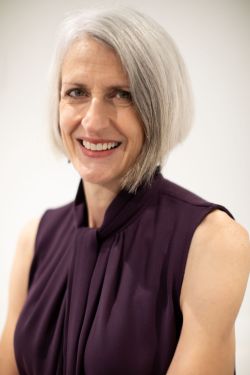
Anne Helmreich, the incoming director of the Smithsonian’s Archives of American Art (Photo by Loli Kantor).
Anne Helmreich has been named the director of the Smithsonian’s Archives of American Art, effective 27 February 2023. Helmreich is currently the associate director of grants programming at the Getty Foundation and brings 35 years of experience in higher education and arts administration to this new role.
The Archives of American Art fosters advanced research by accumulating and disseminating primary sources that document more than 200 years of the nation’s artists and art communities. Helmreich will oversee its Washington, D.C., headquarters and research center, New York City research center, and Lawrence A. Fleischman Gallery. She will also oversee its collections development, exhibitions, and publications, including the Archives of American Art Journal, the longest-running scholarly journal in the field of American art. Additionally, Helmreich will lead the Archives’ digitization program and the stewardship of its holdings consisting of some 30 million items and an oral-history collection of more than 2,500 audio and video interviews, the largest accumulation of in-depth, first-person accounts of the American art world.
“Anne understands how effective and impactful art can be in recording and expressing the American story,” said Kevin Gover, the Smithsonian’s Under Secretary for Museums and Culture. “Her track record as a successful administrator, educator and user of the Archives of American Art made her the obvious choice to conserve this vital collection and to make its holdings even more accessible to the art world and beyond.”
As associate director of grants programming at the Getty Foundation, Helmreich supports individuals and institutions committed to advancing the greater understanding and preservation of the visual arts in Los Angeles and throughout the world. Through strategic grant initiatives, it strengthens art history as a global discipline, promotes the interdisciplinary practice of conservation, increases access to museum and archival collections and develops current and future leaders in the visual arts.
She also represents the Getty Foundation in the LA Arts Recovery Fund, which supports small to mid-sized arts organizations in Los Angeles.
Helmreich has been awarded over two dozen grants, published two books, edited five collections, written 19 book chapters, published 20 scholarly papers, and contributed to over half a dozen exhibition catalogs. At the Archives of American Art, Helmreich aims to expand its digital offerings, foster an inclusive and diverse culture that represents the many communities and histories that make up the United States and establish the Archives as America’s preeminent storyteller for the arts.
“I am very excited to help move the Archives of American Art into the future by making it more accessible to more researchers from all backgrounds and by expanding public engagement,” Helmreich said. “The Archives’ unique collections have helped generations of art historians record and study American art, and by digitizing and diversifying our collections and our programming for new audiences, we will continue to reflect the history and future of America through this important lens.”
Previously, Helmreich served as the inaugural co-chair of the Getty DEAI Council, the associate director of digital initiatives at the Getty Research Institute, the dean of the College of Fine Arts at Texas Christian University, and director of the Baker-Nord Center for the Humanities and associate professor of art history at Case Western Reserve University. Helmreich holds a Bachelor of Arts from Dickinson College, a Master of Arts in art history from the University of Pittsburgh, and a doctorate in art history from Northwestern University.
Liza Kirwin, deputy director of the Archives of American Art, has served as interim director.
Sweden Nationalmuseum Acquires Portrait of Marie-Gabrielle Capet
From the press release:
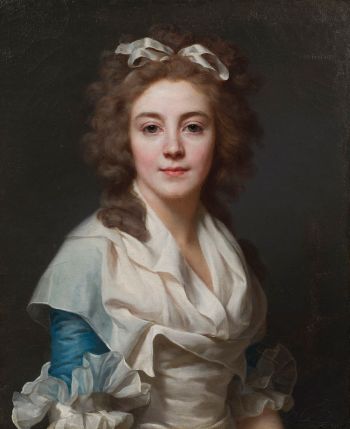
Unknown French artist, Portrait of Marie-Gabrielle-Capet, 1780s, oil on canvas (Stockholm: Nationalmuseum, 7658).
Nationalmuseum has acquired a portrait of Marie-Gabrielle Capet, a French painter of pastels and miniatures. The portrait depicts the artist in the 1780s, when she was a close associate of Adélaïde Labille-Guiard, one of the most celebrated portrait painters of the day, and her future husband François-André Vincent. There is ample evidence to suggest that it was Vincent who painted this portrait of the young Capet.
Marie-Gabrielle Capet (1761–1818) was born in Lyon in humble circumstances. Thanks to well-connected acquaintances, in her twenties she became a pupil of the portrait painter Adélaïde Labille-Guiard, who was known for taking on female pupils only. Evidence of their close relationship can be seen in Labille-Guiard’s large self-portrait from 1785, now in the Metropolitan Museum of Art in New York. Capet appears beside her teacher, along with another pupil, Marie Marguerite Carreaux de Rosemond. Labille-Guiard was one of the few female members of the French academy of fine arts, where she was a tireless advocate for women’s rights. In her personal life, she had a long-term relationship with her colleague François-André Vincent. In 1792 they bought a house together, where Capet also moved in.
The recently acquired portrait was likely painted a few years earlier. Labille-Guiard and Vincent both used their protégée Capet as a model, and there are several sketches of her as such, although none can be directly tied to the painting acquired by Nationalmuseum. The portrait shows her in a near-frontal pose, turning slightly to meet the onlooker with a piercing but gentle gaze, which betrays the close relationship between model and artist. The saturated colours and cohesive, symmetrical composition point to Vincent as the likely creator; these stylistic features had long made him Jacques-Louis David’s main rival in neoclassical painting.
In many respects, this portrait of Marie-Gabrielle Capet is a representation of a remarkable home, where artistic coworking and domestic roles were commingled. In an artistic sense, Capet seems to have been wholly dependent on her teacher Labille-Guiard. After the latter’s death in 1808, Capet continued looking after Vincent, whom she called ‘father’, until he died in 1816. Capet herself died only two years later, at the age of just 57, apparently from a broken heart and incapable of continuing her painting career.
“This portrait of Marie-Gabrielle Capet is notable for its unusually strong sense of presence. We really get the feeling of standing eye to eye with the model,” said Magnus Olausson, head of collections at Nationalmuseum. “With this acquisition, we can add another piece of the puzzle to the others in our collection spotlighting the great French female artists of the 18th century. So we are delighted that this significant work will shortly go on display at Nationalmuseum.”
The portrait of Marie-Gabrielle Capet will be on display in the 18th-century painting gallery from 1 February 2023.
Nationalmuseum receives no state funds with which to acquire design, applied art and artwork; instead the collections are enriched through donations and gifts from private foundations and trusts. This acquisition has been funded by a generous donation from the Sophia Giesecke bequest.
Mark Hallett Departs the Mellon Centre to Lead the Courtauld
From the PMC announcement (11 November 2022) . . .
 The Paul Mellon Centre’s Director, Mark Hallett, will be stepping down after more than a decade in post to take up a new role next year as the Märit Rausing Director of the Courtauld Institute of Art.
During his time as Director, Hallett has overseen a major expansion and diversification of the London-based Centre, which is part of Yale University, and a partner of the Yale Center for British Art at New Haven. Under his leadership, the Centre has become celebrated for its support of world-class research on all periods and aspects of British art and architecture, understood in their broadest global contexts. Over the past ten years, the Centre has not only dramatically extended its scholarly reach, but also tripled in size. It has enthusiastically embraced the benefits of online publication and communication, and wholeheartedly committed itself to diversifying the field of British art studies. Over this same period, the Centre has also developed a highly ambitious series of research, teaching, learning, and networking initiatives, all of which have been designed to promote the very best scholarship on British art and architecture, to share knowledge and expertise, and to widen the Centre’s audiences.
Mark Hallett said: ‘’It has been a great honour to have led the Centre over the last decade. During that time, I have worked with a brilliant team of colleagues, both in London and in New Haven, to make the PMC a vital, vibrant, and expansive centre for the study of British art. Today, the Centre is in wonderful shape, and I know it will continue to thrive and develop. At the Courtauld, I look forward to building on the remarkable legacy of the current Märit Rausing Director, Professor Deborah Swallow, and to working with similarly world-class academics, curators, students, and supporters in helping the Courtauld write a new and exciting chapter in its history.’’
Susan Gibbons, Vice Provost for Collections and Scholarly Communication, Yale University, and ex-officio Chief Executive of the Paul Mellon Centre, said: ‘’The transformation of the Centre under Mark’s leadership has been remarkable. He has opened the doors of the Centre wide, not only to London, but to the world, while carefully sustaining the high quality research and scholarship that has been the hallmark of the organization. From the launch of British Art Studies and the British Art in Motion undergraduate film competition, to the formation of networks for researchers and practitioners, to broadening fellowship and grant opportunities, Mark has truly championed new ways to understand and engage with British art history.”
Sydney’s Powerhouse Announces Gift of Schofield Jewellery

French demi-parure consisting of necklace (shown) and a pair of earrings (not pictured), gold and onyx cameos, 1820
(Sydney: Powerhouse, gift of Anne Schofield; photograph by Marinco Kajdanovski)
◊ ◊ ◊ ◊ ◊
Press release (3 November 2022) from Sydney’s Powerhouse:
Powerhouse today announced an unprecedented gift from Australia’s leading antique jewellery dealer, 100 rare pieces of historical gemstone jewellery, this acquisition is one of the most significant donations in the museum’s history.

Ring, gold, chrysoprase, and rose diamonds, ca 1780 (Sydney: Powerhouse, gift of Anne Schofield; photograph by Ryan Hernandez).
Anne Schofield’s personal jewellery collection includes works created between the 17th and early 20th centuries featuring an astonishing range of gemstones and techniques. Highlights from the Anne Schofield Collection include exquisitely crafted archaeological jewellery, 18th-century hardstone intaglios, Carlo Giuliano earrings, an Egyptian-style lapis lazuli demi-parure, Art Nouveau dragonfly and wasp pedants, Cartier and Georg Jensen pieces, and a French demi-parure with onyx cameos from 1820.
Internationally renowned for her knowledge and passion for fine jewellery, Ms Schofield established her legendary boutique Anne Schofield Antiques in Woollahra in 1970. It was the first successful business in Australia to specialise in antique jewellery. A long-standing donor and supporter of the Powerhouse as Life Fellow and honorary adviser for jewellery, in 2014 she generously lent 70 significant objects from her personal collection to the award-winning exhibition, A Fine Possession: Jewellery and Identity. [See The Culture Concept Circle for coverage of that show.]
The Anne Schofield Collection will be photographed and made available on the Powerhouse website and will be on display at Powerhouse Ultimo next year.
“Over the past 30 years I have made many individual donations of antique and costume jewellery to the Powerhouse, to enhance the museum’s existing holdings. Many famous collections throughout the world have grown in importance as a result of private donations and bequests. I strongly believe that collectors who have enjoyed success should consider giving back to their city or country as generously as Australia has given to them,” Anne Schofield said.
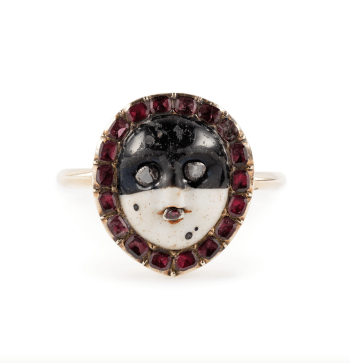
Ring (Italy), gold, enamel, garnets, and rose diamonds, ca 1760 (Sydney: Powerhouse, gift of Anne Schofield; photograph by Ryan Hernandez).
“Anne Schofield has extraordinary knowledge and expertise in fine jewellery. Over many years she has generously shared her knowledge with our museum and shared her collections with our audiences and communities. This transformative gift to the people of Sydney and NSW will have an impact for many generations to come,” Powerhouse Trust President Peter Collins AM KC said.
“Across her incredible career, Anne Schofield has continually sought out ways to share her remarkable collections with the public. This generosity of spirit could not be clearer than in this extraordinary donation that will transform the Powerhouse collection. Jewellery is not only powerful decorative art, but a form of social history and it is our privilege to be able to share this with the community. I pass on my deep gratitude and thanks to Anne for this gift and her ongoing commitment to the Powerhouse Museum,” Powerhouse Chief Executive Lisa Havilah said.
During her formative years in London in the early 1960s, Anne became passionate about the decorative arts with a focus on costume and, eventually, antique jewellery. In 1970 she established Anne Schofield Antiques on Queen Street Woollahra. In 2003 Anne was appointed a Member of the General Division of the Order of Australia AM for her services to the performing arts and to the decorative arts, particularly antiques, as an author and consultant. Anne is a member of the international Society of Jewellery Historians (SJH), a Life Fellow of the Powerhouse museum, a member of the Australian Art and Antique Dealers Association (AAADA), and co-author with Kevin Fahy of the seminal book Australian Jewellery: 19th and Early 20th Century.
Powerhouse sits at the intersection of arts, design, science, and technology and plays a critical role in engaging communities with contemporary ideas and issues. We are undertaking a landmark $1.4 billion infrastructure renewal program, spearheaded by the creation of the flagship museum, Powerhouse Parramatta; expanded research and public facilities at Powerhouse Castle Hill; the renewal of the iconic Powerhouse Ultimo; and the ongoing operation of Sydney Observatory. The museum is custodian to over half a million objects of national and international significance and is considered one of the finest and most diverse collections in Australia. We are also undertaking an expansive digitisation project that will provide new levels of access to Powerhouse collections.
NGA Announces the Sant Fund for Women Artists
From the press release (27 October 2022), which includes links for most works of art referenced in the document:
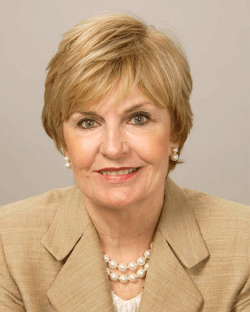
Victoria Sant served as president of the NGA from 2003 to 2014.
The National Gallery of Art in Washington, D.C. announced today a remarkable gift of $10 million from the family of Victoria P. Sant, former president of the National Gallery of Art, to fund the acquisition of work by women. An endowment fund, the Victoria P. Sant Fund for Women Artists, will further the National Gallery’s ongoing priority of acquiring more work by women, from historic works to living artists.
In an ongoing commitment to this work, many acquisitions over the past years expand the holdings of creations by women artists across genre and medium. Two acquisitions of special significance were recently approved at the May 2022 Board of Trustees meeting: a portrait by Bolognese painter Lavinia Fontana (1552–1614), the first painting by an early modern Italian woman artist to enter the collection, and a small sculpture by Luisa Roldán (1652–1706) that is the first work by a woman sculptor created before 1850 to enter the collection.
“The National Gallery of Art and our millions of visitors have benefited tremendously from Vicki’s dedication to serving the American public,” said Kaywin Feldman, director of the National Gallery. “It is exciting that we now have an endowment fund to help us acquire masterpieces by women artists, and one that will carry the name of such an exemplary advocate and leader. We look forward to adding important works by women artists from all eras to the collection and continuing the work which Vicki so passionately championed.”
The Victoria P. Sant Fund for Women Artists will be the cornerstone in the ongoing efforts to address the gap of women artists represented in the collection. Vicki Sant (1939–2018) was the first woman president of the National Gallery and a member of the Board of Trustees for 15 years. Future acquisitions will benefit from the generosity of her family, given in loving memory toward a cause so important to her. The National Gallery intends to use this fund to expand the of acquisitions of work by women as part of its commitment to increase holdings of works by these artists. In the past two years (May 2020 to May 2022), 50.6% of the works acquired by purchase were by artists of color, compared to just 12.6% in the two years prior (a 302% increase). During the same period, works by women artists comprised 35.5% of the total, compared to just 20.3% during the two years prior (a 75% increase).
Lavinia Fontana, Portrait of Lucia Bonasoni Garzoni, ca. 1590
This highly detailed and exquisite portrait depicts the 16th-century musician Lucia Bonasoni Garzoni (b. 1561–at least 1610) by the most productive woman artist of the late 16th century, the Bolognese painter Lavinia Fontana. This portrait is among Fontana’s best preserved and most accomplished surviving works in the genre. A rare depiction of a 16th-century woman musician by a 16th-century woman artist, this painting tells the story of two accomplished women who were able to overcome obstacles in a patriarchal society to succeed in the artistic spheres of painting and music.
Fontana died just before her 62nd birthday after a highly successful career. Trained by her father, Prospero Fontana (1512–1597), in the late mannerist style, and most famous for her portraits of noblewomen, she produced her first dateable works around 1575. In addition to portraits, she painted secular and religious subjects, including altarpieces for churches (a rarity in the period), portraits of scholars, and mythological nudes—a subject that was unheard of for women in the period. In 1577, Fontana married Gian Paolo Zappi (ca. 1555–1615), who acted as her business manager; she supported her family, which included 11 children, with the profits from her painting. Fontana is one of 68 known women artists from Bologna in the early modern period and was a trailblazer for women artists who succeeded her.
Luisa Roldán, Virgin and Child, ca. 1680/1686

Luisa Roldán, Virgin and Child, ca. 1680/1686, painted wood, 56 cm high (Washington, DC: NGA, 2022.39.1).
This small carved wood and painted statue by Luisa Roldán is the first work by a woman sculptor from before ca. 1850 to enter the National Gallery’s collection. Widely accepted as a work by Roldan on stylistic grounds, it shares close similarities with a range of sculptures that are widely acknowledged to be by her.
Born in Seville, Roldán was the daughter of Pedro Roldán, one of the city’s most accomplished sculptors. Her introduction to sculpture most likely came from Pedro, with whom she worked in close partnership. At the age of 19, she left home to marry one of her father’s studio assistants, with whom she set up a workshop and began undertaking commissions. Some of her earliest works, identifiable by style, include various life-size figures in painted wood for altarpieces in Seville and processional floats (paseos) that reflect but differ from her father’s style. In 1688 Roldán and her husband moved to Madrid, likely in expectation of an appointment at the court of King Carlos II. Eventually she was awarded the royal title of escultora de cámara, which did not prove especially lucrative. She turned to specializing in painted terracotta scenes. When Felipe V ascended to the throne in 1701, she was reappointed to the Spanish court. Lauded for her accomplishments as a sculptor, she nevertheless died destitute, unable to pay for a funeral. On the day she died, she received recognition as an “Accademica di merit” from the Accademia di San Luca in Rome.
Other Acquisition Highlights by Women Artists
The National Gallery has continued to represent the work of women artists with notable acquisitions over the last two years in all areas of the museum.
Paintings
Faith Ringgold’s (b. 1930) The American People Series #18: The Flag is Bleeding (1967) is the first painting by a leading figure of contemporary art to enter the collection. This pivotal work exemplifies the artist’s skill in using art as a vehicle to question the social dynamics of race, gender, and power. The National Gallery also acquired two works by Carmen Herrera (1915–2022), one of the leading practitioners of abstract art during the second half of the 20th century: Untitled (2013) and the sculptural relief Untitled Estructura (Yellow) (1966/2016). Associated with non-representational, concrete abstraction in Europe, the United States, and Latin America, Herrera’s art contributed to the cross-pollination of modernist ideas.
Genesis Tramaine’s (b. 1983) Clinging unto the Lord (2021) blends a provocative use of color with an urban-inspired, mixed-media approach that focuses on the shape and definition of the “American Black Face” and uses exaggerated features to capture the spirited emotions of the untapped, underrepresented souls of Black people. Carla Accardi (1924–2014), a prominent figure of postwar Italian art and the Italian feminist movement, painted the wavelike forms of Rossorosa (1966) in red varnish on a sheet of clear Sicofoil suspended in front of pink cardboard. The work exemplifies Accardi’s preference for combinations of maximum-intensity hues and bold patterns to create powerful optical effects. Two quilts by Rosie Lee Tompkins (1936–2006) also entered the collection last year. Tompkins created irregularly shaped quilt tops that she valued for their visual and spiritual qualities, rather than their functionality.
Other painting highlights include SONG OF SOLOMON 5:16 – BE BEEWORLD: BE B BOY B GIRL (after “Emperor Xuanzong and Yang Gueifei playing the same flute” by Utamaro Kitagawa) (2014–16) by artist Rozeal (formerly known as Iona Rozeal Brown, b. 1966); Sarah Cain’s (b. 1979) Self-Portrait (2020), an exuberant, mixed-media abstract painting; and Eko Skyscraper (2019) by Njideka Akunyili Crosby (b. 1983), the first work by this celebrated artist to enter the collection.
Sculptures
Sonia Gomes (b. 1948), a contemporary Afro-Brazilian artist, is known for her mixed-media works made of fabric, wire, and other materials. Correnteza (Current) (2018), a sculpture from her Raízes (Roots) series, brings the aesthetic and the human together in memorable sculptures that are at once traditionally Brazilian and fluently contemporary. Chakaia Booker’s (b. 1953) Egress (ca. 2000), the first sculptural work by her to enter the collection, is created with recycled tires that transform familiar symbols of urban waste and blight into extraordinary compositions of renewal.
A pioneer of second-wave feminist and post-war Black nationalist aesthetics, Betye Saar’s (b. 1926) practice examines African American identity, spirituality, and cross-cultural connectedness. The Trickster (1994) reflects Saar’s continued introspection, her assertion of the aesthetic and conceptual power of African cultural forms, and the belief that art can be made from anything. The first major relief by Louise Nevelson (1899–1988), Untitled (ca. 1975), resembles Nevelson’s classic, earlier work in that it consists largely of found pieces of black-painted wood that fit tightly within boxlike containers.
Prints and Drawings
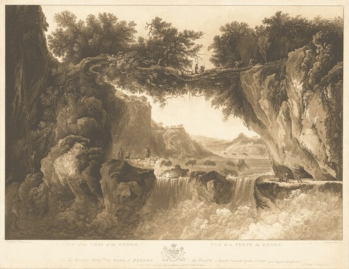
Maria Catharina Prestel, after Louis Bélanger, View of the Loss of the Rhone, 1791, etching and aquatint printed in brown on laid paper, sheet (trimmed to platemark) 56 × 72 cm (Washington, DC: NGA, Ailsa Mellon Bruce Fund, 2021.23.1).
Maria Catharina Prestel (1747–1794) was one of the few prominent female pioneers of aquatint. View of the Loss of the Rhone (1791), depicting a geologic fault in France, exemplifies how Prestel created inventive textures to evoke the tactility of brushwork.
The National Gallery acquired three works by Zarina (1937–2020), one of the most celebrated South Asian artists of the past century, who explores questions of displacement, mobility, loss, memory, migration, and cultural dominance in her work: Homes I Made/A Life in Nine Lines (1997) a portfolio of nine etchings; Corners (1980), made from cast paper; and Untitled (1968), a wood relief print.
Israeli artist Orit Hofshi’s (b. 1959) Time… thou ceaseless lackey to eternity (2018), one of her largest polyptychs, explores the history and founding of Israel and its ongoing conflicts with Palestine using the universal themes of migration, displacement, and the toll that human civilization has taken on the land. Nicole Eisenman (b. 1965) is best known as a painter who skillfully combines art history, queer politics, and popular culture into engaging, often fantastical figurative subjects. Beer Garden (2012–17)—at nearly four feet square—stands out as her most monumental print to date and took five years to complete.
Photographs

Carrie Mae Weems, Echoes for Marian, 2014, chromogenic print, image: 127 × 127 cm (Washington, DC: NGA, 2021.8.1).
Celebrated for her ability to explore issues of race, class, gender, power, and injustice with eloquent insight and passionate conviction, Carrie Mae Weems (b. 1953) often uses the past to shine a light on the present. Weems’s Untitled (1996, printed 2020) consists of seven inkjet prints, each a reproduction of a historic photograph and each framed with sandblasted text on glass inspired by the heroism of the 54th Massachusetts Regiment, one of the first African American regiments formed in the North during the Civil War. In her photograph Echoes for Marian (2014), Weems depicts herself standing in front of the Lincoln Memorial in Washington, DC, paying homage to Marian Anderson, who performed a concert there in 1939 when the Daughters of the American Revolution barred her from singing in Washington’s Constitution Hall. Weems’s photograph shows how architecture can not only exude a sense of power, but also reinforce it.
Other photography highlights include works by Christina Fernandez (b. 1965), a Los Angeles–based Chicana artist who uses photographs and installations to explore her Mexican heritage and themes of identity, migration, labor, and gender. The National Gallery acquired six prints from her Lavanderia series (2002–03), which depicts laundromats in the Boyle Heights neighborhood of LA, an area of the city that was known at the time as a bastion of Chicano culture, as well as her installation piece, Bend (1999–2000, 2020). Two important photographs by JoAnn Verburg, 3 x Three (2019) and WTC (2003), show how Verburg captures extended moments of time in her art, a theme that she has explored since the 1970s.
◊ ◊ ◊ ◊ ◊
Note — 2014 marked the 75th anniversary of Marian Anderson’s performance at the Lincoln Memorial. The same year that Weems produced her photograph honoring Anderson, the Daughters of the American Revolution hosted Of Thee We Sing, a concert in Constitution Hall “to pay tribute to the talent, strength, and courage” of Anderson as a “remarkable and inspiring woman” (as quoted from the organization’s Marian Anderson Statement, available from the DAR website).
The Huntington Acquires Portrait by Vigée Le Brun
From the press release (1 November 2022) . . .

Élisabeth Louise Vigée Le Brun, Portrait of Joseph Hyacinthe François-de-Paule de Rigaud, comte de Vaudreuil, ca. 1784, oil on canvas, 51 × 38 inches (San Marino: The Huntington Library, Art Museum, and Botanical Gardens, Gift of The Ahmanson Foundation).
The Huntington Library, Art Museum, and Botanical Gardens has acquired a major painting by Élisabeth Louise Vigée Le Brun (1755–1842), the most important female artist of 18th-century France. Portrait of Joseph Hyacinthe François-de-Paule de Rigaud, comte de Vaudreuil (ca. 1784) is the second masterpiece to come to The Huntington through a gift from The Ahmanson Foundation.
“We are enormously grateful to The Ahmanson Foundation for making this acquisition possible,” Huntington President Karen Lawrence said. “Adding an important work by Vigée Le Brun helps us achieve one of our goals—adding more works by important women. Once again, The Ahmanson Foundation proves to be an invaluable strategic partner, allowing us to make a masterpiece accessible to Southern California audiences.”
The Vigee Le Brun painting complements The Huntington’s significant collection of 18th-century French decorative art, which was established by Henry and Arabella Huntington in the early 20th century. “This finely painted masterwork will go on display in the Huntington Art Gallery, the building that holds French tapestries and carpets that were once part of the French court’s accoutrements at the Palais du Louvre and Versailles,” said Christina Nielsen, the Hannah and Russel Kully Director of the Art Museum at The Huntington. “It will not only add rich context, but will also shine as a star French painting. While our collection of 18th-century British portraiture is one of the best in the nation, this is our first French portrait of this caliber.”
The painting also has an interesting history. The painter and the subject were both part of the inner circle in the royal court, and they both greatly shaped Parisian salon culture. Their friendship has been celebrated by contemporary writers in poems and verse.
Vigée Le Brun was the daughter of a portraitist and was painting professionally by the time she was in her teens. When she was 28, she was inducted into the French Royal Academy, with the support of Marie Antoinette, and she was one of only four female members. Vaudreuil (1740–1817) was an actor, socialite, and Vigée Le Brun’s primary private patron. In her memoir Souvenirs, Vigée Le Brun reveals her affection for him, calling him “l’Enchanteur” (The Magician).
Painted to commemorate the day when Vaudreuil was made Knight of the Order of the Holy Spirit by King Louis XVI, the seated portrait shows off the sitter as well as the artist’s virtuosity. Vaudreuil is dressed in an ornate brown coat with gold braids, trim, and beads and white silk lining. He wears a sheer lace jabot and cuffs. His shimmering blue sash and the silver badge on his coat represent the knightly Order of the Holy Spirit. The red silk rosette and ribbon are of the royal military order of Saint Louis, which he received from King Louis XVI in 1770. He clasps a fashionable tricorn hat with white plumes under one arm and holds the handle of a ceremonial sword.
Vaudreuil was the son of the governor and commander-general of the French colony Saint-Domingue on the Caribbean island of Hispaniola. In addition to a great inheritance, Vaudreuil’s wealth also derived from his own Saint-Domingue sugar plantations, which were powered by enslaved people. “As with our recently acquired drawings of the Jamaican sugar plantation where the famous ‘Pinkie,’ from our British portraits collection, grew up, the Vaudreuil portrait provides us with an opportunity to shine a brighter light on the history of European colonization,” Nielsen said. “We must, and will, reckon with the lives of the people represented on our walls.”
The painting is slated to be installed in the Huntington Art Gallery in November.
◊ ◊ ◊ ◊ ◊
The painting sold in Paris at Christie’s, Maîtres Anciens: Dessins, Peintures, Sculptures (Sale 21059, Lot 232), on 17 May 2022 for €592,200, over twice its low estimate (€250,000–350,000). Two versions of the painting exist: the other is in the collection of the Virginia Museum of Fine Arts.










 Enfilade
leave a comment