Attingham Courses in 2026
Attingham offerings for 2026:
The Study Programme | Sweden: Stockholm and Its Hinterland
Led by David Adshead with Beatrice Goddard, 8–14 June 2026
Applications due by 30 January 2026
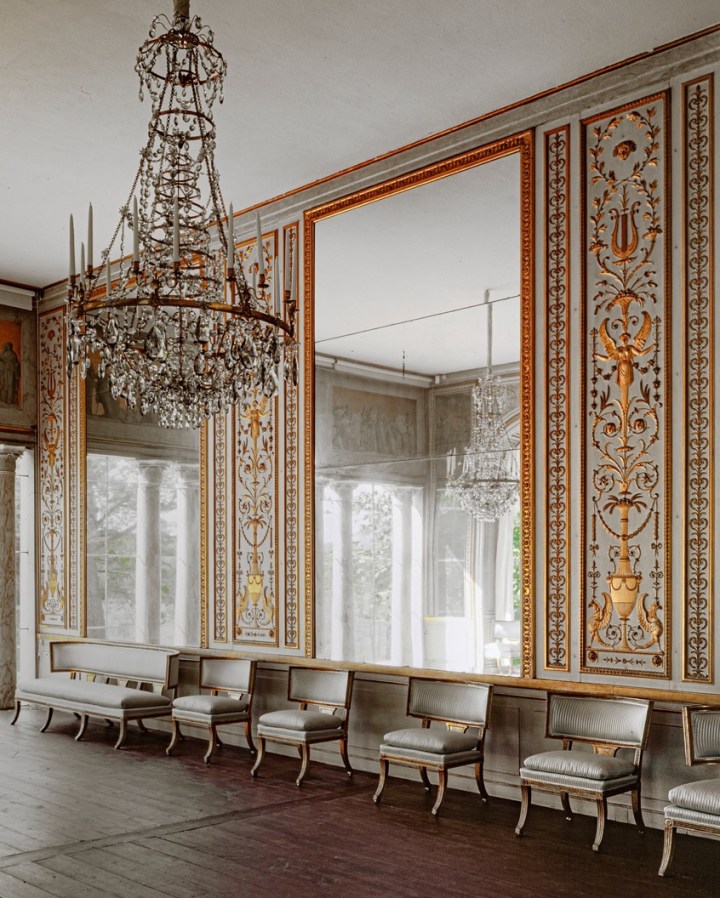
The Hall of Mirrors, Gustav III’s Pavilion at Haga Park. The Royal Palaces, Sweden (Photograph: ©Jens Markus Lindhe).
This intensive seven-day course will study the patronage of successive Swedish royal dynasties and that of the nobility and wealthy merchant class, in Stockholm’s palaces and the castles and country houses of its hinterland—Svealand, the nation’s historic core. With earlier outliers, it will focus on the arts and architecture of the mid 17th to early 19th centuries, encompassing the Baroque, Rococo, neo-Classical and ‘Empire’ styles.
For more than a hundred years, from the accession of Gustavus Adolphus in 1611 to its loss of territory at the end of the Great Northern War in 1721, Sweden was a European military superpower and enjoyed an ‘Age of Greatness’, its fortunes reflected in the richness of buildings, interiors, and collections of fine and decorative arts, particularly those of the monarchy. A new political compact with power-sharing between government and parliament—the so-called ‘Age of Liberty’—subsequently encouraged a flowering of the arts and sciences and the further influence of all things French. During the following ‘Gustavian Age’, led by the energetic but latterly autocratic, Gustav III, Sweden’s elegant interpretation of neo-Classicism reached its apogee.
In Stockholm, visits will be made to the Riddarhuset, Riddarholmskyrkan, the Royal Palace, and Gustav III’s Museum of Antiquities. Outside Stockholm, in addition to a number of private houses, visits will include, Tullgarns Palace, Drottningholm Palace, Svartsjö Palace, the English landscape park at Haga, Rosersberg Palace, Svindersvik a summer residence, Gripsholm Castle, the manor house at Grönsöo, and Skokloster Castle. For the last two nights we will be staying in the town of Mariefred on the south-west tip of Lake Mälaren.
◊ ◊ ◊ ◊ ◊
The 73rd Summer School
Led by David Adshead and Tessa Wild, with Sabrina Silva, 27 June — 12 July 2026
Applications due by 30 January 2026
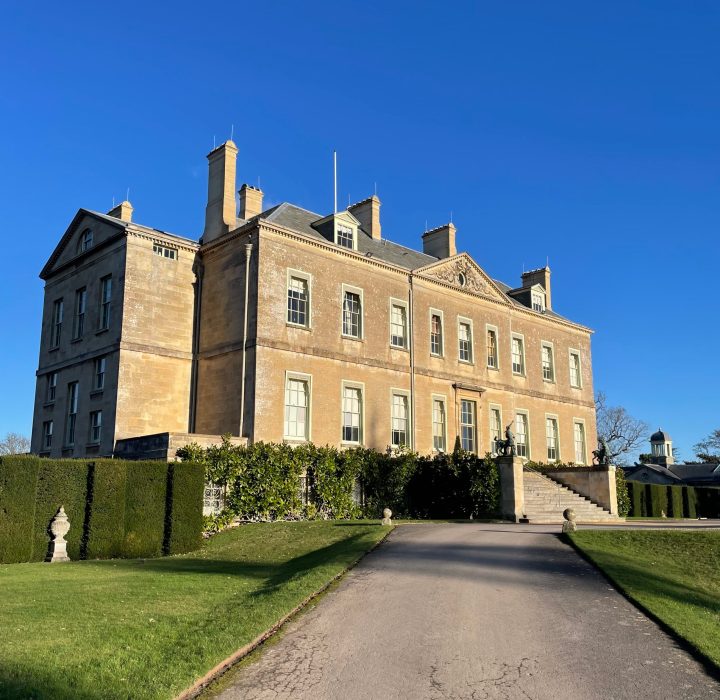
Buscot Park, Faringdon, Oxfordshire, 1780–83.
The 73rd Attingham Summer School, a 16-day residential course will visit country houses in Sussex, Derbyshire, Nottinghamshire, Buckinghamshire, and Oxfordshire. From West Dean, our first base, we will study, amongst other houses and gardens: Petworth House, where the patronage of great British artists such as Turner and Flaxman enrich its Baroque interiors; Parham, a fine Elizabethan house in an unrivalled setting; and Standen, an Arts and Crafts reinterpretation of the country house.
In the Midlands, a series of related houses will be examined: Hardwick Hall, unique amongst Elizabethan houses for its survival of late 16th-century decoration and contents; Bolsover Castle, a Jacobean masque setting frozen in stone; and Chatsworth, where the collections and gardens of the Cavendishes and Dukes of Devonshire span more than four centuries. Other highlights include Robert Adam’s crisp neo-Classical interior and Fishing Pavilion at Kedleston Hall.
The final part of the course will focus on the rich estates and collections of Oxfordshire. Our itinerary will include Broughton Castle, a moated and fortified manor house with a chapel first consecrated for Christian worship in 1331, and Buscot Park, with its superb collection with works by Rembrandt, Botticelli, Rubens, Edward Burne-Jones and Dante Gabriel Rossetti, and furniture by Robert Adam and Thomas Hope. While at Buscot we will have the opportunity to explore one of the country’s finest water gardens, designed by Harold Peto in 1904 and extended from 1911–13, and a surviving country house theatre created in 1936 for the 2nd Lord Faringdon. We will also visit the much more modest 17th-century stone-built, Kelmscott Manor, the beloved country home of William Morris and his family, and the place that he described as ‘Heaven on Earth’.
◊ ◊ ◊ ◊ ◊
Royal Collection Studies
Led by Helen Jacobsen, with Beatrice Goddard, 6–15 September 2026
Applications due by 15 February 2026

James Roberts, The Pavilion Breakfast Room at Buckingham Palace (known by 1873 as the Queen’s Luncheon Room), 1850, watercolour and bodycolour with gum arabic, paper: 26 × 38 cm (RCIN 919918).
The Royal Collection is one of the world’s leading collections of fine and decorative art, with over one million works from six continents, many of them masterpieces. Working in partnership with The Royal Collection Trust, this ten-day residential course offers participants the opportunity to study the magnificent holdings of paintings, furniture, metalwork, porcelain, jewellery, sculpture, arms and armour, books, and works on paper and to examine the architecture and interiors of the palaces which house them. Based near Windsor, the course also examines the history of the collection and the key roles played by monarchs and their consorts over the centuries. Combining a mixture of lectures and tutorials, visits to both the occupied and unoccupied palaces in and around London and close-up object study, Royal Collection Studies aims to give experienced professionals in the heritage sector a deeper understanding of this remarkable collection.
◊ ◊ ◊ ◊ ◊
From College Library to Country House
Led by Andrew Moore, with Rita Grudzien, 7–11 September 2026
Applications due by 15 February 2026
This course is conceived from the perspective of the British aristocracy and gentry whose education centred upon preparing them to run their country estate, including the house and collections, and argues for the importance of the library and the book collection in this process. Too often in country house studies the architecture, interior design, and art collections have held sway; this course aims to foreground the College book collections at the disposal of tutors and the subsequent development of the country house library. Libraries reveal not only the intellectual or recreational interests of past generations, but also how books manifest taste, fashion, and opportunities for display. Book historians and tutors well known in their respective fields will conduct the course, attending to a broad variety of subjects including book binding, the development of the idea of rare books and of book collections, library portraiture, and questions of spatial analysis and mobility—all in the context of the collections housed in some of the oldest and most complete book rooms in Britain.
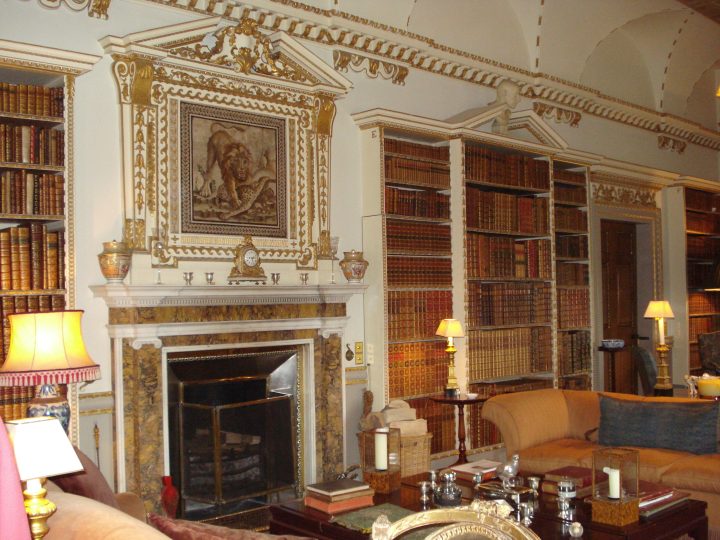
Library at Holkham Hall.
This intensive residential five-day course is based in the exceptional surroundings of St Catharine’s College, a constituent college of the University of Cambridge. Directed by Dr Andrew Moore, the programme plans to visit a series of iconic libraries. These include the historic private library of Houghton Hall, created by Robert Walpole, and Holkham Hall, home to one of the greatest private manuscript and printed book collections in Britain, housed today in three of the country’s most important country house library rooms. The course will also visit the library designed by James Gibbs for Edward Harley, Earl of Oxford at Wimpole Hall in Cambridgeshire, and the Braybrooke library rooms at Audley End, of considerable interest for being reconstituted from dressing rooms into the 3rd Lord Braybrooke’s library, incorporating the inherited Neville family books. The library at Audley End functioned as an informal family sitting room, with the adjacent study (the South Library) still displayed as it looked in the early 19th century.
The course includes the Old Libraries of St John’s College and Queens’ College; the Wren Library, Trinity; the Perne Library at Peterhouse; the Parker Library at Corpus Christi; and the Founder’s Library at the Fitzwilliam Museum. Additional seminars will take place in the context of the historic book collections in the Cambridge University Library designed by Giles Gilbert Scott (1880–1960). St Catharine’s College will host a seminar on the medical book collection of John Addenbrooke (1680–1719), founder of Addenbrooke’s Hospital, Cambridge.
◊ ◊ ◊ ◊ ◊
Note (added 14 January 2026) — From Attingham’s Instagram account (6 January 2026) . . .
We are thrilled to congratulate Annabel Westman on being awarded an MBE in the New Year Honours “for services to heritage, particularly to The Attingham Trust and historic textiles.” Annabel’s time as Director of the Attingham Summer School (1993–2005) and Executive Director of The Attingham Trust (2005–2021) helped shape Attingham into the vibrant, welcoming, and extraordinary community it is today. Alongside this, her distinguished career as a textile historian and consultant has enriched the understanding and restoration of historic interiors worldwide. This honour is richly deserved, and we are so proud to celebrate Annabel and all she continues to give to the field.
Decorative Arts Trust Prize to Fund Digital Porcelain Rooms Project
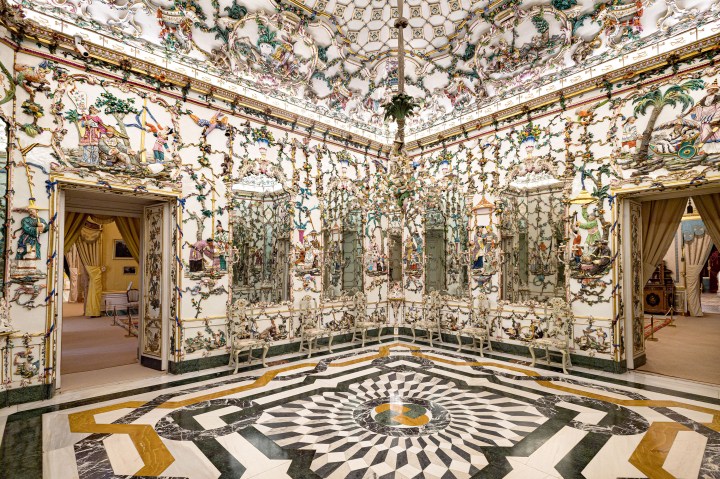
Porcelain study of Charles III of Spain, 1760–65, painted soft-paste porcelain
(Aranjuez: Patrimonio Nacional de España)
◊ ◊ ◊ ◊ ◊
From the press release:
The Decorative Arts Trust is thrilled to announce that the 2025 Prize for Excellence and Innovation will be awarded to The Digital Porcelain Rooms Project, a collaboration between the Custard Institute for Spanish Art and Culture at Southern Methodist University’s Meadows Museum and the Edith O’Donnell Institute of Art History at the University of Texas at Dallas.
The goal of the porcelain rooms project is to reanimate and reinterpret two of the most important interiors in the canon of 18th-century decorative arts: the Salottino di Porcellana in Naples, Italy, and the Gabinete de Porcelana in Aranjuez, Spain. The project embraces an expansive definition of decorative arts, examining not only the design and materiality of porcelain interiors but also the labor, technologies, and global flows that made them possible.
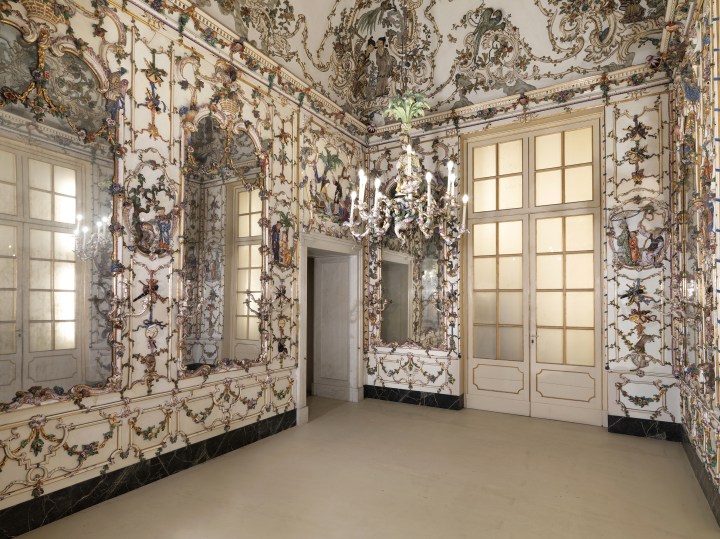
Porcelain room of Maria Amalia of Saxony, 1757–59, painted porcelain and stucco (Naples: Museo e Real Bosco di Capodimonte; photo by Luciano Romano).
Maria Amalia of Saxony’s 1757–59 Salottino di Porcellana was originally installed in the Royal Palace at Portici in Naples and is now housed at the Museo e Real Bosco di Capodimonte. Designed in the so-called Chinese taste using local craftsmen, the Salottino was left unfinished when Maria Amalia departed for Spain in 1759 but was later completed with a Roman mosaic floor, likely sourced from nearby Herculaneum. Charles III’s Gabinete de Porcelana was developed 1760–65 at the Palacio Real de Aranjuez near Toledo, Spain, reflecting his assertion of political authority through elaborate interior design.
The Digital Porcelain Rooms Project is a transnational, interdisciplinary effort that brings together curators, art historians, archaeologists, conservators, technologists, and cultural heritage leaders from leading museums, research institutes, and universities across Europe and the United States. The project involves the participation of the Museo e Real Bosco di Capodimonte, Centro MUSA Musei della Reggia di Portici, the Center for the Art and Architectural History of Port Cities at La Capraia, and the Palacio Real de Madrid.
The Decorative Arts Trust Prize for Excellence and Innovation, founded in 2020, funds outstanding projects that advance the public’s appreciation of decorative art, fine art, architecture, or landscape. The Prize is awarded to a nonprofit organization in the United States for a scholarly endeavor, such as museum exhibitions, conservation and preservation projects, and online databases. Past recipients include Drayton Hall; the Concord Museum, Cooper Hewitt, Smithsonian Design Museum; the Black Craftspeople Digital Archive; and Craft in America. Nominations are accepted through June 30, annually. For more information about the Prize for Excellence and Innovation, visit decorativeartstrust.org/prize.
Forbidden City’s Qianlong Garden Reopens after Conservation
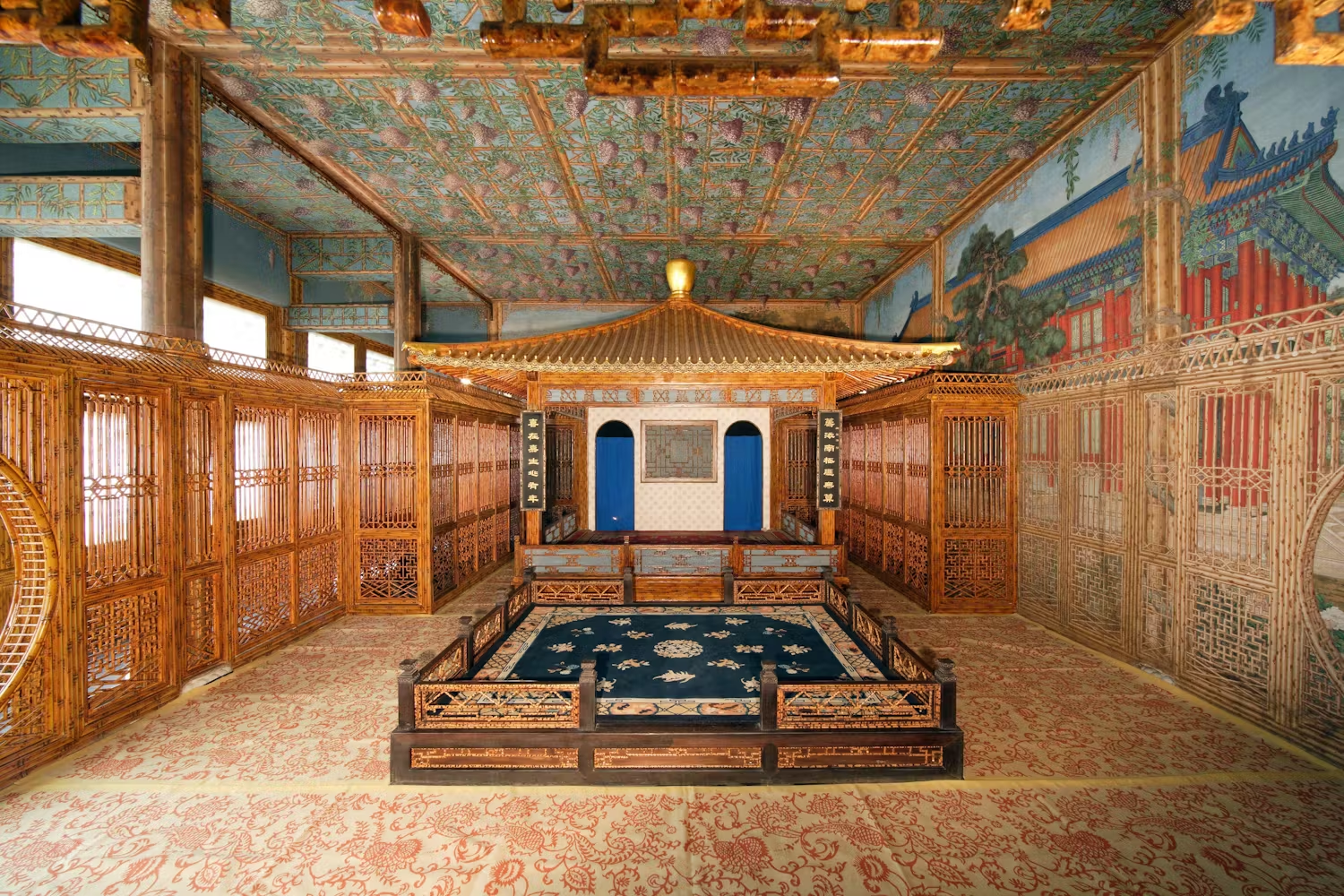
When the Qianlong Emperor abdicated in 1796, he had a retirement complex waiting for him in a 1.6-hectare space within the Forbidden City. But he never took up residence in the Palace of Tranquil Longevity, and the site has remained largely untouched ever since. It contains some of the most extraordinary examples of Chinese interior design in existence today. Pictured here, Juanqinzhai, or Studio of Exhaustion from Diligent Service, is noted for the trompe-l’oeil silk paintings on the ceiling and walls of its private theater. Its reception room also contains unusually fine bamboo thread marquetry and inner bamboo skin carvings, as well as jade inlays and sophisticated textile decorations.
◊ ◊ ◊ ◊ ◊
From the WMF press release (30 September 2025) . . .
World Monuments Fund (WMF) and the Palace Museum today announced the official public opening of the Qianlong Garden, a masterwork of 18th-century Chinese imperial design located in the northeast corner of Beijing’s Forbidden City. After a two-decade-long conservation effort, the garden has reopened. A new on-site exhibition will offer a comprehensive understanding of the Qianlong Garden’s interiors, design, and craftsmanship. The inauguration of the garden will be accompanied by the publication of the book Tranquil Longevity, Predestined Serenity: The Origins, Interpretation and Conservation of the Qianlong Garden, providing an in-depth look at the history of the Qianlong Garden and the restoration of the site.

Restored exterior of Qianlong Garden.
Constructed by the Qianlong Emperor (r. 1735–1796) as a planned retreat for his later years, the 1.6-hectare site includes 27 buildings across four courtyards, with ornate interiors that preserve original furniture, decorative finishes, and rare materials largely untouched since the 18th century. Following an extensive 25-year conservation initiative led by World Monuments Fund (WMF) in partnership with the Palace Museum, the site now features restored interiors and exteriors showcasing some of the most refined and culturally significant artistry of the Qing Dynasty. This collaboration brought together international experts and Chinese artisans to address the site’s preservation challenges, revive endangered craft techniques, and uphold the garden’s extraordinary architectural integrity.
“This is a landmark moment for heritage conservation in China,” said Hunghsi Chao, Senior Regional Director for East Asia at World Monuments Fund. “Qianlong Garden represents an unparalleled survival of imperial interior design, and its preservation requires both technical precision and deep cultural understanding. Through our work with the Palace Museum, we have not only safeguarded a historic treasure but have helped reinvigorate traditional craftsmanship and inspired new generations of conservation professionals.”
As a cornerstone of the conservation effort, WMF launched the CRAFT Educational Program (Conservation Resources for Architectural Interiors, Furniture, and Training) in 2011 to provide formal training in architectural conservation. In partnership with Tsinghua University and the Palace Museum, the program became a master’s-level conservation initiative in China to align with international standards, blending scientific methodology with traditional Chinese techniques.
“World Monuments Fund’s partnership with the Palace Museum has shown how international collaboration and local expertise can come together to achieve something truly exceptional,” said Bénédicte de Montlaur, President and CEO of World Monuments Fund. “Qianlong Garden is a living document of Qing-era craftsmanship and global influence—its preservation stands as a model for how education, science, and culture can shape the future of heritage.”

Model of the Qianlong Garden from the exhibition “Heavenly Craftsmanship: The History and Preservation of the Ningshou Palace Garden.”
A pilot project for the broader site was launched in 2002 with the restoration of Juanqinzhai (Studio of Exhaustion from Diligent Service), a pavilion known for its rare trompe l’oeil silk murals, bamboo marquetry, and theatrical stage. Conservation of Juanqinzhai revived long-lost techniques and informed all subsequent work throughout the garden. Completed interventions include the Fuwangge (Belvedere of Viewing Achievements), Zhuxiangguan (Lodge of Bamboo Fragrance), and Yucuixuan (Bower of Purest Jade), while work continues across the remaining courtyards.
“Joint projects involving the Palace Museum in China and World Monuments Fund based in the United States, beginning in 2000 and continuing to the present, have demonstrated that, in the context of globalization, different civilizations can achieve mutual understanding and respect through dialogue, communication, and cooperation, and thus jointly promote the prosperity and development of human civilization,” said Director Wang Xudong of the Palace Museum.
The inauguration ceremony welcomed representatives from the Palace Museum and World Monuments Fund, cultural leaders, and conservation experts to celebrate the public opening of the Qianlong Garden as part of the Palace Museum’s centennial. Building on the success of this project, the Palace Museum and World Monuments Fund will continue to collaborate on preservation and training initiatives throughout the Forbidden City.
Alongside the opening, the Palace Museum published Tranquil Longevity, Predestined Serenity: The Origins, Interpretation, and Conservation of the Qianlong Garden, providing an in-depth look at the storied history of Qianlong Garden. The book also details the full story of the spirit of cooperation between Chinese and American heritage professionals who faced daunting obstacles to restore the site. Readers can explore the garden and its preservation through detailed illustrations, new photography, rarely published drawings, and historic photographs of the Qianlong Garden taken during the last days of the Qing Dynasty.
The exhibition Heavenly Craftsmanship: The History and Preservation of the Ningshou Palace Garden will be on display in the garden’s Suichu Hall and the east and west side halls, presenting the historical and cultural value of the Ningshou Palace Garden and the achievements of its preservation and restoration.
Shrewsbury’s Flaxmill Maltings and the 18th-C. Origins of the Skyscraper
◊ ◊ ◊ ◊ ◊
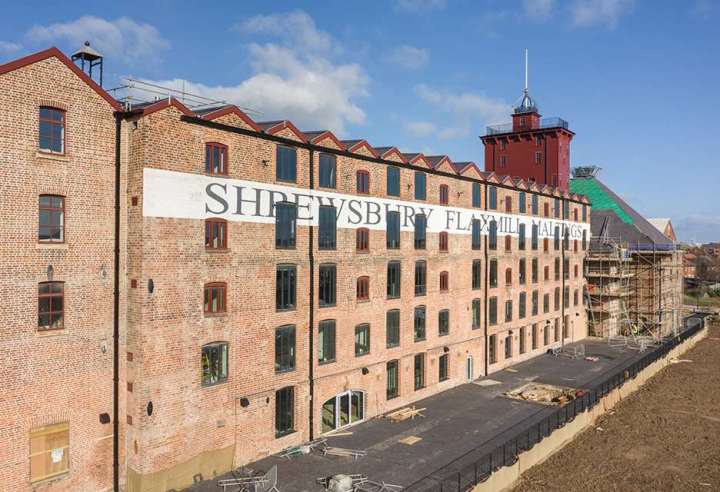
Last week in The New York Times (20 June 2025), Helen Barrett wrote about Shrewsbury’s Flaxmill Maltings, the world’s first iron-frame building, constructed in 1797, which recently opened to the public following a 20-year restoration aimed at telling the story of England’s ‘industrial heritage’. In 2024, this 18th-century forerunner of the skyscraper was selected by The Royal Institute of British Architects as ‘West Midlands Building of the Year’.
An English Heritage press release from this spring (31 March 2025) issued a plea for the site’s bell to be returned. As far as I can tell, it’s still missing, though I would be glad to hear otherwise. –CH
◊ ◊ ◊ ◊ ◊
English Heritage will open the Shrewsbury Flaxmill Maltings site on April 1 — and experts say now is the time to return its lost iconic bell. The bell, missing since the 1980s, is an important part of Shrewsbury Flaxmill Maltings’ history. It’s considered a symbol of the socio-economic change brought on by the Industrial Revolution.
The design of the late 18th-century building itself is groundbreaking too. The flaxmill was the world’s first multi-storey, iron-frame building, providing the blueprint for all modern high-rise buildings, which changed skylines around the world forever. As part of the re-opening, English Heritage will offer a self-guided exhibition and behind-the-scenes tours so the public can experience this historic site for themselves.
The main purpose of the flaxmill was to spin linen thread from flax. The business thrived since its opening in 1797, and the site expanded with the flaxmill eventually becoming Shrewsbury’s largest employer. For almost 200 years, the bell was a familiar sound to the residents of Shrewsbury. It would ring out to mark the start and finish of each working day at the flaxmill and, later, the maltings. However, during the 1980s or 1990s the bell was lost when the building was left derelict following the closure of the business in 1987. The bell, believed to be about 24 inches tall, was originally operated by a pull rope, later changing to an electric chiming mechanism after the Second World War. It is easily identifiable, with ‘1797’ distinctively cast upon it.
Matt Thompson, Interim Curatorial Director of English Heritage:
“We believe the bell went missing in the late 1980s or early 1990s, when Shrewsbury Flaxmill Maltings was left derelict. Whilst it is possible that the bell could have been melted down, it is more likely that someone took it as a souvenir of this imposing, historic building which – at the time – looked close to ruin. Maybe it’s sitting in someone’s garden or in a shed now? As Shrewsbury Flaxmill Maltings begins its new incarnation as an English Heritage site, it feels like the right time to appeal for information on the bell’s whereabouts so that we can restore it to its rightful place.
When it opened in 1797, the flaxmill needed 800 workers and a third of these were children. Shrewsbury itself was too small to provide that number, so children were brought in from as far afield as London and Hull under the parish apprenticeship system. Mostly from the workhouses and often orphans, these children were allocated to work at the mill, given housing, food and clothes but not paid wages. The bell would have called these children in from the Apprentice House nearby. Days were long and conditions often brutal, with testimony from some former child labourers at the mill eventually contributing to the 1833 Factory Act, which restricted the hours that children could work each day.
As with much of England’s industrial heritage, Shrewsbury Flaxmill Maltings is a hugely underappreciated historic site. As the world’s first multi-storey, iron-frame building, its pioneering design paved the way for modern high-rise buildings and it has rightly been dubbed ‘the grandparent of skyscrapers’. Without Shrewsbury Flaxmill Maltings, today’s cities would look very different and, for that reason alone, the building deserves international recognition.
However, the social change brought about by this very flaxmill and the factory system in general is equally as important to British history. The associated urban migration, long, hard working hours and exploitation of children were catalysts for labour reform movements and legislation to improve conditions, including the 1833 Factory Act for which the government received testimony from former workers at Shrewsbury Flaxmill.
The lost bell is a symbol of this huge societal shift: it oversaw the increased reliance on machinery, the dwindling fortunes of the flax industry, the change in purpose of the building to a maltings and, after a brief silence whilst the building housed soldiers during the Second World War, it was given an electric chiming mechanism to ring out over the handful of workers at the maltings. It would be a fitting end to the incredible story of Shrewsbury Flaxmill Maltings if we could find the bell and restore it to its rightful place, providing today’s visitors with an audible connection to the site’s history and past generations of workers.”
Bethlehem’s Moravian District Added to UNESCO’s World Heritage List
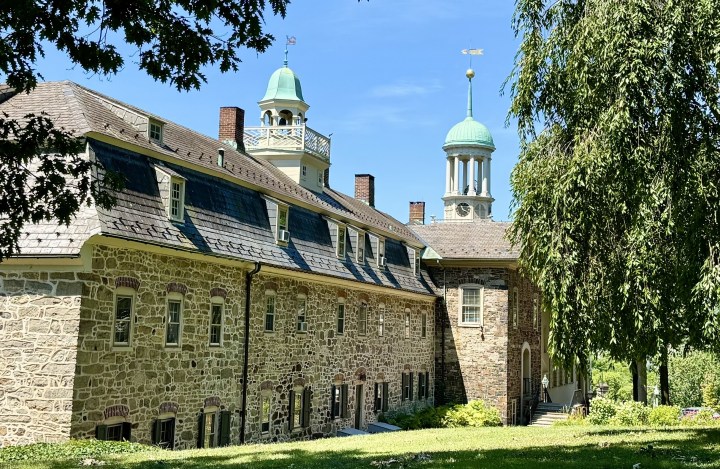
Bell House Complex, built in 1746, 56 West Church Street, Bethlehem.
◊ ◊ ◊ ◊ ◊
Last year, the Historic Moravian Bethlehem District in Pennsylvania (consisting of nine buildings, four ruins, and a cemetery) was added to UNESCO’s World Heritage List. Eve Kahn describes her visit to the city of Bethlehem (70 miles north of Philadelphia) in the latest issue of Preservation (Spring 2025) . . .
I am having a heady preservationist moment in mid-air. It’s a crystalline winter morning in Bethlehem, Pennsylvania, a city known for industriousness and architectural stewardship since the 1740s. I have been escorted up sinuous staircases to the domes belfry of Central Moravian Church’s Sanctuary, a gabled and stuccoed building that has welcome worshipers since it opened in 1806. From my perch overlooking Main Street, I admire the church’s well-kept tower clockfaces and its planes of gray slate roofing, supported by walls six feet thick. All around, Moravian setters’ 18th-century masonry buildings have adapted into bustling museums, businesses, and homes, cheek by jowl with their Victorian and Art Deco counterparts . . . (p. 21).
UNESCO designated the place [of Bethlehem] as part of what is officially called a “transnational serial property,” along with three 18th-century hamlets in Europe: Herrnhut in Germany, Gracehill in Northern Ireland, and Christiansfeld in Denmark. All were set up as Christian communities by members of the Moravian Church, a Protestant sect founded in the 1450s in what is not the Czech Republic. Fleeing persecution, the community dispersed, and in the 1700s a group of adherents revived the Moravian Church. They eventually scattered worldwide to worship and proselytize. In 1741, some especially intrepid Moravians settled on Pennsylvania acreage at the confluence of the Lehigh River and Monocacy Creek, on land that white explorers had recently swindled from the Lenape people (p. 22).
◊ ◊ ◊ ◊ ◊
From the National Park Service press release (26 July 2024) . . .
Secretary of the Interior Deb Haaland today applauded the selection of the Historic Moravian Bethlehem District in Bethlehem, Pennsylvania, to the United Nations Educational, Scientific and Cultural Organization’s (UNESCO) World Heritage List. The list highlights cultural and natural heritage sites around the world considered to be of outstanding value to humanity.
“The United States is deeply honored to be included in UNESCO’s World Heritage List with the listing of the Historic Moravian Bethlehem District where visitors from around the world are able to learn about the rich history of Moravian settlements, their cultural tradition and spiritual ideals,” said Secretary Haaland. “This designation is a recognition of the incredible work of the National Park Service and its local partners to preserve an important part of American—and world—history.”
This designation is UNESCO’s 26th—and the first transnational World Heritage listing—in the United States. In addition to the Historic Moravian Bethlehem District, the listing of Moravian Church Settlements includes the historic settlements of Herrnhut, founded in 1722 in Germany, and Gracehill, established in 1759 in Northern Ireland. The three areas join as an extension of the Moravian settlement of Christiansfeld in Denmark, founded in 1773, which was added to the World Heritage List in 2015, to form a single World Heritage listing for Moravian Church Settlements.
“This well-deserved designation demonstrates the lasting, global influence of the Moravian Church and the preservation of some of America’s most treasured landmarks that support and illustrate our heritage and history,” said National Park Service Director Chuck Sams.
The Historic Moravian Bethlehem District is also a national historic landmark. Established in 1741 as a planned community, it was the religious and administrative center of Moravian activities in North America. Similar to the other three settlements, many of its buildings still serve their original purpose. In 2022, Secretary Haaland authorized the National Park Service (NPS) to develop a nomination of Moravian Church Settlements for World Heritage List consideration.
NPS supported this effort with the full cooperation of property owners, the City of Bethlehem, Bethlehem Area Moravians and Moravian University. NPS advised the Bethlehem World Heritage Commission and guided them through the technical requirements of the nomination process as well as communicated with the governments of Germany, the United Kingdom, and Denmark on the development of the nomination.
The NPS is the principal U.S. government agency responsible for implementing the World Heritage Convention in cooperation with the Department of State. The NPS manages all or part of 19 of the 26 U.S. sites. Inclusion of a site in the World Heritage List does not affect U.S. sovereignty or management of the sites.
Restoration of the Williamsburg Bray School Completed
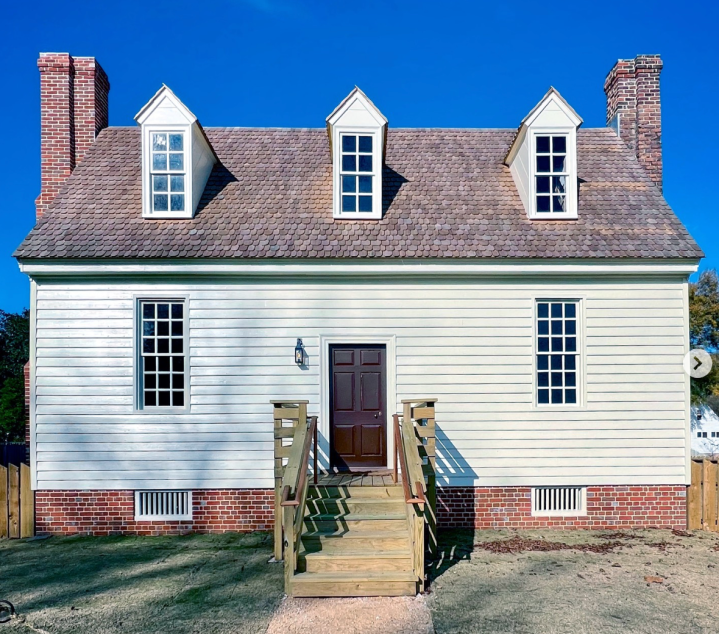
Opened in 1760, the Bray School is believed to be the oldest surviving building in the United States for the education of Black children. As noted by Lauren Walser in her Preservation article, the school “taught a pro-slavery, faith-based curriculum based on the teachings of the Church of England.” Photo from the Instagram account of Bruce A. deArmond, which foregrounds historic architecture.
◊ ◊ ◊ ◊ ◊
The story of the recovery of the Bray School at Colonial Williamsburg is recounted in the latest issue of Preservation (Spring 2025). The formal dedication of the restored building took place on 1 November 2024. It opens to the public this spring. From Colonial Williamsburg:
The Williamsburg Bray School was one of the earliest institutions dedicated to Black education in North America. From 1760 to 1774, teacher Ann Wager likely taught hundreds of students between the ages of three and ten. Students learned the tenets of the Anglican Church and subjects including reading, and for girls, sewing. The Bray School’s deeply flawed purpose was to convince enslaved students to accept their circumstances as divinely ordained. Hidden in plain sight on the William & Mary campus for over 200 years, the Williamsburg Bray School now stands in Colonial Williamsburg’s Historic Area as the Foundation’s 89th original structure. . . .
The Bray School will be used as a focal point for research, scholarship, and dialogue regarding the complicated story of race, religion, and education in Williamsburg and in America.
◊ ◊ ◊ ◊ ◊
From Colonial Williamsburg:
Maureen Elgersman Lee and Nicole Brown, eds., The Williamsburg Bray School: A History through Records, Reflections, and Rediscovery (Williamsburg: Colonial Williamsburg, 2024), 176 pages, ISBN: 978-0879353032, $20.
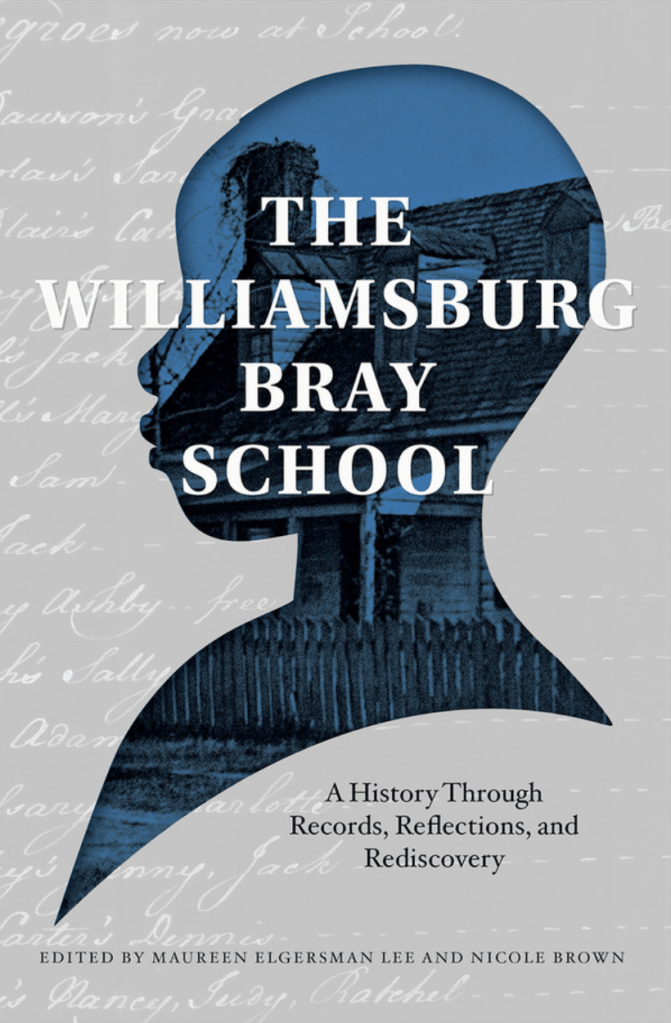 Seven letters tracing the arc of the Williamsburg Bray School—from its founding in 1760 to its closing in 1774—provide the foundation for a collection of essays that explore the school’s history and its implications for the enslaved and free Black children who attended. These letters are some of the surviving correspondence between the Williamsburg school’s administrators and the Associates of Dr. Thomas Bray, a London-based Anglican charity whose charge was to minister to what it saw as the spiritual needs of African Americans. The essayists reflect on the evolution of the Williamsburg Bray School, offering a variety of perspectives on the school and the children who attended it. Some pieces reflect years of research and writing on the establishment of the school. Others, including writings from some of the descendants of these students, represent more recent opportunities to reflect on the school and its historical context. In addition to a short history of the school, a map that pinpoints where the children resided in Virginia’s colonial capital, and photographs of the historic letters, the book delves into the 21st-century discovery of the Williamsburg Bray School building, its subsequent move from the William & Mary campus to Colonial Williamsburg’s Historic Area, and the restoration of the structure that can help tell the complicated story of race, religion, and education in Williamsburg and early America. Author Antonio Bly also shares the poignant story of Isaac Bee, a student at the school who broke the bonds of his enslavement to a Williamsburg planter and rose up from slavery to freedom.
Maureen Elgersman Lee, director of the William & Mary Bray School Lab, holds both a master’s degree and a doctorate in African American Studies. She is an award-winning professor and author of numerous books and articles on the history of Blacks in the Americas.
Nicole Brown is Graduate Assistant for the William & Mary Bray School Lab and a PhD Candidate in American Studies at William & Mary; she was previously a Program Design Manager at The Colonial Williamsburg Foundation. As a first-person historical interpreter, Brown portrays a variety of women including Ann Wager, the 18th-century white teacher at the Williamsburg Bray School, and Monticello’s Martha Wayles Skelton Jefferson. Brown’s ongoing academic research centers Black literacy in the Atlantic World via interdisciplinary and descendant-engaged scholarship.
Eli Wilner & Co. Makes an 18th-C. Pier Mirror for Drayton Hall
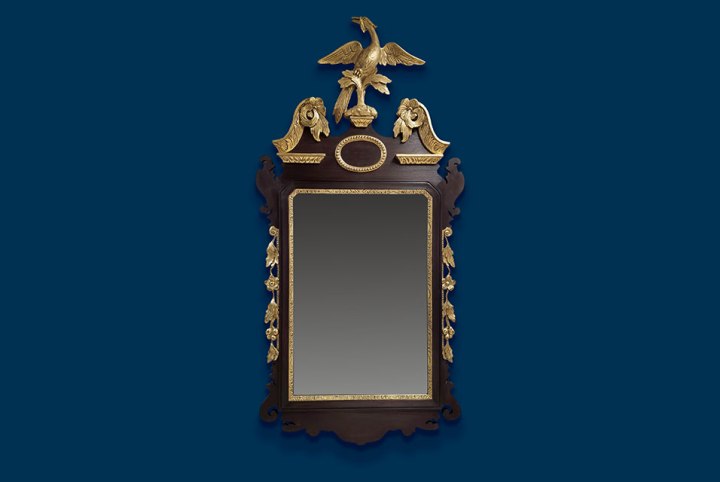
Late-18th-century-style pier mirror; walnut, basswood, and parcel-gilt; created in 2024–25 by Eli Wilner & Company for Drayton Hall Preservation Trust, Drayton Hall Museum Collection. The mirror was unveiled at the 2025 Charleston Show (March 21–23).
◊ ◊ ◊ ◊ ◊
As noted at Art Daily:
With assistance from their partial funding program for museums, Eli Wilner & Company recently completed the creation of a late 18th-century style pier mirror for Drayton Hall Preservation Trust. March has been another successful month for Eli Wilner & Company’s frame funding initiative, with $125,000 in partial grants having been distributed to date. Nearly $50,000 in funding is still available. Exciting new projects are being submitted on a daily basis by museums across the country. Remaining funds will be committed to new projects by 30 April 2025 and can be used for frame restoration, historic frame replication, or mirror replication projects. Interested institutions can apply by emailing the details of their reframing or frame restoration needs to info@eliwilner.com. No project is too large.
Patricia Lowe Smith, Drayton Hall’s Director of Preservation, initially contacted Wilner in the spring of 2024 about the potential project after they had discovered telltale marks on the original moldings surrounding the drawing room windows, indicating a lost pier mirror. Since no other documentation was found to provide the specifications or origin of the object, Wilner presented Drayton’s team with period-appropriate replacement options based on historical photographs and hand-tracings of Drayton’s walls.
The selected digital mockup was then printed to scale for Wilner’s master carpenters to begin construction of the walnut substrate and basswood blocks for the multiple hand carved elements. To get a better understanding of the depth proportions and construction methods that were not apparent in two-dimensional photographic images, they visited nearby institutions including the Metropolitan Museum of Art and the New-York Historical Society, and the Museum of the City of New York to examine similar objects.
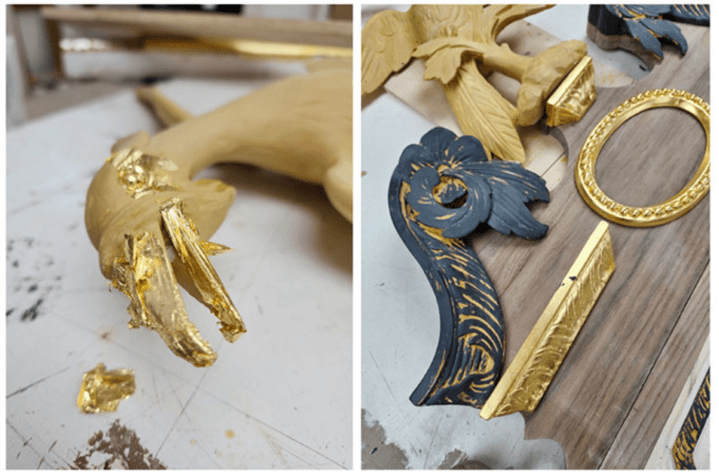 After several months of woodworking and carving, the basswood portions of the frame were prepared with layers of finely sanded gesso and bole (a liquid clay) and watergilded. These delicate elements were then burnished and patinated to a period appropriate character. Meanwhile, the walnut substrate sections were stained. Finally in February 2025, following an in-person studio visit with members from Drayton Hall’s preservation team, all portions of the frame were fully secured into position, and the glass and hanging hardware was installed.
Eli Wilner & Company has completed over 15,000 framing projects for private collectors, museums, and institutions including The Metropolitan Museum of Art, the Smithsonian American Art Museum, and The White House. Wilner was honored by the Historic Charleston Foundation with the Samuel Gaillard Stoney Conservation Craftsmanship Award, for their work in historic picture frame conservation. In 2024, Eli Wilner was presented with an Iris Award for Outstanding Dealer of the Year by the Bard Graduate Center in New York City.
Preservation Long Island Receives Curatorial Internship Grant
From the press release (18 November 2024). . .
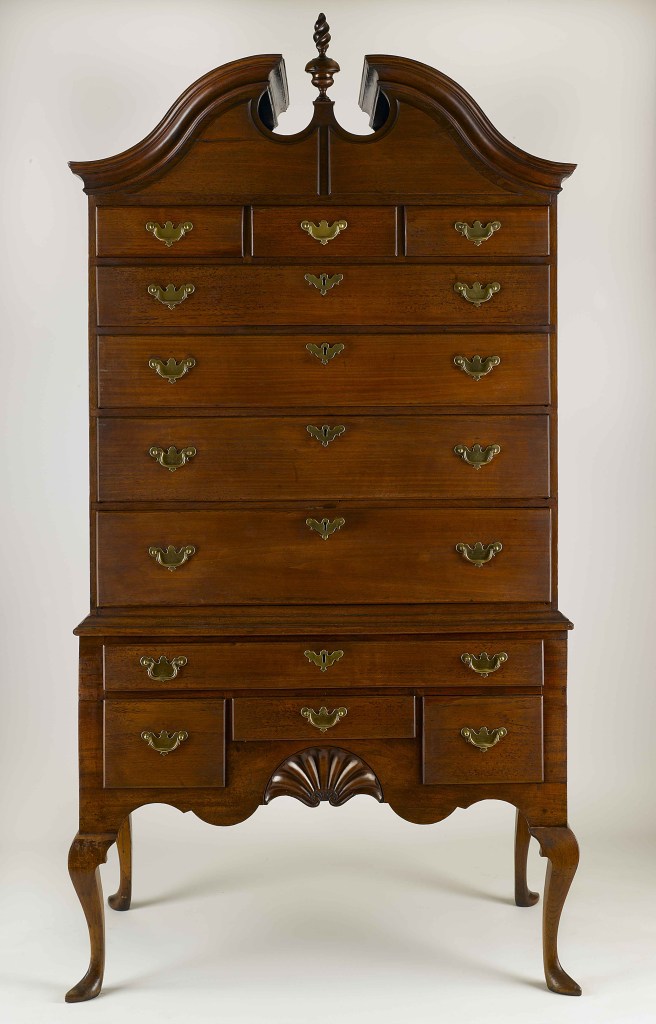
High chest of drawers, Queens County, New York, 1740–70, walnut, tulip poplar, pine (Preservation Long Island purchase, 1961.13.1).
The Decorative Arts Trust is thrilled to announce that Preservation Long Island (PLI) is the recipient of the 2025–27 Curatorial Internship Grant. Headquartered in Cold Spring Harbor, New York, PLI was founded in 1948 as the Society for the Preservation of Long Island Antiquities. PLI advances the importance of historic preservation in the region through advocacy, education, and stewardship. Their program areas include interpreting historic sites, collecting art and material culture pertaining to Long Island history, creating publications and exhibitions, and providing direct support and technical assistance to individuals and groups engaged in local preservation efforts.
In 2026, PLI will celebrate the United States Semiquincentennial as well as the 50th anniversary of their landmark furniture publication, Long Island is My Nation: The Decorative Arts and Craftsmen, 1640–1830. PLI’s Peggy N. Gerry Curatorial Fellow will collaborate with Chief Curator & Director of Collections Lauren Brincat on a series of objectives aimed at cataloging Long Island furniture in public and private collections across the region, reexamining these objects from new perspectives, and enhancing their accessibility to 21st-century researchers and the public. The Fellow will take a leading role in a new initiative building upon previous scholarship towards the creation of a collaborative Long Island furniture digital database, an exhibition, and an accompanying catalogue. Also, the Fellow will coordinate and participate in a Long Island furniture symposium in summer 2025. PLI will post the Peggy N. Gerry Curatorial Fellow position on their website at preservationlongisland.org in spring 2025. For more information about Curatorial Internship Grants, visit decorativeartstrust.org/cig.
Drayton Hall Awarded Decorative Arts Trust Funding Prize
From the press release (25 November 2024) . . .
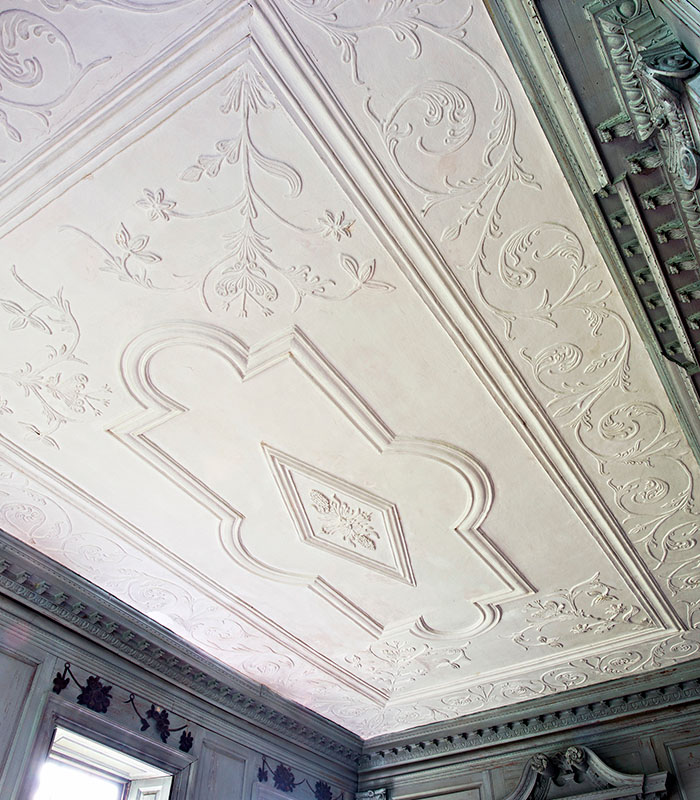
Drawing Room Ceiling, Drayton Hall (Charleston, South Carolina; photo by Willie Graham).
The Decorative Arts Trust is thrilled to announce that the 2024 Prize for Excellence and Innovation will be awarded to Drayton Hall Preservation Trust in Charleston, South Carolina, for projects to include the conservation of the plaster ceiling in the house’s Great Hall, the investigation of the plaster ceiling in the Drawing Room, and digital and in-person access to these spaces during conservation treatment and the results of the interventions. Drayton Hall, built 1738–50, is the earliest example of Palladian architecture in the United States. Surviving in relatively untouched condition, and displayed devoid of furnishings, Drayton Hall offers architectural historians the rare opportunity to study materials and designs from every period in the house’s history.
The Decorative Arts Trust Prize for Excellence and Innovation, founded in 2020, funds outstanding projects that advance the public’s appreciation of decorative art, fine art, architecture, or landscape. The Prize is awarded to a nonprofit organization in the United States for a scholarly endeavor, such as museum exhibitions, print and digital publications, conservation and preservation projects, and online databases. Past recipients include the Concord Museum; Cooper Hewitt, Smithsonian Design Museum; the Black Craftspeople Digital Archive; and Craft in America.
More information about the Prize for Excellence and Innovation is available here»
IDEAL Internship Grants from Decorative Arts Trust

Family Room at Filoli, Woodside California
(Photo by Jeff Bartee)
◊ ◊ ◊ ◊ ◊
From the press release (28 October 2024) . . .
The Decorative Arts Trust is pleased to announce the six institutions that received IDEAL Internship Grants for 2025: the Asheville Art Museum in Asheville, North Carolina; Bard Graduate Center in New York City; The Clay Studio in Philadelphia; Filoli in Woodside, California; the High Museum of Art in Atlanta; and the Liberty Hall Historic Site in Frankfort, Kentucky.
The IDEAL Internship Grants program was established in 2020 to create opportunities for undergraduate students of color through collaborations that create meaningful introductions to the museum field and introduce new perspectives and voices to curatorial practice. Since its founding, the program has supported 16 interns.
Once the Asheville Art Museum reopens following the damage brought by Hurricane Helene, the curatorial department will host two undergraduate interns to assist with the development and educational programming for two upcoming exhibitions.
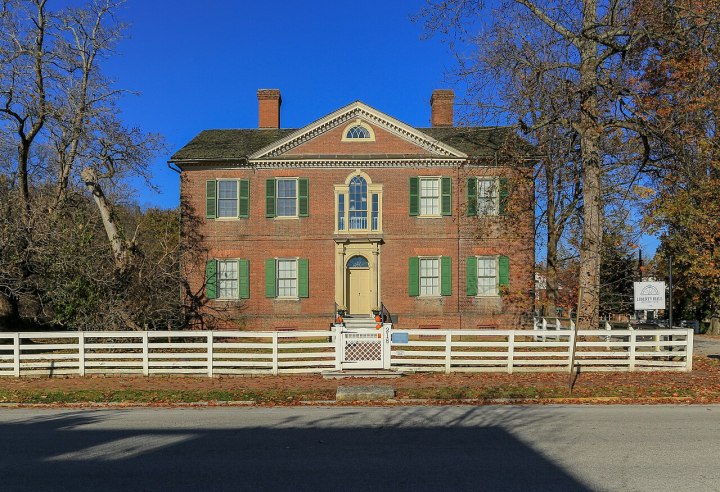
Liberty Hall, Frankfort, Kentucky, built in 1796 (Photo by Christopher Riley, Wikimedia Commons, November 2018).
Bard Graduate Center will create an internship within their Marketing, Communications, and Design department, specifically for Pratt Institute’s Undergraduate Communications Design program. The intern will work closely with staff on exhibition design, catalog production, and institutional branding.
The Clay Studio, in Philadelphia, will hire an intern who will gain valuable experience working with both physical and digital archival systems, the documentation of artworks, and exhibition planning and implementation.
Filoli, a Georgian Revival estate turned museum in Woodside, California, will host a Collections Intern to gain tangible and meaningful experience in preservation, cataloging, photography, and database management.
As the High Museum of Art in Atlanta approaches its centennial anniversary in 2026, the curatorial team will welcome an intern to assist with the reinstallation of American art galleries and conduct research on objects in the permanent collection.
Liberty Hall Historic Site in Frankfort, Kentucky, will host an intern to study the Black experience at two houses owned by the prominent Brown family, specifically regarding the buildings’ construction, urban enslavement, emancipation, and Reconstruction.
For updates about applying for these internship opportunities, visit the institutions’ websites and follow them on social media. The IDEAL Internship Program is part of the Decorative Arts Trust’s Emerging Scholars Program. For upcoming grant application deadlines, visit decorativeartstrust.org or email thetrust@decorativeartstrust.org.










 Enfilade
leave a comment