Restoration of the Williamsburg Bray School Completed
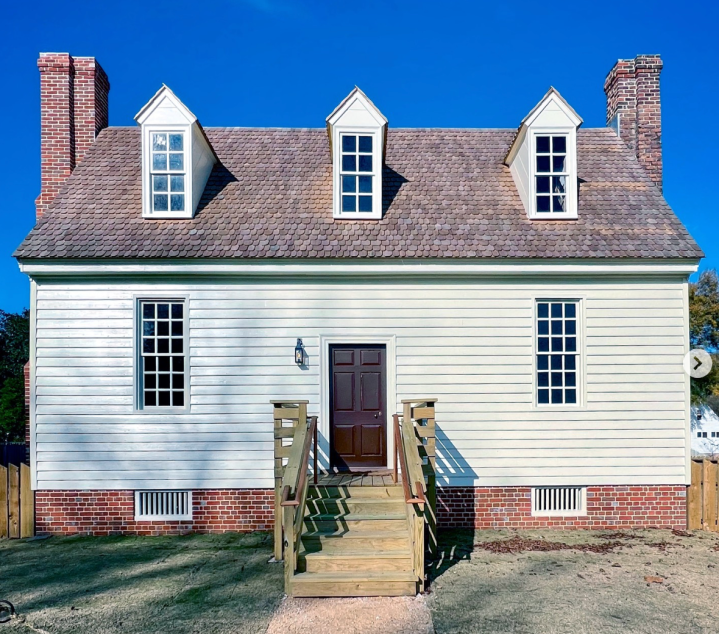
Opened in 1760, the Bray School is believed to be the oldest surviving building in the United States for the education of Black children. As noted by Lauren Walser in her Preservation article, the school “taught a pro-slavery, faith-based curriculum based on the teachings of the Church of England.” Photo from the Instagram account of Bruce A. deArmond, which foregrounds historic architecture.
◊ ◊ ◊ ◊ ◊
The story of the recovery of the Bray School at Colonial Williamsburg is recounted in the latest issue of Preservation (Spring 2025). The formal dedication of the restored building took place on 1 November 2024. It opens to the public this spring. From Colonial Williamsburg:
The Williamsburg Bray School was one of the earliest institutions dedicated to Black education in North America. From 1760 to 1774, teacher Ann Wager likely taught hundreds of students between the ages of three and ten. Students learned the tenets of the Anglican Church and subjects including reading, and for girls, sewing. The Bray School’s deeply flawed purpose was to convince enslaved students to accept their circumstances as divinely ordained. Hidden in plain sight on the William & Mary campus for over 200 years, the Williamsburg Bray School now stands in Colonial Williamsburg’s Historic Area as the Foundation’s 89th original structure. . . .
The Bray School will be used as a focal point for research, scholarship, and dialogue regarding the complicated story of race, religion, and education in Williamsburg and in America.
◊ ◊ ◊ ◊ ◊
From Colonial Williamsburg:
Maureen Elgersman Lee and Nicole Brown, eds., The Williamsburg Bray School: A History through Records, Reflections, and Rediscovery (Williamsburg: Colonial Williamsburg, 2024), 176 pages, ISBN: 978-0879353032, $20.
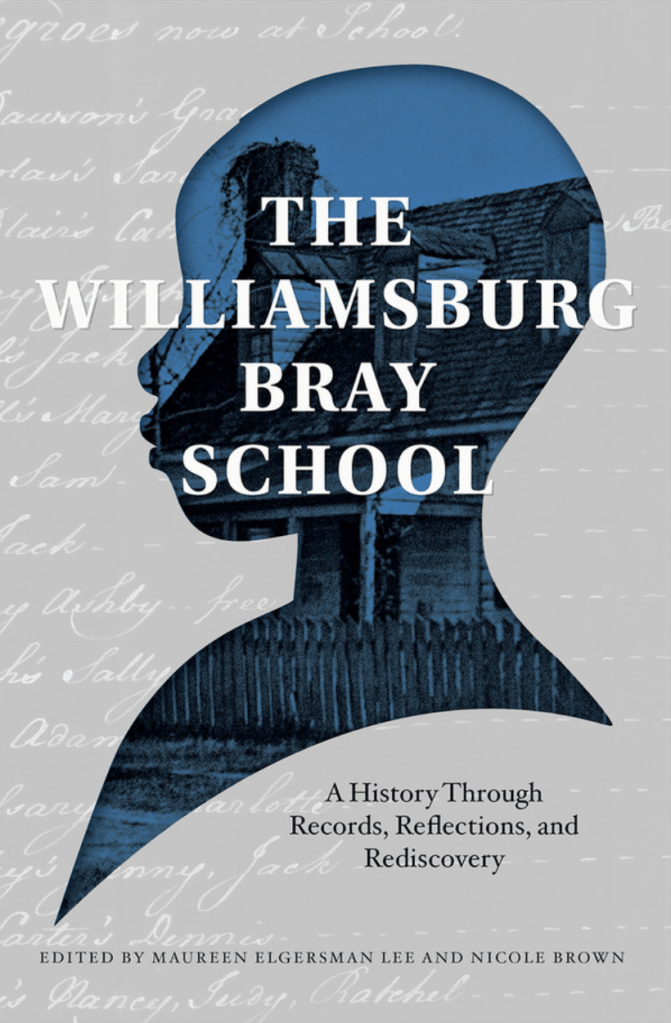 Seven letters tracing the arc of the Williamsburg Bray School—from its founding in 1760 to its closing in 1774—provide the foundation for a collection of essays that explore the school’s history and its implications for the enslaved and free Black children who attended. These letters are some of the surviving correspondence between the Williamsburg school’s administrators and the Associates of Dr. Thomas Bray, a London-based Anglican charity whose charge was to minister to what it saw as the spiritual needs of African Americans. The essayists reflect on the evolution of the Williamsburg Bray School, offering a variety of perspectives on the school and the children who attended it. Some pieces reflect years of research and writing on the establishment of the school. Others, including writings from some of the descendants of these students, represent more recent opportunities to reflect on the school and its historical context. In addition to a short history of the school, a map that pinpoints where the children resided in Virginia’s colonial capital, and photographs of the historic letters, the book delves into the 21st-century discovery of the Williamsburg Bray School building, its subsequent move from the William & Mary campus to Colonial Williamsburg’s Historic Area, and the restoration of the structure that can help tell the complicated story of race, religion, and education in Williamsburg and early America. Author Antonio Bly also shares the poignant story of Isaac Bee, a student at the school who broke the bonds of his enslavement to a Williamsburg planter and rose up from slavery to freedom.
Maureen Elgersman Lee, director of the William & Mary Bray School Lab, holds both a master’s degree and a doctorate in African American Studies. She is an award-winning professor and author of numerous books and articles on the history of Blacks in the Americas.
Nicole Brown is Graduate Assistant for the William & Mary Bray School Lab and a PhD Candidate in American Studies at William & Mary; she was previously a Program Design Manager at The Colonial Williamsburg Foundation. As a first-person historical interpreter, Brown portrays a variety of women including Ann Wager, the 18th-century white teacher at the Williamsburg Bray School, and Monticello’s Martha Wayles Skelton Jefferson. Brown’s ongoing academic research centers Black literacy in the Atlantic World via interdisciplinary and descendant-engaged scholarship.
Eli Wilner & Co. Makes an 18th-C. Pier Mirror for Drayton Hall
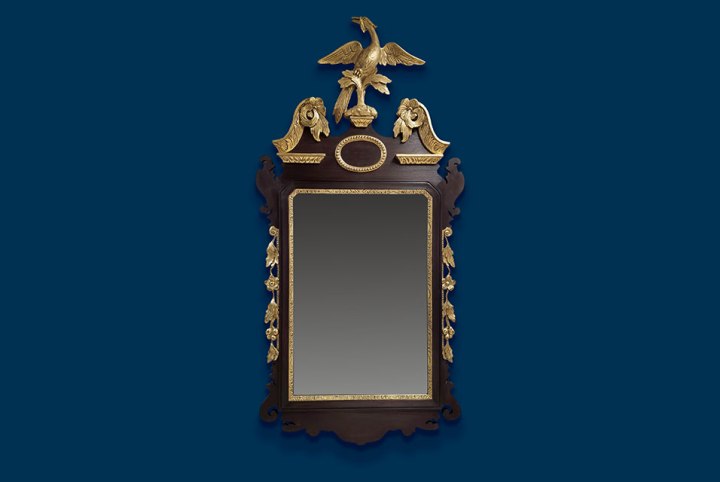
Late-18th-century-style pier mirror; walnut, basswood, and parcel-gilt; created in 2024–25 by Eli Wilner & Company for Drayton Hall Preservation Trust, Drayton Hall Museum Collection. The mirror was unveiled at the 2025 Charleston Show (March 21–23).
◊ ◊ ◊ ◊ ◊
As noted at Art Daily:
With assistance from their partial funding program for museums, Eli Wilner & Company recently completed the creation of a late 18th-century style pier mirror for Drayton Hall Preservation Trust. March has been another successful month for Eli Wilner & Company’s frame funding initiative, with $125,000 in partial grants having been distributed to date. Nearly $50,000 in funding is still available. Exciting new projects are being submitted on a daily basis by museums across the country. Remaining funds will be committed to new projects by 30 April 2025 and can be used for frame restoration, historic frame replication, or mirror replication projects. Interested institutions can apply by emailing the details of their reframing or frame restoration needs to info@eliwilner.com. No project is too large.
Patricia Lowe Smith, Drayton Hall’s Director of Preservation, initially contacted Wilner in the spring of 2024 about the potential project after they had discovered telltale marks on the original moldings surrounding the drawing room windows, indicating a lost pier mirror. Since no other documentation was found to provide the specifications or origin of the object, Wilner presented Drayton’s team with period-appropriate replacement options based on historical photographs and hand-tracings of Drayton’s walls.
The selected digital mockup was then printed to scale for Wilner’s master carpenters to begin construction of the walnut substrate and basswood blocks for the multiple hand carved elements. To get a better understanding of the depth proportions and construction methods that were not apparent in two-dimensional photographic images, they visited nearby institutions including the Metropolitan Museum of Art and the New-York Historical Society, and the Museum of the City of New York to examine similar objects.
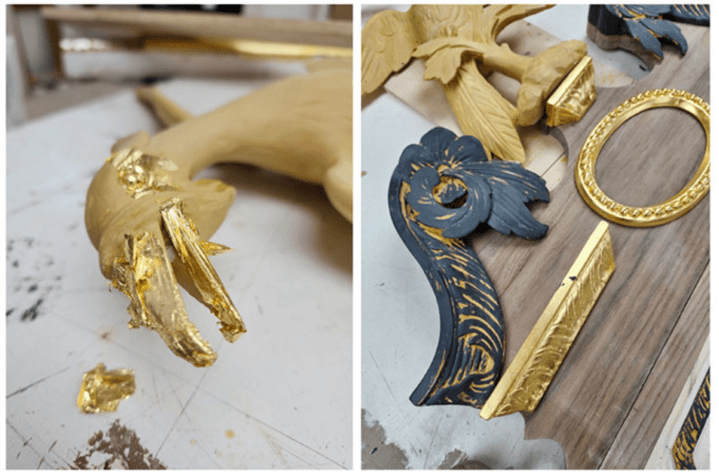 After several months of woodworking and carving, the basswood portions of the frame were prepared with layers of finely sanded gesso and bole (a liquid clay) and watergilded. These delicate elements were then burnished and patinated to a period appropriate character. Meanwhile, the walnut substrate sections were stained. Finally in February 2025, following an in-person studio visit with members from Drayton Hall’s preservation team, all portions of the frame were fully secured into position, and the glass and hanging hardware was installed.
Eli Wilner & Company has completed over 15,000 framing projects for private collectors, museums, and institutions including The Metropolitan Museum of Art, the Smithsonian American Art Museum, and The White House. Wilner was honored by the Historic Charleston Foundation with the Samuel Gaillard Stoney Conservation Craftsmanship Award, for their work in historic picture frame conservation. In 2024, Eli Wilner was presented with an Iris Award for Outstanding Dealer of the Year by the Bard Graduate Center in New York City.
Preservation Long Island Receives Curatorial Internship Grant
From the press release (18 November 2024). . .
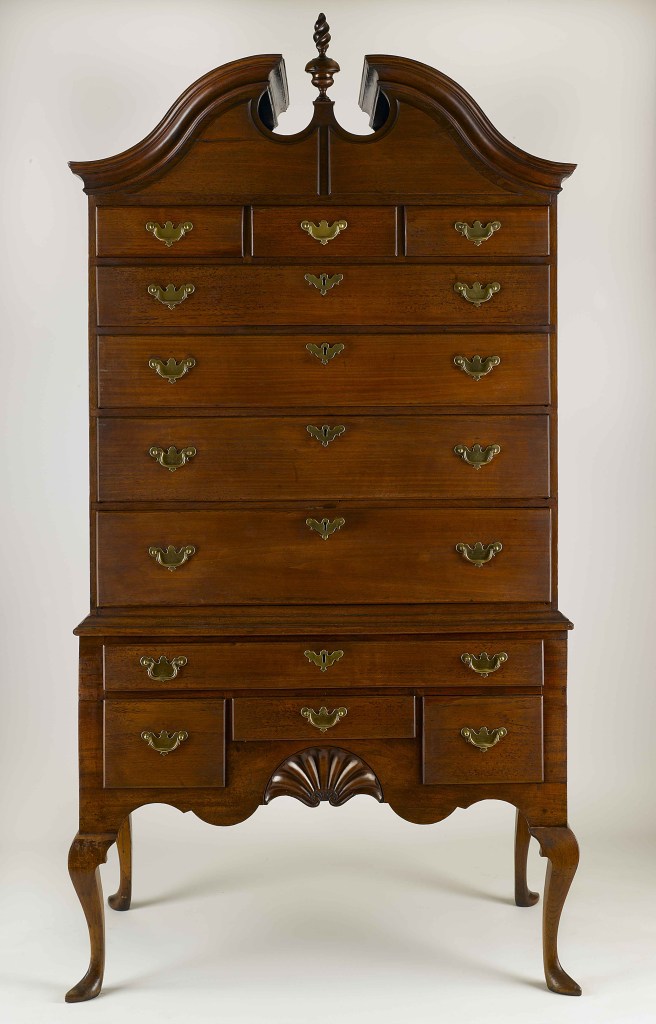
High chest of drawers, Queens County, New York, 1740–70, walnut, tulip poplar, pine (Preservation Long Island purchase, 1961.13.1).
The Decorative Arts Trust is thrilled to announce that Preservation Long Island (PLI) is the recipient of the 2025–27 Curatorial Internship Grant. Headquartered in Cold Spring Harbor, New York, PLI was founded in 1948 as the Society for the Preservation of Long Island Antiquities. PLI advances the importance of historic preservation in the region through advocacy, education, and stewardship. Their program areas include interpreting historic sites, collecting art and material culture pertaining to Long Island history, creating publications and exhibitions, and providing direct support and technical assistance to individuals and groups engaged in local preservation efforts.
In 2026, PLI will celebrate the United States Semiquincentennial as well as the 50th anniversary of their landmark furniture publication, Long Island is My Nation: The Decorative Arts and Craftsmen, 1640–1830. PLI’s Peggy N. Gerry Curatorial Fellow will collaborate with Chief Curator & Director of Collections Lauren Brincat on a series of objectives aimed at cataloging Long Island furniture in public and private collections across the region, reexamining these objects from new perspectives, and enhancing their accessibility to 21st-century researchers and the public. The Fellow will take a leading role in a new initiative building upon previous scholarship towards the creation of a collaborative Long Island furniture digital database, an exhibition, and an accompanying catalogue. Also, the Fellow will coordinate and participate in a Long Island furniture symposium in summer 2025. PLI will post the Peggy N. Gerry Curatorial Fellow position on their website at preservationlongisland.org in spring 2025. For more information about Curatorial Internship Grants, visit decorativeartstrust.org/cig.
Drayton Hall Awarded Decorative Arts Trust Funding Prize
From the press release (25 November 2024) . . .
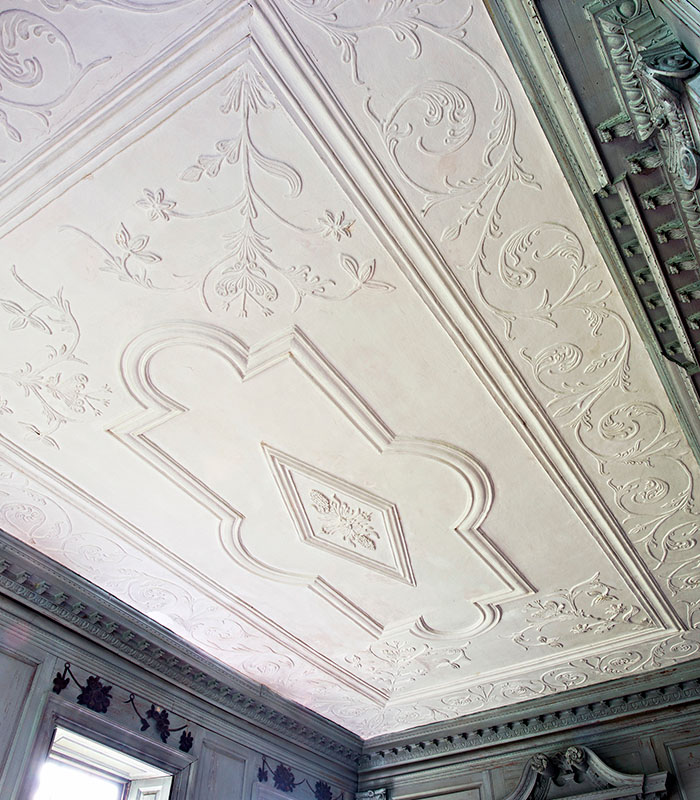
Drawing Room Ceiling, Drayton Hall (Charleston, South Carolina; photo by Willie Graham).
The Decorative Arts Trust is thrilled to announce that the 2024 Prize for Excellence and Innovation will be awarded to Drayton Hall Preservation Trust in Charleston, South Carolina, for projects to include the conservation of the plaster ceiling in the house’s Great Hall, the investigation of the plaster ceiling in the Drawing Room, and digital and in-person access to these spaces during conservation treatment and the results of the interventions. Drayton Hall, built 1738–50, is the earliest example of Palladian architecture in the United States. Surviving in relatively untouched condition, and displayed devoid of furnishings, Drayton Hall offers architectural historians the rare opportunity to study materials and designs from every period in the house’s history.
The Decorative Arts Trust Prize for Excellence and Innovation, founded in 2020, funds outstanding projects that advance the public’s appreciation of decorative art, fine art, architecture, or landscape. The Prize is awarded to a nonprofit organization in the United States for a scholarly endeavor, such as museum exhibitions, print and digital publications, conservation and preservation projects, and online databases. Past recipients include the Concord Museum; Cooper Hewitt, Smithsonian Design Museum; the Black Craftspeople Digital Archive; and Craft in America.
More information about the Prize for Excellence and Innovation is available here»
IDEAL Internship Grants from Decorative Arts Trust

Family Room at Filoli, Woodside California
(Photo by Jeff Bartee)
◊ ◊ ◊ ◊ ◊
From the press release (28 October 2024) . . .
The Decorative Arts Trust is pleased to announce the six institutions that received IDEAL Internship Grants for 2025: the Asheville Art Museum in Asheville, North Carolina; Bard Graduate Center in New York City; The Clay Studio in Philadelphia; Filoli in Woodside, California; the High Museum of Art in Atlanta; and the Liberty Hall Historic Site in Frankfort, Kentucky.
The IDEAL Internship Grants program was established in 2020 to create opportunities for undergraduate students of color through collaborations that create meaningful introductions to the museum field and introduce new perspectives and voices to curatorial practice. Since its founding, the program has supported 16 interns.
Once the Asheville Art Museum reopens following the damage brought by Hurricane Helene, the curatorial department will host two undergraduate interns to assist with the development and educational programming for two upcoming exhibitions.
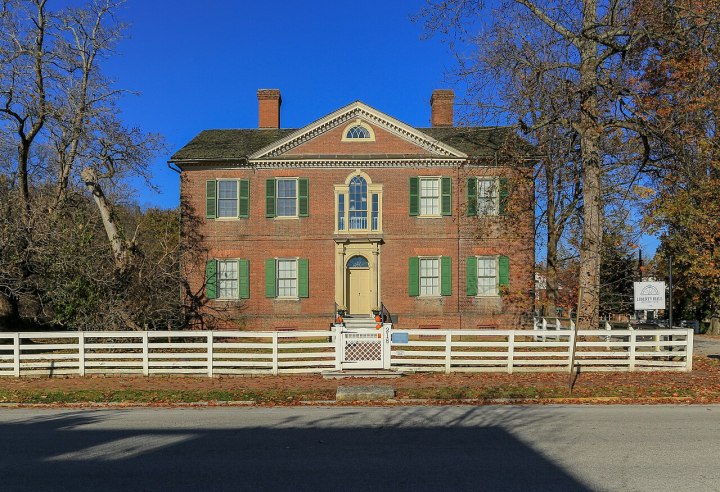
Liberty Hall, Frankfort, Kentucky, built in 1796 (Photo by Christopher Riley, Wikimedia Commons, November 2018).
Bard Graduate Center will create an internship within their Marketing, Communications, and Design department, specifically for Pratt Institute’s Undergraduate Communications Design program. The intern will work closely with staff on exhibition design, catalog production, and institutional branding.
The Clay Studio, in Philadelphia, will hire an intern who will gain valuable experience working with both physical and digital archival systems, the documentation of artworks, and exhibition planning and implementation.
Filoli, a Georgian Revival estate turned museum in Woodside, California, will host a Collections Intern to gain tangible and meaningful experience in preservation, cataloging, photography, and database management.
As the High Museum of Art in Atlanta approaches its centennial anniversary in 2026, the curatorial team will welcome an intern to assist with the reinstallation of American art galleries and conduct research on objects in the permanent collection.
Liberty Hall Historic Site in Frankfort, Kentucky, will host an intern to study the Black experience at two houses owned by the prominent Brown family, specifically regarding the buildings’ construction, urban enslavement, emancipation, and Reconstruction.
For updates about applying for these internship opportunities, visit the institutions’ websites and follow them on social media. The IDEAL Internship Program is part of the Decorative Arts Trust’s Emerging Scholars Program. For upcoming grant application deadlines, visit decorativeartstrust.org or email thetrust@decorativeartstrust.org.
Mount Vernon Enters Next Phase of $30million Restoration
From coverage of the project by The Washington Post:
Michael Ruane, “George Washington’s Mansion Gets First Major Rehab in More than 150 Years,” The Washington Post (17 October 2024). Much of the historic Mount Vernon home in Virginia will close starting next month for a massive preservation project.
. . . On Nov. 1, the bulk of Washington’s famous home is due to close for several months as it undergoes the next phase of its largest-scale rehabilitation in over 150 years.
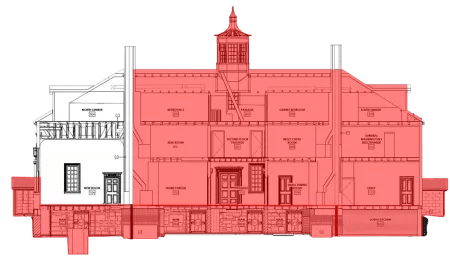
In Phase 2, scheduled to run from November 2024 until January 2025, the New Room, Servants’ Hall, and Kitchen are open; all other rooms will be closed to visitors.
The $30 million project is the most complicated preservation effort since the house was saved from decay in 1860 by the private, nonprofit Mount Vernon Ladies’ Association of the Union, which still owns it, said Douglas Bradburn, president of George Washington’s Mount Vernon. “We’re shutting down a big chunk of it for the next eight months or so,” he said. “I would say that’s two-thirds of the house.”
Other parts of the house, along with the extensive grounds, Washington’s tomb, the quarters for enslaved people and other outbuildings will remain open, Bradburn said in a recent interview. Mount Vernon gets about 1 million visitors a year, and millions more check out the historic estate online, he said.
The historic structure had become loosened from its foundation over time, and the work will resecure it, Bradburn said. There also will be restoration work done in the basement and on flooring, among other things. He said the goal is to complete the project in 2026.
“It’s some of the most important work that’s ever been done at Mount Vernon,” Bradburn said. Earlier repair projects have been piecemeal. At one point, ship masts were used to help support the roof of the crumbling piazza that overlooks the Potomac River. “They’re dealing with problems as they come,” he said. This is a chance for a more complete approach. . .
The full article is available here»
Exhibition | The Birch Trials at Fraunces Tavern
From the press release for the exhibition:
The Birch Trials at Fraunces Tavern
Fraunces Tavern Museum, New York, opening 23 October 2024
Curated by Craig Hamilton Weaver
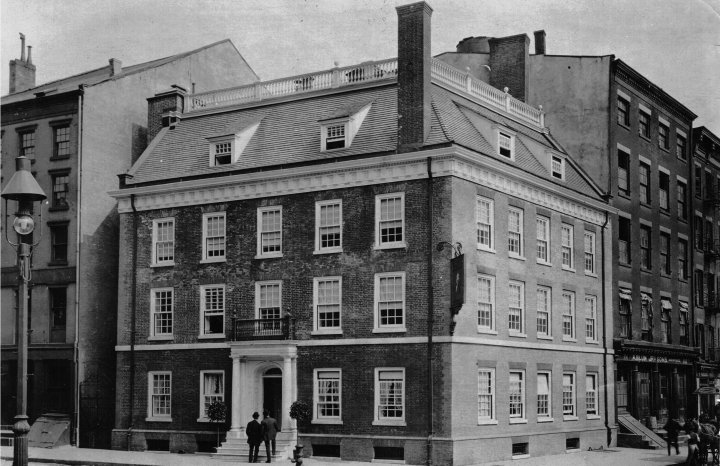
As noted at the museum’s website: “Built by the De Lancey family in 1719, 54 Pearl Street has been a private residence, hotel, and one of the most important taverns of the Revolutionary War.” It is the oldest standing structure in Manhattan.
On 23 October 2024, the Fraunces Tavern Museum, located in the oldest building in Manhattan, will unveil a vastly enlarged permanent exhibition entitled The Birch Trials at Fraunces Tavern. The exhibition highlights the role of Fraunces Tavern in the emancipation of thousands of Black Loyalists at the end of the Revolutionary War (enabling them to leave New York City) and in the creation of the Book of Negroes (the record created of those who departed with the British). The exhibition expands upon one opened at the Museum in June 2023. Recognition is also given to the thousands of Black Patriots who fought to further the cause of American Independence. The previous exhibition attracted a multitude of visitors from around the world, including large numbers of school children. Relocating the exhibition to a larger permanent gallery will enable the Museum to provide a better visitor experience as well as include recent new discoveries of significant information concerning the identities of individuals participating in the Birch Trials and their inclusion in the Book of Negroes.
The exhibition reflects several years of exhaustive research on both sides of the Atlantic in thousands of pages of existing original documents. Museum and Art Committee Co-Chairman and Chief Curator of the exhibition, Craig Hamilton Weaver, emphasizes that “this exhibition is the most comprehensive ever organized on this tremendously significant event in the history of Black emancipation in the United States and is made all the more compelling because it can be viewed within the very walls of the building within which the events occurred.”
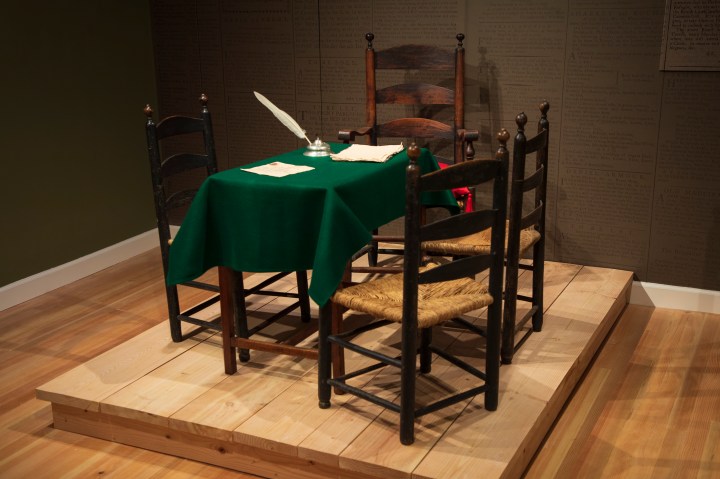
Installation view of The Birch Trials at Fraunces Tavern, 2024.
In 1783, as the Revolutionary War was drawing to a close, a joint British and American Commission met weekly at Fraunces Tavern from April until November. The proceedings of the Commission are known as the ‘Birch Trials’, named after Brigadier General Samuel Birch who oversaw the proceedings. The Commission reviewed and deliberated upon the eligibility of some Black Loyalists to evacuate with the British Army. Testimonies were provided by individuals in person and through documentary evidence to enable the Commissioners to render final decisions. Given that the Commissioners met at Fraunces Tavern weekly and had the responsibility “to superintend all embarkation,” it is reasonable to conclude that the British and American Commissioners reviewed and compiled the lists of names for inclusion in the Book of Negroes during the course of their weekly sessions at Fraunces Tavern. The names would later be inscribed neatly into the final Book of Negroes by staff.
Visitors will observe chairs and a table arranged as if waiting for the Commissioners to enter the room and hear cases. The exhibition also contains reproductions of pages from the Book of Negroes as well as the advertisement in the 30 May 1783 New York Gazette stating that the Commissioners would meet at Fraunces Tavern. Recent discoveries featured in this newly expanded exhibition include the identities of two women, Dinah Archey and Judith Jackson, whose fates were undecided by the Commission at their hearings, but who ultimately were recorded in the Book of Negroes as having evacuated New York City on departing ships.
Major support for this exhibition has been provided by the Robert David Lion Gardiner Foundation. The purpose of the Robert David Lion Gardiner Foundation is to educate, cultivate, and encourage the study and understanding of Long Island and New York’s historic role in the American experience. The Foundation also supports scholarships and historic preservation, including study, stewardship, and promotion of Long Island’s historic educational aspects. The Robert David Lion Gardiner Foundation remains inspired by Robert David Lion Gardiner’s personal passion for Long Island and New York history.
The Descendants Project Purchases Woodland Plantation House
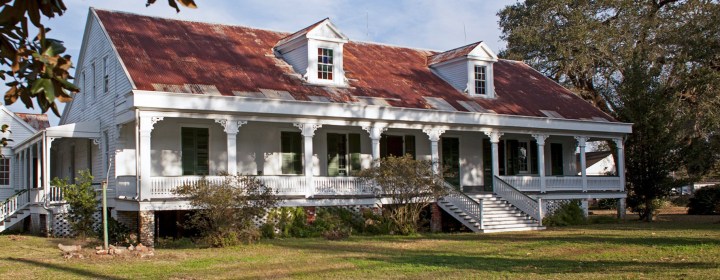
Woodland Plantation House, LaPlace, Louisiana, the oldest portions of which date to 1793. The Descendants Project purchased the house and four acres of land in January 2024 for $750,000. More information is available here»
◊ ◊ ◊ ◊ ◊
From National Public Radio:
Debbie Elliott, “Louisiana Plantation Where Historic Slave Revolt Started Now under Black Ownership,” NPR Morning Edition (9 July 2024).
Jo Banner is excited to show the newly acquired Woodland Plantation House near the banks of the Mississippi River.
“We have still a lot of work to do, but I think for the home to be from 1793, it looks rather good,” she beams.
The raised creole-style building has a rusty tin roof and a wide front porch. Forest green wooden shutters cover the windows and doors. The site is historically significant because this is where one of the largest slave revolts in U.S. history began. It’s also known as the German Coast Uprising because this region was settled by German immigrants.
“The start of the 1811 revolt happened here, on this porch,” Banner says.
Banner and her twin sister Joy are co-founders of the Descendants Project, a non-profit in Louisiana’s heavily industrialized river parishes—just west of New Orleans. Early this year, the group bought the Woodland Plantation Home, putting it in Black ownership for the first time [in its over 200-year history] . . .
“Our mission is to eradicate the legacies of slavery so for us, it’s the intersection of historic preservation, the preservation of our communities, which are also historic, and our fight for environmental justice,” says Joy Banner.
The full report is available here»
More information on the house is available at the Society of Architectural Historians’ Archipedia site»
◊ ◊ ◊ ◊ ◊
About The Descendants Project:
The Descendants Project is an emerging organization committed to the intergenerational healing and flourishing of the Black descendant community in the Louisiana river parishes. The lands of the river parishes hold the intersecting histories of enslavement, settler colonialism, and environmental degradation.
We are descended from the enslaved men, women, and children who were forced to labor at one or more of the hundreds of plantations that line the Mississippi River from New Orleans to Baton Rouge. Starting in the 1970s, large industrial petrochemical plants began purchasing the land of these plantations still surrounded by vulnerable Black descendant communities. The region is now known as ‘Cancer Alley’ for the extreme risks of cancer and death due to pollution. The community faces many other problems such as food insecurity, high unemployment, high poverty, land dispossession, and health issues that stem from a culture of disregard for Black communities and their quality of life.
Through programming, education, advocacy, and outreach, The Descendants Project is committed to reversing the vagrancies of slavery through healing and restorative work. We aim to eliminate the narrative violence of plantation tourism and champion the voice of the Black descendant community while demanding action that supports the total well-being of Black descendants.
Andalusia Acquires Portrait of Adèle Sigoigne by Bass Otis
From the press release from Andalusia Historic House, Gardens & Arboretum:
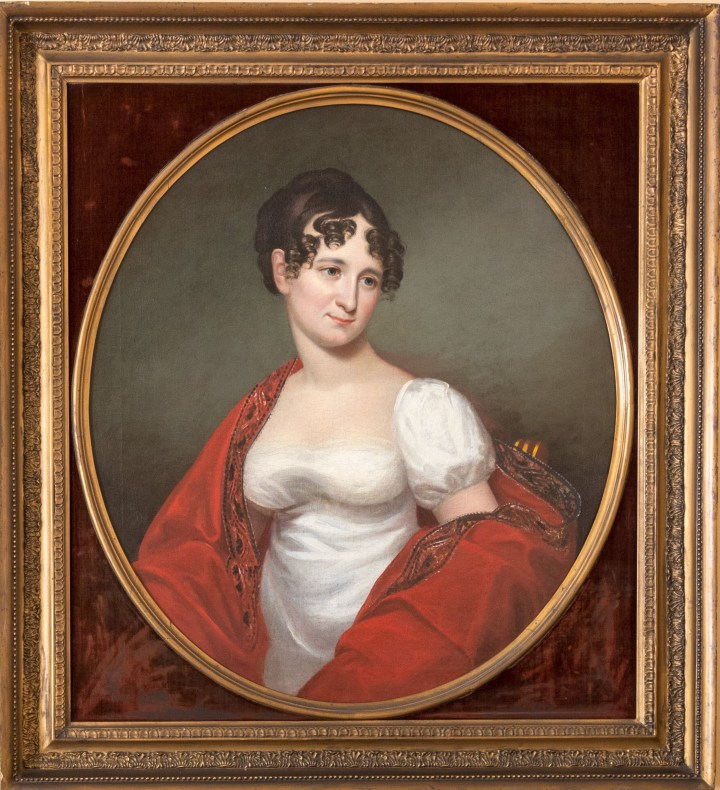
Bass Otis, Portrait of Miss Adèle Sigoine, 1815, oil on canvas (Bensalem, Pennsylvania: The Andalusia Foundation).
An oil painting by Philadelphia artist Bass Otis (1784–1861), Portrait of Miss Adèle Sigoigne (1815)—which has been on view at Andalusia Historic House, Gardens & Arboretum (Andalusia) in Bensalem, Pennsylvania since 2014 as a long-term loan from the Independence Seaport Museum (ISM) in Philadelphia—now joins Andalusia’s permanent collection in an act of collegial partnership. Adèle Sigoigne was a good friend of Jane Craig Biddle (1793–1856) who lived at Andalusia with her husband, Nicholas Biddle (1786–1844). ISM has deaccessioned the painting and transferred its ownership to Andalusia.
“We are overjoyed to have Adèle’s portrait now part of our permanent collection,” said Andalusia’s executive director John Vick. “Every piece of art in the historic house has a unique story to tell about the property and the people who lived here or visited. Adèle was practically family to the Biddles, making this a fitting home for her portrait. We are grateful to our partners at Independence Seaport Museum for recognizing what the painting means to Andalusia and for making this momentous transfer possible.”
“Our staff and Board were unanimous in wanting to transfer this painting permanently to Andalusia,” said Peter Seibert, ISM’s president and chief executive officer. “Its history and associations with the Biddle family are significant, and thus the painting is imminently relevant to their mission. For us, the transfer is a visible reminder of how two museums can come together to ensure that the history and heritage of our community is preserved in public trust for future generations.”
Although it is unclear how or when Jane and Adèle met, their lasting friendship is certain. Close in age and of similar social standing, the two women came from very different backgrounds, however. Jane was a Philadelphian by birth, the only daughter of John and Margaret Craig, the couple who first established Andalusia as a country estate in 1795. Adèle, by contrast, was French-born and had lived in Haiti. After the Haitian Revolution began in 1791, she moved to Philadelphia with her mother, Aimée Sigoigne, who started a school for young women at 128 Pine Street. Adele was one of a few guests who attended Jane’s wedding to Nicholas Biddle, held at Andalusia on 3 October 1811. The Biddles’ three daughters would later attend Madame Sigoigne’s school, including Adèle who was named for her mother’s dear friend. (The name Adèle remained popular for several generations of Biddle descendants.)
Although the portrait is unsigned, its attribution is firm; it is nearly certain that the Biddles commissioned Bass Otis to paint Adèle’s portrait as he also painted Jane’s portrait around 1815. (This painting is in the collection of the Second Bank of the United States Portrait Gallery in Philadelphia.) Both women are shown in fashionable, Empire-style dresses with luxurious fabrics draped over their shoulders: Jane’s is white and sheer while Adèle’s is a vibrant red. Their hair is also similarly styled in an updo with ringlets framing their faces. Nicholas Biddle conveyed his appreciation of Adèle’s portrait to Otis in a letter, which remains with and will be transferred with the painting from ISM.
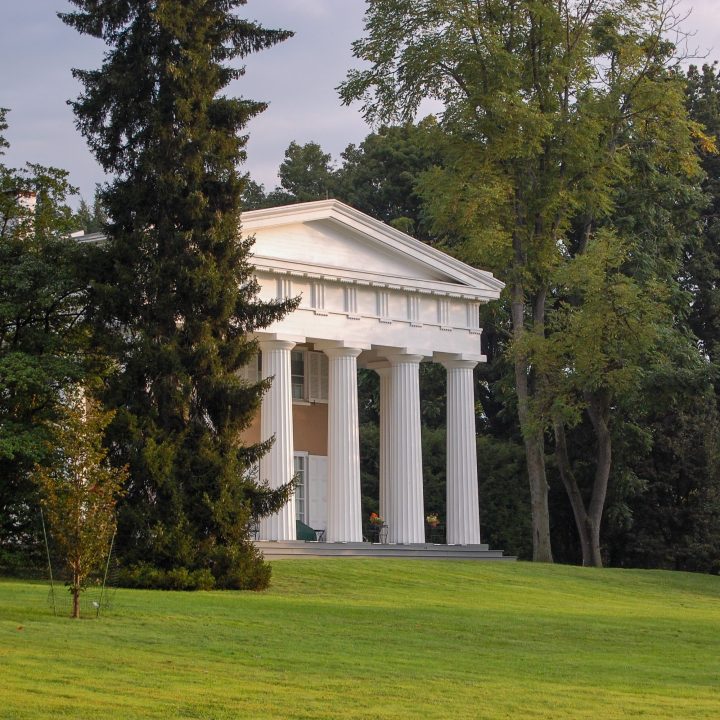
With its oldest portions dating to the 1790s, the house at Andalusia was expanded by Benjamin Latrobe in 1806 and then again in the 1830s, when an addition with a Doric columned porch was constructed according to designs by Thomas Ustick Walter (Walter had trained under William Strickland).
Since the portrait of Sigoigne has been on loan at Andalusia, it has been on view in the historic house’s library, which was part of the 1830s addition designed by architect Thomas Walter. Now in Andalusia’s permanent collection, it will be moved to what is known as the Painted Floor Bedroom. This room is part of the original 1797 construction and could have been where Adèle stayed when she visited Jane around the time that the portrait was made.
The Biddles’ patronage of Bass Otis continued for many years. In 1827, Nicholas Biddle commissioned the artist to paint a copy of Jacques-Louis David’s famous scene Napolean Crossing the Alps (1801). The oil on canvas copy, also on view at Andalusia, was owned by Napoleon’s brother Joseph Bonaparte, who knew the Biddles, lived near them in Philadelphia, and owned a country estate (Point Breeze) near Andalusia. By the 1820s, however, the Biddles began to favor another Philadelphia artist, Thomas Sully, who painted the couple’s portraits in 1826, both of which are on view at Andalusia. In 1829 the Biddles commissioned him to paint another portrait of Adèle Sigoigne, which is in the collection of The Huntington Library, Art Museum and Botanical Gardens in San Marino, California.
◊ ◊ ◊ ◊ ◊
Andalusia Historic House, Gardens & Arboretum is a non-profit organization and a scenic 50-acre property overlooking the Delaware River in Bensalem, Pennsylvania. Established more than 225 years ago, the site is a natural paradise of preserved native woodlands and spectacular gardens, as well as museum with an exceptional collection of paintings, sculptures, decorative art, and rare books and manuscripts.
Zoë Colbeck Named Director of Strawberry Hill
From the press release, via Art Daily (8 June 2024) . . .
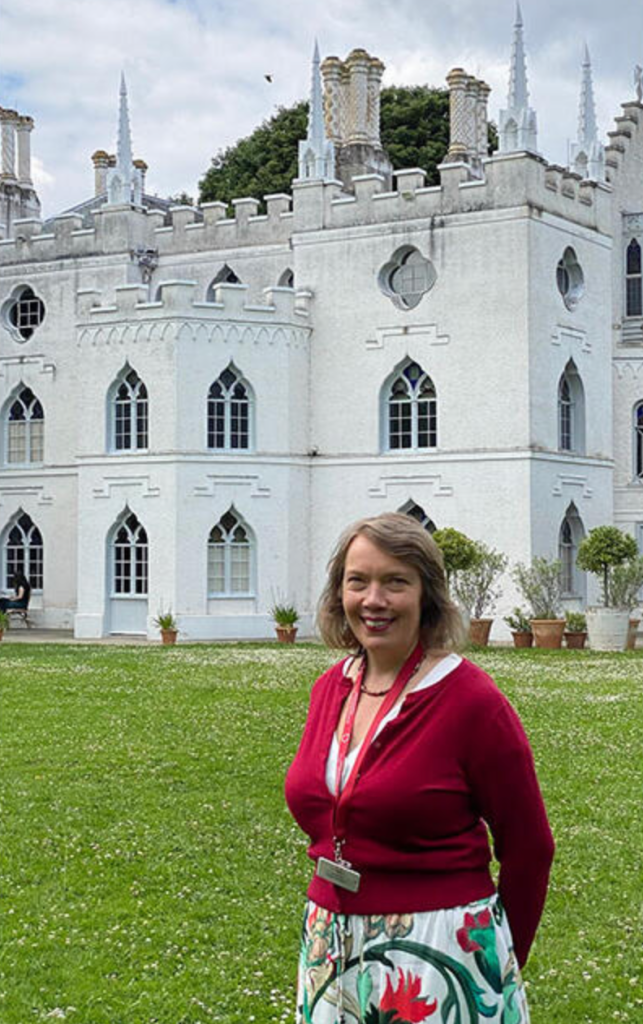 Strawberry Hill House announced that Zoë Colbeck will succeed Derek Purnell as Executive Director of the historic South West London attraction. Zoë joins the team from her previous role as Project Manager at the Solent Cluster, a major decarbonisation initiative based in Hampshire, bringing over 20 years of experience in the heritage sector to Strawberry Hill House and Garden.
Having read chemistry at university, Zoë worked for one of the UK’s largest retailers, specialising in logistics and people management, before joining the National Trust (NT) to combine her passion for heritage with her commercial background. She left the NT in 2021 after 18 years, ultimately as General Manager of the Chartwell Portfolio, one of the NT’s top properties. More recently, she was Commercial and Operations Director with the Mary Rose Trust in Portsmouth.
Zoë took up her new position at Strawberry Hill on 3 June—after her predecessor, Derek Purnell, left to take up an opportunity with the Frederick Ashton Foundation, based at the Royal Opera House in Covent Garden.
Announcing the appointment, Paul Kafka, Chairman of Strawberry Hill Trust, said: “During her time at the National Trust, Zoë led three transformational projects, which, in turn gave her extensive knowledge and vital experience in the fields of climate change mitigation, sustainable management, and heritage conservation. She has a passion for working collaboratively and making a difference for museums, communities, and the planet.” He added: “I am delighted that Zoe is joining Strawberry Hill at this moment in our history. 2024 is going to be a year of change and new directions. Our quest for a sustainable business model continues, even as our reputation as a museum and cultural destination continues to grow.”
Zoë commented: “I am passionate about making a difference for our history and heritage and making it relevant for different audiences. Horace Walpole is such an interesting character, and I am looking forward to leading the team at Strawberry Hill House and Garden through the next stage of development, preserving his legacy and contributing to its future.”










leave a comment