Cultural Heritage Magazine, Spring/Summer 2024

◊ ◊ ◊ ◊ ◊
From the National Trust:
Launched in October 2022 and published twice a year, the National Trust Cultural Heritage Magazine (CHM) showcases the latest curatorial findings, conservation projects, and research initiatives; keeps readers up to date with relevant National Trust publications and events; and shares other insights into the houses, collections, and gardens in the Trust’s care.
In the latest issue, readers will find:
• A conversation between writer and curator Robin Muir and National Curator for Photography Anna Sparham
• A long-term project to revitalise the historic designed landscape at Lodge Park
• Expert insights into a rare 18th-century doll at Dudmaston
• New research on Coleridge Cottage, the Trust’s first literary home
• Research and conservation project round-ups
• Cultural heritage news, events and publications
• Highlights of recent exhibition loans from the National Trust
The full issue is available here»
Upcoming Events from The Georgian Group
Upcoming events from the The Georgian Group:
Hampshire Visit: Stratfield Saye House
Tuesday, 7 May 2024
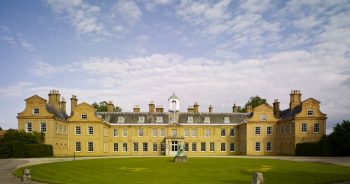
Stratfield Saye House
In the heart of the English countryside on the Hampshire/Berkshire border, you’ll find the elegant, but intimate, Stratfield Saye House, home to the Dukes of Wellington since 1818. After the Battle of Waterloo the First Duke of Wellington, or the Great Duke as he was universally known, was regarded as the saviour of his country and of Europe. A grateful nation voted a substantial sum of money to enable him to buy a house and an estate worthy of a great national hero. After considering many far grander properties, he chose Stratfield Saye. Stratfield Saye House does not compare in either size or grandeur with the other great ducal houses, and it was the Great Duke’s intention to build a huge palace in the northeast corner of the park, but fortunately the money was not available. He therefore set about making his home convenient and comfortable and, as a very practical man, he was well satisfied with the results. The House today is lived in by the 9th Duke of Wellington and his family. Whilst the Great Duke’s wonderful collection of pictures are at Apsley House, which was given to the nation by the 7th Duke in 1947, Stratfield Saye House contains a fascinating collection of paintings and furniture purchased by the Great Duke with many mementos of his occupation of his modest country home. This visit is for Georgian Group members only, and participants must make their own arrangements for transport. Refreshments and lunch are included (£50).
Sue Berry | Builders as Architects and Their Significant Influence in Town and Country: The Morris and Wild Families of Sussex, 1720–1840
Online, 7 May 2024, 6.30pm
Arthur and John Morris played an important role in the development of Coombe, Firle, and Glynde Places in Sussex and worked on houses in Lewes. They dealt directly with clients even when there was an architect. Amon and Amon Henry Wilds worked mainly in two towns, Amon Henry shifting from builder to architect. He made a big impact on Brighton, designing houses, projects, churches, and chapels. There must have been many more local entrepreneurs like these, and we need to know more about them. The Wilds moved to Brighton and undertook speculative development as well as worked for clients. The Morris family did not, as Lewes did not offer the same opportunities. £5 members / £7 non-members.
Steven Brindle | The Greek Revival in England
In-person, The Georgian Group, Fitzroy Square, London, 6.30pm
In the 1750s a debate unfolded in Rome as to which was superior: Greek or Roman art? Despite the publication of volume 1 of Stuart and Revett’s Antiquities of Athens (1762), British architects and clients instinctively took their inspiration from Roman art for another generation or more. Steven Brindle considers the development of the Greek style in England, from its tentative and experimental mid-Georgian beginnings, to its sudden triumph in the Regency age, its establishment as the ‘public style’ in the 1810s and 20s, its relationship to the mainstream neoclassicism of the late-Georgian age, its decline—and its somewhat different course in Scotland. £15 members / £18 non-members.
St Paul’s Cathedral Library Restored
Following a five-year restoration, the 18th-century library at St Paul’s Cathedral is once again open to researchers and tourists (look for the the special Triforium Tour). From Architecture Today (6 November 2023).

Christopher Wren, St Paul’s Cathedral Library, following restoration; completed in 1709, the library is on the Triforium level, behind the southwest tower ((Photo by Graham Lacdao for St Paul’s Cathedral).
◊ ◊ ◊ ◊ ◊
Completed in 1709, the library reaches two stories high and contains more than 13,000 volumes of books and manuscripts, the oldest of which dates back to 1313. Here, Portland stone panelling surround a gallery, with these panels enamoured with deep, ornate carvings. Beneath, an array of brackets supporting the gallery enjoy decoration of equal measure, this time carved out of wood. (Recent research, however, uncovered the fact that the gallery walkway is cantilevered from the wall, with the brackets being purely decorative).

Christopher Wren, Dean’s Staircase, with ironwork by Jean Tijou (Photo by Richard Holltum, from August 2007, from the website of the World Monuments Fund).
Before work began on the restoration in 2018, the most significant changes to the library were the addition of electrical lights and a heating system in the early 1900s. In fact, the cathedral nearly didn’t have a library at all, with its collection almost entirely destroyed by the Great Fire of London in 1666. Following the damage, however, Sir Christopher Wren’s Library chamber was restocked by the cathedral’s Commissioners for rebuilding St Paul’s following the damage.
The £800,000 refurbishment, funded mostly through donations and benefactors of St Paul’s, saw books cleaned, walls re-painted, a new lighting scheme put in place, new desks for readers, as well as a new display case. Work was also done to the cantilevered gallery which was showing signs of sagging. . . .
“The Cathedral Library is a remarkable room, and remains one of Sir Christopher Wren’s great achievements. It is fitting that, as we mark 300 years since his death, his Library is able to reopen after five years of painstaking restoration,” the Dean of St Paul’s Cathedral, the Very Reverend Andrew Tremlett said in a statement. . . .
The full article is available here»
Tour and Talk | Pitzhanger Manor
From Pitzhanger Manor & Gallery:
Collecting in 18th-Century London’s Grand Houses: Pitzhanger Manor, Orleans House, and More
Pitzhanger Manor & Gallery, London, 2 May 2024, 5.30–9pm
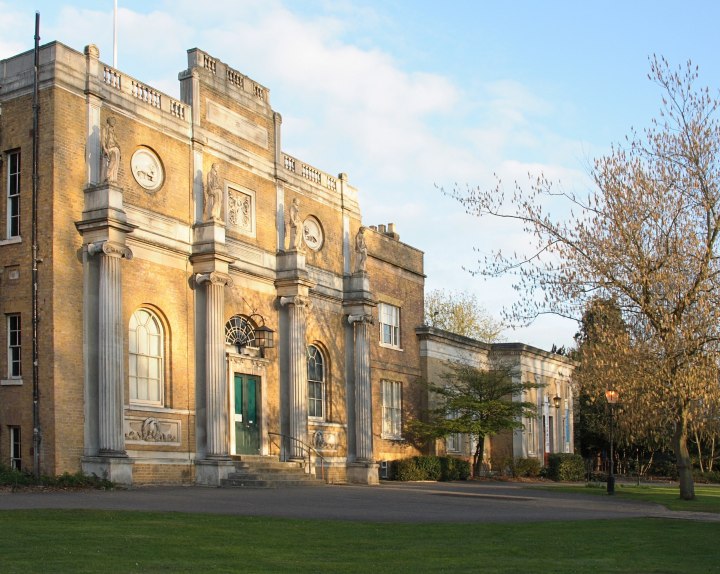
John Soane, Pitzhanger Manor, Walpole Park, Ealing, London, 1800–04 (Photo: Wikimedia Commons, April 2008).
Experience the first-ever in-person event presented by London Luminaries
The evening will include guided tours of Pitzhanger Manor, showcasing Sir John Soane’s architectural marvels, followed by an enlightening talk. Experts in historic estates—Clare Gough, Director of Pitzhanger Manor & Gallery; Tim Corum, Head of Richmond Arts Service; and Emily Burns, Curator of Collections and Interiors for English Heritage—will illuminate the art of collecting in 18th-century London, offering insights into the prestigious collections in Pitzhanger Manor, Orleans House, Marble Hill, Chiswick House, and more. Join us for an evening of history, art, and connectivity.
• Guided tours of the house commence at either 5.30 or 6pm. Guests are welcome to explore freely should they wish to arrive earlier or attend solely for the talk, which starts at 6.45.
• Tickets are £12, with all profits supporting the London Luminaries properties, an initiative born during the COVID lockdown to enhance connections between properties and people.
• Drinks and refreshments will be available for purchase at Soane’s Garden Room until 9pm, not included in the ticket price.
Pitzhanger Manor was the country home of Sir John Soane, one of the most influential architects in British history. Soane designed many extraordinary buildings, but Pitzhanger is unique as a building because it was designed, built and lived in by Soane himself. Following a major three-year conservation project, Pitzhanger reopened in March 2019. The Manor has been revitalised to take it back to Soane’s original designs, its extraordinary architecture restored for the public to see. Pitzhanger Gallery, housed in the 1939 library building, has been improved to allow for major loans and a series of contemporary exhibitions by artists, architects, and designers.
Emily Burns is the Curator of Collections & Interiors (West London) for English Heritage. Properties in her portfolio include Marble Hill, Chiswick House, and the Jewel Tower. Previously, she was a Curator at Watts Gallery – Artists’ Village (2021–23), Vivmar Curatorial Fellow at the National Gallery (2018–20), and Assistant Curator at the National Portrait Gallery (2013–18). Emily’s specialism is in British and Old Master painting and collecting. She holds degrees from the University of Cambridge and UCL and completed her AHRC-funded PhD on art and collecting in England during the Civil Wars and Interregnum, c.1640–1660 (University of Nottingham, 2018). Emily was a contributor to the Paul Mellon Centre’s research project Art and the Country House (2020), and she is the founding Editor of the Jordaens Van Dyck Journal (2021–present).
Tim Corum has worked in the arts for over 30 years, principally in museums and galleries, developing museum exhibitions and festivals at Oldham, Leeds, Bristol, the Horniman in London, and now with Richmond Arts Service. In Leeds and Oldham, he worked on developing international art programmes and a series of major capital projects. In Bristol, Tim led the development of the City Museum and Art Gallery, encouraging artists to intervene in and reframe the museum and art gallery. Though most widely known for the exhibition Banksy versus Bristol Museum, this programme also embraced a diversity of projects with both local and international partners. At the same time, he developed a new international contemporary art collection, building on Bristol’s rich historic art collection. He also led the creative team that developed the new museum, M Shed. In 2015, Tim became a director at the Horniman, where his work focussed on developing participatory programmes, bringing artists and scientists from a wide variety of backgrounds together with communities to create exhibitions and festivals that cast new light on the museum’s internationally significant collections. Tim moved to Richmond during the pandemic to lead the Borough’s Arts Service and direct the development of Orleans House Gallery.
Clare Gough is Director of Pitzhanger Manor & Gallery, architect Sir John Soane’s ‘country’ house in Ealing, West London and its adjacent contemporary gallery. Clare led Pitzhanger through a major conservation project to restore the house to Soane’s innovative design and upgrade the gallery, so it now stages exhibitions with artists ranging from Anish Kapoor to Es Devlin and Rana Begum. Clare is a Trustee of the Art Fund and was previously a Trustee of the Museum of the Home. She formerly worked at the National Gallery and National Gallery Co. Ltd before setting up an art consultancy working with the V&A and other art institutions.
Judith Hawley is Professor of Eighteenth-Century Literature in the Department of English, Royal Holloway, University of London. She frequently appears on BBC radio and TV and is a Trustee of the Pope’s Grotto Preservation Trust. Her research interests range from gin to Grub Street, and she has a particular interest in the history of amateur performance.
Wentworth Woodhouse Visit
From the York Georgian Society:
Wentworth Woodhouse Visit with the York Georgian Society
24 April 2024
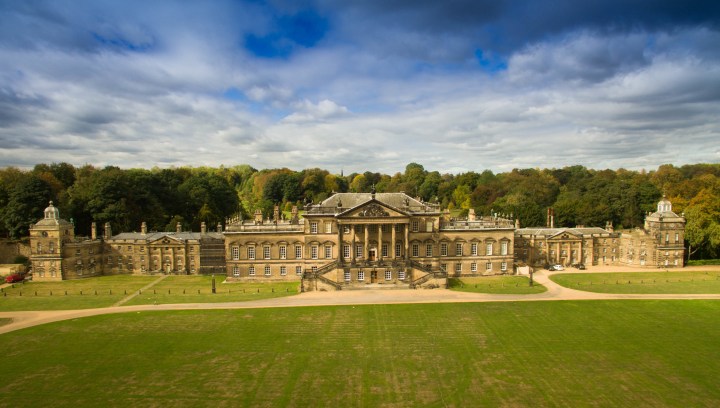
Wentworth Woodhouse, South Yorkshire.
An opportunity to visit one of England’s greatest Georgian country houses—rebuilt by the 2nd Marquess of Rockingham in the mid-18th century—to view the latest developments in its ambitious conservation and restoration programme.
The day will begin with a guided tour of the State Rooms on the main floor. Lunch will be followed by a look at the newly restored Camellia House in the company of Dorian Proudfoot, lead conservation architect for the Wentworth Woodhouse Restoration Project. Originally built in 1738 as an orangery and tea room, the building was later converted to house camellias and other rare plants from China and Japan. After complete restoration from dereliction it is now back in use as a tea room and events venue. Dorian will then take us to the magnificent stable block, originally built in 1782 to house 84 horses and more than 30 staff, together with a riding school, carriage house, and saddlery. The stables and courtyard are being transformed in a £5 million regeneration plan to accommodate a visitors’ centre, kitchen, café, and events venue.
Bookings: YGS members and Friends of York Art Gallery: £43; non-members: £48. Places are limited to 25 persons. The cost includes tea/coffee and biscuits on arrival, lunch, and tours of the State Rooms, Camellia House, and Stables. Book your place here.
Telescope by James Short on Display at the Herschel Museum
On a day when many of us are looking to the skies . . . Press release from Bath’s Herschel Museum of Astronomy:

James Short, Gregorian reflector telescope, 1738–68 (Collection of Richard Blythe, on loan to the Herschel Museum of Astronomy).
The Herschel Museum of Astronomy recently revealed a new display: a Gregorian Reflector telescope created by James Short, the preeminent telescope maker of the 18th century. The brass telescope, on long-term loan to the museum from Richard N. Blythe of Shropshire, was created between 1738 and 1768. It has a focal length of 18 inches and sits on an equatorial mount. Similar telescopes made by Short were used to observe the transit of Venus in 1761 and 1769.
Gregorian Reflector telescopes are constructed with two concave mirrors. The primary mirror collects incoming light and brings it to a focal point. This focused light is then reflected off the secondary mirror, after which the light passes through a central aperture within the primary mirror. Ultimately, the light emerges from the bottom of the instrument, facilitating observation through the eyepiece.
In his 30-year career, Short made at least 1300 telescopes. Considered the finest available, they were sought after by observatories and customers all over the world. Short had no assistant, and when he died in 1768 his method of polishing mirrors was lost. Separately, William Herschel started experimenting with making telescopes in 1773 and went on to produce telescopes of even greater quality than those by Short.

Herschel Museum of Astronomy, 19 New King Street, Bath (Photo by Nick Veitch, Wikimedia Commons, August 2005). Brother and sister, William and Caroline Herschel moved into what was then a new town house in 1777, just a few years before William discovered Uranus (in March 1781). The Herschel museum was established in 1981.
Patrizia Ribul, Director of Museums for Bath Preservation Trust says: “The story of the Herschel siblings William and Caroline is very special, and our acquisitions policy is focused on objects that either belonged to them, or that add important context from the time. The James Short telescope provides visitors with an excellent example of the type of telescope that would have been known to William Herschel. The fact that William, with Caroline’s assistance, went on to create telescopes superior even to this excellent example by James Short, really underlines his expertise and dedication in the field of astronomy.”
The James Short telescope is the latest in a line of exciting long-term loans and acquisitions at the museum, including Caroline’s visitor book, a full-sized replica of William’s seven-foot reflecting telescope, and Caroline’s original memoir manuscript.
The Herschel Museum of Astronomy is dedicated to the achievements of the Herschels: distinguished astronomers and talented musicians. It was from this house that William discovered Uranus in 1781.
Upcoming | Dinah Memorial Unveiling, Stenton, Philadelphia
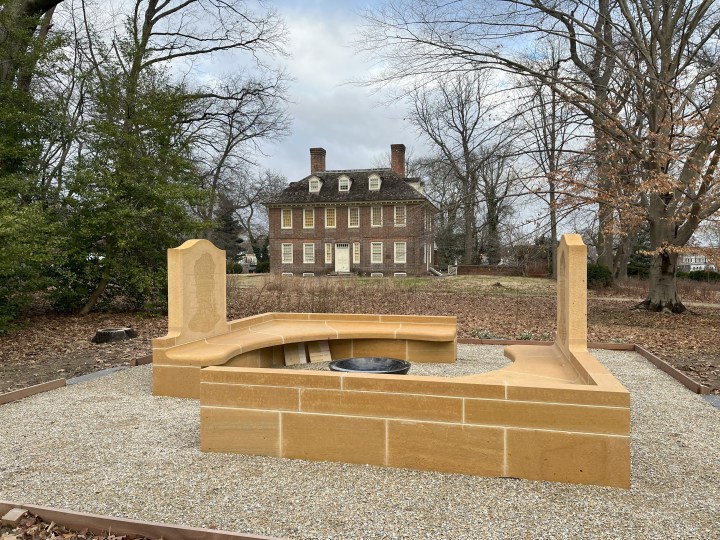
Karyn Olivier, Dinah Memorial, Stenton, Philadelphia, 2024. Nearly finished in this view, the memorial incorporates two brass plaques (one from 1912 and a new one), a small reflecting pool, and questions for both visitors and Dinah herself.
◊ ◊ ◊ ◊ ◊
I hope that Stenton’s Dinah Memorial Project garners the coverage it deserves in the coming weeks; what a compelling, important story! From the press release. . . –CH
Dinah Memorial Unveiling Celebration
Stenton Museum, Philadelphia, 20 April 2024, 2–4pm
On 20 April 2024, The Dinah Memorial, Philadelphia’s first monument dedicated to a formerly enslaved woman, will be unveiled on the grounds of Stenton, where she labored and was buried. This memorial is the physical culmination of Stenton’s Dinah Memorial Project, funded by The Pew Center for Arts & Heritage, a years-long community engagement discussion.
 Dinah’s complex life-story has been uncovered in archival sources in the Quaker Collection at Haverford College as well as in the Logan and related family papers collections at the Historical Society of Pennsylvania. Letters between family members, almanacs, ledgers, legal documents, and an investigation by the Quaker Meeting provided information that allowed Stenton staff to map Dinah’s life from her childhood in the home of Hannah Emlen, who would marry William Logan, to her death and burial in 1805. Though long celebrated for her storied role in saving Stenton from intended burning during the Revolutionary War, Stenton knew that there was more to Dinah than the ‘faithful slave’ narrative for which she was honored on a plaque erected in Stenton Park in 1912. This new memorial, a space in the Stenton landscape designed for questioning and reflection, conceived by acclaimed Philadelphia artist Karyn Olivier, seeks to rebalance Stenton’s historical interpretation, bringing to light the realities of Northern slavery and enslavement by Quakers while highlighting the fullness of Dinah’s humanity.
Executive Director Dennis Pickeral noted that “the Dinah Memorial Project has been transformative for the museum, revealing ignored and untold stories and histories of individuals who were enslaved and labored at Stenton, and for what the project has meant for the museum’s relationship with the surrounding community, who helped create the Dinah memorial and are now partners in charting Stenton’s course for the future.”
The unveiling falls on Stenton’s second annual Dinah Day celebration commemorating her requested release from bondage on 15 April 1776. Visitors can register here to attend the event.
◊ ◊ ◊ ◊ ◊
Built for James Logan, William Penn’s Secretary, between 1723 and 1730, Stenton is located in the historic Logan section of Philadelphia, at 4601 North 18th Street, four blocks east of Wayne Junction. The house is open for tours Tuesday through Saturday, from 1.00 to 4.00pm, April through December, and by appointment throughout the year. Stenton is a member of Historic Germantown, a consortium of nineteen cultural attractions and historic sites located in Northwest Philadelphia.
r e l a t e d p r o g r a m m i n g , r e c e n t a n d u p c o m i n g
Conversation with Memorial Artist Karyn Olivier and Remember My Name: Dinah’s Story Film Screening
Stenton, 2 February 2024, 6pm
The evening features Karyn Olivier, the artist who designed the Dinah Memorial, and a screening of Remember My Name: Dinah’s Story, a film written by Robert Branch and performed by Irma Gardner-Hamond and Marissa Kennedy.
Adrienne Whaley | A Glimpse into Dinah’s World: Revolutionary Black Philadelphia
Zoom, 22 February 2024, 6.30pm
Adrienne Whaley, Director of Education and Community Engagement at the Museum of the American Revolution, constructs Philadelphia through the eyes of Dinah. A recording is available here»
Laura Keim | From Archival Discoveries to Monumental Construction
Facebook Live, Historical Society of Pennsylvania, 1 March 2024, 4pm
Laura Keim has served as the Curator for Stenton since 1999. Images of archival sources for Dinah are available here. A recording of Keim’s presentation from the Historical Society of Pennsylvania is available here»
Amy Cohen | Black History in Philadelphia
Stenton, 4 April 2024, 12.30pm
After twenty years teaching social studies, Amy Cohen became Director of Education for History Making Productions and is a contributing writer for Hidden City Philadelphia. She’ll discuss her new book Black History in the Philadelphia Landscape: Deep Roots, Continuing Legacy (Temple University Press, 2024).
Restoration of Frescoes and Stuccowork at Palazzo Pisani
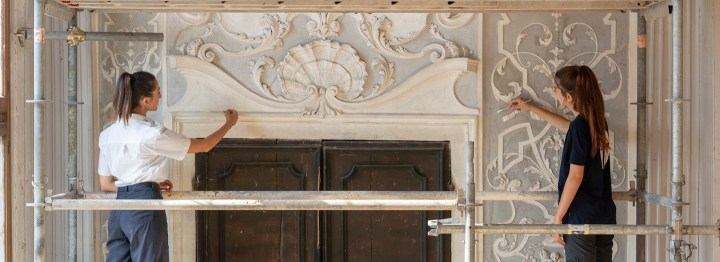
IVBC students restoring the stuccowork in the orchestra rehearsal room, summer 2023
(Venice: Palazzo Pisani; photo by Matteo De Fina)
◊ ◊ ◊ ◊ ◊
From the press release (via Art Daily) for the project (readers may know the Palazzo Pisani from the inclusion of its extraordinary rooftop for Hercule Poirot’s terrace earlier this year in A Haunting in Venice) . . .
Save Venice is proud to support the education and training of the next generation of art conservators by funding coursework and restoration fieldwork at the Istituto Veneto per i Beni Culturali’s restoration school. In 2023, this long-standing partnership fostered a new collaboration between the IVBC and Venice’s prestigious Conservatorio Benedetto Marcello in Palazzo Pisani, through a pilot initiative of conservation treatments funded by Save Venice with generous support by the Manitou Fund through Nora McNeely Hurley.
The 17th-century Palazzo Pisani, located next to Campo Santo Stefano, is the second largest palace in Venice, after Palazzo Ducale. The conservation of frescoes, stuccowork, and marble decoration in two rooms of the conservatory was undertaken in 2023 by the IVBC restoration school as a part of their post-graduate fieldwork program. The remarkable, initial results were presented to the public in December, and Save Venice is now continuing its engagement with the two institutions by funding a 2024 full-year program of stucco conservation in four rooms of the conservatory’s museum.
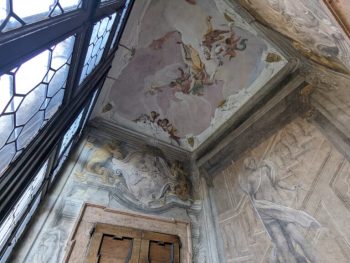
Fresco decoration in the antechamber (‘Adonis Room’), following conservation in 2023 (Venice: Palazzo Pisani; photo by Matteo De Fina).
Located on Palazzo Pisani’s 2nd floor—originally the primo piano nobile—the antechamber overlooks the interior courtyard and provides access to another, larger room. Frescoes, likely dating to the mid to late 18th century, adorn all four walls and depict illusionistic architecture with gargoyles and mythological and allegorical figures including Cupid, Venus, and Adonis. When the interior of the palazzo was heavily reworked in the 19th century, these frescoes were covered over for nearly a century before being revealed again in the mid-20th century.
The adjacent room—now used as the orchestra rehearsal room, as well as for art exhibitions—originally housed Almorò Pisani’s precious library and collection of medals and coins (sold in the 19th century). The rich stucco motifs feature mouldings with geometric designs intertwined with dynamic acanthus leaves, further enriched by coats of arms of the Catholic Church. Bas-relief portraits of John Calvin (on the north wall) and Martin Luther (on the south wall) may be attributed to the workshop of plasterers active at Palazzo Pisani in that period: Giuseppe Ferrari and Francesco Re.
Urgent intervention was needed to address the numerous cracks and fissures that were causing the delicate plaster to lift and detach from the wall beneath. The ornate decoration had been the subject of previous interventions involving the use of methods and materials that were not ideal. The stucco reliefs were whitewashed over with thick layer of lime milk and animal glues that had yellowed and distorted the elegant and refined detailing. The bas-reliefs of Calvinus and Luther were reworked using a yellow material that had discolored and was blotchy in appearance. Previous infiltrations of rainwater from the roof had left stains on the walls, and damp that passed through from the exterior masonry allowed for the formation of salt deposits. A thick layer of dirt and grime and other non-original surface residues were carefully removed, isolated areas of losses to the stucco decoration were recomposed, and the water damage and salt deposits were treated.
New Report | Survey of Asian Ceramics, National Trust for Scotland
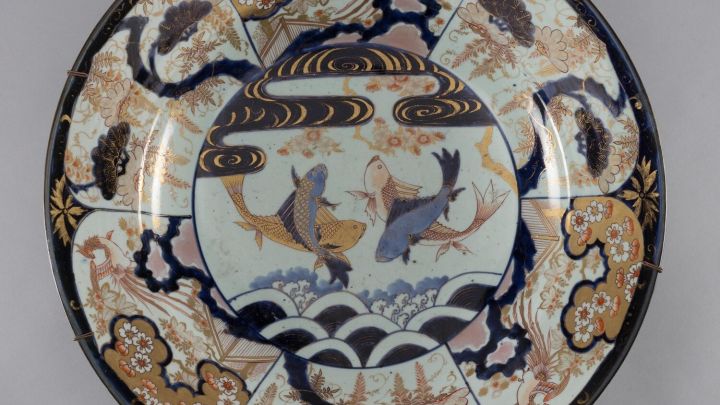
Large dish, porcelain, painted in underglaze blue, iron-red, and gold, Imari-type palette, made in Arita kilns, Japan, Edo period, c.1700–20
(National Trust for Scotland)
◊ ◊ ◊ ◊ ◊
The report was released early this year; Patricia Ferguson provides an introduction here. The full report is available (for free) as a PDF file here.
Patricia Ferguson, Survey of Asian Ceramics in the Collection of the National Trust for Scotland (National Trust for Scotland, 2023), 162 pages.
Between 2017 and 2019 the National Trust for Scotland delivered Project Reveal, a major collections project inventorying a collection of over 140,000 objects, distributed across 50 properties throughout Scotland. Encompassing major object groupings in the areas of fine and decorative art, household furniture and domestic life, these collections chart the experiences of people living in Scotland through 500 years of Scottish history, as well as demonstrating Scotland’s past relationships with the rest of the world.
This survey of Asian ceramics is a natural successor to Project Reveal. It delves deeper into the history and significance of a collection of circa 1,700 ceramic items. Undertaken by the independent researcher Patricia F. Ferguson this report sets out the survey findings, drawing together disparate existing research on the subject and contributing new collection research and knowledge. Focusing on key collections at nine different National Trust for Scotland properties, the report positions the collections within the broader context of historic ceramic production and collecting, with attention to influences such as: fashion and the role of royalty; production in and trade with China and Japan; and the growth of and changes in demand.
Patricia Ferguson is a ceramic specialist with an MA from the School of Oriental and African Studies (SOAS), London. She has worked in London at the British Museum and Victoria & Albert Museum, and as Honorary Adviser on Ceramics to the National Trust (England, Wales, and Northern Ireland). She published Ceramics: 400 Years of British Collecting in 100 Masterpieces in 2016.
New Book | America’s Collection
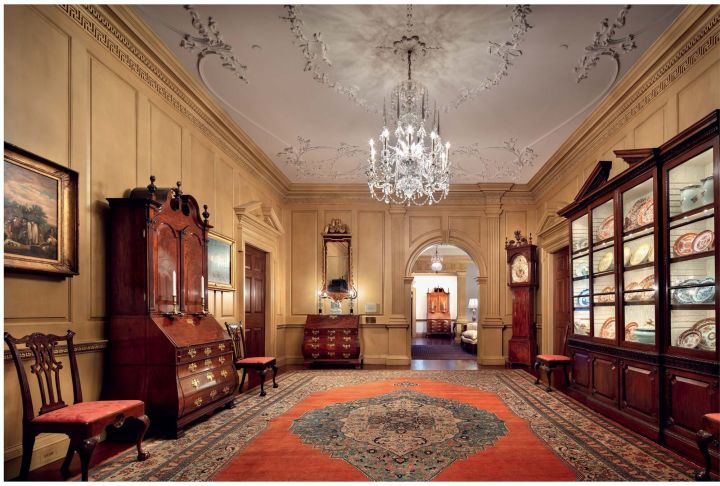
The entrance hall of the Diplomatic Reception Rooms at the U.S. Department of State; completed in 1979, the room includes a rococo ceiling taken in part from Philadelphia’s Powel House, now installed as a period room at the Philadelphia Museum of Art (Photograph by Durston Saylor). For more information on the book and the history of the reception rooms, see James Tarmy’s August 24th article for Bloomberg.
◊ ◊ ◊ ◊ ◊
From Rizzoli:
Virginia Hart, America’s Collection: The Art and Architecture of the Diplomatic Reception Rooms at the U.S. Department of State (New York: Rizzoli Electa, 2023), 352 pages, ISBN: 978-0847873272, $100. With a foreword by John Kerry and contributions by Bri Brophy, Allan Greenberg, Mark Alan Hewitt, Stacy Schiff, Elizabeth Mankin Kornhauser, Alice Cooney Frelinghuysen, Alexandra Alevizatos Kirtley, Elliot Bostwick Davis, Deborah Dependahl Waters, David Rubenstein, Carolyn Vaughan, and Laaren Brown.
The first volume in more than 20 years tells a new and modern story of the U.S. State Department’s Diplomatic Reception Rooms, one of the top collections of American fine and decorative arts in existence.
 The art of United States diplomacy has been conducted over more than two centuries with figures from all over the world, in peacetime and in conflict. For the last six decades, these negotiations have taken place in the rarified environment of the Diplomatic Reception Rooms at the U.S. Department of State. Tucked inside the modern Truman Building in the center of Washington, D.C., lies this special suite of rooms transformed by four renowned architects—gems of classical architecture brimming with exceptional American art and artifacts that tell the story of the nation’s founding and represent the singular ideals of the American character.
Housing one of the finest collections in the world, along with The Metropolitan Museum of Art and Winterthur, these rooms display more than 5,000 objects, including paintings by John Singleton Copley and Gilbert Stuart; silver and porcelain owned by George Washington and other presidents; fine furniture; maps and documents; prints and drawings, not to mention the very desk the Treaty of Paris that ended the Revolutionary War was signed on. With all-new photography and essays, this book captures the history of the rooms and explores more than 150 examples of the extraordinary American art that animates the exquisite spaces.
Virginia B. Hart is director and curator of the Diplomatic Reception Rooms and Bri Brophy is deputy chief curator. The Honorable John F. Kerry is U.S. Special Presidential Envoy for Climate, and former U.S. Secretary of State. Allan Greenberg is an architect and author. Mark Alan Hewitt is an architect and architectural historian. Stacy Schiff is a Pulitzer-Prize-winning author. Elizabeth Mankin Kornhauser is the Senior Curator for the 2026 Bicentennial at Frederic Chruch’s home Olana and Curator Emerita of American Paintings and Sculpture at The Metropolitan Museum of Art. Alice Cooney Frelinghuysen is the Anthony W. and Lulu C. Wang Curator of American Decorative Arts at The Metropolitan Museum of Art. Alexandra Alevizatos Kirtley is the Montgomery-Garvan Curator of American Decorative Arts at the Philadelphia Museum of Art. Elliot Bostwick Davis is Senior Editor, Harvard Social Impact Review, Arts and Culture and a former museum curator and director. Deborah Dependahl Waters is an independent decorative arts historian and part-time assistant professor at Parsons, New School University. David M. Rubenstein is a financier and philanthropist. Carolyn Vaughan is a writer and editor of art books and exhibition catalogues. Laaren Brown is a writer and editor for art and natural history topics. Durston Saylor is a photographer of contemporary interior design and architecture. Bruce M. White is a photographer of works of art and historic architecture. Sarah Gifford is an award-winning graphic designer.










leave a comment