Sir John Soane’s Private Apartments and Model Room
From Sir John Soane’s Museum:
Soane Tour: Private Apartments and Model Room
Sir John Soane’s Museum, London, starting May 19
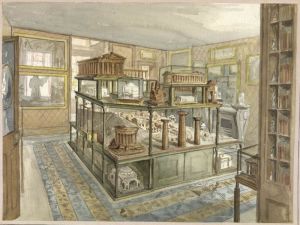
Sir John Soane’s Model Room, watercolour by C. J. Richardson ca. 1834–35
Explore Soane’s unique house-museum with our expert staff on the Soane Highlights Tour. Be transported back to Regency London as we guide you through Sir John Soane’s extraordinary home, including Soane’s fully-restored private apartments and Model Room, not seen by the public for 160 years. Offering a fascinating insight into his work and family life, the tour will show you the highlights amongst the many treasures on display, including paintings by Canaletto and J.M.W. Turner, the 3,000 year-old sarcophagus of Egyptian King Seti I, and William Hogarth’s complete A Rake’s Progress. Tuesday, Thursday, Friday, Saturday, 12:00, £10.
Coverage from The Guardian is available here»
Clandon Park House Gutted by Fire

The Marble Hall at Clandon following the fire, showing a marble relief by John Michael Rysbrack still over the chimneypiece. ©National Trust/John Millar.
◊ ◊ ◊ ◊ ◊
As reported by BBC News (2 May 2015). . .
The investigation into the cause of a fire that ravaged Clandon Park House “will take some time” owing to its complexity, Surrey fire service said. The blaze at the Grade I listed National Trust property near Guildford on Wednesday [April 29] left the structure gutted.
Structural assessments of the building are continuing and will inform what happens to the 18th-century mansion in the future. The trust said it was too early to discuss a restoration of Clandon. But a “significant amount” of the Palladian mansion’s collection had been saved according to Dame Helen Ghosh, the trust’s director general.
“Although the house was pretty well burned out, the operation rescued a significant amount of the collection, and we are hopeful there will be more to recover when our specialists are able to get inside the building and start the painstaking archaeological salvage work,” she said.
“But there is a lot that we will never recover.”
“The immediate sense of shock and loss amongst staff working at the property has quickly been replaced by a steely determination,” Dame Helen added. “When the overall impact of the fire is clearer, we will be able to decide on the longer term future of the house.”
About 80 firefighters tackled the blaze at its height and crews managed to save a “significant” number of valuable antiques, that have now been “safely” put into storage. . .
The full article is available here»
Additional information is available at Emile de Bruijn’s Treasure Hunt: National Trust Collections.
The Landmark Trust Turns 50
The Landmark Trust turns fifty in May:
The Landmark Trust’s Golden Weekend
50 Landmark Open Days in the UK, 16–17 May 2015
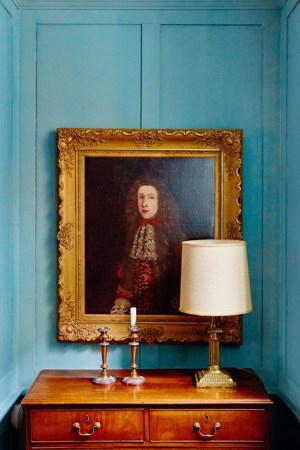
The Dining Room at 13 Princelet Street, Spitalfields, London, built ca. 1718–19. The Landmark Trust is featured in House & Garden (May 2015), pp. 134–39. Photo by Ben Quinton.
The Landmark Trust is a charity that rescues important buildings that would otherwise be lost. We take on historic places in danger and carefully and sensitively restore them. By making them available for holidays, we make sure they can be enjoyed by all, both today and for future generations. We have in our care nearly 200 buildings in Britain and several in Italy and France. Though they range from the sober to the spectacular, all our buildings are rich in history and atmosphere. They include picturesque pavilions and medieval long-houses, artillery forts and Gothick follies, clan chiefs’ castles and cotton weavers’ cottages, the homes of great writers and the creations of great architects, from Browning to Boswell, from Pugin to Palladio.
In the month we were founded, we will open 25 Landmarks for a special, celebratory open weekend across England Scotland and Wales, many never before or only rarely open to the public. The buildings have been carefully picked so that 95% of the British population will be within 50 miles of an open Landmark.
At 3pm on 16 May 2015 local groups, community choirs, bands, bell ringers and musicians of all sorts will simultaneously perform a specially commissioned Anthem for Landmark by acclaimed young composer Kerry Andrew. We hope this will unite Landmarkers and local communities across the country in a wonderful shared celebration.
More information about the weekend is available here»

Richard Samuel Coade, Belmont (Lyme Regis, Dorset), built before 1784, at which point it became the home of Eleanor Coade; appropriately the house showcases the eponymous artificial stone she pioneered.
◊ ◊ ◊ ◊ ◊
One of The Landmark Trust’s latest project, Belmont is scheduled to open later this year:
Belmont (Lyme Regis, Dorset) is a fine, early example of a maritime villa, a new building type that sprang up in the second half of the 18th century with the rising popularity of sea bathing and holidays by the seaside. Our research has shown that the house was built before 1784 by Samuel Coade. This is the date he transferred the house to his niece, Mistress Eleanor Coade (1733–1821), one of the most intriguing figures in 18th-century architecture.
Our project will rescue Belmont from decay and restore it to its late-Georgian glory, creating a Landmark which will sleep 8 people. As it was once Mrs Coade’s holiday villa, so it will be used for holidays again, with its original features repaired and reinstated.
Thanks to a hugely generous financial bequest to Landmark by the late Mrs Shelagh Preston, the fundraising appeal for Belmont has now reached its target. We are so grateful to everyone who supported Belmont, helping us to raise a total of £1.8m.
The Menokin Glass House: A Revolutionary Project
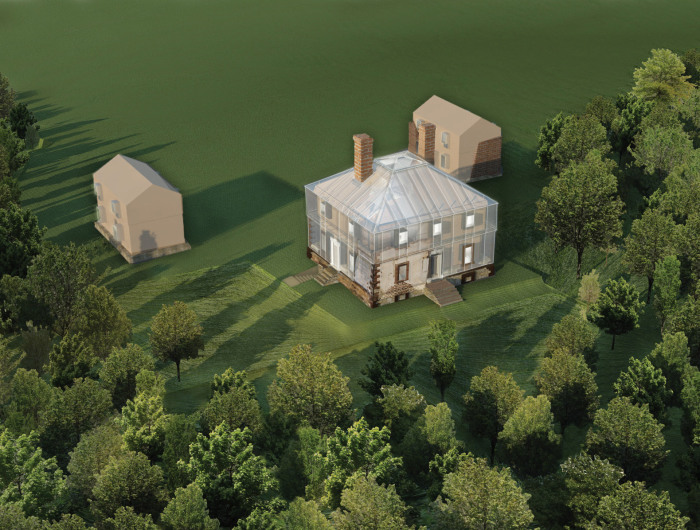
Proposed ‘Glass House’ Restoration for Menokin in Warsaw, Virginia
from the website Menokin: Rubble with a Cause
◊ ◊ ◊ ◊ ◊
From the blog of the National Trust for Historic Preservation:
Meghan O’Connor, “Eighteenth-Century House Ruin to Be Restored…With Glass,” Preservation Nation Blog (3 December 2014).
What some people see when they look at Menokin is a collapsed house, an old ruin, a testament to the perils of ignoring preservation. What the staff and Board at Menokin see, however, is a cutting-edge preservation opportunity.
The Menokin Foundation does not want to restore the house to its original condition. Instead, the Foundation believes Menokin is more valuable to the public in pieces. Menokin was home to Declaration of Independence signer, Francis Lightfoot Lee. The land was given to Lee and his wife Rebecca Tayloe by his father-in-law as a wedding gift. The house was built around 1769. . . .
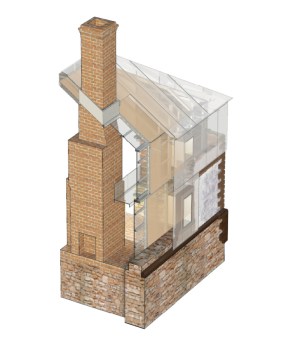
Re-imagining a Ruin: Exterior Structure Cutaway View
Dubbed the “Glass House Project,” the Foundation floated the idea around the preservation community. Pope says, “We started getting really positive responses to it. We got some raised eyebrows, believe me, but we came to [the] consensus that this was an approach worth pursuing.”
To design the Glass House Project, the Foundation hired world-renowned architecture firm Machado and Silvetti Associates in 2012. Designing projects ranging from an addition to the Bowdoin College Museum of Art to the expansion of the Getty Villa, Machado and Silvetti focus on creating contemporary and innovative designs that merge with historic contexts. . . .
The Foundation is currently developing and implementing Phase 1 of the Glass House Project — to build a glass shell around the current remaining structure.
Menokin’s innovation does not just stop at glass. The Foundation’s ultimate goal for the site is to be an internationally known learning and teaching center. In a departure from many historic house museum models, Menokin does not want to focus solely on one story or one time period. The site will not just be a colonial relic, but a place that can have modern implications for, and showcase in a revolutionary way, preservation, history, architecture, and natural resources. . .
Meghan O’Connor is the member services assistant at the National Trust. She enjoys learning, writing, and talking about museums, art, architecture, and anything historic. She worked with Menokin on the museum’s historical interpretation as part of a graduate school class.
◊ ◊ ◊ ◊ ◊
Note (added 15 December 2014) — The original version of this posting included a photo from the original concept team; the current photos comes from the Menokin blog.
Phase II of the Conservation of Thornhill’s Painted Hall Announced

Restoration of the West Wall of the Painted Hall at Greenwich, included in Phase I of the conservation project, was completed in the spring of 2013. Phase II is expected to begin in the summer of 2016.
◊ ◊ ◊ ◊ ◊
Press release, via Art Daily (29 November 2014). . .
The Heritage Lottery Fund today announced that it has earmarked funding of £2.77 million, including a development grant of £98,800, to The Greenwich Foundation towards its £7m scheme to complete the conservation of the Painted Hall at the Old Royal Naval College (ORNC). This first round pass will enable the Foundation to proceed with it plans for the conservation of the remaining 3,700 square metres of paintings: one of the most ambitious painting conservation projects ever undertaken within a historic interior. It will also support improved interpretation and accessibility, the delivery of conservation skills training, and a programme of associated community, learning and public events including scaffolding tours which proved immensely popular during Phase I of the conservation.
Created in the early 18th century by Sir James Thornhill for Sir Christopher Wren’s Royal Hospital for Seamen, the spectacular, Grade 1 Listed, Painted Hall is one of Europe’s most important architectural interiors and is considered to be the greatest achievement of English Baroque art. Phase I of the conservation, which was also supported by a grant from the Heritage Lottery Foundation, saw the west wall and upper hall ceiling restored to their former glory [opened in May 2013]. Phase II will see the lower hall, with its spectacular ceiling, the entrance vestibule and cupola similarly restored.
Sue Bowers, Head of the Heritage Lottery Fund for London, said, “This Baroque masterpiece is one of the lesser-known treasures at the heart of the Greenwich World Heritage Site. HLF funded the first stage of restoration works and we are now delighted to support plans to complete the project.”
“This is absolutely wonderful news,” adds Brendan McCarthy, Chief Executive of the Greenwich Foundation. “Ever since the first phase of conservation was completed, we’ve been looking forward to restoring the rest of the Painted Hall and the HLF stage 1 pass has taken us a long way towards that—although much fundraising remains to be done. The next few months will be very interesting and great fun. There will be changing exhibitions, information, exciting talks and hands-on workshops as part of our overall approach to involving the public as the project develops. Phase II of the Painted Hall conservation will transform the experience of visiting and viewing this remarkable painted interior, and people can also be part of the exciting project by helping us to reach our £7m target.”
The Foundation will submit detailed project proposals, based on a feasibility study by Martin Ashley Architects, to HLF at the end of 2015 with a view to starting work on the project in the summer of 2016. The Painted Hall will be under scaffolding for around two years after the start of works, however the public will have access to the Hall, including on the scaffolding itself. Visitors—including wheelchair users—will be able to get close up to the painted surfaces and watch conservators at work—an exciting element of project.
Key elements of the Phase II programme include
• Cleaning and conservation of the remaining 3,700 square metres of painted wall surface, including the great ceiling in the Lower Hall, executed by James Thornhill between 1708 and 1712. This will remove layers of dirt and varnish, unlocking the colour and vibrancy of these great paintings. The work will be undertaken by Paine & Stewart, leading specialists in the conservation of historic wall paintings who also undertook the conservation work in Phase I.
• Re-presentation of the interior with improved lighting, new seating and interpretation.
• Introduction of environmental improvements to ensure the best possible conditions for the painted surfaces.
• Creation of a new, fully accessible visitor reception in the King William Undercroft with improved facilities, innovative interpretation, dedicated retail, and a new café.
• Improved visibility of the Painted Hall within the Discover Greenwich visitor centre, including a new audio-visual exhibit.
The conservation work is expected to be completed by the summer 2018 with the overall project completed the following year.
A masterpiece that was almost 20 years in the making
With over 4,250 square metres of painted surfaces, the Painted Hall was Thornhill’s most extensive commission, taking the artist almost 20 years to complete. In the dining hall proposed for the Royal Hospital for Seamen the artist was asked to create an homage to Britain’s maritime power and royal family. The astonishing ceiling of the lower hall shows the contribution the British navy made to the prosperity of the nation at the time of William III and Mary II, under during whose reign the Hospital was commissioned, and the Upper Hall ceiling features the last of the Stuart monarchs, Queen Anne, during whose reign the Lower Hall paintings were made. The allegorical theme of the huge and exuberant Lower Hall ceiling is the Triumph of Peace and Liberty over Tyranny, and pays due tribute to Stuart monarchs William and Mary and British maritime power. Within the oval frame are the four seasons and other references to the passing of time including the signs of the zodiac. Beyond the arch in the Upper Hall Queen Anne surveys the continents of the world, while on the west wall her Hanoverian successors, George I and his family, are shown in sober glory. Elsewhere much use is made of trompe l’oeil painting, on the columns, windowsills and in the vestibule. During the period when he working on the painting Thornhill became court Painter to the new King, George I, and was subsequently knighted. After completion in 1727, the Greenwich pensioners moved their dining room to the undercrofts below, and the Hall became a popular visitor attraction with an admission price of 6d. In the early 19th century the Painted Hall became the home of the National Gallery of Naval Art—one of Britain’s first public art galleries. It was not used again as a dining room until 1936, when the paintings were moved to the newly-established National Maritime Museum.
Sir James Thornhill (1675–1734)
Born in Dorset in 1675, artist James Thornhill was to rise to become a court painter and sergeant painter to George I and George II, a master of the Painters’ Company and a fellow of the Royal Society. He was the first English painter to be knighted for his work, in 1720, and sat as a Member of Parliament for 12 years from 1722 until his death in 1734. The eight scenes in the dome of St. Paul’s Cathedral (1715–19) and the allegories in the Painted Hall, Royal Hospital for Seamen (1708–27), are his two most considerable commissions with the majority of his paintings largely executed on the ceilings and stairs of country houses and palaces such as Hampton Court, Blenheim, and Chatsworth. Among Thornhill’s few canvases are the altarpiece for St. Mary’s Parish Church, Weymouth, and a group portrait of the members of the House of Commons in which he was assisted by William Hogarth (who eloped with Thornhill’s daughter in 1729). Thornhill also made a number of portraits (his sitters including Sir Isaac Newton and co-founder of The Spectator Magazine, Richard Steele), book illustrations, theatre scenery, and the rose window of the north transept of Westminster Abbey. Thornhill’s works can be seen in collections across the globe including The Louvre, Paris; Metropolitan Museum, New York; and National Portrait Gallery, Tate, Royal Academy and Courtauld Institute, London.
Saving Mr. Turner’s Country Retreat
◊ ◊ ◊ ◊ ◊
With the UK release of Mike Leigh’s Mr Turner, the Turner House Trust hopes to raise the profile of the painter’s house in Twickenham, which badly needs restoration. From the press release (14 October 2014) . . .
There cannot be many people who are unaware of the imminent general release of Mike Leigh’s award-winning Mr Turner, the biographical film of one of the supreme masters of landscape, England’s JMW Turner. What is less widely known is that Turner might have pursued a different career as an architect and that he designed and built a country villa for use by himself and his father. Completed in 1813, Sandycombe Lodge near the Thames between Richmond and Twickenham, was Turner’s retreat to escape the hectic London art world and the hurly-burly of his own household.
Mike Leigh together with actors Timothy Spall, highly praised for his portrayal of Turner, Paul Jesson as Turner’s father and Nick Jones as Sir John Soane, visited this three-dimensional Turner creation in the early stages of their work on the film.
Although the film is set later in Turner’s life, the director and actors wanted to learn as much as possible about the man behind the pictures. From here he would sketch along the Thames on foot, fish on the river and occasionally entertain his friends including Sir John Soane, architect and fellow-fisherman, whose influence is apparent throughout Sandycombe.
Grade 2* listed Turner’s House is largely unspoilt apart from some later additions, but seriously threatened by damp and long neglect it is now on English Heritage’s Heritage at Risk Register and badly in need of restoration.
Turner’s House Trust is appealing to the nation for help to save it from dereliction. “With additional damage caused by extreme weather conditions in recent years, this is now urgent. We have generous promises of grants and funding, which we must match in order to proceed,” said Catherine Parry-Wingfield, chairman of Turner’s House Trust. “With every pound we are closer to saving this Turner ‘treasure’ for future generations, but we still have a long way to go. We hope that, as this new film will no doubt inspire people to visit the artist’s wonderful masterpieces in our galleries, they will also support a lasting legacy for his country home to be enjoyed by future generations.”
◊ ◊ ◊ ◊ ◊
Note (added 7 January 2016) — An update on the project is available here: Farah Nayerijan, “An Effort to Save J.M.W. Turner’s Country House,” The New York Times (4 January 2016).
The 2013 Georgian Group Architectural Awards
The most recent architectural awards from The Georgian Group were announced last October (yes, I realize the posting is long, long overdue), with nominations open for the 2014 awards until September 19. –CH
◊ ◊ ◊ ◊ ◊
The Georgian Group’s Architectural Awards, sponsored by international estate agents Savills and now in their twelfth year, recognise exemplary conservation and restoration projects in the United Kingdom and reward those who have shown the vision and commitment to restore Georgian buildings and landscapes. Awards are also given for high-quality new buildings in Georgian contexts and in the Classical tradition.
Entries for the 2014 awards are now being accepted. There is no entry fee. Schemes must be in the United Kingdom, Isle of Man or Channel Islands and must have reached practical completion between 1st January 2013 and 1st August 2014. For the purpose of the Awards, the term ‘Georgian’ embraces the period of classical ascendancy in Britain and is taken to mean 1660–1840. The owner’s consent is a condition of entry. Please send a description of your project with a selection of images to robert@georgiangroup.org.uk or to The Georgian Group, 6 Fitzroy Square, London W1T 5DX by 5pm on Friday 19 September 2014.
More information is available here»
◊ ◊ ◊ ◊ ◊
More information about the 2013 results and additional pictures are available here»
2 0 1 3 W I N N I N G A N D C O M M E N D E D S C H E M E S

Restoration of a Georgian Country House
Winner
Townhead, Slaidburn, Lancs (pictured above)
By and for Robert Staples
Early C18 stone house. Previously on buildings at risk register, acquired by present owners 2010, conservatively restored using traditional methods.
Commended
Hadlow Tower, Tonbridge, Kent
Thomas Ford and Partners for The Vivat Trust
1832 by Walter Barton May as part of a now largely demolished country house. 185ft Gothic folly in brick with covering of Roman cement. On World Monuments Fund Watch List by 2003. Now restored and refaced, with lantern (removed after storm damage in 1987) rebuilt.
◊ ◊ ◊ ◊ ◊
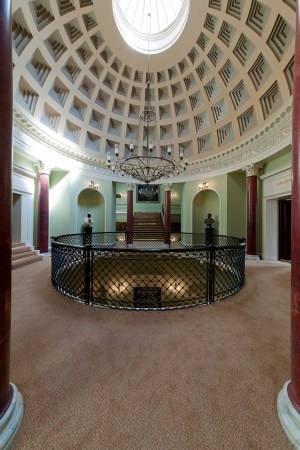 Restoration of a Georgian Interior
Winner
Theatre Royal Drury Lane, London (shown at right)
RHWL for The Really Useful Group Theatres
Restoration of Grand Saloon, The King’s and Prince’s Staircases and the Rotunda. Redecoration with advice from John Earl, Lisa Oestreicher and Edward Bulmer to match as closely as possible Benjamin Dean Wyatt’s original design. Installation of copy of Canova’s Three Graces in the Rotunda.
Commended
Great Fulford, near Exeter, Devon
Ceiling by Geoffrey Preston for Francis Fulford
New decorated plaster ceiling for the C17 double cube Great Dining Room. The original ceiling collapsed C19 and the room was then abandoned until C20; in 1960 a temporary ceiling composed of acoustic tiles was installed to make the room habitable. The 1700 picture hang has also been largely reinstated.
◊ ◊ ◊ ◊ ◊
Restoration of a Georgian Building in an Urban Setting
Winner
Mostyn House, 42 Vale Street, Denbigh
Milrick Ltd for John and Janis Franklin
1722 townhouse, restored in project initiated by Denbighshire County Council and part-funded by Townscape Heritage Initiative with HLF support. Main elevation fully returned to its original appearance, with removal of pebbledash and excrescences (later oriel window to first floor and bay windows to ground floor). Façade limewashed. Internally, lost oak panelling and missing section of oak staircase re-created.
Commended
116 High St, Boston, Lincolnshire
Anderson and Glenn for Heritage Lincolnshire
1728 merchant’s townhouse, later bank; by end of C20, gardens concreted over and house officially at risk and near to collapse. Compulsorily purchased by local authority and restored by building preservation trust supported by Architectural Heritage Fund and HLF. Envelope conserved and some lost features reinstated. Interior fitted out for office use and premises for small businesses built in grounds, giving a boost to a part of Boston cut off by a 1960s ring road.
Commended
107 Great Mersey Street, Liverpool L5
Brock Carmichael for Rotunda Ltd
1820s house, the only Georgian building left in Kirkdale area of Liverpool, near docks. In atrocious condition and on buildings at risk register by 2003, Urgent Works Notice served in 2007. HLF-funded project to restore envelope and restore or replace internal fabric.
◊ ◊ ◊ ◊ ◊
Reuse of a Georgian Building
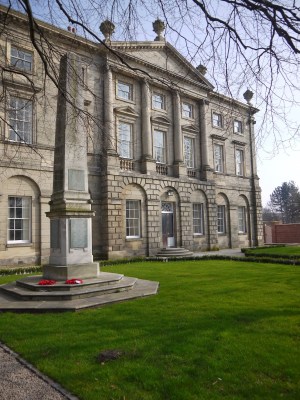 Winner
St. Helen’s House, Derby (shown at right)
Brownhill Hayward Brown for Richard Blunt
1766 by Joseph Pickford, Grade I, one of the finest C18 townhouses to survive in a provincial city. Sold by the Strutt family to Derby School in the 1860s, in educational use till 2004, since when vacant and formally at risk. Bought by Richard Blunt in 2006, now restored and converted to office use, the recession having put paid to a planned hotel conversion.
Commended
Norwood House, Beverley, East Riding
Elevation Design for The Brantingham Group (specialist advice from Patrick Baty)
1765, Grade I townhouse, acquired by local authority 1907 and used as a girls’ school until 1990s, then disused; deteriorated to the point where it was formally at risk. Arson in 2004 damaged the Rococo drawing room and the 1825 Grecian library. Subject to unsympathetic proposals but now sensitively restored and let in its entirety to a culinary school who use it in part as a restaurant.
Commended
Stable block, Sulby Hall, Northants
JWA Architects for Mr and Mrs Sandercock
1790s, attributed to Soane. Sulby Hall was demolished in 1952 and the surviving stable block was subsequently in various uses including as a store for farm equipment and grain. By 2005 it was ruinous and roofless. Natural England initiated restoration as part of a management plan for the owners’ mixed farm and the stable block, fully restored, is now used as a stable yard for stallions in a national breeding programme.
◊ ◊ ◊ ◊ ◊
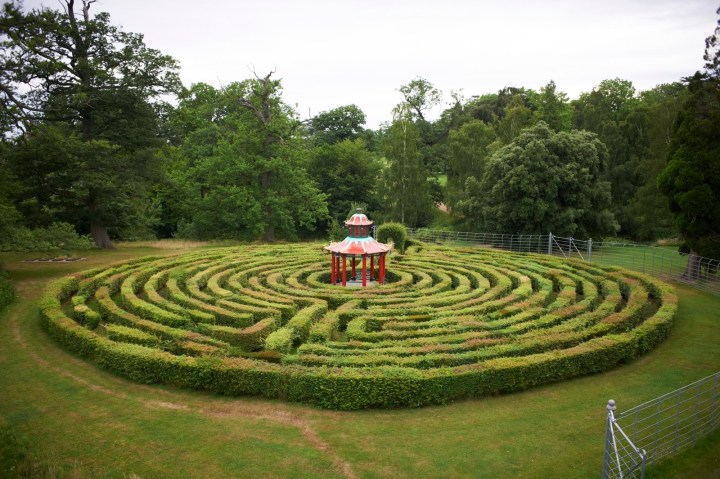
Restoration of a Georgian Garden or Landscape
Winner
Repton pleasure grounds, Woburn, Beds (pictured above)
Woburn Abbey gardeners for The Duke of Bedford
Restoration, and re-creation where lost, of the Georgian pleasure gardens and garden buildings, including Holland’s Chinese dairy, Repton’s pagoda, temple, aviary and cone house and Wyatville’s Camellia House.
Commended
Cow Pond, Windsor Great Park, Berkshire
Russ Canning for The Crown Estate
Part of the ten-year Royal Landscape Project to reinstate the lost historic landscapes of Windsor Great Park. Cow Pond, part of Wise’s 1712 plan for the Park and taking the form of a canal, was overgrown by 2008 and had regressed to swamp. Restoration included dredging and draining, construction of a Baroque footbridge and arbour and new planting.
Commended
Sir James Tillie Mausoleum, Pentillie Castle, Saltash, Cornwall
Cliveden Conservation for Ted Coryton
1713, in ruinous condition and covered in vegetation when Pentillie bought by present owners in 2007. Fully restored following archaeological survey, damaged Tillie statue repaired, vault excavated.
◊ ◊ ◊ ◊ ◊
New Building in the Classical Tradition
Winner
Onslow Park, near Shrewsbury, Salop
Craig Hamilton for Mr and Mrs John Wingfield
Schinkelesque country house on established estate. Five-bay, the centre three bays slightly recessed with arched openings to ground floor, forming an arcade on the garden front. Rendered with stone dressing. Top-lit stair hall with gallery and spiral cantilevered staircase.
Commended
Oval cricket ground, London SE11 (new forecourt pavilion)
Hugh Petter of Adam Architecture for Surrey County Cricket Club
Forecourt pavilion in brick with Bath stone dressing, replacing functional C20 banqueting suite. Central portico articulated with stone columns with bespoke Prince of Wales feather capitals and surmounted by stone urns.
◊ ◊ ◊ ◊ ◊
Giles Worsley Award for a New Building in a Georgian Context
Winner
8B Aubrey Road, London W8
Craig Hamilton Architects for Mr and Mrs Andrew Deacon
New classical mews house replacing former mews in grounds of 25 Holland Park Avenue (1820s). Soanean echoes, especially in recessed arches and rectangular sculpture gallery. Public façade composed of pediment and Diocletian window above full-width front door imitating typical mews garage door.
Commended
A lodge for a country house in Gloucestershire
Craig Hamilton for a private client
Classical lodge in stone on cruciform plan, each axis terminating at either end in a broken pediment; deep block-modillion cornice.
Commended
Trinity Church Terrace, Trinity Street, Borough, London SE1
By and for London Realty
Terrace of ten five-storey houses, forming infill development adjoining Trinity Church Square and designed to harmonise with existing context.
Open House London 2014

From Open City:
Open House London 2014
London, 20–21 September 2014

Forty Hall, the 17th-century estate, is one of the 800 properties included in the Open House London programme.
Open House London, created and delivered by the independent non-profit organisation Open-City, is the capital’s largest annual festival of architecture and design. Now in its 22nd year, it is a city-wide celebration of the buildings, places and neighbourhoods where we live and work. By providing free and open access to 250,000 across 30 boroughs to more than 800 outstanding examples of historic and contemporary buildings, on-site projects and public spaces, it remains the most powerful medium for engaging everyone in a better appreciation of their city.
A full listing of the included sites will be posted on 15 August 2014 at the event website.
Eighteenth-Century Encounters: Lövstabruk, Sweden

by Michael Yonan
In traveling through the forested plains of eastern Sweden, one encounters a Nordic rural idyll. Abundantly verdant, dotted with charming red houses, and home to the occasional moose, it is a region seemingly far removed from the bustle of Stockholm or the university culture of nearby Uppsala. The presence of scattered Viking runestones in the landscape only adds to the feeling of having traveled far from the modern world. Yet as one enters the front gates of Lövstabruk, a beautifully preserved eighteenth-century mining estate, it becomes apparent this was in its time no remote backwater but that, instead, it kept in touch with the most current continental developments in the sciences and arts.
Truthfully, the realization didn’t come entirely as a surprise when I visited Lövstabruk in May. Virtually every Swedish dix-huitièmiste speaks of the town with great affection, and many conveyed the belief that one finds there something very Swedish indeed. That interested me greatly, since one of Sweden’s more remarkable eighteenth-century qualities was its cosmpolitanism, its participation in cultural developments we associate mostly with other places. The best known to art historians is the Swedish connection to France. Yet that’s just the beginning of a much larger history of Swedish cultural exchange, of which Lövstabruk is a prime example.
To understand this place, one needs to be familiar with the Swedish institution of the bruk. The word has no exact English equivalent; it can mean forge, mine, or mill. In Sweden the bruk was a major impetus for small-scale civic development based on Sweden’s immensely rich mineral and metal deposits. The largest of the nation’s many mines was the Great Falun Mine (Stora Kopparberg), which operated for a millennium and at its peak supplied Europe with two-thirds of its copper. Lövstabruk was an ironworks that processed ore from the nearby mine at Dannemora. Interestingly, the region’s miners were a mixture of native Swedes and émigré Walloons who relocated to work in the industry. One can find in Sweden today the legacy of mass Walloon migration in the occasional French or French-sounding name.
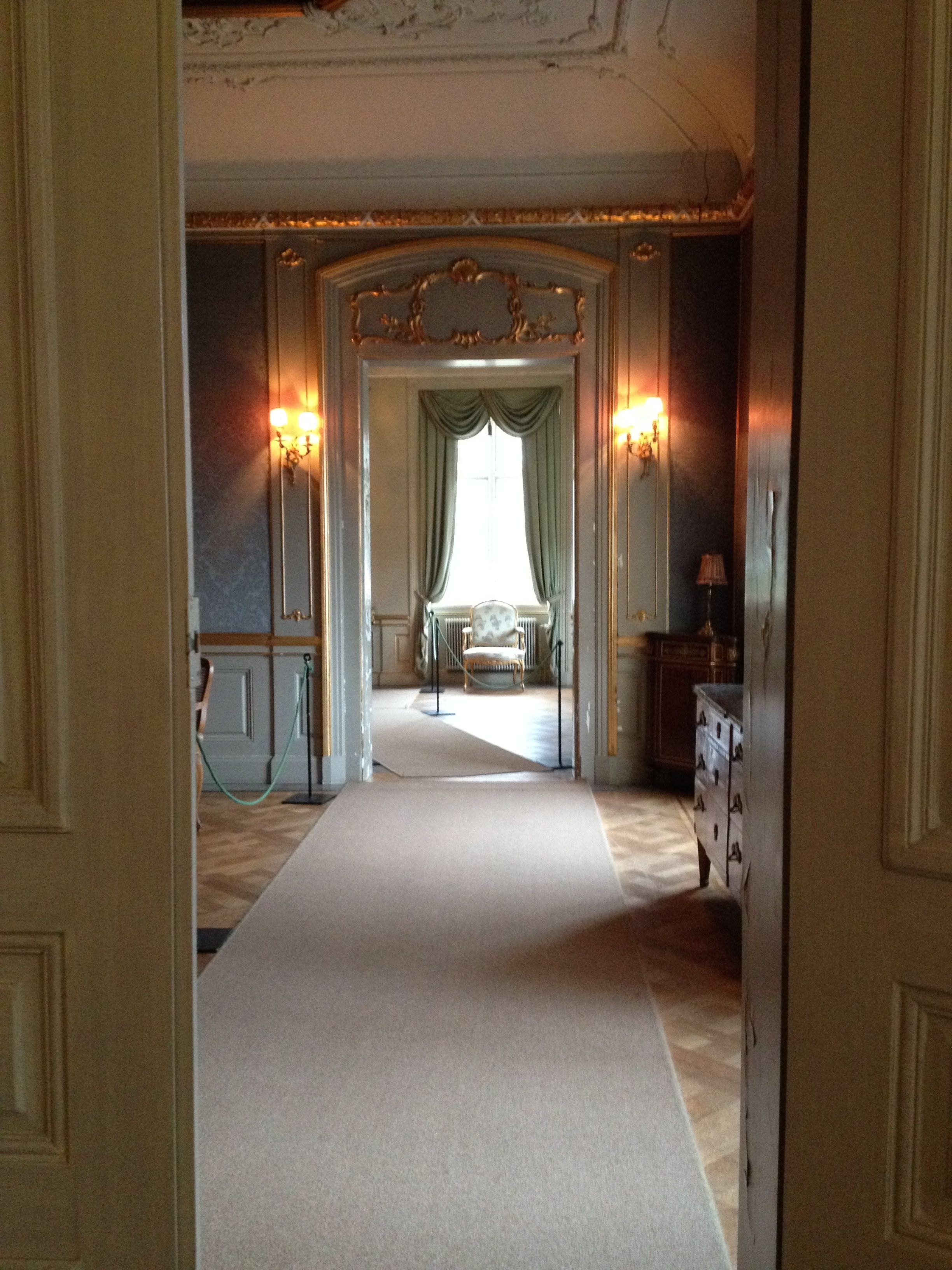 For art historians, Lövstabruk is most interesting because of its material legacy. The nobles overseeing the estate originated in the Netherlands, and it was they who expanded Lövstabruk’s footprint after a 1719 fire. Notable among them was Charles de Geer (1720–1778), who began collecting books and natural specimens for the library at Lövsta. De Geer published a comprehensive multivolume study of insects—modeled after Réaumur and Linnaeus—and oversaw an extensive building campaign that resulted in many of Lövstabruk’s architectural glories. The manor house contains a series of rococo rooms hung with dozens of beautiful eighteenth-century portraits. The musical culture at Lövstabruk was also world-class; the de Geers collected musical scores from Amsterdam and Paris for use in local concerts. But the jewel of Lövstabruk is unquestionably the library, designed by Swedish architect Jean-Eric Rehn (1717–1793). Housed in a separate little building immediately overlooking the central waterway and garden, the library gives the impression of having been left untouched since 1780. It
perfectly evokes the nobleman–scholar–entrepreneur ideal so
cherished during the Enlightenment.
 Postal deliveries to this little Swedish town must have been incredible indeed, containing as they did drawings by Watteau and Boucher, scores by Handel and Vivaldi, and the latest volumes of Diderot and d’Alembert’s Encyclopédie. I spotted Mme de Graffigny’s Lettres d’une péruvienne and books by Montesquieu and Rousseau on the library’s shelves. This give-and-take between such a distinctively local institution, the bruk, and the larger international culture is what makes Lövstabruk so distinctive. Recently, historian Göran Rydén has described Lövstabruk as an architectural metaphor for eighteenth-century Sweden as a whole: “a local community reaching out to a much wider global setting,” as well as “a place consuming commodities from other global places.”1 That interaction between the local and the global produces a “provincial cosmpolitanism,” to use Rydén’s term, the effects of which shaped the formation of Swedish society. To a visitor like me, it seems correct to claim that Lövstabruk was a microcosm of the eighteenth-century world.
1. Göran Rydén, “Provincial Cosmopolitanism: An Introduction,” in Sweden in the Eighteenth-Century World, ed. Göran Rydén (Farnham: Ashgate, 2013), p. 5.
◊ ◊ ◊ ◊ ◊
Michael Yonan is the president of HECAA and author of Empress Maria Theresa and the Politics of Habsburg Imperial Art (Penn State Press, 2011). From January to June 2014 he was research fellow at the Swedish Collegium for Advanced Study, Uppsala.
Royal Kitchen Garden Opens at Hampton Court Palace

Historic Royal Palaces press release (11 June 2014). . .
Made legendary by Henry VIII, undisputed king of the joust, Hampton Court Palace’s enormous tiltyard saw some of the most significant moments of his long and often scandalous reign. Horses thundered, colours fluttered in the breeze, and the court gathered in their finery to watch the displays of pride and chivalry. By 1702 however, with the passion for royal tournaments long faded, Queen Anne had ordered the site to be dug up and cropped with “severall varietys of Eatables, the most proper for Her Majesty’s Use.” The kitchen garden, covering six acres, fed the Queen and her court not only at Hampton Court, but at royal residences across the capital.
This summer, Historic Royal Palaces will be turning back the clock at Hampton Court to return the garden to its eighteenth century heyday, recreating the pathways and planting pattern laid down by the palace’s Georgian gardeners. Based on historic evidence and John Roque’s plan of 1736, it will be as true to the period as possible, right down to the now rare heritage varieties of fruit and vegetables which will be grown there.
This new addition to the palace’s world famous gardens will allow visitors to explore the untold history of food production at Hampton Court, with on-site displays helping to showcase some of the traditional techniques employed by royal gardeners to tend crops fit for a king. Herbs and vegetables familiar to the palace’s Georgian cooks will be reinstated, from Italian celery to borrage, skirret and swelling parsnips. Apricots, nectarines and even peaches will return to the garden in their original fan shapes, while the garden’s very own melonry, complete with hot beds of straw and manure, will also be recreated by the palace’s team of expert gardeners.
Importantly, the garden will be open to the public free of charge, and will provide a valuable educational resource for the local community, as well as the hundreds of visitors and school groups who enjoy the palace every day. As the garden matures, Historic Royal Palaces hopes to be able to run vegetable growing classes at the palace—reconnecting the Great Kitchens at Hampton Court with the locally sourced produce which once stocked them.
Vicki Cooke, Hampton Court Palace’s Kitchen Garden Keeper, said: “The reinstated Kitchen Garden at Hampton Court is the realisation of a massive amount of research, planning and labour by the team, and will give visitors a real taste of the work involved in supplying a royal kitchen. Our ambitious planting scheme showcases a whole range of less well known fruit, vegetables and herbs which would have gone into the lavish meals prepared for the monarchs who lived here, and will mean that each passing season brings new crops waiting to be discovered.”
The opening of the Royal Kitchen Garden is part of a wider celebration of the Georgians across Historic Royal Palaces in 2014, to commemorate the 300th anniversary of the Hanoverian Accession to the British throne.










leave a comment