Setting Les Misérables
As some of you may have noticed, it’s eighteenth-century Greenwich that stands in for nineteenth-century Paris in Tom Hooper’s Les Misérables. And the elephant also returns us to the XVIIIe siècle; see the 24 May 2011 posting from the ‘Lost Paris’ series of the blog, Culture & Stuff). Thanks to Jennifer Germann for the suggestion. -CH
◊ ◊ ◊ ◊ ◊
From Architectural Digest:
Cathy Whitlock, “The Sets of Les Misérables,” Architectural Digest
Through dramatic set design and a pitch-perfect cast, the legendary story of a nation in turmoil comes to vivid new life in Hollywood’s adaptation
 . . . Academy Award–winning director Tom Hooper and production designer Eve Stewart collaborate for the fourth time, having also worked together on the visually stunning and award-winning The King’s Speech, among other productions. In Les Mis, the duo translate the environs of the book, which include majestic French mountain ridges and the bleak Parisian streets of 1832, in all their glory via London’s Pinewood Studios in a shoot that lasted just 12 weeks . . .
The stately grounds of the National Maritime Museum in Greenwich, England, were transformed into the Place de la Bastille, the square where the Bastille prison stood. Originally conceived by Napoléon as a symbol of victory, the 40-foot-tall elephant is front and center at French commander Jean Maximilien Lamarque’s funeral procession and and the subsequent student uprising. Producer Cameron Mackintosh was so fond of the pachyderm that after production he had it moved it to his home in England. . . .
Imperial Apartments at the Correr Museum Restored
This article by Gildas le Roux from the AFP appeared on Sunday, 16 December 2012 at ArtDaily:

Piazza San Marco with View of Museo Correr
(Photo March 2007 by Andrew Balet, Wikimedia Commons)
◊ ◊ ◊ ◊ ◊
After a century of neglect, a magnificent palace built by Napoleon in Venice has re-opened its doors to the public on the island city’s famous St Mark’s Square thanks to a French restoration effort. The reasons for the long abandonment are easily explained — Venice is not Napoleon’s biggest fan. Nor do canal residents have fond memories of the Royal Palace’s most famous resident — 19th-century Austrian empress Elisabeth or ‘Sisi’ — a symbol of the city’s imperial domination. “In popular consciousness, Napoleon is primarily the man who ended the glorious republic of Venice (697-1797),” said Andrea Bellieni, director of the Correr Museum which oversees the Royal Palace.
A group called French Committee for Safeguarding Venice [Comité Français de Sauvegarde de Venise in partnership with the Napoleon Foundation] has financed the restoration of this sumptuous palace, which was in a pitiful state. With a budget of 2.5 million euros ($3.2 million) from private donors, the committee has restored the main halls and the empress’s apartment to its old-time splendour when a 19-year-old ‘Sisi’ and her husband, Emperor Franz Joseph I, stayed there. The furniture decorating the restored chambers is in the same neo-Baroque style popular at the imperial court in Vienna at the time. The empress’s boudoir is a highlight with its images of feminine allegories and flowery garlands.
Napoleon proclaimed himself King of Italy in 1805 and ordered the palace built in 1807 in front of the iconic St Mark’s Basilica after visiting Venice, but never actually lived in it. Built in six years and decorated by French-inspired painter Giuseppe Borsato, the structure is now the only neo-Classical royal palace in Italy. . .
The full article is available here»
Jewish High Holidays
On Site
With Yom Kippur (The Day of Atonement) beginning this evening at sundown, it seems like an appropriate time to note an exceptional piece of eighteenth-century English architecture: the Bevis Marks Synagogue in London, the oldest synagogue in Britain, with a history of continuous worship stretching back 311 years. I was one of 2000 fortunate people to visit the building on Sunday in conjunction with London’s annual Open House weekend.
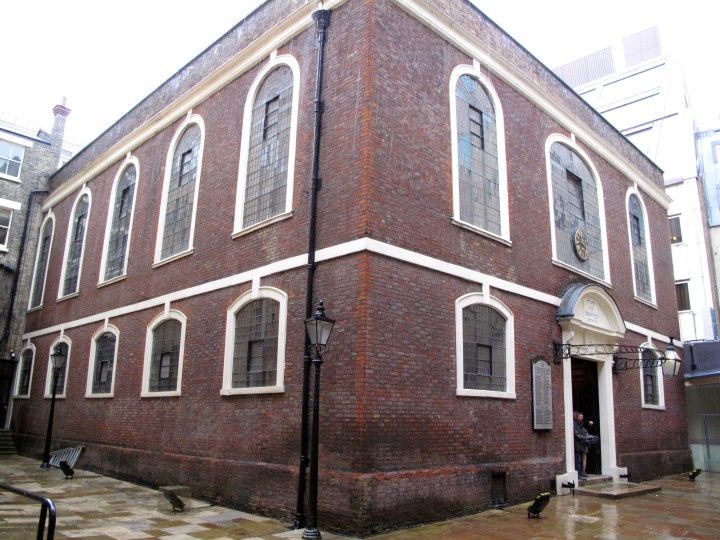
Joseph Avis, The Bevis Marks Synagogue in London, 1701
◊ ◊ ◊ ◊ ◊
A short walk from the Aldgate Tube stop and historically just north of the actual gateway, the Bevis Marks Synagogue was completed in September 1701, the work of Joseph Avis, a Quaker carpenter who had previously worked with Christopher Wren on St Bride’s in Fleet Street. With a few exceptions, the interior and furnishings of this Grade I listed building are original. Some of the benches, in fact, date to the middle of the seventeenth century, when the community met in the upper floor of a house in nearby Creechurch Lane.
It was under Cromwell that these Spanish and Portuguese Jews–many of whom had strong ties to Amsterdam–were legally recognized and allowed to practice their faith openly (in addition to the right to a space for worship, they were granted permission to establish a cemetery). Services today are carried out almost entirely in Hebrew, though there are two exceptions: announcement are made in Portuguese, and prayers for the Queen are said in English.
 Architecturally, the building relates to contemporary dissenting traditions and corresponds to the rebuilding of the fifty-one churches by Wren. One of the points I took away from the visit was simply how easy and useful it would be to include the Bevis Marks Synagogue when teaching Wren and the reconstruction of London following the Great Fire. It would provide a physically tangible way to engage the history of Jews in England, looking both backward and forward. One could, for instance, address the arrival of Jews with William the Conqueror, the expulsion under Edward I in 1290, and the migration of Jews from the Iberian Peninsula after 1492. Looking forward into the eighteenth century, I would like to know more about The Board of Deputies of British Jews, which was formally established on the accession of George III to the throne in 1760. With the synagogue, the character and limits of religious tolerance in the period are nicely introduced. As I’m really just thinking aloud here, I’m sure many of you who teach have already been doing
this and doing it well in your classes–so by all means feel free to chime in
with suggestions.
To all those keeping the fast, G’mar Tov.
-CH
On Site | Kladruby Abbey Church, Czech Republic
Eighteenth-Century Encounters: Kladruby Abbey Church, Czech Republic
By Michael Yonan

Jan Blažej Santini-Aichl, Abbey Church of Kladruby,
near Stříbro, completed in 1726 (Photo by Michael Yonan)
◊ ◊ ◊ ◊ ◊
For most eighteenth-century specialists, the phenomenon of the period’s Gothic revival architecture is principally understood as an English one. Less well known is existence of another eighteenth-century Gothic, this one Central European. I’m speaking of the series of so-called Czech ‘Gothic Baroque’ churches by the Prague-born architect Jan Blažej Santini-Aichl (1677–1723). This summer I traveled to western Bohemia and, generously stewarded by art historian Dr. Martin Mádl, was able to visit one of the more distinctive of Santini-Aichl’s buildings: the abbey church of Kladruby, part of a complex of ecclesiastical buildings that make up a Benedictine cloister, located not far from the town of Stříbro.1
 From a distance, the church doesn’t immediately reveal its eighteenth-century origins. Its height, the pinnacled columns, exterior buttresses, and of course ogive arches all suggest a medieval vintage. That is until one notices the centralized cupola, an element whose arrangement and form is not typically Gothic. Dislocations of style and date increase as one enters the church. As with many Gothic buildings, Kladruby has a basilican plan and employs architectural forms like pointed arches and ribbed vaulting. But few, if any, Gothic churches look quite like this. The ribbed vaults zigzag into stylized lilies, the coat-of-arms of the local abbots. The interior’s pink and pistachio green tonalities, its original hues, are more reminiscent of the rococo than of medieval churches. And the illusionistically painted dome, replete with saints tumbling through the heavens and an oculus representing the Holy Spirit, recalls seventeenth-century Roman predecessors more than Chartres or Ulm. Kladruby reveals itself to be a surprising synthesis of late baroque and medieval architectural styles.
What could possibly explain this? As an American art historian trained to see eighteenth-century art through specific narratives, I’ll confess that this building floored me. To understand it, it helps to know the monastery’s history and the unique culture of Czech religious communities. A church was first consecrated here in 1233, not long after the abbey’s formation. In subsequent centuries the community’s fortunes waxed and waned; it fell into disarray in the sixteenth century and was conquered and plundered during the Thirty Years’ War. Repairs to its buildings began in 1653, but in 1712 the presiding abbot, Maurus Fintzguth, commissioned Santini-Aichl to build an entirely new church, the one we see today, which was completed in 1726.
‘New’ is not quite the right term, however. Most of what one encounters at Kladruby dates, in fact, from the eighteenth century, but scholars have speculated that somewhere within the walls are fragments of the original church. In constructing this new building out of and on top of its predecessor, Santini-Aichl described his architectural process as one of renovation. He did more than simply reconstruct an old church or build a new one on its site, but rather constructed something that simultaneously evokes its predecessor, incorporates it, and improves upon it. In this respect, Santini-Aichl’s building maintains and visualizes the monastery’s medieval history, which Fintzguth viewed as a Golden Age, even as it celebrates its modern resilience.
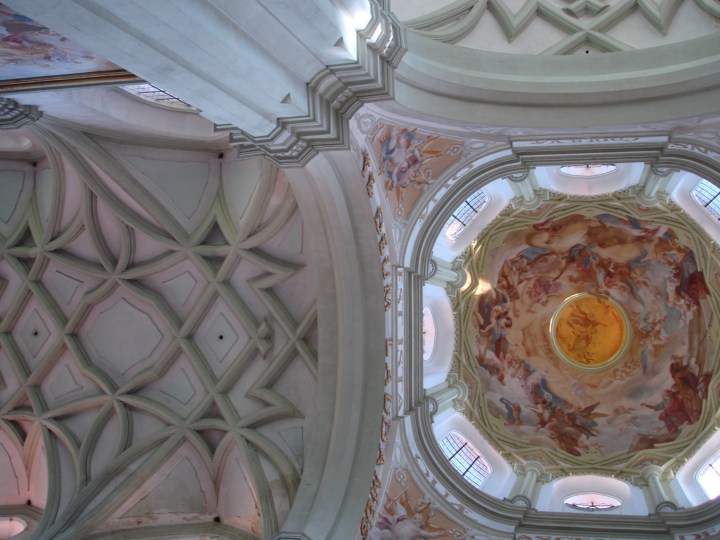
Some scholars have suggested that Kladruby is essentially an eighteenth-century building wrapped in Gothic skin, and indeed given what we know about the eighteenth-century love of surfaces, architectural and otherwise, this would seem to fit. But a recent article by the Czech art historian Pavel Kalina claims that the situation is actually more complicated.2 The interior ribbed vaulting is not used in a manner true to Gothic structural techniques, for sure, but neither is it entirely decorative. It’s somewhere in between, partially structural and partially ornamental, and in achieving this balance it combines medieval and eighteenth-century architectural knowledge. In this synthesis of old and new, Kalina argues, lie traces of dialogues between learned abbots and skilled artisans, as well as existential tensions between the abbey’s past and its present.
Kladruby isn’t an isolated example of such a synthesis. Santini-Aichl constructed a similar Gothic-baroque church at Sedlec, a village near the city of Kutná Hora, and he designed particularly daring synthesis of classical and Gothic architectural forms for the Pilgrimage Chapel of St. John Nepomuk at Žďár nad Sazavou. All are easily reachable as day trips from Prague.
◊ ◊ ◊ ◊ ◊
Notes
1. Three different 360-degree views of the church and its surroundings are available at 360globe.net. Martin Mádl’s wife, Claire Mádl, is editor and co-founder of the journal Cornova, the ‘Eighteenth-Century Studies’ of the Czech Republic.
2. Pavel Kalina, “In opere gotico unicus: The Hybrid Architecture of Jan Blažej Santini-Aichl and Patterns of Memory in Post-Reformation Bohemia,” Umění 58 (2010): 42–56.
◊ ◊ ◊ ◊ ◊
President of HECAA, Michael Yonan is Associate Professor of Art History at the University of Missouri-Columbia. His book, Empress Maria Theresa and the Politics of Habsburg Imperial Art, appeared in 2011 from Penn State University Press.
Walking Tour of London’s Coffehouses
From Unreal City Audio:
Tour of London’s Coffeehouses with Matthew Green
Unreal City Audio: London Walking Tours, Next tour is 28 July 2012
 Join actors, musicians, and Dr Matthew Green for a caffeinated tour of London’s original – and best – coffeehouses: from the City’s warren of medieval streets, through St Paul’s Churchyard, down historic Fleet Street, and into the cobbled courtyards of the Temple. Free shots of black and gritty coffee, brewed after the 18th-century fashion, included.
The streets of London are awash with chain coffee shops. But they are a dismal incarnation of London’s historic coffee culture: a heady brew of wit, wisdom, innovation…and crucified crocodiles.
London’s love affair with coffee can be traced back 350 years to a muddy churchyard in the heart of the City of London. Dr Green will meet you in this churchyard for it was here, in 1652, that a Greek visionary with a twirly moustache and shocking English accent first sold a foul-looking liquid to the public. Coffee would transform the face of the metropolis forever, spawning more than 3,000 coffeehouses, triggering a media boom, scientific discoveries, literary excellence, freedom of speech, dolphin dissections, and imperial triumphs. It was coffee, not tea, that built the British Empire.
Learn about the meteoric rise of the coffeehouses in the 17th century as you weave past their original sites on Cornhill, Cheapside, St Paul’s and Fleet Street; jolt as actors in period costume leap out performing real debates that raged around their candlelit tables hundreds of years ago; hear Dr Green tell stories of the kaleidoscopic activities that went on inside their walls: from dolphin dissections at the Grecian Coffeehouse to lethal duels over Latin grammar at Tom’s; from slave auctions at Garraway’s to ventriloquism and viper decapitations at John’s.
Marvel at a world where you could begin a conversation with anyone you liked simply by asking for the latest news; feel a tinge of nostalgia for this lost world of social conviviality as you gaze through the windows of the cloned coffeehouses that have usurped the City.
◊ ◊ ◊ ◊ ◊
The route (from a previous tour) is available here»
Versailles 3D
Thanks to David Pullins for sharing news of this collaborative project between Versailles and Google:
◊ ◊ ◊ ◊ ◊
Palace History Gallery at Versailles
Château de Versailles, opened 14 June 2012
 What did Versailles look like before Louis XIV? How did the small hunting lodge of Louis XIII become the largest Palace in Europe? What embellishments did the young Sun King want in his Palace of festivities and amusements? Did you know that the Hall of Mirrors was originally a terrace overlooking the gardens?
The palace of Versailles is a unique place, a royal residence, a history museum and a Republican palace. The complexity of the site needs to be explained to the over 6 million visitors from all over the world who come to Versailles each year. The Palace of Versailles, in partnership with Google, opens the Palace History Gallery on 14 June 2012. As a prologue to the visit to the State Apartments, eleven rooms explain to visitors the richly varied functions of the places they are about to explore. The visit combines the presentation of the collections of Versailles with physical scale models and striking 3D reconstructions.
Google / Versailles Partnership
The technological programme rolled out to accompany the opening of the Palace History Gallery is the fruit of close collaboration over more than a year between the teams of the Palace and those of Google. An ambitious technological policy has been implemented in Versailles for several years now to back up its scientific and cultural communication, disseminate knowledge about it more widely and develop new links with the visitors and with new audiences. From the origin of the project, the exhibition curators decided on the role and the scope of the multimedia in each exhibition and online. The partnership with Google provided the opportunity for a more in-depth approach to the use of technologies to develop, enliven and make more incisive its scientific and cultural communication. 3D technology, in particular, is used extensively in different media (in the rooms, on the Internet, on mobile terminals). Google’s Cultural Institute develops technological solutions for viewing, hosting and digitising materials to favour the creative presentation, protection and promotion of culture online.
Thanks to its dedicated team of engineers, Google’s Cultural Institute has already collaborated with organisations in several countries on different projects, notably for putting online thousands of artworks in the framework of the Art Project, the digitisation of the archives of Nelson Mandela and the Dead Sea Manuscripts.
Iza Wojciechowska on Polish Palaces for The NY Times
From The NY Times:
Iza Wojciechowska, “Palace Hopping in Poland,” The New York Times (15 June 2012). . .
 WHEN I was a little girl living in Texas and visited my family in Poland, my grandfather would always take us to palaces. He had been an art historian and curator of a couple of the palaces around Warsaw during some of Poland’s bleakest years of Communism, and even though I was too young to understand that era, or much of Poland’s complicated history, I knew that through these palaces, something about Poland and its once-luxurious glory had been preserved. My imagination conjured images of princesses running through lavishly decorated hallways and grand, echoing rooms.
There are about 250 palaces in the province that surrounds Warsaw and about 2,800 throughout all of Poland. Most were built for kings or aristocrats in the 17th and 18th centuries; since then, government ministries have restored many of them, which now serve as museums. . .
The full article is available here»
Dumfries House in Architectural Digest, February 2012
It’s a widely-shared sentiment, but I think Margaret Russell is doing a fantastic job as editor at Architectural Digest (Penelope Green’s New York Times coverage of the appointment is available here). This month’s issue of AD includes a fine feature, with lovely photos by Derry Moore, on Dumfries House (having just returned from Venice, I’m especially struck by the stunning Murano chandeliers!, original to the house). A Christie’s press release for the planned 2007 sale underscores just how fortunate we are to have the house and its contents still intact. The design team included Piers von Westenholz and David Mlinaric (along with the 2008 book on Mlinaric’s work from Frances Lincoln publishers, there’s an interesting interview with him at the V&A’s website) . -CH
◊ ◊ ◊ ◊ ◊
From Architectural Digest:
James Reginato, “Prince Charles Unveils Dumfries House,” Architectural Digest (February 2012): 58-69.
Scotland’s most dazzling historic country house opens its doors after a rejuvenation spearheaded by His Royal Highness the Prince of Wales

John and Robert Adam, Dumfries House, Ayrshire, Scotland, 1754-59 (Photo by Derry Moore for Architectural Digest)
Several years ago, a major drama unfolded in Great Britain when Dumfries House, one of the most significant and beautiful historic properties in the Commonwealth, teetered on the verge of sale and dispersal. The 18th-century Palladian villa in Ayrshire, Scotland, is a seminal work of renowned architect Robert Adam and his brothers, John and James; it contains a world-class collection of British Rococo furniture, including some 50 examples from a fledgling cabinetmaker named Thomas Chippendale. Ordered straight from the craftsman’s workshop in 1759 by the fifth Earl of Dumfries, who commissioned the house and took up residence there the following year, the furnishings now form part of a magnificent
ensemble that embodies, in the words of His Royal Highness
the Prince of Wales, “British craftsmanship at its best.”

Blue Drawing Room, Dumfries House (Photo by Derry Moore for Architectural Digest)
The fate of the mansion had begun to seesaw in 2005, when John Crichton-Stuart, the seventh Marquess of Bute (a celebrated Formula One driver whose family had inherited the Dumfries title in the early 19th century), felt the strain of balancing its ownership with that of Mount Stuart, the immense Victorian Gothic palace and grounds where he currently resides. Dumfries, exquisite and well looked after though it was, had not been lived in by the family for some 150 years, except for a near-40-year residency by the fifth marquess’s widow, from 1956 to 1993. It truly was a sleeping beauty.

Family Bedroom, Dumfries House (Photo by Derry Moore for Architectural Digest)
When a deal to sell the 2,000-acre property to the Scottish National Trust fell through, Lord Bute took the bold move of marketing it via an estate agency and hiring Christie’s to sell off its holdings. Experts at the auction house began documenting the contents of the mansion; a two-volume catalogue was produced, and sale dates were set for July 12 and 13, 2007.
Just weeks before the auction, however, Dumfries’s plight came to the attention of Prince Charles—a tireless, and rather fearless, advocate of British heritage. . . .
More of the online excerpt of the story and additional photos are available at Architectural Digest.com
◊ ◊ ◊ ◊ ◊
For bloggers and bloggers-to-be, there’s a useful video clip of Margaret Russell speaking in New York at Kravet’s Design BlogFest (18 May 2011). Her appearance underscores, I think, both how hard she’s working to breathe new life into AD and how much blogs have changed the design landscape.
Touro Synagogue — Newport, Rhode Island
The November/December 2011 issue of Preservation highlights a dozen National Trust Historic sites, across the United States, from James Madison’s Montpelier (1797) in Virginia to the Cooper Molera Adobe (1823) in Monterey, California. One that caught my eye, in particular: the Touro Synagogue (1763) in Newport, Rhode Island. From Lauren Wasler’s article in Preservation:
◊ ◊ ◊ ◊ ◊
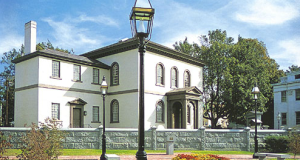 In 1658, 15 Jewish families whose ancestors had fled the Inquisition in Spain and Portugal arrived in Rhode Island by way of the West Indies. Settling in Newport, they established a close-knit community and founded a congregation in a colony already recognized for its religious tolerance. A century later, Isaac Touro became the congregation’s first spiritual leader and was part of the effort to build an elegant house of worship for the faithful.
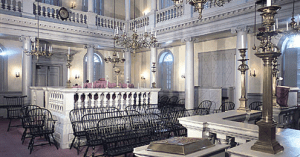 Today, that synagogue endures atop a hill near the city harbor—a living monument to religious freedom. “This is both a historic site and a functional synagogue. It has two distinct purposes,” says Chuck Flippo, manager of Touro Synagogue’s visitors center. “Come in the afternoon and you’ll see it as a historic site with guided tours. Come back in the evening and it reverts to its other role—its primary role—as a synagogue.”
Touro, the oldest standing synagogue in the United States, remains virtually unaltered since it was completed and dedicated in 1763. Designed by Peter Harrison, a British American merchant, sea captain, and self-taught architect, the two-story Palladian structure accommodates the religious needs of a typical Jewish congregation (for example, the ark containing the sacred scrolls is positioned so that worshipers can pray facing Jerusalem), while also reflecting New Englanders’ preference for restraint. Twelve Ionic columns (one for each tribe of Israel) support a second-story gallery; Corinthian columns ringing the gallery support the domed ceiling. Declared a National Historic Site in 1946, the synagogue became a National Trust Historic Site in 2001. . . .
The full article is available here»
Holiday Gift Guide, Part 5: Historic Holiday Rentals
Back in September of 2009, I included a posting on the UK’s Landmark Trust, which rents some remarkable historic properties. Now at the end of another semester, as I’m facing piles of papers to grade (how could I possibly have gotten so far behind in just the past week?), daydreaming about quiet retreats is pretty tempting. Even grading those final exams in these wonderful locales wouldn’t seem quite so bad. What a lovely present indeed! The descriptions come from the Trust’s website (with the italics as my own additions) -CH
◊ ◊ ◊ ◊ ◊
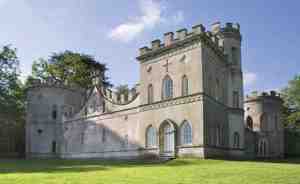 Clytha Castle — Near Abergavenny, Monmouthshire, Wales (1790s)
Roasted chestnuts, anyone? Maybe just the place after a visit to the newly restored Strawberry Hill.
This most affecting folly, which we lease from the National Trust, stands on the summit of a small hill, at the edge of a grove of old chestnuts. It was designed by a little-known architect and garden designer, John Davenport, perhaps with help from his client. Besides being an eye-catcher, the castle was used for grand picnics and as a retreat; the square tower contains fine rooms on both floors. When we arrived it had been empty for twenty-five years and before that had housed a gamekeeper. After more than thirty years as a Landmark, we carried out a major refurbishment in 2007 and reorganised the accommodation, making the circular room in the south turret a kitchen-dining room looking out into the clearing in the woods. . .
◊ ◊ ◊ ◊ ◊
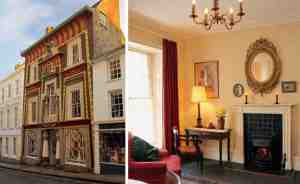 The Egyptian House — Chapel Street, Penzance, Cornwall (1830s)
Yes, I know, it’s a nineteenth-century house, but just the place for serious reflection on the Empire Style and Egyptomania. It was presumably inspired by the Egyptian Hall in Piccadilly, London (1812), which housed William Bullock’s collection, including items brought back by Captain Cook.
This unusual house is a rare and noble survivor of a style that enjoyed a vogue after Napoleon’s campaign in Egypt in 1798. It dates from about 1835 and the front elevation is similar to that of the former Egyptian Hall in Piccadilly, designed by P. F. Robinson. Robinson or Foulston of Plymouth are the most likely candidates for its design, though there is no evidence to support the claim of either.
It was built for John Lanvin as a museum and geological repository. When we acquired it in 1968, its colossal façade, with lotus-bud capitals and enrichments of Coade stone, concealed two small granite houses above shops, solid and with a pleasant rear elevation, but very decrepit inside. During our work to the front, we reconstructed them as three compact apartments, the highest of which has a view through a small window of Mounts Bay and St Michael’s Mount over the chimney pots of the town.
Why was there a geological shop here? Although picked over by Victorians (doubtless including Mr Lanvin) the beaches at Penzance still hold every kind of pebble, from quartz to chalcedony. You will find yourself at the bustling heart of Penzance, a handsome town accessible by train as well as road, where the pulse of the late nineteenth-century colony of artists known as the Newlyn School still beats strongly. Beyond it lies that hard old peninsular in which, at places like Chysauster and the Botallack mine, can be found moving evidence of human labour over an immense span of time.
◊ ◊ ◊ ◊ ◊
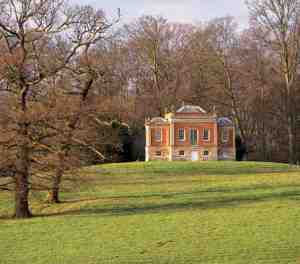 The Chateau — Gate Burton, Lincolnshire (ca. 1750)
Built as a weekend retreat from the city of Lincoln, it would seem ideally suited for getting away from it all.
This is the earliest recorded building by John Platt of Rotherham, designed in 1747 when he was 19 and almost his only work outside Yorkshire, where he practised and prospered for the next 50 years.
It stands on a grassy knoll above a big bend of the River Trent, on the edge of Gate Burton park. Built as a Gainsborough lawyer’s weekend retreat, and later used for picnics and other mild kinds of excursion, it had since been altered and then neglected. Its present owner gave us a long lease of it.
We have restored the Château to its original elaborate and slightly French appearance, an ornament in the landscape, which shows up well from the road some distance away. John Platt must have been a talented young man, because it is difficult to realise until one is inside just how small the scale of the building is; apart from the principal room upstairs, which has a high coved ceiling, there is little space in which to swing a cat. But there are fine views across the park and up a shining reach of the River Trent, along which big slow barges, piling the water in front of them, press on towards an enormous power station, whose cooling towers steam majestically in the distance.
◊ ◊ ◊ ◊ ◊
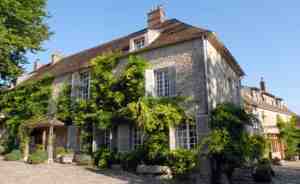 Le Moulin de la Tuilerie — Gif-sur-Yvette, Essonne (near Paris)
An eighteenth-century converted mill house that came to be home for the Duke and Duchess of Windsor, it’s perfect for anyone enamored of the story. I imagine we’re all going to hear lots more about the couple in the coming weeks with the wide release of Madonna’s new film, W.E.
The three buildings on the lovely site known as Le Moulin de Tuilerie in the town of Gif-sur-Yvette are our first French Landmarks. This was the former country weekend residence of the Duke and Duchess of Windsor. Edward VIII abdicated from the British throne in 1936 to marry the woman he loved, a twice divorced American, Wallis Simpson. In exile after the war, the Duke and Duchess of Windsor settled in Paris and Le Moulin de la Tuilerie was the only house they ever owned.
The Windsors were leading lights of international café society, and entertained the glitterati of the 1950s and 60s here, including Maria Callas, Marlene Dietrich, Elizabeth Taylor & Richard Burton, and Cecil Beaton. Edward especially was captivated by the site and commissioned English garden designer, Russell Page, to design the gardens, which he tended himself and whose layout remains today. The buildings are set around a courtyard behind huge oak gates, and the grounds open miraculously to views of the valley beyond. Each Landmark has a private terrace, and all who stay can wander the extensive grounds, parterre merging into ancient rocky woodland full of birdsong, where the Windsors buried their beloved pugs.
Le Moulin de la Tuilerie is on the edge of the town of Gif-sur-Yvette, approximately 35km south-west of Paris – a perfect staging post for journeying on to the rest of France. Just as for Edward and Wallis, still today this is a place for contrasts: a wonderful setting to play host, or enjoy deep tranquillity; an easy day trip by direct train to the bustle and culture of central Paris or the delights of Versailles, and yet a place where the city finally yields to deep countryside.










 Enfilade
leave a comment