Hôtel de la Marine Opens after €132m Restoration

Located in Paris on the Place de la Concorde, the Hôtel de la Marine was designed by Ange-Jacques Gabriel in the 1750s and completed in 1774. It opened to the public earlier this month. (Photo by Jean-Pierre Delagarde for Centre des monuments nationaux).
◊ ◊ ◊ ◊ ◊
From The Art Newspaper:
Sarah Belmont, “Paris’s Landmark Hôtel de la Marine Opens to Visitors—and Co-working Offices—after Four Years of Restoration,” The Art Newspaper (14 June 2021). The 550-room palace has undergone a €132m makeover by the Centre des Monuments Nationaux.
France’s Centre des Monuments Nationaux (CMN) has unveiled a new-look Hôtel de la Marine in Paris after a four-year restoration project costing €132m. The 18th-century state apartments, 19th-century reception rooms and a shop opened to the public on 12 June, with a gourmet restaurant and new displays dedicated to the private collection of Qatar’s Al-Thani dynasty to follow this autumn.
Located on the Place de la Concorde between the Champs-Élysées and the Tuileries gardens, the Hôtel de la Marine was designed in 1758 by Ange-Jacques Gabriel, the chief architect to King Louis XV. The 550-room palace served as the Crown’s furniture storage unit, the Garde-Meuble, before becoming the headquarters of the French navy for more than 200 years. It is where is where the Crown Jewels were stolen during the Revolution in 1792, where the decree that abolished slavery in France and its colonies was signed in 1848, and where sumptuous balls were held throughout the 19th century. . . .
The full article is available here»
Additional information and photos are available at a posting by Heather Clawson, for her blog Habitually Chic (6 June 2021).
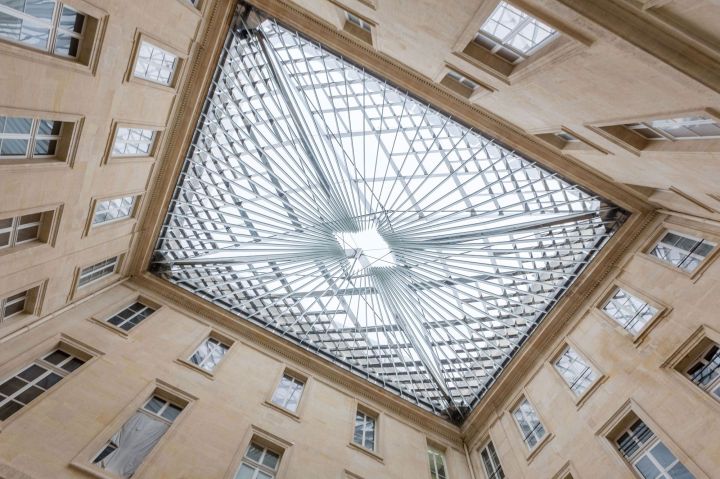
An courtyard of the Hôtel de la Marine has been covered with a new glass roof designed by Hugh Dutton in collaboration with Christophe Bottineau, the chief architect of French historic monument (Photo by Cedric Berieau for the Centre des monuments nationaux).
NMWA’s Comprehensive Renovation To Begin in August
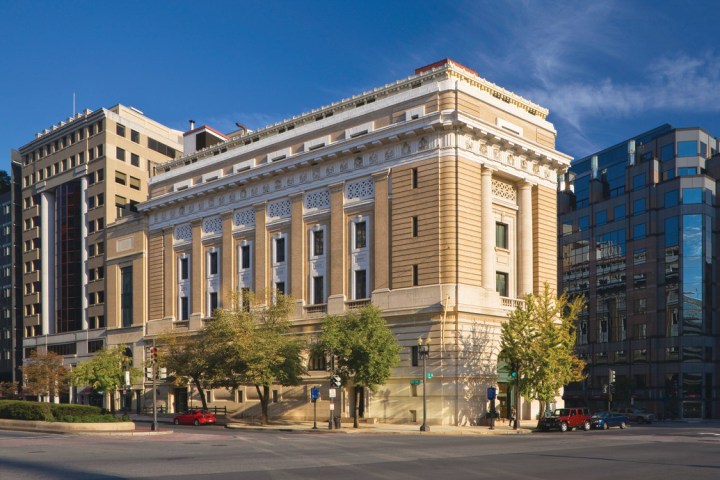
National Museum of Women in the Arts, Exterior, 13th Street and New York Avenue sides, Washington, D.C.
(Photo by Thomas H. Field, September 2008)
◊ ◊ ◊ ◊ ◊
From the museum’s press release (17 May 2021) . . .
Upgrades to historic building will enhance exhibition galleries, programming, scholarship, and accessibility and improve visitor experience.
The National Museum of Women in Arts (NMWA), the world’s only major museum solely dedicated to championing women artists, announces a plan for the comprehensive renovation of the museum’s historic building at 1250 New York Avenue, NW, in Washington, D.C. State-of-the-art upgrades to the museum’s home, a 1908 Classical Revival structure listed on the National Register of Historic Places, will expand NMWA’s exhibition space and enhance its programming, strengthening its work for years to come. The plan requires the building to close to the public beginning 9 August 2021. Construction will commence on 1 September 2021 and will be completed in approximately two years.
The building’s first full renovation since 1987, the $66 million project will honor the structure’s history while improving its interior spaces, mechanical systems, and exterior envelope. The long-planned updates include enlarged gallery space to showcase historic and contemporary artworks and installations; a new destination for researchers and education programs; and enhanced amenities and accessibility for visitors. Infrastructure and storage upgrades will bolster the long-term conservation and security of the museum’s collection of more than 5,500 works.
“From its home in the nation’s capital, NMWA has given deserved prominence to groundbreaking women artists of the past and present for nearly 35 years, but the goal of equity for women through excellence in the arts has yet to be achieved,” said NMWA Director Susan Fisher Sterling. “This renovation will ensure that the museum continues to promote the contributions of women artists in ways that engage audiences and advocates of tomorrow. Thanks to our founder Wilhelmina Cole Holladay and her husband Wallace—whose bold and ambitious vision led them to collect art by women and create a museum for its permanent display—our building is the center of a worldwide movement that champions women in, and through, the arts.”
Beginning in 2015, NMWA undertook a rigorous assessment of the historic building and created an extensive plan for renovations that apply recent advances in engineering, building codes, and sustainability. The Baltimore-based architectural firm Sandra Vicchio & Associates was chosen to lead the project.
“It is a majestic structure—timeless and beautiful,” said Vicchio. “To protect the collection and enable NMWA to educate and engage the world more effectively, we must upgrade the building’s envelope, improve the performance of its systems, and make better use of its interior space. Revitalizing the building is all about positioning the museum for a triumphant future.”
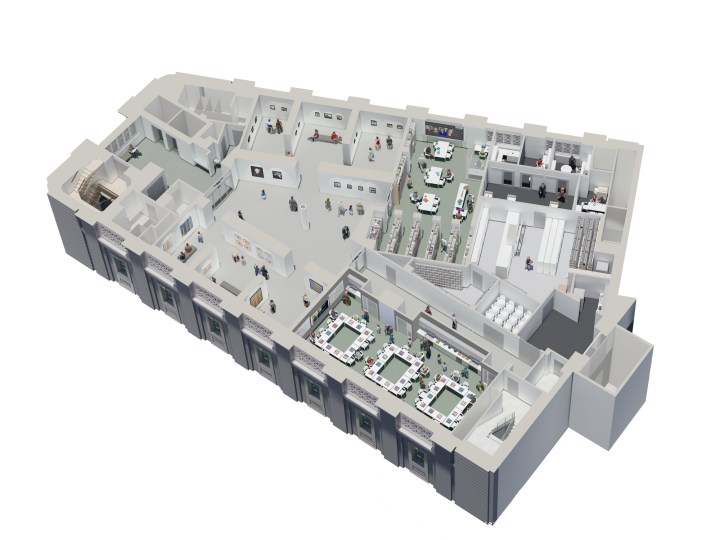
Learning Commons, National Museum of Women in the Arts Renovation Project
(Rendering by Sandra Vicchio & Associates, LLC, with Marshall Craft Associates, Inc.)
The renovation project at NMWA will include
• Transforming the building to provide easier access for all visitors, with upgraded technologies and amenities as well as improved ADA accessibility
• Dedicating a new orientation gallery in the Great Hall that welcomes visitors, introduces the museum’s mission, and tells stories of women artists
• Renovating and enlarging galleries to accommodate historic and contemporary artworks and multifaceted installations
• Creating a new Learning Commons that features a major exhibition gallery, a state-of-the-art Library and Research Center, Reading Room, and an Education Studio for hands-on workshops, curated conversations, and classes, as well as flexible space for rehearsals and other museum events
• Improving wireless and touch-screen technology in galleries, which will enhance visitors’ experiences and learning opportunities with additional connectivity
• Updating the Great Hall and Mezzanine to preserve these iconic spaces while improving their functionality for museum events and facility rentals
• Installing new lighting, climate control, and security technology to support long-term conservation of the art and the overall comfort of visitors
• Enhancing collection storage space to store art more efficiently and care for works of art more effectively
• Improving signage to provide better wayfinding and easy-to-follow pathways throughout the museum
• Restoring the roof, historic cornice, and the building exterior in accordance with the D.C. Historic Preservation Office
During the closure, NMWA will continue to offer a robust slate of online programs and events, virtual exhibitions and digital content. Plans are also underway to present off-site exhibitions and special events.
In less than two years, NMWA has raised over $50 million towards a capital campaign goal of $66 million. With the advent of the COVID-19 pandemic and rising costs in the construction industry, the renovation project costs have grown. Building on the campaign’s robust beginnings, NMWA will continue to solicit gifts throughout the life of the campaign.
“This renovation was the dream of our founder Wilhelmina Cole Holladay, who died on March 6th at age 98,” said Winton S. Holladay, Vice-Chair of the NMWA Board. “In the campaign’s quiet phase, donors and friends have stepped up in wonderful ways, putting us within sight of our campaign goal. With Billie’s passing, we are honored to carry her vision forward by completing this campaign and restoring our building for future generations.”
The museum’s capital campaign is directed by a steering committee of NMWA trustees, advisors, and senior museum staff and is currently supported by gifts from individuals, foundations, and corporations. In addition, the museum has received federal and city funding through competitive grants from the Institute of Museum and Library Services (Museums for America Grant) as well as a first-ever 2020 Cultural Institutions grant from Events DC, a semi-public company supported by D.C. taxpayer funds.
For more information, the capital campaign website displays renderings, tracks project progress, and offers ways to get involved.
About the Historic Building
Designed by the architecture firm Wood, Donn & Deming, the museum’s Classical Revival-style building was completed in 1908 as a temple for the Masons, an organization that did not allow women members. The 78,810-square-foot main building is listed on the DC Inventory of Historic Sites and the National Register of Historic Places. The exterior façade incorporates Tuscan and Mediterranean design elements in addition to Masonic symbolism.
In 1983, Wilhelmina and Wallace Holladay purchased the property to establish a museum dedicated to women artists. The building was refurbished in accordance with the highest design, museum and security standards. After the extensive renovations, which won numerous architectural awards, the National Museum of Women in the Arts opened to the public on 7 April 1987. In 1993, the museum purchased 5,300 square feet of adjacent property, and, following further renovation, the Elisabeth A. Kasser Wing opened in 1997, making the entire facility 84,110 square feet.
New Book and Podcast | 125 Treasures
Hubert Martinet, Elephant Automaton, ca. 1770
(National Trust / Waddesdon Manor)
◊ ◊ ◊ ◊ ◊
In addition to this book celebrating the 125th anniversary of the National Trust (in 2020), the project includes a podcast, hosted by Alison Steadman, the first episode of which addresses Waddesdon Manor’s Elephant Automaton, made by Hubert Martinet (ca. 1770). Tessa Murdoch writes about the elephant for Apollo Magazine (14 May 2021), noting that “an in-depth study of the automaton, written by Jonathan Betts and Roger Smith, is also forthcoming.”
◊ ◊ ◊ ◊ ◊
Tarnya Cooper, 125 Treasures from the Collections of the National Trust (Swindon: National Trust Books, 2021), 224 pages, ISBN: 978-0707804538, £10.
 This engaging, beautifully illustrated book brings together a selection of highlights from the National Trust’s vast collection. Arranged chronologically, starting with Roman sculpture and ending with 20th-century design, it focuses on museum-quality objects as well as important examples of decorative arts, furniture, textiles and objects with fascinating stories. The highlights—from Cardinal Wolsey’s purse to Rodin’s bust of George Bernard Shaw—are illustrated with exquisite photography and accompanied by illuminating captions. Based on the dedicated research of over 60 curators across the organisation, the book also includes a timeline of key moments in the Trust’s history.
Tarnya Cooper is the Curatorial and Collections Director at the National Trust.
Excavating James Madison’s Montpelier

Transferware ceramics, Bride of Lammermoor pattern, after 1819, when Sir Walter Scott’s novel was published.
◊ ◊ ◊ ◊ ◊
From the most recent issue of Preservation Magazine:
Meghan Drueding, “Ceramic Fragments Provide Clues to an Enslaved Community’s Past,” Preservation Magazine (Spring 2021), p. 16.
What does a one-inch-square scrap of an old ceramic teacup mean? Plenty, when it’s found during an archaeological dig at James Madison’s Montpelier, a National Trust Historic Site in Orange County, Virginia.
The dig took place over a four-year period ending in 2016, and focused on the South Yard, which contained housing for many of the people enslaved by the Madison family. It yielded thousands of ceramic pieces from hundreds of china patterns. Their existence revealed that members of Montpelier’s enslaved community often purchased their own ceramics using money they earned through activities like raising livestock, growing vegetables, or sewing—on top of the unpaid work the Madisons required of them.
“The ledger books survive from at least one nearby store,” says Mary Furlong Minkoff, curator of archaeological collections. “We have records of people we know were enslaved at Montpelier buying things for themselves.” . . .
The full article is available here»
Location of 1634 St Mary’s Fort Discovered
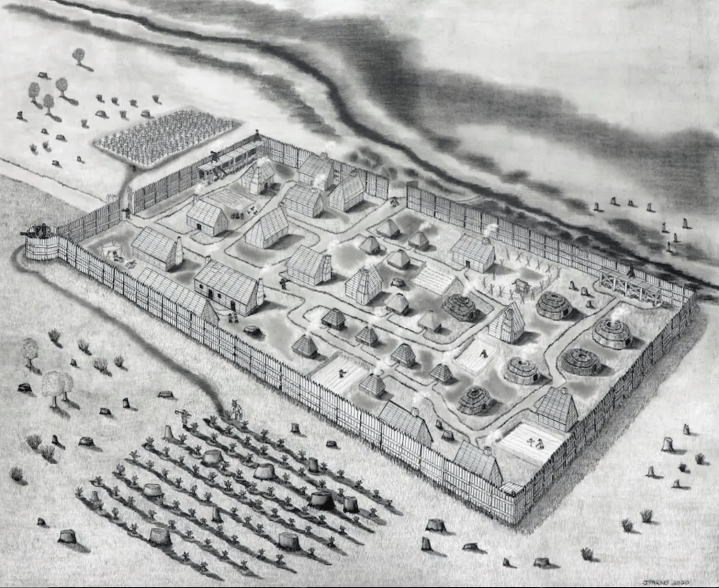
Conjectural drawing of the 1634 fort at the St. Mary’s settlement in Maryland (Jeffrey R. Parno/Historic St. Mary’s City). Interestingly, the outline of the fort does not match a 1634 description of it made by the governor, Philip Calvert.
◊ ◊ ◊ ◊ ◊
St. Mary’s City served as the capital of the Providence of Maryland until 1694, when the capital of the royal colony was moved to Annapolis. For more information on the discovery of the site of St. Mary’s Fort, see Michael Ruane’s reporting for The Washington Post. From the HSMC press release (22 March 2021). . .
In honor of Maryland Day (25 March 2021), Historic St. Mary’s City announces today that Dr. Travis Parno, Director of Research and Collections for Historic St. Mary’s City, and his team have located the site of the original St. Mary’s Fort, the 1634 palisaded fort erected by the first wave of European settlers who founded Maryland. The site, which spans an area approximately the size of a football field, is located in Historic St. Mary’s City (HSMC) in Southern Maryland.
“Finding the location of Maryland’s original settlement is truly exciting news for our state and will give us an opportunity to reconnect with our pre-colonial and early colonial years,” said Governor Larry Hogan. “The state has been proud to support the study of St. Mary’s Fort and looks forward to further excavation of the area as we approach our state’s 400th anniversary,” Governor Hogan added.
St. Mary’s Fort was the first major foothold of European settlement in the state and the fourth English colony in the country after Jamestown (1607), Plymouth (1620), and Massachusetts Bay (1630). In March of 1634, approximately 150 Maryland colonists arrived on two ships, Ark and Dove, in an area that was home to the Yaocomaco, a tribe loosely allied with the Piscataway paramount chiefdom. What little is known about this period is drawn from English colonial records. The archaeological study of St. Mary’s Fort has the potential to unearth new information about Maryland’s pre-colonial and early colonial past.
Members of the HSMC Department of Research and Collections have been conducting fieldwork within the St. Mary’s City National Historic Landmark area since 1971, but definitive traces of St. Mary’s Fort remained elusive until a 2018 grant from the Maryland Historical Trust allowed Parno to hire geophysicist Dr. Timothy J. Horsley to survey two suspected locations using magnetic susceptibility, magnetometry, and ground-penetrating radar. The results, which were verified via a brief archaeological dig, confirmed the fort’s exact location.
The study of St. Mary’s Fort is part of a larger initiative titled People to People: Exploring Native-Colonial Interactions in Early Maryland, scheduled to begin in 2021. Created as a collaborative effort between Historic St. Mary’s City and Piscataway tribal participants, the project will include archaeological excavations at St. Mary’s Fort and indigenous sites near the fort, interpretation and exhibits of native and colonial culture, and public programming about life in the region in the years prior to and during the early seventeenth century.
Parno is currently consulting with Piscataway tribal participants and other stakeholders, and excavations of St. Mary’s Fort are ongoing thanks to the support of private donors and funds provided by Governor Hogan’s office. With the support of the State, St. Mary’s Fort will be integrated into Historic St. Mary’s City’s living history program in time for the state’s 400th anniversary in 2034. In the meantime, the excavation site is open during public visitation hours.
A formal online announcement will premiere 25 March 2021, at 7pm (EST) on the HSMC Maryland Day event page. No registration needed; the premiere will be free and open to the public.
Decorative Arts Trust Announces Recipients of IDEAL Internship Grants
Press release (9 March 2021) from The Decorative Arts Trust:

Samuel Whitehorne House (1811), Newport, Rhode Island. Newport Restoration Foundation bought the Federal period brick mansion in 1969. Five years later, it was opened as a public museum dedicated to 18th-century Newport furniture and related decorative arts.
The Decorative Arts Trust is pleased to announce that the Atwater Kent Collection at Drexel University; The Historic New Orleans Collection and the Backstreet Cultural Museum; the Museum of Fine Arts, Boston; and the Newport Restoration Foundation are the inaugural recipients of IDEAL Internship Grants.
Part of the Trust’s growing Emerging Scholars Program, IDEAL Internships focus on inclusivity, diversity, equity, access, and leadership. Internship grants are awarded to non-profit institutions and require a strong mentorship component.
“The Decorative Arts Trust is striving to improve access to curatorial careers for students of color as a path toward achieving systemic change,” Trust Executive Director Matthew Thurlow states. “These partners were selected based on the impact of the internship, which will offer students experience and stipends while providing the host organizations the opportunity to continue meaningful discussions about inclusion, diversity, and equity.”
Drexel University is stewarding the collection of the former Philadelphia History Museum at the Atwater Kent, which closed in 2018. Drexel’s Lenfest Center for Cultural Partnerships is conducting a multiyear evaluation of the Atwater Kent Collection of over 133,000 works of art and other objects. The intern will focus on exhibitions highlighting little-known objects for galleries at the Peck Alumni Center and the Pearlstein Gallery.
The Historic New Orleans Collection (THNOC), in partnership with the Backstreet Cultural Museum, seeks an intern to further the study and preservation of Mardi Gras Indian suits. The intern will catalog a newly acquired suit, document its history by interviewing the artist, plan a permanent storage solution, prepare the suit for display in an upcoming exhibition, and write an article for an online publication.
The Museum of Fine Arts, Boston intern will focus on a gallery reinstallation project that explores the connections between art, modern design, and jazz in the 1930s, 40s, and 50s. The intern will assist with object research, develop interpretive text, lead gallery tours, and host programs to engage a range of communities with the project.
The Newport Restoration Foundation will hire an intern to analyze their collection of 18th-century furniture at the Whitehorne House Museum. The intern will work with the interpretive staff to address the absences of African-Heritage craftspeople (both enslaved and free) as well as Narragansett peoples in Colonial-era Newport’s material culture.
The Decorative Arts Trust is a non-profit organization that promotes and fosters the appreciation and study of the decorative arts through exchanging information through domestic and international programming; collaborating and partnering with museums and preservation organizations; and underwriting internships, research grants, and scholarships for graduate students and young professionals. Learn more about the Trust at decorativeartstrust.org.
In Memoriam | Wilhelmina Cole Holladay (1922–2021)
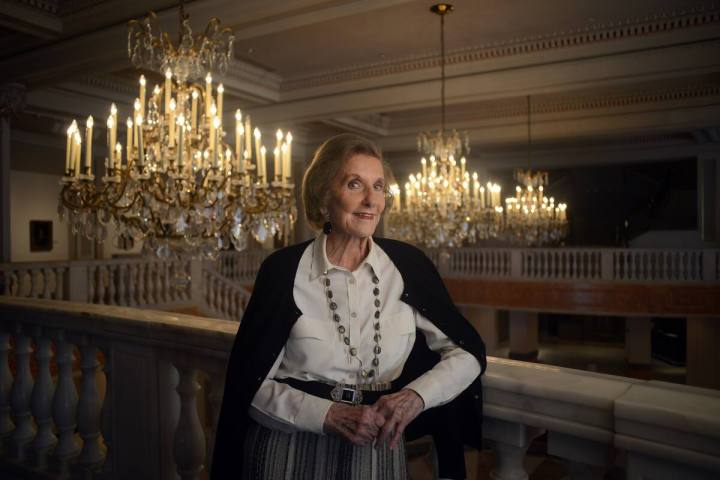
Press release (8 March 2021) from the NMWA:
Wilhelmina Cole Holladay, who founded the National Museum of Women in the Arts (NMWA), the first and only museum solely dedicated to championing women through the arts, died on Saturday, 6 March 2021, at the age of 98 in Washington, D.C. Against tremendous odds and with dedication, drive, and a singular vision, Holladay created a museum to help alleviate the underrepresentation of women artists in museums and galleries worldwide.
“For nearly 40 years, Wilhelmina Holladay has been the guiding light of our museum,” said Director Susan Fisher Sterling. “Mrs. Holladay knew the power of art and the importance of women in art and in the world. Her foresight in recognizing women artists of the past and championing women artists of the present by creating a new museum was visionary—even revolutionary—for the time. Her actions signaled a major shift in our thinking about art and society, and it is her genius and purpose we carry forward with us today.”
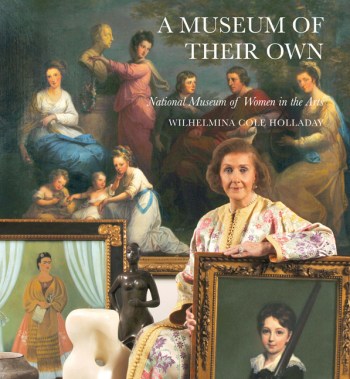
Wilhelmina Cole Holladay, A Museum of Their Own: National Museum of Women in the Arts (New York: Abbeville Press, 2008).
“Wilhelmina, ‘Billie’ as she was known to her friends, believed deeply in philanthropy and volunteerism,” said Board Vice-Chair and daughter-in-law Winton Smoot Holladay. “Her leadership and generosity established the museum, and she worked tirelessly to create an important institution where women artists could fully participate in and shape the national and international cultural conversation. Her unwavering sense of purpose and her love of art enriched the lives of all who were privileged to work alongside her.”
Holladay’s interest in art by women began in the 1970s, when she and her husband Wallace traveled widely to visit museums and galleries. They were particularly drawn to a painting they saw in Vienna, a 1594 still life by Flemish artist Clara Peeters. They saw additional paintings by Peeters at the Prado in Madrid. When Holladay attempted to learn more about the artist, she could find no information on Peeters—or any other female artist—in the standard art history textbook, H. W. Janson’s History of Art. Astonished by this discovery, the Holladays began to search for work by other women artists.
By the 1980s, the Holladay collection had grown to approximately 500 works by 150 artists, from the Renaissance to contemporary times. In addition to artwork, the Holladays kept an archive of catalogues, books, photographs, and biographical information on women artists. Nancy Hanks, then head of the National Endowment for the Arts, encouraged the Holladays to consider establishing a museum, and Holladay focused her considerable organizational and fundraising skills in this direction.
NMWA was incorporated in 1981, and for the next six years, Holladay opened her residence to the public for tours, traveled extensively to garner support for her idea, raised more than $20 million from public and private sources, purchased and renovated a historic building to house the collection, and donated her personal collection and library to the museum. On 7 April 1987, Barbara Bush, wife of the then-Vice President, cut the ribbon to open the museum in a 1907 Renaissance revival landmark building located two blocks from the White House.
NMWA’s collection has grown to include more than 5,500 works by approximately 1,000 artists, such as Louise Bourgeois, Mary Cassatt, Judy Chicago, Frida Kahlo, Georgia O’Keeffe, Faith Ringgold, and Élizabeth Louise Vigée-Lebrun. Special exhibitions have included premier solo showings of work by Camille Claudel (19th-century French), Remedios Varo (20th-century Mexican), Lavinia Fontana (16th-century Italian) and Carrie Mae Weems (contemporary American). The diversity of women’s artistic creativity has been showcased in exhibitions featuring treasures from the Hermitage, pottery by American Indians, theatrical creations by Julie Taymor, representations of the Virgin Mary in Western art, abstract art by Black women artists, and work by emerging artists in the museum’s signature Women to Watch series. These exhibitions have broadened the art historical canon to be more open and inclusive.
The museum is also a leader in online content and arts education, serving the local community through outreach to D.C. public and private charter schools as well as developing an arts education model for schools nationwide. NMWA’s Women, Arts, and Social Change public program initiative offers a platform for speakers and attendees to advance ideas and solutions to society’s most pressing issues—especially those affecting women and girls—and inspires action in the arts and beyond. NMWA also publishes a triennial magazine, serves as a center for the performing and literary arts, and maintains one of the foremost repositories of documents and materials on women artists.
In over 35 years, the museum’s budget has grown to $11 million, and the full-time staff numbers 50. NMWA members and donors—nearly 13,000 strong—come from all over the United States and 21 other countries. Its network of national and international committees has 25 outreach groups with more than 3,000 dedicated members throughout the United States and around the world, including Chile, France, Peru, and the United Kingdom. The committees host regional programs and serve as ambassadors for the museum.
Holladay was born on 10 October 1922, in Elmira, N.Y. She developed an early appreciation of art from her maternal grandmother. She earned a BA degree from Elmira College in 1944, studied art history at Cornell University, and completed postgraduate work in art history at the University of Paris in 1953–54. During World War II, Holladay worked in Washington, D.C., where she met her husband, an officer in the United States Navy. She worked as social secretary to Madame Chiang Kai-Shek from 1945 to 1948, but after the birth of her son Wallace Jr., she dedicated herself to volunteer projects.
In addition to serving as the museum’s chair of the board, Holladay was active in many other ventures, serving on the boards of the National Women’s Economic Alliance, the Adams National Bank, the Corcoran Gallery of Art, the World Service Council of the YWCA, the American Academy in Rome, the United States Capitol Historical Society, the National Gallery of Art’s Collector’s Committee, and the International Women’s Forum. In recognition of her service, Holladay received the National Medal of Arts as well as diplomatic orders from France and Norway. She also was regularly listed as one of the most powerful women in Washington, D.C. and received a lifetime achievement award from the District of Columbia. Among Holladay’s other awards for her service to women include induction into the National Women’s Hall of Fame, a lifetime achievement award from the Women’s Caucus for Art, the Women Who Make a Difference Award from the International Women’s Forum, and the Distinguished Achievement Award from the National League of American Pen Women. She received honorary doctorate degrees from four colleges.
Holladay was predeceased by a son, Scott Cole Holladay and her husband, Wallace F. Holladay. Holladay is survived by a son and daughter-in-law, Wallace ‘Hap’ Holladay Jr. and Winton Holladay; four grandchildren, Brook Holladay Peters (Brian), Fitz Holladay, Jessica Holladay Sterchi (Louis), and Addison Holladay (Eliza); and nine great-grandchildren.
A celebration of life will be announced at a future date. In lieu of flowers, the family requests contributions may be made to the National Museum of Women in the Arts.
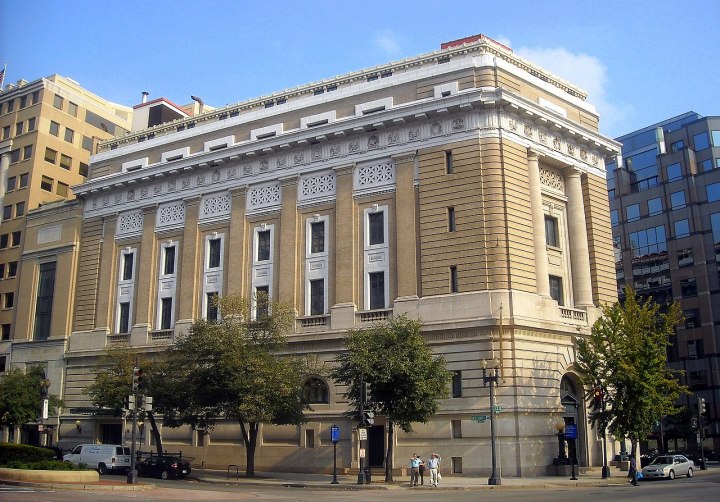
National Museum of Women in the Arts, at 1250 New York Avenue, NW in Washington, D.C. Built in 1908 as a Masonic Temple—to designs by Wood, Donn, and Deming—the Renaissance revival style building has been home to the NMWA for 34 years. Photo: Wikimedia Commons, 2008.
Exhibition | History in Motion: Tom Judd’s Subway Mural
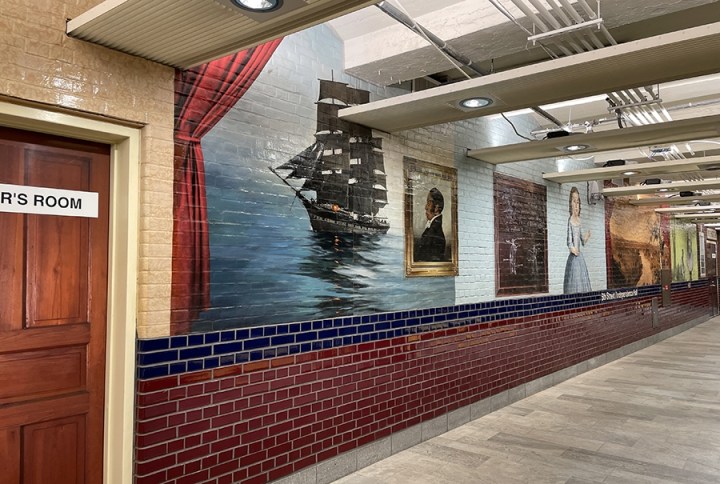
Installation photo of Tom Judd’s Portal to Discovery mural, 2020, produced for Philadelphia’s 5th Street-Independence Hall Station on the Market-Frankford Line.
◊ ◊ ◊ ◊ ◊
The Woodmere Art Museum hosts a virtual opening reception with the artist this evening (Tuesday) at 7pm, ET:
History in Motion: Tom Judd’s Subway Mural
Woodmere Art Museum, Philadelphia, 27 February — 13 June 2021
In connection with the reconstruction of Philadelphia’s 5th Street-Independence Hall Station on the Market-Frankford Line, and as part of SEPTA’s Art in Transit program, artist Tom Judd was selected to create a permanent installation for the station. Titled Portal to Discovery, Judd’s mural on the eastbound and westbound platforms presents figures who contributed to the founding of the United States as well as those who fought for “life, liberty, and the pursuit of happiness” for all. The mural includes portraits of eighteenth- and nineteenth-century Philadelphians such as Frances E. W. Harper, one of the first African American women to be published in the United States, and Absalom Jones, an African American abolitionist and clergyman who founded the Free African Society with Richard Allen in 1787. Juxtaposed with these figures are familiar landscape views of Philadelphia, windows, doors, and other architectural elements of the city. The experience is one of a great historical dreamscape that poses questions and promotes civic dialogue.
 The Museum’s exhibition includes preparatory studies for the mural as well as in-process photographs of the installation; the panels were fabricated by Ben Volta Studios and the installation was managed by James Shuster. The project was realized with help from graphic designer Wenlu Bao; David W. Seltzer, transit consultant and catalog producer; SEPTA; Burns Engineering, Inc.; Converse Winkler Architecture; and Marsha Moss, public art curator and consultant. The mural is an important addition to Philadelphia’s rich landscape of public art.
Judd grew up in Salt Lake City and attended the University of Utah from 1970 to 1972. He received his bachelor of fine arts degree in painting from the Philadelphia College of Art (now the University of the Arts). His work has been exhibited in museums and galleries across the United States, and is in the collections of numerous museums, including the Philadelphia Museum of Art, the Pennsylvania Academy of the Fine Arts, the Birmingham Museum of Art, and Woodmere Art Museum. Judd works in a variety of media, including painting, collage, photography, and installation.
Williamsburg Bray School Initiative Launched
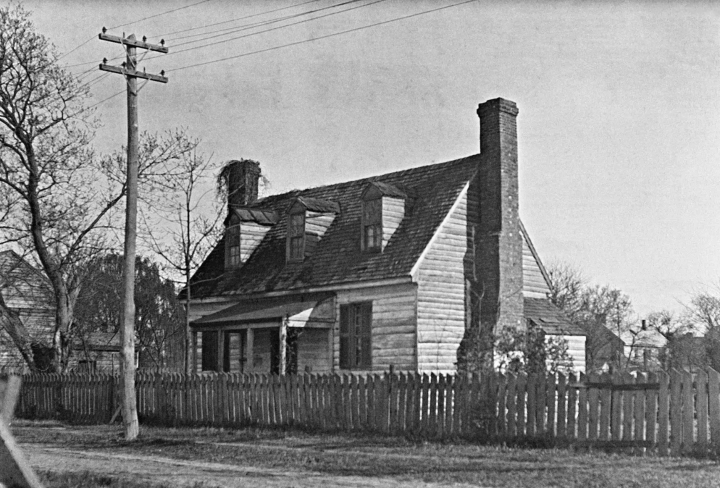
Established in 1760, the Bray School educated enslaved and free Black children in Williamsburg, Virginia. This 1921 photo shows the front elevation of the building, subsequently the Dudley Digges House, in its original location on Prince George Street. The school operated in the building from 1760 until 1765. It is likely the oldest extant building in the United States dedicated to the education of Black children. (Earl Gregg Swem/2010 The Colonial Williamsburg Foundation).
◊ ◊ ◊ ◊ ◊
Press release from Colonial Williamsburg:
A small, white building tucked away on the William & Mary campus once housed the Williamsburg Bray School, an 18th-century institution dedicated to the education of enslaved and free Black children, researchers have determined. Now, the university and Colonial Williamsburg are working together to ensure current and future generations learn about the complex history of what is likely the oldest extant building in the United States dedicated to the education of Black children—and the stories of those who were part of it. The new partnership calls for relocation of the Bray-Digges House to Colonial Williamsburg’s Historic Area, where it would become the 89th original structure restored by the foundation. It also establishes the Williamsburg Bray School Initiative, a joint venture of the university and foundation to use the site as a focal point for research, scholarship, and dialogue regarding the complicated story of race, religion, and education in Williamsburg and in America.
Dendrochronology analysis of the building’s wood framing in 2020 by Colonial Williamsburg researchers confirms that the structure at 524 Prince George St. once housed Williamsburg’s Bray School, an institution that educated many of the town’s Black children from 1760 to 1774. Suggested for establishment in Williamsburg by Benjamin Franklin, the Bray School’s mission was to impart Christian education to Black children and for students to accept enslavement as divinely ordained.
Virginia Governor Ralph Northam was scheduled to join the Williamsburg community for a special event at 5pm Thursday commemorating the history of the Bray School, its rediscovery, and plans for site and interpretation. Due to COVID-19 guidelines, the event was not open to the general public to attend in person but was available virtually via live stream.
“It is hard to overstate the importance of this discovery, of the robust history that will be uncovered through this partnership between William & Mary and Colonial Williamsburg” said William & Mary President Katherine A. Rowe. “So much of our history as a nation has gone unrecorded—the history of African Americans, their oppression, and resistance. By studying the legacy of the Bray School students, we will uncover and illuminate some of the most important impacts of education in the story of America.”
Colonial Williamsburg’s initial work to restore and interpret the Bray School’s historic structure is possible in part thanks to a grant of $400,000 from the Gladys and Franklin Clark Foundation. Cliff Fleet, president and CEO of Colonial Williamsburg, said the project is a critical step toward fostering a broader understanding of Americans’ shared history. The grant from the Clark Foundation will allow Colonial Williamsburg to relocate the structure to the Historic Area, and additional funds will be raised to complete the restoration and interpretive work.
“Colonial Williamsburg and William & Mary’s partnership to research, restore, and interpret the original structure of the Bray School is critical to our ongoing work to uncover our common past and expand our understanding of America’s founding,” Fleet said. “We’re very grateful to the Clark Foundation, whose generous support makes this effort possible. We invite guests, the community, and the nation to join us as we continue to pursue and present a more complete story of all who lived in Williamsburg during the Revolutionary era.”
A Virginia Department of Historic Resources marker commemorating the school’s 18th-century location was unveiled at Brown Hall, a William & Mary residence hall, in early 2019, and Rowe noted that the new joint venture aligns with other William & Mary initiatives that address the institution’s historical involvement with slavery. Construction is to begin this year on Hearth: Memorial to the Enslaved, a monument dedicated to the enslaved individuals who labored at William & Mary, while the Lemon Project is a scholarly and educational initiative that investigates slavery and its legacies— and particularly William & Mary’s involvement in the practice. The Lemon Project takes its name from Lemon, an enslaved worker at William & Mary.
Jody Allen, the Robert Francis Engs Director of the Lemon Project, explained that the Bray School legacy has long been a part of the Lemon Project’s programming. Identification and engagement of descendants of Bray School scholars are among the priorities of the Williamsburg Bray School Initiative. Allen was recently appointed by Governor Northam to Virginia’s Commission to Study Slavery and Subsequent De Jure and De Facto Racial and Economic Discrimination. She said she expects the Bray School Initiative to allow scholars to follow more closely the intriguing line of evidence of a Bray School education having influence that is deep and wide among Williamsburg’s Black population.
“When we talk about the history of slavery and the history of the African American experience at William & Mary, we include the Bray School,” Allen said. “We believe the Bray School not only impacted the children who actually attended the school, but it impacted their descendants. We believe very strongly that they went on to share their knowledge with brothers, sisters, neighbors.”
William & Mary and Colonial Williamsburg are both neighbors, and frequent collaborators. The Bray School has been the object of numerous research initiatives focusing on archival as well as material-culture sources aimed at expanding the collective understanding of history, including the joint archaeological excavation of the historic Bray-Digges House site at Prince George and Boundary streets. Currently, the university and foundation are partners in work led by the city’s Historic First Baptist Church to research and interpret its first permanent site on South Nassau Street. The Bray School partnership will facilitate continued research and interpretation, and a deeper examination of a number of aspects of history through the lens of the Bray School, including perspectives from families whose children attended the school and the motivations of white slaveowners who sent them there.
“Our knowledge of history is not static; it continues to reveal itself through critical work like the investigation of the Bray-Digges House,” said Stephen Seals, a Colonial Williamsburg interpreter, program development manager and community liaison. “The Bray School represents another complex chapter in our nation’s story, and its restoration and interpretation will be critical to our community’s work to foster a more complete understanding of our shared history.”
Nicole Brown, an actor-interpreter and scholar who portrays Colonial Williamsburg Nation Builder Ann Wager, the white teacher at the Williamsburg Bray School, is also a graduate student in William & Mary’s American Studies Program. Currently, Brown is studying the history and impact of the Bray Schools in Williamsburg and beyond. Her work has taken her to Oxford’s Weston Library, where she dove into some 8,000 pages of records of the Associates of Dr. Bray, the London organization that established or tried to establish Bray Schools throughout the New World in Philadelphia, Nova Scotia, and the Bahamas. Brown’s work with Colonial Williamsburg is supported by the Mary and Donald Gonzales Field Experience Fund.
“This research gave me a great deal of insight into Ann Wager and her students. You can learn a great deal about the school based on the books she used at the school,” Brown said. “Quite frankly, you learn a lot about the pro-slavery ideology of the school when you see how many of the books are extremely rooted in systemic racism.”
Julie Richter, a lecturer in William & Mary’s Department of History and the director of the National Institute of American History & Democracy (NIAHD), itself a partnership of William & Mary and Colonial Williamsburg, said there are surviving student lists from only three years: 1762, 1765, and 1769.
“I’m eternally optimistic that there will be a few more lists that someone will find in time,” Richter said. “But right now, we have these three slices in time to try to tease out what students were at the school and who sent them.”
Brown and Richter said slaveowners had varied motivations for enrolling enslaved children. Literacy and math skill increased the auction value of any enslaved individual, while Brown pointed out that a Bray School education increased a person’s usefulness to the slaveowner, in particular one who operated a commercial establishment. Students likely also had varying intentions for use of their education, often in direct contradiction with their owners’, Brown noted.
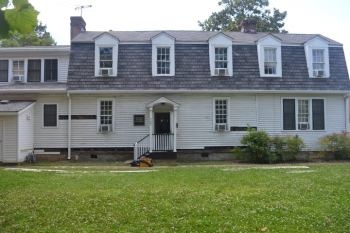 The first dots establishing the Bray-Digges link were unearthed and connected by Terry Meyers, Chancellor Professor of English, Emeritus, at William & Mary. Meyers was reading a memoir by a local resident when he came across a reference to an 18th-century cottage that in 1930 had been moved down Prince George Street from the corner of Prince George and North Boundary streets. He visited Colonial Williamsburg’s John D. Rockefeller Jr. Library, where there was a file on the building.
“From that, I was able to go back and look at what is now 524 Prince George St.,” Meyers said. “And I realized that if you look at that structure and erase the two additions on the right and the left and change the roofline from a Dutch colonial roof to a proper cottage roof, you actually do have an 18th-century cottage.”
Researchers led by Matt Webster, Colonial Williamsburg’s executive director of architectural preservation and research, discovered the reconfigured roof line that Meyers had noticed and a window sash that dates to the original construction date.
“Our analysis of the structure’s oldest elements conclusively places the timber’s harvest between the winter of 1759–60 and the spring of 1760, with the establishment of the Williamsburg Bray School in 1760,” Webster said. “That, combined with existing evidence of the Bray School’s historical location on Prince George Street, makes a compelling case that this is the original structure, and the building still has a great deal more to teach us.”
Meyers found that the Bray School operated in the Digges building from its 1760 founding until 1765, when the school was moved, possibly out to Capitol Landing Road.
Meyers noted that “education is almost invariably subversive.” Like Allen, he said there is evidence that students at the Bray School took their literacy skills back home and spread them around.
“If you are taught to read the Bible,” Meyers said. “you will be able to read other things. Once you educate people, they are better equipped to think critically.”
The timeframe for relocation of the Bray-Digges building is yet to be determined, and Colonial Williamsburg and William & Mary are considering a number of potential sites. The building most recently housed offices for William & Mary’s Department of Military Science and has been known as Prince George House.
Napoleon’s Barge, Newly Restored, Unveiled in Brest

Le Canot impérial de Napoléon, 1810, as installed at Brest, December 2020.
◊ ◊ ◊ ◊ ◊
Unveiled last week at the Musée de la Marine in Brest, as reported in the press release, via CNN (14 December 2020). . .
A spectacular imperial barge built for Napoleon Bonaparte has been unveiled at the Naval Museum in Brest, France, following a restoration project. Ten specialist restorers worked on the vessel, which was constructed in 1810, for two months prior to the opening of the new display on Friday [11 December 2020], according to a press release from the maritime museum. Visitors can appreciate the 62-foot barge from all angles, thanks to glass bays underneath and a mirror that hangs over the top.
Napoleon … ordered the secretive construction of the imperial barge in spring 1810, and it was first used to ferry him around during a visit to the French naval fleet at Antwerp later that year.
The original barge, which had fairly muted decorative elements including an eagle on the prow, was kept in Brest from 1814 onward. The more elaborate elements we see today—a figure of Neptune on the prow, figures at the bow carrying imperial weapons, and the large gold crown supported by four angels on the roof—were added in 1858 prior to a visit from Napoleon III and Empress Eugenie.
In 1943, the barge was moved from Brest to Paris under the protection of the occupying German forces to form part of the new Navy Museum. However, after an eight-day train journey, it was discovered that the doors of its new home, the Palais de Chaillot, were too small to fit the barge. It took two years to make a large gap in the wall of the building, and the barge was finally installed in August 1945.
In 2018, the barge was returned to Brest when the Paris museum closed for renovation.
Jean-Yves Besselièvre, manager of the Naval Museum in Brest, said the barge is one of the museum’s treasures and the only vessel of its kind preserved in France. The restoration is special, he said, because the barge wasn’t built to last a long time: “There is in fact a certain fragility to the object, but it has been perfectly managed by the restorers… and by the hauliers.”
◊ ◊ ◊ ◊ ◊
More information on the larger renovation of the Musée national de la Marine in Paris (scheduled to be completed in 2022) and the institution’s vision for the future is available from this press release.










 Enfilade
leave a comment