Online Book Launch | Pevsner’s Oxfordshire
From The Mellon Centre:
Simon Bradley, Nikolaus Pevsner, and Jennifer Sherwood, Oxfordshire: Oxford and the South-East, Pevsner Architectural Guides: Buildings of England (New Haven: Yale University Press, 2024), 800 pages, ISBN: 978-0300209297, $85.
Book Launch with Simon Bradley, Geoffrey Tyack, and James Davies
Online, Paul Mellon Centre for Studies in British Art, London, 2 November 2023, 6pm
 Simon Bradley, series editor of the Pevsner Architectural Guides, will discuss the latest volume in the series with Geoffrey Tyack of Kellogg College, Oxford. The book addresses half a century of change and development since the original edition of 1974 by Nikolaus Pevsner and Jennifer Sherwood, completing the revision of Oxfordshire initiated with Alan Brooks’s North and West volume of 2017. Fresh accounts are provided of the many ambitious new buildings for the university and its colleges, familiar landmarks such as the Bodleian Library and the Radcliffe Camera are reinterpreted and the many renovations and extensions are described and assessed. Oxford’s commercial buildings, suburbs, and houses are explored in depth, including much that is published here for the first time. The accompanying county area extends from the outskirts of Oxford to Henley-on-Thames, following the historic Thames-side boundary of Oxfordshire and taking in the hills of the southern Chilterns. Here the volume includes enhanced accounts of major country houses such as Nuneham Courtenay and Thame Park, new assessments of church restorations, furnishings and stained glass, more inclusive coverage of post-war buildings, and a fuller selection of vernacular and rural architecture across the whole of this attractive and rewarding quarter of rural England. The evening will also include a contribution from James O. Davies, who will talk about the challenges and rewards of taking photographs of the region’s best buildings for the new volume.
Yale University Press is delighted to offer attendees of the virtual launch a special discount price for the new Pevsner guide to Oxfordshire. Attendees will receive a discount code with their Eventbrite confirmation email.
Book online tickets here»
Simon Bradley is series editor of the Pevsner Architectural Guides and co-author of four other Buildings of England volumes: London 1: The City, London 6: Westminster, Cambridgeshire, and Berkshire.
Geoffrey Tyack is Fellow Emeritus of Kellogg College, Oxford, where he has taught urban and architectural history for many years. He is co-author of the Pevsner Architectural Guides’ Berkshire volume and has also published widely on 19th- and 20th-century architectural subjects. His recent books include The Historic Heart of Oxford University (2022).
James Davies has worked as an architectural photographer for thirty years. He has published widely, with books on English prisons, tin mining, post-war buildings, Stonehenge, and many Pevsner volumes, as well as in magazines including Wallpaper, The World of Interiors, Country Life, and Blueprint.
Online Talks from The Library Company of Philadelphia
Two upcoming online events from the Visual Culture Program of The Library Company of Philadelphia:
Prints of a New Kind: Political Caricature in the United States, 1789–1828
A book talk by Dr. Allison Stagg
Friday, 20 October 2023, 1.30pm ET
Prints of a New Kind details the political strategies and scandals that inspired the first generation of American caricaturists. It examines the caricatures that mocked events reported in newspapers and politicians, the reactions captured in personal papers of the politicians being satirized, and the lives of the artists who satirized them.
Allison M. Stagg is a specialist in 18th- and 19th-century American and British visual culture and has published widely on the subject of American historical caricature. She was the Library Company 2017–18 William H. Helfand Fellow in American Visual Culture.
More information and registration details are available here»
◊ ◊ ◊ ◊ ◊
The Complexities of Phillis Wheatley’s Portrait
A guest lecture by Dr. Jennifer Chuong
Wednesday, 25 October 2023, 1.00pm ET
In the fall of 1773, Phillis Wheatley became the first Black woman to publish a book in the transatlantic world. Poems on Various Subjects, Religious and Moral features an engraved frontispiece portrait of the author. This portrait aimed to portray an enslaved person who, by virtue of her intelligence, erudition, and imagination, exploded slavery’s foundational claim that enslaved persons were objects to be bought and sold. This talk explores how the portrait both supports and undercuts this aim.
Jennifer Y. Chuong is an art historian whose research centers on the art, architecture, and material culture of the transatlantic world in the 18th and 19th centuries as they relate to histories of environment and race.
More information and registration details are available here»
Online Symposium | J. M. W. Turner: State of the Field
From ArtHist.net and YCBA:
J. M. W. Turner: State of the Field
Online, 22–23 September 2023

J.M.W. Turner, Staffa, Fingal’s Cave, 1831–32, oil on canvas, 91 × 121 cm (New Haven: Yale Center for British Art, Paul Mellon Collection).
This symposium will consider the state and meaning of scholarship on J. M. W. Turner (1775–1851), one of Britain’s most celebrated artists. Thinking through the extensive Turner historiography, this symposium will explore some of the key ideas, underlying assumptions, and future directions of research. Panelists will consider the place of their research within the broader field of British studies.
To join us on September 22, please register here»
To join us on September 23, please register here»
f r i d a y , 2 2 s e p t e m b e r 2 0 2 3
All times Eastern Standard Time
9.00 Welcome by Courtney J. Martin (Yale Center for British Art)
9.10 Introduction: Turner in 2025 at the Yale Center for British Art — Lucinda Lax (Yale Center for British Art)
9.25 Keynote Conversation
• Amy Concannon (Tate Britain) in conversation with Richard Johns (University of York), moderated by Tim Barringer (Yale University)
10.25 Break
10.35 Panel 1 | Works on Paper and in the Environment
• Turner’s Pencil: Graphite Landscapes and Extractive Industry — Tobah Aukland-Peck (The Graduate Center, CUNY)
• ‘To Be Broken Up’: Turner, English Landscape, and the Anthropo(s)cenic — Frédéric Ogée (Université Paris Cité)
• A Historiographical Lacuna: Turner’s Prints — Gillian Forrester (independent scholar)
11.55 Break
12.05 Panel 2 | Sharing Turner
• Technical Studies for Turner: How Well Do We Share Knowledge? — Joyce Townsend (Tate Britain)
• The J. M. W. Turner Database: New Approaches to Documenting Turner for the 21st Century — Ian Warrell (independent scholar) and David Hill (University of Leeds)
• Cataloging Turner’s Sketchbooks, Drawings, and Watercolours — Turner Cataloging staff (Tate Britain)
s a t u r d a y , 2 3 s e p t e m b e r 2 0 2 3
9.00 Panel 3 | Early Turner
• Whither Early Turner? — Leo Costello (Rice University)
• Turner and the Landed Estate — John Bonehill (University of Glasgow)
10.05 Break
10.15 Panel 4 | Curating Turner
• Turner at Petworth: Past Approaches and Future Directions — Emily Knight (National Trust)
• The Young Turner: Ambitions in Architecture and the Art of Perspective — Helen Cobby (Bath Spa University)
11.15 Break
11.25 Panel 5 | Varied Approaches: Language, Economy, and Ecology
• The Ecological Turn(er) — Sarah Gould (Université Paris 1, Panthéon Sorbonne)
• ‘The Sun is God’: Turner, Angerstein, and Insurance — Matthew Hunter (McGill University)
• Translating Turner: The French Edition of the Correspondence — Aurélie Petiot (Université Paris Nanterre)
Printmaking for Change: Past and Present

Thomas Rowlandson, The Contrast (detail), 1793, hand-coloured etching and letterpress, 25 × 35 cm
(London: The British Museum)
◊ ◊ ◊ ◊ ◊
From the Paul Mellon Centre:
Printmaking for Change: Past and Present
In-person and online, London, 2–12 October 2023
Join us for a festival of free events exploring how different communities have used, and continue to use, printmaking to enact change, share knowledge, and challenge ideas. With talks, workshops, and behind-the-scenes visits, the two-week festival will explore the potential of printmaking as both a means of mass communication and a radical art form. From the fifteenth century to the present day, the programme will cover a broad range of topics from gender, sexuality and race, to politics, activism, and health. The programme is an introduction to the subject and is open to all. Talks and workshops will take place at the Paul Mellon Centre, the British Museum, PageMasters, and the Royal College of Physicians. Talks at the Paul Mellon Centre will be streamed live via Zoom. Off-site workshops will be in person only.
Registration (required) via Eventbrite opens 8 September.
◊ ◊ ◊ ◊ ◊
Monday, 2 October, 6–8pm
Introductory Session | Printmaking for Change, with Ben Thomas and Marcelle Hanselaar at the Paul Mellon Centre
Prints are multiple yet individual, unpredictable and hard to regulate, often critical, funny, ephemeral, frightening, irreverent, angry or just plain weird. They can be popular or obscure, sophisticated or clumsy, beautiful or ugly or, when responding to market demand, repetitive and dull. They are hard to define and categorise and for that reason tend to be ignored by curators in their displays, yet every national art collection will have far more prints than paintings. Prints are also cheap by comparison with other artworks and can be collected by ordinary people, disseminating their message widely. In this introductory session, art historian Ben Thomas and painter and printmaker Marcelle Hanselaar will discuss the properties of prints that challenge our expectations, and how as an artform they can be democratic, undisciplined and consequently forces for change.
Wednesday, 4 October, 2–4pm
Collections Visit | Printmaking and Politics, with Esther Chadwick and Richard Taws at the Prints and Drawings Study Room of The British Museum
Go behind the scenes at the British Museum to experience a selection of prints from the eighteenth and nineteenth centuries that explore the varied and complex relationships between printmaking and politics. We will look at prints designed to persuade and effect political change and consider printmaking as a link between politics and ‘high art’. Ranging from woodcut to lithography, line engraving to aquatint, our selection will also highlight how print was used around the world at a time of social, political, and economic unrest.
Saturday, 7 October, 10am–12.30pm or 1.30–4pm
Risograph Workshop | Printmaking and Protest at PageMasters, Lewisham
This workshop will introduce you to risograph printing—a technique often described as a cross between screen printing and photocopying, which uses spot colours and stencils to create multiple prints. Taking place at PageMasters in Lewisham, the session will begin with an introduction to risograph and tour of the studio. This will be followed by an exploration of PageMasters’ archive of protest prints and the opportunity to create your own two-colour A4 print to take home.
Monday, 9 October, 10.30am–noon and 1–2.30pm
Collections Visit | Printmaking and Health, with Jack Hartnell and Katie Birkwood at the Royal College of Physicians
Using the fascinating early print collections of the Royal College of Physicians, this session will explore the roles played by printing, printers and print technology in the world of health. From diagrams in surgical manuals to moveable flap books demonstrating the body’s inner anatomical workings, printed objects have long helped medics debate how to care for changing bodies. The Royal College of Physician’s materials will provide us with a window into how bodies past were understood by artists, physicians, midwives and surgeons alike.
Tuesday, 10 October, 6–8pm
Talk | Mezzotint Engraving and the Making of Race, with Jennifer Chuong, Martin Myrone, and Mechthild Fend at the Paul Mellon Centre
How have prints shaped our understanding of bodies and, specifically, our understanding of race as a bodily attribute? In this session we will explore how a particular print technique, mezzotint engraving, contributed to racial theories between the sixteenth and eighteenth centuries. The mezzotint, which can produce smooth tonal areas with dots or lines, became hugely popular in Britain in the second half of the eighteenth century as a means of reproducing portraits. We will discuss how this technique resonated with new anatomical and racial ideas in this period and subsequently how we can better understand print’s role in developing ideas of race and the body.
Thursday, 12 October, 6–8pm
Talk | Printmaking and LGBTQIA+ Communities, with Zorian Clayton at the Paul Mellon Centre
Join V&A curator of prints, Zorian Clayton, to explore LGBTQIA+ liberty and visibility through the varied history of printmaking. Via seventeenth-century radicals, eighteenth-century flamboyance, and nineteenth-century scandal, to contemporary understandings around diverse gender and sexuality, prints and ephemera, Zorian will provide a unique snapshot into a rich and radical history. Through looking at portraits and zines celebrating pioneering activists, writers and artists, as well as highlighting significant Queer spaces in Britain through the centuries, this session will provide an overview of the considerable contribution to printmaking made by the LGBTQIA+ community and its many ancestors.
Book Launch in Honour of Peter Borsay
From Eventbrite:
Book Launch in Honour of Peter Borsay
Online and in-person, University of Leicester, 29 September 2023, 3pm
The Centre for Urban History at the University of Leicester will mark the publication of Peter Borsay’s last book, The Invention of the English Landscape c. 1700–1939, with a symposium in honour of the late professor, who passed away in 2020. Free and open to all, the event will take place on Friday, 29th September 2023, from 15.00 until 17.00, via Teams Live and in person in the Attenborough Film Theatre. Please contact hypirfinance@le.ac.uk with any questions.
The symposium will be chaired by Professor Rosemary Sweet with the following panel of speakers:
• Penelope J. Corfield (President of the International Society of Eighteenth-Century Studies)
• Richard Coopey (Emeritus Senior Lecturer, Department of History & Welsh History, Aberystwyth University)
• Katy Layton Jones (School of History, Open University)
• Keith Snell (Emeritus Professor of English Local History, University of Leicester)
Online Talks | Digital Art History
From the series webpage:
Narrowing the Divide: A Dialogue between Art History and Digital Art History
Artl@s Conversation Series in Digital Art History, Visual Contagions, 2023–24
Organized by Béatrice Joyeux-Prunel, Catherine Dossin, and Nicola Carboni
The the Artl@s Lectures are a series of conversations that Artl@s will organize throughout the 2023–2024 academic year on the theme of Narrowing the Divide: A Dialogue between Art History and Digital Art History.
The field of Digital Art History (DAH) is currently experiencing a notable shift towards establishing its autonomy as a distinct discipline. However, its survival is challenged by the limitations of its investigations. The lack of relationships between computational effort and traditional analysis often limits the generation of novel insight. Digital art history risks becoming a mere spectacle when it relies solely on stunning visualizations without engaging in rigorous research questions. Conversely, art history limits itself from harnessing robust methodologies by disregarding computational approaches.
The digital approach increasingly demands advanced technical skills, thereby often placing art historians in a position where they lack the means and expertise to engage with it. Yet, art historians possess a keen awareness of the pressing issues within the discipline and possess the knowledge of which corpuses are relevant for addressing them. They could potentially provide their questions and corpuses to experts in digital art history. Hence, it is crucial to establish more frequent and substantive opportunities for collaboration between these two approaches. The 2023–2024 Artl@s Conversation Series aims to cultivate a convergence between the field of digital art history and the discipline of art history. The exchange of ideas and results among digital art history specialists, art historians, and the audience will foster a deeper understanding of the possibilities and implications of computational methodologies in the study of art history.
Each event will facilitate a unique encounter between two experts engaged in overlapping subject areas but employing markedly different methodologies. Within this framework, art historians will put forth inquiries and collections to experts in digital approaches, while scholars in digital art history will present the outcomes of their methodologies, along with the aspects they would readily suggest for monographic or non-digital explorations. The aim is to foster collaborations and a heightened mutual understanding of the outcomes between the realms of art history and digital art history. These gatherings provide valuable opportunities for aspiring PhD students in digital humanities and art history to discover new subjects and gain insights into the notable progress being made in both disciplines.
Organizers: Béatrice Joyeux-Prunel (UNIGE), Catherine Dossin (Purdue University), and Nicola Carboni (UNIGE)
s e s s i o n s
AI for Art History, Art History of AI
Online, Friday, 8 September 2023, 14.15–15.45 (Paris and Geneva time) / 8.15–9.30am (EST)
• Leonardo Impett, University of Cambridge
• Pascal Griener, Université de Neuchatel
Click here to join us on Zoom || Read more about the speakers.
◊ ◊ ◊ ◊ ◊
Do We Need Digital Visual Studies?
Online, Friday, 29 September 2023, 14.15–15.45 (Paris and Geneva time) / 8.15–9.30am (EST)
• Béatrice Joyeux-Prunel, Université de Geneve
• Leora Auslander, University of Chicago
Click here to join us on Zoom || Read more about the speakers.
Symposium | Evoking the Incommensurable: Painting the Sublime

Philip James De Loutherbourg, An Avalanche in the Alps, 1803, oil on canvas, 110 × 160 cm
(London: Tate, T00772).
◊ ◊ ◊ ◊ ◊
From the conference website:
Evoking the Incommensurable: Painting the Sublime
In person and online, Friedrich Schiller University, Jena, 26–28 July 2023
Organised by Johannes Grave, Sonja Scherbaum, and Arno Schubbach
Collaborative Research Center (SFB) 1288 “Practices of Comparing,” Bielefeld University, and Research Center for European Romanticism, Friedrich Schiller University Jena.
In the 18th century, the concept of the sublime constitutes a genuine novelty and a driving force for advancements in the theoretical reflection on the arts throughout Europe. Edmund Burke and Immanuel Kant distinguished the sublime sharply from the beautiful, i.e., the traditional organizing subject of treatises on painting and literature, and emphasized its excessive strain on the senses, its incommensurability with any measure, and its irreducibility to any bounded shape. It thus constituted a harsh contrast to the beautiful and challenged the aesthetic values of pictorial or literary representation.
Moreover, the sublime was also a challenge to artistic practice. Theoretical discourse concerning the sublime often referred much more directly to our experience of nature than to our experience of artistic works. Particularly in the case of Kant, it was not evident that the arts are at all able to evoke anything sublime. Nevertheless, various attempts to paint the sublime can be seen in the genre of landscape painting. The sublime stimulated painters to push the limits of painting and to explore its capabilities anew.
The international conference Evoking the Incommensurable: Painting the Sublime will discuss the question of how artists purposefully explored and exploited the limits and capabilities of painting in order to evoke the incommensurable and paint the sublime. Participation is possible both on-site or via Zoom. Please register at paintingthesublime@uni-jena.de by 24 July 2023. The conference will be held in a hybrid format. Please let us know if you would like to attend in person or via Zoom.
w e d n e s d a y , 2 6 j u l y 2 0 2 3
13.00 Arrival and Registration
13.30 Welcome and Introduction
14.00 Panel 1
Chair: Johannes Grave
• Aris Sarafianos (Ioannina), Hard Imitation and the Sublime Real: Art, Exhibitions, Panoramas, Casts, and Displays at the Far Ends of Visibility, c. 1800
• Elisabeth Ansel (Jena), ‘Most Magnificent and Sublime’: Ossian, Blindness, and the Sublime in the Visual Arts
• Hélène Ibata (Strasbourg), Temporal Vertigo and the Historical Sublime in Turner’s Venice Paintings
17.30 Coffee Break
18.00 Keynote Lecture
• Robert Doran (Rochester), ‘Moving Us to Pity’: Visual Art and Sublimity in Burke, Du Bos, and Kant
20.00 Conference Dinner
t h u r s d a y , 2 7 j u l y 2 0 2 3
9.15 Welcome
9.30 Panel 2
Chair: Mira Claire Zadrozny
• Yvon Le Scanff (Paris), Victor Hugo, ‘Bringing out the Sublime’
• Caroline van Eck (Cambridge), The Animal Sublime, c. 1800
• Sarah Gould (Paris), Mary Somerville’s Scientific Sublime: Picturing the Immaterial
13.00 Lunch Break
14.30 Panel 3
Chair: Britta Hochkirchen
• Laure Cahen-Maurel (Bonn), Viewing beyond the Visible: The Power of the Imagination from the Kantian to the Romantic Sublime
• Mark Cheetham (Toronto), The Incommensurability of Arctic Sublimity: Environmental Stereotypes and the Specificity of the Sublime
• Craig Hanson (Grand Rapids), Before & After: Temporal Strategies for Effecting the Sublime
19.30 Reception at Schillers Gartenhaus
f r i d a y , 2 8 j u l y 2 0 2 3
9.15 Welcome
9.30 Panel 4
Chair: Arno Schubbach
• Marie-Louise Monrad Møller (Leipzig), Pauelsen, Dahl, Lundbye: Aspects of the Sublime in Scandinavian Landscape Painting
• Adèle Akamatsu (Paris), Fjords, Waterfalls and High Mountains: Painting the ‘Rough’ and ‘Grand’ Landscapes of Norway from Germany, 1820s–1860s
• Nikita Mathias (Oslo), Painting the Sublime beyond Painting: From the Easel to the Cinema
13.00 Concluding Discussion
Lecture | Alessia Attanasio on Neapolitan Art in English Collections
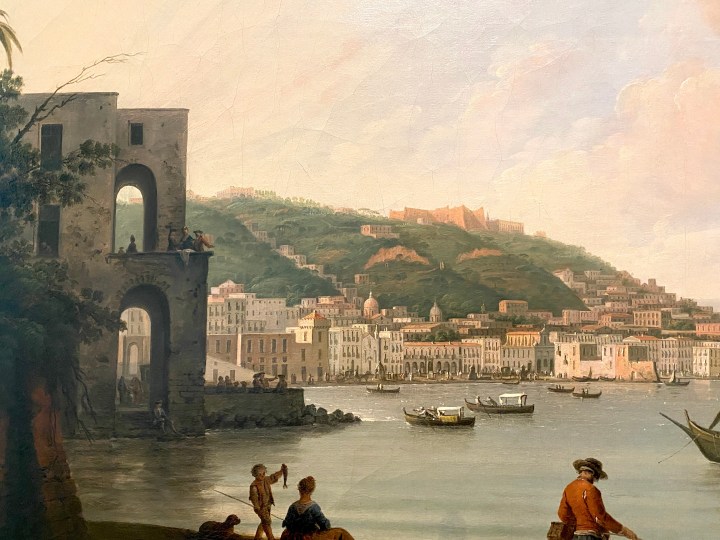
Pietro Fabris, The Bay of Naples from Posillipo, detail, ca. 1770, oil on canvas, 75 × 128 cm
(Compton Verney, Warwickshire)
◊ ◊ ◊ ◊ ◊
From The Wallace Collection:
Alessia Attanasio, The Fortunes of Baroque Neapolitan Art in English Collections during the Grand Tour, 1680–1800
Wallace Collection Seminars on the History of Collections and Collecting
Online and in-person, The Wallace Collection, London, Monday, 26 June 2023, 5.30pm
This talk aims to provide an overview of the history of collecting Baroque Neapolitan art in England from 1680s to 1800s, a period when many English artists and collectors travelled to Naples during the Grand Tour. Based on Alessia Attanasio’s PhD research, it will introduce artists from the Kingdom of Naples who enjoyed considerable success among English patrons, demonstrating how the Grand Tour influenced the market for Baroque Neapolitan art—not just for the newly discovered antiquities in Pompeii, Herculaneum, and Stabiae.
Today, Baroque Neapolitan paintings form a significant part of private and public English art collections; yet there is no publication exploring the significance of these collections as a whole. Therefore, the lecture aims to fill this gap by identifying and locating Neapolitan art in public and private English collections, now disclosed in an up-to-date database. The database will include images, references, notes on subject, author, and context, as well as acquisition and provenance details, providing the first comprehensive view of Neapolitan paintings in England. Alessia will focus on specific private British collections held in country houses such as Compton Verney, with the new redisplay of its unique Neapolitan collection, and Holkham Hall, which owns several Neapolitan paintings, both of which reflect the changes in art collecting in England. The lecture will bring together different fields of study, from the history of art to the art market, and shed new light on the material conditions that made art collecting possible.
Alessia Attanasio is a PhD candidate at the University of Birmingham, focusing on Baroque Neapolitan art that was collected in England during the Grand Tour (1680s–1820s), with particular interests in country houses, history of collecting, and museum studies. Alessia’s interest in museums is supported by eight years of experience working in museums as an assistant curator and museum educator, including Capodimonte Museum in Naples, and the Royal Collection Trust in London. Most recently, Alessia has been undertaking research into Baroque artworks in the Neapolitan Collection of Compton Verney, contributing to the curation of its permanent redisplay, Sensing Naples.
Symposium | Rethinking Methodologies in British Art Research
From the Mellon Centre and Eventbrite:
Expanding the Field: Rethinking Methodologies in British Art Research
Online and in-person, Paul Mellon Centre, London, 23 June 2023
This hybrid event has been programmed by the Early Career Researchers Network (ECRN) and Doctoral Researchers Network (DRN). All interested parties are welcome to attend. You can find out more about the networks here.
This annual symposium offers an opportunity for doctoral and early career researchers to share and discuss their research creative methods, varied approaches, ethics, and methodologies on topics related to British art and art history (broadly defined). By questioning ‘how we come to know what we know’, we aim to reflect on the current possibilities, dilemmas, and challenges in academic research, participatory engagement, or creative practice. Join us to hear from speakers presenting on a variety of topics that cover decolonial, postcolonial, feminist, or queer perspectives; address the impact of quantitative and data-driven methodologies; report on practice-based, curatorial, or collaborative research; or reflect on the role of different media, including digital, audio, and filmmaking.
Travel grants are available for DRN and ECRN members travelling to London from within the UK to join us for the day. Please contact us at doctoralresearchers@gmail.com to be considered for a travel grant.
P R O G R A M M E
10.00 Opening Remarks
10.15 Panel 1 | Transnational Identities
Chair: Lauren Houlton (University of Westminster)
• Rahila Haque (University of the Arts, London) — In Rehearsal: A Methodology for Diasporic Feminist Worlds
• Helena Cuss (Kingston University) — Transnational Art Markets, 1948–57
• Excellent Hansda (University of Liverpool) — Exploring Modern Identity in Twentieth-Century Residential Architecture in Mumbai through ‘Contrapuntal Reading’
• Lucy Shaw (University of Birmingham) — Travel, Sexuality, and Nation in John Minton’s Post-War Work
11.35 Break
11.50 Panel 2 | Perception, Practice, and Participation
Chair: Alex Gushurst-Moore (University of Cambridge)
• Layla Khoo (University of Leeds) — Exploring Practice-based Methodologies in Creating and Evaluating Participatory Contemporary Art within Heritage Sites and Collections
• Antonio Capelao (University College London) — Our Children Will Change the Built Environment
• Adam Benmakhlouf (University of Dundee, Dundee Contemporary Arts) —‘The Work before the Work’
• Alex Culshaw (Arts University Bournemouth) — Listening Lounge Q&A
1.10 Lunch
2.00 Panel 3 | Reconsidering Visual Culture (Virtual)
Chair: Claudia di Tosto (University of Warwick and The Paul Mellon Centre)
• Lea Stephenson (University of Delaware) — Egyptomania, Experiential Research, and the Senses
• Sonal Singh (University of Delhi) — Colonial Cities in British Art, Late Eighteenth to Mid-Nineteenth Century
• Jessica Johnson (University of Oregon) — Of the Wrong Class and Complexion: James Northcote’s Ira Aldridge as Othello, the Moor of Venice
• Tania Cleaves (University of Warwick) — The Ethics of Exclusion: On (Not) Representing Photographs of Child Nudists
• Nora Epstein, (Independent Scholar) — Carving New Lines of Investigation: Material and Digital Methods for Tracing the Use of Tudor Relief Blocks
3.35 Break
3.50 Panel 4 | Creation: Media, Technology, and Representation
Chair: Nick Mols (Welsh School of Architecture, Cardiff University)
• Dawn Kanter (The Open University) — A Digital Approach to the Portrait Sitting in Enhancing Knowledge and Understanding of British Portraiture, 1900–1960
• Clare Chun-yu Liu (Manchester Metropolitan University) — Reinterpreting English Chinoiserie from a Postcolonial Perspective through Fiction Filmmaking / Trailers for Clare Chun-yu Liu’s films: This is China of a Particular Sort, I Do Not Know (trailer) and Another Beautiful Dream (trailer)
• Richard Müller (University College London) — Depictions of the Para-City: Art and Practice as Methodology in Informal Taiwan
4.50 Closing Remarks
5.00 Reception at the Paul Mellon Centre
Lecture Series | Peter Miller on Conservation as a Human Science
From the Warburg:
Peter Miller, On Conservation as a Human Science
E. H. Gombrich Lecture Series
In-person and online, Warburg Institute, London, 13, 14, 15 June 2023
‘Conservation’, ‘preservation’, ‘care’—these words are frequently used today, but by different people, speaking to different audiences. On Conservation as a Human Science makes the case for treating conservation as a single human activity with an intellectual history of its own. Then, focusing more particularly on the kind of conservation done to man-made things it explores the entwined relationship between conservation and history. Like archaeology, to which it bears a close resemblance, conservation explores the depth of time stratigraphically to answer questions about what was in the past from what survives into our present. But, turned around, history, too, can function as a form of conservation—indeed, this was an initial self-definition that persisted into the age of modern, academic history. The ambition of this project is to shift how we understand conservation for a twenty-first century in which climate change will make the task of conservation and the challenge to conservation a more urgent part of public and private life. Moreover, rethinking conservation as a human science also opens up a new perspective on the organization of knowledge at a time when inherited distinctions between disciplines and fields and ‘pure’ and ‘applied’ learning, like those between the ‘head’ and the ‘hand’, are being reconsidered.
Lecture 1 | Tuesday, 13 June, 5.30–7.00pm
In Search of Conservation’s History
Lecture 2 | Wednesday, 14 June, 5.30–7.00pm
Conservation as History
Lecture 3 | Thursday, 15 June, 5.30–7.00pm
History as Conservation
Free and open to all with advance booking, in person at the Warburg Institute, or online via Zoom.
Organised by the Warburg Institute and sponsored by Princeton University Press, the E. H. Gombrich Lecture Series features prominent humanities scholars who address pressing concerns in art, literature, and ideas, across historical periods.
Peter N. Miller is Dean and Professor of Cultural History at the Bard Graduate Center in New York City, and incoming President of the American Academy in Rome. He is the author of a series of books on the early seventeenth-century antiquarian, Nicolas Fabri de Peiresc, on the history of antiquarianism, and on the modern study of objects as evidence. He co-curated Dutch New York between East and West: The World of Margarieta van Varick (BGC, 2009); What Is the Object? (BGC, 2022); and Conserving Active Matter (BGC, 2022), the exhibition and website that concluded the ten-year long project he directed, “Cultures of Conservation,” funded by the Andrew W. Mellon Foundation. His main current interest is in the how and why of research, whether done by professional historians or by curators, conservators or artists. He has been at Bard since 2001. He previously taught at the University of Cambridge, University of Chicago, and University of Maryland, College Park. He was a research fellow at the Warburg Institute, the Wissenschaftskolleg zu Berlin, and visiting professor at the École des Hautes Études en Sciences Sociales in Marseille and École Normale Supérieure in Paris. He has been the recipient of fellowships from the National Endowment for the Humanities, the John Simon Guggenheim Foundation, and the John D. and Catherine T. MacArthur Foundation.










 Enfilade
leave a comment